Brazil

A world-class orchestra in the heart of São Paulo’s Crackland

From our UK edition

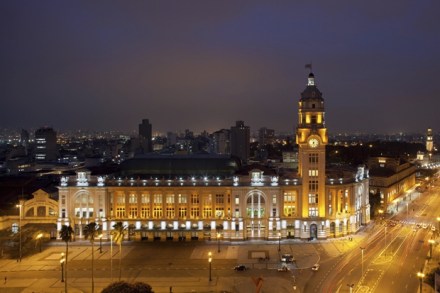
São Paulo has a concert hall that London’s orchestras would kill for. It was originally a railway station, a mighty space bounded by Corinthian pilasters in the style of a French palace, built by Brazilian coffee barons. Now the tracks are buried beneath 800 seats on the main floor, plus another 700 on the balconies and mid-air boxes facing the stage. But it’s the ceiling that produces gasps, or, in the case of a children’s concert I attended, earsplitting squeals of wonder. You’d think Superman had arrived. You see, the ceiling is made up of 15 huge, lavishly decorated panels that match the walnut floor. And they move! Up and down, independently, like monster elevators. Which, given that they weigh 7.5 tons each, is disconcerting.

Taki: why would anyone want 72 virgins? They’re useless in bed

From our UK edition

The long lazy summer is upon us, and as I walk the Swiss hills below the mountain ranges my thoughts are always of the past, the long hot summers of long ago, girls in their pretty dresses, my father in his whites sailing around the Saronic Bay with a ball-and-chain standard flying from his main mast. It meant ‘Wife on board’, which really meant: when I drop anchor in some nearby port, local talent should stay away. Dad was famous, infamous rather, for flying that ensign, because he loved partying with loose women on his boat, and, during the rare occasions my mother would come on board, he didn’t want to embarrass her with the inevitable visitors. After his death, I would drop anchor at different islands and people would ask what happened to the flag.

The coming world oil order

From our UK edition

Following on from Daniel’s post this morning about a more inward looking America, Daniel Yergin has a very interesting essay in the Washington Post about how the changing balance of the US’s energy supplies are going to change its geo-strategic priorities. Yergin makes the point that by 2020, Canada could be a bigger oil producer than Iran and Brazil could be producing more than half of what Saudi Arabia is currently pumping out. Put these developments together with increased domestic energy production in the States itself and the fact that China is on its way to overtaking the US as the world’s largest oil consumer, and the geo-politics of energy begins to look very different.

A flooded world

From our UK edition

It looks like the opening of a Hollywood disaster film. The South African government has declared parts of the country disaster areas, after 40 people died in floods in a month. At the same time, the UN is to launch an appeal for emergency flood aid for Sri Lanka, where at least 32 people have died and more than 300,000 have been displaced. Meanwhile flood waters in Australia have left a trail of destruction, at least 18 dead and a billion dollar bill for reconstruction. And in Brazil, survivors of the floods that have killed more than 600 people are frustrated by the lack of government help. Are these floods causes by climate change? Well, yes and no.

Climate kamikaze

From our UK edition

Several months ago, European leaders went to Copenhagen to save the planet. China, India and Brazil on the other hand went to the climate negotiations in Denmark to showcase the changed distribution of power in the world. Unsurprisingly, the Europeans came home empty-handed, shut out of the key negotiations and powerless despite what was meant to be a standard-setting promise of 20 percent cut in the EU's greenhouse gas emissions. The US and the rising powers struck a non-binding deal, the value of which is still being determined.

A welcome return of defence diplomacy

From our UK edition

Shadow Defence Secretary Liam Fox has given an interview to the Sunday Express, where he talks about overcoming a sense of "colonial guilt" bestowed by revisionist historians and the need for a new government to forge defence links with commonwealth nations, such as Australia and New Zealand, but he also cited India and Saudi Arabia. They have a “strong appetite” for closer defence links with the UK, he argues.   Looking at variable defence relationships with countries like India, and non-NATO partners like Australia makes good sense. Nicolas Sarkozy has done the same – and even invited Indian troops to march down the Champs-Élysées last year on Bastille Day.

Hague’s modern Realism

From our UK edition

In a splurge of activity, William Hague gave both an interview to the FT and another foreign policy speech at RUSI outlining the views of a Conservative government. It was time for an update on Tory thinking, not least because David Cameron’s description of his policy as “liberal conservatism” and his unwillingness to march into a “massive euro bust-up” has had little effect. That is because a struggle over how to engage with the world continues to run beneath the party leader’s message of party unity.

Populist preaching

From our UK edition

Patrick Marnham visits Brazil’s annual festival of literature Many years ago a wild-eyed Englishman hacked his way into the Amazon rain forest and disappeared, never to be seen again. Since then the fate of Percy Fawcett, known as ‘the Colonel’, has remained a mystery. Fawcett, a heavily bearded pipe-smoker in a deerstalker hat, was a figure of fun to the bright young things of England in the 1920s. This was unfair since he was engaged in work of some importance; he was mapping the Brazilian frontier with Bolivia and Peru. Colonel Fawcett returned to the Amazon many times and over the years, distracted from his science, he became convinced of the existence of a Lost World in the heart of the forest.