Bbc

The Uber generation won’t stand for the BBC – but it’s still a national treasure

From our UK edition

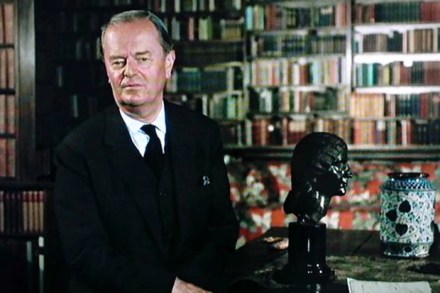
Watching the increasingly bleak and depressing Peep Show the other night I was pleased to note that my on-screen alter ego Mark Corrigan is a big fan of Kenneth Clark’s Civilisation, which is I think my all-time favourite documentary. To me Civilisation, and the then controller of BBC2 who commissioned it, David Attenborough, represent what the BBC should be, and is at its best: a strangely Freudian father figure to the nation, erudite, intelligent, open-minded and very British. The BBC was a product of a strong national culture, but it also helped to further cement it, making events like the Proms or FA Cup final part of our collective experience.

Drones get the job done, as Jihadi John may have just discovered

From our UK edition

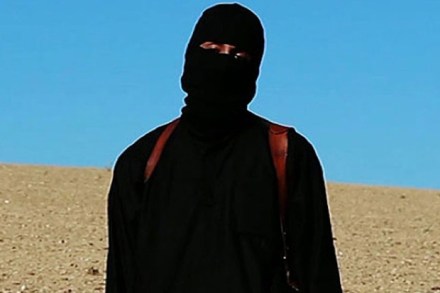
Excellent news, if it is confirmed, that Mohammed Emwazi - aka 'Jihadi John' - has discovered the hard way that seventy-two virgins have not been waiting around for him on a cloud. It is more than a year since David Cameron announced that this country would chase the murderer of British, American and Japanese aid-workers and journalists to the ends of the earth. Unsurprisingly Emwazi just had to be found in Syria. But it is good news that he has been found, not just because justice is served but because it might make other people reflect on the merits of the post-Westminster university career-path that he chose.

The Chinese are willing participants in state censorship

From our UK edition

For three decades, Cui Yongyuan has been one of China’s national treasures. As a veteran television presenter for CCTV (China’s BBC), Cui’s career was made by this state-controlled broadcaster. So his recent talk in London - entitled ‘An Idealist’s commitment and compromise’ - caught my attention for its political undertone. Could he have been talking about the compromises he had to make as a Chinese journalist? To my delight, Cui spoke about this - and more. 'When the Chinese emigrate to democracies, to civilised nations, they enjoy the freedom of the system,' Cui told the Chinese audience. 'But they become patriotic to the point of dogma, such that no one can voice a single ill of China.

I’ve come up with the perfect way to deal with TV Licensing officers

From our UK edition

Faithful readers of this column will know that I do not have a television licence for my flat in London, because I do not have a television. As a result, I receive a couple of letters a month demanding that I prove my innocence, which I never answer because I do not see why I should. Indeed, they normally remain unopened. This week, however, I received one in a window envelope. Through the window, I could see the calendar for November and the 24th of the month circled in red. ‘We’re giving you ten days to get correctly licensed’, it said, and implied that if I did not do so it would send an ‘Enforcement Officer’ after me to start a ‘full investigation’. Such messages are wrong, and may be well be illegal.

Spying and potting

From our UK edition

The main problem with being a TV critic, I’ve noticed over the years, is that you have to watch so much TV. It’s not that I’m against it in principle: I like my evening’s televisual soma as much as the next shattered wage slave with no life. But the reality is that you end up doing stuff like I found myself doing on this Monday night just gone — cringing at pert male arses heaving up and down in a sensitive gay love scene in some moody new BBC spy drama that is going to be occupying our screens for the next five weeks. Why?

Bach breaking

From our UK edition

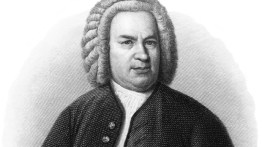
It’s just not what you expect to hear on Radio 3 but I happened upon Music Matters on Saturday morning and after playing us a clip from the opening chorus of St Matthew Passion Tom Service pronounced, ‘Bach is a tasteless and chaotic composer.’ I felt as if my ears had been syringed. Service was actually repeating what one of his guests, the Bach scholar John Butt, had just asserted, as if to verify his intention. Was he really saying that the composer formerly thought of as the epitome of balanced reflection and ‘motivic organisation’ would have sounded ‘incompetent’ to his audiences in 1727? Butt insisted, on the Passion, ‘It’s a complete mess.

Why is the BBC letting the Islamic Human Rights Commission set the agenda?

From our UK edition

The farcically named 'Islamic Human Rights Commission' has featured here many times before. The last time was earlier this year when this Khomeinist group decided to award their 'Islamophobe of the Year' award to the murdered staff of Charlie Hebdo. At their 'awards ceremony' for this the IHRC even joked about what a shame it was that none of the staff of Charlie Hebdo were around to collect the award. Today the IHRC has thrown a smoke grenade into the public debate by issuing 'findings' claiming that the UK government's counter-extremism and counter-terrorism policies are having a 'negative impact' on British Muslims. The 'work' is the usual confection of non-research and pre-ordained 'findings' that you would expect from such an ideologically driven group.

Community listening

From our UK edition

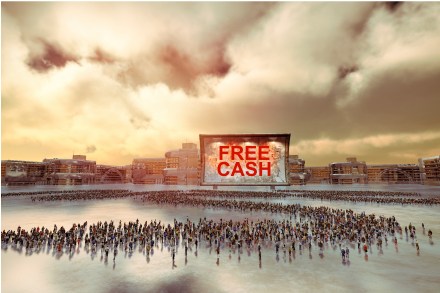
There’s been a lot of fanfare and trailers about BBC Radio’s new ‘online first’ facility. We can now get hold of programmes and listen to them before they go out on air, or download the series and listen to the whole lot in one go. Nothing so strange about that, given the powers of digital, its accessibility and flexibility. But the Radio 4 website is also offering new online-only content, which will never be broadcast in the traditional way. Best Queue is a drama series told in very short (just over four minutes) episodes. Angie and her family are waiting in a massively long queue that promises a large cash handout for those who eventually get to the front.

Why most four-year-olds deserve to be sectioned

From our UK edition

The first episode of Let Us Entertain You (BBC2, Wednesday) definitely couldn’t be accused of lacking a central thesis. Presenter Dominic Sandbrook began by arguing that, since its industrial heyday, Britain has changed from a country that manufactures and exports things into one that, just as successfully, manufactures and exports popular culture. He then continued to argue it, approximately every five minutes, for the rest of the programme. By way of proof, Sandbrook presented a fairly random collection of postwar Britain’s greatest hits, which served both as examples and as opportunities for some nifty wordplay designed to hammer the point home still further.

The films the Arab world doesn’t want you to see

From our UK edition

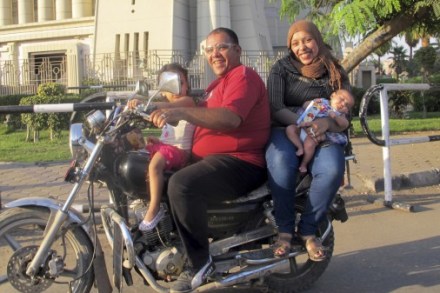
‘I want a woman to be President,’ declared one of the ambulance drivers interviewed by Sherief Elkatsha for his film Cairo Drive. I don’t think he was joking. He was fed up with the struggle to do his job in the chaos of the Egyptian capital’s streets clogged by 14 million vehicles. Elkatsha’s feature documentary took five years to make and takes us from 2009 through the Tahrir Square uprising up to the most recent elections purely through looking at the traffic, the lifeblood of the city. He set out to give us voices, not tell a political story, and this lies behind many of the films shown in last weekend’s BBC Arabic Film Festival, held in the radio theatre at Broadcasting House.

Yet more examples of BBC bias this week

From our UK edition

Two reports on the BBC Ten O'Clock News this week, both unashamedly partisan. Yes, yes, I know they are not the only reports this week guilty of bias. There’s the same ol same ol refugee hugging every night and there was also a report on the fact that our population is about to rise by ten million without even the faintest suggestion that this might not be a bloody good thing. But I mean two specific reports. One, by Reeta Chakrabarti about protests outside abortion clinics. This was the most egregiously biased piece of reporting I have seen for a long while. It took, as a statement of unalterable fact, that these protests were vile. There was not a single voice raised in defence of the protests, or against abortion. It was propaganda, pure and simple.

DVF worship

From our UK edition

Girl is back for half-term so I’ve been able to watch nothing but crap on TV this week. Some of you will say, ‘Oh come on! You pay the bills, so you get to control the remote.’ But that’s not how things work when you’ve got a teenage girl at home. Especially not one whose ankle you have been responsible for breaking. So crap, I’m afraid, is what I’m going to have to review. Not, it must be said, that the crap has all been crap. House of DVF (E! Online), for example. I’ve mentioned it before and the reason I’m mentioning it again is the matchless insights it offers into the strange and terrifying world of womankind.

The Last Kingdom is BBC2’s solemnly cheesy answer to Game of Thrones

From our UK edition

The opening caption for The Last Kingdom (BBC2, Thursday) read ‘Kingdom of Northumbria, North of England, 866 AD’. In fact, though, an equally accurate piece of scene-setting might have been ‘Britain, Saturday teatime, the 1970s’. The series, based on the novels by Bernard Cornwell, has been described in advance as the BBC’s answer to Game of Thrones — and, as various thesps in furs and long beards began to attack each other with swords, it wasn’t hard to see why. Yet, apart perhaps from the level of the violence, the programme’s real roots seem to belong to less sophisticated (and less expensive) shows than that: the kind set firmly in the period known as ‘yore’ and that many of us will dimly remember from our childhoods.

Peter Hitchens proves to be Russell Brand’s Achilles heel

From our UK edition

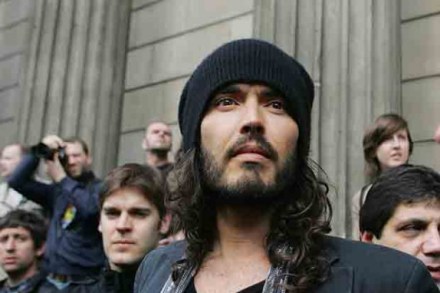
Although Russell Brand has stopped producing his YouTube series The Trews after tiring of being in the spotlight, fans of the comedian-turned-revolutionary can now get their fill in the new documentary Brand: A Second Coming. While the film, which is directed by Ondi Timoner, was originally supported by Brand, he later got cold feet on viewing a first cut. After asking for changes -- and saying that he would try and prevent the film's release -- he went on to distance himself from the project by boycotting the film's premiere. So what was it in the film that caused Brand to perform a U-turn? Well aside from disclosures about his colourful love life, it appears to be none other than Peter Hitchens who gave Brand the biggest headache.

National Poetry Day broke the key rule of poetry readings: never let normal people do the reading

From our UK edition

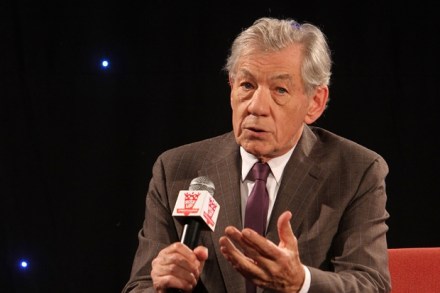
Imagine what Brennig Davies must have felt like just before 11 o’clock last Tuesday evening. The 15-year-old was about to hear Ian McKellen reading his prizewinning short story nationwide on Radio 1. The voice of Gandalf broadcasting words that have emerged from your own head must have been a spooky moment for Davies, whose story ‘Skinning’ had just won the BBC’s Young Writers’ Award (organised with the Book Trust).

What the Great British Bake Off really says about Britain

From our UK edition

There was an interesting news item on the television the other day. A transgendered chap was hoping to become the world’s first dual-purpose father and mother to a baby. He had frozen his semen before the surgeons came along with their secateurs and staple gun. I turned to my wife and said: ‘One day the chill wind of Odin will blow down from the icy north and cleanse our nation of all purulence and disease.’ She said nothing by way of reply — but a moment or two later announced that she was going to bed, and would be sleeping in the spare room. She had a distressed expression upon her face. I was left alone to mull over the possible cause of this sudden estrangement. Could it have been the Odin stuff?

John Whittingdale ruffles feathers at BBC campaign event with off-piste speech

From our UK edition

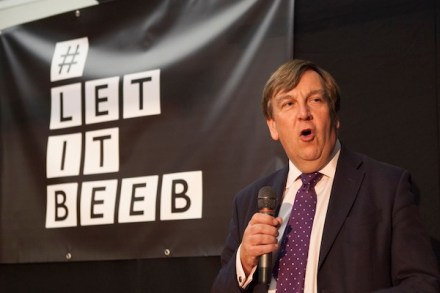
Last night BBC staff and musicians alike assembled at Portcullis House to back UK Music's Let it Beeb campaign. As guests including Lord Hall, Sandie Shaw and Anneka Rice raised a glass to the campaign which aims to protect BBC music services from the threat of charter renewal, MPs including Ed Vaizey and Jess Phillips made sure they didn't miss the chance for a celebrity selfie. It then fell on organisers to urge everyone in the room to sign their petition calling on the government to 'protect vital BBC music services from any budgetary cuts during the charter renewal process'. With that in mind, they made sure that John Whittingdale, the Culture Secretary, was in the audience to hear their pleas.

Robert Peston’s new job ruffles feathers at the BBC

From our UK edition

Earlier this week Mr S reported how Robert Peston's appointment as ITV's new political editor had led his former BBC colleagues to place a sign outside their press room at Tory conference making it clear that he was no longer welcome. Now, in a further sign that his new job has not gone down well with his former colleagues, the BBC's deputy political editor James Landale has posted a cryptic tweet directed at those journalists who have not been promoted in recent months. Landale -- who was overlooked in favour of Laura Kuenssberg for the role of BBC political editor -- has sent a message praising those who -- like him -- put the story first, get on with the job and keep buggering on: https://twitter.

Was BBC1’s Rooney hagiography more scripted reality than documentary?

From our UK edition

Close to the Edge (BBC4, Tuesday) feels very much like an idea conceived during a particularly good night in the BBC bar. Why not take the ‘scripted reality’ methods of such youth hits as The Only Way Is Essex and apply them to a group of over-65s living in Bournemouth? So it is that the chosen oldies are given one main characteristic each, and required to act out events from their own lives — events that might or might not have happened if the cameras weren’t there. Or as Tuesday’s opening caption rather optimistically put it, ‘Some of the scenes have been constructed purely for your enjoyment.’ Which scenes these were, the programme didn’t of course specify.

Coffee Shots: Robert Peston left out in the cold

From our UK edition

This week it was reported that Robert Peston is leaving his role as the BBC's economics editor to join ITV as their political editor. As part of the new job, he is expected to be the host of a Sunday morning politics programme which the broadcaster hopes will rival The Andrew Marr Show. Unsurprisingly the news does not appear to have gone down too well with some members of the Beeb. Stephen Walker, the BBC Northern Ireland Political Correspondent, has shared a photo of a sign outside a BBC press area at Tory conference which has been 'edited' to ban Peston from entering. https://twitter.com/StepWalkTV/status/651359185083465728 Hopefully Peston's new colleagues at ITV will be more welcoming.