Barack obama

Afghanistan: air fares, not infantry needed

From our UK edition

The British government’s policy on Afghanistan has a spasmodic, yet regular kind of rhythm to it. The issue pops up at intervals, hovers menacingly over Brown’s premiership until the PM awakes from a period of inaction. He then goes into hyper-drive, promises all manner of things, and reverts to inactive type a few days later only to repeat the routine a some days/weeks/months [cross out as appropriate] afterwards.  This time is no different. While the government, along with our allies, wait around for the US president to make up his mind on an Afghanistan (and, by extension, how his first term will be remembered), the PM has been overflowing with schemes and speeches.

Brown misjudges the Afghanistan waiting game

From our UK edition

There's something futile about Gordon Brown's and, now, David Miliband's speeches on Afghanistan.  After all, the world is still waiting to hear what Obama's strategy is for the country.  Will he increase troop numbers – and by how much?  What does he actually want to achieve with them?  Until that's known, it's a little premature to talk about a "comprehensive political framework" for handing security responsibilities over to the Afghan army. Worse, though, the PM's statements may actually be damaging.  Sure, it's frustrating that the US President is leaving his allies hanging.

Must-have-elements under Karzai III: an Afghan Army Corps of Engineers

From our UK edition

Whatever happens in Kabul now, the next couple of months will be hard going. Hamid Karzai will form a new government, perhaps with Abdulllah Abdullah. But nobody expects the Karzai III government to be any better or less corrupt than versions I and II. Quite the opposite. In his bid for re-election, President Karzai surrounded himself with chequered figures who could bring him votes: warlords suspected of war crimes, corruption and drug trafficking. None is as influential as Marshal Fahim, his running mate, who has long been suspected of drug-running and other crimes. Expect to look back at the Afghan government’s past performance as a model of probity and efficiency.

The end of special relationships

From our UK edition

Today, two of my colleagues, former senior MoD official Nick Witney and US analyst Jeremy Shapiro, issued a hard-hitting report about transatlantic relationships. Their message is simple. Europe has the US president it wished for, but Barack Obama lacks the strong transatlantic partner he desired. With EU leaders heading to Washington for their transatlantic summit on 3 November, Shapiro and Witney caution European governments: an unsentimental President Obama has already lost patience with a Europe lacking coherence and purpose. In a post-American world, the United States knows it needs effective partners. And if Europe cannot step up, the US will look for other privileged partners to do business with. Unfortunately, many Europeans are in denial about how the world is changing.

Russia pockets Obama’s concession and moves on

From our UK edition

The strategic logic behind President Obama’s decision to alter US plans for a missile defence shield based in Eastern Europe was that this would persuade the Russians, who didn’t like the shield, to agree to the US’s push for tougher sanctions on Iran. But it appears that Moscow isn’t going to play ball.   The Russian Foreign Minister Sergei Lavrov declared after a meeting with Hillary Clinton yesterday that, “Threats, sanctions and threats of pressure in the current situation, we are convinced, would be counterproductive.” So, all that Obama’s concession has done is anger the Czechs and the Poles who weren’t told about the move until the last minute. Iran is an issue that hasn’t gone away.

A prize that will cost Obama

From our UK edition

New Majority points out another reason why Obama should have politely told the Nobel Peace prize committee that he would rather they didn’t award him the prize: “The Nobel Committee has created a pretty little problem for White House counsel Greg Craig this morning. The value of the gift is $1.4 million. Technically, it’s a “Foreign Official Gift,” so it has to be retained by the U.S. government. Donating the money to charity will be very difficult, because first the gift will have to pass through the president’s hands -and the law requires that he must spend $1.4 million of his own money to buy the $1.4 million from the U.S. government.

Peace in our time

From our UK edition

When I first saw the headline Obama wins Nobel Peace Prize, I thought I must have read it wrong. After all, what has Obama actually accomplished in his first nine months in office? (Obviously, that’s not to say he won’t accomplish foreign policy successes in his time in office but he certainly hasn’t yet).   On the foreign policy front, Obama is not actually having much success. Having announced Afghan strategy months into his presidency, he is now reviewing it and seems intent on second-guessing the new commander he appointed. Also for all the goodwill towards him in Europe, he has not got the Europeans to commit substantially more resources to the conflict.

Iran’s threshold power

From our UK edition

The discovery that Iran's regime has, yet again, deceived the international community and secretly built an additional nuclear facility has made world leaders re-focus on the issue. On Friday, the US, UK and France said the UN had to be given immediate access and urged tough new sanctions. Even Russia expressed concern. Today, the Iranian regime's  response came. According to Ali Akbar Salehi, who heads the Atomic Energy Organisation, Iran will keep its uranium enrichment level at up to five percent - much lower than bomb-grade. "We don't want to change the arrangement of five-percent enrichment merely to produce 150 to 300 kilos of 20-percent (enriched) fuel," ILNA news agency quoted the nuclear chief as saying.

The Persian Problem

From our UK edition

The news that Iran has a second, secret nuclear installation can hardly be considered a surprise. Nor, alas, is there anything surprising about Charles Krauthammer's reaction to Barack Obama's decision to make nuclear proliferation an issue at the UN General Assembly: What did he accomplish? Nothing. This is really quite surreal. As we speak, the Iranians are spinning thousands of centrifuges and developing uranium. The American delegate at IAEA announces that Iran already has enough uranium to construct a bomb. It's testing its missiles, flouting all U.N. resolutions, as are the North Koreans. And the response of America?

Eureka!

From our UK edition

Brown's pursuit of Obama through the UN canteen has finally paid dividends: PoliticsHome is reporting that Barack Obama will hold bilateral talks with Gordon Brown later today. After yesterday's negative headlines, Obama was always going to make a gesture that indicated how much he valued Brown; but from the Prime Minister's point of view, the damage has already been done.

From the ridiculous to the damaging

From our UK edition

The ‘Appeal to Conscience’ World Statesman of the Year ought to be treated with more respect, otherwise the award becomes a mockery. The news that President Obama rebuffed the PM’s requests for bilateral talks at the UN or G20 meetings capped a dreadful day for Gordon Brown. A White House spokesman told the BBC: “Any stories that suggest trouble in the bilateral relationship between the US and UK are totally absurd.” To imply that the ‘special relationship is on the rocks is exaggeration, but there’s no doubt that Obama, who held bilateral talks with the leaders of China, Russia and Japan, departed from the Bush administration’s Anglo-American axis.

Obama’s choice on Afghanistan

From our UK edition

The New York Times reports that President Obama has re-opened internal debate about Afghan policy, suggesting that he is going to u-turn from the counter-insurgency strategy that he announced in March. It seems that Joe Biden, who lost the policy argument last time round, might win out with his argument that, “Instead of increasing troops, officials said, Mr. Biden proposed scaling back the overall American military presence. Rather than trying to protect the Afghan population from the Taliban, American forces would concentrate on strikes against Qaeda cells, primarily in Pakistan, using special forces, Predator missile attacks and other surgical tactics.

Gordon Brown gets something right!

From our UK edition

Gordon Brown is expected to offer to decommission one of Britain’s four Trident submarines as part of nuclear non-proliferation discussions at the UN today. The Times has the details: ‘Mr Brown will signal tomorrow that he is ready to negotiate at a meeting of the UN Security Council on nuclear non-proliferation. It follows President Obama’s decision to ditch the US missile defence shield in Eastern Europe. That move, and Russia’s delighted response, has bolstered hopes that a new non-proliferation treaty could be agreed next spring. Officials travelling with the Prime Minister to New York insisted that there was no question of surrendering Britain’s independent nuclear deterrent.

The McChrystal plan

From our UK edition

So, the report written by ISAF commander, Stanley McChrystal, to President Obama on NATO’s Afghan mission has been published. It does not contain a request for more US troops, but most analysts think it is only a matter of time before a request is sent from Kabul. In the recently-published report, McChrystal says: “While the situation is serious, success is still achievable.” But serious changes will be required. These will have to address what McChrystal calls “The weakness of state institutions, malign actions of power-brokers, widespread corruption and abuse of power by various officials.” The US general also admits “ISAF's own errors”. Bear in mind, though, that the report was written before the recent presidential elections went awry.

Decision time for Obama

From our UK edition

Bob Woodward has the scoop that General McChrystal’s review of Afghan strategy calls for more troops. McChrystal is direct, stating that “ISAF requires more forces” and that “inadequate resources will likely result in failure”. He is also clear that these troops are needed now, "Failure to gain the initiative and reverse insurgent momentum in the near-term (next 12 months) -- while Afghan security capacity matures -- risks an outcome where defeating the insurgency is no longer possible." McChrystal has yet to present his request for more troops to the Pentagon but it is clear that he will ask the administration for considerably more troops. Obama now has to decide whether he will back the new commander he put in place and give him the tools he needs.

Mr Obama, tear down these missile sites

From our UK edition

Today Barack Obama publicly tore down the missile installations that George W Bush put up in the Czech Republic and Poland. The system was ostensibly meant to counter threats from Iran, but given the swift creation of missile sites in Poland and the Czech Republic in the wake of Russian’s invasion of Georgia, Moscow’s elite never bought into this rationale – and perhaps rightly so. The strength of Russian feeling has always been clear. The latest Russian National Security Strategy states that the “ability to maintain global and regional stability is being significantly aggravated by the elements of the global missile defence system of the US”.

Obama and Cameron: who thought what about whom?<br />

From our UK edition

Remember that New Statesman article about Obama calling Cameron a "lightweight"?  Well, the Journalist Closest to Obama, Richard Wolffe, has a different take.  Here's what he told the Today programme this morning, courtesy of the ever-alert Andrew Sparrow: "He had a strong impression, a strong reaction, to both Cameron and Brown. It was right at the end of his foreign trip. And he was really taken with Cameron. He and his aides thought that he had energy and verve, a dynamism that suggested he was a good candidate – remember this was a candidate at the time, not a president. And there was bonding that took place which you might not expect of two people at the opposite ends of the political spectrum.

The language of political debate

From our UK edition

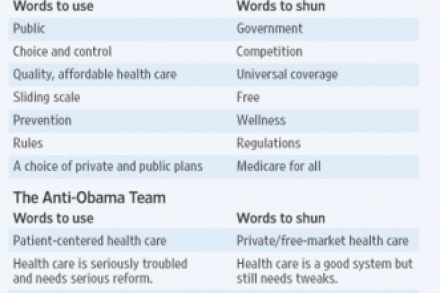
A great spot by Tim Montgomerie over at ConservativeHome, who highlights this Wall Street Journal graphic on the words that both sides of the US healthcare debate should be using to score a rhetorical advantage.  For instance, it suggests that the pro-Obama team should say "rules" rather than "regulations", while the President's opponents should attack the system for being "too profit-driven" and "too bureaucratic": As Tim says, words have power.

Will the Obama administration deny requests for more troops in Afghanistan?

From our UK edition

Frederick and Kimberly Kagan, two of the people involved in devising the surge strategy in Iraq which so transformed the security situation there, have a strong piece in the Weekly Standard arguing that the Obama administration is in danger of repeating in Afghanistan the mistakes the Bush one made in Iraq: not giving the commander on the grounds the tools they need to do the job. The Kagans’ concern has been caused by strong hints from the Obama administration that it is not minded to send any more troops to Afghanistan whatever the review initiated by the new US commander there, General McChrystal, says. (The deadline for McChrystal to make his requests has been pushed back until September). If McChrystal thinks he needs more troops, he should not be denied them.

Is General Jones on his way out?

From our UK edition

With Obama’s administration gradually filling up, problems appear to be brewing at the centre. Though picking ex-General James Jones as a National Security Adviser was seen as a smart move, associating the general’s wide experience and bi-partisan appeal with the young president, it may be turning out not to be so clever after all. President Obama continues to rely on his campaign advisers, principally Denis McDonough, nominally one of Jones’ deputies, and Mark Lippert, the Chief of Staff of the National Security Council and a confidant of Vice-President Biden. Both aides have a close personal bond with the President.