Barack obama

With Obama looking beatable, the Republican candidates debate

From our UK edition

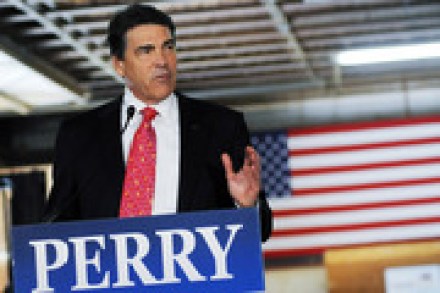
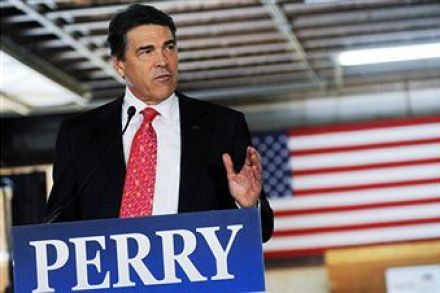
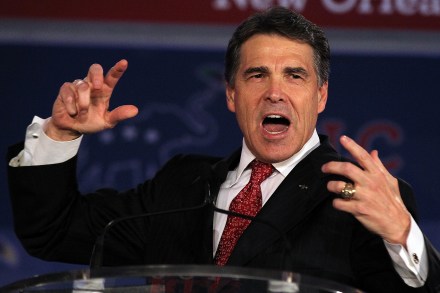
Tonight, the Republican primary race gets serious with a debate at the Ronald Reagan presidential library in California. This is the first debate that Rick Perry, the governor of Texas and the current frontrunner, has taken part in. The Republican nomination is now a far more attractive prize than many expected it to be. 53 percent of voters now disapprove of the job Obama is doing suggesting that he is beatable. At the moment, the Republican nomination appears to be Perry’s to lose. He is benefitting from both the troubles of the Tea Party favourite Michele Bachmann, her campaign manager has just stepped down, and Republican establishment unease with the former frontrunner Mitt Romney. What we haven’t seen yet is whether Perry can take a punch.

Gripped by ‘Dominion’

From our UK edition

What on earth is ‘Dominionism’? Lots of Americans who first heard the word just a few weeks ago are suddenly feeling very angry about it. Liberals say that the US constitution is facing a ‘Dominionist threat’ in the form of Michele Bachman and Rick Perry, two Republicans running for president in 2012. Christian conservatives, meanwhile, cry prejudice: they accuse a secularist elite of conducting a witch-hunt against Christians in politics.   What's the fuss? Dominionism is, we are told, a school of evangelical thought that aims to impose Biblical law over secular government. It is to nutty Evangelicals what Shariah Law is to Islamists,­ a way of achieving theocracy on earth.

Rick Perry soars in the polls, but for how long?

From our UK edition

His presidential campaign is just a fortnight old, and already Rick Perry is soaring in the polls. The three major national surveys conducted since his announcement all give Perry double-digit leads over previous frontrunner Mitt Romney. He has also, importantly, taken the lead in Iowa and is now odds on to win both there and in South Carolina come February. This is certainly an encouraging position for a new candidate, but history suggests that Perry supporters should temper their optimism with a heavy dose of caution. Until the autumn of 2007, Rudy Giuliani led the Republican field by a similar margin to the one Perry has now. And Hillary Clinton's lead over Obama was even more commanding. Neither went on to win their party's nomination.

The Republican battle steps up a gear

From our UK edition

This is perhaps the biggest weekend yet in the race for the 2012 Republican presidential nomination. The candidates clashed on Thursday night in their third televised debate, and will contest the traditionally important Ames Straw Poll in Iowa today. In truth, as Alex says, neither the debate nor the straw poll will have that big an impact on the race. More significant is an event taking place more than a thousand miles from Ames, in Charleston, South Carolina. There, Texas Governor Rick Perry will announce his entry to the race. And judging by current polling and betting trends, he will start out as joint favourite. Until now, Mitt Romney has been the frontrunner, notionally at least.

Why Obama is still odds on for re-election — just

From our UK edition

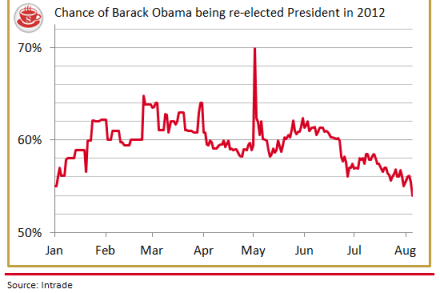
A credit downgrade, unemployment at 9.1 per cent, spluttering growth — the economic cards are certainly stacked against Obama for his re-election in 2012. But here's the thing: American punters still think that he's more likely to win next November than not. Perhaps that's because, contrary to Clinton's famous slogan, it's not actually all about the economy. According to Nate Silver's analysis of the last 25 presidential elections, a better rule of thumb is "it’s half the economy and half everything else, stupid". So if Obama's losing the first half, what about the "everything else"?

America continues to unravel

From our UK edition

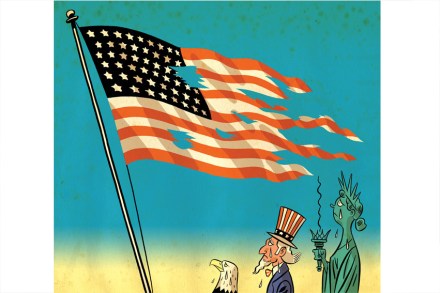
The humbling of America — the cover theme of this week’s Spectator — continues with S&P stripping Uncle Sam of his AAA credit rating. The debt downgrade, it says, “reflects our opinion that the fiscal consolidation plan that Congress and the administration recently agreed to falls short of what, in our view, would be necessary to stabilize the government’s medium-term debt dynamics.” In other words: Obama’s still addicted to debt, and it’s time to stop pretending that his government’s IOU notes rank among the safest investments on earth. Its analysis seems to be pretty much that made by Christopher Caldwell in his brilliant cover story.

The markets wax and wane

From our UK edition

CoffeeHouser 'Ben G' had it right in his comment underneath my earlier post: 24 hour news really does struggle in the face of economic crisis. This morning, all the talk was of a debt-induced apocalypse. Earlier this afternoon, the headlines were about the markets "rallying" after better-than-expected data on the US labour market. And now the BBC website's main headline is that "turmoil in the stock market persists," despite those very same labour market figures. Oh yes, it's difficult to present a consistent front as the money merchants sway and buckle in the breeze. That said, the economic fundamentals remain discouraging. It shouldn't be forgotten that yesterday's losses were extraordinary; in many cases, the worst since the early days of the Credit Crunch.

An open letter to Will Straw about deficit reduction…

From our UK edition

…or why the US cuts are actually faster than, and just as deep as, ours. Dear Will, We hope you don't mind us writing a letter-form response to your latest post on Left Foot Forward, which argues that the "coalition government's cuts are deeper and faster than the Tea Party's". But, as we see it, there are several problems with your figures which are easier to explain in a conversational format. Here they are, as best as we can express them: i) The first obvious problem comes when you say that Obama set out $83 billion of deficit reduction for 2012 in his March Budget. Actually, he didn't.

Apocalypse averted?

From our UK edition

At last, signs that Washington's lawmakers may have scrabbled together a debt deal after all. According to the overnight wires, the White House and Congressional leaders have alighted on a package that would raise the ceiling by $2.4 trillion, so long as the deficit is reduced by at least the same amount over the next ten years. There are more details here, but the key claim is that around $1.2 trillion of immediate spending cuts have already been agreed upon, with a Congressional committee to recommend further deficit reduction measures by the end of November. And although these proposals will still have to pass through the corridors of Congress, leaders from both sides sound increasingly optimistic that it will do just that.

America’s debt crisis fuels Obama’s political crisis

From our UK edition

Momentousness without momentum. That's what we're getting from America at the moment, as this all-crucial debt deal continues to stutter and stall. The main development in Washington yesterday was John Boehner securing enough Republican votes to pass his bill in the House of Representatives — only for it to be summarily tabled by Democrats in the Senate. What will follow over the weekend is yet more frantic negotiation between the Democrats and Republicans in Congress, as each tries to make their various plans more acceptable to the other, while also keeping their own die-hards on side. Meanwhile, the clock keeps on ticking down towards default: three days, 13 hours, 35 minutes...

New favourite emerges to challenge Obama

From our UK edition

There's a new favourite in the race for the Republican nomination to take on Barack Obama in 2012. Yesterday saw Mitt Romney hobbled from his number one spot - on betting website Intrade at least - by Texan Governor Rick Perry. Romney had been seen as the candidate most likely to secure his party's nomination next year ever since he finished second to John McCain in the 2008 primaries. However, support for Romney has never reached the levels expected of frontrunners, with many Republicans keen to vote for someone more conservative. Rick Perry may just be that man. Perry's position as (narrow) favourite is somewhat surprising when you consider that he's not officially running yet.

Where next for the US and Pakistan?

From our UK edition

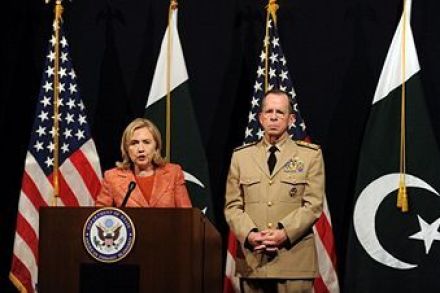
The US-Pakistani relationship is fast deteriorating. In May, I argued that unless President Asif Ali Zardari took decisive action against the ISI, the country's military would continue to undermine relations with the West. Last week, the New York Times reached the same conclusion, calling for the removal of Lieutenant-General Ahmed Shuja Pasha. As President Zardari did nothing — probably fearing a military coup if he did act — the situation has merely been aggravated. What's more, Secretary of State Hillary Clinton has warned that the US could suspend military aid to Pakistan unless it took unspecified steps to help find and fight terrorists. And the White House has since confirmed that it is doing just that.

Boehner’s concession exposes the GOP’s divisions

From our UK edition

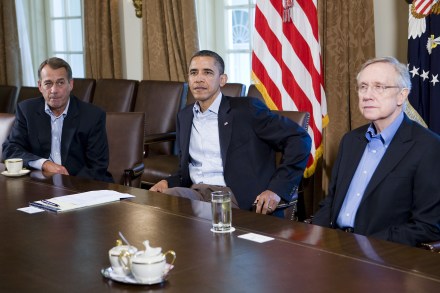
The New York Times reports that House Speaker John Boehner has urged his colleagues to reach a deal with President Obama over raising the ceiling on the national debt. So far, Republicans have been resisting Obama, fearful that tax rises and compromise would damage the party’s chances in next year’s election, which is expected to hinge on restoring America’s public finances. Boehner’s retreat has incited the presidential candidates, who have been campaigning this weekend. The New York Times has the full details, but here's a brief summary. Michelle Bachmann and Tim Pawlenty averred their opposition to raising the debt ceiling; a stance designed to court the party’s purists. Predictably, Mitt Romney adopted a more conciliatory position.

Britain’s ill-defined counter-terror strategy exposed by America’s clarity

From our UK edition

In a post over at the Staggers, defence and security expert Matt Cavanagh has compared and contrasted Barack Obama’s review of US counter-terrorism policy and the coalition’s recent update of the Prevent strategy, together with David Cameron’s professed ‘muscular liberalism’. Here are his insights: ‘The new (American) strategy contains a fairly detailed discussion of the Arab Spring, arguing for applying "targeted force on Al Qaida at a time when its ideology is under extreme pressure" from events in North Africa and the Middle East.

Obama draws down his forces

From our UK edition

It is as Matt Cavanagh predicted in his article for Coffee House, a few weeks ago. Barack Obama has decided to pull 10,000 of the 30,000 American "surge" troops out of Afghanistan this year. The remaining 20,000 will be outtathere by next summer. "Drawdown," is the word that the US President used in his address last night, and it is happening at quite a pace. He presented this approach as a victory, suggesting that America has already achieved most of its goals in the country, and that "the tide of war is receding". But there were one or two revealing notes of concession. "We will not try to make Afghanistan a perfect place," quoth Obama. And he nodded towards the fiscal cost of the war, as much as its human cost.

America and Britain turn their minds to the (fiscal) cost of war

From our UK edition

Five-thousand, ten-thousand, or fifteen-thousand? That's the question hanging in the air as Barack Obama prepares to clarify his withdrawal plan for Afghanistan this evening (or 0100 BST, if you're minded to stay up). And it relates to how many of the 30,000 "surge" troops he will decide to release from the country this year. Washington's money appears to be on 10,000, with half of them leaving this summer and half in December. But no-one outside of the President's clique really yet knows. His final decision will say a fair amount about his intentions in Afghanistan, or at least about just how fast he wants to scram out of there. What's really striking, though, is the emphasis being placed on the bill for Afghanistan.

The myth of cuts

From our UK edition

Last week, Ed Balls warned against the effect of George Osborne’s vicious, front-loaded cuts. Today, we have an update in the form of monthly state spending figures. In cash terms, a new record has been set in state largesse. The UK government’s current spending was £51.7 billion in May, up from £50.6 billion in May last year (the last month of Gordon Brown). George Osborne has so far outspent Gordon Brown every month that he’s been in the Treasury. Even adjusted for the runaway inflation, the Chancellor has on average outspent Brown during his first 12 months:     To fund this extra spending, the Chancellor borrowed £27.4 billion from the public for April and May. Labour chirp today that this is more than the £25.

Republicans pull their punches against each other, but not Obama

From our UK edition

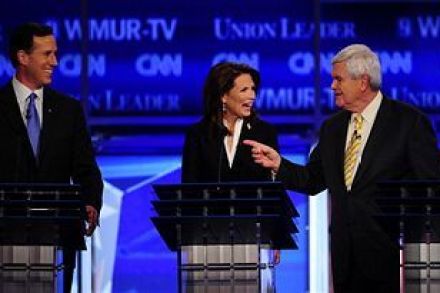
So it turns out the candidates vying for the Republican presidential nomination don’t like Barack Obama, his health care reforms, government bailouts, unions or abortion rights. Who knew? But it seems they do like tax cuts, states’ rights and... each other. The beleaguered Newt Gingrich didn’t even wait for the first question in last night’s debate to commence the Obama-bashing. “We need a new President to end the Obama depression”, he opened. And the others soon piled on. Mitt Romney said that “This President has failed” on jobs and the economy.

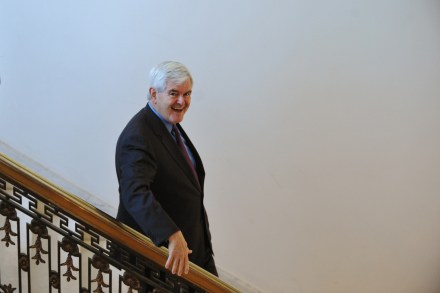
The decline and fall of Newt Gingrich

From our UK edition

A couple of days ago, Newt Gingrich's campaign for the US presidency imploded when the leaders of his campaign team quit en masse. The exodus — which included his campaign manager, spokesman and senior strategists — came after an awful month for Gingrich, and looks like it might seal the fate of his already flagging campaign. Just a month ago, when the former Speaker of the House officially declared that he was seeking the Republican nomination, his fundamentals looked fairly strong. He has very high name recognition (a result of the four years he spent leading the Republicans in Congress in the late 1990s) and was polling fairly well.

Accentuate the differences

From our UK edition

This is an age of ideas, not of ideology. That is the thesis of Amol Rajan’s enthralling overview of the intellectual trends in contemporary British politics, published in today’s Independent. As part of the piece, Rajan has interviewed Maurice Glasman, who gives a far clearer account of 'Blue Labour' than he did during his recent comments to the Italian press. Communities must be organised to resist the caprices of capital and the dead-hand of the state. Resist is probably the wrong word because the aim appears to be, in Philip Blond’s celebrated phrase, the ‘recapitalisation of the poor’, which implies some form of empowerment. Rajan notes that Glasman holds a lot in common with Philip Blond’s Red Toryism and the Big Society.