Banking

Collective failure exposed

From our UK edition

The National Audit Office’s report into the government's handling of the banking crisis and taxpayers’ continued exposure is a pandora’s box of financial horrors. The NAO estimate that taxpayers are underwriting liabilities exceeding £850bn and, buried in the document, is the revelation that the FSA and the Treasury gave RBS “a clean bill of health” in October 2008, days before the bank nearly collapsed. Details are scarce and I haven’t seen the relevant Treasury document to which the NAO refers; but this disclosure is astonishing, even by the standards of Fred the Shred, the FSA et al. This crisis was caused not by market failure but by systemic incompetence within the banking’s sectors most regulated arm – the commercial.

Risky business | 3 December 2009

From our UK edition

With the largest transfer of liabilities in British history – the insurance of the risk of loss on £240 billion of toxic RBS assets by taxpayers – proceeding, there is worryingly little information being given about either what these assets may be or what risks there are to the taxpayer. Rather than the parliamentary enquiry and detailed disclosure Swiss parliamentarians demanded when UBS needed similar assistance, a small press release noting such exotics as “structured credit assets “ has been issued. The spin continues to be that there is nothing to worry about and all this money will come back fine. Bank of England data shows that UK bank exposure to the US increased increased by over half a trillion dollars between 2004 and 2007 to 1.2 trillion.

Labour’s free for all

From our UK edition

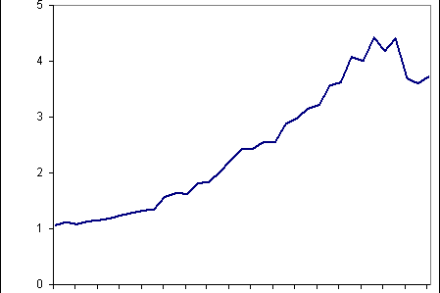
The potentially huge exposure of UK banks in Dubai, depreciating some UK bank share prices again this morning, is a reminder of just how much UK bank lending grew in recent years. The above chart shows the growth in external claims of the UK owned banks around the world over the past decade. The sums lent almost quadrupled to nearly $4 trillion in 8 years.  Anyone interested in discovering which bubbles the UK banks (and now taxpayers) have funded can find the data on the Bank of England website - $1.2 trillion in the United States, $125 billion in Spain, $183 billion in Ireland, $50 billion to the UAE/Dubai. Bank profits soared, and the “New North Sea Oil” of booming bonus pools was taxed to fund ever growing government spending.

A nation of property owners

From our UK edition

An Abu Dhabian official has briefed Reuters that Abu Dhabi will rescue Dubai on a “case-by-case basis”. The official stated: “We will look at Dubai's commitments and approach them on a case-by-case basis. It does not mean that Abu Dhabi will underwrite all of their debts. “Some of Dubai's entities are commercial, semi-government ones. Abu Dhabi will pick and choose when and where to assist." This is potentially bad news for the UK taxpayer, who faces the prospect of provided further cover for British banks, who invested $50bn in the region at the height of the boom. The reason we're in the firing line?

The coming sandstorm

From our UK edition

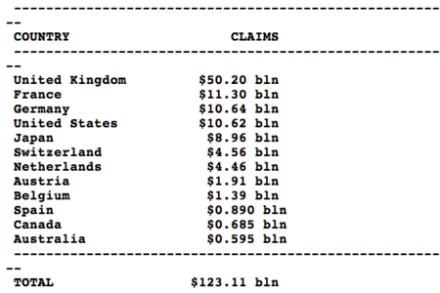
The FT’s Alphaville blog has published a table detailing foreign banks’ exposure in the UAE. Look away now because it’s horrific. Of course not all of this lending was to Dubai, but those sort of funds are unlikely to be required by Abu Dhabi, with its gigantic oil profits and £900bn wealth fund. If Abu Dhabi doesn’t bail out its ailing partner, you can bet your bottom dollar who will.

Dodgy doings in the desert

From our UK edition

Of all the lunacy engendered by this financial crisis, Dubai’s decision to call a six-month creditor standstill on its chief holding company is the most pronounced. Dubai’s successful but hideous entrepot model depends on the confidence capital markets, and as a rule markets don’t react to nasty shocks with a shake of the head and a song and dance routine. It’s as if plague has descended on every stock exchange in the world; investors are fleeing for safety. Overnight, shares in Asia collapsed between 3 and 5 percent, and the FTSE, Dax and Cac40 have opened around one percent down. Prepare for another black day. Will this blip develop into a crisis?

Saving the world | 25 November 2009

From our UK edition

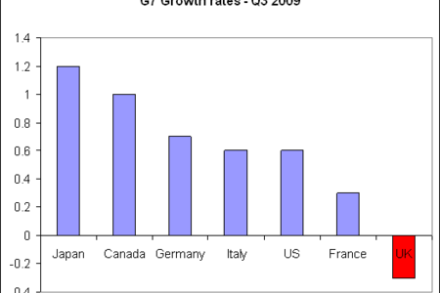
Today’s revised GDP data confirms that the UK remained alone of the world’s major economies in recession in the third quarter of this year*. The fact that the UK remains mired in recession long after most economies have recovered makes clear how uniquely badly positioned the UK economy was to handle a downturn.  While some investment banks continue to argue that this performance reflects the inability of the Office of National Statistics to calculate the data correctly, there is good reason to believe that this huge underperformance is grounded in reality. Economic history teaches that bank crises are amongst the worst things that can ever hit an economy. The collapse in credit availability and soaring bank margins have posed very substantial risks to economic growth.

Missing the point | 25 November 2009

From our UK edition

The Today programme really let Paul Myners off the hook this morning. The interviewer obsessed with why the loans had remained secret for so long. It’s a fair question, and it seems bizarre that we only learn of them ten months after the borrowing was repaid in full. However, there are more important questions. As I wrote yesterday, these disclosure’s most potentially volatile revelation is that Gordon Brown was propping up HBOS whilst urging Lloyds to purchase the ailing giant. Was this issue examined in any depth? No, though it must be determined whether the Lloyds’ board understood HBOS’s predicament in its horrific entirety. The equally crucial question of how the government is addressing the banking system’s continued frailties received scant attention.

There are more pressing financial concerns than this

From our UK edition

The two top dogs at the Treasury Select Committee, John McFall and Michael Fallon, give remarkably different reactions to the news that ministers withheld details of emergency loans to RBS and Lloyds for over a year. McFall argues that secrecy was necessary to avoid a run on the banks; Fallon expresses outrage that Lloyds’ shareholders were not privy to all information when considering the disastrous purchase of HBOS, urged on them by the Prime Minister.   Both have their points. Blind panic is the defining recollection of those autumnal days. If the situation had been exacerbated by full disclosure of the mess RBS and Lloyds were in then God alone knows what pandemonium would have ensued.

Renewed tension between Brown and Darling

From our UK edition

Alistair Darling did look slightly apprehensive when Gordon Brown gatecrashed the G20 finance meeting on Saturday. And how right Darling was: the Prime Minister’s Tobin tax proposal was met with gawping disbelief; it was as if Bernie Madoff had strolled into the room as the new head of the IMF. It is very telling that only the disingenuous French, who can’t believe their luck, support the proposals. The FT reports that Darling is livid that Brown would risk alienating the UK by announcing a policy that he knew the US and others would publicly oppose. The ploy may have been a desperate vote grab, but the Global Statesman of the Year is now a Global Figure of Mirth - Groucho Marx with the ability to raise tax - and he’s back-peddling furiously.

G20: the way ahead ignores unresolved issues

From our UK edition

Home of golf and full of five star hotels, St. Andrews is a lovely spot for a weekend shindig, so it’s no surprise that the G20 have convened there for their latest navel-gaze.   This meeting was supposed to be the preserve of finance ministers, but you can’t keep a statesman down. Gordon Brown delivered an impromptu lecture on 'the way ahead' to ministers who have, by some fluke obviously, stewarded a return to growth in their respective countries. Brown is adamant that curbing stimulus packages and inaugurating exit strategies be co-ordinated globally. He spoke of the need to protect taxpayers’ investments with what he called a ‘social contract’.

Quantatitive Easing is an affront to democracy

From our UK edition

Readers of the Spectator will know George Trefgarne’s work, and today he delivered an important report on the dangers of Quantitative Easing. I urge Coffee Housers to read the speech. It provides an interesting and relevant insight into historical precedents for the policy and how to manage it, and gives a balanced analysis of the current policy’s pros and cons. Trefgarne concurs with Mark Bathgate’s critique. There is little evidence that QE has stimulated money supply, as banks are using the cash to re-balance their lop-sided books. QE is funding the government’s debt habit. The IMF estimates that QE has reduced the benchmark 10-year interest rate on government debt by up to 1%, currently standing at 3.5%.

Printing money is not the solution

From our UK edition

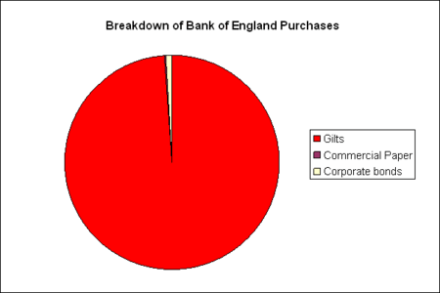
With another £40bn disappearing down the black hole known as the British Banking sector, the financial cost of the economic and banking collapse is now only rivaled by the two World Wars in it’s cost to the UK taxpayer. Rather than going to support credit to business or households, the further £25bn of “newly printed money” announced today is likely to go to help prop up the Government debt mountain.   The above chart shows how the Bank of England has been using quantative easing since March. 98.8 per cent has been used to purchase Gilts. As fast as the Debt Management Office “sells” Gilts to the “market”, the Bank of England shows up and buys them.

Failing to address the banking crisis is hampering recovery

From our UK edition

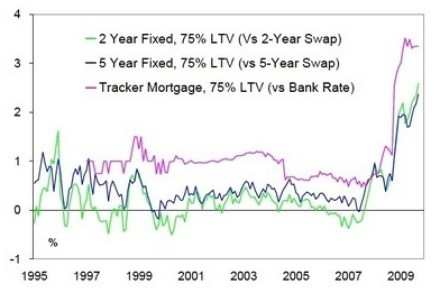
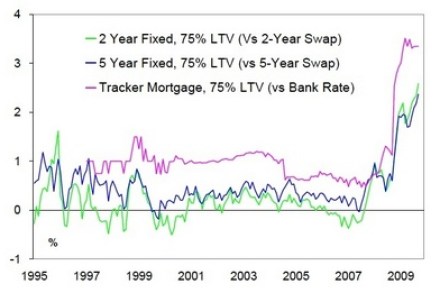
As another £30 billion of taxpayers’ money is handed over to banks, the role of banking sector in the continuing UK recession cannot be understated. 1990s Japan taught the world that developed economies with zombie banking systems don’t grow.  Crippled by bad debts, lending margins on solvent borrowers increase, credit availability declines and ongoing bailouts are needed. This hampers growth in the rest of the economy. The more indebted the private sector, the greater the damage a bust banking system inflicts. The above chart shows how margins on UK mortgages – the gap between borrowing from the Bank of England and what is then leant to mortgage holders – have soared since September last year.

The bills just keep coming in

From our UK edition

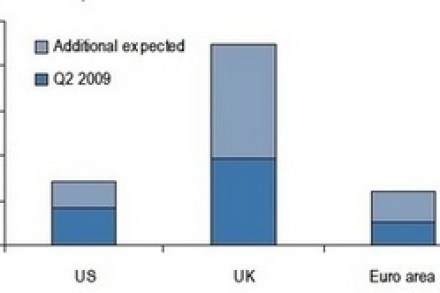
Two years after Northern Rock became the first bank failure of this crisis, another £30 billion of taxpayers’ money needs to be thrown at the banking system. Behind all the noise about improving competition and the European Commission lies one core fact: the UK banks have lost an astonishing sum of money. The above chart shows bank losses as a percentage share of GDP, and illustrates the scale of the crisis that has overwhelmed the banking system and the taxpayer. The IMF estimates that losses could be as high as 25% of UK GDP.   UK banks went on an orgy of lending around the world, becoming the biggest source of credit growth in many countries. RBS trebled its total lending in just three years, expanding its balance sheet to almost 1.5 times the size of the UK economy.

Next step for banks provides further vindication of Osborne

From our UK edition

Alistair Darling has unveiled the initial phase of his plan to get the majority state owned banks back into private ownership. RBS and Lloyds will dispose of more than 918 retail branches across the country over the next four years and will receive up to £40bn of taxpayer funds to strengthen their capital bases. In exchange for this injection, both banks have deferred cash bonuses for 2009. Also, Lloyds will not join the government’s asset protection scheme by securing £13.5bn privately through a rights issue. There is an argument that the government should have gone further and demanded the complete separation of retail and investment arms, followed by additional demergers, and John Redwood makes a clear case as ever.

Brown’s double hit

From our UK edition

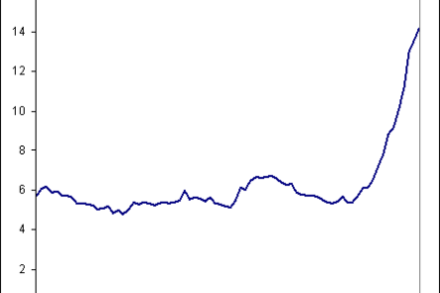
What is the true price of Gordon Brown’s economic incompetence and inept bank regulation? The soaring national debt is one. And if you own a mortgage, you’ll find that you’re paying another. The gulf between the Bank of England base rate and the average mortgage rate is now at a huge high – as banks rip off their customers, trying to fill the hole in their balance sheets. This is an under-discussed topic. The “action we have taken” (a phrase Brown uses to try to lay claim to the Bank of England’s base rate reduction) would have a far greater effect on the economy if the UK banking system was not (still) so badly broken. The below graph, from Citi, shows spreads (ie, gap between base rate and retail rate) on key UK mortgages from 1995.

Brown’s new dividing line ignores that banks are our route to salvation

From our UK edition

Gordon Brown and Alistair Darling will launch their umpteenth fight back today by talking tough on banks and bonuses. They hope to prove the Conservatives are interested solely in “helping their rich friends”. The Times has the details: ‘The Chancellor will tell the party conference in Brighton that legislation to be introduced in the next few weeks will scrap automatic year-after-year bonuses and stop executives getting payouts unless they can prove they are deserved. Bonuses will be deferred over a period so that they can be clawed back if they are not warranted by long-term performance.’ This is not a dividing line.

A mutual decision?

From our UK edition

There is an interesting little story tucked away in today’s Daily Mirror, the government might only sell off Northern Rock and Bradford and Bingley on condition that they are turned into mutually-owned societies. Jason Beattie reports that the idea of turning them back into building societies is being backed by John McFall, the chairman of the Treasury Select Committee, and 29 other Co-Operative party Labour MPs. I suspect that if Northern Rock and Bradford and Bingley are de-nationalised this side of the election, something that I suspect Brown would like to do, the price will be the key determinant.

Barclays vs RBS: A Tale of Luck and Greed

From our UK edition

At the end of the Peter Oborne column James linked to yesterday, Peter writes: I believe that one genuine hero has emerged from the collapse of the British banking system. He is John Varley, the Barclays chief executive who this week proudly announced that his bank would not be taking government money to stay afloat. I admire Varley because he has fought hard to keep one of the greatest names in British banking for more than 300 years independent and out of the hands of the State. It is a hard fight and, who knows, he may yet fail. But at least Varley is doing his best. Fair enough. But it might have been very different had Varley had his way. That is, Barclays might look at what has happened to the Royal Bank of Scotland and shudder "There but for the grace of God, go we".