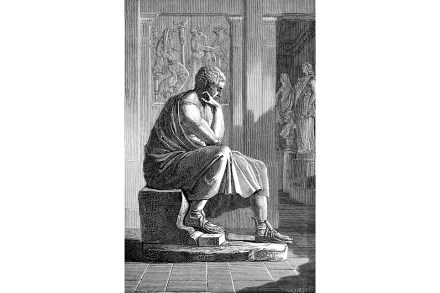
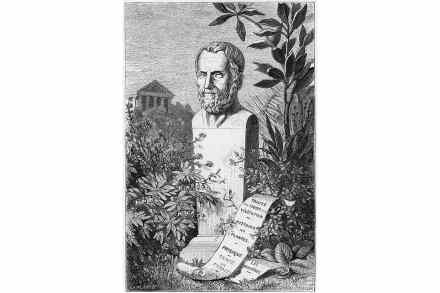
Aristotle

Would the ancients have appreciated David Hockney?

David Hockney has died, and there has died with him an artist whose work has given those of us who are not artists a very great deal of pleasure, in striking contrast to most art that wins prizes these days. The ancient Greeks did not have a word for “art.” The closest they got to it was tekhnê (cf. “technical”), brilliantly defined by Aristotle as “the trained ability to produce something under the guidance of rational thought,” always difficult to discern in the work of most modern artists. So in the ancient world, the artist was on the same level as (say) a dentist – someone whose purpose it was to serve the ordinary public to the best of his technical capacity.

artist

Against Hope

Hope is seen as “an unqualified good” today, Adam Potkay writes in his excellent history of the idea. We hope that things will get better in the world — that peace will come to Ukraine, that religious violence will stop in Burkina Faso, that fat-cat sexual predators in Hollywood will be brought to justice. For members of the world’s three monotheistic religions, it is a virtue to hope in life after death. This hasn’t always been the case. For ancient Greeks and Romans, Potkay observes, hope was mostly a vice.

hope adam potkay

The truth about beauty

In the late 1940s, the German art historian Hans Sedlmayr observed that ‘many things that are classified as “back-ward”... might be the starting-point of real inner progress’. At a moment when the art establishment has abandoned art for political attitudinizing, the path forward begins with a movement of recuperation. In an age when anything can be a work of art, the question of whether something is art has ceased to be compelling: what matters is whether something is a good work of art, and about this the art world has rendered itself hors de combat. Should we be pleased with this state of affairs? Or, to put it another way, is the celebrity of people like Damien Hirst or Marina Abramović or the Chapman brothers a good thing for art?

beauty

Dead letters

In a plea for vocational education, Sen. Marco Rubio famously remarked that we could use ‘more welders and less philosophers’. Doesn’t everyone know that ‘skills pay the bills’? If things weren’t bad enough, the rise of deconstruction and critical theory has created a generation of humanities scholars who themselves see little value in the works they study, insisting that famous art and literature emerged from racist and sexist power structures. What sensible young person would borrow $100,000 to be educated in these pointless disciplines? Eric Adler, a classicist at the University of Maryland, has the answer: anyone who wants to understand his own humanity. Adler’s invaluable survey not only defends the humanities: it even lays out how their allies have fallen short.

classics