Angela merkel

Is Merkel getting her way?

From our UK edition

Below, courtesy of the Telegraph, is a leaked copy of the draft proposals on managing the Greek debt crisis.There are no measures to reduce Greece's debts to sustainable levels; subsidy is the preferred route. This will presumably hit German taxpayers the hardest, but Merkel has managed to obtain private sector involvement, a clear German objective in these discussions.  However, this course is likely to lead to Greece’s selective default as creditors buy back bonds. The European Central Bank has declared that it is happy to allow this and will continue to accept government bonds in the event of sovereign default.
Common Franco-German position on Greek debt

From our UK edition

As I wrote earlier this morning, rumours of a ‘common Franco-German position’ on Greek debt were circulating in the early hours. Details are now emerging. Nicolas Sarkozy has dropped plans to impose a 0.0025 per cent levy on Eurozone bank assets, which was opposed by Angela Merkel for being much too cumbersome. In return, it seems that Merkel is prepared to consider the French-led plan of bond rollover. Merkel is also keen that private sector holders of Greek bonds pay their share of this second bailout. According to the FT, she favours a bond-swap deal, whereby bonds that will mature in the next eight years are swapped for new 30 year bonds paying a lower rate of interest.

Getting a grip of the crisis

From our UK edition

“I’m very worried, this building [the Treasury] is very worried and this government is very worried,” said George Osborne of the unfolding crisis in the Eurozone. In an interview with the FT, the chancellor goes on to say that he is in constant contact with his continental counterparts and urges them once again to “get a grip”. Eurozone leaders are meeting today to discuss further loans to Greece. Three options are being considered: first, an extension of the European Financial Stability Facility; second, private sector creditors re-lend money for a longer period and at a lower rate; third, impose a tax on banks to secure revenue for Greece.

Gearing up for another European drama

From our UK edition

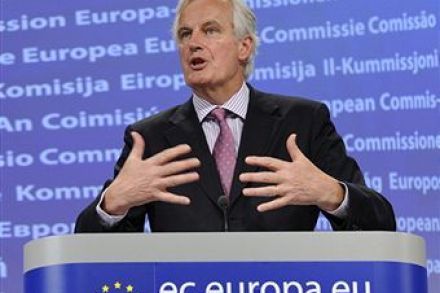
Away from the amateur dramatics in parliament this afternoon, the government is fighting yet another battle with the European Commission over banking reform. European leaders will vote later today on proposals to introduce the rubric of Basel III across European financial institutions. Led by EU Finance Commissioner Michel Barnier and ECB Vice-President Jean-Claude Trichet, these proposals would insist that minimal and maximum capital requirements are imposed on banks. The terms dictate that banks hold 7 per cent of their top-class assets in reserve. Britain opposes the scheme, not because the requirements are too steep: the UK’s Banking Commission has suggested that banks hold 10 per cent of their assets in reserve.

Merkel is running out of patience with the eurozone

From our UK edition

Like an unseasonal Atlantic gale, the Portuguese sovereign debt crisis has blown in to ruin the latest EU summit. This meeting was intended to mark the beginning of the end of the eurozone crisis. Instead, the ponderous European Union has been overtaken by events, with grave consequences. Already speculation about contagion is rife: Spain, Malta* and Italy are now being spoken of in hushed and exasperated tones. The Economist’s Charlemagne correspondent reports that several countries are now wary of the monetary pact that Germany is demanding for delving deeper into its pockets, because they do not want to be accused of surrendering sovereignty.

In Defence of Germany

From our UK edition

Among the many odd things about the Libyan "debate" is the argument that Germany's decision to abstain during the Security Council vote is somehow disgraceful and proof that Germany still isn't ready to play its part on the international stage. (Obviously some of these objections come from the kind of rightists who fear or dislike German influence in other, more peaceful, areas of international politics and business. But never mind.) But Germany's vote seems qualitatively different from the BRIC-blog of abstentions. Brazil, India, China and Russia each have reasons to be wary of this kind of resolution and, indeed, this kind of precedent. Deep down, I suspect some of them would have liked to vote against the resolution.

A Grim St Patrick’s Day

From our UK edition

St Patrick's Day is often pretty grim, not least on account of the American habit of suggesting the poor old boy is actually the patron saint of uncooked hamburgers. It is St Patrick's Day or Paddy's Day and "Patty's Day" is an abomination. True, the pubs tend to be stuffed with insufferable amateurs today but in general Ireland is a decent place to pass St Patrick's Day and a better one than most. At least there are proper Irish people there. But this is not an especially bonny St Patrick's Day and not even a new government that can scarcely fail to be some modest improvement upon its predecessor can alter that drab fact. The Irish Times publishes a rallying leader today, arguing that solidarity and optimism can lift Hibernia from her present predicament.

Meltdown danger

From our UK edition

The situation in Japan is deteriorating further. In the early hours of this morning, the last workers are said to have left the Fukushima Daiichi Nuclear Power Plant as the danger of a nuclear meltdown grew. There have been explosions in three of the plant's reactors and a fourth one is on fire. Everyone within a 30 kilometre radius has been told to stay indoors, and the U.S. Navy's 7th Fleet, stationed more than 100 miles away to help earthquake victims, sailed farther away from the stricken plant after detecting unusual levels of radioactivity in the air. The Japanese Prime Minister, Naoto Kan, has confirmed that, "substantial amounts of radiation are leaking in the area".

Cameron signs up to muscular liberalism

From our UK edition

"State multiculturalism has failed." Angela Merkel put voice to that sentiment last October. Now it David Cameron's turn to do the same. In a speech in Munich today, the Prime Minister has taken a rhetorical torch to Islamic extremism. "Frankly," he says, "we need a lot less of the passive tolerance of recent years and much more active, muscular liberalism." It is, at the very least, a significant political moment. What Cameron is doing here – as explained by Charles Moore and Paul Goodman – is publicly signing up to a philosophy of the world. It is a philosophy that rejects the idea that extremism should simply be contained. Instead, it says that extremism must be fought – and that means engaging in a battle of ideas.

What Cameron should push for in Brussels

From our UK edition

As David Cameron stays in Brussels for his third European summit as PM, it’s becoming increasingly clear that the EU's approach to the eurozone crisis – put up short-term cash and pray – isn’t convincing anyone.   On Wednesday, Moody’s threatened to downgrade Spanish government bonds another notch, citing the fact that, between them, the country’s government and banks have to raise €290bn next year to keep the party going. And, across the eurozone, banks and governments face daunting refinancing targets in 2011, which begs the questions: at what cost? And what happens if they fail to meet them?

A “two stone” solution to the Euro crisis will unbalance the coalition

From our UK edition

Whatever the British government wants, moves are now afoot on the Continent to address some of the structural problem with the Euro. They may in the end lead to some form of fiscal federalism. So far they are not supported by Angela Merkel, the key decision-maker, who worries constantly about the court in Karlsruhe, which has set clear limits on further European integration. But they are said to be supported, at least in part, by Finance Minister Wolfgang Shauble. Writing in the Financial Times, Frank-Walter Steinmeier and Peer Steinbrück argue that the EU needs "a more radical, targeted effort to end the current uncertainty, and provide stronger support for the future of Europe’s common institutions.

Ireland’s crisis is the fault of Fianna Fáil, not just the euro

From our UK edition

In all likelihood, George Osborne will rise this afternoon to groans if not jeers. Britain looks set to lend Ireland £7bn as part of multilateral and bilateral bailouts. Many, particularly the Eurosceptic right, question our involvement, given our straitened financial circumstances and the apparent fact that Britain is sustaining the eurozone’s monetary and debt union, and will have to borrow to do so.     George Osborne has been adamant throughout: Ireland is too important to Britain’s recovery to risk collapse – British and Irish banks are closely linked, debts and borrowing are often co-dependent, trade is very profitable. That the bailout should strengthen the euro is a natural consequence of Ireland being a member of the euro.

G-20 in Seoul: Beyond “Camerkelism”

From our UK edition

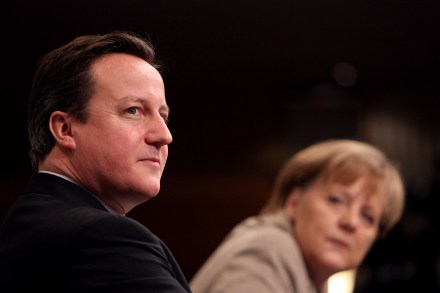
David Cameron is now in Seoul for the first G-20 summit hosted by a non–G-7 member state. It will be the Prime Minister’s second G-20. But things have changed dramatically since he came to power and had to jet to Toronto for his multilateral baptism. Then the Prime Minister’s arguments for austerity measures were theoretical - and a minority position. Now, they are real and have become the majority view. “Camerkelism”, the idea that short-term fiscal consolidation will induce sufficient private-sector activity to more than fully offset the fiscal drag seems to be in the ascendant. Yet the forced smiles at the traditional G-20 class photo will belie a number of continuing problems. The biggest issue will be about the Chinese exchange rate.

A wasted opportunity for EU reform?

From our UK edition

David Cameron made his statement on last week’s EU summit yesterday, answering a range of questions on the 2011 EU budget increase and future changes to the EU treaties. The Tory backbenchers appeared to be on their best behaviour, but Cameron did make an interesting admission. Asked by Ed Miliband if he would he be repatriating powers, he pointed to a reassurance that the UK’s opt out from economic sanctions remained intact, which was not really in question in the first place, and spoke of “progress on the EU budget”. It slipped through virtually unnoticed, but this second remark is actually quite worrying.

Cameron emerges unscathed

From our UK edition

David Cameron’s statement on the European summit just now was an opportunity for pro-European politicians to tweak the Conservative party’s tail about the coalition’s stance on Europe. Ed Miliband told the PM that on Europe ‘we’re here to help him’ and ‘we’re prepared to ignore his previous convictions if he is too.’ Charles Kennedy welcomed the PM as a new pro-European. While Denis MacShane, the very communitaire former Europe Minister, said that there was nothing in Cameron’s statement he disagreed with. There was some grumbling from the Tory benches. Sir Peter Tapsell asked why if Merkel can get a Treaty amended can’t Cameron do the same and allow the country the referendum it was promised.

Cameron’s euro battle is just beginning

From our UK edition

David Cameron sold himself a hospital pass in Europe this week. His failure to secure a budget freeze has revealed that Britain's clout has been wildly exaggerated. The likely 2.9 percent budget increase is mildly inconvenient for Cameron politically, but it is immaterial in the grand scheme of the next round of budget discussions and the mounting wrangle about the Lisbon treaty. He will have to compromise, as he did this week. He made some ground, finding allies to resist an untrammelled treaty change - the Irish, the Dutch, the Danes, the Czechs and the Poles. The biggest prize will be Sarkozy, whose antipathy towards Merkel is arch - the ongoing diplomatic and military discussions between Britain and France must be about more than sharing aircraftless carriers.

Cameron must play his cards well to win in Europe

From our UK edition

The British media woke up this week, realising that Europe still exists. As David Cameron travels to Brussels, questions loom over what, exactly, he can achieve in Europe – at this summit, and more importantly, moving forward.   Much of the commentary surrounding the summit has focussed on the increase to the EU’s 2011 budget, which Cameron is fighting.  And for good reason. It’s insane that Britain – or any other net contributing state – should be forced to accept any increase to the EU budget, at a time of tough austerity at home.   Cameron has spent considerable time talking up the negotiations on the budget increase, so he may have an ace up his sleeve to achieve a cash freeze tomorrow or in the coming weeks. But a 2.

Cameron takes on Europe

From our UK edition

European leaders, we are told, have been charmed by David Cameron since he formed the coalition government – today, we must hope that he can use that charm to good effect. The Prime Minister heads to the EU Summit in Brussels later, following an evening of earnest phone conversations with his French and German counterparts. His plea was simple: reject a planned 6 percent rise in the EU budget  for next year. But the outcome is hazy. While our government wants the budget to be frozen in 2011, the likelihood is that it will alight somewhere between the 2.9 percent sought by the European Council and the 6 percent agreed by the European Parliament.

Cameron prepares for the Brussels offensive

From our UK edition

David Cameron’s first battle with the EU opens on Thursday. Angela Merkel and Nicolas Sarkozy hope to introduce a treaty that will deliver tough sanctions on eurozone members that break budget guidelines. Their success rests on David Cameron’s support. Europe is built on quid pro quos, so Cameron will ensure that the new treaty does not prejudice Britain whilst also seeking to repatriate competences. He will avoid the more avant garde suggestions of outspoken eurosceptics – he knows that a UK Sovereignty Bill and exemption from pan-European customs arrangements are unfeasible unless Britain rescinds its membership - and, in the delicate context of coalition, seek practical assurances instead.

Time for a new approach to the EU

From our UK edition

All eyes are on the spending review, but yesterday another potentially huge challenge landed in the Coalition’s in-tray: the prospect of a new EU treaty.   In the small town of Deauville in Lower Normandy, French President Nicolas Sarkozy and German Chancellor Angela Merkel struck another of those ‘Franco-German compromises’ that tend to set the EU agenda, and have too often left the UK on the back foot. Yesterday’s compromise will see Sarkozy backing German calls for a new EU Treaty to introduce new a mechanism that would enable countries within the euro area, such as Greece, to default.   And Merkel means business.