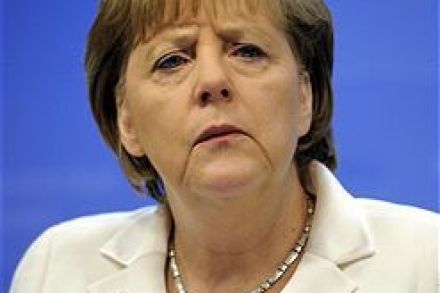
Angela merkel

Who speaks for the euro?

From our UK edition

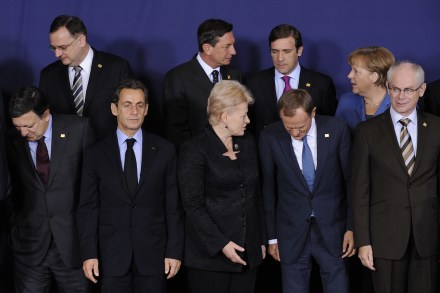
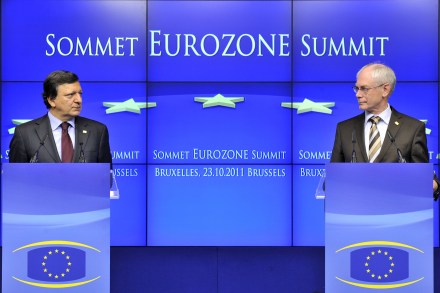
That's a more relevant question that you might think. Despite European leaders talking for ages about the nonsensical notion of the EU 'speaking with one voice' after the Lisbon Treaty, the situation is much more confused today ever. No fewer than six people purport to speak officially for the Euro, while people actually tend to listen to two different leaders altogether. There is ECB chief Mario Draghi, but also Jose Manuel Barrosso, the Commission President; his colleague Oli Rehn, the Commissioner for Monetary Affairs; Jean-Claude Juncker, the head of the Eurogroup; Klaus Regling, head of the EFSF; and finally Herman Van Rompuy.
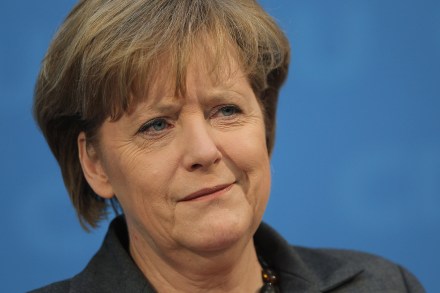
Angela we have heard on high

From our UK edition

As Italy and Greece implode, and the pressure increases for Germany to do something, anything, Angela Merkel has made a call for 'structural changes' in the EU. In other words, in what's bound to get eurosceptics' hackles up, she's pressing for Treaty change and an even more tightly-knit union. At a conference known as Falling Walls, which commemorates the end of the Berlin Wall, she said: 'This is the time for a breakthrough to a new Europe. This is a time for a change toward more sustainability. That is the problem we have to contend with in Europe. And that means it is about more than declarations of intent but rather implementing structural changes.

Cameron leaves Cannes with an IMF headache

From our UK edition

https://www.youtube.com/watch?v=Qm6yP-5RGK8 The Cannes summit leaves the world no further forward on its quest for some kind of solution to the Eurozone crisis. Strikingly, the Germans still won't agree — despite huge diplomatic pressure — to the ECB fulfilling the traditional emergency function of a central bank and acting as lender of last resort. This is a blow when you consider that Cameron thought there was a real possibility Merkel would budge on this after last week's European Council meeting. It also provides Cameron with a domestic political headache. For if the ECB won't act, the IMF will have to take more of the strain — and increasing Britain's contributions to the IMF in the current political climate is not going to be easy.

Reuters: Papandreou to resign on Friday

From our UK edition

Reuters is reporting tonight that the Greek Prime Minister has agreed to resign on Friday. The news agency says that at a meeting Cabinet colleagues told George Papandreou that he had to resign for the good of the Socialist party and he agreed. It quotes one source saying, "He agreed to step down. It was very civilised, with no acrimony." Now, after Thursday’s experience, I suspect we’re all taking reports about what will, or will not, happen in Greece with a pinch of salt. But it does seem that the referendum is off, stymied in part by Merkel and Sarkozy, who have ridden roughshod over the idea of non-interference in another nation’s affairs. That is, I suppose, par for the course for the European project.

Merkel and Sarkozy try to hold the euro together

From our UK edition

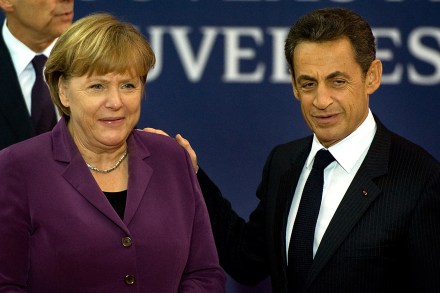
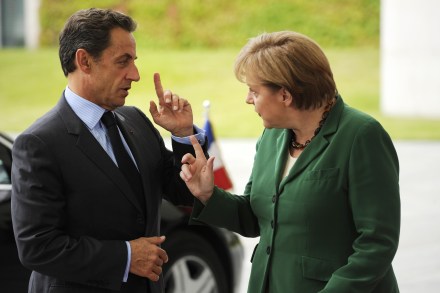
Right about now, Nicolas Sarkozy and Angela Merkel are having George Papandreou for dinner. There have been all sorts of rumours today about what Sarkozy and Merkel will demand from him. Thankfully, they seem to have abandoned plans to tell him to cancel the referendum. But they still seem keen to dictate the question and the timing to him. How that will go down with the Greek demos remains to be seen. One thing is clear, though: the euro is now destroying the whole European project. The European Union’s claim to be a force for peace, stability and democracy in Europe is rapidly disappearing into the Athens smog. The wholesale sacking of senior Greek military officers shows that there are real fears in Athens of a military coup.

Summit for nothing?

From our UK edition

The punchline to yesterday's eurosummit comes in the very first paragraph of the official statement, released in the darkness of morning: "The euro continues to rest on solid fundamentals." Now that you've brushed away the tears from that one, what was it that was actually agreed upon in the end? The main measure is effectively a fiscal target for Greece: its national debt, expected to peak at around 180 per cent of GDP in 2013, will come down to 120 per cent by 2020. And this will be achieved by cutting the value of bonds held by private investors in half, alongside further waves of privitisation and Greek frugality. Brussels will strengthen its "monitoring capacity on the ground," to ensure that Athens abides by these strictures.

The Euro masquerade

From our UK edition

So much rot has been said about the Eurozone crisis that you do wonder whether Merkel, Sarkozy et al have come to believe their own spiel. This is an economic problem and it can’t be solved by political will. Greece is bust and several French, German and Dutch banks were stupid enough to lend €130 billion to the Greek government that they're not going to get back. All the summits in the world cannot change this simple fact. These crisis talks are about bailouts for banks, not bail outs for Greeks. BNP Paribas is in for €37bn. Commerzbank of Germany is owed €15bn. And if Greece defaults, then insurance claims are triggered.

Clegg: Let’s stick together

From our UK edition

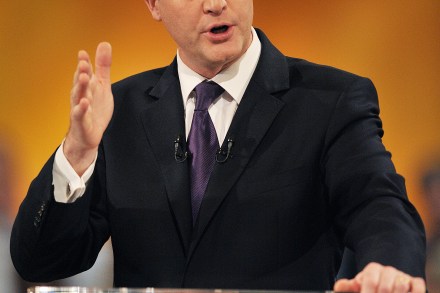
All eyes are on Berlin, where Angela Merkel is trying to convince her supporters in the Bundestag to vote through the expansion of the EFSF. She is expected to succeed, thanks to the votes of the social democrat opposition, which may prove to be the final nail in her political coffin. Markets in Paris and Frankfurt have made cautious gains so far  in expectation of Merkel winning the vote. Elsewhere, Nick Clegg will give a speech in Warsaw about the future of the Eurozone and the European Union. His speech has been trailed in the Guardian. He will say:  'We cannot accept arrangements that would privilege the eurozone as a decision-making body over the European council.

Italy in the firing line

From our UK edition

Markets sank into negative territory this morning, following Standand&Poor’s downgrade of Italy’s credit rating. (Although they have since recovered.) The agency cut Italy’s rating from A+/A-1+ to A/A-1; it also kept its outlook as negative. The agency’s reasoning is hardly surprising: growth is negligible, debt is unsustainable and Silvio Berlusconi’s inert government appears incapable of arresting the crisis. Frail economics and supine politics, those twinned threats to prosperity, have struck again. The implications to the Eurozone, and the world economy, are obvious. An economist in Nomura’s Sydney office told Reuters, “It only adds to the contagion risk over Greece and has encouraged the flight to safety in markets here.

The deep Euro-crisis threatens political stability

From our UK edition

It is hard to overstate how serious the crisis in the eurozone is or what it might do to the politics of Europe. The European project is putting in danger the very political stability in Europe that its supporters have always claimed to be its strategic and moral justification. I understand that American banks are now so nervous about the situation on the continent that they have effectively stopped new lending to European banks. The view in Westminster today is that the Greeks will avoid default for a little longer. But few can see them making it to Christmas. Indeed, the expectation seems to be a default sometime in October.

Merkel & Sarkozy have only words

From our UK edition

It was something of a mystery. Emergency conference calls about the future of the Eurozone were being made yesterday, but there was no news of those discussions. As it turned out, this was for the best of all possible reasons: there was no news to report. Angela Merkel and Nicolas Sarkozy announced no new measures to alleviate the sovereign debt crisis; rather, they merely declared “solidarity” with Greece and assured the markets that Greece would not be forced from the single currency. Their words seem to have assuaged the markets for the moment, but only the most brazen optimist would bet on the rally being long lived.

The Euro-crisis heats up

From our UK edition

Angela Merkel, Nicolas Sarkozy and George Papandreou are in crisis talks about Greek debt. There are rumours that they are preparing an "orderly default" for Greece. But, officially, Merkel is still pressing ahead with implementing the existing Greek debt deals. This meeting also has a domestic context for Merkel. According to the FT, she is determined to stamp on the growing disquiet within her governing coalition over the Eurozone crisis and is pleading for calm resolve. It remains to be seen if she succeeds.  The danger of contagion within the Eurozone remains and concerns about the exposure of French banks persist, which is doubly worrying for Nicolas Sarkozy given the proximity of French banks to the French state.

Merkel’s hard game

From our UK edition

As James noted earlier, Angela Merkel’s response to the Eurozone crisis is hampered by the awkward arithmetic in the Bundestag. Merkel has been faced with these difficulties throughout the crisis. Her answer has been to oppose initial proposals to solve the Eurozone crisis, only to relent later in the day. This has been the pattern from the first Greek bailout to the expansion of the EFSF, which is currently before the Bundestag. Might her apparently determined opposition to Eurobonds (which, of course, would require a huge transfer of power and cash from Berlin to the Med and Brussels) go the same way? Wolfgang Münchau has a comprehensive piece on the subject in today’s FT.

Merkel’s domestic difficulties threaten the Eurozone

From our UK edition

As August draws to a close, Europe is bracing itself for a series of September sovereign debt crises. Events in Germany at the moment have the potential to make these crises into events that could break the back of the Eurozone. As Ambrose Evans-Pritchard reports, Chancellor Merkel might not have the votes to push the European Financial Stability Facility through the German parliament. Merkel is currently under attack from all angles in Germany. Helmut Kohl has criticised her foreign policy, while the German president has implied that she should not have let the European Central Bank buy up so many poor quality bonds. It is now possible to see her coalition collapsing at some point in the near future.

Further tension in the Eurozone

From our UK edition

The Eurozone’s political crisis is deepening. Further to the news that individual member states were seeking their own bilateral deals with Greece to insure their taxpayers’ money from default, the FT reports that disagreements are emerging over how these deals should be conducted. Holland objects that Finland’s accord with Athens relies on Greece using EU bailout funds as collateral. “The Netherlands is no supporter of this proposal,” Jan Kees de Jager, the Dutch finance minister, said. “It is not compatible with the principle of equal treatment of all euro countries.

Stumbling towards fiscal union

From our UK edition

Angela Merkel must tire of repeating herself. Eurobonds are “exactly the wrong answer” to the European debt crisis, she said yesterday for the umpteenth time. She added that they would “lead us to a debt union not a stability union”, a free-for-all funded by German taxpayers. She concluded that “greater commitment” from the 27 member states of the European Union was required to stabilise the situation. Her comments would have, perhaps, placated her mutinous coalition in Germany, which is virulently opposed to Eurobonds and expensive integration.

Tobin’s folly

From our UK edition

The Eurozone Tobin tax announced on Tuesday by Merkel and Sarkozy is intended to reduce market volatility. It could have the opposite effect, and, if introduced in Britain, could cripple Britain’s financial sector, a new report by the Adam Smith Institute says. Based on the example of the “pure” Tobin tax that was implemented in Sweden in the 1980s and a large number of studies looking at equity and foreign exchange markets, a clear relationship was revealed between increasing transaction costs and higher levels of volatility. Transaction volumes also decrease as business is driven to lower tax regimes. When Sweden introduced a levy of 0.

This isn’t just any solution; this is an M&S solution

From our UK edition

Banks and financial institutions endured a painful day’s trading, following Angela Merkel and Nicolas Sarkozy’s announcement yesterday that the Eurozone should adopt a ‘Tobin tax’, a charge on financial transactions. Once again, M&S chose piecemeal changes over the grand structural scheme desired by markets. The Tobin tax was just one proposal of three. The other two were: to create “genuine economic governance of the Eurozone” under, for the moment, EU President Herbert van Rompuy. The second: to impose a ‘Golden Rule’ on the budgets of Eurozone members. The ‘Golden Rule’ will bind national parliaments to agree to limits on national debt levels and impose statutory requirements on mastering budget deficits.

Battle of the century

From our UK edition

The American historian Walter Russell-Mead has a cynical — but very possibly accurate — take on what the French are trying to persuade the Germans to accept with their plan for Eurobonds: 'France’s clear short term goal is to commit Germany to underwrite debts from weak EU states.  That not only staves off a crisis that threatens to engulf France; by putting Germany on as a co-signer for Greek, Italian and Spanish loans, France will ensure that Germany’s credit rating will not be better than France’s. The French will accept almost any German rules to limit the ability of countries like Greece to run up new debts.

Back to the drawing board as Eurobonds look dead in the water

From our UK edition

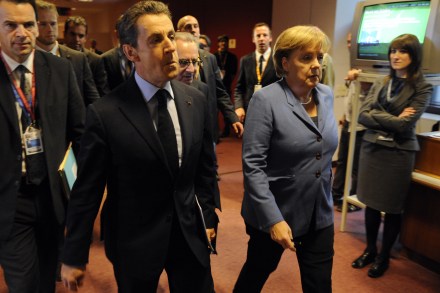
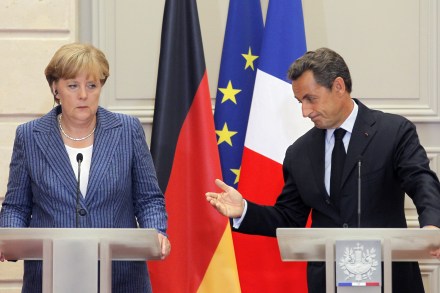
Watch her lips: no Eurobonds. Angela Merkel’s Finance, Minister Wolfgang Schauble has told Der Spiegel: "I rule out Eurobonds for as long as member states conduct their own financial policies and we need different rates of interest in order that there are possible incentives and sanctions to enforce fiscal solidity.” Merkel’s government is making its depositions ahead of tomorrow’s Eurozone summit, rebutting the moves made by other member states over the weekend to introduce Eurobonds, a step towards political integration. Those proposals were backed by Nicolas Sarkozy, with whom Merkel is meeting in private this afternoon.