Ancient greek

A brief history of parties

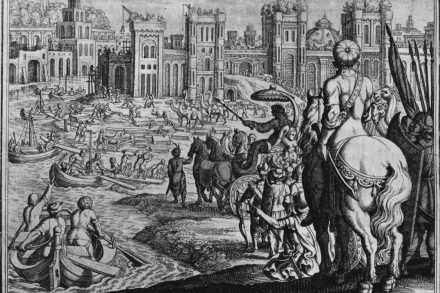
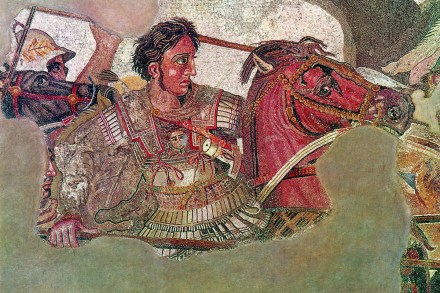
As Enoch Powell pointed out, “all political careers end in failure.” More often than not, those failures are self-inflicted. Without Partygate, for example, Boris Johnson might still be Britain’s prime minister. Although the debacle may not have been the final nail in his professional coffin, it certainly arranged the wake. His fans and critics alike were infuriated by the idea of public servants living it up while the rest of the nation was locked down during Covid in May 2020. That sort of scandal, however, is nothing new — anger at Partygate is nothing to some earlier episodes in history. Alexander the Great was an Olympian boozer who habitually went on weeklong binges after subjugating his enemies.

history

The Roman roots of ‘colony’

The word “colony” meets with a sharp intake of breath these days, but “province” raises no eyebrows. How very odd. The ancient Greeks invented the western notion of the colony. But “colony” is the term the Romans applied to it and is of Latin derivation, from colo, “I cultivate, inhabit” and so colonia. The ancient Greek term was apoikia, literally “a home apart, away”, or perhaps a “home from home.” Greeks established these apoikiai widely around the Mediterranean, mainly from the 8th to 6th centuries BC, clustering along the coasts of Turkey, northern Greece, all around the Black Sea, southern Italy, the eastern Adriatic, Sicily, parts of southern France and Spain, and Cyrene, as Plato said, “like frogs around a pond.

colony

Chroma chameleon

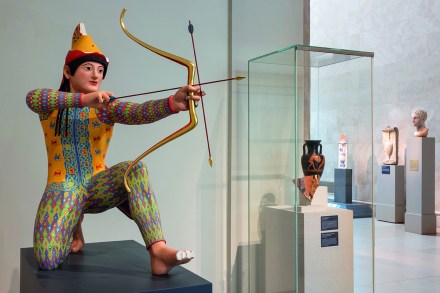
"Who knew the Greeks had such bad taste?” This comment was overheard at the preview for Chroma: Ancient Sculpture in Color, a head-turning exhibition at the Metropolitan Museum of Art. This slight wasn’t targeted at the current denizens of Greece, but, rather, their ancestors of yore. You remember the type: chiton-clad Athenians — let’s not forget the ladies in their peploi! — sauntering through the agora, pondering the nature of reality or, perhaps, the role of hoi polloi within a democratic society. They’re the folks whose aesthetic sensibilities were found wanting, at least to one denizen of twenty-first-century museum culture. What most of us know about life in antiquity is, I dare say, as broadly conceived as the above description.

chroma

In defense of Joshua Katz

Last July 17, my daughter, Solveig Gold, married (then) Princeton professor Joshua Katz. It was a glorious, indeed transcendent (as one friend put it) celebration of the glory of God and the power of love — attended by a large gathering of the canceled, the not-yet-canceled and a lucky few who are seemingly uncancellable. Last month, as the world now knows, he was fired. If you haven’t yet read Solveig’s piece in Bari Weiss’s Substack, put mine aside and read hers first. It is beautiful and inspiring. Mine, by contrast, is merely mad as hell. In July 2020, Joshua published a piece in Quillette taking vigorous exception to the now infamous July 4 “Princeton faculty letter.

joshua katz

Let’s hear it for horiatiki

Time to send your kitchen knives out for sharpening. The hot weather is coming, and you know what that means: Greek salad, or horiatiki as the Greeks call it. Is there any pleasure in life quite like dicing tomatoes, cucumbers and peppers with a knife that balances properly in the palm, whose blade possesses just the right steely flex and strength, and — above all — that is properly sharpened? With the right edged tool, it is hard to stop cutting things up for Greek salad. With the right ingredients, it is hard to stop eating it. This is why Greek salad is the perfect dish to make for a dinner party. As your friends buzz about the kitchen, drinks in hand, you can chop away on autopilot, chatting merrily as your cutting board fills with heaped tomato chunks.

greek horiatiki
athenaeus

The learned drinkers

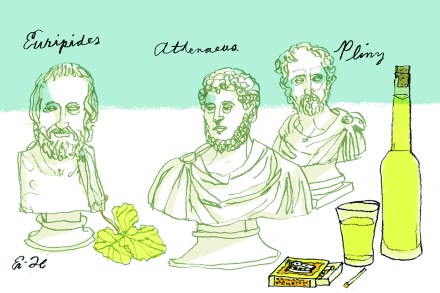
Some of my readers may be unfamiliar with Athenaeus of Naucratis, a shadowy Egyptian-born Greek who floruit somewhere in the Roman Empire during the reigns of Marcus Aurelius, Commodus and Septimius Severus, i.e., around 200 AD. Athenaeus was a rhetorician, grammarian and epicure. But he is known to posterity primarily as the author of The Learned Banqueters (Δειπνοσοφισταὶ), a sprawling, miscellaneous work that touches on, well, just about everything: food, philosophy, fermentation, fabulation and many other subjects, not all of which begin with the phoneme “f.” Henry James called the three-volume Victorian novel a “loose baggy monster.” None was so loose or so baggy as Athenaeus’ compendium. There is a bit of Petronius’s Satyricon (c.

Was Penelope really a ‘silenced’ woman?

Problems about the misuse of history, especially on subjects such as race and colonialism, have been running for a long time. But when it comes to the ancient world, there are also problems about the misuse of literature. Dame Mary Beard’s “manifesto” Women and Power (2018) contains an example of the problem. Her thesis is that women’s voices in the public sphere (my emphasis) have been “silenced” by men ever since the West’s first literature (Homer’s Iliad and Odyssey) gave us our first access to “Western” thoughts, deeds, beliefs, hopes and fears (c. 700 BC). The problem exists in the first example of her thesis, to which she returns four times — Penelope, the wife of Odysseus.

Penelope

Going Greco-Roman in Boston

In a way it felt like a walk around campus on graduation day: one last stroll through the Museum of Fine Arts, Boston before the mayor’s medically nonsensical, legally dubious, morally atrocious mandates force museums, restaurants, gyms and more to oblige entrants to prove that they’re vaccinated against Covid-19. I could comply, but I will not. “There’s nothing more American than coming together to ensure we’re taking care of each other,” said our unctuous new mayor in her typical passive-aggressive fashion. Perhaps, but there’s nothing less American than commanding such sentiments from City Hall and punishing us who see through the ruses of power. The commencement, then, was that of a new relationship between your reporter and his adopted city’s art holdings.

Boston

Travels with Herodotus

I am part of an informal reading group with a few friends and colleagues. At the moment, we are reading Herodotus’s Histories (or “Inquiries,” as he might have said had he been writing in English). It’s lots of fun, in part because it is also an excuse to conduct a little wine appreciation class, but also because that old denizen of Halicarnassus — Herodotus lived from around 484 to 425 bc — was possessed of such high-octane and companionable curiosity about the world: what happened when and to whom and with what result. He wanted to know; moreover, he wanted you to know. Herodotus is most famously a major source of our knowledge of the Persian Wars and such signal moments as the Battle of Marathon (490 bc), Thermopylae (480) and Salamis (also 480).

Herodotus

All Greek to us

We are traveling through a shower of Greek anniversaries, triumphant and calamitous. Last year marked the 25th centenary of the Battle of Salamis in 480 BC, when 300 Greek warships defeated a Persian armada four times larger and ended the Persian empire’s expansion into Europe. This year marks the bicentenary of the beginning of the Greek War of Independence from the Ottoman empire in 1821, which resulted in the first European nation-state to be founded on the Enlightenment values of the American Constitution. Next year will mark the centenary of Greece’s defeat in Asia Minor in 1922, which ended the modern Greek state’s aspirations to absorb all the lands where Greeks lived and had lived since antiquity, an event still referred to as ‘the catastrophe’.

greek

The new McCarthyism

Are you now or have you ever been a supporter of Donald Trump? I am wondering when we are going to have Congressional Committees grilling people about such matters. I suppose they could, in homage to a certain senator from Wisconsin, be called the House and Senate American Activities Committee. Nancy and Chuck should preside. They could share some of that expensive chocolate ice cream that the always well-coifed Nancy likes as they root out people who say things they don’t like and vote for people with whom they disagree. I’m sure they would get a lot of academic support. Just a week or so back, one professor suggested that criticizing St Anthony Fauci or other government officials should be a federal hate crime. Why not?

mccarthyism

Classics takes the Red Pill

There was a time Classicists feared their subject was endangered because not enough people were taking it up. That fear has now been supplanted by anxieties over its manipulation by far-right groups and individuals with insalubrious intentions, like the white supremacist organization that employs images of the Roman gods and heroes to encourage its followers to ‘protect your heritage’. And this is just the tip of the Zuckerberg. In Not All Dead White Men, Donna Zuckerberg examines the abuse of Classics by by those who, in the political equivalent of the perceptual choice in The Matrix, have taken the ‘Red Pill’. Zuckerberg defines Red Pillers as ‘a group of men connected by common resentments against women, immigrants, people of color, and the liberal elite’.

ovid classics