American foreign policy

The Democrats need a new rulebook

Donald Trump’s triumphal return to the White House is the end of more than just the Joe Biden era. Since Bill Clinton’s presidency, Democrats had adhered to a formula they thought unbeatable: They would be socially progressive, economically centrist and staunchly internationalist. Republicans, they thought, had staked their future on demographics that were in decline — whites and the most conservative Christians. Democrats were the party of twenty-first-century America, an ethnically diverse and more secular, or at least religiously liberal, land. What went wrong? When Trump won in 2016, Democrats dismissed it as a fluke.

Democrats

Trump is already the diplomat-in-chief

The United States only has one president at a time. Until January 20, that’s Joe Biden. But President-elect Donald Trump and his skeleton foreign policy team are waiting in the wings, plotting policy behind the scenes on issues — Ukraine, Gaza, Iran, Middle East peace — that have stymied the Biden administration for the last year. In fact, Trump is already influencing the respective calculations of allies, partners and adversaries before he even steps foot in the Oval Office. And Biden’s advisors seem perfectly fine with it. Trump fancies himself as a master negotiator, somebody who’s inherently skilled at poking, pressuring and sweet-talking the opposite side of the table until he gets what he wants.

diplomat

Would a Secretary Marco Rubio implement Trump’s policies?

What on earth is Donald Trump thinking? That’s what many realists and restrainers inside and out of Washington are asking themselves after news broke late last night that Marco Rubio, the senior senator from Florida, is set to be tapped as secretary of state in the next administration.  The reactions haven’t been uniformly bad, mind you. Other candidates rumored to be under consideration, such as Vivek Ramaswamy, caused many in the US foreign policy elite to wretch in fear. Others, like former national security advisor Robert O’Brien and Senator Bill Hagerty, who served as US ambassador to Japan during Trump’s first term, would have been predictable choices with whom most could live.  Rubio, however, is one of the most hawkish options Trump could have picked.

rubio
Kyiv

Why Biden should let Ukraine strike Russian targets during the lame-duck period

On the back of President Trump’s victory November 5, the end of the election season will open an interesting eleven-week window. President Biden will assume lame-duck status and be freed from any concern that a more aggressive posture toward Russia might hurt Kamala Harris’s presidential campaign. Biden might also be considering the implication of handing over Ukraine policy to an individual who has repeatedly signaled his pro-Putin views. Both of these factors argue for Biden breaking from his self-imposed restrictions and supporting Ukraine striking targets in Russian territory during this lame-duck period. Imagine a moderately successful Ukraine attack now, after the November 5 election, on a moderately relevant target, such as a railroad terminal fifty miles inside of Russia.

What comes after Trump’s decisive victory?

The candidate who said Americans should be “unburdened by what has been” is now a has-been. The irony will be lost on her.  Also lost was the traditional graciousness — and normative necessity — of conceding defeat clearly and publicly as soon as the loss is certain. When Donald Trump failed to take that step in 2020, after exhausting his court challenges, he violated that norm and deepened our national divisions. He deepened that chasm on January 6 and later by continuing to challenge the rightful winner. Those challenges threaten the peaceful transfer of power and undermine the public consensus that the winner holds office legitimately.  Kamala Harris learned from Trump’s mistake and repeated it.

donald trump victory

‘Blood! Blood! Blood!’: the Battle of Fallujah twenty years on

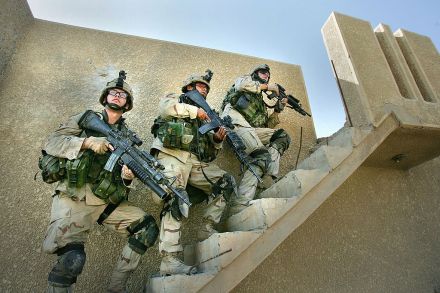
The National Museum of the Marine Corps has built a replica of a street in Fallujah, the Iraqi city that American forces half-destroyed in order to save it, in a battle twenty years ago next month. The exhibit promises visitors an “interactive experience that puts them in the boots of a Marine as he kicks down the door of a suspected insurgent stronghold.” If you have a games console, you can play Six Days in Fallujah, a video game where you take the role of a Marine who narrates the action of a firefight that really happened. Fallujah has become a symbol of gritty heroism and sacrifice — or for critics of the Iraq war, occupation and war crimes. Either way, the battle is deeply lodged in the popular imagination.

Fallujah

The US should stop raising false hope of an Israel-Hamas ceasefire

The months-long ceasefire and hostage release negotiations between Israel and Hamas have been the diplomatic equivalent of Groundhog Day. And the US officials tasked with bringing those talks across the finish-line have contributed mightily to the very bad, never-ending movie we (not to mention the hostages’ families and the more than 2 million Palestinians in Gaza) have watched since President Biden rolled out his ceasefire plan in late May. In the months since, Washington has committed verbal blunder after verbal blunder by getting over its skis and proclaiming progress where no progress exists.

ceasefire

The US is unwise to lift restrictions on the sale of bombs to Saudi Arabia

To the extent Joe Biden had anything to say about Saudi Arabia during the 2020 presidential campaign, it largely centered on shaming the oil-rich monarchy into changing its ways. Coming off the 2018 state-sponsored murder of Washington Post columnist and former royal court insider Jamal Khashoggi in a Turkish consulate, Biden aired numerous complaints about Saudi crown prince Mohammed bin Salman. He pledged to make the kingdom a pariah state during a Democratic presidential debate, accused the Saudi air force of killing children in Yemen — it wasn’t as much an accusation as a fact — and committed himself to reassessing US arms sales to Riyadh. The Saudis didn’t like what they saw during the Biden administration’s opening months.

saudi

Will the US apply pressure to combat Maduro’s election fraud?

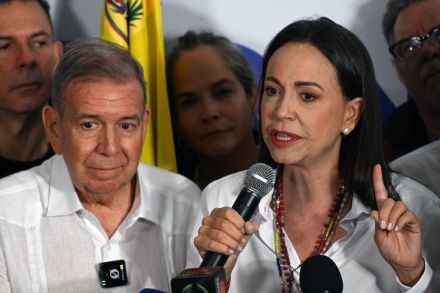
Sunday night was a long one in Venezuela. At midnight, the much anticipated yet dubious results came in for the South American country's election. The head of the National Electoral Council, Elvis Amoroso — a close ally of Venezuelan president Nicolás Maduro who has served as a deputy for his party — said that with 80 percent of ballots counted, Maduro had won with 51 percent of the vote. His rival, Maria Corina Machado’s replacement, Edmundo González, ended with 44 percent. The opposition has a different story. “Venezuela has a new president and his name is Edmundo González Urrutia. We won! And everyone knows it,” Machado said from a press conference following some silence after Maduro’s announced win.

maduro fraud

A superbly written and insightful account of the contemporary American military

Four-star Marine General Kenneth “Frank” McKenzie headed US Central Command — CENTCOM, covering the Middle East — from spring 2019 until spring 2022. It was an eventful, and stressful, three years: taking out long-time Islamic State head Abu Bakr al-Baghdadi in 2019, then notorious Iranian Quds Force commander Qasem Soleimani in early 2020 and overseeing the disastrous final withdrawal from Afghanistan in 2021. Prior to CENTCOM, McKenzie had spent four years in two top-level Joint Chiefs staff posts, and before that he served multiple tours of duty on the ground in Afghanistan. As a younger officer he had been in the Pentagon on September 11, 2001, when American Airlines Flight 77 hit; he was commissioned in the Marine Corps right out of the Citadel in 1979.

McKenzie

Seized Russian assets should be used against Putin

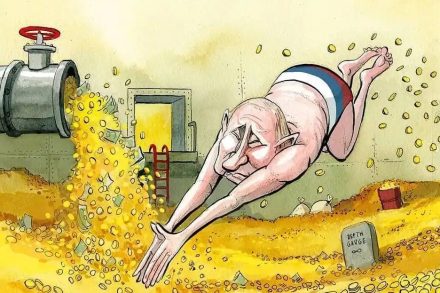
The seizure of enemy treasure, formerly known as plunder and pillage, is an ancient tool of war. Though still practiced in the world’s nastiest conflict zones, it’s a tricky business within a rules-based international order. The G7’s agreement to lend $50 billion to Ukraine — using income from $300 billion of frozen Russian assets to cover interest and repayments on the loan — is a vivid case in point. And some would say, a lily-livered half-measure. The key feature of the deal is that it does not actually claim ownership of Russian loot — which however ill-gotten is mostly held in EU banks in the form of western government bonds. It merely diverts interest payments due on the bonds from the issuing governments.

Russian
nato

Inside the debate over Ukraine joining NATO

NATO’s summit in Washington, DC will be full of pomp and circumstance. The gathering, from July 9-11, is intended in part to celebrate the Alliance’s seventy-fifth anniversary, a symbolic and emotional event for the leaders in attendance. You can expect the red carpet to cover the entire city. Dozens of speeches will be given about how NATO is the oldest and most successful military alliance in history and why the bloc remains a crucial check on Russian expansionism. Some will even claim matter-of-factly that NATO enlargement over the last twenty-five years — NATO has doubled its membership during that period of time — was sound policy and had nothing to do with Russia’s decision-making calculus on Ukraine.

Antony Blinken embodies decades of failure

There is no sign marking the entrance to Barman Dictat. The bar under 44 Khreshchatyk Street in Kyiv boasts the largest mezcal collection in Eastern Europe. On a typical night you can find it by noting the crowd of people wafting cigarette smoke into the evening air. Inside, you’ll find shelves of more than 400 glowing bottles perched above a steel bar stretching more than thirty feet. You’ll find bespoke cocktails — Kraken, Smoky Voice and Tickle Balls. And, on one particular May evening, you’ll find the seventy-first secretary of state of the United States of America at center stage. Clad in black and wielding a scarlet electric guitar, Antony Blinken seemed less enthused about the moment than his staff had perhaps anticipated.

Blinken
war

What is war good for in the twenty-first century?

What exactly is war good for in the twenty-first century? The US should have asked itself this before embarking on decades of aimless occupation in Iraq and Afghanistan. Israel and Russia — very different countries, morally and otherwise — should be asking themselves today. The wars in Ukraine and Gaza both began with changes in an uncomfortable but previously stable status quo. Sometimes Westerners who try to imagine a peace deal for Ukraine invoke Finland’s strategic neutrality during the Cold War. But Ukraine was Finlandized for nearly twenty years after the fall of the Soviet Union, precariously balanced between Russia and the West but fully committed to neither. No one was entirely happy with that — yet there was peace from 1991 until 2014.

The Joe Biden Shuffle defines the G7

Things are always worse than they seem. That adage may seem amusingly cynical, but that is only because it is of what Kant called “the crooked timber of humanity.” Often, as we all know, things are better than they seem. But then there are mournful spectacles like the Group of 7+, which just met in Italy.   The plus sign is for Ursula von der Leyen who, as president of the European Commission, gets to tag along like a poodle, a superfluous though preening and self-important mascot for the increasingly superfluous and self-important OnlyFans forum representing Canada, France, Germany, Italy, Japan, the United Kingdom and the United States.

g7

‘Trumpists and Communists’ on Ukrainian NGO list fight back

A US government-affiliated Ukrainian NGO, texty.org.ua, published a list last week of all the Americans “impeding aid to Ukraine.” There are 388 individuals and seventy-six organizations on the list, including members of the conservative media Alex Jones, Tucker Carlson, members of Congress and a few Spectator writers. The piece is titled “Rollercoaster: From Trumpists to Communists. The forces in the US impeding aid to Ukraine and how they do it.” “The title of this article oversells the product: it is a substantively thin piece, largely an excuse to smear a large group of Americans who have been skeptical of aid to Ukraine in one form or another,” Senator J.D. Vance and Representative Matt Gaetz wrote in a letter to secretary of state Antony Blinken on Tuesday.

ukraine ngo

Joe Biden’s TIME interview: the good the bad and the ugly

President Joe Biden sat down for an interview with TIME magazine in the White House last week. The questions centered around foreign affairs, with interviewers Massimo Calabresi and Sam Jacobs asking about D-Day, Ukraine, Israel and Hamas, nuclear power, China, inflation, tariffs and immigration. Back in March Americans generally agreed that the economy and foreign affairs were weak points in Biden’s administration. The TIME interview is unlikely to change anyone’s mind. Cockburn identified a few overarching themes: Biden accused TIME of misreporting and leaving his accomplishments unreported. The first accusation: “The Russian military has been decimated. You don’t write about that. It’s been freaking decimated.” Another theme: senility.

joe biden time magazine

Is Venezuela preparing for war?

Earlier this month, two American supersonic fighter jets flew over Georgetown, the capital city of Guyana. The US show of force is not only for the attention of Venezuela’s socialist regime who has been escalating toward a military conflict with its smaller neighbor since at least September 2023 when Nicolás Maduro returned from Beijing. The message of sending two F/A-18 Super Hornets flying from a nuclear-powered aircraft carrier sailing in the Caribbean Sea is also for the Islamic Republic of Iran. At first glance, the Venezuela-Guyana conflict is about a century-old border dispute of a dense territory called the Esequibo that makes up two-thirds of Guyana’s land mass but only 15 percent of its population.

nicolas maduro venezuela

Who actually gets hurt by sanctioning Russia?

The US crackdown on trade finance for Russia from international banks — designed to impede imports needed for the continuing assault on Ukraine — is biting hard, reports the FT, quoting an investor who thinks “the logical endpoint of this is turning Russia into Iran.” Quite right too: sanctions like these are a vital non-military way to hobble Vladimir Putin’s campaign. But war and finance intersect in many different ways. Consider also the fate of 400 western-owned commercial aircraft that were leased to Russian airlines before the invasion in February 2022. Now stuck in Russia or its satellites, unmaintained to western standards and unfit to fly back into our airspace, they’re a potential multibillion loss for their owners and insurers.

Russia

Joe Biden’s failure is Bob Gates’s vindication

One of the most famous criticisms of Joe Biden over the years came from former Bush and Obama secretary of defense Robert Gates, who wrote in his 2014 memoir that "I think [Joe Biden] has been wrong on nearly every major foreign policy and national security issue over the past four decades.” The former SecDef has repeatedly been asked if he stands by the statement — and each time, he does. Of course, we're a decade removed from that memoir — and in that time, Gates has openly criticized Biden over the botched Afghanistan withdrawal, his administration's approach to Putin and Russia and the slow walking of military aid to Ukraine. So it seems it's safe to say we're at five decades now. https://www.youtube.com/watch?

robert gates