Africa

Rwanda’s new tragedy

Never lighthearted, my African political exile friend sounded particularly lugubrious on the line from Washington. His voice was low and pensive. For the past few months, he said, he’d been hearing of plans hatched by the regime back home for his assassination. ‘They are very gruesome, very gruesome indeed.’ It was not the first time. In the past he’d always passed the details on to the FBI, which had also called him up several times when they thought he was in danger. This time he hadn’t bothered. ‘I always ask them: ‘What are you doing to protect me?’ and they say, ‘Well, if you see anything suspicious, call 911.’ I’ve

The James Herriot of Africa

Great Rift Valley The mare hangs her head; her neck is swollen, her eyes bloody red, crammed by flies. She has horse sickness, a mainly tropical disease transmitted by midges. ‘All OK?’ asks the stud manager. ‘Not at all,’ says Hugh Cran. ‘Horse sickness is very serious, with a high mortality. We shall have to see.’ The manager looks worried, but at least he was able to call out Hugh, who for nearly 50 years has been a farm and family vet in Kenya’s Rift Valley. A dog disembowelled by hippo tusks, snakebite, big wild beasts, sick camels, exotic tropical plagues, mad upcountry ranchers, the perils of the equatorial road.

Pope Francis condemns Catholic ‘fundamentalists’ and hints at support for use of condoms against Aids

Pope Francis has used another mid-flight press conference to make a statement of significance to millions of Catholics. Asked if the Church should drop its opposition to the use of condoms to stop the spread of Aids (a teaching already modified by Benedict XVI), he effectively declared that the debate was a waste of time. He referred to Jesus’s practice – opposed by the Pharisees on legalistic grounds – of healing on the Sabbath. ‘Healing is obligatory!’ he said. Earlier in the interview, the Pope took aim at Catholic ‘fundamentalists’ whose attachment to rules was ‘idolatrous’. Here’s a transcript from RomeReports: Question: Aids is a serious problem in Africa, the epidemic continues. We know that prevention is

Letters | 5 November 2015

The power of creativity Sir: A rounded education should encourage creativity as well as maths, English, science and history if Britain is to compete in the modern world. Toby Young’s claim that the arts world is exaggerating the decline of arts in secondary schools therefore deserves to be challenged (Status anxiety, 24 October). In spite of his confidence, teachers do think that there is a problem. They fear that the focus on ‘core’ subjects means they shouldn’t offer arts subjects. Students worry that studying the arts will damage an academic profile. But encouraging creativity makes people more adaptable, and helps prepare them for the uncertainties of life. The new head

The Australian example

For many years, Australia has been turning away boats filled with migrants. From a remove, this looks cold–hearted — a nation built by immigrants showing no compassion for others who want a better life. But it is precisely because Australia is an immigrant nation that it understands the situation: if you let the boats land, more people come. People traffickers will be encouraged, migrants will be swindled, and their bodies will wash up on your shores. Any country serious about immigration needs a more effective and robust approach. Tony Abbott, the former Prime Minister of Australia, made that point clearly this week on a trip to London. Delivering the Margaret

The polyphonous Babel of global music

‘Following custom, when the Siamese conquered the Khmer they carried off much of the population, including most of their musicians, to be resettled in what is now Thailand.’ The history of music isn’t a story of chords and scores, instruments or their players. Music’s story is one of wars, invasions and revolutions, religion, monarchy and nationhood. Whether you look at the histories of Africa or Iran, Europe or Uzbekistan, the narratives are the same: colourful, bloody, complicated. Music is not an aesthetic response, an artistic translation of life; music and musicians are society itself. It’s a principle that acts as the guiding thread through the labyrinth of traditions and terminologies

Letters | 10 September 2015

Biblical suggestions Sir: I wish to offer a couple of comments on Matthew Parris’s observation that although his ‘Christian atheism’ provides him with a moral framework, he feels the urge to help people in need, yet feels let down because Jesus offers no guidance about who to help and to what degree (‘Christianity is silent on my great moral dilemma’, 5 September). Jesus wants us to use our minds and our experiences, rather than simply applying set rules, and here is an example of how this works. Take the golden rule of ‘Do unto others’, add to it the Good Samaritan, and stir in the parable of the sheep and

First-rate firsts

It has become something of a truism among writers’ groups and in articles offering advice on how best to secure the services of an agent or publisher that the opening of a novel is everything — the ne plus ultra of the writer’s armoury. If one can knock the reader’s socks off with the first few lines one is almost there. So I’ve decided to conduct an experiment. Before reading any of these four first novels to the end, I shall compare and mark their opening couple of pages. First in line (and chosen entirely at random) is Michela Wrong’s Borderlines. Miss Wrong (you’ll find no silly jokes from me

Just giving

Seven years ago I wrote here about a site called Kiva.org. I had met the co-founder of this charity when she came to Oxford in 2007 and was intrigued by her idea. Jennifer Jackley had been inspired to start the site by Muhammad Yunus’s work on microlending — the practice of issuing small loans to people in the developing world who would other-wise have no access to credit. At Kiva.org, rather than giving money, you lend it. You choose people and businesses, mostly in the poorest parts of the world, and advance them a fraction of the amount they want to borrow, typically $25. The loan is then paid back

Letters | 25 June 2015

Free trade with Africa Sir: Nicholas Farrell suggests that a naval blockade is the only solution to Italy’s immigration crisis (‘The invasion of Italy’, 20 June). Examining the causes of the situation might identify other measures. Since the European Union effectively closed its borders to trade with Africa to protect European farmers from lower food prices, the agricultural economies of most African countries have been in decline. Of course there is another reason for Africa’s decline. About 60 years ago, the Europeans found it convenient to convince themselves that in Africa self-government was better than good government. It followed that aid would be a convenient substitute for the risks or

The invasion of Italy

Let us suppose that along the coast of Normandy up to one million non-EU migrants are waiting to be packed like sardines in small unseaworthy vessels and to cross the English Channel. Let us suppose that first the Royal Navy, then the navies of a dozen other EU countries, start to search for all such vessels in the Channel right up to the French coast, out into the North Sea and the Atlantic even, and then ferry all the passengers on board to Dover, Folkestone, Hastings, Eastbourne and Brighton in a surreal modern-day never-ending version of the Dunkirk evacuation of 1940. Would the British government agree to take them all?

Wild life | 18 June 2015

Laikipia, Kenya   Out cross-country running on the farm in Kenya recently, I came face-to-face with a gang of bull elephants. I zigzagged away from them, keeping downwind, jogged on for a bit, then found myself following the tracks and fresh dung of a herd of buffalo. I paused my stopwatch, had a think then continued at a timid pace while looking around fearfully. The night before I had heard lion and hyena, so as I ran I imagined the yellow eyes that might be following the form of a 50-year-old man huffing, puffing and advancing at a stumble — easy prey, but chewy old meat. I studied the ground

Migrants face many dangers. Are we one of them?

A few weeks ago someone very dear to me passed on a question about The Spectator, asked them by a friend. The friend, who I know and like, had read Douglas Murray’s recent report from Lampedusa about the poor Med-faring migrants, and her question was this: ‘Is everyone at The Spectator a racist?’ Some insults brush past without leaving a mark, others pierce the skin and sink in. This one sunk like a splinter, and like a splinter I’ve been worrying away at it ever since, turning what was a small injury into a painful, bloody mess. I can dismiss the accusation easily enough — the Spectator office is multi-racial,

Celebrations of song and humanity

‘All my life, always and in every way, I shall have one objective: the good of Hungary and the Hungarian nation.’ Ask any musician for a one-sentence summary of Béla Bartók (1881–1945) and they will probably tell you that he is Hungary’s national composer — a musical modernist who passionately championed his nation’s folk music tradition. David Cooper’s new biography seeks both to enrich and complicate that statement, questioning the definition of musical ‘nationalism’ in a country of such pronounced ethnic heterogeneity, at a time when borders were being drawn and redrawn, peoples created and destroyed, across Europe. The portrait that emerges is of no mindless patriot, celebrating his nation

Football’s elite deserve the foulness of Fifa

My favourite moment in the crisis engulfing football’s governing body, Fifa, came with the intervention of a man called Manuel Nascimento Lopes. Manuel is the Fifa delegate from Guinea-Bissau, an African country which occupies 130th place in the Fifa world rankings but which, far more importantly in this context, punches well above its weight when it comes to institutionalised corruption. Thirteenth in the world, according to the organisation Transparency International — not a bad showing for a smallish sub-Saharan rathole which has been almost permanently engulfed in civil war since the Portuguese got the hell out. Manuel suggested that to vote against Sepp Blatter remaining as boss of Fifa would

Comics’ trip

Who says British television lacks imagination? You might have thought, for example, that every possible combination of comedian and travel programme had been exhausted long ago. After all, it’s now 26 years since Michael Palin set the trend by following in Phileas Fogg’s footsteps (sort of). In more recent times, we’ve had Stephen Fry going round America in a London taxi, Billy Connolly going round Australia on a Harley-Davidson trike and — perhaps drawing the short straw — Ade Edmondson going round Britain in a caravan. There’s also been Paul Merton in India, Sue Perkins in China, Sean Lock and Jon Richardson in the Deep South and… well, you get

Things fall apart in Denis Johnson’s latest novel of madness and anarchy in Sierra Leone

‘I’ve come back because I love the mess. Anarchy. Madness. Things falling apart.’ The lines belong to Roland Nair, one of the morally bankrupt spies who careers around Africa in Denis Johnson’s tenth novel, but they might equally well describe Johnson himself, a writer always happiest in his work when the wheels come off and the world breaks down. His novels vary in setting (Prohibition America in Train Dreams, the Vietnam war in Tree of Smoke, a future post-apocalypse in Fiskadoro) but they share a mixture of gravitas and derangement, sarcasm and lyricism, comic danger and dangerous comedy that makes them reliably fascinating — and reliably peculiar. You certainly wouldn’t

Alexandra’s Fuller’s parents are the stars even when their daughter is divorcing, in this sequel to the bestselling Don’t Let’s Go to the Dogs Tonight

‘Double ouzo, hold the Coke,’ Mum ordered at the Mkushi Country Club bar, during spanikopita night. ‘My daughter’s a lesbian.’ The Greek farmers blinked at her uncomprehendingly. ‘Oh, don’t pretend you don’t know what I’m talking about. You bloody people invented it.’ Alexandra Fuller’s wild parents make good copy, as was clear in Don’t Let’s Go to the Dogs Tonight, her bestselling 2002 memoir about her chaotic, often tragic, childhood in Zimbabwe (then Rhodesia). In this new book, purportedly about her divorce after a 20 year marriage to a ‘calm’ American she thought would be her protector — ‘plus, I was so in love’ — Fuller’s parents again, almost by

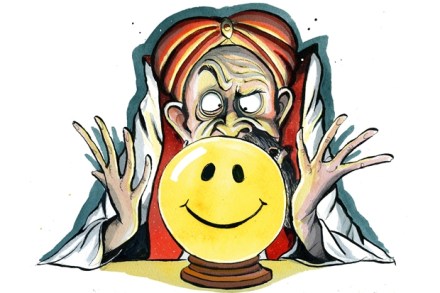
Having oozed optimism for a decade, I am a bit down about the Hopeful Continent

Juba I discovered a 1954 Morris Minor parked outside the Catholic mission station in Mopoi, South Sudan. The car had been there for so long that a guava tree was growing up through the gearbox. To me it was a tragic memorial to Daniel Comboni, the canonised 19th-century missionary who set out to ‘save Africa’ and whose followers built Mopoi. Just a year after that Morris Minor came off the production line, civil war erupted. Millions of deaths later, Mopoi was half-ruined, strangled by figs — though inside the church I found the votive candles still burning and the Blessed Virgin with a resigned expression, raising her hand as if

A walk through Fez is the closest thing to visiting ancient Rome

Fez is one of the seven medieval wonders of the world. An intact Islamic city defined by its circuit of battlemented walls, it is riven by alleyways. You pass doorways that look into a 10th-century mosque, then a workshop courtyard, before coming through a teeming covered market and twisting past the high walls of a reclusive garden palace. The aesthetic highlight of any visit will be the teaching colleges built in the 14th century by the Merenid Sultans, and nothing can quite prepare you for the colours and odours of the open-air tanneries or the drama of listening to the dusk call to prayer from the ruins of the Merenid