-
AAPL
213.43 (+0.29%)
-
BARC-LN
1205.7 (-1.46%)
-
NKE
94.05 (+0.39%)
-
CVX
152.67 (-1.00%)
-
CRM
230.27 (-2.34%)
-
INTC
30.5 (-0.87%)
-
DIS
100.16 (-0.67%)
-
DOW
55.79 (-0.82%)
Poll puts Tories on lowest seat total in history
How is the Conservative campaign going? Well, according to the latest YouGov poll, things are looking worse for Rishi Sunak and his party than when he called the election. The latest MRP poll from the pollster suggests that were an election held now, the Labour party would return 425 MPs, the Conservatives would come in second on 108 seats and the Liberal Democrats in third on 67 MPs.
What will make this particularly uncomfortable is that the figures are less favourable to the Tories than their poll two weeks ago – they are down 32 MPs from the last poll. Meanwhile, Labour are up two from that poll. The big winner, however, appears to be the Liberal Democrats who are now predicted to win a whopping 67 seats (including Michael Gove’s old seat of Surrey Heath), a significant improvement.
Yet the party that is having the biggest impact in terms of reducing the Tories chances appears to be the Reform party, predicted to win 15 per cent of the vote but electing just five MPs. The return of Nigel Farage has had a devastating effect on the Tory vote.
The Conservative campaign has not been helped by the D-Day debacle and a number of gaffes. Given the party is now in the second half of the campaign, it’s hard to see much changing between now and 4 July. Instead, the best hope for the Conservatives is that some voters are turned off the idea of a Labour supermajority.
Now Sunak will say that the only poll that matters is the one on 4 July. But it is worth pointing out that this is one of three MRP polls today – and they all suggest the Tories are on course for a historic defeat. Even ministers have started to say this out loud, with David TC Davies today telling the Sun’s Never Mind the Ballots: ‘I don’t know how large that will be, but I’m not stupid either. You cannot dismiss every single opinion poll.’ He goes on to say that ‘if the polls are even half right’ then ‘Keir Starmer will walk into Downing Street’. It means the rest of the campaign is likely to see the Tories warning of the dangers of Starmer having a big win rather than suggesting Sunak has any chance of mounting a surprise victory.
Sunak on course to lose seat, predicts poll
Good heavens. One of the many polls released today has suggested that Prime Minister Rishi Sunak could become the first sitting Prime Minister to lose their seat at a general election. The Savanta and Electoral Calculus poll for the Telegraph predicts that the Conservative party could be left with just 53 MPs – with the party leader not being one of them. Crikey.
The Telegraph’s MRP poll – which concluded the Tories are on course to face overwhelming defeat from a disillusioned electorate – surveyed approximately 18,000 people from 7-18 June. It concluded that Sunak is predicted to lose his Richmond seat to Sir Keir’s Labour party – although the survey suggests that the contest for the seat will be a close one. The poll projects a win for Starmer of over 500 seats at the election, with a majority of just under 400 and double Tony Blair’s in 1997. However the same poll suggests that Nigel Farage’s Reform UK party will come away with zero seats while the Scottish nationalists may be left with only eight.
In the slimmest of silver linings for Sunak’s boys in blue, the poll suggests the Conservatives would still remain the official opposition to Starmer’s army – ahead of the Liberal Democrats by a mere three seats. Hardly a result to boast about…
Working from home won’t fix Britain’s productivity
Why is Britain’s productivity so stubbornly low? Output per worker increased just 0.1 per cent in the year to April. Across swathes of the economy it is in absolute decline.
One theory, posited by those brave enough to voice unfashionable opinions, is that working from home is dragging down productivity growth. This has been dismissed by unions and the Labour party, who go to great lengths to show flexible working boosts output. Workers, they say, will get more done with fewer breaks, take fewer sick days, and are less likely to change jobs.
Such claims should be taken with a pinch of salt. According to new data from the Office for National Statistics, productivity in London tumbled in 2022, taking output per hour worked to its lowest level since 2009. Economists have suggested remote working, more prevalent in the capital because it has a larger proportion of office staff, is partly to blame.
There are caveats. Correlation is not causation, and productivity is a slippery concept. Changes in the way estimates are made, and movements in output between sectors, can produce spurious effects. But it comes to something when the capital’s output lags behind other parts of the country. Even in early last year, 18 months after the pandemic, almost 60 per cent of London’s workers were either entirely at home or hybrid working.
Before the global financial crisis, our productivity growth ticked along at roughly 2 per cent per year. Since then, it has been dismal, but has deteriorated sharply recently. In the first quarter of this year, it shrunk by 0.3 per cent. An hour’s work in Germany now produces 19 per cent more than an hour’s work in Britain. An American worker produces 25 per cent more than their British counterpart.
It is difficult to overstate the damage stagnant output is wreaking on our economy. Getting more from less has always been the key to rising living standards. When productivity grows, so do company profits and staff wages. This leads to stronger growth, a bigger economy, rising tax revenues and smaller borrowing bills. It is the silver bullet in the chamber, yet politicians are unwilling or unable to pull the trigger.
If Angela Rayner gets her way, this problem could worsen substantially. Labour seem convinced that, after the Tories spent 14 years handing workers new entitlements, more labour market regulation is needed.
Pay in real terms is now two to three times what it was 50 years ago. We work shorter hours and have longer holidays, in jobs that are less dangerous and less dirty. We have employment protection, parental leave, and a range of mandated benefits. Never has a generation of workers had it so good. Still, they are miserable.
Alongside the push from Labour and the unions for more rights – to disconnect, to four-day weeks, to work flexibly from day one of a new job – a new ‘anti-work’ movement is thriving. Gen Z women are turning their backs on hard graft in favour of ‘lazy girl’ jobs. Young people are ‘acting their wage’ and ‘quiet quitting’, all euphemisms for doing the bare minimum. They’re doing so against a backdrop of 900,000 vacancies: employment is, for now, a seller’s market.
It’s hardly surprising that many workers will want to work from home. Doing so reduces – or even removes – the tedium of commuting, and saves hard cash. It may allow staff to live in more remote areas, in more spacious homes with more spacious gardens. Though Labour have attempted to make the business case for more workers’ rights, the term has come to focus almost entirely on the perceived benefits to workers. But, were these new practices so beneficial, compulsion wouldn’t be needed. Presumably, however, many firms are worried that flexibility will impose significant costs.
Hence why tech companies including Google, Meta, Apple, Amazon and, somewhat amusingly, Zoom have all ordered employees back to their desks. Many banks have followed suit. The government is trying to take a similarly tough stance, but the PCS union, which called a strike ballot in April, is a thorn in its side. Jim Ratcliffe, the Manchester United boss, issued staff with a time-limited ultimatum: presenteeism or redundancy.
Are such demands unreasonable? Undoubtedly there are some jobs which can be performed as well, if not more productively, from home. But bosses are understandably nervous, and reports of a rise in ‘mouse jigglers’– those who simulate computer activity and appear to their bosses as though they are doing work – won’t dispel their concerns.
Contrary to what some progressives believe, the purpose of providing employment is not to enhance the wellbeing of employees, but to create something useful which justifies paying wages. The purpose of businesses is to provide products and services people want to buy.
If flexible working suits both sides, let them come to voluntary arrangements. But employers don’t need more burdens, they need fewer. And our once thriving-capital needs more staff at their desks.
What does Keir Starmer think a ‘working person’ is?
Keir Starmer has promised not to raise taxes on ‘working people’. But who, exactly, is a working person? The definition, it turns out, is not so simple. Or rather, Starmer has particular characteristics in mind that might not line up with how others would interpret that phrase.
Speaking on LBC yesterday, Starmer laid out his definition of a working person he would shield from tax rises: ‘people who earn their living,’ he said, who ‘rely on our [public] services and don’t really have the ability to write a cheque when they get into trouble.’
It’s the kind of answer that leads to more questions. In the UK practically everyone (regardless of how well-off they are) will be dependent on certain public services, including the NHS which is the only practical way to access an ambulance or certain emergency services.
The ability to write a cheque when in trouble might not be a sign of your income level, but how much cash a person has on hand at any given time. Does a person with a multi-million-pound property, whose cash is eaten up by a large mortgage every month, fit this definition?
The definition also seems to leave out large groups of people, including pensioners. Or today’s savers. Is a lower cap on ISA accounts being considered? And what about distinctions between workers: is a landlord, who rents out and manages several properties to produce their income, a ‘working person’? If so, that might rule out additional taxes on second homes. If not, that tax – under Labour’s definition – remains on the table.
There seems to have been an attempt today to roll back some of Starmer’s specificity (or arguably vagueness). The shadow chancellor Rachel Reeves gave Sky News a far more basic definition: ‘working people are those people who go out and work and earn their money through hard work,’ she said. This seems more in line with what Labour has ruled out so far: increases to income tax, National Insurance and VAT. But there is clearly still a subjective element to this definition, especially around what constitutes ‘hard work’.
My Labour government will make sure that working people like those I met today in @Morrisons are better off.
— Keir Starmer (@Keir_Starmer) June 19, 2024
Our first steps will deliver economic stability, putting more money back in your pocket.
Vote for change. Vote Labour. pic.twitter.com/E15FIQrBLJ
Despite Reeves’s attempt to provide some clarity, the Labour leader seems to be drawing attention to the debate, tweeting out this afternoon an example of the ‘working people’ he referenced. In this case, staff workers at a Morrisons. No doubt everyone would agree these workers should be recognised for their efforts. But the implication seems to be that Labour is going to be comfortable determining who in work is deserving of the title. Everyone would include doctors and nurses on that list – but what Labour thinks of the role of the landlord, for example, might matter more than the amount of time or effort any individual landlord is actually putting in.
The attempt to understand Starmer’s definition is really another attempt to get to the bottom of Labour’s tax plans. Despite ruling out big revenue raisers, the party has kept its options open when it comes to raising most taxes. By not mentioning specific taxes in the Labour manifesto, it means it is possible to raise them later.
There is growing pressure for Labour to level with the public about what it plans to do in power. But the party only has to hold out for a few more weeks. Time is working in Labour’s favour.
It shouldn’t be surprising that a Muslim son of immigrants is funding Reform
Should it really be a surprise that Zia Yusuf, a Muslim entrepreneur who made his fortune setting up a company that runs an app providing concierge services for posh blocks of flats, has chosen to support Reform?
It is clear that Mr Yusuf has not thrown his lot in with Reform in spite of its policies on migration, but because of them. Britain, he says, has ‘lost control of its borders’, adding, ‘my parents came here legally. When I talk to my friends they are as affronted by illegal Channel crossings, which are an affront to all hard-working British people but not least the migrants who played by the rules and came legally.’ It shouldn’t really shock anyone, any more than it shocks us to find out that people who pay their taxes are not terribly keen on people who evade them, or that people who took great trouble to stick to the rules during lockdowns tended to be the most upset when it emerged that Downing Street staff treated them with a more cavalier attitude. It is simply human nature: most people who stick carefully to the rules tend to feel affronted when others have cheated.
Yet it seems to confuse many people who, over and over again, get confused by the fact that so many of the politicians who have been toughest on illegal migration have been themselves migrants or the children of migrants. Priti Patel, Rishi Sunak, Suella Braverman, and before them Michael Portillo, for instance. Why are these people taking it out on migrants, their left-wing critics ask when they have benefited from migration themselves? For many progressives, someone like Braverman is a traitor to her own kind; they have to imagine deep insecurities which have led her to this dark place.
Progressives struggle with the likes of Braverman because they see people less as individuals than as members of class, racial, and ethnic identities. If you happen to be a British Asian, then you should share the values of all British Asians. Moreover, you should conform to the opinions which grievance politics has assigned to you – which in the case of ethnic minorities is that Britain is a structurally racist country whose white majority population is out to oppress you whether it means to or not.
But that is clearly not how Zia Yusuf, Suella Braverman, and others think. To them, they are not betraying their own people by opposing illegal migration – or even in wanting to slow down the legal variety. Rather, they are thinking back to the efforts their parents put into coming to Britain – which might have required many years of study, filling in forms, paying for visas, etc. – and they feel offended when they see young men (and they mainly are young men) who are exploiting the asylum process by pretending to be gay, Christian, or telling whatever other tall stories help them to play the system.
It all comes down to a basic sense of fairness. This doesn’t mean to say that a party that focuses on migration doesn’t also risk attracting people who are racists – like Ukip before it, Reform UK will face a constant battle to keep out such people, as we have found with its vetting issues this week. But no one should be surprised if other children of migrants are drawn to a party which is serious about wanting to tackle the problem. Reform UK’s opponents will have to find a more intelligent way of opposing it than simply trying to denounce it as racist.
Watch: Just Stop Oil deface Stonehenge
Now they’ve gone and done it. The juvenile antics of the eternally brain dead Just Stop Oil will be familiar to readers by now – with the group recently diversifying from road blockages to defacing objects of cultural or historical significance in their misguided attempt to protect the climate.
Still, the group may have outdone itself his time. Just Stop Oil have just released a video of members of the group spraying Stonehenge with orange paint, as part of the trust-fund fight against climate change.
To their immense credit, members of the public can be seen trying to protect the monoliths, which are over 4,000 years old, from this pig-headed historical vandalism. Unfortunately, they were not able to prevent the stones from being defaced. Mr S can only hope that the cleaning process does not damage the monoliths, which have immense historical significance.
As the for the privileged prats who decided on this stupid action, it goes without saying that they truly deserve the book being thrown at them…
Watch here:
🚨 BREAKING: Just Stop Oil Spray Stonehenge Orange
— Just Stop Oil (@JustStop_Oil) June 19, 2024
🔥 2 people took action the day before Summer Solstice, demanding the incoming government sign up to a legally binding treaty to phase out fossil fuels by 2030.
🧯 Help us take megalithic action — https://t.co/R20S8YQD1j pic.twitter.com/ufzO8ZiDWu
Will the SNP manifesto win back disillusioned voters?
‘Is the biggest problem for the SNP at this election,’ a Times journalist quizzed Scotland’s First Minister John Swinney this morning, ‘a deficit of enthusiasm?’ The SNP leader was in Edinburgh, launching the party’s general election manifesto. It focused on public service improvement, eradication of child poverty, worker’s rights and, of course, Scottish independence. But enthusiasm for the party is hitting new lows – and at a time when the Westminster group looks on track to lose over half its seats in the election, was the manifesto enough to convince Scotland’s undecided voters to vote SNP?
Independence may be ‘page one, line one’ of the SNP’s manifesto, but it was only first mentioned in the fourteenth sentence of Swinney’s launch speech today. Instead the First Minister started by pointing to the cost of living crisis and the aftermath of the pandemic, issues that across Scottish doorsteps tend to come up far more frequently than the constitutional question. But before he delved much into the detail of his election manifesto, Swinney made a point about setting out the party’s values, in a nod to the sinking levels of public trust across the country.
Swinney made a point about setting out the party’s values, in a nod to the sinking levels of public trust across the country
‘People are crying out for principled leadership,’ the FM told the crowd. Swinney conveniently didn’t mention that it was the series of events after Nicola Sturgeon’s arrest – namely the police probe into SNP finances, the arrest of the party’s former CEO and Michael Matheson’s £11,000 iPad scandal – that have given Scottish voters reason to doubt the integrity of their government. Indeed the Matheson scandal is mentioned regularly to canvassers campaigning in Scotland’s constituencies.
The NHS featured heavily, with Swinney taking aim at Sir Keir’s Labour party and the ‘spending cuts’ to public services people should expect under a Starmer government. The SNP plans to introduce a ‘Keeps the NHS in Public Hands Bill’ in Westminster in a bid to push back against creeping privatisation. While a policy that will likely go down well with Scotland’s voters – most of whom count the NHS as a top priority in this election – there remain questions about dealing with staff shortages and performance. Swinney said today that the SNP has ‘delivered the best performing core A&E services in the UK for nearly 10 years’. That doesn’t change the fact that, objectively, Scotland’s health service remains under immense pressure: A&E waiting times remain well off the target and less than 70 per cent of patients are seen within four hours of presentation.
On child poverty, Swinney put more pressure on Labour. He slammed Starmer for refusing to get rid of Conservative party’s two-child benefit cap, asking: ‘Are you in government to help children out of poverty? Or are you so morally lost that you push more kids into poverty?’ He pointed to the SNP’s Scottish Child Payment, which has recently increased to over £26 a week. Sturgeon’s baby box wasn’t mentioned, but as one reporter suggested, do a number of SNP proposals simply rehash previous policies? Swinney insisted successive governments had improved upon older ideas, but throughout his speech made a point reminiscent of Starmer’s Labour party: there simply isn’t enough money to do more.
Continuing the attacks on Labour, the First Minister then pledged to go further than Angela Rayner’s New Deal for Working People on worker’s rights. Labour’s commitments have faced accusations of being watered down, particularly on issues like zero hours contracts. Swinney says that the SNP would work to end ‘exploitative’ contracts and fire and rehire practices, as well as pushing to ‘scrap the so-called Minimum Services Level Act’ adding that it ‘is an attack on the right to strike’. The First Minister repeated a number of times throughout today’s speech that his was a party of ‘moderate, left-of-centre’ policies.
And, of course, independence remains a top priority for the party. The First Minister promised that that an independent Scotland would bring about a ‘prosperous’ economy, protect the country’s public services and even ‘be back in the EU’. Pointing to democracy, Swinney claimed that the SNP government received a mandate for independence in 2021 when Scottish voters brought in a pro-independence majority in Holyrood – not once mentioning the outcome of the 2014 independence referendum. And there was another contradiction: while Swinney now says that a majority of Scottish seats in Westminster would be a mandate for negotiating another independence referendum (as opposed to a direct exit from the Union), the FM was rather more evasive on what it would mean for the ‘Yes’ movement if his party didn’t achieve that majority of seats. ‘I’m not going to predict the general election result,’ he said, brushing off numerous queries on the small print.
Swinney is a better communicator than his predecessor, and seems to have taken the hint that while support for independence remains around 50 per cent, it’s not a top issue this election. Recent polls have shown that SNP voters might be the most flighty, with just under 25 per cent of people who say they’re voting SNP admitting to JL Partners they could change their mind before polling day. Ultimately Scottish voters are more interested in public services and the cost of living, while only one in ten people put independence in their top three priorities. No matter the reality, the SNP can’t afford to weaken their independence message, however, as to do so would put off their core voters. But the problem remains that the party has no real idea of how it would leave the UK. Even if it did, Scottish voters need more evidence of good governance – and less of party infighting – to persuade them.
When will the SNP admit its independence dream is over?
Line one page one of the SNP manifesto is, as promised, about independence. If the SNP wins a majority of seats it will ‘be empowered to begin immediate negotiations with the UK government to give democratic effect to Scotland becoming an independent country’. Well in your dreams. No one seriously believes that independence is coming, even in the SNP.
The leadership has been underplaying independence in this election so far; John Swinney hardly mentioned it in the first leaders debate. The nationalists realise that it is better not to call this 2024 general election any kind of ‘de facto referendum’ as Nicola Sturgeon claimed it would be. This is for the very obvious reason that they would lose it.
No one seriously believes that independence is coming, even in the SNP
The latest YouGov poll shows that the SNP is still 4 per cent behind Labour in Scotland, even though the margin has declined. The SNP is in line to lose up to 20 seats. Indeed, if the polls are right, expect Keir Starmer to tell the SNP after polling day: hey, you’ve had your de facto referendum and you lost. Don’t expect another one from Labour.
The big takeaway from this election is that Scotland’s independence moment seems to be over. The wave of support for the SNP which delivered so many landslide election results – in 2015 the SNP won all but three of Scotland’s 59 seats – has waned. And that waning support will not be enhanced by this manifesto which is a transparent exercise in fiscal hypocrisy.
With 800,000 Scots on waiting lists, and record numbers going private, the NHS, not independence, is the number one issue in this election. The manifesto calls on the Westminster government, whoever it happens to be, to increase spending on health by £10 billion, which would deliver an extra £1 billion for Scotland. The Westminster government note, not the Scottish government – which has complete control of the devolved NHS and could increase spending by £1 billion if it chose to.
In fact, the SNP has chosen to do the opposite and squeezed health spending. The Institute for Fiscal Studies (IFS) point out that spending on the NHS in Scotland in 2000 was 22 per cent higher than in England, as a result of the Barnett Formula. In 2020, this had fallen to 3 per cent. The dirty secret of the SNP years is that since 2007 the nationalists have actually squeezed NHS spending to finance other social projects.
Funding is not the problem with the NHS in Scotland. As the IFS also points out, Scotland still has at least a 20 per cent premium in spending on overall public services. The SNP made its choices but now it wants the UK to pay for them. John Swinney has called on the next government to throw in another £6 billion in England to match the higher wages that doctors and nurses earn in Scotland as a result of Humza Yousaf’s more generous pay deals.
‘Why,’ asks John Swinney, ‘should a nurse in Liverpool earn £3,000 less than a nurse in Livingstone?’ The obvious answer is that the Scottish government decided to reward staff rather than clear the patient backlog. More than 150,000 Scots work in the NHS, a block of votes the SNP has assiduously cultivated over the years.
How the SNP has got away with this sleight of hand for years is no mystery. It has done so by blaming England, which is something of a national pastime in Scotland, and also by concentrating political attention on the constitution.
If only Scotland were independent, John Swinney said this morning, the country could rejoin the EU and become as rich as Denmark, Ireland or Sweden. Though, interestingly, even he had to confess that this might take some time. ‘Success is not guaranteed,’ he conceded. But look to the shining uplands. Independence, he said, would mean ‘bairns not bombs’ – the SNP is the last major unilateralist party in the UK – and the end of child poverty. Yet ending child poverty is something the SNP has signally failed to achieve in the last 17 years. People are beginning to notice.
Nationalists insist that nearly 50 per cent of Scots still say they support an independent Scotland in principle. But in practice many have lost any enthusiasm for the only party that can deliver it. Everyone knows that a repeat referendum is not going to happen so there is more focus on what the SNP has done in the here and now rather than in the future. And as the nationalist tide recedes, voters see who hasn’t been wearing a swimsuit.
Draft my daughters, please
When a man has three consecutive daughters, people inevitably ask if he intends to “keep going for a boy.” I always handle these questions with the requisite courtesy laugh before speaking honestly: I’m not going for anything beyond what is assigned me by the Most High, who is both funny and just. After six in a row, people start believing you. They will return your courtesy laugh and pause before moving on to other small talk. The bomb won’t go off until they hit the pillow: “Holy moly, what did McMorris do?”
After Friday, I will amend my answer with a hearty “Yes. God is both funny and just.” For nothing would be funnier than if he sent me a son. A son with six older sisters, but the only member of the family that is exempt from the war-time draft owing to his 4-A or 4-G status as “sole surviving son.” His sisters would be too busy serving out their vocations as equality fodder to laugh, but I know they’d appreciate the joke.
The hawks who call for a female draft share two things in common: they know the draft will not affect them personally, and they do not count on me murdering them when my daughter receives the summons.
For decades, liberals have proposed forcing women into selective service to prevent the invocation of a draft. They surely never imagined hawkish conservatives would want in on the movement, nor did they take into account that someday Boeing would use Elmer’s glue to secure the doors on commercial flights. The only way to save the stock is defense contracts; there’s no better way to secure defense contracts these days than Diversity, Equality and Inclusion. Neocons who attack DEI when it comes to their sons getting into Yale will happily send your daughter into combat, so Boeing doesn’t have to split its stock. The children they do have will no doubt qualify for 1-S after a phone call or two; or perhaps there will be an orphan exemption, since I have murdered their parents and all.
The same people who want to draft your daughters — while simultaneously blocking amendments that would force female grunts to meet the same standards as males — will emerge as architects of the Chinese ground invasion. My daughters will soon be dead in combat (my sole surviving son will be barnstorming the country selling war bonds as a paid Boeing spokesman). The same country that used the Fighting Sullivans to drop the bomb will no doubt use Slouching McMorrises to fail to conquer the Chinese commies, which for whatever inegalitarian reason didn’t send women to the front line.
There are a bunch of statistics at my fingertips at this moment, pulled from IG reports and military dossiers, college campus surveys and the like. They all say the same thing your lecherous great uncle would tell you when faced with “should women serve in combat?”
America today knows the answer is wrong and, unless Senator Mike Lee and Representative Chip Roy succeed, will proceed anyway. My hypothetical son would illustrate God’s humor. As for His justice: that is for your real-life daughters to bear.
Why won’t this museum let women see its Igbo mask?
The Pitt-Rivers Museum in Oxford has won a reputation for its energetic programme of ‘decolonisation’. Its director, Laura van Broekhoven, is an expert on the Amazon. Nonetheless, on the museum website she actually begins her account of her academic work with the words ‘Laura’s current research interests include repatriation and redress, with a focus on the importance of collaboration, inclusivity and reflexive inquiry.’ She is keen on titles. Not only is she grandly described on the museum website as ‘Professor Dr Laura van Broekhoven’, she is also ‘Professor of Museum Studies, Ethics and Material Culture’ at the University of Oxford. That is quite a combination. Her approach to ‘ethics’ appears to differ radically from that of another Oxford ethicist, Nigel Biggar, whose best-selling book Colonialism has mapped out the pluses and minuses of Britain’s colonial experience without feeling the slightest need to adopt the supposed insights of Critical Race Theory.
The Igbo mask is an object that has been severed from its ceremonial context
There is just a little problem. The museum is pursuing a policy described as ‘cultural safety’ which means that an African mask, made by the people in what is now Nigeria, cannot be seen by women, in accordance with Igbo ceremonial practices. Therefore, not just the mask but online photos have been removed from public view. We might wonder how, as a woman, the Professor Doctor copes with this. She cannot inspect an object in the collection she has been appointed to curate.
Nor is this the only item that is under inspection in this museum. I am sympathetic to the removal of shrunken heads from public view – after all, these were human beings, and it seems odd to me to encourage visitors to gawp at them. I remember visiting the Cairo Egyptian Museum years ago when the mummified bodies of the Pharaohs were kept out of sight behind a firmly locked gate, because the country’s President objected to his distant predecessors being on show (perhaps he wondered whether he too would be on show in 3,000 years’ time). Staring open-mouthed at the naked mortal remains of Rameses II seems to me disrespectful, bearing in mind as well that he was once the greatest ruler on earth. I would also make an important exception for the tabot, the Ethiopian models of the ancient Israelite Ark of the Covenant, several of which are held by the British Museum and are still part of the holy rituals of the Ethiopian Church. They form part of a living religious cult and are regarded with quite exceptional reverence – but they are not actually displayed in the museum and are not available for scientific investigation.
The Igbo mask is, however, an object that has been severed from its ceremonial context and now plays an educational role, enabling scholars, students and the wider public (the museum receives 500,000 visitors a year) to learn about the past and present life of peoples across the world. If the museum was stripped of its current obsession with Critical Race Theory and ‘decolonisation’, its objects would have the power to open our eyes to the mental world of societies very different from our own. If this information is offered in a dispassionate way, we can use it to reflect seriously on the different ways humanity has expressed its beliefs and material needs, setting our own ideas and practices alongside those of societies in every corner of the world.
This mask is no longer part of the ceremonial equipment of the Igbos. Nor, indeed, are the Benin Bronzes still used in the bloody ceremonies over which the Oba of Benin presided in the late nineteenth century – these have been marked out by the museum for return to Africa. All these objects have become the subject of scientific enquiry, and blocking access to them, or returning them to their place of origin, does nothing to promote understanding of different cultures, which is, quite simply, the purpose of the Pitt-Rivers Museum. At the same time it appears that further censorship – surely the right word – will extend to nude figures and matters related to gender.
The removal of the Igbo mask will certainly create a cascade of similar decisions. The Great North Museum in Newcastle has announced that it too is planning to hide away objects such as the shoes worn by certain Aboriginal ritual executioners, which were not supposed to be seen by women or children. The art of the West is also under assault. The National Gallery has announced that a Rubens painting of the Judgement of Paris, of 1636, has not been restored to its original appearance, which included leering satyrs and other sexual motifs, but to its appearance after it was modified by later artists who painted over some of these long-lost details. The National Gallery is not telling the truth about this painting if it displays it in its bowdlerised form. But museums are increasingly losing touch with the truth. In the process they are losing their identity as custodians of the past and present experience of mankind.
Boris Johnson can’t save the Tories from the coming wipeout
Are you beach-body ready? Boris Johnson, who has always projected a joyously uninhibited confidence about his physical form, clearly thinks that he is. The blond bombshell has been basking in Sardinia and is now reported to have a second summer holiday already in the diary which will keep him away from these chilly shores until Wednesday 3 July.
So all the speculation about him helping the Tories out on the campaign trail, being a secret vote-winning weapon and reaching the parts that Rishi Sunak cannot reach, turns out to have been nonsense: he hasn’t offered and he wasn’t asked. Seldom have so many column inches been expended so pointlessly.
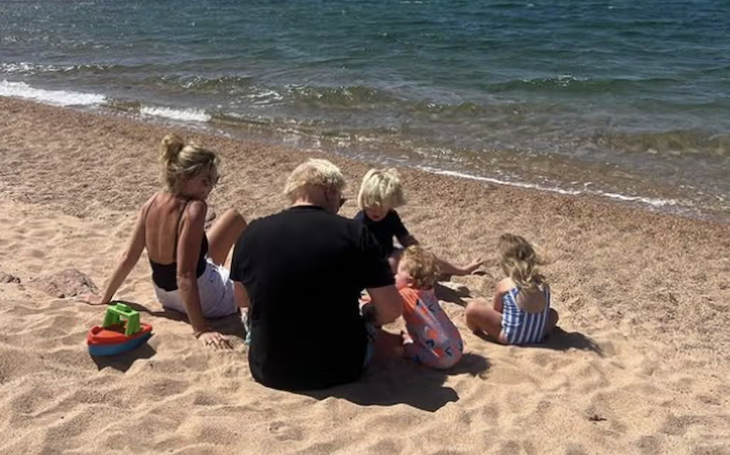
Perhaps there will yet be time for a photo opportunity of a beaming Johnson helping the get-out-the-vote operation on election morning near his manor house in deepest Oxfordshire. But that will be it.
The Tories have already given up on Red Wall seats where Boris is popular
Tellingly, the Times reports that Team Sunak has decided any joint appearances with Johnson would do more harm than good because they have already given up on Red Wall seats where he is popular and are now just trying to save Blue Wall ones where he is less so.
“This is not a campaign that is looking to win seats in the Red Wall. This is a fight for survival. If you look at the seats we’re targeting they don’t have Boris Johnson supporters,’ a Tory strategist is quoted as saying.
Glancing at the front pages of what we once called ‘the Tory press’ underlines the point. The Daily Mail, Daily Express, Daily Telegraph and Times all carry page one tax scare stories about Labour. The final segment of this election campaign is going to see the Tories relentlessly stoke worries among the already-prosperous that Labour will confiscate their money.
The potentially epoch-making electoral realignment the Tories were gifted with in 2019 – largely thanks to a Brexit project most of them never wanted to undertake – has been reduced to ashes in a single term.
And though traces are said to remain of public affection for Johnson in rugby league towns along the M62 corridor and down into the working-class East Midlands, he is as much to blame as anyone for the great lost opportunity. And that isn’t primarily down to ‘lockdown parties’ either.
Upon firing Dominic Cummings at the end of 2020, he was left with a big strategic choice about the future direction of his premiership: deliver the draconian immigration controls that his new electorate yearned for or find an alternative mission that might be more acceptable in polite society.
He chose the latter course, using the fact that Britain was due to host the G7 summit in Cornwall in June 2021 and then the Cop 26 climate summit in Glasgow in the autumn as a springboard to go gaga for Gaia. And all the people who were never going to vote for him anyway were suitably unimpressed, just branding every cripplingly-expensive environmental measure he saddled the country with as too little, too late.
The immigration regime was meanwhile further relaxed rather than tightened, trebling the net inflow, while his 2019 message to those arriving illegally in dinghies – ‘we will send you back’ – remained so much flannel.
Had he still been prime minister then probably the old campaigning flair would have had his party ten points higher in the polls and Nigel Farage would only be eating half the Tory lunch rather than all of it.
But the realignment would still have been on an ebb tide, turned backwards by immigration betrayal and chancellor Sunak’s novel approach to levelling-up: making sure that Tunbridge Wells didn’t lose out to ‘deprived urban areas’.
The Tories are falling back to the lush surroundings of the great boarding schools from whence they came – Home Counties West and South. When the ball next pops out at the back of the scrum, it will most assuredly be a union and not a league one. And neither Johnson nor Sunak will be in any position to pick it up.
Watch: Sunak hits out at defector donor
As the election date draws ever closer, this morning it was the turn of Prime Minister Rishi Sunak to face callers on LBC’s phone-in. And as the questions rolled in, the PM found himself doing a rather lot of defending: of his decision to have the national poll in July, on his party’s plans to introduce national service for 18 year olds and of his, um, predilection for Haribos.
On public trust, LBC introduced a rather novel way of measuring voters’ faith in their potential leaders. Sunak was told by presenter Nick Ferrari that 60 per cent of people would rather Sir Keir Starmer be their GP than the PM – and this figure increased to two-thirds when voters were asked who they’d prefer as their lawyer in court. It might help of course that Starmer actually is a trained legal professional…
And things got a little more awkward when Sunak was quizzed on how much faith Tory party donors have in the Conservatives. On Tuesday night, it was revealed that John Caudwell, a billionaire Tory donor for 51 years and founder of Phones4U, will instead endorse Labour at this election. Caudwell told the Times that he had been ‘despairing about the performance’ of the Tories, adding: ‘Having seen the way the Conservative party has performed in the last five to six years I found myself completely unable to vote for them again.’ Ouch.
‘How significant is that two of Britain’s richest men have announced they’re backing Sir Keir Starmer, one of whom in the past, John Caudwell, has given £500,000 to the Tory party as recently as 2019?’ Ferrari asked the Prime Minister.
‘Well, as you said, they’re too of Britain’s richest men, they can probably afford Labour’s tax rises,’ quipped Rishi – perhaps quite forgetting that not only is he viewed as being richer than the King, the tax burden is still set to rise under the Tories. Not quite the comeback he might have thought it was…
Watch here:
Four wagers for Royal Ascot day two
Aidan O’Brien’s four-year-old colt Auguste Rodin is talented and infuriating in equal measures. When last year’s Betfred Derby winner is good, he is simply superb but when he is bad, he is very poor indeed. He is a nightmare for punters to evaluate because he has been stone last in two of his last five runs but there have been two impressive winning performances during that time too.
My big hopes today lie with my two strong fancies for the Kensington Palace Stakes
All in all, I am happy to take him on in today’s feature race at Royal Ascot, the Grade 1 Prince of Wales’s Stakes (4.25 p.m.). I am no keener to back Inspiral at skinny odds either after her uninspired comeback when fourth at Newbury, even though I accept that race was very much a prep run for Royal Ascot.
Yes, one of these two horses at the top of the market will probably come good on the big stage today but I would rather take a chance with ALFLAILA at a bigger price. Owen Burrows’ five-year-old has won four of his last five starts but ruined his chances last time out in Ireland with a very slow start. Back him each way at 8-1 with bet365, paying three places.
The big handicap of the day is Royal Hunt Cup (5.05 p.m.) and it makes sense to look for confirmed milers who are course specialists, who love fast ground and who are well handicapped. Trainer Dermot Weld’s runner Coeur d’Or ticks all of those boxes except that he does not have Ascot form so I will turn to those at bigger prices.
Age is just a number for BLESS HIM who is now ten years old but who is still capable of running big races. His last run at Haydock was disappointing but before that, on his seasonal debut, he ran really well at Ascot.
With a fast pace guaranteed, he will be held up by jockey Jamie Spencer and so he will need luck in running. Back him each way at 20-1 with SkyBet, paying eight places rather than other bookies offering bigger odds but fewer places.
Another course specialist is PEROTTO but his fitness has to be taken on trust as he has not run since last August because of a setback. However, his last run was a winning one at this track and he is still only six years old. Back him each way at 20-1 with SkyBet, again slightly shorter odds than most of its rival but with eight places.
My big hopes today lie with my two strong fancies for the Kensington Palace Stakes (5.40 p.m.), both of which I put up on Friday. Both Azahara Palace, tipped each way at 25-1 and Elim, tipped each way at 33-1, have been backed heavily and are now towards the top of the market. Here’s hoping both run big races.
I usually stay well clear of the two-year-old races at the royal meeting because they are so hard to predict: Indeed, the first three in yesterday’s Coventry Stakes were returned at odds of 80-1, 40-1 and 50-1. However, I am very sweet on the chances of MISS RASCAL in today’s opener, the Group 2 Queen Mary Stakes (2.30 p.m.) for two-year-old fillies.
Her racecourse debut at Newmarket in April was full of promise and she ran even better when winning at Ascot last month. She goes well on good ground, her stable is in fine form and the booking of jockey Tom Marquand is a bonus too. Back her each way at 8-1 with William Hill, paying five places.
That’s it from me for today, betting wise. Today’s other races are not for me, ones simply to watch and enjoy.
Day one did not go well tipping wise but it was exactly the same with day one of the Cheltenham Festival in March, and then things were soon turned around with a nice profit by the end of the week. All is not lost and I will be back tomorrow morning with some tips for day three.
Pending:
1 point each way Miss Rascal at 8-1 for the Queen Mary Stakes, paying 1/5th odds, 5 places.
1 point each way Alflaila at 8-1 in the Prince of Wales’s Stakes, paying 1/5 odds, 3 places.
1 point each way Bless Him at 20-1 in the Royal Hunt Cup, paying 1/5 odds, 8 places.
1 point each way Perotto at 20-1 in the Royal Hunt Cup, paying 1/5 odds, 8 places.
1 point each way Azahara Palace at 25-1 in the Kensington Palace Stakes, paying 1/5th odds, 5 places.
1 point each way Elim at 33-1 in the Kensington Palace Stakes, paying 1/4 odds, 4 places.
1 point each way Jasour at 11-1 in the Commonwealth Cup, paying 1/5th odds, 3 places.
1 point each way Isle of Jura at 12-1 in the Hardwicke Stakes, paying 1/5th odds, 3 places.
1 point each way Shartash at 10-1 in the Queen Elizabeth II Jubilee Stakes, paying 1/5th odds, 3 places.
Yesterday: – 9.6 points.
1 point each way Makarova at 22-1 with SkyBet in the King Charles III Stakes, paying 1/5th odds, five places. Unplaced. – 2 points.
1 point each way Alyanaabi at 16-1 in the St James’s Palace Stakes, paying 1/5th odds, 3 places. Unplaced. – 2 points.
1 point each way Tritonic at 20-1 in the Ascot Stakes, paying 1/5th odds, 5 places. Unplaced. – 2 points.
2 points win Pied Piper at 8-1 in the Ascot Stakes. Unplaced. – 2 points.
1 point each way Astro King at 12-1 in the Wolferton Stakes, 1/5th odds, 4 places.
1 point each way My Mate Mozzie at 7-1 in the Copper Horse Handicap, paying 1/5th odds, 5 places. 3rd. + 0.4 points.
2024 flat season running total – 2.5 points.
2023-4 jumps season: + 42.01 points on all tips.
2023 flat season: – 48.22 points on all tips.
2022-3 jumps season: + 54.3 points on all tips.
My gambling record for the past eight years: I have made a profit in 15 of the past 17 seasons to recommended bets. To a 1 point level stake over this period, the overall profit of has been 517 points. All bets are either 1 point each way or 2 points win (a ‘point’ is your chosen regular stake).
The mysterious sex appeal of Nigel Farage
I remember sitting on the bus a few weeks into #MeToo and thinking all the men looked disengaged – buried in their phones or listlessly looking out the window. I imagined them thinking it just wasn’t worth it to look up lest they be accused of making unwanted advances. These days, I spend fewer mornings worrying about the fate of the red-blooded male. Nonetheless, it’s not rocket science to suppose that for a significant swathe of men – those who fear being publicly shamed or sacked – it really isn’t worth showing their appreciation of women.
Farage brings to mind the kind of bonking that wouldn’t be followed by a chilly ghosting, but rather more invitations to drink and bonk and make merry
Nor is it surprising that with the decline of male lustiness comes the dimming of men’s better traits, those that were not creepy or sad but fun and spice-of-lifey: that winning audacity thickened with masculine charm. I was fond of the generosity of the committed drinks-buyer who may hope for something physical but who is also just happy paying homage; I was fond, too, of the charisma of the man capable of giving compliments and meaning them, and of the raw sexual appeal of the man who really, really likes women, whether that is bedding them or marrying them or talking to them flirtatiously about real, important things.
It seems, however, that rather than entirely kill them off, #MeToo has created a new appreciation of this ever more rare subspecies of male. How else to explain the continuous rip-roaring romantic success of Nigel Farage?
An admiring high-profile recap this week of his women over the years – wives and others – reminds us of the allure of that kind of red-blooded approach. His first wife was a nurse he chatted up while in hospital recovering after a car crash; then, two sons later, there was the second one, a German bond broker called Kirsten Mehr, whom he met and insta-seduced in a Frankfurt trading room in 1996 when on the hunt for money and a ‘new wife’. She was ‘a stunning government bond broker whose brisk efficiency at first sight belied her ethereal appearance’ – according to his 2011 autobiography Flying Free. There followed a whirlwind marriage and two daughters. A string of girlfriends and mistresses has followed, with Farage known to pursue ‘anything in a skirt’, according to his chum Richard North, the anti-Europe campaigner. He is now with Frenchwoman Laure Ferrari whom he met in Strasbourg in 2007, where she was waitressing.
I do not like Nigel Farage the politician nor, particularly, the man. He seems brash and vulgar and big-headed. Sexually, I’d go for a skinny young man with cheekbones and a natural sixpack any day of the week. That said, his approach to women and fun – the boozy nights in the pub, rounds of cocktails, clouds of his smoke, and his obvious enjoyment of the fairer sex, carnally and otherwise – is a reminder of a jollier time of humorous rollicking, chance-taking and cheekiness. Farage brings to mind the kind of bonking that wouldn’t be followed by a chilly ghosting, but rather more invitations to drink and bonk and make merry. Compare that to today’s po-faced culture of scrupulous consent-seeking and feminist allyship.
In short: the Farage approach, much like that of Boris, is not only fun for the man, it seems to be just as fun for the woman. Take the testimony of Liga Howells, a Latvian woman he met in a Kent pub, who claimed – not that it was a night of advantage-taking and #MeToo rulebook infractions, but of excellent sexual endurance. Though to her claims he had managed seven love-making sessions in a single night, Farage wrote in his memoir that Howells ‘wasn’t screwed. I was’, because he’d drunk too much to be able to perform.
The idea of a Farage sort, or a Boris looking for women on dating apps is simply not possible to imagine. These are blustery, slightly unkempt upper-middle aged men who drink too much and probably have bad breath, not least from the endless smoking (in Farage’s case). This sort has always found women wherever they are; at work, in pubs, in hospital. As for how they make them love, or at the very least enjoy, their company? It’s the scent of the old-school good-time-man, of course, an aroma made extra attractive for being so rare. And thankfully like other unethical luxury goods, it hasn’t yet been entirely banned.
Why Sunak will struggle to win the credit for falling inflation
After a three-year saga, inflation has finally returned to the Bank of England’s target. The Office for National Statistics reports this morning that the inflation rate slowed to 2 per cent in the 12 months to May 2024: its lowest point since July 2021.
The greatest contribution came from another slowdown in food and non-alcoholic beverages: having once peaked at a staggering 19.1 per cent in 2023, prices have now slowed to 1.7 per cent in the year to May, down from 2.9 per cent in the year to April.
It’s a painful reminder of what triggered an early election in the first place
Clothing and footwear also played a role, slowing to 3 per cent in the year to May, down from 3.7 per cent in April. Some of this was off-set by rising transport costs, largely thanks to a rise in motor fuel duty, which saw the division rise by 0.3 per cent in the year to May. But core inflation (which removes more volatile prices like food and energy) still shows a positive trajectory, slowing from 3.9 per cent in April down to 3.5 per cent in May.
Is the return to target a (rare) piece of good news for Rishi Sunak and his MPs? Many in the Tory camp will argue that isn’t even a question: it’s the one priority Sunak announced when he entered Downing Street that has been delivered – and despite politicians having very little control over whether the inflation rate goes up or down (that’s largely down to money supply and interest rates, controlled by the Bank of England), the simple fact that the fight against spiralling inflation has been brought to an end under this government is a win for the Conservatives.
But the return to target is also a painful reminder of what triggered an early election in the first place. Sunak used the good inflation data (and higher-than-expected growth data) from last month to spring into a campaign, insisting that the ‘plan and priorities’ that he ‘set out are working.’ It was supposed to distract from what hadn’t been delivered: specifically his pledge to ‘stop the boats’ which looked more precarious going into the summer, with the number of people arriving across the Channel set to rise, while doubts were also rising about whether flights to Rwanda would really take off.
But if the strategy relies on the economy ‘turning the corner’, as ministers like to say, the public needs to experience this for themselves. Far more compelling to allow people a bit of time to feel the benefits – something that might have started to happen had the Prime Minister waited until the autumn to go to the polls.
It’s a hard argument to make even with more positive data these days, as living standards have still not recovered to their pre-pandemic levels. ‘I’m not going to claim everything is fine,’ shadow chancellor Rachel Reeves said on the media round this morning. It’s not really a point that the Tories dispute – they are careful not to exaggerate or oversell the success of getting inflation under control. But it means there are restraints on how hard they can push their core election message. Of course if you are having to tell people that they are better off than they were six months or a year ago, you are already on the back foot.
A slightly longer timeline might have also allowed for at least one interest rate cut, which is not expected to happen tomorrow when we get the next announcement on rates from the Monetary Policy Committee. As Capital Economics notes this morning, the ‘big disappointment for the Bank’ in today’s inflation release will be that ‘services inflation only nudged down from 5.9 per cent to 5.7 per cent)’ – the expectation was for a greater slowdown. The forecaster says ‘today’s release won’t alleviate the Bank’s concerns about persistent price pressures entirely’ further reducing the (already low) chances of an interest rate cut tomorrow.
Those expectations dropped even further when Sunak called the election. It would be very surprising if the Bank were to start its rate-cutting process during an election, given its fears of being seen to act politically in any way. But rate cuts are not thought to be too far off, either. And whoever is in power when the process starts is likely to get the credit.
The left-wing plot to delegitimize SCOTUS
Left-wing activists are working overtime to smear the conservative majority on the Supreme Court in a blatant attempt to undermine rulings coming out of the nation’s highest court. They attempted to stop Justice Brett Kavanaugh’s nomination with dubious, vague and uncorroborated sexual assault accusations. Justice Amy Coney Barrett was painted as a Catholic extremist — Senator Dianne Feinstein declared during her confirmation hearing that “the dogma lives loudly in you” — and her husband was targeted with a Rolling Stone article that charged him with the crime of… being a lawyer. Justice Clarence Thomas has fended off a series of ProPublica investigations that imply he has ruled more conservatively on cases because of his friendship with billionaire Harlan Crow. Justice Samuel Alito is the latest to be in the crosshairs; the left first went after him for flying an American flag upside down amid a spat with nasty neighbors, and the latest non-troversy is a series of conversations he had at a public event that were secretly recorded.
Lauren Windsor, a self-identified “independent journalist” who surreptitiously records conservatives while pretending to be one of them, was responsible for the leaked tapes. Windsor has a history of dropping secret recordings of top conservative and Republican figures, which are never the bombshells she paints them as. Take the slate of tapes involving Alito. The justice, openly a conservative Catholic, confirms that he believes America would be better off if more people were religious. This might surprise you, but Supreme Court justices are allowed to exercise their First Amendment rights to free exercise of religion and are allowed to think that doing so might be good for others. Unfortunately, the Catholic justices on the bench are subject to prejudice related to historical anti-Catholic bias in America, which rested on the idea that Catholics have outside loyalties (namely to the Pope) that prohibit them from properly serving their country.
When asked about the political divide in America, Alito responds simply that things probably won’t get better until one side or the other wins out as there are some things that are impossible to compromise on. In a separate recording from 2023, Windsor pushes him to point to say that the Supreme Court has a role in healing this divide; instead, he affirms that the court’s role is to decide cases, not to play politics. Scandal!
Windsor neglected to characterize any of the recordings honestly, providing helpful bait for anyone who declined to actually listen to her tapes or dishonest left-wing activists who don’t care what Alito actually said. “Justice Alito admits lack of impartiality with the left,” Windsor said on her X account, adding in interviews that it was concerning what he was willing to admit to a stranger. What he was willing to admit? More like Alito behaved agreeably with someone who was probing him at a public event and, even then, didn’t say much of anything.
Nonetheless, Democrats have seized on the latest round of attacks. President Joe Biden warned that he needs a second term in office because if Trump is elected he will “appoint two more” Supreme Court justices “flying flags upside down.” Biden of course has also done everything possible to skirt SCOTUS telling him he does not have authority to forgive student loan debt. Democratic senator Chris Murphy described the court as being in “crisis” and said it is “brazenly corrupt” and “brazenly political.” Many have called for Thomas and Alito to recuse themselves from cases related to January 6 as former president Donald Trump seeks presidential immunity. The Supreme Court introduced new ethics rules in 2023, the first time this was done in the court’s history. Others would like to see the conservative justices removed entirely.
There is obvious hypocrisy at play when the crowd who accuses “extreme” or “ultra MAGA” of undermining democracy and American institutions openly attempts to delegitimize the Supreme Court. But it seems to be a very predictable reaction from the left as they are used to controlling institutions and tend to lash out when they lose. The draft Dobbs decision overturning Roe v. Wade was likely leaked from a liberal clerk or justice to put pressure on the conservative justices to change their opinion. In the aftermath there were arguably illegal protests outside of SCOTUS justices’ homes plus a thwarted assassination attempt. In response to a decision striking down an ATF rule that improperly reclassified semi-automatic guns equipped with bump stocks as “machine guns,” liberal activist groups accused SCOTUS of having “blood” on its hands.
The left is also likely gearing up for a second Trump term in which lawfare and legal harassment are two of the biggest tools they have to thwart his agenda. An article in the New York Times revealed that the anti-Trump “resistance” is already preparing for a Trump win in November by drafting potential lawsuits to policies they oppose, particularly on immigration. They can likely tie his administration up in court — but for their grand plan to be successful, they need a Supreme Court without a conservative majority.
France’s left-wing coalition would unleash migrant chaos on Britain
Emmanuel Macron has described the left-wing coalition’s manifesto as ‘totally immigrationist’. The Popular Front, which brings together Communists, Greens, Socialists and Anti-Capitalists, was formed at the start of last week to contest the upcoming parliamentary elections.
While there has been the odd divergence on personnel – notably who should be prime minister in the event the left wins the election on 7 July – one issue on which the Popular Front is agreed is immigration: the more the better.
The French left describes immigration as ‘an opportunity’ for the Republic
Its manifesto states that once in power it will establish a maritime rescue agency to help bring migrants across the Mediterranean. It is also committed to extending a ‘dignified welcome’ to all migrants, and to that end it will ‘revise’ Macron’s recent asylum and immigration bill. Under a left-wing government, migrants will receive social support, visas and/or work permits and access to state medical aid.
Workers, students and parents of school-going children will be regularised, and a ten-year residence permit will be the standard residence document for all arrivals in France.
But Macron is hardly in a position to criticise other parties for their lax immigration policies. Since he came to power in 2017, the number of legal and illegal arrivals in France has soared to unprecedented levels.
A recent study found that immigration and purchasing power were the two issues that most influenced how the French electorate voted in last week’s European election. Marine Le Pen’s National Rally romped to a landslide victory in the election.
In an op-ed in Tuesday’s Le Figaro, Nicolas Pouvreau-Monti, the director of the Immigration and Demographic Observatory, laid bare Macron’s own ‘Immigrationist’ policy.
In 2023, a record 323,260 first residence permits were granted to non-European immigrants, a 40 per cent increase on 2016 – the year before Macron was elected president.
On average, Macron’s administration has issued 275,000 first residence permits each year to non-European immigrants, a total of nearly two million since 2017. The majority of permits have gone to Tunisians, Moroccans and Algerians.
Similarly, there has been an explosion in the number of asylum applications, most of which come from Afghanistan, Guinea and Turkey. In 2023, 145,095 claims were registered in France, an 89 per cent increase on 2016, the last year of Francois Hollande’s Socialist government.
A total of 825,000 first-time asylum applications have been registered in France since 2017, explained Pouvreau-Monti, meaning that ‘under the presidency of Emmanuel Macron, France has thus welcomed the equivalent of a city like Marseille made up solely of asylum seekers’.
For obvious reasons, the figures for illegal immigration are more inexact but a think-tank report at the end of 2023 estimated a figure somewhere between 800,000 and 900,000, which means that between 2015 and 2022 the number of illegal immigrants in France has probably risen by around 400,000.
In short, Macron is the most pro-migrant president in the history of the Fifth Republic. He talks tough on the issue – and pockets huge sums of money from the British government with a promise to crack down on the problem – but voters on both sides of the Channel aren’t fooled.
It is, in effect, an open invitation to come to France and make a new life
On the day Macron was accusing the left-wing coalition of being ‘immigrationist’, Sky News broadcast a despatch from Calais. As dozens of French police watched from the beach, Kurdish people smugglers loaded dozens of migrants into inflatable dinghies and one after another waved them off north.
John Vine, the former chief inspector of borders, expressed his disbelief at the footage, given that Macron and Rishi Sunak had pledged last year to stop such scenes. ‘One wonders what on earth is happening,’ said Vine.
The smugglers know that under French law the police can’t enter the water to impound a vessel that hasn’t asked for assistance; they also know that the police are under constant scrutiny from left-wing politicians, judges and journalists.
In March this year, 200 migrants gathered on a beach at dawn to board some inflatable dinghies to England. The police attempted to stop them with batons and tear gas; human rights groups and politicians were outraged.
Manon Aubrey and others from the far-left La France Insoumise subsequently visited Calais to show their solidary with the illegal immigrants. ‘Ten days ago, 200 migrants were violently repressed,’ she tweeted. ‘This shows the reality of migration policy’.
The French left describes immigration as ‘an opportunity’ for the Republic; it is a way of building a new country, what Jean-Luc Melenchon, their most influential politician, describes as his ‘New France’. The left’s manifesto makes that clear, and it will have been read and appreciated by the people smugglers in Europe, in Africa and in the Middle East. It is, in effect, an open invitation to come to France and make a new life.
It will also encourage migrants who want to settle in Britain. It is improbable to believe that a left-wing government in Paris, many of whom are radically hostile to the police, would impose any form of border control on migrants wishing to cross the Channel. Why should they when immigration is an ‘opportunity’? Not just in France, but in Britain and every Western country.
Labour ditches Scottish candidate over ‘pro-Russian’ posts
It’s a day ending in ‘y’ which means that a political party somewhere is having candidate drama. This time it’s Sir Keir Starmer’s lefty Labour lot, who have had to drop their Aberdeenshire North and Moray East candidate over controversial social media posts about Russia and antisemitism. Oh dear…
Andy Brown shared contentious posts about the 2018 Salisbury poisonings, in which the nerve agent Novichok was used in an attempt to take the lives of former spy Sergei Skripal and his daughter Yulia. The links shared by the ex-Labour candidate raised doubts about Putin’s involvement in the attack and suggested that the life-threatening nerve agent did not come from Russia. Another post shared by Brown suggested that crucial information about the poisonings was hidden by then-prime minister Theresa May. And the former Labour candidate was also found to have shared a post dismissing allegations of antisemitism again the Labour party, in which a historian is quoted suggesting Jewish voters in the UK were instead frustrated by Jeremy Corbyn’s pro-Palestine sentiments.
Just hours after Brown’s rather strange social media use was uncovered by the Press and Journal, the Labour party suspended their Aberdeenshire candidate. But since the nomination deadline has passed, the decision means the party is not able to swap in another candidate for the seat. What a mess…
It’s not the only scandal to befall the Moray East constituency, however. Over the last fortnight, Scottish Conservative leader Douglas Ross found himself in a fix after he announced he would be contesting the new seat as the candidate who had been expected to stand, David Duguid, was ill. But after receiving immense backlash both within and outside of his party – including from Duguid himself – the Tory MSP then announced that he would be resigning as leader of the Scottish group. In a bizarre twist, he said he would resign his MSP post if he was successful this general election – and keep his Holyrood job if he wasn’t. Alright for some…
Why does Labour want to ban these 15 peers?
Following last week’s manifesto launches, Mr S has been looking into the fine print. As part of Labour’s plans to reform the House of Lords, Starmer says that he now wants to forcibly retire British peers at 80 years old when – he believes – they will be unfit for public service. But Steerpike is rather sceptical of how Sir Keir’s grand plans will go down with the second chamber, given the Labour leader will be turfing out some rather high-calibre comrades.
Labour’s manifesto states that ‘at the end of the parliament in which a member reaches 80 years of age, they will be required to retire from the House of Lords’. As 83-year-old Labour peer Professor Lord Winston – a pioneer in gynaecological medicine – put it: ‘It’s rather like saying a member of the House of Lords has to be a certain height.’ Quite. Among those whom Starmer would push out include Alf Dubs, 91, a vocal campaigner for refugees who himself was one of the Czech children rescued from Nazi Europe in the Kindertransport. He’d expel Joan Bakewell too, another nonagenarian, once hailed by Gordon Brown’s government as ‘Britain’s voice of older people’. Baroness Butler-Sloss would also go — having just last year, at the age of 90, taken up a role on the Lords procedure and privileges committee.
Yet despite these arbitrary expulsions, more controversial candidates would remain in situ. There’s Evgeny Lebedev, the son of a KGB spy and current owner of the Evening Standard, who is often derided as one of the least active peers in the House. Or Michelle Mone, whose firm PPE Medpro is currently under investigation over controversial Covid contracts. And, of course, Charlotte Owen, the former adviser to Boris Johnson who became one of the youngest ever appointees to the Lords aged, er, 30.
With almost a quarter of the Lords’ sitting members aged over 80, a Labour government could oversee an exodus of a rather impressive bunch. Mr S has compiled a handy list here of some of the Lords which Labour might not want to lay off…
- Professor Lord (Robert) Winston, 83 years old: Professor of Science and Society and Emeritus Professor of Fertility Studies at Imperial College London, Professor Lord Winston is a pioneer in gynaecological medicine, creating new ways to improve fertility treatments and IVF.
- Baroness (Elizabeth) Butler-Sloss, 90 years old: The fourth woman to become a High Court judge and the first female Lord Justice of Appeal, Baroness Butler-Sloss went on to become the highest-ranking female judge in the UK.
- Lord (Alf) Dubs, 91 years old: One of the Czech children rescued from the Nazis in the Kindertransport, Dubs went on to have an illustrious career in politics, becoming a Labour MP for Battersea before holding the post of Fabian Society chair and then director of the Refugee Council.
- Baroness (Joan) Bakewell, 91 years old: Having worked as a broadcaster, journalist and writer Baroness Bakewell was made a DBE for services to journalism and the arts before becoming a Labour peer in 2011.
- Lord (Herbert) Laming, 88 years old: A former probation officer and social worker from Newcastle, Lord Laming was chief inspector of the Social Services Inspectorate between 1991 and 1998. He has worked on high-profile public inquiries, including into the deaths of Victoria Climbie and Baby P.
- Lord (Kenneth) Clarke, 83 years old: First a barrister before becoming a Conservative MP for Rushcliffe between 1970 to 2019, Lord Clarke held a number of Cabinet posts including Lord Chancellor, Health Secretary and Justice Secretary.
- Lord (Michael) Howard, 82 years old: Another barrister turned politician, Lord Howard was elected the Tory MP for Folkestone and Hythe. During John Major’s premiership, he held several Cabinet positions, before serving a brief stint as Conservative party leader from 2003 to 2005.
- Lord (Norman) Lamont, 82 years old: A Cabinet minister under Margaret Thatcher and John Major, Lord Lamont was Britain’s chief negotiator for the Maastricht Treaty and negotiated Britain’s opt-out from the Euro.
- Lord (John) McFall, 79 years old: Growing up in the west of Scotland, Lord McFall became a chemistry teacher before becoming Dumbarton’s MP in 1987. He was elevated to the Lords in 2010 by Gordon Brown, before being elected Lord Speaker of the House of Lords in 2021.
- Baroness (Elizabeth) Smith, 84 years old: The widow of Scottish Labour leader John Smith, Baroness Smith is the president of the Scottish Opera and former chairwoman of the Edinburgh Fringe Festival. Her daughter, Sarah Smith, is the BBC’s North America editor.
- Lord (Norman) Warner, 83 years old: An independent peer, Lord Warner was first an adviser to the Labour party before being elevated to the Lords, after which he served as a former health minister in Tony Blair’s government. He resigned the Labour whip in the Lords in 2015 to become an independent after criticising Jeremy Corbyn’s approach.
- Lord (George) Robertson, 78 years old: Formerly a Labour MP for Hamilton and then Hamilton South between 1978-1999, Labour peer Lord Robertson was the defence secretary in the early days of the Blair government before becoming Nato’s Secretary General in 1999. He is now a special adviser to BP.
- Lord (Christopher) Patten, 80 years old: Formerly director of the Conservative Research Department from 1974-79, Lord Patten became the MP for Bath from 1979 to 1992, serving as a government minister and the Tory party chairman during this time.
- Lord (Christopher) Tugendhat, 87 years old: A former leader writer for the Financial Times, Tugendhat became the Tory MP for Cities of London and Westminister in the 1970s, before becoming vice-president of the European Commission.
- Lord (Neil) Kinnock, 82 years old: The former leader of the Labour Party between 1983 and 1992, Kinnock became vice-president of the European Commission before being made a Labour peer.
The case for not voting at this election
Anyone over the age of 40 can scarcely help comparing this election, or the state of our two main parties, with those of the past. Though in 2024 it seems a choice between dumb and dumber (or grey and greyer), this wasn’t always the case.
The government of Blair, Brown, Prescott and Cook seem like a supergroup compared to the current front bench
The first election I could vote in was in 1992, and back then there was a clear difference. Yes, Labour, under Neil Kinnock, had kicked out many of the hard left and moved to the centre-ground, but it was more a question of style. The Tories wore velvet-collared covert coats and Turnbull and Asser ties, got caught in massage parlours, and closed hospitals. They often had, after 13 years in government, a grotesque air of droit de seigneur about them (think David Mellor or Michael Portillo at his worst).
Labour sported ill-fitting light grey suits, looked as if they stank of Embassy cigarettes and Draught Bass, banged on a lot about ‘caring’ (often in Celtic accents) and were supported by people like Stephen Fry and that nice Prunella Scales and Tim West. They seemed almost the political wing of Art and Literature, and crucially, they’d been so long out of power that people my age (I was 22) hadn’t clocked that money was finite, a politician was a politician and that all parties, once in power, were usually a flop to their supporters.
I was then an Eng. Lit. student, grinding my way through the major works of post-war left-wing drama. In his play Chicken Soup with Barley, Arnold Wesker had written shamelessly that ‘Socialism isn’t talking all the time, it’s living, it’s singing, it’s dancing, it’s being interested in what goes on around you, it’s being concerned about people and the world,’ and as he was older than me and world-famous, I believed him. It took a two-year spell in the former Soviet Union, where people spat out the word ‘idealist’ as if referring to the nastier aspects of an upset stomach, to make me wonder whether Wesker, when he wrote those lines, hadn’t been overdoing the pálinka at the Gay Hussar.
Even so, Labour party history fascinated me and continued to into my thirties. It seemed to me back then all the interesting characters had been in the party. Michael Foot, a snowy-haired visionary, took time off party politics to go and write his books on Byron and Swift. Denis Healey, chancellor of my childhood, had his famous ‘hinterland’ of music and poetry, a mythical entity you imagined him going out to water and fertilise each morning with a sprinkle of Delius and Elizabeth Barrett Browning. Tony Crosland was an erudite womaniser so silkily mandarin – despite his promise to ‘destroy every fucking grammar school’ in the country – that he seemed more like a theatre critic than a dreary minister.
Their contemporaries on the right – characters like Willie Whitelaw and Lord Hailsham – didn’t stand a chance in the glamour stakes. It was only a long friendship with the late historian and novelist Peter Vansittart – a commendably balanced man who evaluated politicians on their personal strengths and weaknesses rather than party-affiliation – which opened me up to the idea that Macmillan could be as interesting as Gaitskell, the travails of Eden as compelling as Nye Bevan’s, and that really, beyond the fact the parties had separate policies, they all belonged to the same world and were different manifestations of the same syndrome.
Being a floating voter, I realised, wasn’t a cop-out but could be a sign of maturity and thoughtfulness – a decent person might just as easily have voted for Heath in 1970 as Harold Wilson in 1964. By then, I was growing jaded too with people who put their best foot forward, who indulged in bouts of competitive virtue-signalling or seemed to court popularity, promising more than they were able to deliver. I became more and more aware, over the years, of the discrepancy between how people wished to be seen and how they actually were. Was I becoming clearer-eyed or just a cynic? Had I moved to the right? It seemed all the time I’d remained a classical liberal, with the terrain shifting radically around me.
The changes have left many in 2024 feeling politically homeless – or at least, uninspired to get down to the polling station. A case in point is one of my oldest friends – a lifelong Labour supporter (and once candidate for a Labour council) who runs an altruistic business. Recently she found out Labour’s proposed changes to employment law, making it infinitely harder to get rid of slack employees or to put them on the zero-hours contracts on which her company, run on a virtual shoestring, depends. She’s also a long-term believer in the rehabilitation of criminals, and appalled by Labour’s promise to build 14,000 new prison places. The Tories, under blowaway Sunak, seem barely worth considering, voting Reform is unthinkable to her and, having Googled her local Lib-Dem candidate and found zero information, she says they’re out too.
And what of the Labour party she no longer feels able to vote for? My friend was a staunch Blairite and, looking back, even the government of Blair, Brown, Prescott and Cook seem like a supergroup compared to the current front bench – most of them faintly like characters from The Office (and secondary characters at that), with weird weekend-interests and authoritarian tendencies – almost none of whom you can imagine talking to at a party without wanting to cast desperate save-me glances over their shoulders. If you think Britain’s unhappy and ill-at-ease now, wait until you’ve had five years of this lot.
If you think Britain’s unhappy and ill-at-ease now, wait until you’ve had five years of this lot
As for the Conservatives, I warned in 2022 they’d bitterly regret sidelining Kemi Badenoch (their surest vote-winner) for Liz Truss or Rishi Sunak, and it wasn’t exactly difficult to make this prediction even then. Sunak, a flyweight without an effective jab or uppercut to his name, is the closest we’ve come in my lifetime (excluding Truss) to feeling like we don’t have a Prime Minister at all. The Tories’ wittering 11th hour promises on immigration, housing and trans-issues (gosh, what took you so long?) are the desperate last-ditch pleadings of a rejected husband just as the Decree Absolute comes through. Meanwhile, Farage’s treefrog-face increasingly seems to exhibit the malicious glee of the trickster, one delighted in causing sheer havoc for its own sake. The Lib Dems? I had to Google their leader last night to find out what he looked like. This never happened with Paddy Ashdown or Charles Kennedy.
I find them all not only ghastly, but dull. Dull in the way photocopying or Rawl plugs or daytime TV or Primark underwear is dull. There seem so many choices, the Conservative party has had so many leaders, you feel like you’re in a restaurant with one of those suspiciously vast ‘international’ menus, wondering why Spaghetti Carbonara is being offered cheek by jowl with sushi or nachos or Bouillabaisse, but knowing they’re all going to be crap.
For once I’m following C.H. Spurgeon’s maxim: ‘Of two evils, choose neither.’ People died for my right, not my obligation, to vote, and I intend to sit tight on 4 July. The single, solitary box I’ll tick this year is the £100 I’ve already bet on a hung parliament, at odds of 7-1, which would pay for new kitchen cupboards. That’s the only kind of cabinet I care about right now and, barring the odd typo in the furniture catalogue, I should at least get what they’ve promised me.