-
AAPL
213.43 (+0.29%)
-
BARC-LN
1205.7 (-1.46%)
-
NKE
94.05 (+0.39%)
-
CVX
152.67 (-1.00%)
-
CRM
230.27 (-2.34%)
-
INTC
30.5 (-0.87%)
-
DIS
100.16 (-0.67%)
-
DOW
55.79 (-0.82%)
The Epstein files have exposed the extent of Sarah Ferguson’s greed
Since the latest tranche of the Epstein files was released over the weekend, the people who have been most embarrassingly affected by them include former British ambassador to Washington Peter Mandelson, Andrew Mountbatten-Windsor (formerly styled Prince Andrew, Duke of York) and Bill Gates. Yet inevitably, attention has turned to Sarah Ferguson, the former Duchess of York, who is emerging spectacularly poorly from the scandal. This is thanks to a series of revelations that portray her as, variously, greedy, an appalling judge of character and someone seemingly willing to figuratively pimp her children, Princesses Eugenie and Beatrice, while she sought to obtain the money that she craved from Epstein.
Many distasteful details were revealed in the first files released last year. In the autumn, it became apparent that, in 2011, following his conviction for soliciting prostitution from a minor a few years prior, “Fergie” had sent Epstein a toadying email in which she called him a “steadfast, generous and supreme friend to me and my family.” Apparently responding to the disgraced sex offender’s protestations, she also insisted that she had not called him a pedophile. In October, an image was published by the Sun newspaper in Britain proving that, along with her husband, the former Duke of York, Fergie had hosted Epstein, Ghislaine Maxwell and the disgraced film director Harvey Weinstein at their Windsor home of Royal Lodge for their daughter Beatrice’s 18th birthday party.
Fergie has been a strange figure in British public life ever since she first married Andrew
The furor was enough for those charities which had (admittedly somewhat unaccountably) chosen to retain her as a patron to drop her. It was further announced that, once her ex-husband was booted out of Royal Lodge, Fergie would no longer be cohabiting with him. This brought an end to a strange domestic association that had seen the former duchess describe their relationship as the “happiest divorced couple in the world.”
Neither of them will be happy now. Andrew’s latest shame has been much publicized – and rightly so, but just as grotesque are stories of how Ferguson gushingly referred to Epstein as “the brother I have always wished for.” Clearly in thrall to the financier’s moneyed charms, she wrote breathlessly that:
In just one week, after your lunch, it seems the energy has lifted. I have never been more touched by a friends [sic] kindness than your compliment to me in front of my girls.
These emails were sent to Epstein in 2009 – a year after his child prostitution conviction – and demonstrate that, for the former duchess, keeping in with the money man was all-important. In July of that year, the correspondence indicates that Ferguson took princesses Beatrice and Eugenie for lunch with Epstein during a trip to Miami. The emails also display a particularly egregious lapse of taste: during one exchange from 2010 she referred to the then 21-year-old Eugenie’s “shagging weekend.” But perhaps these personal revelations – and the presence of the princesses at meetings with the financier – were a quid pro quo for what he offered her in return.
Epstein was a poorly chosen friend. Fergie wrote saccharine missives, apparently revealing that the sex offender had a child with one of the innumerable women he consorted with. But nevertheless, she was sufficiently self-aware to write in 2011 that:
It was sooooo crystal clear to me that you were only friends with me to get to Andrew. And that really hurt me deeeply. More than you will know.
Epstein had severed contact with her earlier that year because he was outraged that she had blunderingly made reference to his sexual proclivities – one outraged email he sent suggested, :I think that Fergie can now say, I am not a pedo.” Predictably, with the removal of Epstein’s patronage came the withdrawal of both influence and much-needed funds.
Fergie has been a strange figure in British public life ever since she first married Andrew in 1986. She has no discernible talents, other than a certain head-down attitude to hard graft. While she previously had a baseline of popularity for her jolly-hockey-sticks silliness and apparent approachability, this has long since been eroded thanks to her not-so-concealed venality and lack of discernment in those who she took money from.
As Fergie reflects on the end of her public career – where even her own charity, Sarah’s Trust announced today that it would close amidst the seismic shame that she now feels – the curse of Epstein has struck again. The former duchess must surely regret writing to him in 2010 that “you are a legend. I really don’t have the words to describe my love, gratitude for your generosity and kindness.” Her sign-off – “Xx I am at your service. Just marry me” – was an offer that the sex offender found it surprisingly easy to turn down. How she must wish that she had been similarly steadfast in rejecting his damaging friendship, too.
The strangeness of Melania Trump
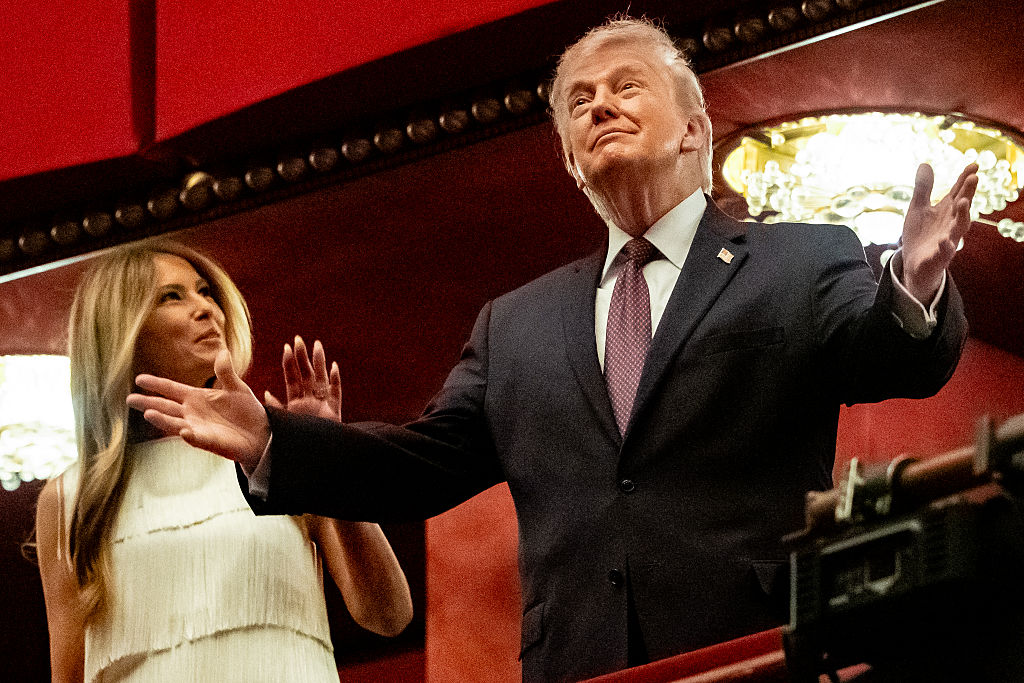
Long ago, in a different world, I edited a magazine called InStyle Weddings, which showcased the nuptial celebrations of the rich and famous. Melania Knauss Trump graced the cover of our spring 2005 issue, in her wedding gown, next to the headline “Behind the Scenes at the Trump Wedding.”
My boss at the time had attended Donald and Melania’s January 2005 knot-tying at Mar-a-Lago, as an invited guest, alongside other Manhattan media machers, plus politicians, movie stars, famous athletes and… Jeffrey Epstein. The Trump Organization furnished the quotes for our article, and also approved all the photos. That the occasion was a precisely orchestrated publicity event as much as a wedding bothered no one, certainly not us or our readers, many thousands of whom snapped up the issue off the newsstand.
Flash forward 20 years and Mrs. Trump needs no magazine publisher to collaborate with. Operating on a much grander scale, she stars in Melania: 20 Days to History, a documentary about the lead-up to last year’s presidential inauguration.
Reviews have been excoriating. In the New York Times, columnist Maureen Dowd labeled the film an “infomercial.” The Atlantic called it “a disgrace.” Variety’s reviewer bashed it for being “orchestrated and airbrushed and stage-managed.” Sounding a grotesque note, the Guardian proclaimed it “a gilded trash remake of The Zone of Interest,” referencing the movie about the family of the commander of Auschwitz who resided next to the death camp.
Seemingly no critics concede that Melania: 20 Days to History is actually quite fascinating. It resembles an extended Instagram reel, gorgeously photographed and appealingly scored. With the help of movie director Brett Ratner (banished from Hollywood after six actresses accused him of predatory sexual behavior), Mrs. Trump is doing the social-media thing, except in movie theaters. She’s curating life, showing her preferred self to the world. Every frame is a choice, and thus every frame is revelatory, full of clues – intentional or otherwise – to who she is. Future historians may well consider it an intriguing artifact of our time.
Of course, the documentary is propagandistic. And yes, Amazon backed it to the tune of $75 million for calculated commercial reasons, not artistic or journalistic ones. Still, by producing this movie, the First Lady is not merely cashing in. She’s declaring that for this, her second go-round as presidential spouse, she will exert tighter control of the narrative, lay down some markers for her place in history, and, maybe, even enjoy herself a little. (Not that she’s the happy-go-lucky type – quite the opposite.) Robust early ticket sales – the film grossed $7 million in its opening weekend – suggest that, just like InStyle magazine readers of old, a fair number of Americans will pay to see the First Lady as she wishes to be seen. With these results, a proposed follow-up, a docu-series on Prime, is a virtual certainty.
So, what do we learn from Melania, the movie? Of paramount importance to Mrs. Trump is her appearance. She wears a full face of makeup in every shot, her hair always silkily blown out. Her Slovenian heritage is never mentioned by name, but it’s crystal clear: brought up in a foreign culture, the First Lady is immune to the American urge, shared even (or especially) by billionaires, to appear “relatable.” She’s allergic to the notion of showing herself off duty, playing sports or simply kicking back in yoga pants, hair in a high pony. Her clothes are her armor.
Her crusade is to project dignity and strength – while maintaining distance from all who gaze upon her.
Trump term #1 clearly reinforced this instinct. For the inauguration in 2017, Mrs. Trump wore a soft 1960s-style powder-blue dress (very Jackie Kennedy) and no hat, while in 2025 she was in a severe navy coat and wide-brimmed boater, which hid the top half of her face. Mrs. Trump’s fittings for this outfit, and the close attention she’s shown paying to tiny details, is one interesting scene in a movie that is thin on content, long on atmospherics. In Melania: 20 Days to History there’s no end of getting in and out of black SUVs, flying on private jets, and ascending skyscrapers via the freight elevator for security’s sake. Mrs. Trump spends much of her time doing this (wearing sunglasses indoors and out) and clearly believes it’s the height of glamour. Lucky for her, director Ratner is good with the romance of motorcades and the drama of flight. And there are so many close-ups of the First Lady’s feet, shod always in gorgeous high heels, this could be a Quentin Tarantino project.
The First Lady’s favorite person in the world clearly is her son, Barron. She speaks of him with great pride, and defers to his wishes. (Not so her husband, but that’s another, more complex matter.) Her parents, Viktor and Amalija, were given their own room in the White House during the first term, and now she mourns that her father will live there alone, Amalija having died in January 2024. Her daughter feels this loss keenly, and mentions Amalija’s taste, self-discipline, and devotion to family at several points in the documentary. (Is her mother Melania’s model in all things? One suspects yes.) On the evening of the first anniversary of her mother’s death, Mrs. Trump goes to St. Patrick’s Cathedral in New York City to light a candle. It’s a strange scene, although beautifully shot – the soaring interior of the cathedral has never looked better. But Mrs. Trump is pictured standing alone, impassive, in front of the altar, neither genuflecting nor making the sign of the cross. The imperative to maintain dignity and composure, and betray no emotion, rules even in that setting.
The First Lady does not appear overly fond of her stepchildren, especially Ivanka Trump. And can you blame her? Ivanka sharp-elbowed her way into primacy among the Trump women in the first term as a special advisor to her father. For round two, she has decamped to Miami with husband Jared Kushner, and her step-mother takes revenge of a sort: There are only two fleeting glimpses of Ivanka in this movie. President Trump, however, appears regularly. He’s the fond, amused spouse, held slightly at an arm’s length. He praises his wife, teases her, seems eager for her approval, and, always, seems genuinely appreciative of the cool grace and studied elegance she brings to the role of First Lady. And well he might, given the tawdry way he has behaved on innumerable occasions. Of course, even Queen Elizabeth wondered at the nature of the relationship between the Trumps. To what degree is it transactional? Melania will never tell.
Knowing touches abound in the soundtrack. When the Trumps are flying from Florida to Washington for the inauguration, Tears for Fears sing “Everyone Wants to Rule the World.” Ratner obviously struggled to capture moments of spontaneity. In one of the few, Mrs. Trump is dancing briefly to the Village People’s “YMCA” – in a far more appealing way than her husband has ever managed.
Despise Melania: 20 Days to History along with all the rest of Trumpian effluvia if you like. Yet in truth the film is not contemptible, only strange – the portrait of a person who opts to remain opaque even as she’s ostensibly giving you a glimpse of her world.
Forgetting was the best defence for the Kindertransport refugees
Michael Moritz, one of Silicon Valley’s most successful venture capitalists, really has got it in for Donald Trump. America is currently in a ‘dark age’ of authoritarian governance, he claims, which spurns legality and liberal do-gooders everywhere. As a lifelong Democrat, Moritz was appalled when, in 2017, Trump failed to denounce the alt-right protestors who chanted ‘Jews will not replace us!’ at a torchlit rally in Virginia. Understandably, Moritz is alarmed by the tide of anti-Semitism today. His Jewish parents narrowly escaped death in Hitler’s Germany when they came to the UK on the Kindertransport. The 71-year-old Moritz now asks the question: how long before the iron-studded jackboot returns to Europe?
Ausländer (meaning ‘alien’ in German), half memoir, half anti-Trump harangue, unfolds in present-day America where Moritz has worked for half a century, first as a journalist, then as a director of Google, PayPal, LinkedIn and Yahoo!. In it he examines a trove of family documents, including swastika-stamped identity cards, in an attempt to ‘make sense’ of his past and the sorrowful legacy left by Jewry’s destruction. His father, Alfred Moritz, lost both his parents to the Nazi death camps; they were taken away, with yellow cloth stars stitched with Jude to their lapels.
In vivid, sharply written pages, Moritz conjures the beery carnival atmosphere of his father’s Bavarian hometown in 1933 when Hitler Youth joined Aryan Fraüleins and pig-tailed schoolgirls in burning books deemed hostile to Germandom. Dreadfully, the pyres fulfilled the 19th-century German Jewish poet Heinrich Heine’s prophecy – that wherever books are burned, people will also eventually be burned. With each iteration of Hitler’s anti-Semitic legislation, Germany tipped into greater terror until it became a vast, punitive barracks with Auschwitz at the end of it all. Hitler, a ‘dreary little apparatchik’ in Martin Amis’s formulation, vowed to lead his people out of the Judeo-Bolshevik darkness. In Moritz’s family there was an embittered acceptance that things could only get worse.
Bone-tired and hungry, Alfred arrived in the UK on 20 April 1937, Hitler’s 48th birthday. He settled in Cardiff, after first being interned on the Isle of Man as an enemy alien. The shrunken grimness of life in Cardiff, with its food rations and soot-blackened buildings, was no deterrent to Alfred and his desire to assimilate. He saw the British as decent-minded people who kept open house to casualties in a totalitarian age. He won a scholarship to Oxford and, in order to save money, sewed his own bow ties.
After the fierce trial of Hitler’s Germany, Wales was a place where Alfred could get on with the business of living. He shrank from feeling foreign – who does not? – but the effort required to fit in was exhausting. Like many refugees to these shores, Alfred was constantly aware of the manner of speech that would betray his non-English identity. The slightest misstep would reveal the foreigner’s failure to understand how the system worked.
The 71-year-old Michael Moritz asks: how long before the iron-studded jackboot returns to Europe?
He met his German Jewish wife Doris (née Rath) in Cardiff in 1953 and Michael was born there a year later. ‘Neither of my parents ever complained about their misfortunes,’ the author says, with some amazement. If their persecution in Nazi Germany remained largely unexpressed it was because trying to forget was their best defence against further sorrows (something which has been forgotten, after all, no longer has the power to hurt).
Doris was so thrifty in the home that she ironed gift-wrapping paper for future re-use. In photographs, she often wears an expression of baleful incredulity: did I really escape Hitler? Everything in her Cardiff existence radiated the most careful parsimony. She taught immigrant Pakistani children in a number of local elementary schools, where she became known for her stringent pedagogic ardour. She bore grudges all her life and disapproved of the great wealth her son accumulated in tech-savvy northern California. ‘Why can’t you be like everyone else and buy a normal house?’ she complained to him. For 30 years she worked as a volunteer in a Cardiff charity shop.
Ausländer, a restlessly enquiring and at times strikingly poetic book, sounds a warning against the totalitarian temptation. Truth and language – the very historical record – were abased by Hitler to produce the results he wanted the German people to hear: that Jews were a noxious bacillus. Murderous anti-Semitism had happened once; it can happen again, Moritz seems to be saying. The gangsterish ethos of the Beer Hall putsch is never far away in parts of eastern Europe today. But Trump remains the book’s chief bogeyman. This ‘vindictive, selfish and humourless man’ has gulled the American nation with his rabble-rousing and become arch master of a new politics-as-spectacle. He is the Messiah come to bring America to its mighty destiny. Or not.
Goddesses and courtesans: six centuries of the female body in art
This is a book that many of us might like to have on our coffee tables – beautifully produced, not too heavy and full of pictures of pretty ladies, many of them with no clothes on. Its purpose is to show not only how artists have viewed the female body from the Renaissance to the present but also to explain how this body has been used to express both emotion and the attitudes of the day.
Take Hiran Powers’s 1845 marble sculpture of a naked woman in chains, entitled ‘The Greek Slave’. This appeared after Britain had abolished slavery but before the American Civil War had put an end to it in the US. Thanks in part to the statue’s symbolism, beauty and perhaps also to its slight but titillating hint of bondage and thus of female subjection, it touched many nerves. It also accurately reflected the spirit of the age, becoming the most discussed and reproduced work of art at the time.
The first of the 80 artworks shown in these brilliantly coloured pages – red, green, yellow and pink – is everyone’s favourite: Botticelli’s exquisite 1486 ‘Birth of Venus’. The goddess, modestly swathed in her Rapunzel-like hair, her pearly skin enhanced by the alabaster powder applied by the painter, sails serenely to shore to teach us humans some much needed lessons about love.
Almost 400 years later, Alexandre Cabanel’s ‘Birth of Venus’ shows the continuing popularity of the subject. This time the goddess lies supine upon her shell, arms outflung behind her head and surrounded by clouds of adoring cupids. Perhaps the most sensuous version of the goddess of love is Titian’s ‘Venus of Urbino’, gazing at us in languorous invitation. Apropos, Dempsey notes that the ideal woman of the 16th century had no body hair (with numerous books and pamphlets giving tips on how to remove it).
In art, the female body could without offence be naked if it was a representation of classical mythology, such as Rubens’s fleshy ‘Three Graces’; or the ‘Rokeby Venus’, Velazquez’s only surviving nude, seen from the back; or depicting mainly anonymous females in a situation where nudity was natural, such as Ingres’s 1814 ‘La Grande Odalisque’ – not her fault she is in a harem. Manet’s ‘Olympia’, however, caused a scandal when it was first exhibited in 1865 and it is not hard to see why. Unlike the nudity of Venus, sterilised by the fact that she is an allegorical figure, or Ingres’s passive odalisque, Olympia is a fille de joie clearly at the top of her game and ready to take on all comers. As well as the boldness of her gaze, there was the fact that in 19th-century Paris ‘Olympia’ was a common synonym for a prostitute.
Twenty year later, another painting of a woman, this time fully clothed – John Singer Sargent’s ‘Madame X’ – again caused outrage, for the rather ludicrous reason that one of the jewelled shoulder straps of her sumptuous black evening gown was slipping off her shoulder. This hint of undressing, coupled with Virginie Gautreau’s lack of discretion over her love affairs, was enough. Later, Sargent painted the strap back on her shoulder, as it can be seen today in New York’s Metropolitan Museum of Art.
Before the age of the printing press, let alone the mass reproduction of the past century, a portrait was often the only way for its sitter to express his or her wealth, sophistication, status, beauty and innocence, or lack of it. The bejewelled images of Elizabeth I exude royal power; Thomas Gainsborough’s portrait of Georgiana, Duchess of Devonshire (cut down from its original full length to torso only to fit over a mantelpiece), shows the youthful duchess with a cloud of hair, a wary expression and a huge black hat. As a leader of fashion, she found her hairstyles and hats being slavishly copied.
When the art nouveau movement swept Europe in the late 1880s, two of its exponents could not have approached the female body more differently. In Gustav Klimt’s portrait of Adele Bloch-Bauer, the wife of a rich industrialist and the only person he painted twice, she is surrounded by glittering gold tesserae (Klimt had been heavily influenced by the Ravenna mosaics while he was painting her), giving her a justified aura of sophistication and immense wealth. Turn the page and there is the female body in its rawest form: Egon Schiele’s explicit ‘Nude in Black Stockings’ – scrawny and vulnerable, yet pulsating with energy.
As Dempsey points out, our world is flooded with images; we can see art when and where we want. But a few centuries ago paintings were only available to the rich who commissioned them or to church congregations, and thus the effect was both more telling and more powerful.
Just as Dickens’s writing helped bring the terrible social conditions of the poor to attention, so George Watts used his art to show, as Dempsey puts it, ‘the plight of the urban poor and the unfair treatment of Victorian women’. His 1848 painting ‘Found Drowned’ (‘found’ was the word used to avoid the stigma of suicide, which was illegal and would prevent a Christian burial) depicts a pale, thin young woman whom the viewer infers has thrown herself into a river because she found herself alone, starving and pregnant. Here the female body is a comment on the hypocrisy of Victorian society.
To illustrate the past century, photographs are included, many of faces rather than bodies, such as that of the woman that became known as the ‘Face of the Depression’ and Andy Warhol’s head-only print of Marilyn Monroe. Here I have to say that I found the omission of Lucian Freud inexplicable. Nor was I overly keen on the whiff of political correctness – black is always spelt with a capital B and one artist is given the pronouns they/them/theirs. But hey-ho, the pictures are great.
Lust for gold: White River Crossing, by Ian McGuire, reviewed
Ian McGuire’s previous historical novels, The North Water (2010) and The Abstainer (2020), tightly plotted literary thrillers with Shakespearean bodycounts, embodied the Schopenhauerian creed that to be human is to suffer. His latest, White River Crossing, is no different.
Canada, 1766. A pedlar appears at Prince of Wales Fort, a Hudson Bay Company trading post on the Churchill River, bearing a fistful of gold ore. The chief factor, Magnus Norton, dispatches his deputy, John Shaw, his nephew, Abel Walker, and Tom Hearn, first mate of the fort’s whaling sloop, on a 500-mile expedition to the Barren Grounds, deep in the subarctic tundra, to locate the source of the treasure. They’re guided by a native Indian chieftain, Datsanthi, and his family.
Shaw, a domineering white supremacist, acts on impulse, driven by lust for gold and for Keasik, the ill-treated wife of Datsanthi’s petulant son, Nabayak. For Shaw, white men ‘strive to improve the world’, while the Indian and Esquimaux tribes, ‘only partly human’, eschew progress. Hearn, a brooding outsider, traumatised by his lost faith and the death years earlier of his friend Stephen Cowper, is ‘restless by nature’ and less interested in the gold than ‘the great adventure of searching for it’.
Like Hilary Mantel in her Wolf Hall trilogy, McGuire achieves a cinematic intimacy by writing the past in the present tense. Here, focusing a dispassionate lens on an often savage world, he trades in the Faulkneresque richness of The North Water for a brutal frugality (‘bellies torn open, noses and ears sliced off and the rest of their faces pummelled to a scarlet mash’). Passages of dialogue and interior monologue, rendered in contemporary language, function as soliloquies, revealing the characters’ contrasting natures.
We are granted multiple perspectives – but Hearn is the novel’s tragic hero. Believing reason is just ‘a clever and complicated trick designed to disguise the unfathomable depths of muddlement and confusion that lie all around us’, he acts with care and caution. Until, that is, circumstance presents an opportunity for a new life, and he starts to feel he’s ‘a freed man, self-justified, unchained by fear and fully, astoundingly, alive’. His fate is sealed.
Shelley warned that ‘Gold is a living god, and rules in scorn, /All earthly things but virtue.’ Virtue is on the side of those Indians who remain true to their traditions, such as Ministik, who proves to be Keasik’s salvation. He says to her: ‘Tell me why you suffer.’ Is there a more beautiful, tender question one human can ask another?
The latest junior doctors’ strikes aren’t about pay
Junior doctors have voted to extend their strikes – by a whisker. Turnout for yesterday’s vote collapsed to less than 53 per cent – a whisker above the threshold needed to make it legal. Framed as a pay dispute, the strikes are the result of a needlessly ruined career structure, and a government perversely willing to leave British doctors unemployed.
The strikes started after an early February 2023 ballot in which turnout was more than three quarters and 98 per cent were in favour. In the following strikes, support remained at or above 90 per cent, but turnout kept dropping. In March 2024 it was 62 per cent, last July it was 55 per cent.
Some readers will feel juniors merit more pay; I suspect there are few who think the injustice is such that they are right to strike. But then I haven’t met a single junior doctor who feels that way, and as a hospital consultant I meet a large number in teaching hospitals and district generals alike. They’re not shy of telling me their feelings and I’m not shy of asking. They feel underpaid – people generally do – but none support the strikes for that reason.
Being a junior doctor is, in many ways, a miserable job
What upsets them is the mess that’s been made of workforce planning. Their jobs and training posts are now routinely given to foreign doctors. They see their own careers being threatened or stalled or ruined. It is beyond question that there are some juniors who really are determined to strike in order to get a pay rise. Perhaps most of those have BMA posts; I’ve not met one in the wild.
Against that, Wes Streeting and the Department of Health have not taken substantive action to solve the problem of British medical jobs being given to foreign doctors and British doctors being left unemployed. They have made noises about major changes, but no more. They have created new posts, spending our money inventing new junior doctor jobs the NHS hasn’t needed, but they haven’t addressed the real problem.
Certain approaches are restricted by law. For employers themselves to decide they will prioritise British applicants would be indirect discrimination and fall foul of the Equality Act. There are mechanisms by which the government could get round this, like the old Resident Labour Market Test. But fundamentally it is the government’s job to set the law, so they are not being serious when they object that the law limits what they can do.
The NHS is an appalling employer that I’ve served for decades. Being a junior doctor is, in many ways, a miserable job. You are at the whim of opaque and unforgiving rotas, often kept secret from you until the last moment. Management is incompetent and the training schemes are mindlessly bureaucratic.
Gone are the awful days of 100-hour weeks, thank heaven, but also gone is much of what made the early years bearable. Hospitals used to provide free accommodation because juniors worked such long hours and were moved so frequently that nothing else was practical. The rooms were grotty but you had the esprit de corps of living with your colleagues. When you went to work you had the same sense of belonging to a core team, a ‘firm’. Today rotas favour shift work, with colleagues who vary from day to day.
Superimposed on that are other practicalities. The pay of juniors has declined since 2008, as they are fond of pointing out. This is a more favourable date for comparisons than others, but it’s still true.
The purchasing power of doctors’ salaries has declined overall too, in large part because of the utter mess we have made of our housing stock. No longer are the nice bits of town the places where the doctors live; like everyone else, they’re crowding into what remains. The Doctors’ and Dentists’ Review Board was founded in 1960 to make life fair for a profession that couldn’t take industrial action, working for a monopoly employer. Over the years, the perception is that it has come to recommend whatever rise the government says they can afford.
In a December letter to the junior doctors, asking them not to go ahead with their Christmas strikes, Streeting wrote of bringing in legislation to prioritise UK graduates. His language was careful and revealing. He wants to prioritise those who have graduated in the UK, regardless of their citizenship, rather than those who are British, regardless of where they trained. His distinction favours diversity over patriotism, but it would be hugely better than the current mess, and the Health Secretary should not make an easy win for the country contingent on the juniors calling off their strikes.
Streeting just needs to wait for this strike mandate to expire; the next time turnout is likely to be too low to make the ballot results legal. Or he could decide that prioritising British doctors for British jobs would be a win for the juniors, a win for the NHS and patients, a win for him, and would cost nothing. If he can fix the problem that’s driving so much anger, the slim majority willing to vote for strikes will evaporate.
Musical bumps: Discord, by Jeremy Cooper, reviewed
From skylarks and bumblebees to the changing seasons and the sea, composers have long drawn inspiration from the natural world. In Discord, Jeremy Cooper’s eighth novel, Rebekah Rosen goes a step further, seeking inspiration not in nature itself but in a wartime diary chronicling the annual crops on a Peckham allotment.
She intends to use this natural code as the basis of a piece for saxophone and orchestra commissioned for the 2022 BBC Proms. Her chosen soloist is Evie Bennett, a rising star on the international stage. Cooper’s narrative traces their complex – indeed, discordant – collaboration, through alternating points of view.
Though both trained at the Royal College of Music, in other respects they are polar opposites. Rebekah, a semi-recluse, abandoned professional piano performance through a dread of public scrutiny. Her joyless marriage to a Devonshire farmer is only redeemed by the presence of a much loved stepson. At once highly principled and highly prejudiced, she decides against pursuing a divorce when the proposed solicitor’s ‘timbered mock-Tudor office’ offends her sensibilities.
Evie, 20 years Rebekah’s junior, is a far more resolute character. A socialist with ‘a lower-case s’, she deplores the country sports she observes when staying with Rebekah. Leading her own ensemble, she believes that her music has an educational as well as aesthetic function. She seeks to demystify the concert platform, wearing outfits such as high-cut culottes adorned with twinkling lights.
Cooper charts the ebb and flow of the women’s relationship with meticulous precision. His prose is rigorous, verging on the clinical. He shies away from overt emotion. The breakdown of Evie’s 13-year liaison, her mother’s breast cancer and her agent’s larceny are dispatched in a few understated sentences. As in earlier novels – Bolt from the Blue, which sets a mother-daughter relationship against the world of the Young British Artists, and Brian, which explores a solitary council worker’s lifetime of cinema-going – he focuses on the externals, offering detailed accounts of the women’s musical credos, influences and bugbears. (The American composer John Adams, for example, is unlikely to look kindly on Evie’s description of him as ‘a smug showman with eyes on stalks for the main chance’.)
Elvis Costello likened the notoriously difficult art of writing about music to ‘dancing about architecture’. In contemporary fiction, James Runcie has come closest to success with his Bach-based The Great Passion; but although the essence of Rebekah’s composition remains elusive, Cooper richly conveys the intricacies of artistic collaboration.
What hope is there for the Church of England today?
A familiar defence of Anglicanism holds that flowers of principle bloomed in the mucky soil of compromise. Yes, this idea runs, the Church of England that evolved from Henry VIII’s marital strife was indeed a theological hotchpotch; but there is nevertheless much to be said for a tolerant strand of Christianity forming a middle way between Roman Catholic and hardline Protestant alternatives.
The perceived breadth of Anglicanism has long remained its selling point. Like the proverbial Australian farm, it is (or was) a Church with few fences but many wells. Elasticity over matters of secondary importance used to apply at a structural level. The old system involving autonomy for the Anglican Communion’s provinces across the world reflected deep cultural differences and a belief that relations should depend on trust and friendship, not on institutional arrangements and enforceable rules.
Then came battles calling for a more rigorous approach to discernment. Unity was stretched to breaking point during the 1980s and 1990s over women bishops. Since then, the acceptance of clergy in same-sex relationships has proved unendurably divisive for many. ‘What had once been like a gentlemanly game of tennis that needed no umpire [became] more like a scrappy game of football calling out for the restraint of a referee,’ one prominent cleric wrote.
As Archbishop of Canterbury from 2002 to 2012, Rowan Williams tried to embed greater cohesion via a so-called Covenant. But the move failed, owing to a deep clash of outlook between American liberals and African conservatives in particular. As Sarah Mullally takes up what pass for reins of power at Lambeth Palace, a high proportion of her global flock do not even acknowledge her as a figurehead, let alone a leader to be followed.
Good Faith does not neglect international perspectives. But the main thrust of this hard-hitting, opinionated tract is signalled by its subtitle. Canon Angela Tilby, one of Britain’s most respected religious affairs commentators, fears that the C of E itself is now falling apart.
High on her list of bugbears stands Holy Trinity, Brompton (HTB), the west London parish which has exported its brand of shiny evangelicalism around the country through takeovers of declining congregations. Though hailed by its supporters as a success story, the HTB approach involves for Tilby a sweeping away of traditional piety and an assault – via the fusing of congregations – on the parish system. For up to a millennium this system has located the Anglican presence in what she calls ‘visible landscapes’, offering a historic anchor and source of spiritual care to all who seek it. She judges that the setup has been further undermined by other schemes ‘attempting to abandon the parish model and replace it with larger units, with the clergy deployed over larger areas’. Less attention is paid to a widely rehearsed counter-argument: that tough times render the status quo unviable and may require unpalatable change.
Tilby sees Justin Welby’s thumbprint on the reforms she deplores, given that they were partly enabled by a power grab from the centre. Her conclusion is that the former archbishop probably did more than any other single figure to hasten what she describes as the C of E’s ‘implosion’.
There is more of a link than one might assume between the failure to recognise sexual abuse of individuals [a trigger for Welby’s downfall] and the attempt to forcibly reorder the Church in the name of mission and growth. I am not suggesting that the two are morally equivalent; sexual abuse is a crime as well as a sin, and its concealment is a scandal, while the bullying of parishes and clergy reveals a less culpable lack of pastoral care and moral discernment. But in both cases there is a disregard for proper boundaries, an imposition of desire and will on the vulnerable, and a failure to ‘discern the body’, both of victims and of the Church.
This forms a very bracing statement of the case for the prosecution. Though a powerful advocate, Tilby might have been better advised to air other views on two deeply vexed topics that are in any case better discussed apart.
Much of her narrative rings true, how-ever. Good Faith offers a vivid sketch of Christianity’s evolution in England from ancient times, and of a benign faith-based legacy often downplayed by secularists. Take an example such as Magna Carta. Eight centuries after it was promulgated ‘for the honour of God… and the reform of the realm’, laws deriving from principles set out in this document secure freedom of belief across a vast belt of the world. Christians, along with others hailing the religious dimension, remind us that the two billion people who live in common-law polities are the document’s heirs, and that almost every contemporary constitution draws inspiration from it. Time and again, scriptural tenets have provided an ecosystem for the flourishing of goods, ranging from representative government to scientific progress. Spool forward to the recent past and we can trace the huge contributions, transposed into fresh keys, of Anglican thinkers and artists – Archbishop William Temple, T.S. Eliot, Dorothy Sayers, Rose Macaulay, W.H. Auden and C.S. Lewis among many others.
The problem, as Tilby emphasises, is that the C of E of her youth in the 1950s and 1960s was a class act compared with today’s hollowed-out body. Attendance has fallen at exponential rates, intellectual formation (including among bishops) is often thin, and in her eyes too many clergy are trapped in the headlights of identity politics. In brief, there is no shortage of bad or weak faith side by side with better varieties.
For this reason even those who share Tilby’s outlook may finish her book with heavy hearts. It reads less as a spirited apologia for Anglicanism today than a melancholy chronicle of decline. England ought to need its Church. But is the leaky vessel proclaiming itself an ark of salvation still seaworthy?
Are western governments actively facilitating money laundering?
On the outskirts of Fort Worth, Texas, there is a two-storey factory churning out a vast number of dollar bills every day for the United States Federal Reserve. When Oliver Bullough visited, he counted 129 pallets in one room, collectively containing more than $4 billion. He also watched a woman use a jack to casually shift another $64 million across the concrete floor. Yet he barely used cash on his visit to the Lone Star state, relying on credit cards and smartphone apps, apart from when tipping waiters. As he points out, this is increasingly typical: many fewer Americans or Brits are bothering with cash, and when they do it is for small transactions. So why is more and more money being printed in such places, and in the biggest denominations?
The answer, he suggests, is money laundering. Those dollars grease the global network used by gangsters, terrorists and thieves to evade the law and fund their operations and bank profits. This is why the value of US dollar bills has hit a record high, despite the waning use of cash in the country. It explains why the $100 bill – the third most common banknote in circulation after the $20 and $1 two decades ago – now comprises about 80 per cent of paper dollars at a time when most citizens use small denominations – if at all. It is a similar story with Canadian dollars, Swiss francs and the pound sterling. But then, according to one estimate, 70 per cent of dollars are held abroad. ‘The link between Medellin and Moscow is the$100 bill,’ says a top British cop.
Bullough, who set out on his journalistic career in Vladimir Putin’s home city of St Petersburg, has built a reputation for focusing on financial crime. Now he turns his attention to the money laundering that lies behind so much bloodshed and misery in the world. It is of course impossible to say accurately how much dirty money is sloshing around, but according to some estimates the mountains of illicit cash might be larger than every nation’s economy apart from the US’s and China’s. Even the IMF admits it could be as much as $5 trillion.
Clearly there is a shameful systemic failure – and this book offers an insight into the complicity, hypocrisy and unforgivable inertia that aids some of the most gruesome people on the planet. More than five decades of legislation, diplomacy and prosecution have been a total failure, Bullough states boldly at the outset – a view endorsed by one of the world’s foremost experts, who says that all efforts to stem these streams of laundered cash are worthless. With a journalistic eye for a good story and considerable depth of knowledge, Bullough examines Baltic banks, the bureaucratic mess of compliance and the bizarre casinos handling massive sums on US Pacific islands.
His narrative begins in the unlikely environs of Bicester village, observing the hordes of young Chinese shoppers loading up with expensive goods. When he mentions this to a senior police officer, he is given a lesson in how criminal networks develop strategies to evade controls. Factories in China ship drugs to our gangsters, who make payment to Chinese students at our universities, who buy designer handbags and luxury watches at our shopping malls, which are sent on to China for sale to their own fashion victims. ‘There’s the profit, see?’ says the officer. ‘It’s all co-ordinated by WeChat and we really struggle to follow it.’
This concept of swapping drugs for Gucci handbags and Rolex watches sparked Bullough’s exposé. He moves on to examine cash smuggling in the 1980s era of Miami Vice, the explosion of shell companies and offshore banks in the 1990s, then the hiding of murky money through trade, free ports and cryptocurrency (although he is over-negative about Bitcoin). Often the tactics used are blatant: Anguilla, a British colony, had three banks for its 6,000 inhabitants in 1980, then 96 three years later. Later on, when crooks could no longer simply stuff their cash into dodgy banks, a researcher digging into US customs data found claims of salad dressing sold for $720 a bottle, razor blades imported from Panama at $29.35 each and sinks coming from Venezuela that supposedly cost $8,911.85 when similar ones were on sale in Hong Kong for barely a dollar.

It is hard to disagree with Bullough’s central argument that powerful players only pay lip service to stopping the cleaning of dirty cash, picking on weak targets such as the Marshall Islands and Muslim charities while ignoring flagrant violations in Britain, Switzerland and the US. Bullough seems incensed by how Al Capone – who reportedly inspired the term ‘money laundering’ after funnelling his bootlegging profits through cash-intensive businesses such as laundromats – was jailed finally for tax evasion rather than murder, kidnapping or extortion. ‘This was not a triumph wrought by official ingenuity but a disaster caused by political idiocy,’ he fumes. ‘If a criminal has that much money for you to follow, you’ve already failed.’
The parallel with the modern war on drugs is obvious, since this lethal market is the liquidity that lies at the heart of the money laundering system. Ending this self-defeating struggle is among Bullough’s suggestions to cure this societal curse, along with simpler measures such as to stop printing those high denomination banknotes and for western countries to impose effective transparency on shell companies in their domains. Instead, blinkered politicians in Washington and Westminster shy away from stopping the torrents of cash that sustain murderous cartels, child pornographers, dictators, human traffickers and kleptocrats, with the most terrible consequences for the world.
The tale of John Tom, the Cornish rebel with the Messiah complex
When was the last battle fought on English soil? The traditional answer, still sanctioned by Wikipedia, is Sedgemoor, in 1685, when the Duke of Monmouth’s rebellion was defeated and more than 1,000 combatants were killed. But there are other candidates, such as the Jacobite encounters at Preston and Clifton Moor in 1715 and 1745, reminders that English history didn’t end in everlasting peaceful compromise with the Glorious Revolution of 1688. The subject of Ian Breckon’s book was killed at yet another last battle, at Bossenden Wood in Kent, in 1838.
It wasn’t a pitched battle like Sedgemoor, and only 11 people died, nine on the day and two later of their wounds. But both sides were armed, and one at least was a regular force, a detachment of the 45th Foot (Nottinghamshire Regiment), only recently returned from Burma and India, though the latest recruits had joined from Ireland, having travelled to Kent for seasonal work.
The group these soldiers confronted, however, were homegrown insurgents, not colonial ones. They were led by a Cornishman, John Nicholls Tom, but that was not the name he went under. Tom claimed to be Sir William Courtenay, the rightful heir to the Earldom of Devon. (There was a real Sir William, but he was overseas.) In the previous weeks, he had also claimed to be the Messiah.
The story Breckon tells begins in carnival spirit as Tom arrives in Canterbury in 1832, where he initially adopts yet another persona, that of Count Moses Rothschild, attracting attention by his flamboyant dress and manner and apparent generosity. After taking up the identity of Sir William Courtenay, he then stands twice for parliament in Kent, proving a popular turn at the hustings, but losing on both occasions.
Tom/Courtenay presented himself as a military hero, a Knight of Malta and a friend of the poor, who attacked the unpopular church tithes and appeared to support further parliamentary reform, which had expanded the scope of the electorate by only a few per cent in the recently passed Reform Act.
This fact of 19th-century politics, now that Tom was pretending to be an aristocrat from a venerable landed dynasty, was the greatest obstacle to his chances of being elected. It’s difficult to be an electorally successful populist when the people don’t have the vote. It was only after the elections, as Tom continued his political agitation, publishing a journal and making public appearances, that suggestions that he was an imposter began to surface. He was eventually hoist by his own petard after volunteering false evidence in a smuggling case, and was convicted of perjury. Initially sentenced to imprisonment and transportation, after a petition and a medical examination he was sent instead to Kent County Lunatic Asylum.
He presented himself as a military hero and a friend of the poor, who supported parliamentary reform
By this point, Breckon’s story, which we have known from the beginning will end in tragedy, has taken a decidedly dark turn. In the asylum Tom was visited by his wife and her brother-in-law, who revealed the patient’s real identity – as a Truro maltster who had gone missing on a business trip, appearing to lose his mind as he clothed himself in a new persona. But Tom refused to recognise them. He stuck to the fiction that he was Courtenay, and began to make religious pronouncements, though, from the record kept by the asylum superintendent, he was not yet claiming divine status. Tom still had supporters on the outside from his political campaigns who began agitating for his release, as did his wife, despite his repudiation. Given the sequence of events that followed, it was unfortunate that the asylum superintendent was of the opinion that Tom ‘would harm no one’.
The campaign succeeded at the beginning of Queen Victoria’s reign; but Tom continued to reject his wife, and so was released into the care of a follower in the Kent countryside, a yeoman farmer who was only gradually disabused about the state of Tom’s mind and the threat he posed. By that time, it was too late. Tom, following the playbook of so many cult leaders before and since, gathered a ragtag collection of the downtrodden and disaffected, convincing them that he alone could answer their needs and that he would use supernatural powers to do so. Soon enough, his provocations descended into violence. Once he had shot dead a man who had a warrant for his arrest, the machinery of state creaked ponderously but inexorably into gear and the bloody denouement of Bossenden Wood was the conclusion.
The tale has been told before, but Breckon’s version brings to it the storytelling skills of a historical novelist, while adhering closely to his carefully assembled and sifted sources. Tom/Courtenay was a cause célèbre before he turned violent, appearing as a character in the work of the most popular novelist of the day, Harrison Ainsworth. Breckon notices, too, that the story of Bossenden Wood was reported as Oliver Twist was being published, and he draws attention to the new world of the workhouse and those who feared it as recruits for Tom. He might also have mentioned that Dickens was at work at the same time on Barnaby Rudge, his novel inspired by the murderous consequences of another populist and religious fundamentalist (and a genuine aristocrat), Lord George Gordon.
Historians have interpreted Tom’s rising in the context of the poor laws, of rural disaffection (E.P. Thompson called it the ‘last peasants’ revolt’) and religious discord. Breckon brings all this in, and adds the suggestion that Tom represents a type familiar today, a millenarian prophet proposing simple solutions to a confused populace. Perhaps; but he is best recalled as a very particular case on the cusp of modernity, when who you were was as difficult to establish as what your real state of mind was. Breckon mentions other impostors of the age. More deluded than the Tichborne Claimant and more dangerous than Princess Caraboo, Tom was a mercifully rare example in British history of a cult leader who drew enough of a following to make him a genuine threat to others.
Why are men still in women’s prisons?
The women are at it again. For Women Scotland (FWS), specifically. They’re the pressure group who took on the Scottish government, which believes men are women if they say so, and secured a Supreme Court judgment that ‘sex’ in the Equality Act refers to biological rather than ‘certificated’ sex. Now they’re back in court taking on the same government over its policy of allowing some male prisoners who identify as trans to be held in the female estate.
Aidan O’Neill KC, who is representing FWS, suggested to the Court of Session on Tuesday morning that the Scottish government was doubling down as ‘a political calculation’ and that women locked up with men were being ‘used by the Scottish government in this case to be traded as pawns for political gain’. The government, for its part, contends that a blanket rule for accommodating inmates by sex ‘would violate the rights of some prisoners’, and says its policy allows flexibility to bar violent or dangerous male prisoners from entry to the female estate.
O’Neill flipped this on its head, asking the court: ‘Why do women have to be human shields to protect the nice trans-identifying male prisoners against the risk of violence against them if they were in the male estate?’ He went on to accuse Scottish ministers of ‘institutional neglect of and contempt for women’s rights’ and drew parallels between their prison policy and Animal Farm: ‘All women are equal, but men identifying as women are more equal than others.’
Robust stuff, but necessary to get across the injustice of imprisoning men alongside women. There are, per the 2025 figures, 19 transgender prisoners in Scotland, which represents less than one-quarter of 1 per cent of the incarcerated population. Yet the Scottish Prison Service’s policy has been drawn up with these prisoners in mind, only changing from a gender-affirming approach to a case-by-case stance as a result of the Isla Bryson scandal. (Male double rapist, briefly held in women’s estate, public uproar, Scottish government refused to say he was a man, Nicola Sturgeon resigned as first minister not long after.) This point should not be overlooked: the transgender prisoner policy is not a policy for transgender prisoners only; all prisoners, but especially women, feel its effects.
Women make up 4 per cent of the Scottish prison population and the women who end up in prison come from exactly the backgrounds you would think. A 2021 Glasgow University study found 78 per cent of Scottish women prisoners had suffered head injuries, with nine in ten of them having sustained the injury as a result of domestic violence. In 69 per cent of cases, their first head trauma was inflicted before they reached the age of 15. More than half of women in Scottish prisons were sexually abused as children and 46 per cent as adults. This is an acutely vulnerable population in need of safe conditions.
Gender-based prison placement is a useful illustration of a point gender activists try to elide: that there is a conflict at law and in policy between trans rights and women’s rights. Placing trans-identifying men in women’s prisons advances the interests of trans-identifying men (e.g. gender affirmation, safety) but does so by undermining the interests of women prisoners (e.g. dignity, safety). If the interests of women prisoners are rooted in single-sex custodial spaces – and they are – then rendering these spaces mixed-sex attacks those interests at the root.
None of the foregoing should be misinterpreted – or misrepresented – as callousness towards transgender prisoners. For those wishing to check my priors, this list of Coffee House pieces on criminal justice and prisons confirms me as a whiny liberal who wants to see many fewer people in prison and for those prisons to be safe, sanitary, appropriately staffed and geared towards the eventual reintegration of offenders into law-abiding society. Custody should be a place of safety for those confined and those employed there, and any prison which cannot guarantee minimally safe conditions has no business being in operation.
In the case of transgender prisoners, safety surely requires distinct facilities designed to serve their needs. The E-wing of HMP Downview, a women’s prison in Surrey, is set aside to house men who identify as women, though this is an imperfect solution in that it uses up the resources of a women’s prison to house male prisoners. Ministers north and south of the border should consider the case for a small number of bespoke prisons for transgender convicts, reflecting their size relative to the general prison population and their highly specialised healthcare and other needs.
Wanting transgender prisoners confined safely and with dignity is not an ignoble cause but it cannot be pursued within the women’s estate without diminishing the safety and dignity of women. Women prisoners are not political pawns. They are abused, battered, impoverished, drugged, exploited and ill-treated. They should not be forced on top of it all to play background parts in someone else’s ideological morality play.
The Epstein files have exposed the extent of Fergie’s greed
Since the latest tranche of the Epstein files was released over the weekend, the people who have been most embarrassingly affected by them include Peter Mandelson, Andrew Mountbatten-Windsor and Bill Gates. Yet inevitably, attention has turned to Sarah Ferguson, the former Duchess of York, who is emerging spectacularly poorly from the scandal. This is thanks to a series of revelations that portray her as, variously, greedy, an appalling judge of character and someone seemingly willing to figuratively pimp her children, Princesses Eugenie and Beatrice, while she sought to obtain the money that she craved from Epstein.
Many distasteful details were revealed in the first files released last year. In the autumn, it became apparent that, in 2011, following his conviction for soliciting prostitution from a minor a few years prior, Fergie had sent Epstein a toadying email in which she called him a ‘steadfast, generous and supreme friend to me and my family’. Apparently responding to the disgraced sex offender’s protestations, she also insisted that she had not called him a paedophile. In October, an image was published by the Sun proving that, along with her husband, the former Duke of York, Fergie had hosted Epstein, Ghislaine Maxwell and the disgraced film director Harvey Weinstein at their Windsor home of Royal Lodge for their daughter Beatrice’s 18th birthday party.
Fergie has been a strange figure in British public life ever since she first married Andrew
The furore was enough for those charities which had (admittedly somewhat unaccountably) chosen to retain her as a patron to drop her. It was further announced that, once her ex-husband was booted out of Royal Lodge, Fergie would no longer be cohabiting with him. This brought an end to a strange domestic association that had seen the former duchess describe their relationship as the ‘happiest divorced couple in the world’.
Neither of them will be happy now. Andrew’s latest shame has been much publicised – and rightly so, but just as grotesque are stories of how Ferguson gushingly referred to Epstein as ‘the brother I have always wished for’. Clearly in thrall to the financier’s moneyed charms, she wrote breathlessly that:
In just one week, after your lunch, it seems the energy has lifted. I have never been more touched by a friends [sic] kindness than your compliment to me in front of my girls.
These emails were sent to Epstein in 2009 – a year after his child prostitution conviction – and demonstrate that, for the former duchess, keeping in with the money man was all-important. In July of that year, the correspondence indicates that Ferguson took princesses Beatrice and Eugenie for lunch with Epstein during a trip to Miami. The emails also display a particularly egregious lapse of taste: during one exchange from 2010 she referred to the then 21-year-old Eugenie’s ‘shagging weekend’. But perhaps these personal revelations – and the presence of the princesses at meetings with the financier – were a quid pro quo for what he offered her in return.
Epstein was a poorly chosen friend. Fergie wrote saccharine missives, apparently revealing that the sex offender had a child with one of the innumerable women he consorted with. But nevertheless, she was sufficiently self-aware to write in 2011 that:
It was sooooo crystal clear to me that you were only friends with me to get to Andrew. And that really hurt me deeeply. More than you will know.
Epstein had severed contact with her earlier that year because he was outraged that she had blunderingly made reference to his sexual proclivities – one outraged email he sent suggested, ‘I think that Fergie can now say, I am not a pedo.’ Predictably, with the removal of Epstein’s patronage came the withdrawal of both influence and much-needed funds.
Fergie has been a strange figure in British public life ever since she first married Andrew in 1986. She has no discernible talents, other than a certain head-down attitude to hard graft. While she previously had a baseline of popularity for her jolly-hockey-sticks silliness and apparent approachability, this has long since been eroded thanks to her not-so-concealed venality and lack of discernment in those who she took money from.
As Fergie reflects on the end of her public career – where even her own charity, Sarah’s Trust announced today that it would close amidst the seismic shame that she now feels – the curse of Epstein has struck again. The former duchess must surely regret writing to him in 2010 that ‘you are a legend. I really don’t have the words to describe my love, gratitude for your generosity and kindness’. Her sign-off – ‘Xx I am at your service. Just marry me’ – was an offer that the sex offender found it surprisingly easy to turn down. How she must wish that she had been similarly steadfast in rejecting his damaging friendship, too.
Wuthering Heights’ race row is the height of nonsense
Most of us associate Wuthering Heights with high school English classes or Kate Bush caterwauling over the moors while exhibiting some remarkable interpretative dance moves. The news then that the Emerald Fennell-directed film of what she calls “my favourite book in the world” has become the subject of a race-based controversy may come as a shock.
This has been seized upon by the book’s most stalwart admirers to mean that Heathcliff must be played by a black or mixed-race actor
Yet the latest interpretation of Emily Brontë’s classic novel, which is being released, appropriately, on Valentine’s Day, has already been met with contempt and derision by many before anyone even sees it. Margot Robbie – fresh from taking the world by storm as Barbie – plays Cathy Earnshaw, the novel’s lovelorn and tormented protagonist, and Jacob Elordi, the star of Fennell’s much-derided previous film Saltburn, has stepped up to the role of Heathcliff, the equally tormented Byronic antihero whose tempestuous love affair with Cathy threatens to tear the very fabric of society apart. And the songs – the songs! – are provided by the none-more-modish Charli xcx.
Objections can be made to the film on an artistic level. Fennell has been derided in many quarters as a nepo baby whose career owes more to remarkable luck and family connections – her father is the society jewellery designer Theo Fennell – than talent, and the model-gorgeous pairing of Robbie and Elordi will almost certainly play against the inherent darkness and misery at the heart of the novel. Robbie’s Cathy may, indeed, be wuthering all over the place, but she still looks like someone who has popped into the nearest Aesop shop before doing so.
Yet it’s the casting of Elordi that has proved more problematic. The last cinematic version of the film was directed by Andrea Arnold in 2011, and starred the multiracial actor James Howson as Heathcliff in an interpretation that foregrounded the idea of the character being black or mixed race. He is belittled, bullied and whipped like a slave throughout, and this lends itself to the now-standard interpretation that the forbidden love between Cathy and Heathcliff is based on racial prejudice as much as anything else. Brontë famously describes Heathcliff in the novel as “a dark-skinned gypsy, in aspect.” This has been seized upon by the book’s most stalwart admirers to mean that Heathcliff must be played by a black or mixed-race actor in these ethnically-conscious times, and that Elordi’s casting is both offensive and a prima facie example of whitewashing.
While Brontë’s description of Heathcliff as “dark-skinned” is inarguable, the Victorian use of the term did not mean “black” or “mixed-race,” as there was no such interpretation of the phrase in 1847, when the novel was written. There were other, considerably more robust, references to black-skinned people used by Brontë’s contemporaries. If she had wished to refer to Heathcliff as a person of colour, she would have done so in terms that most people would now regard as racist, or in the very least as profoundly unacceptable.
I am usually the last person to rush to the defence of Emerald Fennell, but the furore in this instance seems entirely misplaced. She herself has said of Elordi’s casting that “I think the thing is everyone who loves this book has such a personal connection to it, and so you can only ever make the movie that you sort of imagined yourself when you read it. I don’t know, I think I was focusing on the sado-masochistic elements of it.” The actor, meanwhile, tactfully dodged the discourse altogether and commented that “this is Emerald’s vision and these are the images that came to her head at 14 years old; somebody else’s interpretation of a great piece of art is what I’m interested in — new images, fresh images, original thoughts.”
We live in an age where “race-blind” and “gender-blind” approaches to acting are supposedly the norm, but the furore here shows that this modish approach is only welcomed if it goes in an approved direction. It’s perfectly acceptable to think Wuthering Heights is going to be bad, but the reasons for its potential failure are far simpler than this manufactured contretemps. Let’s have less wuthering nonsense and more clear-sighted common sense, as otherwise these shenanigans will become regrettably commonplace.
Fennell has said, with misguided optimism, “The great thing about this movie is that it could be made every year and it would still be so moving and so interesting,” she added. “There are so many different takes. I think every year we should have a new one.” For the love of Brontë – and our collective sanity – please let this one be the last one for a while.
No, Jacob Elordi isn’t a ‘whitewashed’ Heathcliff
For those of us who associate Wuthering Heights either with high-school English classes or Kate Bush caterwauling over the moors while exhibiting some remarkable interpretive dance moves, the news that the new Emerald Fennell-directed film of what she calls “my favorite book in the world” has become the subject of a race-based controversy may come as a shock.
Yet the latest interpretation of Emily Brontë’s classic novel, which is being released, appropriately, on Valentine’s Day, has already been met with contempt and derision by many before anyone even sees it. Margot Robbie – fresh from taking the world by storm as Barbie – plays Cathy Earnshaw, the novel’s lovelorn and tormented protagonist, and Jacob Elordi, the star of Fennell’s much-derided previous film Saltburn, has stepped up to the role of Heathcliff, the equally tormented Byronic antihero whose tempestuous love affair with Cathy threatens to tear the very fabric of society apart. And the songs – the songs! – are provided by the none-more-modish Charli xcx.
Objections can be made to the film on an artistic level. Fennell has been derided in many quarters as a nepo baby whose career owes more to remarkable luck and family connections – her father is the society jewelry designer Theo Fennell – than talent, and the model-gorgeous pairing of Robbie and Elordi will almost certainly play against the inherent darkness and misery at the heart of the novel. Robbie’s Cathy may, indeed, be wuthering all over the place, but she still looks like someone who has popped into the nearest Aesop shop before doing so.
Yet it’s the casting of Elordi that has proved more problematic in the contemporary sphere. The last cinematic version of the film was directed by Andrea Arnold in 2011, and starred the multiracial actor James Howson as Heathcliff in an interpretation that foregrounded the idea of the character being black or mixed race. He is belittled, bullied and whipped like a slave throughout, and this lends itself to the now-standard interpretation that the forbidden love between Cathy and Heathcliff is based on racial prejudice as much as anything else. Brontë famously describes Heathcliff in the novel as “a dark-skinned gypsy, in aspect.” This has been seized upon by the book’s most stalwart admirers to mean that Heathcliff must be played by a black or mixed-race actor in these ethnically-conscious times, and that Elordi’s casting is both offensive and a prima facie example of whitewashing.
While Brontë’s description of Heathcliff as “dark-skinned” is inarguable, the Victorian use of the term did not mean “black” or “mixed-race,” as there was no such interpretation of the phrase in 1847, when the novel was written. There were other, considerably more robust, references to black-skinned people used by Brontë’s contemporaries. If she had wished to refer to Heathcliff as a person of color, she would have done so in terms that most people would now regard as racist, or in the very least as profoundly unacceptable.
I am usually the last person to rush to the defense of Emerald Fennell, but the furore in this instance seems entirely misplaced. She herself has said of Elordi’s casting that “I think the thing is everyone who loves this book has such a personal connection to it, and so you can only ever make the movie that you sort of imagined yourself when you read it. I don’t know, I think I was focusing on the sado-masochistic elements of it.” The actor, meanwhile, tactfully dodged the discourse altogether and commented that “this is Emerald’s vision and these are the images that came to her head at 14 years old; somebody else’s interpretation of a great piece of art is what I’m interested in — new images, fresh images, original thoughts.”
We live in an age where “race-blind” and “gender-blind” approaches to acting are supposedly the norm, but the furore here shows that this modish approach is only welcomed if it goes in an approved direction. It’s perfectly acceptable to think Wuthering Heights is going to be bad, but the reasons for its potential failure are far simpler than this manufactured contretemps. Let’s have less wuthering nonsense and more clear-sighted common sense, as otherwise these shenanigans will become regrettably commonplace.
Fennell has said, with misguided optimism, “The great thing about this movie is that it could be made every year and it would still be so moving and so interesting,” she added. “There are so many different takes. I think every year we should have a new one.” For the love of Brontë – and our collective sanity – please let this one be the last one for a while.
The censors are winning
They say you should never meet your heroes, a rule that is not always correct. But I did have a salutary session some years ago when a friend in New York asked me if I wanted to meet a comedian I really do admire.
I had been looking forward to the meeting, but unfortunately it took place during the summer of 2020. If you remember those far-distant days, this was a time when America was obsessing over the story of alleged disproportionate police violence against black Americans. One of the cases was that of a woman named Breonna Taylor. Although the case for the police’s actions and the victim’s innocence revolved around a number of issues, the main one was whether officers should have shot when they did. As ever, this involved highly specific ballistics issues and a considerable amount of hindsight. For two hours I sat with my comedy hero discussing post-mortem reports and bullet trajectories.
All this is occurring in a visual culture where if something hasn’t appeared online it effectively has not happened
Certainly I have had funnier meetings. I went away dismayed for a number of reasons. One was the fact that this seemed such a bizarre way to litigate a case. Yes it was important, but is it healthy for everyone to obsess over it in such minute detail?
The thought recurred to me this week with the shooting of a second protester by ICE officials in Minnesota. These officials are currently going after a good many people who broke into America illegally and have then continued to commit other crimes while in the country. The point of why the American taxpayer should continue to fund and allow this is a sore one for many. Other Americans – mainly on the left – believe that ICE either should not perform these raids, or should conduct them with a greater degree of decorum. As a result, prominent Democrat politicians and others have been encouraging protesters to stand in ICE’s way, something which already led to the death of Renée Nicole Good three weeks ago.
The nature of this second shooting – of an anti-ICE protester called Alex Pretti – has now returned America to the ballistics obsession. Online rumors claimed that the ICU nurse had fired at officers with a gun he was carrying. Then it was suggested that his firearm may have accidentally discharged.
The story has led the bulletins around the world. And it made me wonder again about this state of things. Yes, it is important to Americans who their federal officials take shots at, and why. But why are these cases getting so much more attention in the news cycle than, say, the reported shootings of tens of thousands of brave protesters on the streets of Iran?
The answer is, in part, a very simple one: visuals. As with the handful of black people killed by US police during the 2010s, these recent ICE killings benefit from taking place in a society where almost everyone owns a phone camera. Think of the number of angles the world was able to see of the death of George Floyd. Members of the public had cameras; police turned out to have bodycam footage.
It is the same with those killed while trying to monitor or stop ICE going about their duties. Within minutes of the event, the news has gone around the internet. People are able to analyze the footage for themselves and reach their own conclusions. Then a second angle video comes out, sometimes a third and so on. Law enforcement officers’ footage will emerge, too. Within 24 hours everybody can be an expert, not just on the shooting, but on how differently they might have reacted were they the federal agent in such a situation coming across a handgun.
Which returns me to the subject of Iran. Why hasn’t there been a greater global outcry about the untold number of protesters being gunned down on its streets by regime thugs intent on suppressing the anti-regime movement? Why, even weeks after Donald Trump gave warning that the world would not stand by and watch Iranians being massacred, has nothing been done to support the protests?
I am afraid the explanation is that we haven’t watched the violence unfold in real time, because of a difference between free and unfree societies. Censorship works. If you search online, you can find footage of the aftermath of the Iran massacres. There are even some tapes that appear to show the Basij militia and other regime forces taking aim at the crowds. But the mullahs were clever at the outset of these uprisings. They turned off the internet and other communications channels, and as a result the world has had to rely on small bits of footage smuggled out by dissidents.
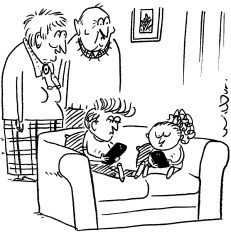
All this is happening in a visual culture where if something hasn’t appeared online then it effectively has not happened. What are mere reports of tens of thousands of Iranians being killed if we lack the visuals?
Of course, one reason for the lack of balance is that the violence is happening in one country – America – and the other in a theocratic dictatorship. But it is also the fact that when the mullahs flick the switch and carry out massacres in effective darkness their trick works. The US President and others warned the Iranians not to execute protesters in public. There was talk of the suspension of some public hangings. But there has been no reported let-up in the public shootings of thousands. The only thing we have lacked is the crucial footage of every interaction that might have caused the world to feel forced to know – and act.
More footage is coming out. The window seems to be closing when outside intervention, plus the domestic pressure inside Iran, might have coalesced. If that is the case then it is obviously a tragedy for the Iranian people. It also says something tragic about our own culture. Dictatorships manipulate – that is their operating procedure. But for us to allow ourselves to be manipulated is another thing entirely.
Don’t give up on gold just yet
Anyone who thought that gold, the world’s oldest form of money, was a safe asset that they could tuck away and forget about has been through a rough few days. It has soared, then plunged, then soared again. Its price has been even more volatile than Bitcoin or one of the overhyped artificial intelligence stocks. Even so, amid all the noise, one point is surely clear: gold’s bull market is not over yet – and it is likely to recover very soon.
It has been quite a ride. After surging to an all-time record of $5,580 (£4,085) an ounce last week, gold tumbled by 9 per cent on Friday. It then fell by another 3 per cent as the markets opened on Monday, taking it back down to $4,554 (£3,334). Silver, its junior cousin, witnessed even more extreme price moves, hitting an all-time high of $121 (£88.60) an ounce on Thursday before falling back by 41 per cent over the next two days of trading. By today, both the precious metals had rallied again, with gold rising by 6 per cent and silver up by almost 10 per cent. Anyone with serious money invested in either will have had an uncomfortable few days.
The long-term case for gold is as strong as it has ever been
It is not hard to work out what has been going on, though. The bull market in both gold and silver was driven by worries about the stability of the dollar. If President Trump was planning to take control of the federal reserve and start wildly printing money, gold would be the only serious alternative. With the appointment of Kevin Marsh as the new chairman of the Fed on Friday, those fears have started to fade. Marsh is a serious and experienced banker, and although he is part of Trump’s circle, no one thinks he is about to trash the currency, at least not in the next few years. The dollar is secure as the world’s reserve currency for now.
Despite that, the long-term case for gold is as strong as it has ever been. Government deficits have been rising for years and show no signs of ever coming back under control. The US deficit will be more than 5 per cent of GDP this year, even though the economy is booming. France will borrow more than 5 per cent of its output, the UK more than 4 per cent, and even Germany has joined the debt party, with massive borrowing to fund spending on defence and infrastructure.
As long as governments continue to behave like that, there will be rising demand for what has always been the main alternative to printed money. The last few days have been a wild ride, and lots of the speculators and day traders who jumped on the soaring gold and silver price last week have been burned. But the long-term bull market in precious metals is as strong as ever – and that is not going to change any time soon.
David Cameron is right: spiteful Labour is wrecking our schools
Agreeing with David Cameron was not on my bingo card, but politics in 2026 is a funny old game, and so here we are. The former prime minister has blasted the Labour government for taking ‘a spite-laden wrecking ball’ to school reforms that raised standards, improved education, and benefited children from the least well-off backgrounds. And he is right.
Labour’s infantile crusade against elitism extended to cutting the state-school Latin Excellence Programme
Since their very first days in office, Keir Starmer and his Education Secretary Bridget Phillipson have seemed intent on destroying Britain’s finest schools. The decision to add VAT to fees has led to the closure of more than 100 private schools, among them small institutions catering for children with special educational needs, top-performing prep schools and an 850-year-old Cathedral school.
Each closure means disruption for children and their families, and job losses for teachers and support workers. But Labour’s determination to wage class war and get one over on the toffs means this is of no regard. How else to explain the decision to introduce fees at short notice, and halfway through the academic year, leaving parents struggling to make alternative arrangements? Of course, this sop to militant teaching unions has little impact on the super-rich. It’s aspirational families, those who wanted more than the state could offer, but could only just afford it, who have had to move their children elsewhere.
Labour’s infantile crusade against elitism extended to cutting the state-school Latin Excellence Programme, which had provided funding for over 5,000 pupils to study this ancient language. Again, cuts were made mid-way through a school year, causing serious disruption. And again, the wealthy, in public schools, had their Latin lessons continue. It was bright and enthusiastic state-school kids who suffered.
Cameron is absolutely right to say that, when it comes to education, Labour has been engaged in ‘curbing aspiration, curtailing excellence, levelling down and denying so many children the opportunities they deserve’. His intervention comes in response to the government’s Schools Bill, which is currently making its way through Parliament and returns to the House of Lords today. While much attention has focused on whether a social media ban will be added to the legislation, shocking proposals for education have been largely overlooked.
Central to the Schools Bill are proposals to erode the freedoms granted to Free Schools and Academies. These institutions were established by Tony Blair, under the last Labour government, but really took off from 2010 onwards, when Cameron was prime minister and Michael Gove was his education secretary.
The 750 Free Schools currently operating in England are independent of local education authorities. They have the power to adapt the national curriculum, determine the shape of the school day, introduce strict behaviour rules, and set their own policies for hiring staff. Many, including most famously Michaela Community School in north London, led by the indomitable Katharine Birbalsingh, have proved to be astonishingly successful, regularly topping school league tables despite working in socially deprived communities.
Yet rather than defending these schools and allowing more children to benefit from a great education, Labour has sought to appease the teaching unions that demand the sham equality of low standards for all. Despite being budgeted and ready to go, Labour cancelled the Free Schools that were green-lit by the previous government. This includes Eton Star Academy in Middlesbrough – a project close to Cameron’s heart, for being led by his alma mater, and close to my heart for being in my birthplace.
I am too old to have attended a Free School, but I did benefit from a previous Conservative education policy that gave parents the right to choose their child’s school. Aged 11, I was bused out of Middlesbrough and sent to a high-performing school in a neighbouring town. Under Labour’s Schools Bill, even this would be made more difficult. Phillipson has thrown her weight behind local authorities that want to block popular schools from growing and force children into nearby, under-performing institutions. My teenage self would hate me for saying it, but the ex-Tory leader is right when he says: ‘Labour’s message to aspirational parents and pupils in Middlesbrough? “Know your place.”’
For all its many faults, the 2010 coalition government, led by David Cameron, established a phonics programme that drove up reading standards in primary schools, alongside a more rigorous curriculum and challenging exams in secondary schools. All children benefited from these improvements, but children from the most deprived backgrounds undoubtedly gained the most. Yet the sixth-form socialists currently running the country sneer at elitism and view aspiration as a threat. Their Schools Bill promises to destroy education and thwart the prospects of working-class kids.
Why Turkey wants to help Iran
The Iranian regime remains firmly in the crosshairs of American bombers. As President Trump mulls whether to strike, Turkey is using every available channel to halt a military intervention. President Recep Tayyip Erdoğan has personally offered to mediate between Tehran and Washington. At the same time, Turkish authorities have tightened their grip on exiled Iranian opposition figures.
Turkey’s sudden support for Iran is not born of friendship. Over the past two decades, the two countries have repeatedly found themselves on opposing sides. In the Syrian civil war, Iran sent Shi’a proxies to prop up the dictator Bashar al-Assad, while Turkey armed and trained Sunni rebel groups. Ankara’s push for dialogue is driven by a fear of regional destabilization. Should the US strike, Turkey worries Iran will descend into chaos or an all-out civil war. This could prompt over a million people to flee – likely toward the Turkish border.
Turkey can hardly handle another such wave. There are still almost three million Syrians in the country who fled their own civil war. Hosting the largest number of refugees in the world has cost Erdogan dearly among the electorate. If another wave of migration begins, even billions of euros from the EU will not persuade Ankara to reopen its doors.
In fact, reports have leaked of a government contingency plan to create a buffer zone inside Iran if the state collapses. This would serve to contain migration and stop Kurdish militants from gaining a foothold in a post-Ayatollah Iran. The Turkish army already maintains similar zones in Syria and Iraq.
There are well over 100,000 Iranians already living in Turkey, many of them dissidents. While the Iranian security forces were massacring protesters by the thousand, Iranian opposition rallies in Turkey were banned.
An Iranian dissident journalist, Kaveh Taheri, was arrested by Turkish police on January 26 and sent to a deportation center. He had lived in Turkey for 13 years and was awaiting a humanitarian visa for Europe. The authorities may now deport him for “posing a threat to Turkish national security.”
“If they deport Kaveh, the regime will execute him. I am 100 percent sure,” an Iranian who knows him well tells me on the phone.
Saeid Soltani (not his real name) is another Iranian dissident who has been living in Istanbul for many years. He fled Iran after he was repeatedly jailed for his journalistic work and activism. His crime was campaigning against underage children being given the death sentence.
“Everyone I spoke with knew someone who was killed,” Soltani says of the latest protests. “In the city of Rasht, fleeing protesters hid in the bazaar. The [IRGC] set fire to the bazaar to force them out. Then they opened fire. The bodies were left on the streets. In Rasht alone, at least 700 people died in one day.”
Despite having left Iran, Soltani still lives in fear. His Turkish residence permit was denied a few months ago. If the police catch him, he’ll go straight to a deportation center. Last summer, he began receiving threats and photographs of his Istanbul apartment from an Iranian phone number.
The Iranian secret service is active in Turkey. Soltani believes that as long as they target fellow Iranians, the Turks will rarely intervene. In 2019, an IRGC whistleblower was shot dead in the middle of Istanbul. The following year, an opposition leader was abducted from Turkey, smuggled across the border and executed.
Israel is a key reason why Ankara lobbies for dialog over regime change in Iran
“I know for a fact that the Iranian consulate in Istanbul has 400 people on its payroll,” Soltani continues. “Do they need 400 diplomats just in Istanbul? Of course, a lot of these are intelligence.” He claims that regular Iranians are often approached to become informants. This creates an air of paranoia where it is difficult to trust anyone among the diaspora.
When agents target the US or Israel, the Turkish response changes. Last week, six people were arrested for carrying out surveillance at the Incirlik NATO airbase in southern Turkey. Other alleged Iranian plots against Israeli tourists have also been thwarted.
While Turkey does not want Israelis getting assassinated on its soil, Israel is a key reason why Ankara lobbies for dialogue over regime change in Iran. A common narrative in pro-government media is that after Iran, the next target will be Turkey.
The anxiety is not entirely baseless. Israel bombed Syria, Lebanon, Iran, Yemen, Qatar and the Palestinian territories in 2025 alone. While hitting a NATO member like Turkey is probably a step too far, the collapse of the Iranian regime would leave Israel’s military dominance in the region unrivaled.
The British countryside isn’t racist
In the fevered imagination of those obsessed with implementing ever greater ‘diversity’, there is seemingly no object or aspect of life they won’t seek to change at all costs. Thus it’s no surprise to hear that the latest target of opprobrium is the British countryside itself.
It epitomises the blundering ignorance of the global, Anywhere class who have been in charge for too long
Following a Defra report in 2019 that revealed that some saw the countryside as ‘being for white people and middle-class people’, officials have spent the last few years working on changing that – by making the great outdoors more welcoming to ethnic minorities. National Landscapes, a charity mostly funded by Defra, has been busy overseeing the diversity drive. New proposals at local level include producing fresh marketing material featuring people from ethnic minorities written in ‘community languages’, and the suggestion that dogs should be kept under tighter control because some groups dislike them. The management of Surrey Hills has already concurred that ‘some demographics are under-represented in our countryside’, while Suffolk and Essex Coast Heaths has expressed concerns about ‘the composition of visitors’.
Never mind the hideous management-speak that proliferates among our rural custodians, who seem to perceive the countryside a mere amenity or theme park. Never mind also the technocratic verbiage and all its crude utilitarian intent. What’s more guaranteed to revolt many is the customary and predictable asymmetrical multiculturalism on display, an ideology which remains entrenched in the class who run Britain. This is the inconsistent belief that all cultures are equal and valid – except, it seems, that which pertains to the historically indigenous people of this country, whose culture is held in lesser regard and whose people are expected to make undue concessions and forever apologise for who they are.
One concern of Defra is that rural facilities ‘cater to white English culture’. According to its research, ‘Protected landscapes were closely associated with “traditional” pubs, which have limited food options and cater to people who have drinking cultures. Accordingly, Muslims from the Pakistani and Bangladeshi group said this contributed to a feeling of being unwelcome.’ Those doubting, snide inverted commas reveal much about the aloof mindset of our civil servants. And it’s not as if those who run pubs haven’t enough on their plate right now, proprietors of drinking holes which for centuries have been at the heart of genuine, organic and indeed traditional communities.
At a time in which so many in Britain are already alarmed about the rapidly changing demographic composition of their country – a transformation that began with Tony Blair’s decision to open the doors to Eastern Europe immigrants in 2004, and accelerated with the ‘Boris wave’ earlier this decade – such an initiative is hardly likely to calm the nerves of a people increasingly looking for salvation in Reform UK.
Its leader, Nigel Farage, became the most consequential politician of the age by focusing on a class who many blame for destroying the fabric of this country: the out-of-touch, liberal metropolitan elite – he repeats these cliches deliberately and to good effect – who have little affection for or attachment to this land. Nothing could cement this perception more than this latest diversity drive.
It embodies a form of technocratic authoritarianism that has been central to the ruling classes ever since globalisation arrived in earnest after the end of the Cold War, one which announced itself here with the election of a New Labour government and creed in 1997. Intrinsic to Tony Blair’s neophilia and heavily diluted Christianity was his belief that the state should be reorganised and that it should facilitate tolerance and good behaviour because it was ‘the right thing to do’.
The encouragement and enforcement of multiculturalism was one key ingredient in this regard. This ideology in its statist incarnation has no truck with the previously accepted understanding that different ethnic groups should be free to concentrate and assemble in different parts of cities and the countryside, as has been the natural tendency of different peoples since time immemorial. This new initiative reflects the notion that this country everywhere should ‘represent’ the precise ethnic make-up of Britain as a whole.
It epitomises the blundering ignorance of the global, Anywhere class who have been in charge for too long, a self-seeking, preening elite who appear to care for their esteem and reputation far more than their country or its people. They always make matters worse as a result. Nothing is more likely to aggravate racism than proposals which so wantonly insult and demean the left-behind of this country.
It reflects, once more, the imposition of a corrosive, high-status ideology. It is as much to do with enforcing uniformity as encouraging diversity. And ironically, and tragically, its chief consequence will be yet more division and more rancour.
Colombia can’t give Trump the cocaine crackdown he wants
When President Donald Trump hurled abuse at Colombia’s President Gustavo Petro last month, branding him a “sick man who likes making cocaine and selling it to the United States,” it was strikingly audacious. Trump leaned into bombastic provocation: there is no evidence to suggest Petro himself makes cocaine. And yet, Trump’s claim didn’t come as a shock – the two leaders have spent the past year locked in a volley of barbs with one another.
Petro, Colombia’s first left-wing leader, likes to fire back with ideological, often sermonizing lectures on imperialism and US hypocrisy. But tangled up in the rancorous exchanges – many of them about drugs – is a stubborn fact: Colombia is the world’s largest producer of cocaine. With the US a primary destination for the drug, Trump wants less of it to be produced and fewer drugs in general to cross the border into America. It is this issue which is likely to dominate when these two unpredictable, ideologically opposed leaders meet in Washington today.
Perhaps an exchange in person rather than online or in speeches will dampen the verbal fireworks between Trump and Petro – or they could explode into an eccentric display of political theatrics. Whatever the outcome of today’s meeting in the White House, and even if they emerge declaring themselves newfound amigos, Petro cannot give Trump what he wants. Colombia’s cocaine production will not stop anytime soon – and neither will the flow of drugs to the US.
Consumption in the US remains strong and is expanding across the globe
Globally, around 25 million people use cocaine every year, and Colombia supplies nearly 70 percent of it. Trump has singled out Petro – a former guerrilla fighter in his younger days – as a convenient political target, accusing him of running “cocaine mills,” in part probably because of his open defiance of Washington. Petro even stated last month that he was ready to take up arms again if the US launched military action in Colombia following veiled threats from Trump.
While the barrage of criticism targeted at Colombia from the White House is relatively new, the scourge of cocaine in the country isn’t. For decades, Colombian governments relied on hardline military strategies, targeting traffickers and small farmers who grow coca crops, the leaves of which are the raw ingredient for cocaine. But the problem persisted — and coca and cocaine kept coming back.
Petro has continued operations against major traffickers, boasting record cocaine seizures and more than 700 extraditions to the United States since 2023. He has also promoted voluntary substitution programs for coca plant farmers – yet coca cultivation remains the highest it’s ever been. Last year, the US decertified Colombia as a partner in the fight against drugs, a symbolic blow that further strained relations.
Last year, Petro also claimed that “cocaine is illegal because it is made in Latin America, not because it is worse than whisky” and floated the idea of legalization. As a result, some – including Trump – question how serious he is about tackling drugs.
But beneath the Colombian president’s eccentric rhetoric lies a more substantive point. He’s not saying cocaine is benign, but that the illegal cocaine trade devastates Colombia far more than the US, fueling a multibillion-dollar economy that sustains armed groups and entangles rural regions.
The 2016 peace deal between the Colombian government and the guerrilla Revolutionary Armed Forces of Colombia (FARC) ended decades of war, but it did not dismantle the country’s coca economy. In fact, it grew, as dissident factions and new groups moved in to fill the vacuum. Petro has tried negotiating with FARC and other armed groups under his “total peace” plan, but the cocaine industry remains strong. He cannot even stop its production at home, let alone its flow to the US.
Aside from this, though, Trump and his continued pressure on Colombia seem to miss the core driver behind the country’s cocaine industry which lies beyond Bogotá’s reach: demand. Consumption in the US remains strong and is expanding across the globe. Petro’s term in office runs out in August, but whoever succeeds him as president will have just as little control over how countries consuming Colombia’s cocaine address drug use – be that through treatment, regulation or punishment.
So as long as consumers keep demanding cocaine, Colombia will keep supplying it. For drug traffickers and cartel bosses, it’s a lucrative income. For the coca farmers themselves, the crop is hard to beat. It provides a more reliable living than legal crops which require more time, decent roads to transport them, and markets to sell them in.
And yet, while the drug trade poses real challenges, Petro has become a political punch bag for Trump. The row between the two over drugs merely provides a convenient lever.
Trump thrives on leverage and submission; Petro is one of the least inclined leaders in the region to offer either. Petro’s public challenges – over the treatment of Colombian migrants on deportation flights to America, the US’s bombing of alleged drug boats in the Caribbean and Pacific, broader foreign policy issues such as Venezuela and Palestine, as well as deepening ties with China – don’t align with Trump’s expectations. What’s more, the capture of Nicolás Maduro in Venezuela reminded Bogotá that Trump’s threats can translate quickly into action – even more worrying given Trump warned Petro that he too better “watch his ass.”
While Trump says he wants less cocaine making its way into the US, he also wants more power, praise and obedience. Unless Petro is willing to pander to the President in ways he has consistently resisted, even small conciliatory gestures will not satisfy Trump for long. The cocaine will keep flowing – and, most probably too, so will the verbal sparring.