-
AAPL
213.43 (+0.29%)
-
BARC-LN
1205.7 (-1.46%)
-
NKE
94.05 (+0.39%)
-
CVX
152.67 (-1.00%)
-
CRM
230.27 (-2.34%)
-
INTC
30.5 (-0.87%)
-
DIS
100.16 (-0.67%)
-
DOW
55.79 (-0.82%)
Benefits treats: how Britain became a freeloader’s paradise
Plastered around Westminster this Easter were adverts for the Tower of London. ‘The perfect place for troublemakers – pre-book now,’ the poster read. ‘Members go free.’ So too – near enough – do those on Universal Credit (UC).
Easter-holiday treats can be expensive for hard-working families. For those on benefits they’re a breeze. A trip to the Tower of London for a family of four costs £111. But if one of the parents is on UC (or a long list of other benefits), a £107 saving is applied and the whole family can get in for just £4. Visit the Tower’s café for fish and chips and UC bags you a half-price meal (£16.95 for the rest of us).
If looking at animals is more attractive than looking for a job, the Zoological Society offers those on UC an £82 discount to London Zoo, reducing the family ticket from £108 to £26. It’s the same story across London’s most popular tourist attractions: HMS Belfast (£68 discount), St Paul’s Cathedral (£61), Westminster Abbey (£60), the Cutty Sark (£54), Kew Gardens (£45), the London Transport Museum (£44) and the Science Museum’s Wonderlab (£27).
It gives a whole new meaning to the term ‘leisure class’, and this benefits bonanza is hugely popular – with those on welfare. Less so for the rest of us, who are paying for it.
This is not the Britain Keir Starmer and Rachel Reeves pretend they live in. ‘I believe in a Britain founded on contribution,’ the Chancellor declared at last year’s Labour conference. Her vision, she concluded, was of a country ‘defiant in an uncertain world and powered by the contribution of its people’.
Fast-forward six months and that uncertain world has arrived. The defiance, though, is missing. A dispirited Treasury now joins the OECD and IMF in warning that the UK could be among the worst-hit nations in the world by red-hot inflation and recession. Households will be squeezed.
What is certain, though, is which people this government will protect. And it won’t be those who pay their dues. Instead, Britain’s shrinking working middle finds itself trapped in a vice. Above, sitting prim, are asset-rich pensioners (a quarter of whom are millionaires) who are protected from and by every government decision. Below are those living on welfare, increasingly insulated from rising costs and shielded from hardship.
Benefits claimants are now the real focus of Labour’s attention, advocacy and largesse, as the Treasury’s response to this latest crisis shows. Having correctly identified that a Liz Truss-style subsidy-for-all approach to household energy costs – forecast to climb by £332 each – is unaffordable, Reeves instead favours a ‘targeted approach’. And those singled out for any spare cash? People on benefits. This is partly because Whitehall prefers to use the existing benefits system to assign spending than through fairer means but also because Britain under Labour is now – literally – a welfare state.
We don’t just redistribute more to benefits claimants when crises strike: almost the entire public sector is geared permanently to making welfare an increasingly attractive way of living. Welfare-advice websites are awash with listicles of the top ten days out for those on UC, with staggering discounts advertised. Ticketing and events sites dedicate whole sections to discounts for those on benefits – and they’re proving popular. London Zoo sold 300,000 UC tickets in 2024/25 with only a screenshot or PDF required as proof. The annual accounts of Historic Royal Palaces (which runs the Tower) show that they have adjusted the ‘admission income yield to ensure overall income isn’t reduced’. In other words, those of us buying full-price tickets are paying more to subsidise the cheaper tickets.
Welfare advice websites are awash with listicles of the top ten days out for those on Universal Credit
The same is true in state-subsidised leisure centres. Better, which provides swimming pools, gyms and sports facilities on behalf of London councils, offers half-price memberships for benefit claimants. While a chunk of these discounts are covered by charities or full-fee payers, the thinktank Onward has identified a hidden benefits bill of £10 billion paid directly by taxpayers. Onward’s report reveals discounts for broadband, reduced council tax bills, subsidised utilities, cheap travel and even holiday provision. Add it all up and it’s hard to argue that those on benefits are enduring this cost-of-living crisis in quite the same way as the rest of us.
This week, the standard UC allowance rose by 6.2 per cent – just shy of double last year’s inflation rate. Labour has guaranteed the allowance will rise above inflation for the next three years. Meanwhile, average earnings for employees are up just 4.1 per cent. At the same time, those in work are expected to help shield the economy by drawing down savings built up during the pandemic, while frozen tax thresholds drag five million more people into higher bands.
To understand where the rot began, you have to go back to a Tory policy, ‘Help for Households’. In the dying months of the Boris Johnson government, David Buttress, a former CEO of Just Eat, was appointed ‘cost-of-living tsar’. On top of the discounted entry prices for attractions, he pushed for ‘social tariffs’ on broadband and browbeat retailers, including Asda, Morrisons and Amazon, to offer discounts to shoppers on welfare. Not only were these policies popular but they were seen as a right by a public that now demands more and more state support. Truss, Rishi Sunak and now Starmer have bolstered them.
When governments give up on growth as the driver of higher living standards, they reach instead for controlling the cost of living. Labour takes the same approach. Starmer has appointed Lord Walker of Broxton, the executive chairman of Iceland, as a ‘cost-of-living champion’. Much of this role seems to involve attacking business. Two weeks ago, Lord Walker said: ‘Businesses using a global crisis to rip off households need to be called out and penalised.’ Indeed, since the Iran crisis began, not a week has gone by without Reeves or Starmer summoning supermarket bosses, shipping magnates or petrol producers to Downing Street to insist the government ‘can’t do it alone’ and demand support.
Part of this is pure political strategy: create a myth of price gouging and profiteering when prices rise in order to shift the blame away from your management of the economy. But there is also a deeper misunderstanding of the role prices play.
The unintended consequence – as we’ve seen before – is untrammelled inflation. A top Treasury official – at the coal face in 2022 – explains: ‘We put in place a whole load of support schemes for households and companies which enabled them to accommodate higher energy prices without having to cut their expenditure elsewhere. And so the price of the whole basket went up. I can’t escape the conclusion that it was a combination of those energy price hikes by fiscal authority that enabled inflation to rise so high.’
Factor in the discounts, price protection and top-ups, and the British system is a pretty lavish one
Now, Labour plans to bake all this into the system by reviving a Gordon Brown plan to add a new ‘socio-economic duty’ to the Equality Act. The change will force public bodies to consider reducing inequality in everything they do. The trouble is, as the Chancellor discovered when scoping out means testing, the Whitehall system will revert to the path of least resistance and meet its duties by prioritising those on benefits, entrenching this two-tier system in law.
Advocates of the status quo argue that our welfare system is actually not generous at all. And it’s true that, on its own, Universal Credit is not especially benevolent. A single adult over the age of 25 who is out of work receives £424.90 a month as a basic allowance, placing Britain towards the lower end of OECD members. That leaves the British system behind countries such as Germany (£490) and France (£530). By contrast, the most generous systems in Europe are in the Netherlands and Denmark; support in the latter can reach £2,500 a month or up to 90 per cent of previous earnings.
Our European neighbours are more generous on child benefit too. While we argue about the two-child cap (which was abolished on Monday), countries such as Sweden and Austria offer higher child payments and bonuses for larger households. But this generosity comes with far stricter expectations.
A Briton out of work typically receives far less of their previous salary than workers elsewhere (12 per cent vs 55 per cent). But those more generous systems also expect more in return from those out of work. The Danish system operates more like unemployment insurance, and every citizen has to pay a monthly fee to fund their own protection. If you find yourself unemployed your payment is based on past earnings – an incentive for high pay – and, crucially, payments reduce after three months and grind to a halt after two years. It’s our failure to incentivise contribution that makes Britain stand out in Europe.
The message is clear: get back to work. The result is a Danish unemployment rate of just 3.1 per cent. In Britain, by contrast, benefits seem to get more and more generous the longer people are out of work as health-related top-ups remove the incentive to find a job. Millions of benefit-claiming Brits have been out of work for more than half a decade. It’s little surprise, then, that the current unemployment rate is 5.2 per cent.
Once the discounts, price protection and top-ups are added, though, the British system is a pretty lavish one. As one welfare expert explains: ‘It’s the layering that actually makes the British system more generous.’ Add health claims to standard out-of-work entitlements and you really can bring home a tidy sum. Factor in what’s possible after the two-child cap is lifted and the numbers can skyrocket.
Figures from the Centre for Social Justice show that a family with three children, with at least one parent claiming the average rates of Universal Credit, housing and health benefits including Personal Independence Payment, will get £46,000 annually from the state. Make it five children and this rises to £55,000. This compares with £28,000 after tax for a typical minimum-wage family with one full-time and one part-time parent. To take home the same amount as a three-child family with combined benefits would require a salary of roughly £71,000 before tax – rising to £90,000 to match the benefits of a family of five children.
Estimates suggest around 20 per cent of those entitled to certain benefits don’t claim them
Tot all these layered entitlements up, add in the sheer scale of benefit receipt and it’s easy to see how Britain has ended up spending so much on welfare. On some measures of total social spending, the UK sits among the higher spenders in Europe. But, costs aside, it’s the disincentive to work combined with such a bounty of benefits treats that’s the real killer in the British system.
Worst of all, we’ve not yet hit peak benefit Britain, and the forecasted £120 billion on disability-benefit spending in five years’ time won’t be the end of the story either. Estimates suggest around 20 per cent of those entitled to certain benefits don’t claim them – presumably because they don’t need to. The more top-ups we make available, the more barriers we take down, the more we use the benefits system to unlock things like energy bills support, the more likely even more people will start claiming. No surprise, then, that a trial of ‘self-service’ claiming for Personal Independence Payment saw successful claims up by 7 per cent.
Whether these claims are genuine or not, health-related inactivity is now growing ten times faster than the working-age population. This means fewer contributors supporting more and more dependants through a system of extreme generosity to those on welfare, and punishment economics for everyone else. For Britain’s fraying social contract, this could prove impossible to sustain.
Do you suffer from ‘excited delirium syndrome’?
Hadiza Atunse, a 25-year-old PA, smashed her Toyota Auris into a Mini Cooper, spun out of control and flipped into a hedgerow in Wilmslow, near Manchester. When the coppers turned up, she declined to partake in a breathalyser and the police, mysteriously, did not give her a tongue swab to determine drug use. I say ‘mysteriously’ because the young lady was also found with a large bag of coke in her car.
Later it was discovered that she was driving without insurance. Yet Ms Atunse copped only a £730 fine because the judge seems to have accepted the defence’s argument that she had been suffering from ‘excited delirium syndrome’, which, coincidentally, is what afflicts me in the moments before Bargain Hunt comes on the TV. I run backwards and forwards between the kitchen and the lounge, preparing my Bargain Hunt snack of a mug of tea and two Petit-Beurre biscuits and, wrapped in a pre-show exhilaration, wonder to myself, will one of the experts be the lovely Izzie Balmer, or will it be Danny Sebastian with his grating histrionics? Will the contestants win a Golden Gavel?
It had never occurred to me that my excited delirium might be dignified by the suffix of ‘syndrome’ or that in the future I might be able to use it to mitigate – or perhaps entirely excuse – some appalling crime I might commit. This condition, medically, involves hyperthermia, excessive sweating, superhuman physical strength, violence and incoherent shouting – all of which I go through before Bargain Hunt begins. It is also closely linked to cocaine, although in my case I blame the Petit-Beurre, as I’ve snorted Charlie only once 40 years ago and it made me sneeze. (I’ve only done ecstasy once, as well – and that experiment had me laid out flat on a lawn at midnight, clench-jawed, with people holding my hand and saying: ‘Rod, Rod, we all love you.’ Never, ever again.)
Our judicial system lives in a fairy tale, where every malefaction is the consequence of a medical condition
But the magical invention of these ‘syndromes’ to describe what is simply anti-social or criminal behaviour – beginning with ADHD, by the way – is one of the great growth industries of our age, along with vape shops, Kurdish heroin cartels cutting people’s hair ineptly and the magnificent, grandiose con of psychotherapy, a handmaiden to narcissism. If only such imagination had been abroad when Hermann Goering was in the dock at Nuremberg: ‘My client suffers from acute body dysmorphia, depression and excited delirium syndrome. This explains the carpet bombing of London, the looting of valuable artefacts, the stuff with the Jews – everything, really, your honour.’ And Hermann walks away with a 750 mark fine and a lifetime of being interviewed by a sharp-eyed and suspicious Gitta Sereny.
Do you ever get the feeling there is something wrong with our criminal justice system? That we have somehow lost a grip on the reins? That the balance has tilted so far away from the victim and in favour of the perp that we may as well embrace the proposal put forward by the imbecilic, buck-toothed Scottish Green munchkin Kate Nevens and abolish prison and essentially criminal justice altogether? Our judicial system still lives in a land of fairy tales, where every human malefaction is the consequence not of wickedness or selfishness, but of a medical condition which absolves them of guilt, even if that condition is simply ‘intense stupidity’.
This denial of responsibility on the part of the individual is the only way that the liberal left can support its sociopathic hypothesis that the only real crimes in society are success and hard work and discipline and the accumulation of wealth. Everything else is the consequence of unfortunate genetics.
You will remember the larks – what larks! – occasioned when hundreds of mainly black youths went on the rampage in Clapham, shoplifting, terrorising locals, vandalising, a week or so back. The coppers advised stores to close for an hour or so – thanks for your help, the Met – and in the end arrested only six teenage girls. Why did they not go in equipped with riot shields and truncheons and drag the rioters into paddy wagons? No such luck – that’s from a previous, fascistic era. In this era the store owners who pay not only their taxes and extortionate business rates foot the bill, and the feral scumbags, the skanks, who contribute nothing to our economy, are allowed their fun with no redress.
Shortly after this happened the newspapers wrung their hands and wondered why young people were occasioned to behave in such a manner. Of course it wasn’t all young people. Nor, in truth was the description ‘black’ precise enough. It seems to have been British Caribbean young people – not, as Kemi Badenoch pointed out, African kids. ‘You do not see scenes like this in Lagos or Nairobi,’ she said.
Anyway, here’s how Lee Elliot Major, a professor of social mobility (how can you have a professor of social mobility? It’s not a subject or a discipline. It’s a state of wishful thinking), explained it in – natch – the Grauniad: ‘There’s nothing new about young people organising mass meet-ups. What’s changed is the context. We’ve dismantled the physical spaces where young people used to gather safely: youth clubs, community centres, even affordable public venues. Digital platforms have taken their place, organising gatherings at speed and scale. We often frame these moments as problems of behaviour. But they are also symptoms of a deeper shift: a generation with fewer structured opportunities, fewer shared spaces, and more uncertainty about where they fit.’
They are problems, you absolute plank, of atrocious socialisation, rotten parenting and wickedness. These people did not riot because of a lack of opportunity to play a game of ping-pong in a youth club. It is not about a lack of ‘structured opportunities’, whatever the hell they are, but a lack of decency and probably a mistaken sense of victimhood inculcated by faux academics such as yourself, Lee.
Is a ‘link-up’ a modern ‘flash mob’?
The public disturbances in Clapham, achieved by social media link-ups, have their precedents. ‘You can imagine what an exhilarating week this has been,’ wrote Harold Nicolson in 1945, ‘The surrounding of Berlin; the link-up with the Russian armies.’
Link-up, first recorded from 1945 by the Oxford English Dictionary, has since been applied chiefly to military connection and that of spacecraft.
On the same day as the first Clapham disturbance, three ‘flash mobs’, as they called themselves, were honestly busy in Slough High Street, doing little dances and holding up placards calling for the place to be named UK Town of Culture 2028.
This outbreak belonged to a slightly old-fashioned trend that began in 2003 for crowds suddenly to materialise to do something attention-seeking, such as the flash mob at Grand Central Station.
By chance flash mob shared a name with the petty criminals exemplified Henry Twiss, ‘one of the flash mob’, charged in London in 1832 with stealing silver coins and a purse. Since the 17th century flash coves had lived in flash cribs and spoke a flash cant.
Of course mob was a triumphant apocopation of mobile vulgus, coined in the 18th century during a vogue for abbreviations. Others, like incog, have not lasted.
An alternative to flash mob was invented by the American critic Howard Rheingold, whose book Smart Mobs (2002) ranged wider than groups organised by mobile phone.
Before mobile phones, steaming gangs, first named in Hackney in 1987, depended on pre-digital communications.
At the moment, ‘Link me up, Scotty’ is a humorous way of requesting a website’s URL, based on a line in Star Trek, ‘Beam me up, Scotty’, which according to experts (who proliferate) was never uttered in that form. It is too soon to tell if link-up will establish itself as a name for a call to mob action.
2744: Fiddles – solution
The unclued lights are DOCTORS and all can be verified in Brewer.
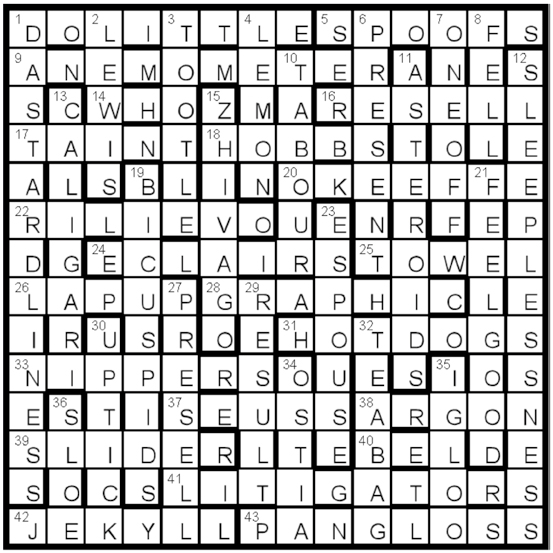
First prize Sarah Darlington, Acton Trussell, Stafford
Runners-up Colin Ratledge, Leven, East Yorks; Mark Humble, Beercrocombe, Taunton
The cattle rustlers have returned
Kenya
When a mob of Somali cattle I bought in Kenya’s far north arrived on the farm in February, we quarantined them in a remote corner. To protect them against lions they slept in a boma with high drystone walls topped with treacherous thorns, guarded by a fierce police-licenced guard named Joseph.
The Somalis are great stockmen, though these beautiful beasts, known as Awai, are more long-legged and rangy than our traditional ranch Borans. My lorryload of cattle had survived a two-year drought on rocks and dust and they could walk hundreds of miles to water, yet they were randy and highly fertile. These are ancient cattle, of the sort that you see in petroglyphs and ochre painted on rock faces across Africa. I have fallen in love with them.
Along with the cows I’d bought were some young bulls I wanted to castrate, but my stockman Leshoomo forbade me to do it, saying word had spread about them locally and his Samburu people were clamouring to buy them for breeding. We hadn’t even branded them with our herd number, KH9, because we wanted to let them recover from the journey first.
Last week, a gang of seven armed Samburu rustlers attacked Joseph in the boma after sundown, pouring bullets into the stockade. As the cattle inside stampeded around, brave Joseph took cover among them and whenever he saw a head pop up above the wall in the moonlight, he fired a bullet at it. In all, around 20 shots were fired from both sides and finally the raiders took off. I was away from the farm that evening but drove through the night, arriving at dawn to find three cattle shot in the crossfire, bullet holes and blood everywhere. I’d asked for the badly injured cows to be slaughtered and I came upon Joseph looking distraught among the bodies, their throats all slashed.
It was our first cattle raid for 13 years and we had long fooled ourselves that rustling was a thing of the past in our valley. I had fine memories of gunfire and adventures, of sleeping on bandit tracks out in the high plains with my cowhands in pursuit of lost stock, staring up at the constellations, – and I sometimes felt almost gloomy that the world had become so dull with progress. Naturally, however, livestock rustling still goes on across northern Kenya and it was only a matter of time. Recently I had seen many Samburu warriors wearing the white-beaded headband that shows they are about to become elders, when they’re allowed to marry and acquire cattle wealth. Such rites of passage traditionally involve an orgy of rustling to acquire cows to pay the bride price.
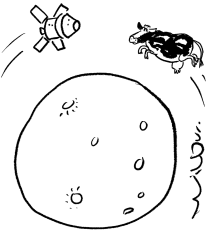
Years ago, we were on our own when a raid occurred. In those days we had no firearms and so all we could do was wait for the raiders to get away with our animals and then track them for days while we negotiated with the Samburu elders to intervene and return what was ours. The Samburu traditionally believe that they had once lived on Lakira Lesiran – the planet Venus – where God had given them cattle. In time, they had overgrazed the planet so badly that God slung a rope from Venus to Earth. Down this he sent both humans and cattle to a water spring called Malalua, some 20 miles north of our farm. After their arrival among Earth’s virgin pastures, though cattle spread among cultures, the Samburu still believed all cows should be returned to them, so taking them is not stealing.
On the morning of the recent raid, I was amazed and grateful when teams of police reservists from five other farms and wildlife conservancies mustered to help us track the bandits. In all, 30 men were deployed, together with relay teams of bloodhounds which picked up the raiders’ scent and bounded off across the plains baying loudly. At one point a ranger team used a drone. A senior police officer appeared and suddenly an armoured vehicle called a Rhino, armed with a heavy machine gun, trundled by. The dramatic response was welcomed by a number of Samburu, who feared that rather than return home empty-handed, the retreating raiders might turn to rustling livestock from their own people’s cattle camps.
After 12 solid hours of tracking, the scent had evaporated and the trail went cold for the bloodhounds. The rustlers had given us the slip, perhaps to raid another day. But we were on the plains, close to the springs at Malalua. It was the eve of my 61st birthday – and I’d spent it chasing cattle rustlers. We packed it in for the day and I invited all the men for a feast made from the raid-slaughtered cows. Joseph was the hero of the day.
2747: Head of the herd
‘1A/36A/1D/4D’ (five words in total) is an extract from a song about the escape of 21D/15D (three words in total). Remaining unclued lights tell when and whence the escape occurred.
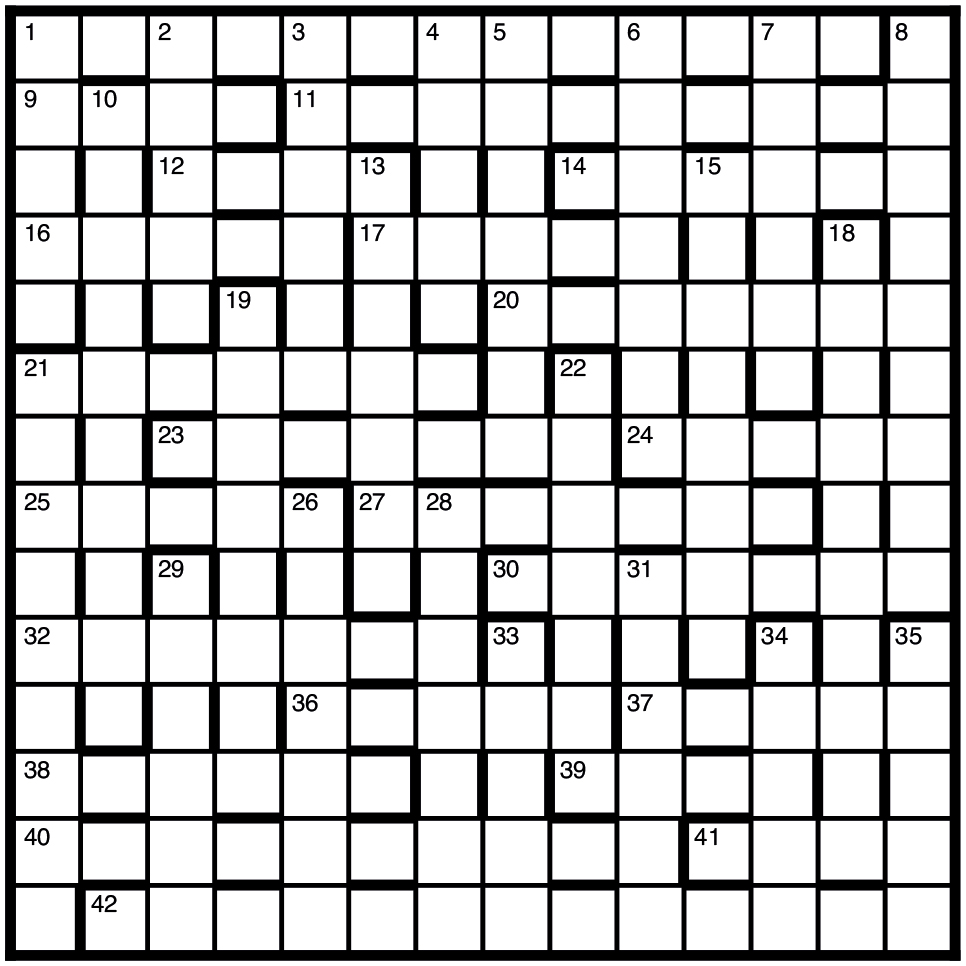
Across
9 Orderly really not tense (4)
11 Arab runs past the dark carbonate mineral (10)
12 Small flock nibbled rhubarb (4)
14 Certain proteins no longer in beer (nothing turns on it) (6)
16 Woman has money, gold and silver (5)
17 Message from Spain fellow heard (5)
20 Rhine in Germany is more vigorous (7)
21 Careless treatment of poor Glen shocks (7)
23 Maybe Grace Darling in junk heading for Eastbourne (7)
24 Shy grandmaster (5)
25 Bright like brass in Vilnius (5)
27 Pound note for Samson suggested by female? (4,3)
30 Snaps capturing nice sliced pieces of cake (7)
32 Fashionable fruit Oscar plucked is pottable (2,5)
37 Rectrix stripped and flexed straight muscles (5)
38 Barber in fashion less than kind (6)
39 Nymph to follow slavishly (4)
40 Japanese spa town greeting aguish Zulu I treated (10)
41 Large fish in Buckeye State dad caught (4)
42 Abused consorts left at an astronomical rate (5,8)
Down
2 Extreme insult rajah swallows (5)
3 Cowslip, whitish, I start to grow inside (6)
5 Young posho cut the rabble with a new dagger (7)
6 Trundles in classy cars (7)
7 Socialising baseball team Chinese dynasty hosts (6)
8 Resident doctor initially repaired parts of nerve cells (9)
10 Crude Bedouin shocked ten (not nine) (10)
13 Fish and a different fish rounding island (7)
18 Reddish-brown carrot tenor ate con brio (10)
19 Scruffy old women land wearing jumpers (4-4)
22 Chaps skinned kipper and crabs (7)
26 Some present Osaka as an Asian holiday resort (7)
28 Hankie Henry lost Rex spattered with much of mucous discharge (7)
29 Violent gangster nearly strangles no-good no-hoper down under (6)
33 Prenatal procedure I moan about (5)
34 Small bluebottle with 500 hairs on the hindlegs (5)
Download a printable version here.
A first prize of a £30 John Lewis voucher and two runners-up prizes of £20 vouchers for the first correct solutions opened on 27 April. Please scan or photograph entries and email them (including the crossword number in the subject field) to crosswords@spectator.co.uk, or post to: Crossword 2747, The Spectator, 22 Old Queen Street, London SW1H 9HP.
How far would I go for oil?
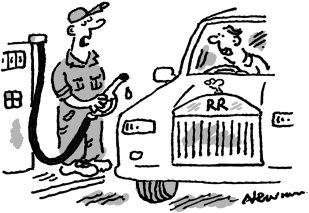
The oil delivery man had way too much swagger and, as he waved his nozzle about, I realised that he might be expecting a little something.
Oh dear, I thought, as he pushed the nozzle into my oil tank, pressed the button on his lorry and spent less than ten seconds giving me the amount of oil I could afford.
Oh dear, what if the oil crisis is now at such fever pitch that desperate housewives in remote places are offering a little something on the side to get more oil?
Ten seconds’ worth of oil did feel like the end of the world. Usually, I can afford to let the lorry fill the entire tank and it comes to about a grand. Now the cost of filling the tank is nearer two grand, so I decided to order €300 worth to tide me over and hope that Mr Trump wins the first war ever won in the Middle East, backs down or has a personality bypass quite soon. If you’re on oil you have to hope for a miracle.
What if the oil crisis is at such fever pitch that desperate housewives are offering a little something on the side?
For about nine seconds I prayed for the sound of the liquid to keep going before it stopped and the oil man pulled his nozzle out with a flourish and gave me a smirk.
He stood by his lorry in my backyard with his engine running and the pump still running and he looked at me and he smirked.
I laughed nervously. ‘I usually do fill up, only I’m waiting to see if… well, you know, I can’t do a fill…’
‘Oh,’ he said, breezily, ‘you couldn’t do a fill…’ And he just stood there.
Did he want an off-the-books cash tip to stick his nozzle back in? Or an offer of something else? Not really my type, I thought. A bit short. Stop it! I told myself.
I was imagining all this, of course I was. I do have a vivid imagination. But also, I’m very intuitive. I have got to know the two or three oil delivery men over the nearly three years we have been in rural Ireland and they have always just filled my tank, clattered their nozzle back into place, pushed a pink invoice at me, climbed into their lorry and driven off.
This one was definitely lingering, giving me very odd looks. When he left, I stuck my measuring stick into the tank to see what I had got and when I pulled it out showing less than a third full I actually felt relieved it was that much. Then I started scraping the dip stick against the inside mouth of the tank so that every last molecule of oil went back inside. It felt obscene to let even one drop fall to the floor.
We installed a new oil boiler system for hot water and heating, rather than eco heat pumps or solar panels that don’t work, because we started doing this Airbnb business. So we have to produce enough hot water for people to shower themselves crazy in our house. You can’t imagine how much showering some people do when they climb into someone else’s shower.
I had two French cyclists last summer who ran the shower in the king-sized en suite for so long I thought they had fallen asleep in there.
People run the hot water until they not only run out the hot water, they drain the water tanks down so it takes hours for them to refill.
Our water comes from a natural spring in the hillside above and is stored in tanks and then pumped around the house with electric pumping machines. As for electricity, it’s many times the cost here than in most of Europe.
In fact, inflation is at such a rampant rate across the board that I went down to the village the other day, picked a small bottle of mouthwash off the shelf in the pharmacy, and when I got it to the till the woman said ‘€9’.
‘No, you don’t understand, I want this small bottle of mouthwash.’
‘Yes,’ she said, ‘it’s €9.’ (I notice it’s also €9 for a chicken in the local supermarket. Maybe the plan here is to just make everything €9.)
‘It’s mouthwash,’ I said. ‘It can’t be €9.’
‘It’s €9,’ she said. (About £8.)
‘But I could buy a bottle of wine for that,’ I said (not that I drink). ‘It would be cheaper to gargle in a decent Côte du Rhône.’ She shrugged.
There was a woman I know standing behind me. I turned and tried to engage her. ‘€9?’ I said. She looked uninterested and said: ‘Oh, I’ve been meaning to ask, have you any rooms for 29 May?’ It was her son’s wedding and she had guests to put up. I said I thought I had two for that date.
Great, she said, because she’d like to book them. I said I would text her the Airbnb link as we don’t do anything off the books. She said that was fine.
Later, after I sent the link, with a goodwill discount applied to the date she wanted, she asked a few questions but pointedly did not book the rooms, even though I made clear that they’d be gone soon if she didn’t book quickly.
She probably looked at them and could not believe the price of a room in my cranky old house is more than €100 a night.
If anyone asks me how I work out my prices from now on, I will say this: a small bottle of mouthwash in Nowheresville, West Cork is €9. That is the base line. Therefore, the price of a bed for the night, with breakfast and unlimited hot showering and the ability to run an entire hillside of water dry, and all the electricity needed to pump that, cannot be any less than ten times the cost of a bottle of mouthwash. This, I feel, is a more than scientific way of doing basic economics.
Dear Mary: how can I tell a friend she has Mounjaro face?
Q. Like many women of a certain age, I’m ‘on the pen’. I’ve lost about 20lb on Mounjaro, which I judge to be enough. However, the friend who urged me and many others to try it has lost more than 60lb. Not only does she have the dreaded Mounjaro face – deeply lined – but she wears short, sleeveless dresses that reveal arms and legs that are, bluntly, not those of a 20-year-old. Mary, I have always felt that tight garments are both unflattering and vulgar. I am also anxious because this well-meaning friend has become a subject of private mockery for turning herself from a voluptuous size 18 beauty to a haggard size 10. How can I tactfully suggest that she needsa bit more flesh?
– C.P., London NW1
A. As the poet Robbie Burns lamented in 1786: ‘Oh wad some Power the gift gie us/ To see oursels as others see us!’ To help your friend, you might club together with other ‘losers’ to purchase a thank-you present for her. A ‘mini me’, which costs £239 from Printerval, is a resin statuette about 9in high. It is a scaled-down, 3D replica of a human. To achieve the chilling accuracy, the human must go into a 3D scanner and have hundreds of photographs taken. As your friend studies the sinister trophy she will indeed see herself as others see her and the penny will drop.
Q. I’ve had a sofa covered in Fermoie linen and it looks really smart. How can I stop my daughter’s grubby boyfriend from leaving scuff marks and grime when he comes at weekends? She’d be furious if I asked him to sit on an older sofa.
– Name and address withheld
A. Take a tip from the owners of smart Airbnb premises who buy remnants and lengths of matching fabric to place on top of smart sofas, tucked carefully in. This means that, should spillages occur, the remnant can go into a cold wash while the sofa retains its pristine perfection. At the Fermoie outlet store in Marlborough, remnants and lengths of fabric can be had at bargain prices as the company is keen to achieve ‘zero waste’. You can order by Zoom appointment should you be unable to visit.
Q. University friends have asked me to a weekend at a house which has a hot tub. I cannot stand hot tubs, with their bobbing plasters and all the bacterial infections they pass on. How can I say ‘no’ when they will all be bullying me to get in? – P.W., Basingstoke.
A. Pre-empt the bullying by carrying a chair to the hot tub and sitting down to chat to them. Claim you’ve just had a spray tan and can’t get wet for 48 hours.
The real reason we should be burning our own gas
Regular readers of this column will be familiar with my promoting an idea called a ‘Paceometer’ (pictured). Rather than presenting speed in, say, miles per hour (distance/time), it presents speed the other way round, in minutes per ten miles (time/distance).
Created by the cognitive scientists Eyal Peer and Eyal Gamliel, the Paceometer shows something which is mathematically trivial but completely non-intuitive. Quite simply, the faster you are going already, the less time you save by going 10mph faster still. Accelerate from 20-30mph and you save ten minutes on a ten-mile journey. Accelerate from 70-80mph and you save just over a minute.
Upgrading to Concorde to fly across the Atlantic saved you less time than your great-grandfather saved in his first 20 miles riding a bike
Once you have seen a Paceometer, you will drive in a completely different way. Formula 1 drivers have learned the distinction intuitively: ‘It isn’t how fast you go, it’s how little you slow down.’
It was the Paceometer which finally revealed to me why the bicycle was such a world-changing invention. A bicycle isn’t all that fast in terms of mph, but a return journey of 20 miles that would take six hours and 40 minutes on foot takes about one hour and 40 minutes on a bicycle. Since the typical human journey is under ten miles, the aggregate time savings from cycling were immense. By contrast Concorde was very, very fast, but only really offered significant time savings to the few hundred people who crossed the Atlantic many times a year. Even then, it wasn’t that significant: upgrading to Concorde to fly across the Atlantic saved you less time than your great-grandfather saved in his first 20 miles riding a bike.
The Paceometer fascinates me because it forces you to ask a philosophical question which the use of conventional metrics typically leaves unasked: what do we really mean by fast? To say that the difference in speed between cycling and walking is greater than the difference between Concorde and a 747 sounds odd, yet at some level it is true.
Perhaps, in all kinds of fields, this need for quantification is making us unwittingly stupid. We glom onto metrics for ease of comparison, ease of aggregation and ease of argumentation. They lend us the appearance of objectivity. But in many cases they are causing us to seek simplicity in the wrong place – in the definition of a problem, not its solution. Oliver Wendell Holmes put it perfectly: ‘For the simplicity on this side of complexity, I wouldn’t give you a fig. But for the simplicity on the other side of complexity, for that I would give you anything I have.’
Look at UK energy policy and you’ll see at its heart a moronic metric, where burning gas bought from Norway does not count in the same way towards our emissions target, as burning gas we already possess does. (By this hand-washing logic, we should simply make all UK gas reserves the personal property of Ed Miliband, blame him for the resulting emissions and then sacrifice him on an altar; this approach worked in the Old Testament, after all.) A far more sensible suggestion would be to devote some of the additional taxes we could raise from using our own gas supplies towards research into alternative forms of energy, research which could benefit the wider world far more than any feeble contribution we can make by reducing our meagre 1 per cent of the world’s carbon emissions.
Many such metrics (think NHS waiting lists) are what you might call a ‘paradigm trap’, where problems become hard to solve because some arbitrary approach to quantifying the problem makes it impossible creatively to redefine it. This is perhaps the biggest difference between what we are taught at school and what we need to thrive in the real world. In school, it is cheating to rewrite the question; in real life, it’s the first thing to try.
Spectator Competition: Take heed
Comp. 3444 invited you to submit a Hilaire Belloc-style cautionary tale for our times. This one was last set in 2009 and the world’s pitfalls have changed a bit since then. There were many very good entries, covering a lot of bases. Commendations to Bill Greenwell, Frank Upton, Basil Ransome-Davies, Sue Pickard, J.C.H. Mounsey, Duncan Forbes and George Simmers (‘Young Eric told such dreadful truths/ He was the most disliked of youths’). The £25 voucher winners are below.
‘But why,’ asked Osbert, ‘should I try
To think when I can ask AI?’
Identifying Osbert’s need
His chatbot fulsomely agreed.
First, algebra and Kierkegaard
Were what young Osbert found too hard,
But soon he couldn’t add, subtract,
Or know how, socially, to act
Without consulting with the bot
And trusting it as he should not,
For chatbots, though their powers are great,
Are tempted to hallucinate.
Poor Osbert now, alas, in thrall
To one that makes no sense at all
Stands as a warning: what you’re taught
Is dogma without human thought.
Adrian Fry
Nina’s family, clever chaps,
Beseeched her to beware of apps:
‘You want some haddock?’ they would say,
‘There’s Waitrose just a stroll away!’
‘Fear appenstances…’ they insisted;
Nina stubbornly persisted.
One day, she tried to change a flight,
That app, it changed her flight all right,
Then showing all that it could do,
It changed her name and passwords too,
It claimed she’d moved to Birkenhead,
It rented out her garden shed…
Poor Nina fought until she broke,
‘Your call’s important to us (joke),’
Then took a flight to Timbuktu,
Because the app had told her to.
Nick Syrett
Hearken to the tale of teenage Spencer
Who ran off to be an Influencer
Ignoring his parents’ heartfelt pleas
Though they wailed and begged on bended knees.
‘Just be an accountant, chef or plumber,
Even join a rock band as the drummer,’
The parents cried with tear-stained cheeks,
But Spencer was deaf to their desperate squeaks.
He took lots of selfies, he posed and he pouted,
He filmed silly pranks, he sang and he shouted,
His follower numbers soon went sky high
And he took himself off to live in Dubai.
He was filming himself on that fateful day
(Boasting how life was no work and all play)
When an Iranian rocket fell on his head
And poor Spencer was rendered entirely dead.
Joseph Houlihan
Henry, the fifteenth Lord Lestrange
Did not believe in climate change.
His seat was a substantial pile
On the north coast of our fair isle,
And every morning he would say:
‘The tide seems pretty high today,
But global warming’s just a tale,’
Until one Thursday, in a gale,
His home fell into the North Sea.
Ever resourceful, Lord Henry
Spotted an ice-floe drifting past,
And leapt onto it, and held fast,
But then he found he had to share
It with a hungry polar bear,
Who, unable to catch a seal,
Thought Henry made a noble meal.
Brian Murdoch
Jemima rode green bikes so fast
You felt the breeze as she whizzed past.
Ignoring road signs, crossings, lights,
She gave pedestrians shrieking frights.
One day she turned her pedals fleet
The wrong way down a one-way street,
Then swerved a red light, without fuss,
In front of an oncoming bus.
A call to 999 was made,
A crew attended, plied their trade:
They gathered up the sad remains,
Took photographs of all the stains.
(Back at the morgue there would be time
To filter out the bits of Lime.)
Don’t ride about like Mr Toad
When other folk are on the road.
Helene Nowell
Lord Sucker lived a happy life
Because he had a lovely wife
Who catered for his every mood
And sent him pictures in the nude
And thanked him nicely when he gave
Her all the money he could save.
He loved her with just one regret
They hadn’t actually met.
He asked an expert: ‘Find her soon
So we can have our honeymoon.’
Meanwhile he gave her beauty’s crown
Until the expert tracked her down
And showed on Sucker’s smartphone screen
A gangling boy of seventeen.
Do not investigate your dreams:
You’ll find that nothing’s as it seems.
Philip Roe
‘You know, at least you ought to know,
Unless your name is Sleepy Joe:
Free speech! It’s in the first Amendment
And Declaration of Independence –
Home of the Brave! Land of the Free,
Defending life and liberty,
Pursuit of happiness, y’all,
And nevermore to be in thrall
To all those woke, repressive laws
Imposed on us, all in the cause
Of Democrat depravity
Like – take the law of gravity…!’
Thus spoke Jim, soon to levitate,
Perched high atop the Empire State –
You’ve guessed the sequel: some laws should
Be heeded – they’re for your own good.
David Silverman
No. 3447: Ouch
You are invited to outdo Kingsley Amis by detailing the hangover from hell in the style of any other writer (150 words maximum). Please email entries to competition@spectator.co.uk by 22 April.
The Battle for Britain | 11 April 2026
No. 894
Black to play. A variation from the game Tan-Goryachkina, Fide Women’s Candidates, Cyprus 2026. White is two pawns up, but Black has a surprising winning move. Which one? Email answers to chess@spectator.co.uk by Monday 13 April. There is a prize of a £20 John Lewis voucher for the first correct answer out of a hat. Please include a postal address and allow six weeks for prize delivery.
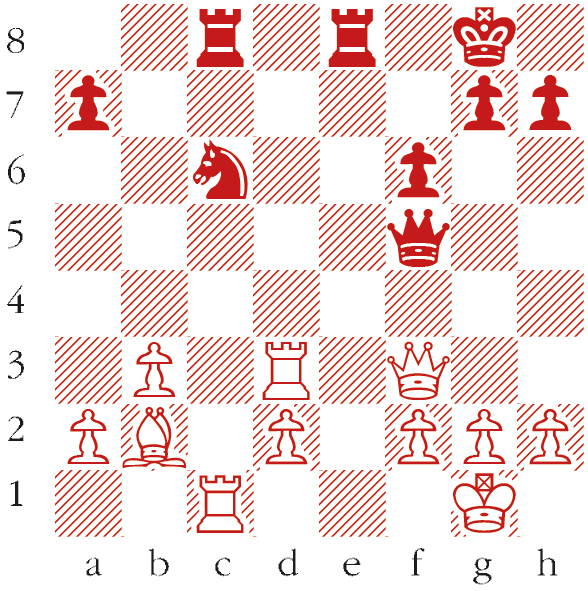
Last week’s solution 1 Rc6! threatens 2 Bb2#. Then 1…Ne6 2 Bd6# or 1…Nf5 2 Ng6# or 1…Nd5 2 Nd7# or 1…Ne4 2 f4#
Last week’s winner Laura Gould, Edinburgh
The noble work of chairlift diplomacy
In 1956, three British MPs encountered a group of Swiss politicians in the bar of the Hotel Fluela in Davos and after a few drinks challenged them to a ski race. A timed slalom contest took place the following day, with the three-person Swiss team beating the Brits by a combined four seconds. Not willing to take this lying down, the MPs insisted on a rematch the following year and thus was born the Anglo-Swiss Parliamentary Ski Week, which celebrated its 70th anniversary last week.
I heard about it from my friend Dan Hannan shortly after I became a peer, and immediately put my name down, imagining it to be a massive freebie. Not so. The Graubunden canton provides you with a free lift pass, and the local ski school, which organises the races, throws in some complimentary guides. But apart from that you have to pay for everything yourself.
It’s fair to say that this exercise in chairlift diplomacy isn’t as glamorous as it once was. The oldest participant this year was the 93-year-old Lord McColl, still an active member of the Upper House, and his wife, Evy Lise, told me about the times King Charles made a surprise appearance. He was comfortably beaten in the giant slalom, as you’d expect.
The Swiss team continued to win in every category until an upset occurred in 2024. At the start of the race on the final day, a man in his mid-fifties turned up and asked if he could have a go. Unlike the immaculately turned-out Swiss, he was dressed in an MCC cricket jumper and a woolly hat, arousing some suspicion. But he turned out to be a bona fide peer, so was given a bib and a number.
Fifty-four seconds later – which is the time it took him to complete the course, comfortably beating every other contestant by at least half a second – a legend was born. The late entrant turned out to be Clifton Hugh Lancelot de Verdon Wrottesley, an Anglo-Irish hereditary. He represented Ireland in the men’s skeleton at the 2002 Winter Olympics, just missing a medal by 0.61 seconds, so the giant slalom course was a walk in the park. He took home the cup for the fastest time and bought everyone a drink afterwards – James Bond in ermine.
Lord Wrottesley was beaten by half a second last year by Marc Jost, a Swiss parliamentarian, and for the 70th anniversary the home team were taking no chances. They introduced a new rule whereby you had to participate in the activities leading up to the final in order to compete, thereby ruling out our Olympian, who has four children he can’t abandon for a week. I was hoping Lord Wrottesley would show up anyway – he has a house in nearby St Moritz – but no such luck. It fell to me, Liz Truss, four peers and eight contestants from the other place to hold the British end up. Needless to say, we were all beaten, although with a time of just under one minute and 12 seconds I did at least come first among the Lords contingent. Liz came third in the ladies’ competition.
He took home the cup for the fastest time and bought everyone a drink – James Bond in ermine
It wasn’t all fun and games. On Thursday evening the parliamentarians had a round-table discussion about the impact of AI on the future of democracy. I suggested our countries, as the two biggest European economies outside the EU, work together on a transnational framework for regulating AI – a more light-touch regime than the one Brussels is hoping to impose on us.
That isn’t as ambitious as it sounds. According to Tim Loughton, an ex-minister in attendance, the Berne Financial Services Agreement, which came into force on 1 January, wouldn’t have happened had it not been for some British lobbying on the inter-parliamentary ski trip. It creates a joint regulatory framework across financial services that’s expected to raise billions in tax revenue every year. As Tim pointed out, even if the Ski Week were an ‘all expenses paid’ trip, as Private Eye once claimed, it would have paid for itself many times over. It shouldn’t be confused with the other annual jamboree in Davos.
Politicians are often derided as freeloaders – and back in the 1980s the News of the World used to send a photographer every year hoping to catch Cecil Parkinson up to no good in the hotel bars. But the group I’ve just spent a few days with were a pretty wholesome bunch, particularly our hosts. Absent Lord Wrottesley, I expect they will carry on winning for the next 70 years – and few would begrudge them that. Still, I think I can shave at least ten seconds off my time so will come again next year. Got to do my best for King and Country, even if he’s unlikely to turn up again.
Candidates Tournament
Javokhir Sindarov from Uzbekistan has dominated the first half of the Candidates Tournament in Cyprus, with an astonishing start of six points from the first seven games. That puts the 20-year-old 1.5 points clear of his closest pursuer Fabiano Caruana, and makes him a huge favourite. The tournament winner earns the right to challenge for the world championship title.
Hikaru Nakamura, one of the pre-tournament favourites, is all but out of the race after starting with just 2.5/7. Against Sindarov, he chose an ambitious sacrifice of two pawns in the opening, reaching a situation where the bishop pair – especially the one on d6 – are known to offer good long-term prospects. But the position remains double-edged, and after a dozen quick-fire moves, Sindarov had just played 12…O-O, a move that Nakamura had failed to anticipate in his pre-game preparation.
For a tournament like the Candidates, all participants enlist the help of other top players to analyse the openings they intend to play. Those analysts use chess engines extensively, such as the famous Stockfish, but they must also use their judgement to guess which moves are most likely to wrong-foot a human opponent.
Nakamura was almost certainly well-prepared for 12…e5 and 12…Nf5, which have both been played several times. But rather than just ‘reviewing the literature’, top level opening analysis should anticipate plausible alternatives. Sindarov’s 12…O-O is natural and hardly inferior, so it needed to be investigated. As it was, Nakamura was left unarmed in a wildly complicated position. After the game he condemned his analysts for their omission, though it must be said that chance plays an important role. Experienced players know that there are gaps in any opening repertoire, but they cross their fingers that opponents will not stumble upon them!
Hikaru Nakamura-Javokhir Sindarov
Fide Candidates Tournament, April 2026
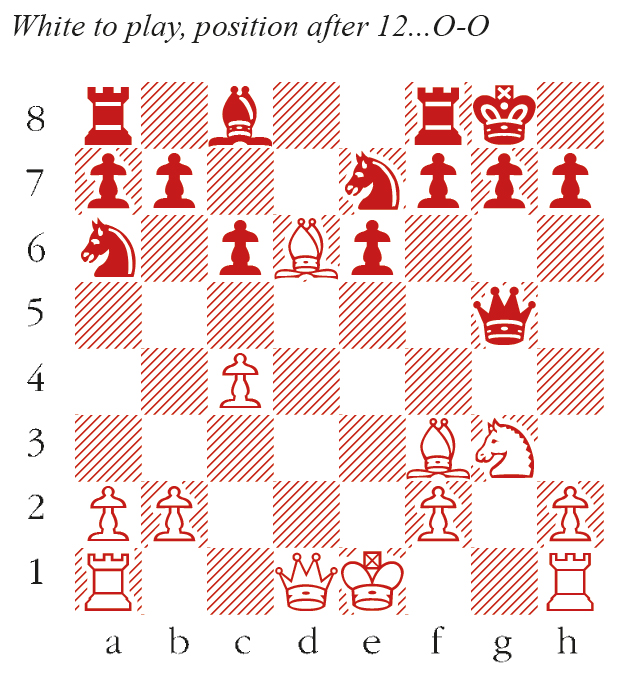
1 d4 d5 2 c4 e6 3 Nc3 c6 4 e4 dxe4 5 Nxe4 Bb4+ 6 Bd2 Qxd4 7 Bxb4 Qxe4+ 8 Be2 Na6 9 Bd6 Qxg2 10 Bf3 Qg5 11 Ne2 Ne7 12 Ng3 O-O (see diagram) 13 h4 Nakamura spent more than an hour deciding between this move and 13 Ng3-e4, and it seems he chose the wrong one. Without the computer’s assistance, it is extremely hard to anticipate that 13 Ne4 Qa5+ 14 b4 Nxb4 15 O-O is promising, despite the three pawn deficit. Qa5+ 14 b4 Nxb4 15 O-O Re8 16 Qd2 The most natural follow-up, but the quirky 16 Qe1! was stronger, because after 16…c5 17 Rd1, the freeing move Ne7-f5 is unavailable. c5 17 Rad1 Nf5! 18 Nxf5 exf5 19 Qf4 Nc6 20 Kh1 It seems that 20 Kh2! Nd4 21 Rxd4 cxd4 22 Rg1 still offers reasonable compensation, as the White pieces are so active, and the king on h2 instead of h1 ensures that 22…Re1 could be met by 23 Rxg7+! with a draw by perpetual check. Nd4 21 Rg1 g6 22 Bd5 Be6 Sindarov begins a series of exchanges in order to realise his three pawn advantage. 23 Bxb7 Ne2 24 Qd2 Qxd2 25 Rxd2 Nxg1 26 Bxa8 Rxa8 27 Kxg1 Rd8 28 Bf4 Rxd2 29 Bxd2 Bxc4 30 Be3 Bxa2 31 Bxc5 a5 The opposite coloured bishops offer Nakamura no respite here. 32 f4 f6 33 Kf2 Kf7 34 Ba3 Ke6 35 Bf8 a4 36 Ke3 Kf7 37 Bb4 h6 38 Kf2 g5 39 Kg3 Bd5 40 Ba3 Be4 41 Bc1 gxh4+ White resigns, as Black’s king will shepherd the a-pawnwhile White’s king is distracted by the h-pawn.
Starmer must drop this terrible Troubles bill
As we mark another anniversary of the Good Friday Agreement, we should be less inclined to celebrate and more disposed to worry. What was achieved on 10 April 1998 was remarkable. It worked not because it resolved everything, but because it deliberately did not, allowing former enemies to move forward without settling every question of the past. Yet it depended on consistent political leadership to embed its spirit into a society divided by grievance. That leadership is now faltering, with the risk of the past being weaponised in ways the Agreement was designed to avoid.
The struggle for a united Ireland continues. One of the Agreement’s greatest achievements was to move it from the gunman to the ballot box. But legitimacy cuts both ways. It cannot mean the British state passively accepts the systematic reinterpretation of the past through processes that are partial, unbalanced and detached from the conflict as we lived it. Nor can it mean exposing those who served under lawful authority to investigative frameworks that fail to recognise the conditions in which they operated.
Peace required not perfect justice, not complete agreement, but drawing a line under the past. That need was recognised in subsequent efforts to address legacy issues, including proposals led by Archbishop Eames. Yet governments of all parties have stepped back from the difficult decisions required to secure such closure. The current trajectory – repeated investigations, retrospective legal reinterpretation, new civil action avenues and a narrowing focus on state actors – can never resolve the past.
We should also remember what restraint looked like in practice. In 2009, outside Massereene barracks in Antrim, two off-duty soldiers, Patrick Azimkar and Mark Quinsey, were murdered in a calculated act of provocation by dissident republicans. The aim was clear: to drag the security forces back into confrontation. They refused. The response was disciplined, measured and lawful. Yet the killers were never brought to justice. Though the state showed restraint, the system it now relies upon has never been capable of providing clean or final closure.
All this matters not just for how we interpret the past, but for how we shape the future. If those asked to act on behalf of the state come to believe that decisions – taken under pressure yet according to the rules of the time – will be revisited decades later through a different legal and moral framework, the effect is predictable. Hesitation grows. Initiative declines. The moral component of fighting power is weakened. The credibility of the state is undermined.
This brings us to the Northern Ireland Troubles Bill. In its current form, it does not resolve the problem it seeks to address. There is no meaningful threshold for re-opening cases, no clear recognition of context, and continued exposure of individuals to processes that cannot deliver finality.
Some legacy inquests are already set to proceed and appear politically untouchable. These are previously investigated events where no wrongdoing was found. Alongside them sits a further tranche of cases destined for yet another round of legal sifting. This is not resolution; it is delay dressed up as process. If we are serious about honouring the Agreement, political leadership is vital and intervention is needed. Those cases should not be recycled through another layer of procedure. They should go directly to the Legacy Commission, where they can be considered in the round, with proper context, and with a view to drawing matters to a close rather than reopening them indefinitely.
More broadly, the bill must restore balance. It must introduce a clear threshold before cases can be reopened: genuinely new and compelling evidence, independently certified by a Supreme Court judge. The bill must recognise the conditions under which decisions were taken at the time. And it must provide those who served with the certainty that they will not be drawn repeatedly into processes, often influenced by ulterior motives, that offer no realistic prospect of closure. Such an approach is not about evading accountability. It is about restoring proportion. Above all, it is about political will.
The Good Friday Agreement worked because leaders were prepared to make difficult choices in the interests of stability. That same discipline is required again. Without it, legal process will displace political judgment, thereby destroying the balance that made peace possible. Anniversaries should not be moments merely for reflection: we should use them to put things right. In the interests of the country and national security, Starmer must stop this detrimental bill.

De Gaulle or nothing: lessons from the General
The first time I set foot in the White House as a Labour political adviser, in spring 2024, to see a then all-powerful Jake Sullivan as the US National Security Adviser, I went as an Atlanticist. By my final visit to the West Wing in January, accompanying David Lammy as his aide to see J.D. Vance, I was an Anglo-Gaullist. In between lay the humiliation of Chagos, twists and turns over Ukraine, surprise American strikes on Iran and the realisation that our closest ally, the superpower we had built our entire security around, had become erratic, emotional and unpredictable.
When Labour came to power, I truly believed the country had been suffering mainly from Tory problems. I learnt the hard way that our instability stemmed mostly from British problems. And this brought me to Gaullism. What we’re living through, the penny dropped, is a little like the Fourth Republic: those agonising postwar years where France, its confidence collapsed, became ungovernable and lost in the world.
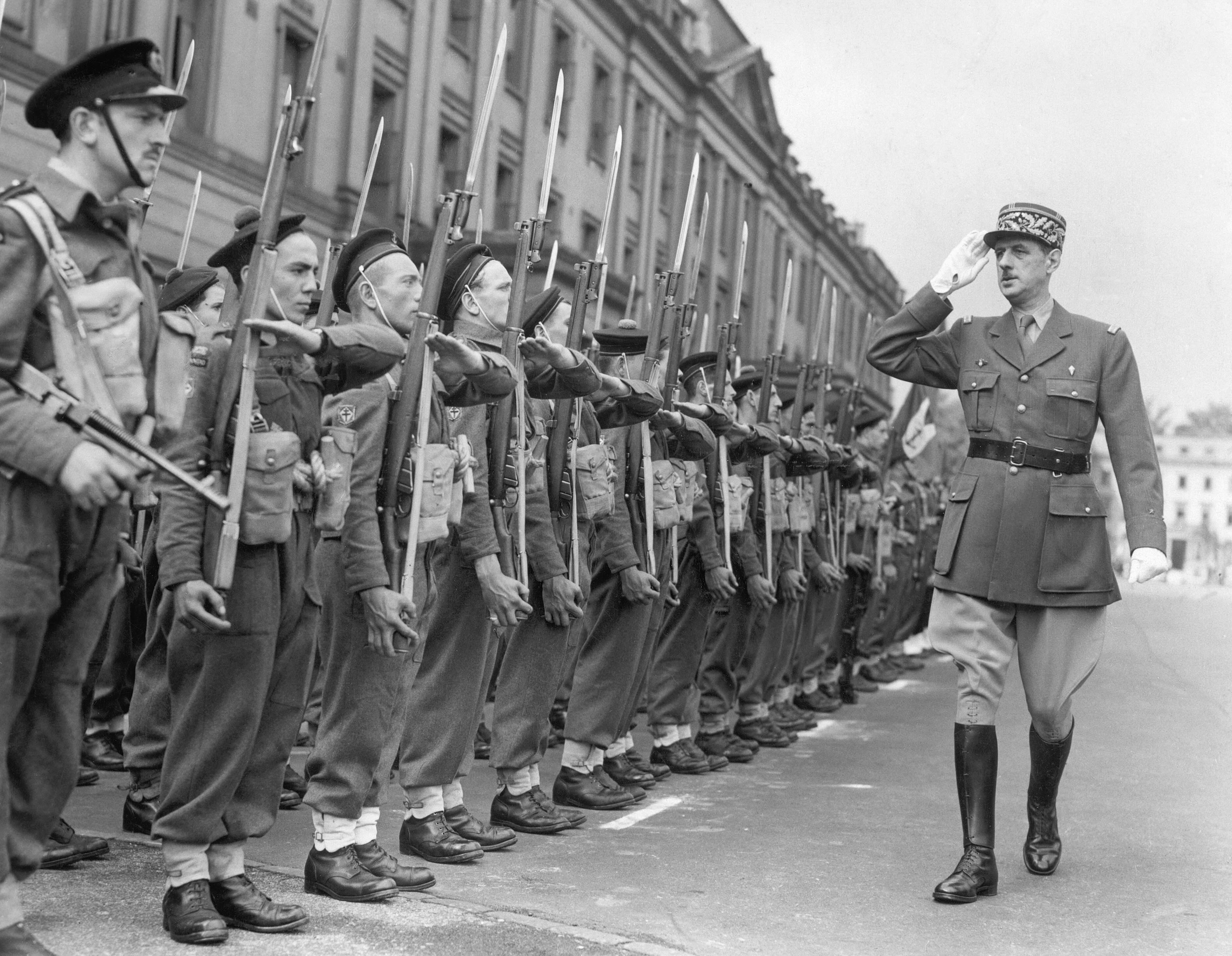
By the end of the Fourth Republic in 1958, France had cycled through 22 governments in 12 years. Its party system was wildly fragmented: except for the communists, no party held more than a sixth of the vote. This was the logic behind Charles de Gaulle’s Fifth Republic: a radical concentration of power. Ignoring the wails of republican traditionalists, Gaullism turned the president from a symbol into an executive that could overcome paralysis. At the same time, de Gaulle brought in electoral reform. France’s two-round first-past-the-post system allows voters to select their first-choice candidate, then to choose between the two frontrunners, endowing the winner with an actual majority.
The magic of Gaullism was that it masked retreat with a determined effort to boost national morale
True, our affairs are not quite as bad as those of 1950s France. But No. 10 isn’t an Élysée, let alone a White House. It’s a glorified Victorian private office, understaffed not just compared with its French and American counterparts, but even to Australia. In the most centralised country in the developed world, this is disastrous. It leaves the prime minister without the staff to wield power and creates civil service blockages and departmental disputes. The result is a paralysis of state.
What, then, might a British version of de Gaulle’s stunning French turnaround actually look like? Anglo-Gaullism would start by creating a proper Department for the Prime Minister and follow French wisdom when it comes to electoral reform. The best way to manage a now five-party system is to adopt Australian-style, ranked-choice voting, with an automatic, instant run-off for Westminster. Like France in the 1950s, we have splintered blocs on the left and right. This will produce successive, chaotic, unrepresentative, winner-takes-all results if you keep using first-past-the-post. Can we hope for stability when either Zack Polanski or Nigel Farage could win hollow landslides on less than a third of the vote? Of course not.
De Gaulle knew governing was more than a constitution. ‘Nothing is possible for the state when its powers do not have a civil service that can exercise them,’ he pronounced after becoming president. In 1945 he founded L’École Nationale d’Administration with urgency as he loathed the sluggish mediocrity of the civil service and sought an elite cadre to replace it. Such vanguardism is unfashionable. But there is no British Gaullism without it. That means injecting Whitehall with a generation of experts in the technological frontier of AI, biotech and beyond.
The old man in a hurry worked with a speed no French government has mustered since Napoleon’s consulate. ‘Without these efforts,’ he said of his first drastic policy, ‘we would remain a country that lags behind, oscillating between drama and mediocrity.’ He was talking about the public finances. At the start and very pinnacle of his power, when he knew the Algerian crisis would allow him to do almost anything, de Gaulle ignored his ministers and implemented the 1958 Rueff Plan. This included tax hikes, a devaluation of the franc and cuts to tariffs and subsidies. It also took on France’s two most powerful lobbies: farmers and veterans. And it worked. For the first time in a century France’s GDP overtook Britain’s. Our lesson is clear: an Anglo-Gaullist prime minister, should they ever have the opportunity, must take on welfare and end the pensioners’ triple lock.
But what to do with the money? I will pause here to consider the critics. Jonny Ball, in a thoughtful essay for UnHerd, correctly warned that any Anglo-Gaullism only ‘hawking a message of salvation-through-defence spending, with rearmament presented as a catalyst for national renewal’ will fail. Well I quite agree. Which is why any Anglo-Gaullism worth its name must stick as close as possible to the French original and avoid being a Bevinite reheat. De Gaulle did not fall into that trap of crude military Keynesianism. He chose instead to treat a France that had fallen behind almost like a developing country in chronic need of modernisation. He had no other choice: France in 1958 had just 45 miles of motorways and more than 20 per cent of the population were still peasants. Neither do we have much choice: with only 67 miles of completed high speed rail and some of the highest energy prices in Europe.
Franco-Gaullism was a form of futurism. Anglo-Gaullism must be the same. The president talked endlessly to the French about tomorrow and a distinctly French modernity. And he struck ground, building France’s first thousand kilometres of motorways, five new towns around Paris, the city’s main airport and France’s first nuclear power plant. Gaullism was nothing less than a generational investment in infrastructure. It would be left to his successor, George Pompidou, to launch the legendary Messmer Plan for nuclear energy autonomy. Thirty-seven currently operating nuclear reactors were built in the 1970s, leading to a French grid that is 70 per cent nuclear-powered today. Anglo-Gaullism must be about building fast: from the Oxford-Cambridge Arc to affordable high-speed rail to a nuclear plan of our own.
The magic of Gaullism was that it masked retreat with a determined effort to boost national morale. France might no longer be an empire, but she was entering a promising new future. And the genius of de Gaulle was to re-enchant through storytelling a nation that had utterly lost confidence in itself. Although he had been born in 1890, he was obsessed with television. Every night, alone or with his wife Yvonne, he would watch the evening news. He would call in TV executives for ‘feedback’ on his interventions at the drop of a hat and experiment with camera angles; he even took lessons from an actor at La Comédie-Française. He understood that politics is performance and performance is persuasion. What the youthful Kennedy was to America, the ageing de Gaulle was to France – its first master of television.
Britain’s de Gaulle will need to speak the language of posts, reels and streams and consume them for hours upon hours. But he or she will also need a story, which this government has so notably lacked. That’s why de Gaulle kept at his side the gifted novelist André Malraux. He was the only man allowed to speak at any length after the president in cabinet, despite being just minister of culture. Why? Because they needed to hear, every week, the story – one that drew on history and ideas to create a vision of continuity and progress. Anglo-Gaullism must weave such new myths to live by. They will not come from a PR agency.
Historical comparisons are always a bit of a stretch. We have no Algeria, thank God. And there was a lot not to like in the French 1960s. The thuggish Service d’Action Civique beating up communists. The françafrique postcolonial web of corruption. The suffocating rigidity that led to May 1968. France at the time operated a state monopoly of television and de Gaulle jealously guarded it. Television was, he believed, his. But what would he have made of social media? Doubtless he’d have had zero tolerance for foreign billionaires algorithmically gaming the national debate on platforms awash with authoritarian bots. Anglo-Gaullism would relish the fight against big tech.
This brings us to de Gaulle at his most subtle: which is to say towards Europe. ‘My most difficult task is to bring down to earth,’ he said to Konrad Adenauer, ‘those nationalist Frenchmen who float in their nationalist cloud.’ De Gaulle courted West Germany because he believed that if the two countries did not share a little sovereignty through the Treaty of Rome, the logic of superpower geopolitics was such that they would end up with none at all.
‘No state is independent,’ he once admitted to Pompidou, ‘for it is in reality more or less always linked to others.’ Rude and intransigent towards the nascent European Commission, de Gaulle sought instead what he called a ‘political Europe’ – a geopolitical team for France around a loose customs and subsidy club. This quest was as important to him as his independent nuclear deterrent.
De Gaulle spoke in grandeur but he also spoke hard truths to France as he pulled out of Algeria. Anglo-Gaullism must do the same. We are going to need much higher defence spending. Because what I saw up close is that the special relationship, as most Britons understand it, in which America gives us special treatment, does not really exist. Instead, we have a ‘specialist relationship’ with Washington when it comes to spying, surveillance and Trident, which confers real capacities at the cost of independence.
Becoming less dependent on America militarily means becoming a better, less needy ally to them
The harshest truth we need to admit is that America has changed. It no longer only cooperates with us as allies but coerces us as vassals. A political movement like MAGA is not an aberration but fundamentally a part of what America is: a society too polarised to practise predictable long-term geopolitics in Europe or Asia. The US cannot be trusted to stay with us on Russia. We are too dependent, in too many ways, on an unpredictable superpower whose zig-zagging trajectory is not ours to influence.
This is why Anglo-Gaullism must seek that geopolitical Europe: to build up our independence and theirs. This begins in Brussels with economics. Hopes for a free trade deal with the United States have not come to pass. Britain needs a customs alliance with the EU: a pact against Trump’s coercion where the UK and EU agree to support each other in the trade wars and to begin exploratory talks for a new customs and regulatory union for goods for growth. This is close to what de Gaulle sought out of the then EEC to defend France’s sovereignty.
The more erratic the US becomes, the less British national interest will align. But there is much more room to disagree and diverge as an ally than we realise. Nothing frustrated me more in my time in the Foreign Office than chunks of our national security state just waiting for cues from Washington on what to think. I often used to ask officials: can’t we be a little more French? Ending this culture of followership doesn’t mean rejecting Washington or anything daft like junking Five Eyes. Becoming steadily less dependent on America militarily means becoming a better, less needy ally to them. From the time I spent in meetings with Vance, that was what I realised he really wanted. Anglo-Gaullism need not be puerile anti-Americanism.
If the leader of the Free French could reconcile with Germany after the war, we can reconcile with France after Brexit. And there is only one basis for a renewed entente this geopolitically profound: working together on that ultimate expression of sovereignty – nuclear weapons. Trident, from its software to its missiles, is critically dependent on the Americans. We should build a new and complementary aircraft-delivered nuclear system with France. And here will be Britain’s grandeur – as a guardian of Europe.
Tim Montgomerie and the Spectator team discuss whether Britain needs its own De Gaulle on the latest Edition podcast:
A journey to the dark side of the Moon

David Whitehouse has narrated this article for you to listen to.
The climax of the Artemis II mission lasted just a few hours. The capsule, named Integrity, rounded the Moon, the crew becoming the most distant humans in history as they moved from its sunward side into its shadow.
The familiar features of the permanently Earth-facing side made way for the more heavily cratered far side. This is not the Moon we know. The far side is different. It has a thicker crust, no major solidified lava plains and is more heavily cratered, like the aftermath of the final war.
Before reaching it, the crew saw two Apollo landing sites: Apollo 12 touched down on Oceanus Procellarum (Ocean of Storms), and Apollo 14 landed on the plains of Fra Mauro, the target for the aborted Apollo 13 mission. There have been travellers here before, but not like this.
The Moon’s brightness illuminated Integrity’s interior. The crew turned out the cabin lights to get a better view. Most of the far side was in darkness, creating something like a hole in the sky, so they concentrated on the sunlit crescent as they sped towards the Moon’s shadow and the end of their outward journey.
One of their earlier studies was Mare Orientale, a 200-mile series of concentric craters formed 3.7 billion years ago by an asteroidal impact that almost shattered the Moon. It lies on the limb, so is difficult to see from Earth. Apollo astronauts saw it half a century ago but only from 150 miles. They were unable to appreciate its true magnificence.
During the encounter, two of the crew of four took turns at the windows facing the Moon while the others ate lunch. Their timeline determined which lunar features they should be taking pictures of, and when they should just use their eyes to look for subtle colour changes. They commented on lines of craters, bright so-called ejecta blankets splashed across the surface by ancient impacts, and the ever-changing jagged shadows of the terminator – the line between day and night. Astronaut Jeremy Hansen said that the crew proposed naming a crater ‘Carroll’, after Commander Reid Wiseman’s late wife, Carroll Taylor Wiseman, who died of cancer in 2020 at the age of 46.
As well as the Moon, the crew could see the distant Earth, a tiny blue and white crescent moving towards the Moon’s limb. When the Moon obscured it, they would be out of contact for 43 minutes. They call it LOS or ‘loss of signal’. For the crew it hardly mattered as they were surveying the dark side of the Moon, looking for flashes of light caused by minor impacts and for a hazy glow above the Moon’s limb caused by electrostatically levitating dust. They also tried to see if they could see any planets.
The blackout ended with the crew responding to Mission Control’s ‘Integrity comms check’ message. They were already on their way home and leaving the Moon, whose influence they would shake off in 18 hours. They are heading towards Friday’s re-entry and splashdown – the most dangerous part of the mission.
For the crew, having seen the Earth and the Moon like nobody else, things will be forever different. Four people counted apart from the billions on Earth, their lives seemingly obeying different rules. They will leave part of themselves on the Moon.
Tim Montgomerie joins the Spectator team to discuss our fascination with space – plus many other topics from this week’s magazine – on the latest Edition podcast:
The rise and fall of Tariq Ramadan
There has been so much news of late that stories which might once have caused a splash have sailed by all but unnoticed. One in particular seems worthy of bringing into a greater light, not least because it has been almost entirely ignored by the English-language media.
Tariq Ramadan is the grandson of the founder of the Muslim Brotherhood. In recent years he was probably the most famous Muslim intellectual in the West. Last month, a court in Paris found him guilty of the rape of three women and sentenced him to 18 years in prison.
To Islamic audiences he preached one message, to western audiences he told another
The case is the culmination of several trials since allegations were first made against him in 2017. Clearly expecting a guilty verdict, despite denying the charges, Ramadan broke a court order and skipped France. The 63-year-old is currently hiding out in Switzerland, claiming he was unable to attend his Paris trial because he is suffering from anxiety and depression linked to an alleged flare-up of multiple sclerosis. The court found him fit to attend. But now he has been sentenced, Ramadan will presumably continue to try to evade French justice and stay in Switzerland.
The trial was held behind closed doors due to potential witness intimidation. Ramadan and his defenders will doubtless continue to insist that he is the victim of persecution by an ‘Islamophobic’ justice system. But the most extraordinary thing about Ramadan is not his fall but his rise.
For a time in the 2000s and early 2010s, he was regularly referred to as one of the most important voices on the planet – certainly one of the most important Islamic voices. In many ways, this was a mystery.
Ramadan’s scholarly credentials were questionable and principally came from his being awarded a PhD by the University of Geneva. On multiple occasions he misrepresented the subject of his thesis – the political thought of his Islamist grandfather, Hassan al-Banna. It was initially rejected but seems to have been crowbarred through the academic system despite much opposition, not least because Ramadan was accused of having whitewashed much of his grandfather’s fascistic thought.
Ramadan’s French-Swiss accent and suave-ish demeanour impressed some people. But had he not come from Islamist royalty he would most likely have remained unknown. Fortunately for him he was born who he was and when he was – specifically coming of age at a time when the West had a deep need of ‘public moderate Muslim figures’ and a small supply of them.
This was how I first encountered him in the 2000s. I had helped arrange an English publication of Caroline Fourest’s Frère Tariq, in which the French journalist devastatingly showed how Ramadan spoke out of both sides of his mouth. To Islamic audiences he preached one message, to western audiences he told another.
On the rare occasions he was put on the spot, Ramadan was evasive. In a French TV debate in 2003, Nicolas Sarkozy – not then president – tried to get him to condemn the Islamic teaching that a woman should be stoned to death for adultery. The most he could say was he thought there should be a ‘moratorium’ on stoning for such a crime.
Ordinarily such talk would go down badly. But at around this time the situation in Europe was getting worse. After the 7/7 bombings in London in 2005, Ramadan was one of the Muslims appointed to the UK government’s counter-extremism taskforce. A number of us were sharply critical of this, but nothing seemed able to stop Ramadan´s remorseless rise. In television studios and debating chambers across many countries he and I debated and argued against each other for years. I once called him ‘my closest enemy’. He always came across to me as both fraudulent and cunning.
In 2005 he was made a professor at St Antony’s College, Oxford, and held a teaching position at the university right up until the first sexual assault allegations were made against him more than a decade later.
Why he should ever have been given such a position at Oxford was itself a mystery. One of the people who put him forward for the role once admitted to me that he had no knowledge of Ramadan’s academic history, nor his Islamist track record. So why was he appointed to St Antony’s? The college had always been known as the ‘spook college’. Was it a sign that parts of the Establishment had found a way to embed and elevate Ramadan? As the years went on, and no allegation or misstep seemed to touch him, that certainly became my own suspicion.
As the relationship between Europe and its Muslims came under an ever-greater spotlight it was in the interests of officials, like those in the Blair government, to promote ‘moderate’ Muslim voices – whether they were actually moderate or not. Ramadan fitted a bill. One explanation as to why (until recently) no criticism or exposé of him ever landed is that he was simply too important to certain people.
When the Obama administration came into office in the US, Ramadan had an almost equally gilded ride. Past travel bans relating to his alleged funding of terrorist-linked groups and connections to extremists were forgotten.
From Athens to Oxford, whenever I encountered him I could never understand the entitled, arrogant attitude he projected as he mouthed evasive platitudes. It was as though he knew he was always going to be fine. Life was good to Tariq.
All of this has come to an end due to something I suppose not many people could foresee. But, as I say, the more striking thing about Ramadan is not his fall, but his rise.
He will doubtless appeal the French verdict. But I would be surprised if we hear much from him again. The accounts of his victims tell us too much about him. But the supply and demand problem that created him says an awful lot about us, too.
Why Trump stepped back from the brink
At 5 p.m. ET speculation was rife that a deal between the United States and Iran was in the works. Pakistan’s Prime Minister, Shehbaz Sharif pleaded for President Trump to extend his 8 p.m. Tuesday deadline – before he destroyed every bridge and power plant in Iran – by another two weeks in order to give diplomacy more time to work. Yet the New York Times reported that Iranian officials cut off direct contact with their American counterparts. And the White House wasn’t offering definitive answers about whether Trump was leaning toward escalation or a ceasefire.
The ceasefire couldn’t have come at a better time for both sides
Finally, less than an hour and a half before the deadline, Trump made his announcement: the US would suspend bombing operations against Iran for two weeks if Tehran agreed to re-open the Strait of Hormuz. “We received a ten point proposal from Iran, and believe it is a workable basis on which to negotiate,” Trump wrote. “Almost all of the various points of past contention have been agreed to between the United States and Iran, but a two week period will allow the Agreement to be finalized and consummated.” The Iranians confirmed the news less than an hour later, with Iranian foreign minister Abbas Araghchi claiming that Trump agreed to the general framework of Iran’s ten-point proposal.
As one would expect, the US and Iran both claimed victory. Iran’s Supreme National Security Council boasted that Tehran forced the so-called “Great Satan” to recognize Iran’s negotiating position, which included control over the Strait of Hormuz, assurances that the US and Israel wouldn’t resume the war and full sanctions relief for the Iranian economy. In the hours and days ahead, Trump and his advisers will argue that the nearly six weeks of strikes and threats of more to come finally coerced the Iranians to enter serious negotiations. Either way, the result is the same: for at least two weeks, the fighting will stop, more vessels will transit the region’s waterways and US and Iranian officials will try to come to a mutually-acceptable settlement. Israel, too, will be restrained from further action during this time period.
The ceasefire couldn’t have come at a better time for both sides. While the Iranians have been resolute throughout the conflict, they have nevertheless seen dozens of their senior officials and military officers killed, their navy effectively sunk, their air force grounded and a good portion of their ballistic missile stockpile destroyed. A hypothetical US bombing campaign against Iran’s bridges, nuclear power plants and energy facilities, which Trump threatened to green-light if Tehran didn’t make a deal, would have negatively impacted its ability to prosecute the war at the current pace. And despite the Iranian people’s hatred for the regime, many of them could use a break from the war, which has made their daily lives even harder.
Trump, too, needed a respite. The war is unpopular with the American people, with one poll finding 60 percent of Americans opposing it. A March poll by the Pew Research Center was even more brutal for the president: 64 percent of Americans surveyed were not confident about Trump’s decision-making on Iran. Americans by and large didn’t buy Trump’s rationale for why the war needed to happen in the first place, partly because the Trump administration neglected to make much of a case to the public beforehand. Congress never authorized the war either, which means that it’s not a stretch to call the entire endeavor unconstitutional.
The war is also hitting pocketbooks across America. Gas prices are above $4 a gallon. Compared to this time last year, that’s roughly 90 cents more for a gallon of regular gasoline, yet another irritant to American families dealing with higher costs across the board.
It’s tempting to think Trump’s last-minute announcement is the beginning of the end. But that reading would be far too optimistic. What we have here is a pause to the war with the possibility of a diplomatic resolution. Getting there will require extraordinary hard work and a willingness by Washington and Tehran to meet each other half-way. This is not something Trump is particularly fond of doing – he sees concessions to the other side as weakness, not the cost of doing business. Nor is he exactly a man with unlimited patience. Iran, meanwhile, will remain skeptical of any proposal Trump puts on the table, knowing that it could be rescinded the same day. This is not without some justification; on two separate occasions, Trump has chosen to cut diplomacy short in favor of military force. Even if the next two weeks proceed without incident, we could end up watching the same movie play out later this month.
What do you do with a captured soldier?
What do you do with a captured soldier?
In 255 BC, fighting the Carthaginians, the Roman consul and general Marcus Atilius Regulus was taken prisoner near Tunis. They sent him back to Rome, having sworn an oath that he would ensure the release of some important Carthaginian prisoners; but if he failed, he himself would return to Carthage. Regulus went back, informed the Senate of his mission, took no part in the discussions or the vote, except saying that the prisoners were fine, active young officers, while he was bowed with age. The Senate decided not to return them, and Regulus made his way back to Carthage, well aware of the consequences.
Cicero reported the story – true or not – in his work On Duties and argued that Regulus had been right to return to Carthage: one should not choose moral wrong in any circumstances. An oath was a covenant made with justice and good faith: it was backed by religious sanctity, a solemn promise given before the gods. The war was a legitimate one against a declared enemy. In those circumstances an oath was as binding as a treaty. Rome’s Twelve Tables featured sacred laws in which good faith was pledged even to the enemy, and there were no cases in which Romans used to render stricter decisions than the violation of an oath. Besides, Regulus himself believed in the sanctity of oaths. That was why he thought it morally right to return to Carthage and pay the terrible price.
Finally, said Cicero, consider the battle of Cannae (216 BC), at which the Romans had lost 70,000 soldiers. Hannibal took prisoner 8,000 Romans who had been left in camp. The Senate voted not to ransom them: soldiers had to learn that they must conquer or die. Hannibal was totally demoralised by this display of unshakeable values in the face of disaster.
The details of the unspeakable torture to which Regulus was subjected, which will not be printed here, would have thrilled the IRGC. One rather fears that their joy would have been shared by many, including politicians, who march with other screaming anti-Semites along our streets. Thanks to the Americans’ rescue mission, their pleasures must await another day.