-
AAPL
213.43 (+0.29%)
-
BARC-LN
1205.7 (-1.46%)
-
NKE
94.05 (+0.39%)
-
CVX
152.67 (-1.00%)
-
CRM
230.27 (-2.34%)
-
INTC
30.5 (-0.87%)
-
DIS
100.16 (-0.67%)
-
DOW
55.79 (-0.82%)
Why is it OK to fly a Palestinian flag but not the St George’s Cross?
If, like me, you spend too much time on social media you’ll have noticed a recurring theme in recent days: horror at the phenomenon of flags with the cross of St George starting to appear across much of the country.
That’s hardly a surprise; social media has always been awash with left-wing types, for whom patriotism is racism under a different name, and who seem to do nothing but parrot all the usual dull cliches. But today’s version of those cliches turns out to be interesting – because it reveals a double standard so jarring as to be off the scale.
The England flag is upsetting only to those who choose to be upset by it
It was back in 2014 that Emily Thornberry tweeted a now legendary picture of a house with three England flags draped across the front, with the caption ‘Image from #Rochester’. If ever a picture could be said to sneer, this was it – and it cost Thornberry her job as shadow Attorney General. Fast forward to August 2025 and the sneering has deepened into something more accusatory: the assertion that flag flying is a sign not just of racism but of fascism, far-right sympathies and support for violent attacks on minorities.
Take Marina Purkiss, a reliably ranty X type who is ever-present on talk shows and phone-ins. Purkis has skillfully developed her brand, such that she now has 483,000 followers on X. This week she posted: ‘No one gives a f*ck about your flag…But we give a f*ck about the hate-mongering vitriol that compelled you to plant it.’
Another ever-reliable ranter is Narinder Kaur, who posted this on X: ‘This platform and the country as a whole seems to be on the edge of some sort of fascist-racist-flag flying-for-the-wrong-reasons boiling pot of hate!’
One is reminded of George Orwell’s line that ‘England is perhaps the only great country whose intellectuals are ashamed of their own nationality’, although it’s unlikely he had the likes of Purkiss or Kaur in mind. Can the same be said of Guardian columnist John Harris? His latest column takes 1,300 words to make similar points to those made by Purkiss and Kaur in their brief tweets: ‘Flags as symbols of prejudice, not pride – and a distinct air of menace. Welcome to England 2025. The rapid spread of these banners is unsettling – and shows how the hard right is reaching people and places the left cannot.’ He writes:
Despite claims that it is all about patriotism rather than prejudice, what has materialised up and down the country feels like an unauthorised version of what the Home Office used to call the hostile environment, as if football hooligans have taken control of road markings and street furniture… it marks yet another instalment of a story that could not be more serious: the long march of a politics full of audacity and ambition… But also bear in mind something much more frightening: the fact that what is afoot goes far deeper than the manoeuvrings of politicians and parties. It goes into the cultural spaces where people live their lives.
But one sentence is especially revealing because it exposes that double standard I referred to earlier:
The prominence of Palestine flags at this year’s festivals proves that music’s radical edges have not been completely blunted; even the most apolitical artists surely understand that what they do is a product of exactly the kind of cultural mixing and open attitudes that the new right wants to squash.
Harris devotes an entire column to suggesting how ‘unsettling’ it is that the England flag is being flown, but at the same time how wonderful it is that the Palestinian flag is now prominent. There you have it, in all its stark, hypocritical bluntness: England flag = bad. Palestinian flag = good.
It has – let’s be charitable – presumably not occurred to Harris, and to the others who berate the flying of the England flag but celebrate that of the Palestinian, that the prominence of the latter is genuinely frightening for British Jews. The flag is flown on the regular hate marches, where some marchers celebrate the massacre of 1,200 Jews on 7 October 2023. It’s flown on those marches alongside chants calling for the expulsion of Jews from Israel and for a global intifada – the murder of Jews. And it is flown in neighbourhoods where its presence is in effect a sign that Jews are not welcome. But who cares, eh? It’s only Jews being frightened by Jew hate and, as David Baddiel pointed out in his eponymous book, Jews don’t count.
The England flag is upsetting only to those who choose to be upset by it, and to see an expression of patriotism as race hate. But if you want to fly a flag that, while it of course symbolises the Palestinian cause, also symbolises hate against Jews, for many on the left that’s just fine.
Rachel Reeves is itching to whack up taxes
Gosh, Labour really does hate private landlords. Rachel Reeves’ latest property tax proposal to be dangled before the public is to charge National Insurance contributions (NICs) on income from rental properties. This would set it aside from other forms of investment income, which are liable for income tax but not NICs. It would also represent a growing war against small-time private landlords as opposed to corporate ones. Companies letting properties would not be affected by the change and neither would private landlords with substantial salaries be hit badly – there is a ceiling on the main rate of NICs, with income over £50,000 a year taxed at only 2 per cent above that level.
Rachel Reeves has no ideas other than dreaming up ways of extracting more of our money
The proposal thus targets private landlords with non-property incomes of less than £50,000 a year. Has Reeves stopped to ask herself who these people are? Many of them are pensioners who worked in the private sector and cannot look forward to the sort of gold-plated, index-linked pensions underwritten by the taxpayer which will fund Reeves’ retirement. They will have bought property in order to bolster what they could see was going to be an inadequate income from their private pensions.
Yet Reeves now proposes to whack these people over the head in order to fill her fiscal black hole – a black hole which has developed, let’s not forget, thanks to generous wage rises for public sector workers. Those wage rises will, in due course, feed through into higher pension payouts given that most public sector pensions are linked to either final or lifetime earnings.
In other words, Reeves is contemplating yet another transfer of wealth from private pensioners to public ones, from people who have done poorly out of the pension system to people who have done extremely well. In the name of fairness, she should apply NICs to income from public sector pensions before threatening small-time landlords.
But will Reeves actually get the extra revenue she is hoping for – which the Treasury appears to have estimated at £2 billion? What the proposal would do is to give small-time landlords a strong incentive to set up companies and become corporate landlords themselves – an act which could well reduce the tax take from landlords, not increase it. On the other hand, it could well prompt some landlords to sell, perhaps reducing house prices in some areas with large numbers of buy-to-lets, but at the cost of reducing rental supply and thus raising rents, at least in the short term.
I am all for equalising taxes between earned income and investment income, by the way – if, that is, it is achieved by cutting, and hopefully eventually eliminating, NICs altogether. Reeves, on the other hand, just wants to whack up taxes. Now that her token benefit cuts have been snuffed out by backbench Labour MPs she has become a one-club Chancellor, with no ideas other than dreaming up ways of extracting more of our money.
While she treats small-time landlords as big-time capitalists, the real fatcats of the property world seem to have been left alone. The Conservatives didn’t exactly distinguish themselves in their efforts to protect leaseholders from rapacious freeholders, watering down proposals to limit excessive service charges and ground rents. But Labour, having at first backed the idea, seems to have kicked the whole thing into touch. It is far easier, I guess, to pick on the small guy rather than the offshore freehold company with frightening lawyers.
Iran may be down, but it’s not out
The sirens began at about 5 am. A Houthi ballistic missile was on its way, over Jerusalem, in the direction of the coastal plain. After half a minute or so, I began to hear the familiar sound of doors scraping and muffled voices, as people made their way to the shelter.
It has become a regular occurrence. No one makes much of a fuss anymore. For most Israelis, most of the last 70 years, Yemen was a remote country on the other edge of the Middle East, the part facing the Indian Ocean, rather than the Mediterranean. What was known about it consisted of a few items of food and folklore that the country’s Jewish community had brought with it to Israel when it fled there en masse in the late 1940s. Now, it has become a strange, uninvited nocturnal visitor, periodically launching deadly ordnance at population centres.
Outside Syria, the Iranian losses are decidedly less terminal
The missile, like the great majority of its predecessors, was quickly intercepted and downed. The Ansar Allah government in Sana’a can’t match the Jewish state in either attack or defence. Still, on the rare occasions when the Houthis have broken through, the results are not to be dismissed. They succeeded in closing Ben Gurion airport for a few days back in May, when one of their missiles landed near the main terminal. And in July, a civilian in Tel Aviv was killed when a Houthi drone penetrated the skies over the city and detonated in a crowded street.
Israel’s response to the Houthis’ aggression has been swift and consequential. Extensive damage has been inflicted on the Hodaida and Salif ports, the airport at Sana’a, the oil terminal at Ras Issa and other infrastructural targets. Speaking to me in his offices in the port city of Aden a few weeks ago, Yemeni Defence Minister Mohsen al-Daeri noted the ‘huge impact’ of the Israeli counterstrikes, describing the airport, Salif and Hodeidah as the ‘lungs’ through which the Houthis breathe.
But with due acknowledgement to Israel’s response, it should be noted that while the Houthis’ lungs may be damaged, they are clearly still breathing. Their continued ability to lob occasional missiles at Israel goes together with their ongoing and far more consequential terrorising of shipping seeking to pass through the Gulf of Aden-Red Sea route. In the last two months, they have sunk two Liberian-flagged, Greek-owned ships. Traffic through the area remains down by 85 per cent compared to the pre-October 2023 period.
In June, I visited the frontlines in Yemen’s Dhaleh province, where the Houthis face off against UAE supported fighters from the Southern Transitional Council. The discrepancy in capacities between the sides was immediately apparent. The STC fighters are well organised, highly motivated and able to hold the line. But in weaponry and in particular in the crucial field of drones, the Iran-supplied Houthi fighters have the clear advantage.
The evident durability of Iran’s Yemeni allies raises a larger question. In Israel (and in the west, in so far as the west pays attention to such things), a narrative has taken hold according to which the successful campaign fought by Israel and the US against Iran in June, along with Jerusalem’s mauling of Hezbollah in 2024 have effectively put paid to Teheran’s regional ambitions and broken the Iran-led regional alliance. The very coining of the term ‘Twelve Day War’ to describe the June fighting is clearly intended to recall Israel’s triumphant Six Day War in 1967, in which the Jewish state vanquished the armies of Egypt, Syria and Jordan. The 1967 victory broke the forward march of Arab nationalism. The 2025 war against Iran, implicitly, is deemed to have achieved something similar with regard to Tehran’s Islamist regional bloc.
The achievements of the US and Israel against Iran and its proxies in Lebanon, Yemen and elsewhere were without doubt impressive and demonstrated a vast conventional superiority. There are reasons, however, to temper the euphoria and take a close look at the current direction of events. This is important not only or mainly because modesty is a becoming virtue. It matters because failure to note how Iran and its proxies are organising in the post-June 2025 period runs the risk of allowing them to regroup, rebuild and return.
Of the defeats and setbacks suffered by Iran in the course of 2024 and 2025, only one element is almost certainly irreversible. This is the fall of the Assad regime in Syria. Assad’s toppling has removed Syria from the Iranian axis and turned it into an arena of competition between Israel, Turkey and the Gulf countries.
Elsewhere, however, the Iranian losses are decidedly less terminal. In Yemen, as we’ve seen, Tehran’s Houthi clients have yet to suffer a decisive blow. They have managed effectively to close a vital maritime trade route to all but those they choose to allow to pass. The west and the Gulf are not currently engaged in equipping their own clients to give them an offensive capacity against the Houthis. Unless and until that happens, Iran’s investment in Yemen is set to continue to deliver dividends.
In Iraq, largely ignored by western media, the Iran-supported Shia militias remain the dominant political and military force in the country, commanding 238,000 fighters. They prudently, and apparently on Iranian advice, chose to largely sit out the war of the last two years. But the current ruling coalition of Prime Minister Mohammed Shia al Sudani rests on the support of the militias, in their political iteration as the ‘Coordination Framework.’
The ruling coalition is in the process of advancing legislation that will make permanent the militias’ status as an independent, parallel military structure. In Baghdad in 2015, a pro-Iran militia commander told me that the intention was to establish the militias as an Iraqi version of the Revolutionary Guards in Iran. The current legislation would go far toward achieving this aim.
In Lebanon, too, despite its severe weakening at the hands of Israel, the Hezbollah organisation is flatly rejecting demands that it disarm. The government of Prime Minister Nawaf Salam has made clear that it has no intention of seeking to use force to induce the movement to do so. Given Hezbollah’s infiltration of state institutions, including the Lebanese armed forces, it is not clear that the government would be able to employ coercive measures even if it wished to. The continued Lebanese dread of civil war also plays a role here. Only Israel’s ongoing campaign to prevent Hezbollah’s rebuilding of its forces is likely to be effective.
So taken together, what this picture amounts to is that Iran has suffered severe setbacks on a number of important fronts over the last 18 months. But in none of them, with the possible exception of Syria, is it out of the game. The sirens in the Jerusalem night sky are a fair indicator. Complacency would be a grave error. Reports of Iran’s demise have been much exaggerated.
London needs more – not fewer – ‘headphone dodgers’
When you’re travelling abroad, a good way of getting the measure of any city is the culture of its public transport. I visited Australia several times as a child and I was surprised by how chatty strangers were on trains and buses. People sat down and struck up a conversation with whoever was sitting next to them. I’ve noticed that natural connection between passengers in many other countries.
It’s different in London, where passengers generally sit in tense silence, avoiding any interaction with each other and not even acknowledging that anyone had the temerity to travel at the same time as them. If something extreme happens like a truly epic delay, people might start to exchange a few eye rolls and even some brief, frustrated words, but they’ll quickly withdraw back into themselves.
The tyrannical silence of public transport is probably a greater and more pervading problem
At the top of many Londoners’ gripe list isn’t the silence of public transport but the noise. ‘Headphone dodgers’, who play music, podcasts or social media videos out loud through their phone’s speakers, have been annoying passengers of late. They’re the new version of the ‘I’m on the train’ phone calls that plagued us when mobile phones appeared in the mid-90s.
Opposition MPs have been calling on the government to do something about ‘headphone dodgers’. Shadow transport secretary Richard Holden said passengers shouldn’t have to ‘endure somebody else’s choice of crap music’ and the Liberal Democrats called for fines of up to £1,000.
Sadiq Khan has spotted another bandwagon and hopped on board. The mayor has launched a campaign encouraging people to use headphones when they play music and other content on London’s public transport, with posters appearing this week on the Elizabeth line asking travellers not to play audio out loud or have conversations on speaker mode.
On the face of it, this seems a sensible and welcome development because ‘headphone dodgers’ can be a bit of a nuisance. But the tyrannical silence of public transport is probably a greater and more pervading problem. It’s a problem that’s got worse in the smartphone era because almost everyone is plugged into headphones now, listening to our music, pods or audiobooks and avoiding the horror of even momentary eye contact.
Encouraging more people to retreat into our private worlds will only make trains and buses even less sociable. Yes, the ‘headphone dodgers’ often seem to be listening to ‘crap music’ – tinny, angry urban songs seem surprisingly popular – but I’ve also been in carriages where an impromptu DJ plays a crowd-pleasing banger that puts a smile on most of their fellow travellers’ faces.
I’ve seen barriers between passengers melt away when they team up to ask a ‘headphone dodger’ to pipe down. A poll for the Lib Dems found that half of respondents wouldn’t feel comfortable asking somebody to turn down their music on public transport but I’ve often seen people do just that and the offender has always blushed and complied.
For all the media hype, these nuisances are few and far between but the stiff silence that they interrupt is almost universal and it comes with its own price. Watch the news any day of the week and ask yourself whether we seem like a society that needs less or more connection.
On that note, I was pleased to see that Khan is planning a second poster campaign that will encourage passengers to look up from their phones and become aware that others travelling on public transport may be in more need of a seat. Let’s have more stuff like that which brings us a bit closer together and a bit less of the restrictions that move us a little further apart.
Yes, fewer people wearing headphones does mean there would be antisocial noise sometimes, but it also means we might start speaking to each other more. We might find that’s a good thing and that it plays a part in ironing out the sort of sadness and alienation that leads someone to blast their music on a train.
Picasso’s ravishing work for the ballet
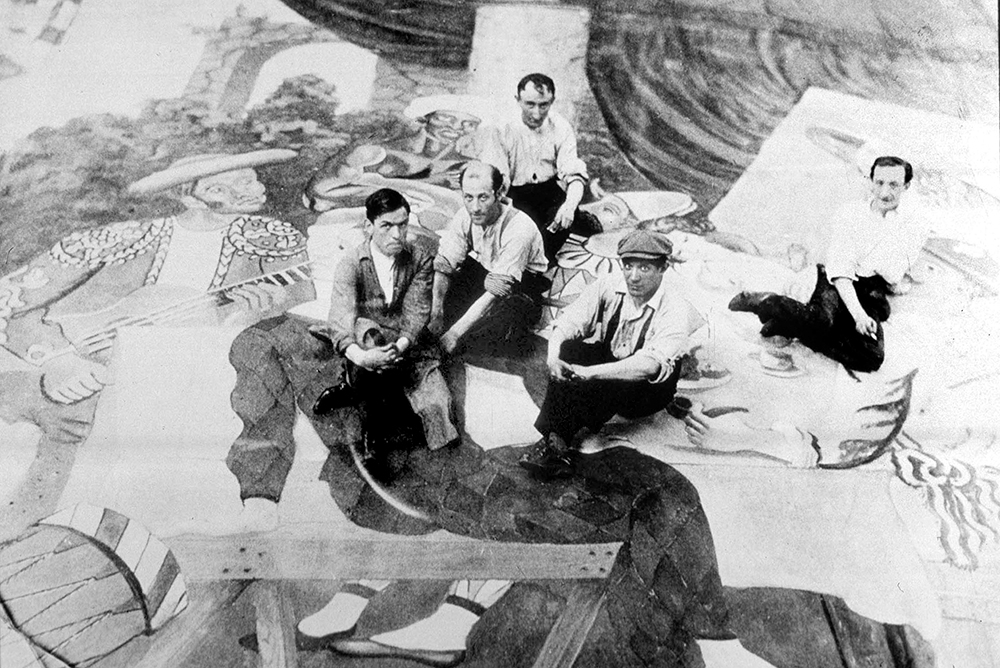
Visitors to the Victoria and Albert Museum’s new storehouse in Stratford’s Olympic Park are being enthralled by an atmospherically lit chamber devoted to the display of one vast and magnificent work of art: Picasso’s 10 metre-high, 11 metre-wide drop-curtain for Le Train Bleu, a popular hit of Diaghilev’s Ballets Russes, first seen in 1924. The canvas, for many years rolled up in storage, isn’t strictly the work of Picasso himself: Diaghilev’s scene painter Prince Alexander Schervashidze had meticulously expanded it overnight from a small gouache on plywood known as ‘Two Women Running on the Beach’ (1922), but Picasso was so delighted when he saw the result that he decided to endorse it with his signature on the bottom-left-hand corner.
Cocteau spotted Picasso and corralled him and Satie into a sensational project
This ‘marvel of the 20th century’ – as the critic Richard Buckle rapturously described it – serves as a pendant to an upcoming exhibition at Tate Modern entitled Theatre Picasso. Built on a base of Tate’s own holdings and centred on the masterly painting ‘Three Dancers’ (1925), it also extends to embrace Picasso’s images of ballerinas, bullfights, flamenco and saltimbanques, fashionably complemented with ‘interventions’ by contemporary artists. Documenting it all is a weighty catalogue loaded with concepts currently dominant in academia, drawing on the ‘performative’ notions of the likes of Gilles Deleuze and ‘informed by the perspectives of feminism, colonialism, ecologies and so on’. Don’t let such arcane theorising and vaporous artspeak put you off: Tate Modern’s walls will be showing Picasso at his best, freshly contextualised. (And to be fair to the curators, the catalogue will also contain illuminating essays on the roots of flamenco in the African diaspora and Picasso’s early involvement in anarchism.)
Whether ‘performative’ or not, it is undeniable that Picasso’s art is obsessed by performers: they are ubiquitous throughout his works. In his early years in Barcelona, he painted garish images of cabaret singers and can-can dancers in low smoky dives; during his subsequent rose period, he found a gentler wistfulness in travelling circus folk. Then came his hard-edged experiments with cubism in Bohemian Paris, where in 1915, he encountered the well-connected young man of the moment Jean Cocteau, and a new set of theatrical possibilities opened up.
Cocteau had long been hanging around Diaghilev’s circle in the hope of winning a commission for the Ballets Russes. So far he had failed: the great Russian impresario had brushed him aside with the challenge ‘Etonne-moi, Jean’ – the implication being that Cocteau should buzz off until he could come up with something really good. He now had that in hand: he had spotted Picasso, his genius still little appreciated, and corralled him and the composer Erik Satie into a project to create an entertainment that would be both sensational and unprecedented. An étonné Diaghilev duly succumbed, introducing his own protégé, the choreographer Leonid Massine, into the mix.
What this gang of four cooked up was the crazy Parade. Set outside a fairground ticket booth, it featured a conjuror, two acrobats and an American ingénue modelled on Mary Pickford, all vainly trying to solicit customers with their routines. They are overseen by three massive grotesque figures, conceived cubistically: one of them, for example, appeared hidden in a blue, white, green and red box representing a man in evening dress on its front and a house and a tree on its rear. Against a backdrop of higgledy-piggledy skyscrapers, the tone of the action devised by Cocteau was that of inconsequential cartoon farce, but Picasso also painted a richly whimsical front curtain depicting a winged horse and feasting musicians and harlequins.
The productions Picasso designed for Diaghilev served as living billboards for his art
The resulting clash of realist and cubist idioms proved one reason that Parade was scandalously booed at its première in Paris in 1917, and some stiff-necks found its flippancy distasteful at a time when French soldiers were being slaughtered during the catastrophic Nivelle offensive. Yet there were many who fell for it, too. Its free-wheeling originality and wit, heralding the playfulness of dada and surrealism, earn it a place among the defining moments in the development of modernism. It also brought Picasso fame beyond metropolitan coteries: in an age before colour reproduction or mass media, the productions that he went on to design for Diaghilev over the next seven years served as advertisements, living billboards, for his art.
Much to his chagrin, Cocteau was sidelined in the later stages of Parade’s rehearsal, but the bond Picasso established with Diaghilev and Massine would yield further fruit. Le Tricorne, premièred in London in 1919, was a tale of marital jealousy in a rustic Spanish setting evoked by pale ochre and pink flats, with a backdrop of a star-spangled sky and Goyaesque costumes in startlingly vivid scarlet, yellow and black. Picasso personally painted the front drop curtain and attended to every detail of prop and make-up: the entire spectacle was considered ravishingly beautiful and scored instant universal success, sparking a vogue for all things Hispanic.
Immediately after this came the Italianate Pulcinella (1920), to a score for which Stravinsky neoclassically reorchestrated music by Pergolesi. Diaghilev was aghast at Picasso’s early draft of designs for this commedia dell’arte-inspired ballet, tearing up the sheets of paper and stamping on them in a rare display of bad temper. Picasso meekly abandoned his elaborate idea of presenting a baroque theatre inside a theatre and substituted it for two houses on a moonlit Neapolitan street with a view over the bay to Vesuvius – a concept marked, in the words of Douglas Cooper, by ‘an astonishing simplicity’ that showed ‘that Cubism could be happily allied with a mood of unashamed romanticism’.
Pulcinella marks the high point of Picasso’s work for the Ballets Russes. All that followed was a flamenco show, a backcloth for L’Après-midi d’un faune and the drop-curtain for Le Train Bleu (which rose to reveal distinctly feeble décor by the cubist sculptor Henri Laurens – one of Diaghilev’s miscalculations). The odd one out is Mercure, commissioned in 1924 by Diaghilev’s rival Etienne de Beaumont, but briefly imported into the Ballets Russes’ repertory in 1927. Not so much a ballet as a series of tableaux, it reunited Picasso with Parade’s composer Satie and choreographer Massine, and allowed him to give full rein both to his fascination with the imagery of Greek myth and his desire to transcend the limited dimensions of a painted canvas. But the resort to exaggerated caricature, including bulbous female breasts, came over as mere crudity, and the piece was received with either bafflement or hostility. ‘The whole thing appeared incredibly stupid, vulgar, and pointless,’ complained the normally fawning dance critic Cyril Beaumont.
After his involvement in the artistic laboratory of the Ballets Russes had ceased, Picasso contributed little of note to the theatre. By the end of the 1920s his interest in designing for the medium had waned, reviving only vestigially in the early 1960s when he allowed work he had previously made to be adapted for another mythological ballet Icare, at the Paris Opéra. The Tate Modern exhibition doesn’t stop there, however. It interprets the word ‘theatre’ in its widest sense, relating it to the staginess of studio compositions and the artist’s self-dramatised persona. Even if this seems somewhat tenuous, it has certainly provided the curators with a good excuse to show a fine selection of marvellous art culled from a span of Picasso’s immense oeuvre. One obvious link is left unmade, however: it would lead to David Hockney, whose decade designing opera (and a new version of Parade) owes a great deal to Picasso’s pioneering example.
The time Spike Milligan tried to kill me
The theatre impresario Michael White rang me one day in 1964, and said he was presenting a play at the Lyric Hammersmith, where there was a small role he thought might suit me. The play was an adaptation of the novel Oblomov by Ivan Goncharov, where the eponymous hero spends most of his life in bed, unable to see the point of engaging with the world outside. It was being put on as a vehicle for Spike Milligan, who was said to be jealous of the success of his longtime partner in The Goon Show, Peter Sellers. Sellers had recently made a seamless transition from the world of anarchic comedy to film, where he proved himself to be an accomplished ‘straight’ actor. Milligan and his management hoped he could make a similar transition, and this play was thought to be a perfect showcase for him.
Every evening at the theatre I was subjected to a couple of hours of ritual humiliation
The director, Frank Dunlop – a delightful man, who looked like an amiable walrus – auditioned me for the part of Alexeyev, the shy aesthetic friend of Oblomov. The role would mean a couple of scenes with Milligan, and I was thrilled when I got it.
Playing opposite Milligan was the feline beauty Joan Greenwood, whose voice – a low gurgling contralto – once heard was never forgotten. Bill Owen, who was cast as Zakhar – Oblomov’s long-suffering servant – was a very talented comic actor, who had not so long before had great success as Macheath in the Weill/Brecht Threepenny Opera. Frank had cast all the supporting roles with excellent actors, and we began rehearsals at the Lyric, with hopes high.
The rehearsals progressed quite well. Milligan was clearly finding his feet as a legitimate actor, but he entered into the process in good faith, and kept the cast amused with his comic riffs when we had breaks.
As the opening night approached, after endless run-throughs and rewrites, Milligan was given extra comic business to liven things up, but when the play finally opened to the public it was still a faithful, if mildly creaking, adaptation of the Goncharov novel.
On the opening night the first act limped along to no great effect. The audience was unresponsive, and possibly perplexed. Milligan had trouble with his lines, knocked over a couple of props, and was not proving himself to be a potential rival to Peter Sellers.
In the interval Milligan’s agent came up to the dressing-room I was sharing with two other lads. He was nervous, pacing round the room, endlessly asking each one of us: ‘How do you think it’s going?’ ‘Well, I don’t know really – it’s going’ was the general response. He was too nervous to go out front and watch the second act, so he decided to stay in our room and listen to the rest of the play on the tannoy.
The second act was called and the curtain went up. The beginning of the act took place in a park on a summer’s day, a brass band playing in the background. Oblomov, now risen from his bed, was out with his girlfriend, enjoying the fresh air, embarking on a tender relationship, a love that had motivated him to see the reason for living in the world.
Over the tannoy we heard Milligan addressing the audience: ‘Since you’re not all in your seats I think Joan and I will go for a little walk. Come on, Joan – let’s go!’
There was now a roar of laughter from the audience. Their favourite comedian was finally delivering what they wanted – his unexpected and anarchic ad libs.
The agent in the dressing-room turned white, and possibly green when he heard the next statement from the stage.
‘I don’t think this is going too well,’ Milligan said to the now hysterical public. ‘I hope Milton Shulman is here. He usually likes me.’ Shulman was the critic of the London Evening Standard. He had a deserved reputation for being a harsh, but humorous theatre critic.
‘Milt, are you there?’
‘Yes, I’m here,’ Shulman shouted back at the stage.
‘Milton, take a bow. Ladies and gentlemen, I give you Milton Shulman.’
Gamely, Shulman stood up to deafening applause. Somehow, after this riotous episode died down, the play resumed and limped again to its final curtain.
At the party after, people just didn’t know what to say. The cast went home, recognising sadly that, after all the hard work and dedication, they were in a turkey.
The next day we were called to rehearsal. Frank, Michael, and possibly Milligan himself had decided the show could be salvaged. As Milligan had broken down the fourth wall of the theatre by stepping out of character, a remedy was being suggested for saving the show.
Milligan would now add business, talk to the audience, do his brilliant extemporising. We, the rest of the cast, would play our roles absolutely as written but the show would evolve into an original event, where the actual nature of the play, and the performance of it, was being mocked by the man in the central role as if, in a nightmare, a comedian found himself in a straight play and didn’t know how to proceed, except to win over audiences to his side, conspiratorially inviting them to see the ridiculousness of theatre.
Each performance was now completely different from the previous ones. Milligan had been given his head, and audiences began to flow in. A few weeks later various critics, including Kenneth Tynan, came to see it a second time, and hailed it in the press as an extraordinary piece of theatre, the ‘funniest show in town’.
When the five-week run ended at the Lyric, it transferred to the Comedy Theatre in the West End, where, after more rehearsals, it was retitled Son of Oblomov.
Some of the actors were replaced, and some bailed out, unable to carry on in what seemed like total confusion and mayhem. Tristram Jellinek, a fine actor playing a romantic hero, was not best pleased when he came on for his first scene with Oblomov, to hear Milligan whisper to the audience: ‘Here he is, folks, Isolde Jellinek.’
More comic business was meticulously rehearsed into the show, and we were often asked after a performance whether we were taken by surprise by something Spike did. Of course we often were but also we sometimes were not, because it had been planned, and we had endlessly perfected looking nonplussed at some of the wildest interpolations.
When the show went to the West End, it was a sell-out hit, the hottest ticket in town. For a young actor, to be in a success like this was heady stuff, and the first months of the run were a lot of fun. Not just because the show was different every night, and you were kept on your toes, but because everyone came. I met new people, I went out most nights after the show to actors’ haunts, and became part of the West End acting community.
I was also pleased, because at the Lyric my performance had been generously praised by a few critics, and so I had been given a new scene with Bill Owen, where we fed ducks and I imitated their quacking. This little turn went down well, and I think Michael White especially was delighted that his flâneur friend (we’d met at Les Deux Magots in Paris) had pulled something off.
The Queen, who rarely went to the theatre, came for her birthday, with Prince Philip, Prince Charles, Princess Margaret, Lord Snowdon, Peter Sellers and his then wife Britt Ekland. To please the royal party, Milligan and Sellers, standing up in the stalls, performed a Goon Show sketch in the middle of the show. None of the cast knew this was going to happen, but that’s the way it was, and we conscientiously carried on as if we were performing in a great classic, pretending not to notice the madness in our midst.
A few minutes later, there was banging on my door, Milligan shouting ‘I’m going to kill you’
Spike seemed to like me, and often invited me to go to Ronnie Scott’s club in Soho after the show. Fuelled by alcohol, I would tell him my problems, about my fight with depression, and my visits to the analyst. He never showed much empathy, or said anything about his own condition, for everyone knew he was manic-depressive. Next to the bed where he spent most of the first act he often sipped a beverage that was definitely not water, and sometimes even popped a pill during my scene with him. I was young, flattered by his friendship and, like most young people, not shy about talking into the night about myself.
In my first scene with him, I would tiptoe on to the stage and then wake up the sleeping Oblomov. At one performance, as I made my entrance, he sat up in bed and addressed the audience: ‘Here he comes – he’s not well. He goes to a psychiatrist four times a week.’ (Then, in a whispered aside) ‘I think he’s mad.’
Another time as I came on: ‘Watch this actor – he’s the worst actor in England.’
Joan Greenwood was outraged that I had been insulted in this way, and I can’t say I was thrilled, but I accepted that the show’s success was dependent on this humiliation of the actors by the comedian, and resignedly carried on.
The night I came on for my rather quiet, intimate scene with him, and found a drunk from the audience sitting in my chair on the stage, was more challenging, but as everyone in the cast thought it very funny, I didn’t think I was in any position to complain. Spike had invited the man on to the stage. He was wearing a football scarf and shaking a rattle, and kept shouting ‘Ipswich’. So stoically I carried on regardless.
One of Spike’s favourite bits of business was to interrupt my dialogue, go to the front of the stage and take a chocolate from a member of the audience in the front row. This brought the house down. Clearly audiences loved seeing how this disruption threw the other actor, me in this case. One night he did it with the usual response, and as he settled back into the scene I slowly got up and went to the front of the stage, helping myself to another chocolate. An even bigger roar of laughter. He never did it again.
Another time in the middle of our scene he said, ‘Sorry, I’ve got to have a pee,’ jumped off the front of the stage, and ran through the stalls to the lavatory at the back of the auditorium. Left alone, I began to improvise a soliloquy along the lines of ‘It’s been snowing here – the lake is frozen, etc.’ but realising that this was going nowhere I stood up, the quiet and gentle Alexeyev, and in a loud voice sang: ‘Swanee, how I love you, my dear old Swanee, I’d give the world to be right in the heart of Dixie.’ I was greeted with an ovation, but told later by the company manager that I had overstepped the mark.
A nice interlude in the run was the arrival of the Actors’ Studio company. They were rehearsing Three Sisters in our theatre, and since I had friends in the company from my time in New York, I was allowed to attend the rehearsals. It was by no means a successful production, but spending the day watching some of the greats of the American theatre – George C. Scott, Kim Stanley and Luther Adler – was a welcome respite for me, before going to the theatre in the evening for a couple of hours of ritual humiliation.
I began to get bad colds, flu, and other little maladies, doubtless psychosomatic, and would often call the theatre in the morning to say I was not well enough to perform and that my understudy should go on.
Quite late in the run, at a matinee, I came on to do my scene with Milligan. Clearly he wasn’t well, or had popped one too many of those pills. We would do a page or two of our scene, then he would start rambling about the war in Vietnam, the killing of young children, then he would go back to the text. But every time he would repeat the same dialogue we had already delivered. When he began speaking the same dialogue for the third time, I attempted to move things on, by saying before my line: ‘As I said a moment ago.’ Before I completed the speech he sat up in bed and said, ‘This actor is a complete egotist. I have no more to say’, and pulled the bedcovers over his head.
I then improvised a few lines to cover the embarrassment, and Bill Owen, followed by Valentine Dyall, came on to save me, before I made my exit.
At the interval the company manager rushed to my dressing-room. ‘Stay in your room and lock your door. Spike has gone nuts.’ I nervously followed his instructions.
In the middle of our scene he said, ‘Sorry, I’ve got to have a pee,’ and jumped off the front of the stage
A few minutes later, there was banging on the door, Milligan shouting ‘I’m going to fucking kill you’ – but I didn’t respond and he went back to his room. Going on for my second scene with him, I was paralysed with nerves, but he had turned into a zombie, murmuring the text and not looking at me. In the evening performance it was the same. I went home shaken, wondering whether I would be fired for upsetting the star, and feeling very guilty I had offended him.
I thought of writing him a note to apologise. I knew too well by now he was manic-depressive, and I knew also how easy it is to trigger a manic episode in someone so disturbed.
The next morning I received a call from the company manager saying Spike was ill, and would not be performing that evening. The cast was called to rehearse with his understudy.
At the theatre there was a discussion about who should go on. His understudy John Collins was well prepared to do it, but it was decided that Bill Owen should play Spike’s part that night.
Owen interpolated his own jokes – not particularly appropriate – and it was decided after one performance he should not do another. At the next performance Valentine Dyall offered his services, and he went on, with his somnolent bass voice and a personality which suggested something of the night. The response from the audience was understandably muted. At the third performance John Collins finally went on, did a very good imitation of Milligan, and kept the show afloat. It must be a record in the history of West End theatre that the leading role in a show was played by four different artists in the space of a week.
Meanwhile on the front page of the Daily Mail there was a headline about Milligan’s mystery illness. Michael White questioned me about what I had done to him. I tried to explain as best I could. The cast stood by me, and there was a general sigh of relief when Milligan returned before the end of the week.
After he came back, everything seemed to resume as earlier. He played the scene with me quite generously, and after a week or so invited me to go out with him to Ronnie Scott’s again. I went and didn’t talk about myself for a change. I was pleased by the outcome, but wary, and not so long afterwards told the management I wanted to give my notice. I had already been in the show for almost a year, and that was enough.
The cast gave me go-away gifts, and Milligan gave me a book, with a nice if rather bland: ‘Thank You and Goodbye.’
An English Chekhov: The Gathered Leaves at Park200 reviewed
Chekhov with an English accent. That’s how Andrew Keatley’s play, The Gathered Leaves, begins. The setting is a country house where a family of recusant English Catholics meet for a weekend of surprises and high drama.
The audience was on its feet, cheering and clapping, some of them in tears
At first, the main conflict seems a little flimsy. William Pennington, a pompous grandee born in the 1920s, won’t forgive his children for being who they are. His daughter Alice scooted off to the south of France where she raised an illegitimate girl whom William has never met. His sons, Giles and Samuel, were sent to boarding school where Giles had to protect the autistic Samuel from bullies who mocked his eccentric behaviour. Samuel now lives in a sheltered flat where Giles visits him twice a week to keep their friendship alive. William can’t accept this set-up and he belittles Giles for treating Samuel with selfless and heroic compassion. How twisted is that. And yet, how like life.
The elegant set designed by Dick Bird breathes old money. A grand country house like this ought to be lined with ancestral portraits but the sight of painted faces on the walls would distract the audience. The solution is to leave oblong recesses where the paintings might have hung and to let these empty shapes create an air of emphatic but anonymous magnificence. You’re not supposed to notice this detail but it affects you unconsciously.
A similar trick has been played with the script which features two adulterous romances, one historic and the other ongoing, that don’t lead anywhere. They just linger inertly. Might they be mistakes? No, the playwright added these details to give a sense of naturalism to the play, to make it feel more real – because everyone’s life includes unexplored avenues and mysteries without answers.
Adrian Noble’s mastery of this wonderful play extends to the performances. Richard Stirling is brilliant as the nerdy, obsessive Samuel who can never tell a lie. Zoë Waites plays Giles’s neglected wife, Sophie, as a wounded empress struggling to conceal her pain from her court of admirers. Her children (Ella Dale and George Lorimer) are brilliantly funny as a pair of bickering siblings who struggle to outdo each other while they play boardgames and wrap birthday presents. Dale is a particularly gifted young comic. Naturally funny. The top honours belong to Jonathan Hyde whose poetic, haughty, over-sensitive face presents William’s character in outline before a word is spoken. He’s a priggish tyrant who has to pass through the fires of experience to learn the true meaning of love and wisdom. If you can sit unmoved through the final reconciliation scene you must be a robot.
At Park200, the seats are within touching distance of the stage and the actors can see what effect they have wrought as they take their bows: an audience on its feet, cheering and clapping, some of them in tears. That’s a good night’s work. Keatley is a special kind of dramatist. He starts by imitating Chekhov and ends up matching him.
Every Brilliant Thing is a monologue written by Duncan Macmillan and delivered by a variety of luminaries. On 21 August, the role was taken by Jonny Donahoe who began by touring the stalls and asking volunteers to recite phrases from numbered cards.
The show is not a drama but a semi-improvised parlour game about a small boy (Donahoe) who writes a list of pleasures to keep him occupied while his mother recovers from a suicide attempt. Cued by Donahoe, the playgoers recited the words on their cards which included simple enjoyments like eating ice cream, climbing trees, the smell of cut flowers, etc.
Artistically, it’s as demanding as listening to a knock-knock joke or reading the contents on a cereal box
These readings were broken up by scenes improvised by other members of the audience. One person played Donahoe’s father. Someone else played the vet who executed the family dog with an injection. A third volunteer played a man called Sam who became Donahoe’s husband later in life. Together they chose a pet dog and named him Metaphor.
The good-natured crowd enjoyed these larks and no one seemed to mind being mocked. One woman was told that she dressed like a university lecturer. Donahoe plonked himself down beside a man and a woman in their sixties. ‘Nice old couple,’ he announced. The man smiled. The woman didn’t.
This is a cheap show to produce because no rehearsals are needed and the running costs are low. The audience plays the roles that might have gone to professional actors. Artistically, it’s as demanding as listening to a knock-knock joke or reading the contents on a cereal box. Harmless fun for grown-ups who want to spend 90 minutes back at nursery school. At the same time it breaks the covenant between the audience and the producer. We go to the theatre to experience a night of entertainment, not to provide it. The playgoers should bill the venue for their time.
Fails to outshine the original: The Roses reviewed
The Roses is a remake of The War of the Roses (1989), the diabolically funny black bitter comedy that was directed by Danny DeVito and starred Kathleen Turner and Michael Douglas as a couple who start out in love, then hate each other like poison, and once their battle is under way it’s no holds barred. You remember the dinner-party scene and what he did to the fish course? You remember him sawing the heels off all her shoes and her serving him that liver pâté on crackers? (Let’s just say: no pets were spared.) Of course you remember. Will you remember this ‘reimagining’ in 36 years? It has an excellent director, an excellent scriptwriter, an excellent cast (Benedict Cumberbatch, Olivia Colman) but no, you probably won’t.
The film is directed by Jay Roach (Austin Powers, Meet the Parents, Bombshell) from a script by Tony McNamara (The Favourite, Poor Things, The Great) and stars Cumberbatch as Theo, an architect and Colman as Ivy, a chef. It has an in medias res opening that plunges us into their couples therapy where they’ve been asked to write a list of the things they still like about each other. She doesn’t stick to the brief. Her list finishes with: ‘Theo, what a cunt!’ (You may have seen this in the trailer. You can see entire films via trailers these days.) Much to the therapist’s horror they both burst into laughter. This tells us that they still get each other and may, at any moment, reconcile. We are asked to root for them. Mostly, I just wanted to bang their heads together.
We next flashback to their initial meet-cute in a restaurant where, to escape a dinner with boring colleagues, he tries to escape through the kitchen. Here, he encounters Ivy, a lowly chef slicing salmon. It’s a coup de foudre. They immediately have sex in the walk-in freezer which must break quite a few hygiene laws but I’m not an expert on food safety. Next thing we know they’ve decamped from the UK to California, are married with two kids, yet while her career rockets his fails catastrophically. (Quite how she builds a restaurant empire from a single seaside eaterie called… wait for it… We Have Crabs is anyone’s guess.)
She’s flying on private jets and drinking champagne while he’s at home either combing out the kids’ nits or funnelling his ego through subjecting them to a programme of military fitness. He resents her success. To help fill the void she bankrolls his construction of a dream family home overlooking the ocean. He goes way over budget while she feels her role as a mother has been trashed. Tensions come to the boil in that house, the one neither will cede in any divorce.
There’s a dinner party from hell. There’s a gun. Knives are thrown. He destroys her beloved oven, the one that once belonged to Julia Child. They do their utmost to hurt each other. This escalating nastiness made sense in the original as Douglas’s character could not let his wife go. She was his possession. She belonged to him. She must not leave him. This was never communicated yet we understood it.
But here? Both are excellent communicators whose relationship seems to have been almost entirely based on witty repartee. I didn’t understand why they couldn’t just sit down and talk it through. It may be that the script is too clever for its own good. It gives them the tools (chiefly, articulacy) to help them out of their stand-off, which they do not then deploy.
There’s some fun in watching Colman and Cumberbatch go head-to-head and there are some decent lines. (‘Shall we have one of those circular arguments that go nowhere?’) But it’s not a relationship you can believe in and it fails to outshine the original. As for the ending, no chandelier? Really?
In defence of Notting Hill Carnival
This isn’t going to be a piece celebrating the rich cultural tapestry of London’s Afro-Caribbean community, sombrely expressing the importance of preserving its heritage and history. I just like going to Carnival. I see it as an opportunity to make the most of the last dregs of the summer. I’ll meet my friends, dance to a grizzled Rasta’s tunes with a Magnum or two (a syrupy, 16.5 per cent alcohol, Jamaican tonic wine), watch the steel drums and befeathered dancers, before decamping with a box of jerk chicken and fried plantain.
There’s no £499 VIP Platinum wristband you can buy to have the premium Carnie experience
I spent the first decade or so of my life in London, and returning here as an adult is a disillusioning experience. A bit like the disappointment of trying a favourite childhood snack years later, you start to wonder whether it’s the recipe that’s changed or you. Almost every spot I remember has been ripped up and replaced with some soulless global franchise – the only ones to afford the rent and wages. The Trocadero arcade whose escalators I remember scrambling up and down? Now a capsule hotel and mosque. Even the heart of London’s nightlife, Soho, is hampered by regulations closing busy spots by midnight, forcing people into clubs with obscene entry prices.
Notting Hill Carnival is thus one of the few opportunities in London that isn’t pay-to-play. There’s no £499 VIP Platinum wristband you can buy to have the premium Carnie experience. If you want to hear legendary selector Gladdy Wax and his unmatched reggae collection (it helps that he owned his own record shop), you’ll have to get yourself through the throng halfway up Portobello Road. Inevitably you’ll be waylaid by someone playing dancehall icon Buju Banton, or your friends will inexplicably split off when they hear a Chris Brown song off Colville Terrace (good luck finding them again). No matter where you end up, you’re within minutes of a genre legend and a crowd that has been lured in with a couple of deep cuts and some well-timed classics.
As trite as it sounds, it’s a rare moment where – if only briefly – you feel like you’re back in old, unpolished London, where hospitality isn’t dictated by your bank balance, and where you don’t have to book three years in advance. I speak to one woman with a leg tattoo of the Kray twins – a local, she’s brought her kids for the umpteenth year – and chat to a Bangladeshi copper who says if she weren’t working the festival she’d probably be partying herself. The festival itself counterintuitively also feels apolitical, leaving no one feeling unwelcome. There’s no chanting of slogans, and while there are plenty of flags, it’s Grenada or St Lucia rather than Israel or Palestine. Patriotism, after all, abhors a vacuum.
When it comes to violence, sure, the festival undeniably pulls above its weight for an average day in Notting Hill. Yet much like cities tidying up for the Olympics, just because you habitually secrete something away and forget about it, it doesn’t mean it conveniently stops existing. A black teenager bleeding out on the street is no less tragic when it’s on a fringe London estate than when it’s outside a row of pastel-coloured houses.
Those clamouring for Carnival’s demise see it as just another skirmish in the culture wars. Booing from their armchairs, they derive their politics from a state of opposition. But if all you have is a hammer, everything looks like a nail.
There’s a degree of bitterness in the matter – understandable to some degree – ‘Why are they apportioned an annual patriotic parade, but I’m the villain for wanting the same?’ Yet celebration isn’t a zero sum game, and Carnival isn’t the enemy. It’s one of the few remnants of a bygone London, and we’d be sorry to see it gone.
A revelation: Delius’s Mass of Life at the Proms reviewed
Regarding Frederick Delius, how do we stand? In the 1930s, Sir Henry Wood believed that Proms audiences much preferred Delius to Holst, and most critics back then would have described him as a major British composer. Times change: if you took your music GCSE in the late 1980s, you’ll have sensed that the Bradford lad was no longer quite up there. But you might well have been taught by people who still remembered him as a giant, and there was also the legacy of that greatest of composer biopics, Ken Russell’s Song of Summer, in which Delius’s music explodes in sunbursts of passion and colour against Russell’s austere black and white cinematography.
If you’d told a Promenader in 1950 that Delius would be forgotten they’d have inched away from you
Anyway, it’s 2025, and even those lingering cultural memories have flown like late swallows. Scrolling through social media after this Proms performance of Delius’s Nietzsche oratorio A Mass of Life I found one (presumably youngish) commenter remarking that they had never heard of the composer. And yet people still insist (well, bores do, anyway) that the classical canon is set in stone. If you’d told any Promenader in 1950 that within a century Delius would be forgotten and that Mahler – Mahler! – would be as popular as Beethoven, they’d have inched away from you, calling quietly for a nurse.
Delius hasn’t completely vanished, but he’s certainly shrunk – a composer of operas, symphonic poems and large-scale choral works reduced to a handful of lollipops on a relaxation playlist. Sir Mark Elder is one of the few A-list conductors who has kept the faith and a decade ago in Manchester he gave a rapturous performance of Delius’s Song of the High Hills, which emerged as little less than an English Eine Alpensinfonie. Still, nothing about this year’s Proms programme was more unexpected than the appearance (for the first time since 1988) of A Mass of Life, with Elder conducting.
My first instinct was to question the BBC’s motives. The 2011 Proms included Havergal Brian’s Gothic symphony and insiders whispered that it was an attempt to drive a stake through Brian’s cult reputation by demonstrating, live on Radio Three, that his music was beyond redemption. (It didn’t work, of course. Cults don’t operate that way.) Hand on heart, though, I don’t think that was the plan here. Elder was too committed and the soloists were just too good – Jennifer Davis, Claudia Huckle, David Butt Philip and (as Zarathustra) Roderick Williams, a singer incapable of giving an insincere performance, with a voice drenched in sunlight. Two massed choruses filled the choirstalls: the BBC Symphony Chorus and the London Philharmonic Choir.
True, the orchestra was the BBC Symphony, and with them you never quite know if you’re going to get world-beating virtuosity or a bored radio orchestra doing the contractual minimum. Good news: Elder hurled himself straight into Delius’s opening invocation and choir and orchestra leaped to meet him, with exultant choral singing and orchestral playing of such lyricism and lustre that you might almost have been listening to the LSO. Elder knows exactly how to support voices, and Delius’s tender, lapping accompaniments were as delicate as baby’s breath.
The big revelation was the sheer confidence with which Delius stepped up and claimed his Wagnerian inheritance. All the familiar fingerprints were there – the iridescent woodwind harmonies; that languishing chromatic way of tailing off a melody. But there was such verve, too; such vaulting rapture as Delius wrapped himself around Nietzsche’s superheated poetry. It couldn’t last. Someone – Donald Tovey? Michael Kennedy?– once suggested that Delius’s inspiration lives in the moment, or not at all. It soars, or it’s sunk. Even Elder couldn’t sustain 100 minutes of unalloyed ecstasy, and A Mass of Life sags markedly before its (suitably epic) finish. But the same goes for Mahler’s Eighth Symphony, and it’s curious that we’re so much more likely to hear one work than the other. Can’t we have both?
In Oxfordshire, Waterperry reaffirmed its reputation as the least fussy of summer opera festivals with an open-air Don Giovanni that punched far above its weight. The stage represented three Pullman cars and the period was the 1920s. Basically Mozart on the Orient Express, then, not that the concept really mattered beside John Wilkie’s inventive direction, Charlotte Politi’s balletic conducting and some delightfully sweet and zesty singing across the board.
One of the three women usually emerges as the emotional centre of any Don Giovanni and in this case it was Georgia Mae Ellis as Elvira; a study in wounded dignity. Edmund Danon was a remarkably sinister Giovanni – a real predator, with a devilish vocal swagger – and Emyr Wyn-Jones’s blokeish Leporello channelled One Man, Two Guvnors. John Savournin takes over as artistic director at Waterperry next season. If he can sustain the musical standards and can-do spirit of this cracking little festival, that’s going to be a treat.
There’s nothing ironic about civilisation
A recent photograph on a BBC website startled me. It was of hundreds of books thrown out of a former library in Croydon on to the ground.
It startled me because I had taken an almost identical photograph 34 years before – in Liberia. The books in the University of Liberia had been pulled from their shelves and scattered in similar fashion to those in Croydon. Of course, the books in Liberia were at a higher intellectual level.
The capital city of Monrovia was in those days cut off from the rest of the country by the forces of Charles Taylor, and the only way to arrive was by the Steel Trader, a ship owned by a redoubtable old Africa hand, Captain Monty Jones, responsible, at his risk and profit, for revictualling the besieged city. On board was an American ex-marine, known to me only as Rambo, who sat on the stern looking for pirates to blow out of the water. (To his disappointment, they never materialised.) There was also Serge, a French mercenary who found life in France wearisome, and was engaged to train one of the Liberian parties to the civil war.
Monrovia was a city destroyed, but in a very special way. The war had overthrown the regime of Samuel K. Doe (Dr Doe, as he was always called, once he had exchanged a timber concession for an honorary doctorate), who himself, as master sergeant in the Liberian army, had overthrown the regime of President William Tolbert, executed in the presidential palace and the last of the Americo-Liberian presidents.
While I was in Monrovia, I visited the self-styled Field Marshal Brigadier-General Prince Y. Johnson, who had captured President Doe. Before visiting him, I had been warned that it was best to go in the morning, before he had drunk too much and smoked dope, after which he was inclined to go out looking for people to shoot. I had also watched the notorious video in which he was seen ordering the naked Samuel Doe’s ears to be cut off, so that he would reveal the numbers of his bank accounts in London. Doe died soon after, horribly mutilated. Johnson told me that his ambition was to be a pastor and, during his exile in Nigeria, he became one. He subsequently returned to Liberia, was elected senator, was twice candidate for the presidency and was granted a five-day state funeral. The destruction in Monrovia in 1991 was of a special kind. It was not just by bullet and shell, as in any war: it was a thorough and painstaking annihilation of every last vestige of Americo-Liberian civilisation, obviously hated by some with a violent passion.
The John F. Kennedy Hospital, for example, where open-heart surgery had not long before been carried out, was nothing but a large, dark, echoing shell. There was not a single bed or member of staff present. It was deserted and abandoned, and every piece of equipment had been destroyed – carefully, meticulously destroyed. Anything with wheels or castors had had them sawn off, at the expense of hours of effort. It was as if people had gone through the building with a determination to ensure that it would never again be used for its original purpose, believing it to be evil, oppressive, alien.
At the maternity hospital, I found that all the medical records, every page of them, had been used as lavatory paper and left on the ground. ‘This,’ the disposition of the records seemed to say, ‘is what we think of your antenatal care, your foetal monitoring, your caesarean sections and your concern for maternal mortality.’
The very word is now suspect, and in the writings of academics is usually provided with quotation marks
At the Centennial Hall, where presidents were inaugurated and other important ceremonies held, there was a Steinway grand piano. I should imagine that it was the only one of its kind in Liberia. It sat in the middle of the hall, its legs sawn off, its body on the ground. Again, this was no ordinary destruction, no mere smashing, but iconoclasm that was carefully considered and chosen. All around the body of the piano, with its legs spread-eagled, was a necklace of human faeces at regular intervals. It was not gang rape; it was gang defecation.
I showed this to two young British journalists who had managed to make their way to Monrovia (civil wars are to journalists what carcasses are to vultures), but who had omitted to go to the Centennial Hall. They saw nothing in it, nothing at any rate of any special significance. Indeed, they found my reflections on the piano, my insistence that its treatment in this fashion was of great symbolic significance, mysterious. Why was I worried about the fate of a mere musical instrument when something like a quarter of a million people, a tenth of the population, had been killed, and an even greater proportion displaced?
I recognised here a similar argument made against Schubert Lieder – that an appreciation of them did not prevent extermination camp commandants in Germany from committing the worst of atrocities, indeed may have assisted them in doing so insofar as being moved by them might have persuaded them of their continued humanity. If, therefore, I cared for the piano destroyed, or incapacitated, in the Centennial Hall in Monrovia, it was because I was indifferent to the quarter of a million dead.

Croydon in 2025 is not quite Monrovia in 1991, needless to say, but it has its problems. The ex-library from which the books were so unceremoniously ejected was now intended for a community centre (whatever that might be), and for the moment it was being used to house the people considered the most vulnerable, all sources of vulnerability naturally being equal. What are a few books to set against the lives of the most vulnerable?
There are more pressing practical needs than those of civilisation, and there always have been. The very word civilisation is now suspect, and in the writings of decent academics is usually provided with quotation marks, to indicate that the word can only be used ironically. Was not the medal given to all surviving British soldiers of the first world war inscribed with the words ‘The Great War for Civilisation’?
The ADHD racket
In 1620, in the Staffordshire market town of Bilston, a teenage boy decided he didn’t much fancy going to school. Rather than resort to conventional methods, 13-year-old William Perry claimed that he was possessed by a demon. His symptoms included reacting with spasms to the reading of the first verse of St John’s Gospel and peeing blue urine.
Thousands flocked to Bilston to witness his supposed possession. King James I, who wrote a book on necromancy and black magic, took a personal interest in the case. It was only when the Bishop of Coventry had the bright idea of reading him the equivalent scriptural passage in Greek – a language the boy didn’t speak but the Devil presumably could – and drew no reaction that suspicions were aroused. Perry later admitted to faking his symptoms and dyeing his urine with ink. He was let off with a slap on the wrist and sent back to school.
We may look on the credulity that allowed Perry to fake demonic possession with the sneer of modernity, yet a glance at some recent headlines might cause us to think twice before mocking the past. Last week, engineering executive Shannon Burns convinced an employment tribunal that the consequences of a drinking session on a work trip abroad actually weren’t her fault at all, but the result of her attention deficit hyperactivity disorder (ADHD).
ADHD takes the blame for a whole panoply of evils, from adultery to bad exam performance
Burns, a vice-president of engineering at a software company, had been sacked for, among other things, getting plastered and falling asleep in a sauna. She blamed the company for its failure to supply her with a special coach to help her cope with her ADHD. This, claimed her lawyers, helped explain why she had lost her room key that evening (rather than, you know, a night on the sauce), as well as accounting for her more general failure to be a ‘self-starter and finisher’ at work, despite her senior position and £220,000 salary. And, somehow, she won. The judge agreed that Burns’s condition had contributed to a ‘great deal of forgetfulness’.
Similarly, 45-year-old Samantha Brown took to the pages of the Daily Mail last week to shift the blame for her succession of infidelities. ‘ADHD has seen me indulge in sexual behaviours that were not in my best interests,’ she complained. ‘I never wanted to have affairs, and I hated myself for it, but I still couldn’t stop.’ It’s not quite ‘the dog ate my homework’, but it’s close. The absence of any personal agency here is telling; that there might be people who suffer from ADHD yet manage to avoid cheating on their partners seems not to have occurred to Ms Brown.
ADHD has become the possession de nos jours. It takes the blame for a whole panoply of evils, from adultery to bad exam performance. The hidden scourge is also adding tens of thousands of people to the welfare bill every year. Since 2020, the number of people annually claiming Personal Independence Payments (PIP) for ADHD has almost trebled, from 27,351 to 78,978. Those receiving the maximum possible PIP award for ADHD increased from 6,656 to 35,283 over the same period.
Such ailments are hard to disprove but can carry sizeable pay cheques, which creates obvious incentives. In some cases, the government will even pay for ADHD claimants to hire special ‘support workers’ and ‘job aides’ to assist with day-to-day administrative tasks. You wonder what happens if the government-funded job aides themselves require administrative help due to ADHD: does it just go on and on forever, like a state-subsidised M.C. Escher painting?
This is all part of a general trend towards medicalising everyday behaviour. That is not to say that ADHD in particular is not a real condition. But we appear increasingly keen to hand out diagnoses (and benefits) for things that were once considered part and parcel of human existence. Diagnosing the disorder among younger generations also presents inherent difficulties. How do we separate genuine cases of ADHD from what psychologist Jonathan Haidt has dubbed ‘the great rewiring of childhood’ – the consequences of growing up with unfettered access to smartphones and other technologies which are notoriously destructive of attention spans?

Still, following the example of Master Perry in 1620, the sharp-elbowed middle classes have realised that modern superstition can be deployed to their advantage. Some 42 per cent of private school pupils are receiving extra time in exams for conditions including ADHD, compared with 26 per cent of their counterparts at non-selective state schools. If nearly half of private school students really do have a disorder so serious that it can qualify for disability benefits then we should be looking at what’s in the water at Malory Towers, not handing out extra time and amphetamines. Parents and teachers surely know much of this is a racket but encourage it because it means easier exams and workarounds that can cheat the system.
Wanting to shift the blame is part of human nature. Having the spine to admit responsibility for our own actions is always going to be a hard sell. But as we allow a conveniently subjective condition to become the new catch-all get out clause for bad behaviour, even failure, we are perhaps closer to our gullible forebears than we think. If he were around today, William Perry wouldn’t be faking demonic possession but making sure he had his ADHD diagnosis at the ready.

Denmark’s ‘spiritual rearmament’ is a lesson for the West
Something unusual is happening in Denmark – and other countries across Europe, including Britain, ought to pay attention. This spring, Denmark’s Prime Minister, Mette Frederiksen, stood before a group of university students and made a striking statement: ‘We will need a form of rearmament that is just as important [as the military one]. That is the spiritual one.’
Few expected such words from the leader of the Social Democrats, a party which spent much of the 20th century reducing the Church of Denmark’s influence in public life. Yet this was no passing remark. Just days earlier, Frederiksen had announced a major military build-up: increased conscription, a sharp rise in defence spending and intensified strategic readiness. Like the rest of Europe and Nato, Denmark is preparing for a more dangerous world.
But there’s a deeper problem, one that Frederiksen – unusually for a western leader – has dared to identify. Many young Danes are unwilling to fight. Some openly admit they wouldn’t die for Denmark – not for democracy, not for the flag, and certainly not for a modern welfare state that promises everything but inspires nothing.
This is not just Denmark’s crisis. It affects all post-Christian societies and raises a question that Britain, too, must confront. What binds a people together when the systems they trusted start to falter?
Denmark is among the most secular nations on Earth. Though the Church still exists by law, it plays little role in the daily lives of most citizens. Religion is viewed as a private matter. For generations, the state has quietly absorbed the Church’s traditional functions: care for the poor, moral formation, rites of passage, community. And yet the country’s Prime Minister is now calling on the Church to return. In an interview with the Christian newspaper Kristeligt Dagblad, she went even further, urging the Church of Denmark to step up not merely as a cultural institution, but as a vital part of national life.
‘I believe that people will increasingly seek the Church,’ she said, ‘because it offers natural fellowship and national grounding… The church room has helped people through many crises. I believe the Church will find that these times call for such a space.’
Then came a sentence that would have been unthinkable from a Danish Social Democratic Prime Minister just a decade ago: ‘If I were the Church, I would be thinking right now: how can we be both a spiritual and physical framework for what Danes are going through?’
This is not religious romanticism. It is political realism. It is the recognition that rights, services and social protections cannot sustain a society on their own. People are not willing to suffer for tax models. They do not risk their lives for procedural democracy. But they will fight for what they hold sacred.
Denmark is discovering what many nations in the West are about to learn: that a system built on comfort, entitlement and personal freedom leaves nothing to defend when hardship occurs. And hardship – in the form of war, threat and sacrifice – is returning to the European Continent.
Britain is in a similar situation. Military recruitment is declining. Political leaders speak of new global threats and of boosting defence spending, but say nothing of belief, meaning or moral courage. No one seems to be asking the fundamental question: do we have anything left that people would die to protect? That is the real crisis.
What is becoming clear in Denmark is the limit of secular governance. Rights and freedoms, as noble as they are, do not exist in a vacuum. They are the fruit of a deeper moral vision, one rooted in transcendence, in religion, in a shared understanding of truth and goodness. Cut off from those roots, the tree will not stand. And when sacrifice is required, the will to make it will vanish.
This is why Frederiksen’s words matter. They are not necessarily a return to personal faith, but they are an admission that faith itself is necessary. That no civilisation can survive, let alone defend itself, without something sacred at its foundation.
Britain still retains symbols of faith – cathedrals, bishops, coronation liturgies – but without conviction, those symbols will become museum pieces: objects of nostalgia, not sources of strength. In the end, the question facing every western democracy is not how to govern, but why it exists.
The fact that a call for ‘spiritual rearmament’ has come from the Prime Minister of Denmark suggests that the crisis of meaning is finally reaching the most rational, bureaucratic and post-religious corners of European politics. Even those who replaced the Church with the welfare state are beginning to feel the ground shifting beneath them.
Is Angela Rayner pushing up house prices?
By George
There is a popular movement to fly St George’s flags from lampposts. The St George Cross was used as an emblem of Henry II of England and Philip II of France during the Third Crusade in 1189. From 1218 it was used as the flag of Genoa, and in 1348 became a flag used by the English royal family. Some others using it today:
— Georgia: national flag incorporates a large St George’s Cross with a smaller one in each quadrant; Sardinia: St George’s cross with a Moor’s head in each quadrant; Barcelona: St George’s crosses in two quadrants, with stripes in the other; naval flags of Bahamas, Jamaica and St Kitts and Nevis; autonomous Caucasian regions of Abkhazia and Adjara; Swedish freemasons.
Property damage
Angela Rayner was accused of hypocrisy for buying an £800,000 flat in Hove when her department has blamed second-home owners for exacerbating the housing crisis. Is Rayner helping to price out local buyers?
— In 2022, Brighton and Hove council said the average price of its residential property was £467,622, more than ten times the average household income of £36,788.
— However, only 5,700 of the city’s 130,394 properties are either vacant or being used as a second home (council tax records do not distinguish between the two).
— A further 2,218 are short-term lets.
Qualified success
Education Secretary Bridget Phillipson admitted that white working-class pupils are underperforming at GCSE. What’s the full picture of GCSE result and ethnicity? Percentages who gained at least a grade 5 in English and maths in 2024:
Chinese 78
Indian 70
Bangladeshi 57
Black African 50
White other (than British) 48
Pakistani 46
White British 43
Black Caribbean 31
Irish Traveller 17
Gypsy/Roma 7
Growth mindset
Is there hope for the economy? Independent forecasts for UK GDP growth in 2026:
IMF 1.4%
Barclays Capital 1.3%
Berenberg, Capital Economics, CEBR, NIESR 1.2%
KPMG, Nomura, UBS 1.1%
HSBC, JPM, CBI, OECD 1%
Oxford Economics 0.9%
NatWest 0.8%
Letters: Bring back the hotel bath!
Moore problems
Sir: Many years ago a colleague warned me that I was so impossibly uncool that one day I was bound to become hip. Has this moment arrived? Charles Moore (Notes, 23 August) informs me that there is a ‘currently fashionable conservatism’ which is ‘militantly against Ukraine’. By this he presumably means not regarding Ukraine as a sort of lovely Narnia, full of birdsong, democracy and honesty, which – as it happens – it isn’t. Even so, I wonder where this ‘fashionable conservatism’ is to be found? After more than a decade of suggesting the Ukraine issue is not as simple as many believe, I have – as far as I know – failed to change a single mind. The fact that I’ve visited the region and know a bit about its history has been a positive disadvantage, as is so often the case in modern British debate.
I also note that Charles accepts ‘one should not project the entire second world war on to now’, and then promptly does. Or at least he thinks he does. In today’s Britain, confused ignorance of events in eastern Europe since 1989 is matched only by deep misunderstanding of the Munich era. I used to wonder how nice, intelligent people (such as Charles) repeatedly got this country into stupid, lengthy wars which predictably damaged us. I don’t wonder any more.
Peter Hitchens
London W8
Frightful shower
Sir: The paucity of baths in hotels and ‘refreshed’ accommodation, as lamented by Charles Moore (Notes, 23 August), is a misery. As a landscape painter, after toiling outside all day the idea of a hot, relaxing bath – vs a shower – and a pint of Guinness keeps me going. I travel far and wide and this is my only criterion.
Josephine Trotter,
Hook Norton, Oxon
Stocking up
Sir: Much has been written about the national problem of shoplifting, including Lionel Shriver’s article (‘My shoplifting shame’, 23 August). As long as the punishment is non-existent or absurdly inadequate, the activity will continue and probably increase. Shriver dismisses public shaming as a deterrent. However, let’s try bringing back the public stocks at virtually no financial cost; hurling rotten eggs, tomatoes etc. in very public locations just might have a positive impact on the villains.
Andrew Ashenden
Cambridge
Out of it
Sir: James Heale’s article on a political sea change appears spot-on (Politics, 23 August). It was Attlee after the war, Thatcher in 1980s, Blair in the late 1990s. Each leader captured with the zeitgeist.
Nigel Farage has the same shrewd ability to identify what concerns a large part of the electorate. If he can outflank the Tories, create a strong internal party constitution, keep gaining media attention and mobilise a disgruntled silent majority, the 2030s could see Farageism at work.
There’s a shift towards the right in Europe. We should assume Reform UK will continue its rise, aided by Kemi Badenoch’s failure to cut through to the average voter. This sea change could create a tsunami of problems for the Tories, who at this rate risk being annihilated in 2029.
Henry Bateson
Whittingham, Northumberland
Legless
Sir: William Pecover enquires as to the worth of The Eel’s Foot in the game of Pub Legs (Letters, 23 August). Strict application of the rules – essential in avoiding family disputes – supplies the answer: a foot does not have legs, so nul points.
Jeremy Stocker
Willoughby, Warwickshir
Transported by music
Sir: It was enlightening to read Richard Bratby on the cultural impact of railways (Arts, 16 August). However, his analysis of Joseph Roth’s musical experience of the Austro-Hungarian railways omits mention of Johann Strauss II’s engaging polka ‘Vergnügungszug’ – ‘Pleasure Train’ – which celebrated the opening of the Austrian Southern Railway. The polka memorably imitates the train’s bells and chuffing progress through the countryside – and it has continued to feature in the Vienna Philharmonic’s new year concerts. Readers would do well to seek out this gem, especially in the 200th anniversary of Strauss’s birth.
Darius Latham-Koenig
London SW1
Lives on the line
Sir: Marian Waters, who recalled how she’d pass railway journeys imagining she was foxhunting alongside the train (Letters, 23 August), may be delighted with this. It appeared in staff copies of GWR timetables until nationalisation in 1948: ‘Every care must be taken to avoid running over packs of hounds which, during the hunting season, may cross the line.’
David Pearson
Haworth, West Yorkshire
Creature discomforts
Sir: Seldom have I experienced such fellow-feeling for a politician as on reading in Mark Mason’s ‘Notes on… bank holidays’ (23 August) how Sir John Lubbock’s newly acquired pair of ferrets scared his fellow train passengers and, when put into his briefcase, ate his parliamentary papers. My own ferret, purchased in a moment’s weakness at my ten-year-old daughter’s insistence, chased the cat around the sitting room before Tigress leapt on to the window sill; savaged me every time I opened its cage to feed it; and kept me awake all night trying to gnaw through the wood. I returned it to the farm whence I bought it within a week, my daughter (and Tigress) happy with the pair of white mice I bought instead.
Tom Stubbs
Surbiton, Surrey
Don’t bring back British Rail
The theme of my holiday reading has been the insidious ways in which the vanities and fetishes of rulers harm the interests of citizens. I started with 1929, Andrew Ross Sorkin’s new history of the Wall Street crash, which I’ll be reviewing elsewhere ahead of its release in October –my point here being not about whether President Herbert Hoover and the US Federal Reserve mismanaged that market cataclysm and its aftermath, but rather the fact that my zero-value, plain-cover ‘uncorrected proof’ copy of the book was held up by French customs for almost three weeks for want of a ‘commercial tax ID number’ on the packaging label.
‘A common post-Brexit headache,’ the publisher shrugs. Likewise, President Donald Trump’s recent flurry of petty protectionism includes the removal of a de minimis exemption which allowed goods worth $800 or less to enter the US without tariffs – prompting Royal Mail and most of Europe’s postal services to suspend transatlantic parcel shipments. Designed to stop US consumers accessing cheap goods from the likes of the Chinese fast fashion retailer Shein, the measure will impede also all manner of small-scale trade and harmless connections. I doubt it will create new jobs in America, but it will destroy plenty of livelihoods and goodwill elsewhere.
British Rail reborn
Next on my reading pile was ‘Rail’s Last Chance’, a Centre for Policy Studies paper by Tony Lodge offering ‘a four-point plan to save the railways’ from whatever Labour and the rail unions are about to do to them. One of Lodge’s key points – and a long-time hobby-horse of this column – is the value added by the unsubsidised ‘open access’ passenger services that are hated by left-wingers, who want the network to be renationalised en bloc and who claim open access merely cannibalises revenues from taxpayer-subsidised franchisees. Lodge has data to show that the three open-access operators on the East Coast mainline (Grand Central, Hull Trains and Lumo) have in fact driven overall traffic growth as well as fare competition and higher standards of passenger satisfaction.
And his killer argument is that EU open-access reforms ‘inspired by the success of the privatised system in the UK’ have (according to a Brussels report) ‘proved to reduce the price and increase the quality and frequency of passenger trains in Austria, Czechia, Italy, France, Spain and Sweden’. But Transport Secretary Heidi Alexander is looking the other way. As I’ve said before, I’d bet on open access being abolished before this government falls, leaving travellers at the mercy of a state-owned monolith called Great British Railways. As Lodge says, rail can be ‘at the centre of Britain’s industrial, employment, housing and regeneration strategies’. But not if blinkered ministers are hellbent on delivering a reincarnation of failed and almost forgotten British Rail.
Inflation untamed
Meanwhile, the fact that the UK has the highest inflation rate in the G7 at 3.8 per cent (led by food price rises at 4.2 per cent) is another insidious threat. Where should blame lie? On lavish public-sector wage settlements and hikes in private-sector employment costs. On high import prices reflecting a weak pound, in turn reflecting low global confidence in UK growth prospects under Labour. And on the Bank of England under Governor Andrew Bailey – who has proved incapable of fulfilling the Bank’s mandate to hold inflation at or close to 2 per cent.
Behind that failure is the revelation that much of the official data on which the Bank relies has turned out to sit somewhere between dubious and hogwash. One way or another, expectations of the current occupants of Downing and Threadneedle Street are so low that their potential to cause further damage to citizens’ interests has slipped a long way down the news agenda behind the hot stuff about asylum hotels and Angela Rayner’s property portfolio. But UK economic management has rarely looked less competent: the media must turn its autumn fire in that direction.
Kevin candidates
Across the pond, Trump continues to attack his own central bank, the Federal Reserve, whose chairman Jerome Powell, due to retire in May next year, I have seen described as ‘effectively toast’ – but who has nevertheless continued to hold his ground. Wrestling with the inflationary impact of tariff wars on one hand and a weakening labour market on the other, Powell has resisted the President’s demand for ultra-low interest rates, though he may make a token cut in September. In return, Trump has sawn the legs off Powell’s chair by naming successor candidates he thinks more likely to toe his line, including former Fed governor Kevin Warsh and White House economist Kevin Hassett. Pursuing that theme, he should probably also name Kevin Costner, who in his Yellowstone role as the Montana ranch king John Dutton secures the abject loyalty of sidekicks by branding them like cattle.
My dodgem strategy
The heat and most of the holidaymakers have gone from the Dordogne, and my neighbour, the biggest businessman in the locality, says: ‘La France est ruinée.’ Who am I to contradict him with my rosé-tinted view of the microeconomy of our little lost valley? But boy, do his compatriots know how to party. Deep in the forest at Besse (pop. 153), a huge throng feasted on spit-roast lamb and pig like victorious warriors in an Asterix cartoon. The previous night at Daglan, after dinner at the ever-reliable Le Petit Paris, my party took to the fairground dodgems – offering a final metaphor from this longer-than-usual summer idyll. Keep the pedal to the metal, roll with the bumps, challenge the opposition head-on. Even as Rachel Reeves’s autumn statement looms, life’s too full of possibilities to be gloomy.
Portrait of the week: Reform’s migration crackdown, South Korea’s school phone ban and Meghan Markle misses Magic Radio
Home
Nigel Farage, launching Reform’s policies on illegal migrants, said: ‘The only way we’ll stop the boats is by detaining and deporting absolutely anyone who comes via that route.’ A Taliban official in Kabul responded: ‘We are ready and willing to receive and embrace whoever he [Mr Farage] sends us.’ The government sought to appeal against a High Court ruling which temporarily forbade the housing of asylum seekers in the Bell Hotel in Epping, Essex. Protests against asylum hotels and counter-protests continued in several places. The government said it would introduce a panel of adjudicators instead of judges to hear migrants’ appeals in the hope of speeding up the asylum process. The number of migrants arriving in England in small boats in the seven days to 25 August was 950.
Lucy Connolly, released after serving 40 per cent of a 31-month sentence for inciting racial hatred in a tweet in the wake of the Southport murders, said she considered herself ‘Sir Keir Starmer’s political prisoner’. A new craze spread for flying Union flags and crosses of St George from lampposts after Operation Raise the Colours, a Facebook group, supported such gestures. Some councils, such as Tower Hamlets in east London, removed them from ‘council-owned infrastructure’; 12 councils run by Reform said they would not take down national flags. There were two stabbings at Notting Hill Carnival.
The number of people living on out-of-work benefits rose to 6.5 million. More than half the jobs lost since last autumn’s Budget were in pubs and restaurants: nearly 89,000 or 53 per cent of the total. Gas and electricity prices will rise by 2 per cent from October. Annual food price inflation rose to 4.2 per cent. Britain’s third largest steel maker, Speciality Steels UK, was pushed into liquidation after insolvency courts heard the firm owed creditors hundreds of millions of pounds; the government agreed to cover wages and costs while a buyer was sought. Poundland avoided going into administration after the budget retailer’s restructuring plan was approved. Angela Rayner, the Deputy Prime Minister, bought a third home on the south coast for more than £700,000, adding to her property in her Ashton-under-Lyne constituency and her grace-and-favour ministerial apartment in Admiralty House, Westminster. Shares in WH Smith fell by 42 per cent after an accounting error forecast North America profits of £55 million instead of the £25 million now expected.
Abroad
There is a famine in Gaza City affecting more than half a million people, according to the Integrated Food Security Phase Classification, a globally recognised body; its report was called an ‘outright lie’ by Israel. Benjamin Netanyahu, Israel’s Prime Minister, called a double strike on a Gazan hospital that killed 20 people, including five journalists, ‘a tragic mishap’. Israel launched air strikes against Houthi targets in Sanaa, the capital of Yemen. Russia bombarded Ukraine with 574 drones and 40 missiles in one night. Ukraine confirmed Russia had crossed into the eastern industrial region of Dnipropetrovsk. A Ukrainian drone blew up an oil pumping station in the Russian region of Bryansk, halting oil pipeline deliveries to Hungary and Slovakia.
Ghislaine Maxwell, serving a 20-year sentence for sex-trafficking, told Todd Blanche, the US Deputy Attorney General, in a newly released inteview transcript: ‘President [Donald Trump] was never inappropriate with anybody.’ The US President said he would remove Lisa Cook from the Federal Reserve’s board of governors; she said she will sue. FBI agents searched the home of Mr Trump’s former national security adviser John Bolton. Kilmar Abrego Garcia, who was mistakenly deported to a notorious prison in El Salvador in March and then brought back to the United States to face human trafficking charges, was arrested by immigration officials and told he may be deported to Uganda. The Duchess of Sussex said what she misses about Britain is Magic Radio.
A 50 per cent tariff on Indian goods entering the United States came into effect. The US government will take a 10 per cent stake in the California-based chip-maker Intel with a $8.9 billion investment. Evergrande, the Chinese property giant, was delisted from the Hong Kong stock exchange with debts of $45 billion. Porsche scrapped plans to build its own electric vehicle batteries. François Bayrou, the French Prime Minister, called a vote of confidence for 8 September over his plans for budget cuts. The Danish government said it would abolish 25 per cent VAT on books to combat a ‘reading crisis’. South Korea banned phones in classrooms. CSH
Why France hates Macron
One of the pleasures of spending the summer in France is that I can turn aside from our national problems and concentrate on those of our neighbour. They are similar but gratifyingly worse. You have to know someone quite well before they will open up about their own politics to a semi-outsider. I used to feel the same way when our own politics were chaotic in the aftermath of the EU referendum and French friends would approach me with that characteristic note of smug condescension to ask what on earth was going on.
Emmanuel Macron is the ablest President of France since Charles de Gaulle. Yet he is hated across the political spectrum. The young are especially venomous. I once delivered a series of lectures in France on the global response to the Covid pandemic. I was struck by the number of people who came up afterwards, as the drinks were being handed round, to say that they would not be vaccinated. Why not? Because Macron wants us to. Any other reason? Aucune. Macron wiped out the Gaullists in the presidential election of 2017, but his personal unpopularity has dragged down his own party, Renaissance, which was supposed to replace them. The result has been the collapse of the political centre. The next presidential election seems likely to offer an unappetising choice between extreme left and extreme right.
One reason for Macron’s unpopularity is that he has made a courageous attempt to tackle some of France’s deep-seated problems, such as its impossibly complicated and inflexible labour laws, its excessive number of public holidays and a benefits system that threatens to bust the state. The assault on these collective national perks has hit the solid wall of existing entitlements. No one would think of designing a system like this today, but because it exists it creates vested interests which furiously resist any attempt at rationalisation or affordability. France has helped itself to the shortest working week in Europe. In the half-century after the war it progressively reduced its pension age at a time when expectation of life was rising by leaps and bounds. When Macron raised it to 64, still far too low, the public reaction was foul-mouthed abuse and riots in the street. Both the main opposition parties have pledged, to enthusiastic public applause, that they will reduce it back to the lowest level in the world. When Prime Minister Michel Barnier tried to address the resulting deficit in the social security budget, his government fell. His successor François Bayrou is about to try again. He points out that France has been living beyond its means for 50 years and that public debt is currently rising by €5,000 per second. Unanswerable really. But watch out for the fall of his government next. Perhaps France really is ungovernable. Still, it was ever thus and the country seems to get on very nicely with national bankruptcy.
The French courts have barred Marine Le Pen from standing for the presidency in 2027. It is part of her sentence for improperly diverting EU funds to her party, National Rally. No one doubts that she is guilty. Her defenders’ response is that everyone does it and she was only picked on because the authorities don’t like her politics. Perhaps it is true. I do not know and neither do they. But I do know that, whatever one thinks of Le Pen, banning a politician with the highest personal ratings in France is a seriously bad idea. It punishes not just the candidate herself but the third of the electorate who want to vote for her.
In Germany there is a move to do something very similar. Alternative für Deutschland (AfD) is currently at 25 per cent in the polls. Yet Germany’s domestic intelligence agency has opened the door to a legal ban by classifying it as a ‘confirmed right-wing extremist’ party. This is mainly because of its support for the mass deportation of immigrants, a policy with growing electoral appeal. The National Rally and AfD are both populist parties offering the classic populist message that the establishment is conspiring to frustrate the popular will. Can anyone think of a better way of validating that message than by banning them?
France may be living on borrowed time and borrowed money, but so what? Its people have an engaging wit, a winning indifference to unwelcome realities and an enviable lifestyle. On that note, I shall now head for the local street market, stock up on fresh fruit and veg and delicious cheese, and put the world to rights with friends over coffee and croissants. What will we say about the future of France? Merde! And the rest of Europe? Merde encore!
Botched brilliancy
In one sense, everything went right for Nodirbek Yakubboev at the Rubinstein Memorial, held in Poland earlier this month. The 23-year-old grandmaster, who was part of Uzbekistan’s gold medal winning squad at the Chennai Olympiad in 2022, scored a convincing tournament victory with four wins and five draws and pushed into the world’s top 50. And yet, it could have been even better. In the penultimate round, Yakubboev conducted a sparkling attack, only to blow it at the crucial moment and let his opponent, Matthias Blübaum, escape with a draw.
It began with an enviable flash of optimism in the diagram position. Older, wiser heads would surely just castle kingside, but Yakubboev advanced 14 h4, preparing Nf3-g5. Classical theory suggests that this offensive was doomed to failure, since Black’s kingside defences are unfurrowed, and the open centre allows for a counterattack, but such generalities can never be more than a guideline. Blübaum, the reigning European Individual Champion, soon find himself in severe difficulties, despite a lack of conspicuous errors.
Nodirbek Yakubboev – Matthias Blübaum
Rubinstein Memorial, Polanica Zdroj, 2025
1 d4 d5 2 c4 e6 3 Nf3 Nf6 4 Nc3 Be7 5 Bf4 c5 6 dxc5 Bxc5 7 a3 Nc6 8 b4 Be7 9 e3 O-O 10 cxd5 Nxd5 11 Nxd5 exd5 12 Bd3 Bf6 13 Rc1 a6 (see diagram above) 14 h4! d4 Crucially, 14…Bg4 loses to 15 Bxh7+! Kxh7 16 Ng5+ Bxg5 17 hxg5+ Kg8 18 Qxg4. Or 14…h6 has the drawback that 15 Bb1!, preparing Qd1-d3 is hard to meet. 15 Rc5 dxe3 16 fxe3 Ne7 16… h6 deserved consideration here, though 17 Ng5 would maintain the pressure. 17 Ng5 g6 17… Ng6 was a lesser evil, but 18 Qh5 h6 19 Bxg6 fxg6 20 Qxg6 Bc3+! 21 Rxc3 Bf5 22 Qd6 hxg5 23 Qxd8 Raxd8 24 Bxg5 leaves Black with a very bad endgame. 18 h5 Nd5 19 hxg6 hxg6 20 Bxg6 Nxf4 21 Bxf7+ Rxf7 (see diagram below)
22 Rh8+!! Exquisite, but the fireworks are not over. Bxh8 22…Kxh8 23 Nxf7+ forks king and queen. 23 Qxd8+ Rf8 24 Qe7 Nxg2+ 25 Kd2 Bg7 26 Rxc8 Tempting, but not best. 26 Rc7! would have clinched the game, as 26…Rf2+ 27 Kc1! Rf1+ 28 Kc2 Bf5+ 29 Kb3 Rb1+ 30 Ka4 b5+ 31 Ka5 sees the king skip town just in time, and Black will soon be checkmated. Rfxc8! Vacating the f8 square as an escape route. 27 Qf7+ Kh8 28 Qh5+ Kg8 29 Qh7+ Kf8 30 Qf5+ Kg8 31 Qh7+ 31 Qd5+ Kh8 32 Qxg2 should win in the long run, but Black can still put up a fight. Kf8 32 Ne6+ Kf7 33 Qf5+ The problem is that 33 Nxg7 Rh8! wins the knight Kg8 34 Qg5 Kf7 35 Qf5+ Kg8 36 Qg5 Kf7 37 Nxg7 Nxe3 38 Kxe3 Rg8 39 Qd5+ The queen has run out of backup, so there is nothing better than endless checks. Draw agreed.
No. 865
Black to play. O. Bronstein – L. McShane, World Blitz Team Championships, London, 2025. Bronstein sacrificed a knight for a kingside attack, but here I missed a chance to decide the game in my favour. Which move should I have played? Email answers to chess@spectator.co.uk by Monday 1 September. There is a prize of £20 for the first correct answer out of a hat. Allow six weeks for prize delivery.
Last week’s solution David Marsh, Gurnard
Last week’s winner 1 Qh8! Then 1…Kd4 2 Rf4# or 1…d4 2 Qh1# or 1…g3 2 Qh4#. Any move by Re5 is met by 2 Nc5#