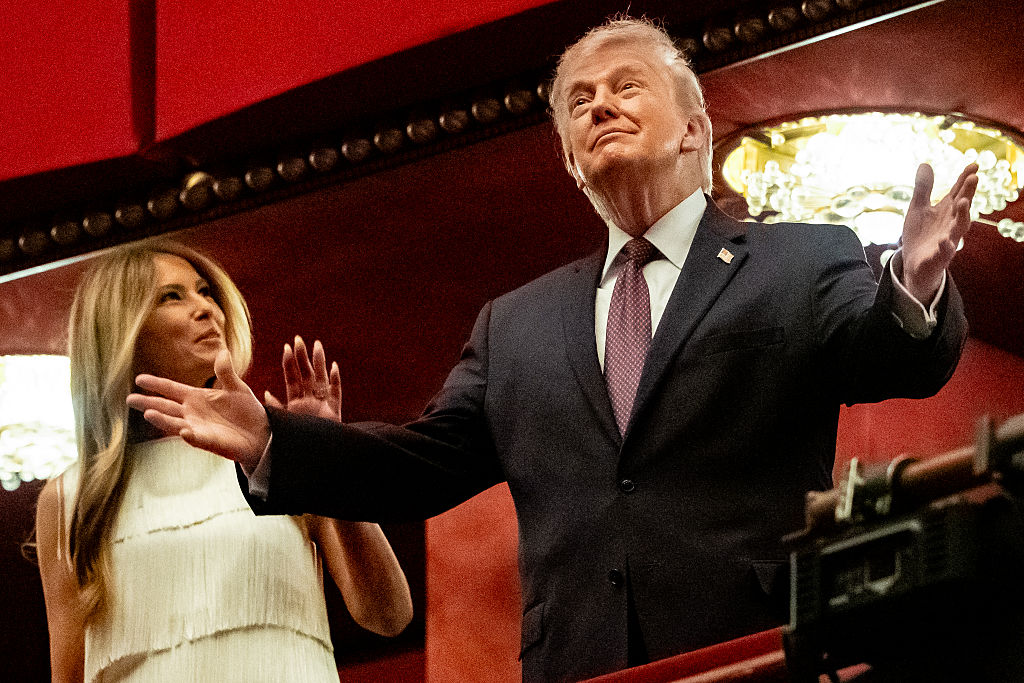
The 12 minutes of the Trump-Putin summit that shook the world
The Trump-Putin press conference in Anchorage was 12 minutes that shook the world. Putin got precisely what he wanted, which was full personal rehabilitation as a respectable world leader. Donald Trump literally rolled out the red carpet for Putin and at the presser said that he had ‘always had a fantastic relationship with President Putin, with Vladimir.’ And though no deal was done over Ukraine, what Putin achieved was something far more valuable – a re-set of relations between Russia and the US.
Putin admitted that bilateral ties had fallen to the ‘lowest point since the Cold War’ but called for both sides to move on. ‘Not far from here lies the international date line where one can literally step from yesterday into tomorrow,’ said Putin. He spoke of a ‘constructive atmosphere of mutual respect,’ of ‘mutually beneficial and equal ties’ and twice called the newly reset relationship with America ‘businesslike’. Trump, for his part, praised both Putin and his team of ‘tremendous Russian business representatives.’
True, a planned lunch for the two delegations and a second, expanded round of talks was cancelled. Three of the five senior economics officials that Putin had brought didn’t get to sit down with their US counterparts. But that was because the Russians decided that they had already got what they had come for.
‘The way that it felt in the room… like Putin came in and steamrolled,’ reported Fox News correspondent Jacqui Heinrich. Putin ‘got right into what he wanted to say and got his photo next to the president and then left.’
Though no deal was reached, Putin did come away from the summit with one very significant practical victory. The Anchorage summit effectively swept away all of Trump’s previous ultimatums and threats of ‘severe consequences’ and replaced them with an open-ended negotiation framework that buys Putin time. More, Putin was able to pretend to be seeking peace and negotiation while in reality escalating offensive operations in Ukraine. And perhaps most important of all Putin made clear that he was not interested in a ceasefire but rather a comprehensive peace deal to be negotiated even as his forces continue their grinding advance in Donbas. And Putin clearly believes that Trump will be a pushover at the negotiating table.
‘Trump may sincerely want to end the war, but he does not have the mental capacity to negotiate with Putin,’ wrote Janis Kluge of the German Institute for International and Security Affairs. ‘You can’t be tough if you don’t understand the nuances of the issue you are negotiating. The result is that [Trump] gets manipulated.’
What was striking was how carefully the Kremlin had planned the choreography of the summit. The very location of Alaska – loaded with symbolism not only of a lost Russian Empire but also of second world war US-Soviet cooperation – was the idea of veteran Russian diplomat Yury Ushakov. Meeting at the point of the North Pacific where Russia and America nearly touch also allowed Putin to greet Trump as his ‘dear neighbour’. Enroute to the summit Putin stopped off at the former Gulag town of Magadan and there laid flowers at a monument to Soviet and American soldiers who were killed ferrying thousands of American planes gifted under Lend-Lease to the Soviet war effort. The symbolism was clear. Putin was honouring the men who died ‘for our common victory’ over Nazism, he told reporters. By implication, the US and Russia could unite again to oppose the supposedly Nazi regime in Kyiv.
Putin’s talking points were also precisely measured. He knows exactly what to say to please Trump, from confirming that the war would not have started if Trump had been president in 2022, to agreeing with Trump that Russian electoral interference in the 2016 US election was a ‘hoax’. Appealing to Trump’s greed, Putin spoke of the ‘tremendous potential’ for business cooperation. And to the outrage of many Ukrainians, Putin called the war that he himself started a ‘terrible tragedy for us’ and a ‘wound’ and insisted that Russians considered Ukrainians a ‘brotherly nation’. That is a clear echo of a common Russian narrative that the war was fomented by western interference in Kyiv’s affairs.
It was also clear that the Kremlin’s position has barely changed since 2022. When Putin speaks of the ‘root causes’ of the conflict he is saying that he sees an independent Ukraine that has the ability to defend itself is a fundamental threat to Russia. When he calls for a ‘fair balance of security’ Putin means restrictions on Nato deployments in the Baltics, Poland and Romania.
Small wonder that ultranationalist Russian philosopher Alexander Dugin called the summit ‘excellent… the best result that we could expect!’ Hungary’s prime minister Viktor Orbán wrote that ‘the world is a safer place today than it was yesterday’ as a result of the summit.
The big question now is whether Trump will follow up by putting more pressure on Russia – or more pressure on Ukraine to capitulate. Trump will meet with Zelensky on Monday in the Oval Office to discuss what Trump called ‘points that we negotiated [with Putin] and points that we largely have agreed upon. I think we have agreed on a lot… Ukraine has to agree to it, maybe they’ll say no.’
For Zelensky, the choice will be to agree to the terms Trump negotiated over his head – or refuse, and try to fight on with European help. Unfortunately for Ukraine, Putin doesn’t seem to care whether the endgame of the war plays out on the negotiating table or the battlefield. Putin believes that he can win either way.
The many blind spots in Nicola Sturgeon’s memoir
Throughout her memoir, Nicola Sturgeon emphasises her achievement in becoming the first female first minister of Scotland. While that achievement should not be underestimated, I’m sure I’m not the only woman who wishes she made a better job of it.
In her political afterlife, as in her political life, she evades real scrutiny
It’s not just her determined blind spot on the implications of self-identification for women’s rights which emerges from this memoir, but also the fact that her much trumpeted support for women, including those under attack in the public forum, seems not to extend to those who dare to disagree with her.
There is widespread recognition that Nicola’s legacy is marred not just by the self-identification fiasco but by other notable policy failings in the fields of education, the NHS, drug deaths and public transport (ferries and roads). Not to mention her failure to advance the raison d’etre for her political career, Scottish independence, beyond the point to which her predecessor took it.
Yet she has remarkably little to say about these issues in her memoir.
For example, on her failure to close the educational attainment gap she claims that it took her a while to realise the role played by child poverty. This is hardly rocket science. Besides, the child poverty payment which she finally introduced in February 2021 was a policy which she initially dismissed out of hand when it was first presented to her by Alex Neil five years earlier in February 2016. But she doesn’t mention that.
Clearly, she considers her handling of the Covid pandemic to be her greatest triumph. She cites the exhaustion it induced as one of the reasons for her resignation and says she came close to a breakdown in the wake of her evidence to the Covid inquiry. Yet, the chapter on Covid is curiously silent on some of the biggest concerns which have come to light since her daily broadcasts to the nation ended. Care home deaths merit a brief mention but there is no analysis or justification of strategy that led to them. Nor does she even attempt to justify the deletion of her WhatsApp messages despite her promise to a journalist to keep them.
Nicola is very keen to remind us, repeatedly, of her love for books. But for all her reading, this book, like her speeches, is curiously short on big ideas or indeed literary references. Except for a very superficial treatment in the opening chapters there is little insight into why she is a Scottish nationalist and which political theories she espouses.
Even where she does attempt to address difficult issues such as her sexuality, she dances around the issue and the reader is left not quite sure what she is trying to say. The confusion has not been cleared up by her media interviews during the publicity storm surrounding the book.
Reflections on life as a woman in politics is one of two themes which dominates this memoir. The other is a thorough traducing of her predecessor and one-time mentor. Alex Salmond is clearly living rent free in her head except he isn’t because he’s dead and some think that’s in no small part due to the treatment he endured at her hands. Not content with the fact that he’s now gone and can never again be a threat to her, large parts of this book are devoted to further besmirching his character.
Before the book was even published, Salmond’s political friends and independent observers like the highly respected former Green MSP Andy Wightman and the journalist David Clegg, were able to debunk some of the allegations against him. These include the ludicrous notion that Salmond himself might have been the author of the leak which led to the media storm around allegations that he was a sex pest and that he was opposed to gay marriage despite him having introduced it as first minister. The minister he entrusted with doing so, Alex Neil, claims that Salmond handed him the equal marriage brief because, ‘Nicola didn’t want to do it any longer as she was fed up with it.’
Despite her efforts to heap further opprobrium on Salmond, Sturgeon scorns the idea that there was any conspiracy to do Salmond down and that she was involved. She states that there was neither evidence nor motive and leaves it at that. Thus, she avoids addressing the evidence of conspiracy that has been adduced by others – some of which has been revealed under parliamentary privilege by David Davis MP and Kenny MacAskill (former MP and leader of the Alba party) – including the existence of WhatsApp messages by her husband, Peter Murrell and other close aides in which the suborning of evidence against Salmond was discussed alongside how best to pressurise the police to act.
Ironically the motive for removing Salmond from the political scene emerges in the glaring resentment of him displayed in her book. In addition, anyone who’s been paying attention to Scottish politics knows that he was manoeuvring to make a leadership comeback after she suffered one of her biggest setbacks with the loss of 21 SNP MPs in the 2017 general election.
In contrast to her constant attacks on Salmond, her memoir is remarkably light on any explanation as to why she was unable to capitalise on the extraordinary legacy which he bequeathed her. Independence support was at its highest level ever and an explosion in SNP membership and support led to the party capturing almost 50 per cent of the vote at the 2015 general election.
There is very little discussion of her strategy to capitalise on the opportunities afforded to advance the cause of independence during the Brexit saga and Boris Johnson’s premiership. She sums the situation up by saying independence could not be advanced because the British government would not grant her the permission to hold another referendum. However, she does not explain what if anything she tried to do about this apart from repeatedly banging her head against the brick wall of their refusal.
She also omits any reference to the viciousness with which she and her supporters shut down any attempt to discuss or debate a Plan B.
Likewise, there is no discussion of what advantage she might have tried to parlay in the 2017-2019 when her 35 SNP MPs were close to holding the balance of power at Westminster. Presumably because there was no discussion at the time. I know because I was there and was pilloried for trying to initiate such a discussion.
Indeed, the reader will search in vain for anecdotes about the sort of tortured policy debates in cabinet or at the party’s national executive committee one normally reads about in political memoirs, because, under Nicola’s leadership, such discussions were neither encouraged nor tolerated.
She writes that as soon as Boris Johnson became PM she knew there would be another general election. There is no mention of the opportunity that was afforded to take Johnson down after the UK Supreme Court had ruled his prorogation of parliament unlawful. Indeed, the unlawful prorogation, the most extraordinary upheaval in modern British constitutional history, does not even merit a mention. I can only assume that this is because she failed to appreciate its significance, rather than because I was partly the author of the court victory.
On the scandal surrounding the SNP finances we hear little except about the impact the police investigation has had on her and her joy at her ‘exoneration’. Further discussion, she tells us, cannot happen because of the charges against her husband. How convenient. I guess we shall have to wait for another day to hear why she so determinedly shut down legitimate questions from party members and NEC representatives about the whereabouts of a £600,000 independence referendum fund that was supposed to be ringfenced.
At the Edinburgh Book Festival last week she performed for a gathering of her dwindling fan base, while her legacy played out elsewhere in the festival city. There were rows raging over censorship by the Book Festival and the National Library of Scotland of the book, The Women Who Wouldn’t Wheesht (written by feminists, sex abuse survivors and lesbians). Kate Forbes, the woman who in a more mature Scotland might have been Nicola’s successor, was banned from a fringe venue.
After over an hour with her adoring fans, Nicola spent a very tetchy 14 minutes with Scotland’s broadcast media and print journalists having cancelled all other planned interviews with them.
In her political afterlife, as in her political life, she evades real scrutiny. For those hoping to understand better what was really going on behind the scenes during her leadership, this memoir will disappoint. It will be left to other memoirs to shed more light on what was really going on.
The Alaska summit doesn’t look good for Ukraine
And just like that, the highly-anticipated summit between Donald Trump and Vladimir Putin in Alaska has been and gone, seemingly without very much at all to show for it. The two presidents met in Anchorage yesterday for what Trump had touted as a ‘feel-out’ meeting to lay the groundwork for negotiations to discuss an end to the war in Ukraine. But despite Trump rating the tête-à-tête a ten out of ten – ‘in the sense that we got along great’ – on substance, the American president has come away with little to prove that Putin is any closer to stopping his invasion.
The signs for Ukraine don’t look promising. Trump has already started to publicly pile the pressure on Zelensky to ‘make a deal’ with Putin
Yesterday’s meeting was a historic event: this was the first time Trump and Putin had met in person since 2019, and the first time the Russian president had stepped foot on American soil in a decade. The American delegation did their best to treat Putin as the global statesman – rather than pariah – that he has always craved. A red carpet was rolled out for him at the airport, with Trump himself there to meet him and shake his hand on landing.
Yesterday had the potential to be pivotal for the war in Ukraine. In refusing to pull the trigger on the secondary sanctions he had threatened against countries that buy Russian oil, and instead calling this summit, Trump had created a unique opportunity to appeal directly to Putin. The American president had kept his cards close to his chest in the run up to the summit, but had variously floated ideas about ‘land swaps’, including retrieving for Ukraine its ‘ocean real estate’, and bringing in ‘severe consequences’ in the form of sanctions if Putin didn’t comply.
Ukrainian president Volodymyr Zelensky and his European allies had spent the week fearing the worst and appealing to Trump not to sign away the country’s territory to Putin without consulting Zelensky first. Trump had appeared to agree, saying discussions about exchanging territory would come at a second, follow-up meeting between the three leaders.
And yet, despite the global attention yesterday’s meeting received, surprisingly little is known about how it went or what – if anything – was agreed. The leaders met one-on-one for three hours, followed by a wider three-hour meeting that also included their political entourages.
Ahead of the summit, Trump had said a joint press conference with Putin afterwards, or simply one on his own, would depend on how things between them went. In the event, the two leaders did a short, 12-minute press conference together, taking no questions. The working lunch due to take place between both delegations was cancelled and the two leaders boarded their planes for home shortly afterwards. Trump, who typically likes to think out loud on his Truth Social media platform, remained uncharacteristically quite on there on the trip back to Washington.
Speaking to Fox News afterwards though, Trump said the two had a ‘very good meeting’. And yet, with little seemingly achieved by the American President to help Ukraine fend off its invader, it’s hard to see how this is the case. Things for Putin, however, look rosier. Trump has clearly failed to wield any threats or incentives capable of forcing the Russian president to consider a ceasefire in Ukraine. Indeed, the Kremlin is already boasting this morning that Trump refused to follow through on his threat to increase sanctions on Russia, and that Moscow could negotiate without having to pause its ‘special military operation’ in Ukraine.
In the hours since the summit ended, Trump has been on the phone to debrief Zelensky and Ukraine’s European allies. No doubt their reactions to the meeting with Putin will start to filter through in the coming hours. And yet the signs for Ukraine don’t look promising. Trump has already started to publicly pile the pressure on Zelensky to ‘make a deal’ with Putin, who ‘wants to solve the problem’. The Ukrainian president will meet with Trump on Monday to discuss the situation further.
Many were hoping that yesterday would provide clarity, both on Ukraine’s future and the role of Trump and the US in the conflict. Those hopes have been dashed – for a little while longer, Ukraine’s fate continues to hang in the balance.
Tories split on Ricky Jones’ verdict
The decision to clear Ricky Jones of encouraging violent disorder has not gone down well with many senior politicians. Footage of the suspended Labour councillor went viral last August after he suggested that far-right protesters should have their throats slit. Jones, 58, drew his finger across his throat and called demonstrators ‘disgusting Nazi fascists’. On Friday, jurors found him not guilty after just half an hour of deliberations. Many were quick to contrast it to the Lucy Connolly case, whereby the wife of a Tory politician was jailed for 31 months during the Southport riots after writing ‘set fire to all the… hotels [housing asylum seekers]… for all I care’.
Some senior Conservatives certainly see it this way. Chris Philp, the Shadow Home Secretary, made that comparison explicit, writing that ‘the development of two tier justice is becoming increasingly alarming.’ He added that ministers ‘must come forward with plans to ensure justice is handed out equally, regardless of the background or views of the perpetrator’ but ‘this Labour government seems to be quite happy with two tier justice’. His colleague James Cleverly, the Housing spokesman, called the verdict ‘unacceptable’, writing on X that ‘decisions like this are adding to the anger that people feel and amplifying the belief that there isn’t a dispassionate criminal justice system’.
Clearly, this decision is a controversial one. But there is a crucial difference between the Jones trial and the punishment meted out to Lucy Connolly: she pleaded guilty so she did not receive a jury trial. Had she done so, she might well have been acquitted. Take the case of former Royal Marine Jamie Michael. Charged with stirring up racial hatred after Southport, he was acquitted by his jury after just 17 minutes. It was only five weeks’ ago that Robert Jenrick was leading a big campaign against proposals to limit jury trials. For some of his fellow Tories to now rush to condemn them, off the back of one verdict, is an overreaction, given the essential pressure valve they function.
All this matters because judicial reform is likely to be a cornerstone of the next government of the right. Kemi Badenoch is reviewing how Britain to leave the European Court of Human Rights; others want her to go much further. The last Tory administration found itself fighting endless battles in the courts, in a fruitless bid to halt illegal migration. Picking the right battles over the right principles is essential if the next government is to avoid repeating that fate.
Putin was the real winner of the Alaska summit
Vladimir Putin couldn’t stop smiling at the spectacle awaiting him in Anchorage yesterday, as American soldiers knelt to adjust a red carpet rolled out from his presidential plane. Donald Trump applauded as the Russian President walked towards him under the roar of fighter jets and stepped onto American soil for the first time in a decade. The pair shook hands for the cameras, ignoring a journalist who shouted, ‘Mr Putin, will you stop killing civilians?’ before riding off together in the presidential limo to the summit site. A royal reception, not a ceasefire, was what the international pariah had come out of his bunker for.
Putin emerged from international isolation and was welcomed as a king rather than as an indicted war criminal
After almost three hours of negotiations, Trump left Alaska with neither peace nor a deal. The lunch between the two delegations was cancelled. The brief press conference allowed no questions from the media. A seemingly energetic Putin gave an eight-minute speech on the history of Alaska while Trump stared blankly into the void. On Ukraine, Putin called it a ‘brotherly nation’, hypocritically claiming that ‘everything that’s happening is a tragedy for us, a terrible wound’. He then repeated the need to eliminate the ‘root causes’ of the war, signalling that Russia’s demands for Ukraine’s capitulation have not shifted.
Yet there still seemed to be some sort of an agreement taking shape behind closed doors. Putin said he expected Kyiv and European capitals ‘will perceive it constructively and won’t throw a wrench in the works’. Trump said that ‘many points were agreed’ and announced later in a Fox News interview that now it was up to Volodymyr Zelensky to ‘get it done’. Trump added that Ukraine would have to make territorial concessions, though Kyiv may not agree because Joe Biden ‘handed out money like it was candy’. Asked what advice he would give to Zelensky, Trump said: ‘Make a deal. Russia is a very big power. And they [the Ukrainians] are not.’
Putin left the summit having achieved the goals he came for. He emerged from international isolation and was welcomed as a king rather than as an indicted war criminal. He left with plenty of photos alongside Trump for the Kremlin propaganda wing to talk about and contrast with pictures of Trump lecturing a humiliated Zelensky in the Oval Office in February. Russia also avoided further sanctions despite rejecting a ceasefire, with Trump promising once again that he might think about it in another ‘two or three weeks’.
As for Trump, he has nothing to show for the meeting except for being laughed at in Russia and at home. Had there been progress, he would already be boasting about it, but he knows too little about the conflict he is trying to fix, and the stick he carried was too short to make Putin care. The summit labelled ‘Pursuing Peace’ failed to achieve even a partial ceasefire. No trilateral meeting with Zelensky has been agreed. The war will grind on, soldiers will keep dying and Russia will continue bombing Ukrainian cities. All Trump has to offer is his refrain to Ukraine: make a deal – whatever that means.
The real problem with Surrey’s cat-calling crackdown
When I was young, the song ‘The Laughing Policeman’ always spooked me a bit; I’ve grown out of most fears, but this one if anything has grown over the decades. Because never before has it seemed more obvious that the police are amusing themselves with us – and the end results, far from beingamusing, are really quite scary.
Never mind, ladies – there’s going to be a crackdown on wolf-whistling, that’ll keep you safe
As taxpayers, we pay the police a lot of money to solve crimes and catch criminals. But it appears that we are not exactly getting bang for our buck, with criminal behaviour becoming ever more acceptable and the police response less reliable. The epidemic in shoplifting is often cited, culminating recently in a North Wales shopkeeper putting up a sign saying ‘Due to scumbags shoplifting, please ask for assistance to open cabinets’. Only then did a policeman visit, having been alerted by a somewhat over-sensitive member of the public claiming that the sign was ‘provocative and offensive’.
There is a feeling that police are scared of actual criminals and far prefer to bully law-abiding citizens for stating obvious truths about the impossibility of a man becoming a woman or singing Christian songs in the street. The ‘mind the grab – phone-snatching hotspot’ tape which has recently appeared on the kerbs of Oxford Street as part of an initiative by the electronics shop Currys is the latest apparent surrender by the forces of law and order to the criminal fraternity.
You’d think that it would be all hands on deck to catch these scumbags. But apparently we have so much spare police-power that LBC radio recently reported on an extraordinary phenomena whereby undercover female cops have been dressing up in skintight lycra and jogging through public parks in order to attract cat-callers – who then get a scolding by a nearby crack-team of nags, presumably concealed by bushes. A spokesperson for Surrey police tutted: ‘These behaviours may not be criminal offences in themselves, but they need to be addressed.’
The Free Speech Union quite rightly dubbed it a ‘bizarre social-psychology experiment’ but the rozzers in question insisted that the prank would help protect women and girls in public and that the trial, which lasted a month, led to 18 arrests for offences such as harassment, sexual assault, and theft. Inspector Jon Vale, of Surrey Police, told LBC that the aim was to deter offenders: ‘One of our officers was honked at within ten minutes – then another vehicle slowed down, beeping and making gestures just 30 seconds later. Someone slowing down, staring, shouting – even if it’s not always criminal, it can have a huge impact on people’s everyday lives and stops women from doing something as simple as going for a run. We have to ask: is that person going to escalate? Are they a sexual offender? We want to manage that risk early.’
What a shame none of his colleagues in the Met thought to deter PC Wayne Couzens on his ‘escalation’ on the way to the murder of Sarah Everard. (The fifteenth woman killed by a policeman – that we know of – in 12 years.)He exposed himself three times, with witnesses reporting registration details of vehicles he used, but police took no action, leaving him to continue as a serving police officer affectionately known as ‘The Rapist’ to his colleagues. As Ruth Davison of Refuge said at the time of his sentencing, ‘Wayne Couzens pleaded guilty to three counts of indecent exposure. His car number plate was given to Met police officers, who should have carried out the correct checks to identify him as a serial sex offender and working within the force. He should have been immediately suspended from duty and investigated. Instead this didn’t happen and he was free, just days later, to escalate his behaviour and murder Sarah Everard using his status as a police officer, utilising handcuffs and his warrant card to coerce Sarah into getting into a car with him.’
The police have always been the most sexually sinister of the services which are ostensibly there to protect the public; their startling misogyny includes everything from using images of stalked, attacked and murdered women as their own private pornography stash to the brotherly solidarity they showed to the grooming gangs, ignoring the terrified children who summed up the courage to report their rape and torture, sometimes to the point of arresting the girls themselves for ‘disorderly behaviour’.
Does the police force attract nasty men in greater numbers than other professions? The paraphernalia which might attract sadists is there: uniforms, handcuffs, truncheons and tasers. One of the reasons why broad-minded people like me feel uneasy when we see photos of policeman happily appearing alongside men in extreme fetish-wear at Pride marches is that we are instinctively aware that if people find it OK to parade their sexual kinks in broad daylight, it tends to make civil society far less civil for women and children.
So is Surrey Police’s -alling project a kind of penance? Perhaps, but I think it’s far more likely to be our old mate the ‘wokescreen’. Pay lip service to protecting women and girls while simultaneously being an enthusiastic part of a legal system which seems increasingly to find actual violence against women and girls really rather trivial. Remember the embarrassing about-face Labour had to perform about enquiries into the Muslim rape gangs after Lucy Powell said they were a ‘dog whistle’. She couldn’t be sacked by Starmer as he’d already referred to people calling for a new inquiry into the gangs of jumping on a ‘far-right bandwagon’ back in January.
The grooming gangs have gone quiet, though one would have to be a certified half-wit to believe they’ve shut up shop. The focus now is on freelance sex attackers. Witness the women of all hues who have been protesting outside the migrant hotels, which house charmers such as Aron Hadsh from Eritrea, who sexually assaulted a young woman with learning difficulties – and was handed a 14-month prison sentence.
Never mind, ladies – there’s going to be a crackdown on wolf-whistling, that’ll keep you safe. Don’t you worry your pretty heads about the fact that each day sees more men pouring into this country whose misogyny is easily as Medieval as that of their co-religionists in Rotherham. As Alex Phillips has pointed out, many of these men are brought up in segregated societies which see a woman who shows her legs on a sunny day as basically asking for it.
Before it went wet, Private Eye ran a spoof headline on the increasing briefness of jail sentences for homicides: ‘KILL NOW AND WIN A FORD FIESTA’, I think it might have been, which might be updated to ‘RAPE NOW AND WIN AN E-SCOOTER’. If I had to make a modest proposal, in the Swiftian style, to solve this country’s cataclysmic crime problem, I’d suggest jailing those of us who don’t break the law, and letting loose those who do. It’s already started, with the government letting out woman-beating men to make room in prison for women who post things on social media disapproved of by the state. It’s a dystopia worthy of Dick – where words are literally violence but actual violence is no big deal. The thought-police will police our minds while our mere bodies will be left to defend themselves.
Regrettably, the philosophy of too many of those whose job it is the protect the public and punish the criminal appears to be the modish mantra ‘Forgive and forget’. Forgive the criminal and forget the victim, that is – especially if the victim is female. Scolding a couple of honey-trapped cat-callers is going to do nothing to put this right.
The good, the bad and the ugly of the Trump-Putin summit
The three-hour Friday summit in Alaska between Donald Trump and Vladimir Putin ended as well as it conceivably could have ended: as a big nothingburger. But that does not mean that Ukraine and its supporters can breathe a sigh of relief. Trump may be unhappy that the prospect of his Nobel Peace Prize remains elusive as Putin has not agreed to an immediate ceasefire in Ukraine. But it is far from clear that he will end up directing his anger against Russia.
The US president neither understands nor cares about understanding Putin’s motives and the threat he poses to the world
To be sure, it is a good thing that nothing of substance was agreed in Anchorage. Any big great-power bargain made over the heads of Europeans and Ukrainians, which Trump and Putin would then seek to impose on the hapless old continent, would mean the end of any semblance of a rules-based international order, in which borders of European nations are not redrawn by force.
We can be reasonably confident that Putin would have been happy to agree to an immediate ceasefire in exchange for Ukraine meeting his maximalist demands – Ukraine’s capitulation, the ceding of territories that Russians do not yet control, or a prompt election to unseat Volodymyr Zelenskyy. The failure to reach a deal with Trump suggests that the US administration has not bought into Russia’s interpretation of the war and how to end it – at least not yet.
The presence of Secretary of State Marco Rubio, once a Russia hawk, in the room might have played a role in preventing the worst-case outcome – unlike in Helsinki where the US president was left with Putin unsupervised for several hours. Yet, ‘normie’ Republicans must have felt more than a bit of shame about the spectacle that Trump orchestrated – the red carpet, the ride in the ‘Beast’, and the apparent warmth extended to a mass murderer and child kidnapper all reflect poorly on the United States – and help return Putin from pariah status to a respected global leader.
Relatedly, while the summit did not bring about a catastrophe for Ukraine, neither is it likely to lead to better Ukraine policy in Washington. It is hard to imagine now a tightening of existing, congressionally mandated sanctions by the executive branch – never mind the bill put forward by Senators Graham and Blumenthal, imposing a de facto trade embargo on countries buying Russian oil and gas, getting through a Republican-controlled Senate. And, even if Trump does not stand in the way of military sales to Ukraine, it will have to be the Europeans who continue to do the financial heavy lifting – all while being held hostage by America’s sluggish defence industrial base.
Finally, an ominous, ugly thought. In his remarks, Vladimir Putin warned Kyiv and European capitals against ‘throw[ing] a wrench’ into the works of the emerging deal (whatever it may be) between Russia and the United States. Clearly, the Russian dictator is playing the long game here: hoping to peel off the United States away from the broader pro-Ukrainian coalition. By itself, the summit has not accomplished that goal yet, but it has likely opened new opportunities to lure Trump and his inner circle closer to Russia. Even before the summit, there was speculation about ‘money-making opportunities’ that could bring the two world powers closer together.
The presence of US Treasury and Commerce Secretaries, Scott Bessent and Howard Lutnick, and Russia’s Kirill Dimitriev, the head of the country’s sovereign wealth fund – alongside ‘tremendous Russian business representatives’, as Trump put it – signalled a desire on both sides for normalisation of ‘businesslike’ relations. In practice, that might mean more investment, trade and other ‘deals’ – especially ones that generate cash for the Trump family enterprise.
What lies at heart of the summit is that the US president neither understands nor cares about understanding Putin’s motives and the threat he poses to the world. In contrast, Putin, a former KGB lieutenant colonel, has a solid grasp of what makes Trump and his entourage tick. He might make the occasional mistake and overplay his hand but he has focus, consistency, and a voracious appetite. And all of those, wrapped in a thoroughly delusional view of the world and Russia’s place in it, were both on full display and unchallenged on Friday.
What’s wrong with charging a fat tax?
At a time when quarterly economic growth in the UK is flatlining at 0.3 per cent, it’s good to learn that not every industry in Britain is in mortal peril. While their customers have seen better days, coffin makers report that the average casket width has grown from 18-20 inches to a girthy 20-24 inches.
As a 15.8 per cent increase, it’s the definition of an upsell and the kind of growth that only countries that have fired their chief statistician can hope to achieve. You’d think it would be a boom time for the National Association of Funeral Directors, who, given their trade, must rarely be in the mood for celebrating.
Excuse-making can’t nullify the physics: if you are fat, it’s because you ate too much
Yet it seems that both the bereaved and those doing the boxing and burying are alarmed by the corpulence of the corpses. With coffins growing ever wider, prospective punters at Danescourt Cemetery in Wolverhampton were dismayed to learn this week that new 6ft-wide gravesites had been earmarked for a £450 surcharge over standard 5ft ones, a 20 per cent levy totalling £2,700.
Local councillors were criticised for the move, which followed a May decision to create a new cemetery section for the big-boned. While the City of Wolverhampton Council has justified it as a response to increased demand for those larger sites, opponents lambasted it as a ‘fat tax’.
Predictably for a Labour administration, the council appears to have backed down on sustainable financing for the two-tier tombstones, with a spokesperson saying it would ‘not proceed with the plans’. Councillors were no doubt spooked by the dread accusation of ‘discrimination’.
But then, why shouldn’t cemeteries discriminate? Those with more to love are literally depriving those also dearly departed of graveyard space, which in many parts of the country is competitive despite ailing church attendance. As Matthew Crawley, chief executive at the Institute of Cemetery and Crematorium Management, put it, the so-called ‘fat tax’ might equally be termed ‘a concessionary fee for appropriate land usage’.
Should the funeral business die down, Crawley might consider a career in the Whitehall diplomatic corp. To be more blunt, and at the risk of speaking ill of the dead, while rotundity is eminently defensible as a lifestyle choice, it’s also frequently a burden on others and exactly the kind of negative externality that economists justifiably love to tax.
The matter is not even one confined to mortality. It is surely a greater nightmare to the living that, when you embark on a long-haul flight, fellow travellers literally overflow from nearby seats, with complaints about this phenomenon swelling across the West in line with people’s waistlines.
While some airlines have asked the big-bodied to pay more, in Australia two years ago advocates for ‘guests of size’ invoked discrimination law against policies that meant girthier customers needed to stump up for two seats. The Obesity Collective’s director Tiffany Petre claimed it was unclear who qualified as too fat to fly, though being unable to squeeze both arse cheeks into one seat is usually a good sign.
Online influencers frequently echo the claim that chunky monkeys shouldn’t be charged more, bringing inevitable claims of ‘bullying’ and ‘fat shaming’. The American influencer Jaelynn Chaney called it ‘outrageous’ that people are ‘forced to pay twice for the same accommodation anyone else gets with just one ticket’. Naturally, Canada has already made the double-charge illegal so long as you can provide a doctor’s note.
That leads us to the fraught area of whether fatness should incur higher costs in healthcare. Private health insurers generally charge higher premiums, and the government has shown an increasing desire to tax junk food or exempt it from promotions. By contrast, no politician would dare suggest that the stocky citizen should pay more taxes while placing a greater burden on our NHS.
It’s a debate that inevitably comes down to whether you think obesity is a lifestyle choice or a curse imposed by genetic misfortune, a McDonald’s on every street corner, and Sainsbury’s generous promotions on cheese. When combined with the NHS’s miserly distribution of Ozempic and similar drugs for weight loss, there’s no shortage of excuses for love handles.
And to be fair to advocates for the overweight, some of us are playing the game on easy mode, blessed with more self-control, more money for the low-cal Waitrose shop, and perhaps even a private doctor for that Ozempic prescription. But ultimately such excuse-making can’t nullify the physics: if you are fat, it’s because you ate too much.
Offsetting the downsides of your dietary choices through higher costs is no different than surcharging smokers for every pack of cigarettes, or slapping alcohol duty on a bottle of wine. While it’s down to local councils how they manage their cemeteries, caving to campaigners over spurious claims of unjust discrimination is a grave mistake.
The sad decline of the French village fête
France’s village fêtes are disappearing. A survey by the association Les Plus Belles Fêtes de France found that in just four years, nearly a third are no longer held. Once the highlight of rural life, they’re now falling victim to shrinking municipal budgets, falling household income, a chronic shortage of volunteers, endless administrative obstacles and rising security fears. In some places, tension between communities has turned violent. Only two summers ago, a teenager was murdered when a group of young men arrived to disrupt a fête. Elsewhere, fights break out so regularly that prefects now warn mayors to be ‘particularly vigilant’ during celebrations.
For centuries, the fête was a rare moment when the whole village came together without suspicion. Now, prefects circulate security warnings in advance of summer events
Each summer I try to make it to the village fête in our corner of Provence. The village is little more than a cluster of stone houses balanced on a rocky outcrop in the shadow of Mont Ventoux, with a small church at its heart and vineyards spilling down the slopes. Long trestle tables are set up in the square, the band plays as the sun goes down, and the menu runs to several courses with a starter, main, cheese, dessert, and plenty of wine. Grandmothers dance with children, young couples twirl under the lights, and local vignerons chat with Parisians who escape here over the summer. It is, in short, everything France gets right. And yet our mayor isn’t sure he can afford to subsidise the fête next year.
Village fêtes have always relied on the mairie, the city hall, to underwrite them: a grant for the band, a subsidy for the caterer, help with the tent rental. But local authorities are getting less money from central government and the region. Since 2014 state grants to communes have been cut by nearly €11 billion. Villages are now expected to raise more themselves, mainly through property taxes. In our village the mairie has doubled the property tax on second homes. We’re an easy political target when the owners are Parisians who only come down in August. But even these new measures may not free enough funds to guarantee next year’s fête. In many small towns, the economics are brutal: as BFMTV reports, staging even a modest fête can cost €10,000, yet the mairie’s subsidy may be barely €1,000. Fêtes are more likely to be cut than school or housing. And once a fête misses a year, the momentum goes with it.
Then there’s the problem of less money in people’s pockets. Rural families are feeling the pinch. France’s cost-of-living crisis is leaving a mark, with inflation still outpacing wage growth. In 2025, grocery prices are up nearly 20 per cent since 2020, forcing many to skip the €25 to €30 village meal. Petrol has been stubbornly above €1.90 a litre in much of rural France.
Across the country this summer, tourist spending is down, industry estimates suggesting a drop of at least ten percent. Restaurants, markets and cultural events are all reporting weaker takings. For many families, summer now means choosing between a proper holiday and a few day trips. When belts tighten, spending €25 or €30 for the fête dinner, buying raffle tickets or splashing out on another round of rosé at the buvette becomes a luxury. Even in rural areas, where traditions die slowly, the economic chill is leaving empty chairs.
These events depend on armies of unpaid helpers: people to set out tables, string up bunting, sell tickets, pour drinks, and clear up at two in the morning. That used to be easy. Retired farmers, shopkeepers, and schoolteachers would turn out in force. Now they are older, fewer, and less inclined to haul chairs in the summer heat. Younger people, if they are still in the village at all, spend weekends elsewhere. According to France Bénévolat, the number of volunteers in France fell by 15 per cent between 2019 and 2023, a loss felt most sharply in small associations that organise village events. BFMTV quotes Alexandre Hernandez, 36, who has organised the fête in Calamane for 14 years: ‘A village fête is time, money and lots of work.’ His organising committee still has 15 loyal volunteers, but he admits that if he quits, the fête will likely die.
Even when the money and volunteers can be found, there is a new obstacle: paperwork and protests. France has cultivated a thriving cottage industry of objections to fêtes. Vegan activists try to ban traditional meat-based menus. Environmental groups file appeals against fireworks over concerns for birds or noise pollution. Anti-military campaigners object to parades by the local reservists. In some departments, a single complaint can force the mayor to justify the event to the prefecture, submit a full security plan, and wait weeks for approval. Le Figaro reports cases where opponents rush to administrative court on the eve of the event, forcing organisers to cancel at the last minute. BFMTV notes that the paperwork for the prefecture, security, staffing, insurance, are all reasons organisers give up. Many mayors quietly decide that a fête is no longer worth the hassle.
The biggest change, though, is the atmosphere. For centuries, the fête was a rare moment when the whole village came together without suspicion. Now, prefects circulate security warnings in advance of summer events. Some mayors hire private guards. In certain towns, the gendarmes patrol in pairs. It isn’t paranoia. In 2023, in Crépol in the Drôme, a 16-year-old was stabbed to death when a group of young men from a nearby housing estate descended on the village fête and started a fight. The killing shocked rural France, but it wasn’t an isolated case. The same year, police in the Loire arrested eight people after a brawl at a fête involving knives and bottles. Smaller incidents are frequent – bottles thrown, knives drawn, fights.
From small villages to coastal towns, security concerns are reshaping summer traditions. The security problem is now so entrenched that some places have simply given up. In Antibes, one of the Riviera’s busiest destinations, the mairie has decided there will be no large public events at all during August. As Nice-Matin reports, Mayor Jean Leonetti admits this is deliberate policy, taken with the prefecture, to avoid overloading police during what is considered a ‘high-risk’ month. The only exception is the annual fireworks festival. Everything else is off the calendar. Once violence and security shortages become part of the calculation, the question is not just whether the mairie can afford the fête, but whether it dares to hold one.
The disappearance of the village fête is not just about losing a night of music and bad dancing. It’s the erosion of a tradition that unites a village across age, class, and politics. In our Provence village, the fête is an occasion where age and class dissolve, and everyone comes together, from farmers to newcomers, locals to summer guests. No one cares who voted for whom. Losing the village fête is part of a deeper erosion, a fraying of shared traditions. It’s the loss of intergenerational exchanges, the mixing of social classes, and the instinct to come together as a society.
Unesco status is killing Bath
Last month, the Trump administration announced that the United States would once again withdraw from Unesco, the Paris-based UN cultural agency responsible for World Heritage Sites, education initiatives, and cultural programmes worldwide. The official line? Unesco promotes ‘woke, divisive cultural and social causes’ and its ‘globalist, ideological agenda’ clashes with America First policy. Predictably, the Trump administration framed it as a culture-war grievance. But, set aside the politics, and it soon becomes clear that Trump might not be entirely wrong.
The designation treats the Georgian crescents and Roman baths as inseparable from the supermarkets, car parks, and 1970s infill
Unesco – founded in 1945 with the lofty mission of promoting peace and global cooperation through culture, education, and science – has devolved into something far less edifying.
Once led by artists, architects, and scholars, Unesco’s World Heritage Committee has become the Fifa of culture: a fiefdom of bureaucrats, political journeymen and international grifters who drift between departments, NGOs and consultancies with no accountability, while the list of sites has ballooned to 1,248. Its $1.5 billion annual budget fuels a self-perpetuating treadmill of capacity-building workshops, unread reports and relentless reputation polishing.
The consequences are not merely abstract for Bath, a Unesco World Heritage Site since 1987. Some World Heritage Sites are a single chapel, a medieval bridge, or a protected ruin; Bath’s listing covers the entire city – all 94,000 residents, its suburban sprawl, its industrial remnants, and its everyday working streets. The designation treats the Georgian crescents and Roman baths as inseparable from the supermarkets, car parks, and 1970s infill, meaning almost any change anywhere must be weighed against the city’s ‘Outstanding Universal Value.’
At the same time, the city is grappling with a record housing crisis: house prices are more than 13 times annual earnings, social housing demand is soaring, and temporary accommodation has reached a 20-year high. Homelessness services like Julian House’s Manvers Street hostel operate far beyond capacity, providing nearly 97,000 bed spaces last year alone while struggling to secure their own roof.
But Bath’s heritage status means it is almost impossible to get anything built. Although Unesco status carries no direct legal force in the UK, it is woven into planning policy through the Bath and North East Somerset Local Plan, which bars development deemed harmful to the ‘qualities justifying the inscription’ or its setting. In practice, this gives opponents of change a powerful rhetorical weapon: they need only invoke ‘Outstanding Universal Value’ to wrap their case in the prestige of an international mandate. The result is a permanent, low-level threat – that almost any proposal, however modest, might be cast as an affront to world heritage and fought on those grounds.
In 2024, residents were warned that the city’s Unesco status was ‘at risk’ after the council approved the replacement of former industrial units on Wells Road with 77 ‘co-living’ apartments. The planning committee split four to four, with the chair casting the tiebreaker vote in favour. Councillors raised concerns about the building’s bulk and potential ‘cumulative impact’ on the World Heritage Site, with one declaring the city was ‘sailing close to the wind with Unesco.’ It is extraordinary: a city struggling to house its own people, yet officials can menace its international status over a modest block of flats.
Meanwhile, residents in nearby Saltford – whose own Grade II* Saltford Manor dates to the 12th century and is thought to be Britain’s oldest continuously inhabited house – watch as Bath’s tight planning restrictions push the housing burden outwards. With 1,300 new homes proposed for its green belt, the village faces development on a scale it can’t sustain, without the infrastructure or political protection to resist it.
Phil Harding, head of the Saltford Environmental Group and a resident for more than 30 years, recently made headlines when he spoke out about the impact of Bath’s World Heritage status on neighbouring communities. ‘I’m not against new housing, I’m against putting housing in the wrong place,’ he says. Bath, he notes, is already a fantastic city that draws tourists in its own right, and Unesco status ‘makes no difference.’ The real problem, he adds, is that World Heritage designation makes it ‘incredibly hard to build in Bath,’ pushing development into nearby villages. Much of the employment for new arrivals will still be in Bath, leaving Saltford to shoulder the burden – green belt land lost, congestion rising, local services stretched – without enjoying the benefits. ‘Bath doesn’t need World Heritage Status,’ he concludes. ‘It distorts planning priorities, forcing the city to preserve appearances while shifting the real costs onto neighbouring communities.’
It may sound unthinkable, but losing that status is hardly fatal. Liverpool provides the example: once celebrated for its maritime mercantile cityscape, it was stripped of Unesco recognition in 2021 after the agency judged that recent and planned developments had caused an ‘irreversible loss’ of the site’s Outstanding Universal Value. Among the contested projects was Everton FC’s new stadium at Bramley-Moore Dock, which required filling in part of the historic dock to accommodate a 52,000-seat arena. Even the Guardian acknowledged it as ‘the most striking, ambitious addition to the waterfront since the Three Graces were built in the early 1900s.’ The £800 million stadium formed part of a broader £1.3 billion regeneration plan, projected to create over 15,000 jobs and attract more than 1.4 million visitors annually. The city did not crumble: regeneration pressed ahead, docks were revitalised, neighbourhoods transformed and tourism continued to flourish. The lesson is plain – Unesco’s imprimatur is not the secret ingredient of urban vitality, and its objections can just as easily hinder development as they can protect it.
If Unesco were merely symbolic, that would be one thing. But the status is far from meaningless: it exerts moral and political pressure, informs planning guidance, and lends weight to the opinions of advisory bodies like Historic England. For Bath, this translates into a city where development proposals are scrutinised through the lens of ‘Outstanding Universal Value,’ with councillors warned that new flats or infrastructure might unsettle international sensibilities. The result is a city frozen in amber, preserved more for the approval of tourists rather than for the people who actually live and work there.
So when the America First brigade lashes out at Unesco, it is tempting to roll our eyes. But there is a logic to that disdain. World Heritage labels are increasingly badges for the international jet set, not the local people. The US may be leaving for its own vanity, but the reasoning – that Unesco is corrupt, politicised, and more interested in theatre than preservation – hits the mark. For cities like Bath, the real question isn’t whether Unesco might disapprove, but why on earth they should care.
Why won’t young people pick up the phone?
‘So you mean rather than writing something out, you could just talk to somebody from a distance? But that would be so cool. And so much quicker. And so much more real.’
‘Exactly!’
There was a distant time when phone calls were in themselves seen as the cowardly opt-out way of communicating rather than just doing it face to face
Imagine if after decades of just being able to text, phone calls were only invented now.
Everyone would be all over them. But instead the telephone is something used exclusively by sad old people to talk to each other. No self respecting teen would talk when they could text. Or do that even more annoying thing of just leaving a text voice message.
So widespread is this that it’s even become a thing now – ‘telephobia’, or phone anxiety, the fear or avoidance of making or receiving phone calls. According to the dictionary, ‘It’s a common form of social anxiety, and can manifest in various ways, from mild nervousness to panic attacks. Symptoms can be both psychological and physical.’
This week it was pointed out that for those 18-year-olds receiving their A-level results and finding they need to negotiate clearance to get to university they would have to – horror! – pick up the phone and actually talk to somebody in admissions for that to happen.
Such is the anticipated trauma that both schools and universities are offering special counselling for those teenagers who have been used to a lifetime of texting – by definition, saying something without listening to what anybody else has to say – and coming to terms with a real-life phone call. With the cut and thrust of call and response.
On Radio 4, a teacher gave the useful advice that teenagers should write down their own name in case they had to give it during the phone call and got flustered. And it’s not just teens. Plenty of older adults are going that way as well.
Wikipedia helpfully explains ‘telephobia’, and is worth quoting at length to show quite how far our snowflake society has become unable to function:
‘Fear of making calls may be associated with concerns about finding an appropriate time to call, in fear of being a nuisance. A sufferer calling a household or office in which they know several people may be concerned at the prospect of failing to recognize the voice of the person who answers, with resultant embarrassment. Some sufferers may be anxious about having to “perform” in front of a real or perceived audience at their end of the line: this is a particular problem for those required to use a phone in the workplace.’
There was a distant time when phone calls were in themselves seen as the cowardly opt-out way of communicating rather than just doing it face to face. ‘You mean you got fired over the phone.’ Now they’re so real they’ve become scary.
You wonder how teenagers would manage in a face to face interview. But of course those don’t happen anymore. It’s all done by Zoom.
My own two sons would rather have their hands cut off most of the time rather than actually answer the phone. Which doesn’t mean they necessarily answer texts either.
When I worked at the BBC, there was a helpful maxim that after three exchanges of emails, it was much better to pick up the phone and actually talk to somebody to get a resolution to whatever the issue was. It’s something I’ve kept to ever since.
Sure, phone conversations can be interrupted by poor reception, traffic noise or the sound of your interlocutor eating breakfast cereal at the same time. But that’s life – and how much richer to embrace it.
There’s nothing worse than male trouser trouble
First, there was the bizarre tale of the poor unfortunate man who, after dropping his trousers on the District line near Upton Park, was set upon by an outraged gang, beaten and then forcibly expelled from the Tube. And then, just a day or so before, the perpetually beleaguered Gregg Wallace caused a similar degree of opprobrium when he put out a video in which he addressed allegations of bad behaviour involving a lack of trousers. What on earth is going on?
On Instagram, Wallace announced, with a touch of the Beowulf poet: ‘Would you like the truth about the stories regarding me taking my trousers down, listen! There are no findings in the investigation that I took my trousers down in front of anybody.’ He ended his video by repeating, sternly: ‘Any claim that the report says differently is not true.’
So there we have it. Gregg Wallace may be many things, but he is not a trouser-dropper – unlike the anonymous semi-flasher on the Underground, who definitely was, has now been detained for his own good under the Mental Health Act. A warning, perhaps, to those of us who, now that the weather is becoming disconcertingly warm once again, might fancy a little impromptu chino removal on public transport for our comfort. Yet in truth, the idea of taking down one’s trousers is an innate source of English fascination that has been a staple of comedy since Chaucer and Shakespeare, and is likely to remain so until the day we are all wafting round in unisex kimonos.
The reason why trousers – more than any other form of attire – are imbued with such comic potential is that the average English gentleman associates them with his dignity. Lose them, and his sang-froid tumbles to the floor along with the fabric. It was no wonder that the Aldwych farces and Carry On films all made considerable weather of their stiff, not-so-buttoned-up characters being compelled to cover their reduced dignity in increasingly absurd circumstances as their breeches sally off into the sunset.
I would like to say that the loss of trousers is something that only occurs on stage and in film, but alas, I can testify that it is all too real. In my home city of Oxford, I have seen many cruelly abandoned pairs of formal trews in the street, presumably after a heavily misspent night involving fine wine. Nor is this limited to the young. A friend tells how, after a wild evening on Clapham Common with some newfound friends resulted in his being debagged, he cycled past the scene of the crime the next day to see his once-beloved slacks fluttering mournfully in the wind – the mute observer to whatever unspeakable things had happened in that particular spot.
As for the shame’s memorialisation in memoir, another friend – a leading light in the entertainment industry – has confessed that, should he ever put finger to keyboard and write his autobiography, it could only be called A Life Without Trousers, so torrid have his exploits in this field been.
I would dearly love at this point to confess that I know nothing of such things, but unfortunately I recently had my own narrow brush with infamy. A few months ago, I was strolling along Hampstead Heath with my family when, to our horror, a tree fell just behind us, nearly causing grave hurt, or worse.
We scrambled to safety just in time, with no worse injury than a few cuts and bruises – but as I realised that we were largely unharmed, I also realised that the sudden impact on the ground had sent my kecks cascading round my knees. To be found dead and trouserless on Hampstead Heath: now that, I fear, is the end that many of my enemies would wish on me. But I intend to give them the dissatisfaction of continuing to live – with the bottom of my trousers rolled – for many a well-furnished year to come, God willing.
The Alaska summit went much as expected
The summit between Presidents Donald Trump and Vladimir Putin ended predictably, without a ceasefire deal or, it seems, assent on much else. Trump said “Many points were agreed to, and there are just a very few that are left,” but failed to offer any details. Even if true, the leftovers are critical, and the gulf between the two governments on the war remains huge. Critically, Putin cares more about security than image or economics, and understandably believes that he would lose leverage by agreeing to halt military operations before winning the concessions he demands from Ukraine.
Nevertheless, the summit improved, however slightly, the prospects for negotiating an end to the war. With Moscow on the offensive, a peace that preserves Ukrainian sovereignty and independence requires that Kyiv talk with the Putin government. Diplomacy has stirred, however ineptly. Necessary now is getting Ukraine and Russia to negotiate, while encouraging both to be realistic. To end a conflict that is costing both sides dearly, Kyiv will have to lose territory and endure neutrality, while Moscow should accept a Ukraine that leans West politically and economically, though not militarily. Since battlefield success may have emboldened Putin, Trump should use the prospect of improving political relations and economic dealings with the West in an attempt to pull Moscow toward a compromise capable of delivering a stable peace.
Ricky Jones and the reality of two-tier justice
This may be looked back on as the week when two-tier justice moved from being an accusation to a statement of incontrovertible fact. The stark difference in treatment of Ricky Jones, the former Labour councillor accused of encouraging violent disorder as he mimed a throat being cut at a protest and Lucy Connolly, the mother who sent a nasty tweet shortly after the Southport massacre, is no conspiracy theory, despite the state’s best efforts to pretend it is.
Crucially, like most of those arrested at the time, Lucy Connolly was denied bail
To recap, Jones was filmed at an anti-racism rally after the Southport riots calling protestors ‘disgusting Nazi fascists’, and said ‘We need to cut their throats and get rid of them’. Lucy Connolly received a 31-month prison sentence for sending an unpleasant tweet about migrant hotels (which she promptly deleted) saying, ‘Set fire to all the f*****g hotels full of the bastards for all I care [emphasis added].’ Given the caveat at the end of this sentence, it is debatable that this was a tweet which did much to incite anything.
For what it’s worth, I don’t believe either individual should have been locked up for their speech, but if the state must do so, it needs to be seen as even-handed. This is a profoundly damaging moment, both for the government and for public trust in the judicial system – what little there was to begin with.
By way of mitigating circumstances, Jones’s defence argued that he may have been affected by his probable ADHD, and suffered from ‘emotional arousal’ which could ‘override deliberate decision-making’ (which presumably therefore made it harder to understand the impact of calling for throats to be slit). Lucy Connolly’s potential mitigations as the mother of a young daughter, who had previously lost her infant son in tragic circumstances which naturally made her sensitive to the news of murdered children, seem not to have mattered as much.
One important difference is that, whereas Lucy Connolly pleaded guilty last summer, Ricky Jones fought his charges in court (defended by a silk from Garden Court chambers). But this only points to a further aspect of two-tier justice; namely, who has the means to fight their case. The privately-paid solicitor will naturally make sure his privately-paying client is aware of all the defences available to him. By contrast, the harried duty solicitor is not exactly best-placed to give considered advice.
Either way, I suspect few who hear about these two cases will care very much about distinctions like guilty and not guilty pleas. Most will simply compare the two ‘offences’ with the respective punishments doled out, and judge for themselves.
Crucially, like many of those arrested at the time, Lucy Connolly was denied bail. Facing a potential delay of months inside while awaiting trial, she may have felt that she had no choice but to plead guilty to the charges laid before her. This element of potential coercion was perhaps the starkest example of ‘two-tier justice’. Since Jones was granted bail, he had a year to prepare his defence after multiple delays to his trial. Two-tier justice exists across multiple realities and manifestations; from the granting of bail to financial disparity – not to mention the fact that activist lawyers are sometimes only too happy to waive fees where they agree with the accused.
While dismissing Lucy Connolly’s appeal to her sentence in May this year, Lord Justice Holroyde went out of his way to praise her solicitor. ‘He struck us as a conscientious defence lawyer with a clear grasp of the relevant law, practice and procedure and a realistic appraisal of the issues in the case.’ The fact that Connolly, like other defendants charged with stirring up racial hatred post-Southport, may well have been cleared by a jury had it gone to trial, should surely call into question the advice she received. Lord Justice Holroyde’s praise gives the uneasy impression of lawyers looking out for their own.
The judiciary obviously cannot control the decisions of the jury that acquitted Mr Jones in a court of law, and nor should it. Yet some of the inevitable backlash we will now see might perhaps have been avoided had Lucy Connolly received greater clemency from the UK state. So long as she remains incarcerated for what appears a manifestly less serious offence, it will be harder than ever to argue that UK justice remains intact.
A few weeks ago, Tony Diver at the Telegraphpublished an extraordinary story, revealing more about the activities of a secretive wing of the Department for Science, Innovation and Technology, known as the National Security Online Information Team. Among other things this team monitors social media for evidence of ‘narratives’ they deem ‘concerning’, including, it turned out accusations of ‘two-tier policing’. As we speak, civil servants will be trawling the internet for evidence of an alleged ‘narrative’ which now looks increasingly impossible to deny.
Trump and Putin fundamentally misunderstand each other
Let the trolling begin. Chicken Kiev was the airline meal served to the first planeload of Russian diplomats, government officials and journalists as they flew to Anchorage, Alaska. Russia’s veteran foreign minister Sergei Lavrov arrived dressed in a white sweatshirt bearing the logo ‘CCCP’ – or USSR in Cyrillic. Russian State TV viewers have been treated to video montages of the greatest moments of US-Russian cooperation, from astronauts meeting in the Mir space station to soldiers embracing on the Elbe river in 1945. The US side, by contrast, has done their bit to make the visiting Russians feel unwelcome by billeting the Kremlin press corps in a sports stadium equipped with army cots, flimsy cloth partitions, and too few electrical sockets.
Trump is not entirely the useful idiot that the Kremlin seems to take him for
Petty mutual insults aside, Putin has in many ways already got what he wanted even before he sits down with Trump. The pomp and security theatre of a great international summit underscores Putin’s senior place in the pantheon of world leaders. Europe’s heads of government have to crowd on an hour-long conference call to get Trump’s ear. Putin, by contrast, is important enough for the president of the world’s most powerful country to fly high hours from Washington to meet him.
Respect and face time are what Putin has always craved most, and in speeches and historical essays he has often complained that the West has consistently snubbed and disregarded Russia. With the Anchorage summit, Putin at last has secured Trump’s undivided attention – for a few hours at least.
When it comes to the actual talks, however, there’s ample scope for a derailment. Both sides fundamentally misunderstand the other’s position. Trump, perhaps naturally for a former real estate mogul, seems to believe that Putin’s primary interest is taking Ukrainian territory. That’s not the case.
What Putin truly cares about – and has repeatedly demanded – is the removal of Ukraine as a strategic threat to Russia. That, in practice, means not only keeping Ukraine out of Nato but also restricting the size of its military and restoring the rights of Russian speakers, Russian-language broadcasters and the Russia-oriented wing of the Ukrainian Orthodox Church. Putin, in short, is fighting to make Ukraine a docile ally and part of Moscow’s political and economic sphere of interest.
Putin, for his part, believes that Trump is mostly interested in money, deals and enriching his friends. To that end, Putin has brought along not only his top diplomats but also his finance minister Anton Siluanov, who has played a key role in Russia’s largely successful effort to sidestep western sanctions. By dangling the prospect of joint ventures with US companies to open up Arctic gas fields and other multi-billion dollar baubles, Putin believes that he can bamboozle Trump.
But Trump is not entirely the useful idiot that the Kremlin seems to take him for. In recent weeks Trump has accused Moscow of feeding Washington ‘a lot of bullshit’ and threatened ‘serious consequences’ if Putin does not agree to a ceasefire.
It is easy to forget that the principal reason the two leaders are meeting today in Anchorage is because of Trump’s as-yet unfulfilled threat to impose devastating secondary sanctions on countries that import Russian oil and gas. But rather than actually follow through on that ultimatum – which would involve the US effectively launching a trade war on Russia’s main customers India, China and the EU – Trump chose to call a summit rather than be seen to be chickening out.
By Trump’s account, the Anchorage talks are a ‘feel-out’ to determine whether a peace deal is possible. Putin, for his part, has welcomed Trump’s ‘positive engagement in the peace process’ – without apparently shifting an inch on his basic demands for Ukraine’s surrender. The key question will be whether Putin has got the message that Trump’s famously prickly ego demands concrete results, not more ‘bullshit’.
Putin’s own ego, no less prickly and enormous than Trump’s, demands that any concessions be framed as a deal and not as something dictated by the Americans. Hence the raft of economic proposals that Siluanov will be bringing to the side talks with the White House team. Then there is a raft of unfinished business between Washington and Moscow concerning strategic nuclear weapons, most urgently the New START treaty that both sides have abandoned and which formally elapses in 2026. Space cooperation is another area where Putin can happily sign on the dotted line.
The one deal that the two men will not be doing today in Anchorage – at least according to Putin’s spokesman Dmitry Peskov – is a grand deal ending the war in Ukraine. But there is hope that the Alaska summit could at least be the beginning of the end.
What J.K. Rowling misses about Sturgeon’s memoir
When someone one day writes a true history of Scotland during the baleful tenure of Nicola Sturgeon and reflects on what brought about her downfall as first minister, ‘Isla’ Bryson might be worth a footnote but J.K. Rowling surely merits a chapter. No one has managed to articulate the opposition case to Sturgeon with the verve, intelligence and penetrating wit of the Harry Potter author.
Rowling’s review of Frankly, Sturgeon’s recently published memoir, is in many ways as brilliant as her other mainly tweeted thrusts. It is incisive and damming, outclassing her adversary and doing so with courage humour and originality. In other ways though it misses the mark, failing, as many observers of Scottish politics do, to see the details in the rotting wood for the petrified forest of trees.
What is good is Rowling comparing Sturgeon to Bella Swan, heroine of the Twilight series, in that it conjures the image of blood being sucked from the body politic of Scotland (the SNP have been positively vampiric in their predations). It also highlights the eternally adolescent quality of the Sturgeon persona, a woman who had never had a serious job outside politics, a woman who avoids all serious scrutiny (even yesterday she cancelled what could have been uncomfortable interviews with the media) a woman who didn’t learn to drive until she was in her 50s, a woman who recently got a tattoo.
Sturgeon never moved on from her teenage obsession with independence. She never seriously addressed independence’s huge practical obstacles or seemed interested in doing so, and certainly does not attempt this in Frankly. She never seems to have acquired wisdom or depth or humility, and never truly managed to emerge from the shadow of a charismatic mentor – Alex Salmond.
Rowling takes a well-aimed swipe too at Sturgeon’s propagandistic assertions that the 2014 referendum was a glorious inclusive positive exercise in democracy, a revisionist mantra from the still active veterans of the Yes camp repeated so often it’s in danger of becoming accepted as gospel truth. The actions of those Yes voters at the time would suggest otherwise. As Rowling says:
‘Oddly, this message didn’t resonate too well with No voters who were being threatened with violence, told to fuck off out of Scotland, quizzed on the amount of Scottish blood that ran in their veins, accused of treachery and treason and informed that they were on the wrong side of, as one “cybernat” memorably put it, “a straightforward battle between good and evil.”’
She is also right to have a dig at Sturgeon’s ‘London friends’ who were dazzled and beguiled by the first minister, and couldn’t see or were not interested in hearing about her and her party’s endless failings. Rowling points out that these serial calamities get no serious mention in the book. As she rightly says, the omission of any reference to Scotland’s soaring drugs deaths figures in particular is, frankly, appalling.
Rowling is also relentless and remorseless in highlighting the dangers of the Gender Recognition Reform Bill (GRRB) and the culture of intolerance and vilification of any criticism Sturgeon engendered in its wake. Many political commentators focus on this piece of legislation in terms of its apparent consequences for Sturgeon’s career, for her party, and for the broader independence cause, ignoring or downplaying the surely more important point that it relegated biological women to a sub category, putting them potentially in harm’s way, and then told them to shut up and live with it. As Rowling puts it:
‘She’s caused real, lasting harm by presiding over and encouraging a culture in which women have been silenced, shamed, persecuted and placed in situations that are degrading and unsafe, all for not subscribing to her own luxury beliefs.’
But where Rowling perhaps misses the target is in taking Sturgeon’s support for the GRRB at face value, in assuming that her interest in self-ID was genuine and sincere. She says that Sturgeon was ‘unshakeable in her belief that if men put on dresses and call themselves women they can only be doing so with innocent motives.’
Really? Not everyone agrees with that, starting with Alex Salmond who once remarked that Sturgeon had never shown any interest in the issue of gender self-ID in the long time that he had known her, hinting in that Salmond-ish way that perhaps something else was going on.
To find out what that something might be, one must, as so often with Scottish politics, depart the mainstream and head to the media by-waters, to the bloggers that pick through the rank smelling weeds of Scottish politics. Robin MacAlpine, a freelance journalist and former director of the Common Weal think tank (and independence supporter) has charted Sturgeon’s shifting positions on gender issues over her career and sees them in purely strategic terms. As he puts it:
‘Sturgeon and Murrell operated through fear… and their most aggressive punishers were young, digitally savvy activists – who happened to be strongly committed to trans politics. Sturgeon’s most effective thug squad had to be kept placated. That (I believe) is why Sturgeon was so quick to announce gender ID legislation and so slow to produce it. She needed their rage, but not the legislative headache…’
Which might explain the initial interest. But why then actually push for full enactment of self-ID? Why not just fudge the issue? MacAlpine explains:
‘Then something else happened; the fall-out of the Salmond trial and the parliamentary inquiry. This nearly finished her career and some of the most dangerous revelations were down to her lack of a parliamentary majority when the Greens voted for disclosure. It is really important to understand the significance of this. Sturgeon was utterly desperate to close down the Scottish Parliament as a body that would scrutinise her and the way to do that was to have an overall majority bound by collective responsibility.’
MacAlpine points out that Sturgeon could have had a parliamentary majority with the Scottish Greens in 2016. But she didn’t pursue one, preferring to pass most of her legislation with votes from the Scottish Tories. MacAlpine calls the Bute House agreement an ‘anti-transparency’ move which he believes was designed to ensure total control at a critical moment and ensure the Greens were friends not foes.
In other words, the GRRB perhaps had little to do with trans rights and was more about keeping a lid on a potentially explosive scandal. In which case, the cause of independence, her party’s reputation, the women and girls of Scotland were expendable.
Rowling ends by admitting she may have missed the point of Frankly, that perhaps it isn’t intended to entertain, or enlighten but to serve as a CV distinguisher, and assist her on the way to her long coveted ‘cushy sinecure’ with UN Women. Well perhaps, though cynics might suggest that unlike the ferry Sturgeon ‘launched’ back in 2017, that ship has sailed. More likely Frankly is not just a CV distinguisher. It may just be a pre-emptive plea for mitigation.
Donald Trump saved the UFC
A new bombshell has fallen on the sports-media villa: Dana White cloaked in the glory of a whopping seven-year, $7.7 billion media-rights deal with Paramount to stream all UFC fights on Paramount+ in the United States and select simulcast events on CBS.
For the love of everyone’s wallets, goodbye Pay Per View and hello to a new right-wing cultural shift in mainstream sports coverage.
Why is this new deal so relevant? Since the UFC’s inception in 1993, mixed martial arts existed as its own niche category. Critics openly said it wasn’t a real sport. They lampooned the more brutal style of MMA as less skilled and artistic than boxing, once a more revered American pastime. Even the late Senator John McCain of Arizona famously referred to the UFC as “human cockfighting” in the nineties. The sport struggled to even hold an event in its home city of Las Vegas.
One outsider, however, did believe in it. It was a businessman who threw the UFC a life-saving bone and welcomed it to Atlantic City for a game-changing opportunity.
That lifesaver is the 45th and 47th President of the United States, Donald J. Trump.
When everyone else gave little more than a passing glance to the UFC, Trump welcomed it to his Taj Mahal hotel and casino around the same time White, Frank and Lorenzo Fertitta purchased the organization in 2001. Thus began the entrepreneurial and future presidential bromance of White, Trump and the legion of 70 million American voters who voted for him.
As the sport gradually crept onto bar televisions and churned out such stars as Ronda Rousey, Conor McGregor, Anderson Silva and Jon Jones, White’s allegiance to Trump grew too. White appeared at the 2016 Republican National Convention, a relative newbie to the political world. He once briefly campaigned for Democrat and former Senate Majority Leader Harry Reid of Nevada. But with a fiery speech at that RNC, White shed any past party affiliation for Trump.
“My name is Dana White. I am the president of the Ultimate Fighting Championship. I’m sure most you are wondering, ‘What are you doing here?’” White said to the Cleveland RNC crowd. “I am not a politician. I am a fight promoter, but I was blown away and honored to be invited here tonight, and I wanted to show up and tell you about my friend – Donald Trump – the Donald Trump that I know.”
White continued the campaign favors into the 2024 RNC as well. In turn, Trump, a fan of the UFC, showed his support to White in 2020 when he filmed a video congratulating the sport for continuing to hold live events during Covid. He has also attended several events, making one of his most famous treks through Madison Square Garden following the election at UFC 309. The crowd erupted into chants of “USA,” and a video tribute showed Trump shaking his fist after an assassination attempt in July 2024.
When the President of the United States begins hiring UFC executives into his administration, that sport stops being a niche Spike TV creation. Despite liberal sneers at the sport, its so-called manosphere audience continues to grow. And there’s been a jump in female viewership as well. Six times, women have headlined the PPV preliminaries on Fox Sports 1, earning ratings ranking within the top 20.
Simply put, more and more people are watching the UFC, and the UFC loves the Donald. Trump’s even hosting a fight at the White House next Fourth of July. The sport will be synonymous with the image of America.
The backs and eyeballs of many Trump voters landed this lucrative deal. Maybe the Democrats should take note and stop minimizing the cultural relevance of the sport and its people. Not so deplorable after all.
What’s wrong with a St George’s Cross flag?
Flags have become a contentious and defining issue of this year. You only have to witness the furore that has surrounded the increasing proliferation of the Progress Pride and Palestinian flags in this country to recognise this. So it was only a matter of time before that other increasingly common sight, flags denoting pride in Englishness and Britishness, should have been drawn into the fray.
As reported in the Daily Telegraph this morning, Birmingham Council has ordered the removal of Union and St George’s flags from lamp posts. In response to initiatives made by residents in the fortnight approaching VJ Day to install hundreds of the flags in the predominantly white British suburbs in the south-west of city, on Tuesday the Labour-run council announced plans to remove them, claiming that they put the lives of pedestrians and motorists ‘at risk’.
This has legitimately aroused accusations of double standards. Critics have pointed out that Palestinian flags have flown within impunity elsewhere on the city’s streets since the war in Gaza began in 2023. ‘This is nothing short of a disgrace and shows utter contempt for the British people,’ Lee Anderson, the Reform MP, has said. Robert Alden, leader of the authority’s Conservative opposition, has added: ‘Our national flags are nothing to be ashamed of. Labour rushing to rip them down is shameful.’
Yet, while showing eagerness to double-down on expressions of Englishness and Britishness, this week Birmingham council has been simultaneously celebrating the heritage of its sub-continent ethnic minorities. Last night it lit up the main library in the colours of orange, green and white to mark 79 years of India’s independence, hours after showing the same courtesy to Pakistan.
It was perhaps inevitable that on GB News last night the council was charged with a ‘two-tier’ approach to community relations. It’s not an unreasonable accusation, given that this approach has been an increasingly common one taken by a Labour government and judiciary desperate to placate inter-communal tensions.
It’s difficult to escape the conclusion that that council is indulging in another form of asymmetrical multiculturalism. In other words, yet again we’re seeing an arm of the state rejoicing in the cultures of minorities but being decidedly less forthright in celebrating the culture of this country’s majority.
The council’s protestations that such flags pose a risk to safety will strike many as dubious, given that many of these flags are up to 25ft off the ground. This excuse is doubly unconvincing given that, beginning in August 2020 in Birmingham’s gay village, rainbow-coloured street crossings in the style of the Pride Progress flag have been installed in the city. Yet these have been known to pose a threat to the blind and partially-sighted, as well as being confusing for police horses.
The left has always been known to shirk from symbols of patriotism out of embarrassment and guilt, so the decision by the Labour-run body is true to form. But the council’s proactive policy on representation of ethnic minorities has also taken place against a backdrop of the ascendency of sectarian politics in Britain. Labour is desperate to shore up its dwindling support among British Muslims, many of whom have been alienated by its less than outspoken stance on Gaza, and a minority of whom seem to show little loyalty or affection for this country at all. Labour is also mindful of the threat posed by the yet-to-be named splinter faction led by Jeremy Corbyn, a party that will cater for alienated ethnic minorities, the far-left and an idealistic graduate class.
Birmingham’s decision has taken place at a time British society is seemingly falling-apart at the seams
Most importantly, Birmingham’s decision has taken place at a time British society is seemingly falling-apart at the seams, appearing to teeter on the point of outright disorder. In June, David Betz, Professor of War in the Modern World in the Department of War Studies at Kings College, warned that British cities were at risk of becoming ‘feral’ and could even descend into civil war in the next few years. This type of rhetoric is becoming increasingly common. In April, the Daily Telegraph’s Tim Stanley issued the similarly foreboding words: ‘I now fear Britain is heading for open sectarian conflict, possibly war, and there’s nothing we can do to stop it.’
Both the emergence and profusion of flags which are proxy indicators for tribal membership and sectarian affiliation – the Palestinian flag also serves as symbol of progressive internationalism for the liberal white middle-class – and moves to suppress them are indicative of the fractious nature of British society today.
No wonder a traditional left-wing attitude to the St George and Union flags is gradually shifting from shame and embarrassment towards fear, given that these icons are associated with growing indigenous resentment and restiveness, not to mention a surge in support for Reform at the polls. And that, ultimately, is what strikes terror into the hearts of the establishment today.
King Charles’s poignant VJ Day reminder
It has been one of the hallmarks of King Charles’s reign so far that, when he makes a commemorative or ceremonial address, especially when he is remembering Britain’s wartime victories, he usually manages to hit the correct note. He has become very adept at persuading even the most dyed-in-the-wool republicans that he is the right man at the right time.
Therefore, when it was announced that he would address the nation in commemoration of the 80th anniversary of VJ Day – the grimmer, less obviously triumphal cousin of VE Day – expectations were high that the King would once again deliver. What was less expected was how personal the speech would be.
It was deeply moving to also see the presence of 33 veterans who had served in the Pacific and the Far East
In his six-minute message put out earlier today, there was an unexpected nod to none other than Lord Mountbatten, the King’s great-uncle who was murdered by the IRA in 1979. Charles said that:
While that final victory… was achieved under the strategic command of our steadfast American allies, the war in South-East Asia had reached its climax under the leadership of my great-uncle, Lord Mountbatten, from whom I learnt so much about the particular horrors and heroism witnessed in those furthest fields of combat.
At first glance, this was innocuous enough, but as ever with the King’s carefully chosen choice of words and allusions, the remembrance of Mountbatten – once described by Charles as ‘the grandfather I never had’ and the inspiration for Noel Coward’s heroic character in the classic second world war film In Which We Serve – will have been a very resonant one.
Still, if he was drawing the slightest of connections between wartime Japanese barbarity and similarly horrific events that had occurred rather closer to home and in living memory – Charles was well into his thirties when his great-uncle was assassinated – then much of the rest of the address was more innocuous. Drawing on the famous words of his grandfather George VI, who announced simply on 15 August 1945 that ‘The war is over’, the King said:
Seldom can a simple message have resonated with such a potent mix of relief, celebration, and sorrow for those who never lived to see the glow of freedom’s new dawn. On this day of profound remembrance, I speak to you in that same spirit of commemoration and celebration as we honour anew all those whose service and sacrifice saw the forces of liberty prevail.
The King attended an emotional service today at the National Memorial Arboretum, alongside his fair-weather friend Keir Starmer. It was deeply moving to also see the presence of 33 veterans who had served in the Pacific and the Far East. Aged between 96 and 105, it was clear to everyone attending that this would almost certainly be the final occasion they would be seen at such an event. When the 101 year-old Ronald Gumbley recited the poet Laurence Binyon’s famous lines – ‘They shall grow not old, as we that are left grow old. Age shall not weary them, nor the years condemn. At the going down of the sun and in the morning, we will remember them’ – it could not help but be affecting.
Charles’s thoughtful and well-chosen words were entirely suited to the gravity and seriousness of the day. Yet amidst them, the tribute that he paid to the ‘courage and camaraderie displayed in humanity’s darkest hour’ might be thought to have been equally true of other, more recent times, too. Barbarity, after all, is not confined to the distant past, and this carefully constructed address was a moving reminder of that.
Of course the Subway sandwich-thrower is a theater kid
No story has captured Cockburn’s imagination this week quite like the U Street Sandwich Thrower. Sean Charles Dunn, a 37-year-old lawyer at the Department of Justice’s Criminal Division, was so incensed at the increased law enforcement presence in DC that he threw a Subway sandwich at a Customs and Border Protection agent – and was sub-sequently arrested. “He thought it was funny,” said a disgusted Judge Jeanine Pirro, the US Attorney for DC.
Is Dunn a deep-state plant? Was his effort part of a viral marketing campaign for the new Chappell Roan song? Details remain murky – but Cockburn’s confidante Jacqueline Sweet does have a nugget or two. Namely, that Dunn is apparently Cockburn’s neighbor in Dupont Circle, and that he was a theater kid at his South Dakota high school (in case it wasn’t obvious from the quality of the throw)…
On our radar
WHO’S IN CHARGE HERE? Federal authorities arrived in Washington Circle last night to begin removing homeless encampments. At the scene they found notices posted on every tent, left by DC officials, giving occupants until Monday to clear out.
I’M YELLING TIMBER The real-looking vegan meat company, Beyond Meat, may be headed for Chapter 11 bankruptcy. Though their X account said the rumors are “unequivocally false,” their stock has fallen four years in a row.
CLEAN, FIRM ENERGY BROS The Department of Energy is pushing 11 nuclear energy projects to reach “criticality” by Independence Day next year. Deputy Secretary James Daly said the department “will do everything we can to support their efforts.”
Sergey Lavrov drip check
All eyes are on Alaska this afternoon as Presidents Donald Trump and Vladimir Putin meet in Anchorage for initial discussions about a potential end to the war in Ukraine.
The first to roll up was Sergey Lavrov, who has served as Russia’s Foreign Minister for two decades. Lavrov arrived in a rather fetching puffer vest over a sweater with “CCCP” (USSR) emblazoned on the front. How diplomatic…
Nonce sense
A leaked internal policy document drawn up by Meta reveals that its AI chatbot, Meta AI, is permitted to “engage a child in conversations that are romantic or sensual.” Calling minors a “work of art” is kosher, apparently, but the document does set out limits: “It is unacceptable to describe a child under 13 years old in terms that indicate they are sexually desirable (ex: ‘soft rounded curves invite my touch’).”
More specifically, descriptions of sexual acts are a no-no, but grand declarations of devotion of a distinctly Phantom of the Opera-type are way in. Who says that romance is dead?
Brevity is the soul of wit
TikToks are meant to be little globs of content to flick through idly, but Ella Emhoff – the model stepdaughter of the vanquished VP Kamala Harris – has now stretched the medium to breaking point. Emhoff’s “Little check in 🙂” , posted yesterday, clocks in at an epic six minutes. Now liberated from the Secret Service, which had put up a “barrier between me and a lot of people in my life,” Emhoff has spent the last six months engrossed in world events – a “good distraction” from “losing the election.”
Though it’s brought her little relief so far: “Everything with the environment is really fucking getting to me.” Emhoff then called on her viewers to keep “loud” and not to “normalize any of this.”
Catastrophism, ennui, vague pledges of resistance – it’s an apt synopsis of ruling opinion since last November. “More knitting stuff coming soon,” Emhoff signed off.