-
AAPL
213.43 (+0.29%)
-
BARC-LN
1205.7 (-1.46%)
-
NKE
94.05 (+0.39%)
-
CVX
152.67 (-1.00%)
-
CRM
230.27 (-2.34%)
-
INTC
30.5 (-0.87%)
-
DIS
100.16 (-0.67%)
-
DOW
55.79 (-0.82%)
An English Chekhov: The Gathered Leaves at Park200 reviewed
Chekhov with an English accent. That’s how Andrew Keatley’s play, The Gathered Leaves, begins. The setting is a country house where a family of recusant English Catholics meet for a weekend of surprises and high drama.
The audience was on its feet, cheering and clapping, some of them in tears
At first, the main conflict seems a little flimsy. William Pennington, a pompous grandee born in the 1920s, won’t forgive his children for being who they are. His daughter Alice scooted off to the south of France where she raised an illegitimate girl whom William has never met. His sons, Giles and Samuel, were sent to boarding school where Giles had to protect the autistic Samuel from bullies who mocked his eccentric behaviour. Samuel now lives in a sheltered flat where Giles visits him twice a week to keep their friendship alive. William can’t accept this set-up and he belittles Giles for treating Samuel with selfless and heroic compassion. How twisted is that. And yet, how like life.
The elegant set designed by Dick Bird breathes old money. A grand country house like this ought to be lined with ancestral portraits but the sight of painted faces on the walls would distract the audience. The solution is to leave oblong recesses where the paintings might have hung and to let these empty shapes create an air of emphatic but anonymous magnificence. You’re not supposed to notice this detail but it affects you unconsciously.
A similar trick has been played with the script which features two adulterous romances, one historic and the other ongoing, that don’t lead anywhere. They just linger inertly. Might they be mistakes? No, the playwright added these details to give a sense of naturalism to the play, to make it feel more real – because everyone’s life includes unexplored avenues and mysteries without answers.

Adrian Noble’s mastery of this wonderful play extends to the performances. Richard Stirling is brilliant as the nerdy, obsessive Samuel who can never tell a lie. Zoë Waites plays Giles’s neglected wife, Sophie, as a wounded empress struggling to conceal her pain from her court of admirers. Her children (Ella Dale and George Lorimer) are brilliantly funny as a pair of bickering siblings who struggle to outdo each other while they play boardgames and wrap birthday presents. Dale is a particularly gifted young comic. Naturally funny. The top honours belong to Jonathan Hyde whose poetic, haughty, over-sensitive face presents William’s character in outline before a word is spoken. He’s a priggish tyrant who has to pass through the fires of experience to learn the true meaning of love and wisdom. If you can sit unmoved through the final reconciliation scene you must be a robot.
At Park200, the seats are within touching distance of the stage and the actors can see what effect they have wrought as they take their bows: an audience on its feet, cheering and clapping, some of them in tears. That’s a good night’s work. Keatley is a special kind of dramatist. He starts by imitating Chekhov and ends up matching him.
Every Brilliant Thing is a monologue written by Duncan Macmillan and delivered by a variety of luminaries. On 21 August, the role was taken by Jonny Donahoe who began by touring the stalls and asking volunteers to recite phrases from numbered cards.
The show is not a drama but a semi-improvised parlour game about a small boy (Donahoe) who writes a list of pleasures to keep him occupied while his mother recovers from a suicide attempt. Cued by Donahoe, the playgoers recited the words on their cards which included simple enjoyments like eating ice cream, climbing trees, the smell of cut flowers, etc.
Artistically, it’s as demanding as listening to a knock-knock joke or reading the contents on a cereal box
These readings were broken up by scenes improvised by other members of the audience. One person played Donahoe’s father. Someone else played the vet who executed the family dog with an injection. A third volunteer played a man called Sam who became Donahoe’s husband later in life. Together they chose a pet dog and named him Metaphor.
The good-natured crowd enjoyed these larks and no one seemed to mind being mocked. One woman was told that she dressed like a university lecturer. Donahoe plonked himself down beside a man and a woman in their sixties. ‘Nice old couple,’ he announced. The man smiled. The woman didn’t.
This is a cheap show to produce because no rehearsals are needed and the running costs are low. The audience plays the roles that might have gone to professional actors. Artistically, it’s as demanding as listening to a knock-knock joke or reading the contents on a cereal box. Harmless fun for grown-ups who want to spend 90 minutes back at nursery school. At the same time it breaks the covenant between the audience and the producer. We go to the theatre to experience a night of entertainment, not to provide it. The playgoers should bill the venue for their time.
Fails to outshine the original: The Roses reviewed
The Roses is a remake of The War of the Roses (1989), the diabolically funny black bitter comedy that was directed by Danny DeVito and starred Kathleen Turner and Michael Douglas as a couple who start out in love, then hate each other like poison, and once their battle is under way it’s no holds barred. You remember the dinner-party scene and what he did to the fish course? You remember him sawing the heels off all her shoes and her serving him that liver pâté on crackers? (Let’s just say: no pets were spared.) Of course you remember. Will you remember this ‘reimagining’ in 36 years? It has an excellent director, an excellent scriptwriter, an excellent cast (Benedict Cumberbatch, Olivia Colman) but no, you probably won’t.
The film is directed by Jay Roach (Austin Powers, Meet the Parents, Bombshell) from a script by Tony McNamara (The Favourite, Poor Things, The Great) and stars Cumberbatch as Theo, an architect and Colman as Ivy, a chef. It has an in medias res opening that plunges us into their couples therapy where they’ve been asked to write a list of the things they still like about each other. She doesn’t stick to the brief. Her list finishes with: ‘Theo, what a cunt!’ (You may have seen this in the trailer. You can see entire films via trailers these days.) Much to the therapist’s horror they both burst into laughter. This tells us that they still get each other and may, at any moment, reconcile. We are asked to root for them. Mostly, I just wanted to bang their heads together.
We next flashback to their initial meet-cute in a restaurant where, to escape a dinner with boring colleagues, he tries to escape through the kitchen. Here, he encounters Ivy, a lowly chef slicing salmon. It’s a coup de foudre. They immediately have sex in the walk-in freezer which must break quite a few hygiene laws but I’m not an expert on food safety. Next thing we know they’ve decamped from the UK to California, are married with two kids, yet while her career rockets his fails catastrophically. (Quite how she builds a restaurant empire from a single seaside eaterie called… wait for it… We Have Crabs is anyone’s guess.)
She’s flying on private jets and drinking champagne while he’s at home either combing out the kids’ nits or funnelling his ego through subjecting them to a programme of military fitness. He resents her success. To help fill the void she bankrolls his construction of a dream family home overlooking the ocean. He goes way over budget while she feels her role as a mother has been trashed. Tensions come to the boil in that house, the one neither will cede in any divorce.
There’s a dinner party from hell. There’s a gun. Knives are thrown. He destroys her beloved oven, the one that once belonged to Julia Child. They do their utmost to hurt each other. This escalating nastiness made sense in the original as Douglas’s character could not let his wife go. She was his possession. She belonged to him. She must not leave him. This was never communicated yet we understood it.
But here? Both are excellent communicators whose relationship seems to have been almost entirely based on witty repartee. I didn’t understand why they couldn’t just sit down and talk it through. It may be that the script is too clever for its own good. It gives them the tools (chiefly, articulacy) to help them out of their stand-off, which they do not then deploy.
There’s some fun in watching Colman and Cumberbatch go head-to-head and there are some decent lines. (‘Shall we have one of those circular arguments that go nowhere?’) But it’s not a relationship you can believe in and it fails to outshine the original. As for the ending, no chandelier? Really?
In defence of Notting Hill Carnival
This isn’t going to be a piece celebrating the rich cultural tapestry of London’s Afro-Caribbean community, sombrely expressing the importance of preserving its heritage and history. I just like going to Carnival. I see it as an opportunity to make the most of the last dregs of the summer. I’ll meet my friends, dance to a grizzled Rasta’s tunes with a Magnum or two (a syrupy, 16.5 per cent alcohol, Jamaican tonic wine), watch the steel drums and befeathered dancers, before decamping with a box of jerk chicken and fried plantain.
There’s no £499 VIP Platinum wristband you can buy to have the premium Carnie experience
I spent the first decade or so of my life in London, and returning here as an adult is a disillusioning experience. A bit like the disappointment of trying a favourite childhood snack years later, you start to wonder whether it’s the recipe that’s changed or you. Almost every spot I remember has been ripped up and replaced with some soulless global franchise – the only ones to afford the rent and wages. The Trocadero arcade whose escalators I remember scrambling up and down? Now a capsule hotel and mosque. Even the heart of London’s nightlife, Soho, is hampered by regulations closing busy spots by midnight, forcing people into clubs with obscene entry prices.
Notting Hill Carnival is thus one of the few opportunities in London that isn’t pay-to-play. There’s no £499 VIP Platinum wristband you can buy to have the premium Carnie experience. If you want to hear legendary selector Gladdy Wax and his unmatched reggae collection (it helps that he owned his own record shop), you’ll have to get yourself through the throng halfway up Portobello Road. Inevitably you’ll be waylaid by someone playing dancehall icon Buju Banton, or your friends will inexplicably split off when they hear a Chris Brown song off Colville Terrace (good luck finding them again). No matter where you end up, you’re within minutes of a genre legend and a crowd that has been lured in with a couple of deep cuts and some well-timed classics.
As trite as it sounds, it’s a rare moment where – if only briefly – you feel like you’re back in old, unpolished London, where hospitality isn’t dictated by your bank balance, and where you don’t have to book three years in advance. I speak to one woman with a leg tattoo of the Kray twins – a local, she’s brought her kids for the umpteenth year – and chat to a Bangladeshi copper who says if she weren’t working the festival she’d probably be partying herself. The festival itself counterintuitively also feels apolitical, leaving no one feeling unwelcome. There’s no chanting of slogans, and while there are plenty of flags, it’s Grenada or St Lucia rather than Israel or Palestine. Patriotism, after all, abhors a vacuum.
When it comes to violence, sure, the festival undeniably pulls above its weight for an average day in Notting Hill. Yet much like cities tidying up for the Olympics, just because you habitually secrete something away and forget about it, it doesn’t mean it conveniently stops existing. A black teenager bleeding out on the street is no less tragic when it’s on a fringe London estate than when it’s outside a row of pastel-coloured houses.
Those clamouring for Carnival’s demise see it as just another skirmish in the culture wars. Booing from their armchairs, they derive their politics from a state of opposition. But if all you have is a hammer, everything looks like a nail.
There’s a degree of bitterness in the matter – understandable to some degree – ‘Why are they apportioned an annual patriotic parade, but I’m the villain for wanting the same?’ Yet celebration isn’t a zero sum game, and Carnival isn’t the enemy. It’s one of the few remnants of a bygone London, and we’d be sorry to see it gone.
A revelation: Delius’s Mass of Life at the Proms reviewed
Regarding Frederick Delius, how do we stand? In the 1930s, Sir Henry Wood believed that Proms audiences much preferred Delius to Holst, and most critics back then would have described him as a major British composer. Times change: if you took your music GCSE in the late 1980s, you’ll have sensed that the Bradford lad was no longer quite up there. But you might well have been taught by people who still remembered him as a giant, and there was also the legacy of that greatest of composer biopics, Ken Russell’s Song of Summer, in which Delius’s music explodes in sunbursts of passion and colour against Russell’s austere black and white cinematography.
If you’d told a Promenader in 1950 that Delius would be forgotten they’d have inched away from you
Anyway, it’s 2025, and even those lingering cultural memories have flown like late swallows. Scrolling through social media after this Proms performance of Delius’s Nietzsche oratorio A Mass of Life I found one (presumably youngish) commenter remarking that they had never heard of the composer. And yet people still insist (well, bores do, anyway) that the classical canon is set in stone. If you’d told any Promenader in 1950 that within a century Delius would be forgotten and that Mahler – Mahler! – would be as popular as Beethoven, they’d have inched away from you, calling quietly for a nurse.
Delius hasn’t completely vanished, but he’s certainly shrunk – a composer of operas, symphonic poems and large-scale choral works reduced to a handful of lollipops on a relaxation playlist. Sir Mark Elder is one of the few A-list conductors who has kept the faith and a decade ago in Manchester he gave a rapturous performance of Delius’s Song of the High Hills, which emerged as little less than an English Eine Alpensinfonie. Still, nothing about this year’s Proms programme was more unexpected than the appearance (for the first time since 1988) of A Mass of Life, with Elder conducting.
My first instinct was to question the BBC’s motives. The 2011 Proms included Havergal Brian’s Gothic symphony and insiders whispered that it was an attempt to drive a stake through Brian’s cult reputation by demonstrating, live on Radio Three, that his music was beyond redemption. (It didn’t work, of course. Cults don’t operate that way.) Hand on heart, though, I don’t think that was the plan here. Elder was too committed and the soloists were just too good – Jennifer Davis, Claudia Huckle, David Butt Philip and (as Zarathustra) Roderick Williams, a singer incapable of giving an insincere performance, with a voice drenched in sunlight. Two massed choruses filled the choirstalls: the BBC Symphony Chorus and the London Philharmonic Choir.
True, the orchestra was the BBC Symphony, and with them you never quite know if you’re going to get world-beating virtuosity or a bored radio orchestra doing the contractual minimum. Good news: Elder hurled himself straight into Delius’s opening invocation and choir and orchestra leaped to meet him, with exultant choral singing and orchestral playing of such lyricism and lustre that you might almost have been listening to the LSO. Elder knows exactly how to support voices, and Delius’s tender, lapping accompaniments were as delicate as baby’s breath.
The big revelation was the sheer confidence with which Delius stepped up and claimed his Wagnerian inheritance. All the familiar fingerprints were there – the iridescent woodwind harmonies; that languishing chromatic way of tailing off a melody. But there was such verve, too; such vaulting rapture as Delius wrapped himself around Nietzsche’s superheated poetry. It couldn’t last. Someone – Donald Tovey? Michael Kennedy?– once suggested that Delius’s inspiration lives in the moment, or not at all. It soars, or it’s sunk. Even Elder couldn’t sustain 100 minutes of unalloyed ecstasy, and A Mass of Life sags markedly before its (suitably epic) finish. But the same goes for Mahler’s Eighth Symphony, and it’s curious that we’re so much more likely to hear one work than the other. Can’t we have both?
In Oxfordshire, Waterperry reaffirmed its reputation as the least fussy of summer opera festivals with an open-air Don Giovanni that punched far above its weight. The stage represented three Pullman cars and the period was the 1920s. Basically Mozart on the Orient Express, then, not that the concept really mattered beside John Wilkie’s inventive direction, Charlotte Politi’s balletic conducting and some delightfully sweet and zesty singing across the board.
One of the three women usually emerges as the emotional centre of any Don Giovanni and in this case it was Georgia Mae Ellis as Elvira; a study in wounded dignity. Edmund Danon was a remarkably sinister Giovanni – a real predator, with a devilish vocal swagger – and Emyr Wyn-Jones’s blokeish Leporello channelled One Man, Two Guvnors. John Savournin takes over as artistic director at Waterperry next season. If he can sustain the musical standards and can-do spirit of this cracking little festival, that’s going to be a treat.
There’s nothing ironic about civilisation
A recent photograph on a BBC website startled me. It was of hundreds of books thrown out of a former library in Croydon on to the ground.
It startled me because I had taken an almost identical photograph 34 years before – in Liberia. The books in the University of Liberia had been pulled from their shelves and scattered in similar fashion to those in Croydon. Of course, the books in Liberia were at a higher intellectual level.
The capital city of Monrovia was in those days cut off from the rest of the country by the forces of Charles Taylor, and the only way to arrive was by the Steel Trader, a ship owned by a redoubtable old Africa hand, Captain Monty Jones, responsible, at his risk and profit, for revictualling the besieged city. On board was an American ex-marine, known to me only as Rambo, who sat on the stern looking for pirates to blow out of the water. (To his disappointment, they never materialised.) There was also Serge, a French mercenary who found life in France wearisome, and was engaged to train one of the Liberian parties to the civil war.
Monrovia was a city destroyed, but in a very special way. The war had overthrown the regime of Samuel K. Doe (Dr Doe, as he was always called, once he had exchanged a timber concession for an honorary doctorate), who himself, as master sergeant in the Liberian army, had overthrown the regime of President William Tolbert, executed in the presidential palace and the last of the Americo-Liberian presidents.
While I was in Monrovia, I visited the self-styled Field Marshal Brigadier-General Prince Y. Johnson, who had captured President Doe. Before visiting him, I had been warned that it was best to go in the morning, before he had drunk too much and smoked dope, after which he was inclined to go out looking for people to shoot. I had also watched the notorious video in which he was seen ordering the naked Samuel Doe’s ears to be cut off, so that he would reveal the numbers of his bank accounts in London. Doe died soon after, horribly mutilated. Johnson told me that his ambition was to be a pastor and, during his exile in Nigeria, he became one. He subsequently returned to Liberia, was elected senator, was twice candidate for the presidency and was granted a five-day state funeral. The destruction in Monrovia in 1991 was of a special kind. It was not just by bullet and shell, as in any war: it was a thorough and painstaking annihilation of every last vestige of Americo-Liberian civilisation, obviously hated by some with a violent passion.
The John F. Kennedy Hospital, for example, where open-heart surgery had not long before been carried out, was nothing but a large, dark, echoing shell. There was not a single bed or member of staff present. It was deserted and abandoned, and every piece of equipment had been destroyed – carefully, meticulously destroyed. Anything with wheels or castors had had them sawn off, at the expense of hours of effort. It was as if people had gone through the building with a determination to ensure that it would never again be used for its original purpose, believing it to be evil, oppressive, alien.
At the maternity hospital, I found that all the medical records, every page of them, had been used as lavatory paper and left on the ground. ‘This,’ the disposition of the records seemed to say, ‘is what we think of your antenatal care, your foetal monitoring, your caesarean sections and your concern for maternal mortality.’
The very word is now suspect, and in the writings of academics is usually provided with quotation marks
At the Centennial Hall, where presidents were inaugurated and other important ceremonies held, there was a Steinway grand piano. I should imagine that it was the only one of its kind in Liberia. It sat in the middle of the hall, its legs sawn off, its body on the ground. Again, this was no ordinary destruction, no mere smashing, but iconoclasm that was carefully considered and chosen. All around the body of the piano, with its legs spread-eagled, was a necklace of human faeces at regular intervals. It was not gang rape; it was gang defecation.
I showed this to two young British journalists who had managed to make their way to Monrovia (civil wars are to journalists what carcasses are to vultures), but who had omitted to go to the Centennial Hall. They saw nothing in it, nothing at any rate of any special significance. Indeed, they found my reflections on the piano, my insistence that its treatment in this fashion was of great symbolic significance, mysterious. Why was I worried about the fate of a mere musical instrument when something like a quarter of a million people, a tenth of the population, had been killed, and an even greater proportion displaced?
I recognised here a similar argument made against Schubert Lieder – that an appreciation of them did not prevent extermination camp commandants in Germany from committing the worst of atrocities, indeed may have assisted them in doing so insofar as being moved by them might have persuaded them of their continued humanity. If, therefore, I cared for the piano destroyed, or incapacitated, in the Centennial Hall in Monrovia, it was because I was indifferent to the quarter of a million dead.

Croydon in 2025 is not quite Monrovia in 1991, needless to say, but it has its problems. The ex-library from which the books were so unceremoniously ejected was now intended for a community centre (whatever that might be), and for the moment it was being used to house the people considered the most vulnerable, all sources of vulnerability naturally being equal. What are a few books to set against the lives of the most vulnerable?
There are more pressing practical needs than those of civilisation, and there always have been. The very word civilisation is now suspect, and in the writings of decent academics is usually provided with quotation marks, to indicate that the word can only be used ironically. Was not the medal given to all surviving British soldiers of the first world war inscribed with the words ‘The Great War for Civilisation’?

Event
Speaker Series: An evening with Jeffrey Archer
The ADHD racket
In 1620, in the Staffordshire market town of Bilston, a teenage boy decided he didn’t much fancy going to school. Rather than resort to conventional methods, 13-year-old William Perry claimed that he was possessed by a demon. His symptoms included reacting with spasms to the reading of the first verse of St John’s Gospel and peeing blue urine.
Thousands flocked to Bilston to witness his supposed possession. King James I, who wrote a book on necromancy and black magic, took a personal interest in the case. It was only when the Bishop of Coventry had the bright idea of reading him the equivalent scriptural passage in Greek – a language the boy didn’t speak but the Devil presumably could – and drew no reaction that suspicions were aroused. Perry later admitted to faking his symptoms and dyeing his urine with ink. He was let off with a slap on the wrist and sent back to school.
We may look on the credulity that allowed Perry to fake demonic possession with the sneer of modernity, yet a glance at some recent headlines might cause us to think twice before mocking the past. Last week, engineering executive Shannon Burns convinced an employment tribunal that the consequences of a drinking session on a work trip abroad actually weren’t her fault at all, but the result of her attention deficit hyperactivity disorder (ADHD).
ADHD takes the blame for a whole panoply of evils, from adultery to bad exam performance
Burns, a vice-president of engineering at a software company, had been sacked for, among other things, getting plastered and falling asleep in a sauna. She blamed the company for its failure to supply her with a special coach to help her cope with her ADHD. This, claimed her lawyers, helped explain why she had lost her room key that evening (rather than, you know, a night on the sauce), as well as accounting for her more general failure to be a ‘self-starter and finisher’ at work, despite her senior position and £220,000 salary. And, somehow, she won. The judge agreed that Burns’s condition had contributed to a ‘great deal of forgetfulness’.
Similarly, 45-year-old Samantha Brown took to the pages of the Daily Mail last week to shift the blame for her succession of infidelities. ‘ADHD has seen me indulge in sexual behaviours that were not in my best interests,’ she complained. ‘I never wanted to have affairs, and I hated myself for it, but I still couldn’t stop.’ It’s not quite ‘the dog ate my homework’, but it’s close. The absence of any personal agency here is telling; that there might be people who suffer from ADHD yet manage to avoid cheating on their partners seems not to have occurred to Ms Brown.
ADHD has become the possession de nos jours. It takes the blame for a whole panoply of evils, from adultery to bad exam performance. The hidden scourge is also adding tens of thousands of people to the welfare bill every year. Since 2020, the number of people annually claiming Personal Independence Payments (PIP) for ADHD has almost trebled, from 27,351 to 78,978. Those receiving the maximum possible PIP award for ADHD increased from 6,656 to 35,283 over the same period.
Such ailments are hard to disprove but can carry sizeable pay cheques, which creates obvious incentives. In some cases, the government will even pay for ADHD claimants to hire special ‘support workers’ and ‘job aides’ to assist with day-to-day administrative tasks. You wonder what happens if the government-funded job aides themselves require administrative help due to ADHD: does it just go on and on forever, like a state-subsidised M.C. Escher painting?
This is all part of a general trend towards medicalising everyday behaviour. That is not to say that ADHD in particular is not a real condition. But we appear increasingly keen to hand out diagnoses (and benefits) for things that were once considered part and parcel of human existence. Diagnosing the disorder among younger generations also presents inherent difficulties. How do we separate genuine cases of ADHD from what psychologist Jonathan Haidt has dubbed ‘the great rewiring of childhood’ – the consequences of growing up with unfettered access to smartphones and other technologies which are notoriously destructive of attention spans?

Still, following the example of Master Perry in 1620, the sharp-elbowed middle classes have realised that modern superstition can be deployed to their advantage. Some 42 per cent of private school pupils are receiving extra time in exams for conditions including ADHD, compared with 26 per cent of their counterparts at non-selective state schools. If nearly half of private school students really do have a disorder so serious that it can qualify for disability benefits then we should be looking at what’s in the water at Malory Towers, not handing out extra time and amphetamines. Parents and teachers surely know much of this is a racket but encourage it because it means easier exams and workarounds that can cheat the system.
Wanting to shift the blame is part of human nature. Having the spine to admit responsibility for our own actions is always going to be a hard sell. But as we allow a conveniently subjective condition to become the new catch-all get out clause for bad behaviour, even failure, we are perhaps closer to our gullible forebears than we think. If he were around today, William Perry wouldn’t be faking demonic possession but making sure he had his ADHD diagnosis at the ready.

Event
Coffee House Shots Live: Can the Tories turn it around? – Manchester Special
Denmark’s ‘spiritual rearmament’ is a lesson for the West
Something unusual is happening in Denmark – and other countries across Europe, including Britain, ought to pay attention. This spring, Denmark’s Prime Minister, Mette Frederiksen, stood before a group of university students and made a striking statement: ‘We will need a form of rearmament that is just as important [as the military one]. That is the spiritual one.’
Few expected such words from the leader of the Social Democrats, a party which spent much of the 20th century reducing the Church of Denmark’s influence in public life. Yet this was no passing remark. Just days earlier, Frederiksen had announced a major military build-up: increased conscription, a sharp rise in defence spending and intensified strategic readiness. Like the rest of Europe and Nato, Denmark is preparing for a more dangerous world.
But there’s a deeper problem, one that Frederiksen – unusually for a western leader – has dared to identify. Many young Danes are unwilling to fight. Some openly admit they wouldn’t die for Denmark – not for democracy, not for the flag, and certainly not for a modern welfare state that promises everything but inspires nothing.
This is not just Denmark’s crisis. It affects all post-Christian societies and raises a question that Britain, too, must confront. What binds a people together when the systems they trusted start to falter?
Denmark is among the most secular nations on Earth. Though the Church still exists by law, it plays little role in the daily lives of most citizens. Religion is viewed as a private matter. For generations, the state has quietly absorbed the Church’s traditional functions: care for the poor, moral formation, rites of passage, community. And yet the country’s Prime Minister is now calling on the Church to return. In an interview with the Christian newspaper Kristeligt Dagblad, she went even further, urging the Church of Denmark to step up not merely as a cultural institution, but as a vital part of national life.
‘I believe that people will increasingly seek the Church,’ she said, ‘because it offers natural fellowship and national grounding… The church room has helped people through many crises. I believe the Church will find that these times call for such a space.’
Then came a sentence that would have been unthinkable from a Danish Social Democratic Prime Minister just a decade ago: ‘If I were the Church, I would be thinking right now: how can we be both a spiritual and physical framework for what Danes are going through?’
This is not religious romanticism. It is political realism. It is the recognition that rights, services and social protections cannot sustain a society on their own. People are not willing to suffer for tax models. They do not risk their lives for procedural democracy. But they will fight for what they hold sacred.
Denmark is discovering what many nations in the West are about to learn: that a system built on comfort, entitlement and personal freedom leaves nothing to defend when hardship occurs. And hardship – in the form of war, threat and sacrifice – is returning to the European Continent.
Britain is in a similar situation. Military recruitment is declining. Political leaders speak of new global threats and of boosting defence spending, but say nothing of belief, meaning or moral courage. No one seems to be asking the fundamental question: do we have anything left that people would die to protect? That is the real crisis.
What is becoming clear in Denmark is the limit of secular governance. Rights and freedoms, as noble as they are, do not exist in a vacuum. They are the fruit of a deeper moral vision, one rooted in transcendence, in religion, in a shared understanding of truth and goodness. Cut off from those roots, the tree will not stand. And when sacrifice is required, the will to make it will vanish.
This is why Frederiksen’s words matter. They are not necessarily a return to personal faith, but they are an admission that faith itself is necessary. That no civilisation can survive, let alone defend itself, without something sacred at its foundation.
Britain still retains symbols of faith – cathedrals, bishops, coronation liturgies – but without conviction, those symbols will become museum pieces: objects of nostalgia, not sources of strength. In the end, the question facing every western democracy is not how to govern, but why it exists.
The fact that a call for ‘spiritual rearmament’ has come from the Prime Minister of Denmark suggests that the crisis of meaning is finally reaching the most rational, bureaucratic and post-religious corners of European politics. Even those who replaced the Church with the welfare state are beginning to feel the ground shifting beneath them.
Is Angela Rayner pushing up house prices?
By George
There is a popular movement to fly St George’s flags from lampposts. The St George Cross was used as an emblem of Henry II of England and Philip II of France during the Third Crusade in 1189. From 1218 it was used as the flag of Genoa, and in 1348 became a flag used by the English royal family. Some others using it today:
— Georgia: national flag incorporates a large St George’s Cross with a smaller one in each quadrant; Sardinia: St George’s cross with a Moor’s head in each quadrant; Barcelona: St George’s crosses in two quadrants, with stripes in the other; naval flags of Bahamas, Jamaica and St Kitts and Nevis; autonomous Caucasian regions of Abkhazia and Adjara; Swedish freemasons.
Property damage
Angela Rayner was accused of hypocrisy for buying an £800,000 flat in Hove when her department has blamed second-home owners for exacerbating the housing crisis. Is Rayner helping to price out local buyers?
— In 2022, Brighton and Hove council said the average price of its residential property was £467,622, more than ten times the average household income of £36,788.
— However, only 5,700 of the city’s 130,394 properties are either vacant or being used as a second home (council tax records do not distinguish between the two).
— A further 2,218 are short-term lets.
Qualified success
Education Secretary Bridget Phillipson admitted that white working-class pupils are underperforming at GCSE. What’s the full picture of GCSE result and ethnicity? Percentages who gained at least a grade 5 in English and maths in 2024:
Chinese 78
Indian 70
Bangladeshi 57
Black African 50
White other (than British) 48
Pakistani 46
White British 43
Black Caribbean 31
Irish Traveller 17
Gypsy/Roma 7
Growth mindset
Is there hope for the economy? Independent forecasts for UK GDP growth in 2026:
IMF 1.4%
Barclays Capital 1.3%
Berenberg, Capital Economics, CEBR, NIESR 1.2%
KPMG, Nomura, UBS 1.1%
HSBC, JPM, CBI, OECD 1%
Oxford Economics 0.9%
NatWest 0.8%
Letters: Bring back the hotel bath!
Moore problems
Sir: Many years ago a colleague warned me that I was so impossibly uncool that one day I was bound to become hip. Has this moment arrived? Charles Moore (Notes, 23 August) informs me that there is a ‘currently fashionable conservatism’ which is ‘militantly against Ukraine’. By this he presumably means not regarding Ukraine as a sort of lovely Narnia, full of birdsong, democracy and honesty, which – as it happens – it isn’t. Even so, I wonder where this ‘fashionable conservatism’ is to be found? After more than a decade of suggesting the Ukraine issue is not as simple as many believe, I have – as far as I know – failed to change a single mind. The fact that I’ve visited the region and know a bit about its history has been a positive disadvantage, as is so often the case in modern British debate.
I also note that Charles accepts ‘one should not project the entire second world war on to now’, and then promptly does. Or at least he thinks he does. In today’s Britain, confused ignorance of events in eastern Europe since 1989 is matched only by deep misunderstanding of the Munich era. I used to wonder how nice, intelligent people (such as Charles) repeatedly got this country into stupid, lengthy wars which predictably damaged us. I don’t wonder any more.
Peter Hitchens
London W8
Frightful shower
Sir: The paucity of baths in hotels and ‘refreshed’ accommodation, as lamented by Charles Moore (Notes, 23 August), is a misery. As a landscape painter, after toiling outside all day the idea of a hot, relaxing bath – vs a shower – and a pint of Guinness keeps me going. I travel far and wide and this is my only criterion.
Josephine Trotter,
Hook Norton, Oxon
Stocking up
Sir: Much has been written about the national problem of shoplifting, including Lionel Shriver’s article (‘My shoplifting shame’, 23 August). As long as the punishment is non-existent or absurdly inadequate, the activity will continue and probably increase. Shriver dismisses public shaming as a deterrent. However, let’s try bringing back the public stocks at virtually no financial cost; hurling rotten eggs, tomatoes etc. in very public locations just might have a positive impact on the villains.
Andrew Ashenden
Cambridge
Out of it
Sir: James Heale’s article on a political sea change appears spot-on (Politics, 23 August). It was Attlee after the war, Thatcher in 1980s, Blair in the late 1990s. Each leader captured with the zeitgeist.
Nigel Farage has the same shrewd ability to identify what concerns a large part of the electorate. If he can outflank the Tories, create a strong internal party constitution, keep gaining media attention and mobilise a disgruntled silent majority, the 2030s could see Farageism at work.
There’s a shift towards the right in Europe. We should assume Reform UK will continue its rise, aided by Kemi Badenoch’s failure to cut through to the average voter. This sea change could create a tsunami of problems for the Tories, who at this rate risk being annihilated in 2029.
Henry Bateson
Whittingham, Northumberland
Legless
Sir: William Pecover enquires as to the worth of The Eel’s Foot in the game of Pub Legs (Letters, 23 August). Strict application of the rules – essential in avoiding family disputes – supplies the answer: a foot does not have legs, so nul points.
Jeremy Stocker
Willoughby, Warwickshir
Transported by music
Sir: It was enlightening to read Richard Bratby on the cultural impact of railways (Arts, 16 August). However, his analysis of Joseph Roth’s musical experience of the Austro-Hungarian railways omits mention of Johann Strauss II’s engaging polka ‘Vergnügungszug’ – ‘Pleasure Train’ – which celebrated the opening of the Austrian Southern Railway. The polka memorably imitates the train’s bells and chuffing progress through the countryside – and it has continued to feature in the Vienna Philharmonic’s new year concerts. Readers would do well to seek out this gem, especially in the 200th anniversary of Strauss’s birth.
Darius Latham-Koenig
London SW1
Lives on the line
Sir: Marian Waters, who recalled how she’d pass railway journeys imagining she was foxhunting alongside the train (Letters, 23 August), may be delighted with this. It appeared in staff copies of GWR timetables until nationalisation in 1948: ‘Every care must be taken to avoid running over packs of hounds which, during the hunting season, may cross the line.’
David Pearson
Haworth, West Yorkshire
Creature discomforts
Sir: Seldom have I experienced such fellow-feeling for a politician as on reading in Mark Mason’s ‘Notes on… bank holidays’ (23 August) how Sir John Lubbock’s newly acquired pair of ferrets scared his fellow train passengers and, when put into his briefcase, ate his parliamentary papers. My own ferret, purchased in a moment’s weakness at my ten-year-old daughter’s insistence, chased the cat around the sitting room before Tigress leapt on to the window sill; savaged me every time I opened its cage to feed it; and kept me awake all night trying to gnaw through the wood. I returned it to the farm whence I bought it within a week, my daughter (and Tigress) happy with the pair of white mice I bought instead.
Tom Stubbs
Surbiton, Surrey
Don’t bring back British Rail
The theme of my holiday reading has been the insidious ways in which the vanities and fetishes of rulers harm the interests of citizens. I started with 1929, Andrew Ross Sorkin’s new history of the Wall Street crash, which I’ll be reviewing elsewhere ahead of its release in October –my point here being not about whether President Herbert Hoover and the US Federal Reserve mismanaged that market cataclysm and its aftermath, but rather the fact that my zero-value, plain-cover ‘uncorrected proof’ copy of the book was held up by French customs for almost three weeks for want of a ‘commercial tax ID number’ on the packaging label.
‘A common post-Brexit headache,’ the publisher shrugs. Likewise, President Donald Trump’s recent flurry of petty protectionism includes the removal of a de minimis exemption which allowed goods worth $800 or less to enter the US without tariffs – prompting Royal Mail and most of Europe’s postal services to suspend transatlantic parcel shipments. Designed to stop US consumers accessing cheap goods from the likes of the Chinese fast fashion retailer Shein, the measure will impede also all manner of small-scale trade and harmless connections. I doubt it will create new jobs in America, but it will destroy plenty of livelihoods and goodwill elsewhere.
British Rail reborn
Next on my reading pile was ‘Rail’s Last Chance’, a Centre for Policy Studies paper by Tony Lodge offering ‘a four-point plan to save the railways’ from whatever Labour and the rail unions are about to do to them. One of Lodge’s key points – and a long-time hobby-horse of this column – is the value added by the unsubsidised ‘open access’ passenger services that are hated by left-wingers, who want the network to be renationalised en bloc and who claim open access merely cannibalises revenues from taxpayer-subsidised franchisees. Lodge has data to show that the three open-access operators on the East Coast mainline (Grand Central, Hull Trains and Lumo) have in fact driven overall traffic growth as well as fare competition and higher standards of passenger satisfaction.
And his killer argument is that EU open-access reforms ‘inspired by the success of the privatised system in the UK’ have (according to a Brussels report) ‘proved to reduce the price and increase the quality and frequency of passenger trains in Austria, Czechia, Italy, France, Spain and Sweden’. But Transport Secretary Heidi Alexander is looking the other way. As I’ve said before, I’d bet on open access being abolished before this government falls, leaving travellers at the mercy of a state-owned monolith called Great British Railways. As Lodge says, rail can be ‘at the centre of Britain’s industrial, employment, housing and regeneration strategies’. But not if blinkered ministers are hellbent on delivering a reincarnation of failed and almost forgotten British Rail.
Inflation untamed
Meanwhile, the fact that the UK has the highest inflation rate in the G7 at 3.8 per cent (led by food price rises at 4.2 per cent) is another insidious threat. Where should blame lie? On lavish public-sector wage settlements and hikes in private-sector employment costs. On high import prices reflecting a weak pound, in turn reflecting low global confidence in UK growth prospects under Labour. And on the Bank of England under Governor Andrew Bailey – who has proved incapable of fulfilling the Bank’s mandate to hold inflation at or close to 2 per cent.
Behind that failure is the revelation that much of the official data on which the Bank relies has turned out to sit somewhere between dubious and hogwash. One way or another, expectations of the current occupants of Downing and Threadneedle Street are so low that their potential to cause further damage to citizens’ interests has slipped a long way down the news agenda behind the hot stuff about asylum hotels and Angela Rayner’s property portfolio. But UK economic management has rarely looked less competent: the media must turn its autumn fire in that direction.
Kevin candidates
Across the pond, Trump continues to attack his own central bank, the Federal Reserve, whose chairman Jerome Powell, due to retire in May next year, I have seen described as ‘effectively toast’ – but who has nevertheless continued to hold his ground. Wrestling with the inflationary impact of tariff wars on one hand and a weakening labour market on the other, Powell has resisted the President’s demand for ultra-low interest rates, though he may make a token cut in September. In return, Trump has sawn the legs off Powell’s chair by naming successor candidates he thinks more likely to toe his line, including former Fed governor Kevin Warsh and White House economist Kevin Hassett. Pursuing that theme, he should probably also name Kevin Costner, who in his Yellowstone role as the Montana ranch king John Dutton secures the abject loyalty of sidekicks by branding them like cattle.
My dodgem strategy
The heat and most of the holidaymakers have gone from the Dordogne, and my neighbour, the biggest businessman in the locality, says: ‘La France est ruinée.’ Who am I to contradict him with my rosé-tinted view of the microeconomy of our little lost valley? But boy, do his compatriots know how to party. Deep in the forest at Besse (pop. 153), a huge throng feasted on spit-roast lamb and pig like victorious warriors in an Asterix cartoon. The previous night at Daglan, after dinner at the ever-reliable Le Petit Paris, my party took to the fairground dodgems – offering a final metaphor from this longer-than-usual summer idyll. Keep the pedal to the metal, roll with the bumps, challenge the opposition head-on. Even as Rachel Reeves’s autumn statement looms, life’s too full of possibilities to be gloomy.
Portrait of the week: Reform’s migration crackdown, South Korea’s school phone ban and Meghan Markle misses Magic Radio
Home
Nigel Farage, launching Reform’s policies on illegal migrants, said: ‘The only way we’ll stop the boats is by detaining and deporting absolutely anyone who comes via that route.’ A Taliban official in Kabul responded: ‘We are ready and willing to receive and embrace whoever he [Mr Farage] sends us.’ The government sought to appeal against a High Court ruling which temporarily forbade the housing of asylum seekers in the Bell Hotel in Epping, Essex. Protests against asylum hotels and counter-protests continued in several places. The government said it would introduce a panel of adjudicators instead of judges to hear migrants’ appeals in the hope of speeding up the asylum process. The number of migrants arriving in England in small boats in the seven days to 25 August was 950.
Lucy Connolly, released after serving 40 per cent of a 31-month sentence for inciting racial hatred in a tweet in the wake of the Southport murders, said she considered herself ‘Sir Keir Starmer’s political prisoner’. A new craze spread for flying Union flags and crosses of St George from lampposts after Operation Raise the Colours, a Facebook group, supported such gestures. Some councils, such as Tower Hamlets in east London, removed them from ‘council-owned infrastructure’; 12 councils run by Reform said they would not take down national flags. There were two stabbings at Notting Hill Carnival.
The number of people living on out-of-work benefits rose to 6.5 million. More than half the jobs lost since last autumn’s Budget were in pubs and restaurants: nearly 89,000 or 53 per cent of the total. Gas and electricity prices will rise by 2 per cent from October. Annual food price inflation rose to 4.2 per cent. Britain’s third largest steel maker, Speciality Steels UK, was pushed into liquidation after insolvency courts heard the firm owed creditors hundreds of millions of pounds; the government agreed to cover wages and costs while a buyer was sought. Poundland avoided going into administration after the budget retailer’s restructuring plan was approved. Angela Rayner, the Deputy Prime Minister, bought a third home on the south coast for more than £700,000, adding to her property in her Ashton-under-Lyne constituency and her grace-and-favour ministerial apartment in Admiralty House, Westminster. Shares in WH Smith fell by 42 per cent after an accounting error forecast North America profits of £55 million instead of the £25 million now expected.
Abroad
There is a famine in Gaza City affecting more than half a million people, according to the Integrated Food Security Phase Classification, a globally recognised body; its report was called an ‘outright lie’ by Israel. Benjamin Netanyahu, Israel’s Prime Minister, called a double strike on a Gazan hospital that killed 20 people, including five journalists, ‘a tragic mishap’. Israel launched air strikes against Houthi targets in Sanaa, the capital of Yemen. Russia bombarded Ukraine with 574 drones and 40 missiles in one night. Ukraine confirmed Russia had crossed into the eastern industrial region of Dnipropetrovsk. A Ukrainian drone blew up an oil pumping station in the Russian region of Bryansk, halting oil pipeline deliveries to Hungary and Slovakia.
Ghislaine Maxwell, serving a 20-year sentence for sex-trafficking, told Todd Blanche, the US Deputy Attorney General, in a newly released inteview transcript: ‘President [Donald Trump] was never inappropriate with anybody.’ The US President said he would remove Lisa Cook from the Federal Reserve’s board of governors; she said she will sue. FBI agents searched the home of Mr Trump’s former national security adviser John Bolton. Kilmar Abrego Garcia, who was mistakenly deported to a notorious prison in El Salvador in March and then brought back to the United States to face human trafficking charges, was arrested by immigration officials and told he may be deported to Uganda. The Duchess of Sussex said what she misses about Britain is Magic Radio.
A 50 per cent tariff on Indian goods entering the United States came into effect. The US government will take a 10 per cent stake in the California-based chip-maker Intel with a $8.9 billion investment. Evergrande, the Chinese property giant, was delisted from the Hong Kong stock exchange with debts of $45 billion. Porsche scrapped plans to build its own electric vehicle batteries. François Bayrou, the French Prime Minister, called a vote of confidence for 8 September over his plans for budget cuts. The Danish government said it would abolish 25 per cent VAT on books to combat a ‘reading crisis’. South Korea banned phones in classrooms. CSH
Why France hates Macron
One of the pleasures of spending the summer in France is that I can turn aside from our national problems and concentrate on those of our neighbour. They are similar but gratifyingly worse. You have to know someone quite well before they will open up about their own politics to a semi-outsider. I used to feel the same way when our own politics were chaotic in the aftermath of the EU referendum and French friends would approach me with that characteristic note of smug condescension to ask what on earth was going on.
Emmanuel Macron is the ablest President of France since Charles de Gaulle. Yet he is hated across the political spectrum. The young are especially venomous. I once delivered a series of lectures in France on the global response to the Covid pandemic. I was struck by the number of people who came up afterwards, as the drinks were being handed round, to say that they would not be vaccinated. Why not? Because Macron wants us to. Any other reason? Aucune. Macron wiped out the Gaullists in the presidential election of 2017, but his personal unpopularity has dragged down his own party, Renaissance, which was supposed to replace them. The result has been the collapse of the political centre. The next presidential election seems likely to offer an unappetising choice between extreme left and extreme right.
One reason for Macron’s unpopularity is that he has made a courageous attempt to tackle some of France’s deep-seated problems, such as its impossibly complicated and inflexible labour laws, its excessive number of public holidays and a benefits system that threatens to bust the state. The assault on these collective national perks has hit the solid wall of existing entitlements. No one would think of designing a system like this today, but because it exists it creates vested interests which furiously resist any attempt at rationalisation or affordability. France has helped itself to the shortest working week in Europe. In the half-century after the war it progressively reduced its pension age at a time when expectation of life was rising by leaps and bounds. When Macron raised it to 64, still far too low, the public reaction was foul-mouthed abuse and riots in the street. Both the main opposition parties have pledged, to enthusiastic public applause, that they will reduce it back to the lowest level in the world. When Prime Minister Michel Barnier tried to address the resulting deficit in the social security budget, his government fell. His successor François Bayrou is about to try again. He points out that France has been living beyond its means for 50 years and that public debt is currently rising by €5,000 per second. Unanswerable really. But watch out for the fall of his government next. Perhaps France really is ungovernable. Still, it was ever thus and the country seems to get on very nicely with national bankruptcy.
The French courts have barred Marine Le Pen from standing for the presidency in 2027. It is part of her sentence for improperly diverting EU funds to her party, National Rally. No one doubts that she is guilty. Her defenders’ response is that everyone does it and she was only picked on because the authorities don’t like her politics. Perhaps it is true. I do not know and neither do they. But I do know that, whatever one thinks of Le Pen, banning a politician with the highest personal ratings in France is a seriously bad idea. It punishes not just the candidate herself but the third of the electorate who want to vote for her.
In Germany there is a move to do something very similar. Alternative für Deutschland (AfD) is currently at 25 per cent in the polls. Yet Germany’s domestic intelligence agency has opened the door to a legal ban by classifying it as a ‘confirmed right-wing extremist’ party. This is mainly because of its support for the mass deportation of immigrants, a policy with growing electoral appeal. The National Rally and AfD are both populist parties offering the classic populist message that the establishment is conspiring to frustrate the popular will. Can anyone think of a better way of validating that message than by banning them?
France may be living on borrowed time and borrowed money, but so what? Its people have an engaging wit, a winning indifference to unwelcome realities and an enviable lifestyle. On that note, I shall now head for the local street market, stock up on fresh fruit and veg and delicious cheese, and put the world to rights with friends over coffee and croissants. What will we say about the future of France? Merde! And the rest of Europe? Merde encore!
Botched brilliancy
In one sense, everything went right for Nodirbek Yakubboev at the Rubinstein Memorial, held in Poland earlier this month. The 23-year-old grandmaster, who was part of Uzbekistan’s gold medal winning squad at the Chennai Olympiad in 2022, scored a convincing tournament victory with four wins and five draws and pushed into the world’s top 50. And yet, it could have been even better. In the penultimate round, Yakubboev conducted a sparkling attack, only to blow it at the crucial moment and let his opponent, Matthias Blübaum, escape with a draw.
It began with an enviable flash of optimism in the diagram position. Older, wiser heads would surely just castle kingside, but Yakubboev advanced 14 h4, preparing Nf3-g5. Classical theory suggests that this offensive was doomed to failure, since Black’s kingside defences are unfurrowed, and the open centre allows for a counterattack, but such generalities can never be more than a guideline. Blübaum, the reigning European Individual Champion, soon find himself in severe difficulties, despite a lack of conspicuous errors.
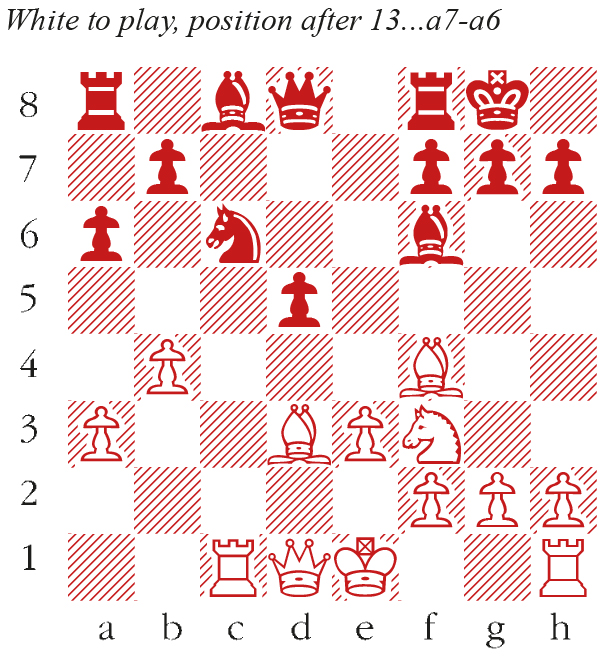
Nodirbek Yakubboev – Matthias Blübaum
Rubinstein Memorial, Polanica Zdroj, 2025
1 d4 d5 2 c4 e6 3 Nf3 Nf6 4 Nc3 Be7 5 Bf4 c5 6 dxc5 Bxc5 7 a3 Nc6 8 b4 Be7 9 e3 O-O 10 cxd5 Nxd5 11 Nxd5 exd5 12 Bd3 Bf6 13 Rc1 a6 (see diagram above) 14 h4! d4 Crucially, 14…Bg4 loses to 15 Bxh7+! Kxh7 16 Ng5+ Bxg5 17 hxg5+ Kg8 18 Qxg4. Or 14…h6 has the drawback that 15 Bb1!, preparing Qd1-d3 is hard to meet. 15 Rc5 dxe3 16 fxe3 Ne7 16… h6 deserved consideration here, though 17 Ng5 would maintain the pressure. 17 Ng5 g6 17… Ng6 was a lesser evil, but 18 Qh5 h6 19 Bxg6 fxg6 20 Qxg6 Bc3+! 21 Rxc3 Bf5 22 Qd6 hxg5 23 Qxd8 Raxd8 24 Bxg5 leaves Black with a very bad endgame. 18 h5 Nd5 19 hxg6 hxg6 20 Bxg6 Nxf4 21 Bxf7+ Rxf7 (see diagram below)
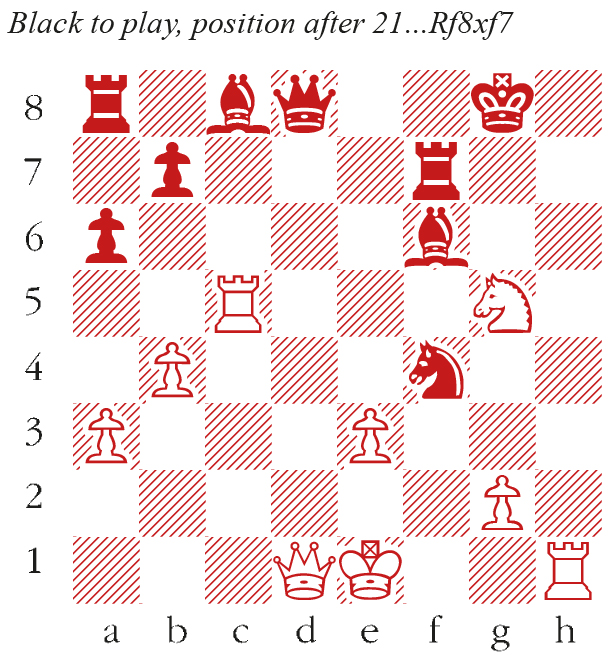
22 Rh8+!! Exquisite, but the fireworks are not over. Bxh8 22…Kxh8 23 Nxf7+ forks king and queen. 23 Qxd8+ Rf8 24 Qe7 Nxg2+ 25 Kd2 Bg7 26 Rxc8 Tempting, but not best. 26 Rc7! would have clinched the game, as 26…Rf2+ 27 Kc1! Rf1+ 28 Kc2 Bf5+ 29 Kb3 Rb1+ 30 Ka4 b5+ 31 Ka5 sees the king skip town just in time, and Black will soon be checkmated. Rfxc8! Vacating the f8 square as an escape route. 27 Qf7+ Kh8 28 Qh5+ Kg8 29 Qh7+ Kf8 30 Qf5+ Kg8 31 Qh7+ 31 Qd5+ Kh8 32 Qxg2 should win in the long run, but Black can still put up a fight. Kf8 32 Ne6+ Kf7 33 Qf5+ The problem is that 33 Nxg7 Rh8! wins the knight Kg8 34 Qg5 Kf7 35 Qf5+ Kg8 36 Qg5 Kf7 37 Nxg7 Nxe3 38 Kxe3 Rg8 39 Qd5+ The queen has run out of backup, so there is nothing better than endless checks. Draw agreed.
No. 865
Black to play. O. Bronstein – L. McShane, World Blitz Team Championships, London, 2025. Bronstein sacrificed a knight for a kingside attack, but here I missed a chance to decide the game in my favour. Which move should I have played? Email answers to chess@spectator.co.uk by Monday 1 September. There is a prize of £20 for the first correct answer out of a hat. Allow six weeks for prize delivery.
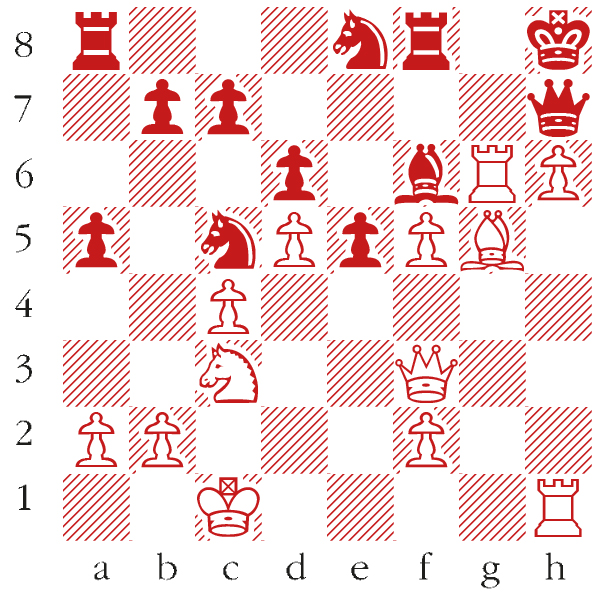
Last week’s solution David Marsh, Gurnard
Last week’s winner 1 Qh8! Then 1…Kd4 2 Rf4# or 1…d4 2 Qh1# or 1…g3 2 Qh4#. Any move by Re5 is met by 2 Nc5#
Spectator Competition: Ad it up
For Competition 3414 you were invited to provide an extract from a well-known literary work rewritten to include appropriate product placements.
Honourable mentions, in a top-notch entry, go to Max Ross, Ralph Goldswain, Hamish Wilson, John O’Byrne and Paula Cameron – and to Matt Quinn and Nick Syrett for a pair of excellent twists on Betjeman. The winners, printed below, are rewarded with £25 John Lewis vouchers.
The Owl and the Pussycat went to sea
In an opulent Ovington boat,
They took some money and Rouse Runny Honey
Wrapped up in a Burberry coat.
The Owl looked up to the stars above
And sang to a Gibson guitar,
‘O lovely Pussy, O Pussy, my love,
You’re as sweet as a Fry’s chocolate bar.’
Pussy said to the Owl, ‘You elegant fowl!’
How CandyCrave sweetly you sing.
O let us be married! too long we have tarried:
I’ve yearned for a Samuel’s gold ring!’
So they opted to take a Cook’s City Break
At the Holiday Inn in Dundee,
Where, dining on cake and Cadbury’s Flake,
They were happy as happy can be.
Alan Millard/Edward Lear
It is an Ancient Mariner
returning from the sea
wearing a Musto Offshore coat
and shoes from Dubarry.
The bridegroom’s doors are open wide;
I’m wearing Hugo Boss.
Why should I listen to his yarn
about some albatross?
Their wedding will be starting soon,
The Veuve Cliquot is chill.
This mariner begins his tale
so I must listen, still.
The wedding March sounds from the church.
The Bentley’s brought the bride,
wearing a dress from Vera Wang.
‘There was a ship …’ he cried.
D.A. Prince/Samuel Taylor Coleridge
‘What do you make of that, Watson?’ asked Holmes, handing me a meagre and dirty pillow.
I put down my ever-reliable Webley Model 83 revolver and sniffed. ‘Rowland’s Macassar Oil,’ I replied. ‘A gentleman of the utmost good taste has rested his head on this.’
‘Not the usual clientele of the Fighting Cocks. Lord Saltire has been here. I wish I had your discriminating nose!’
‘That rough pipe mixture of yours is to blame. If you would try Ogden’s “Wayfarer” Flake, you would find that it does not occlude the senses. But we must hurry. I will summon a dog-cart.’
‘There is no need, Watson. Our Starley Mark IV Safety Bicycles will bear us more swiftly than any dog-cart.’
‘And the Dunlop tyres are a sovereign proof against punctures.’
I donned my Kumfi-Klips, guaranteed to protect the most luxuriant turn-ups from harm, and we resumed the chase.
Frank Upton/Arthur Conan Doyle
Glory be to Bond for high-end branded things
And the cachet of his name which gives their price tags wings;
All things exciting as his Aston Martin’s throb,
Exclusive as his suits from Savile Row and shoes by Lobb;
As coveted as Bollinger and Bentley and Missoni,
His Burberry, his Mont Blanc pen, Omega and Peroni.
All products unaffordable to normal mortal men;
But hard-core consumer porn for those who have a yen
For Macallan, Lamborghini. Pol Roger and Perrier,
And flashing Amex credit cards at Harrods or at Cartier.
For objects of unquenchable desire both large and small.
Praises be to Hollywood who product-placed them all.
Martin Parker/Gerard Manley Hopkins
A Heaven on Earth, a blissful paradise,
God-wrought, the garden was. In pleasant soil
Grew trees with every fruit and every plant.
By Satan tempted, our first parents then
Through Eden took their solitary way
To B&Q, for wood to build a hive
For every red and buff-tailed bumblebee
To pollinate their God-ordainèd patch;
Wilko, for Weedol fastest action spray,
Then Notcutts Garden Centre, where
A Summer Half-Price Sale had come to pass –
And thence they purchased every flowering plant
From every blessèd page of Gardeners’ World:
French lavender and foxglove, nectar-filled
And David Austin roses. Sing, sweet Muse
Of Man’s first list of bee dinners – and the fruit.
David Silverman/John Milton
It is a truth universally acknowledged, that a single man in possession of a good fortune, must be in want of a Hublot Classic Titanium Watch (blue sheen and inertia in contact with the wrist, satin-finished); Berluti Rapiécé-Reprisé oxfords with three eyelets and a mix of calf and alligator leather; a Superfino Fedora Panama hat from Hilditch & Key; a Caple Classic Wine Cabinet (Wi6135BS) housing up to 46 bottles of Bordeaux; Havana-brown Chopard sunglasses with buffalo horn structure; a Holland and Sherry Champagne suit in refined wool; a woven leather Bottega Veneta Intreccio key ring; a snakewood cane with Fritz handle and brass collar; a case of Tom Ford Oud Wood Eau de Parfum; an Evermade Titanium Wallet (Hive edition); a Goldvish Le Million phone; a Bennet Winch Canvas Suit Carrier holdall; a Rimowa Classic carry-on aluminium cabin case; a Hisense L9Q Projector (5000 lumen); a wife.
Bill Greenwell/Jane Austen
No. 3417: Forget me not
You are invited to submit an elegy on a piece of obsolete technology (16 lines maximum). Please email entries to competition@spectator.co.uk by midday on 10 September.
2718: Caged
The unclued lights (one hyphened and one of two words) each bear a common feature.
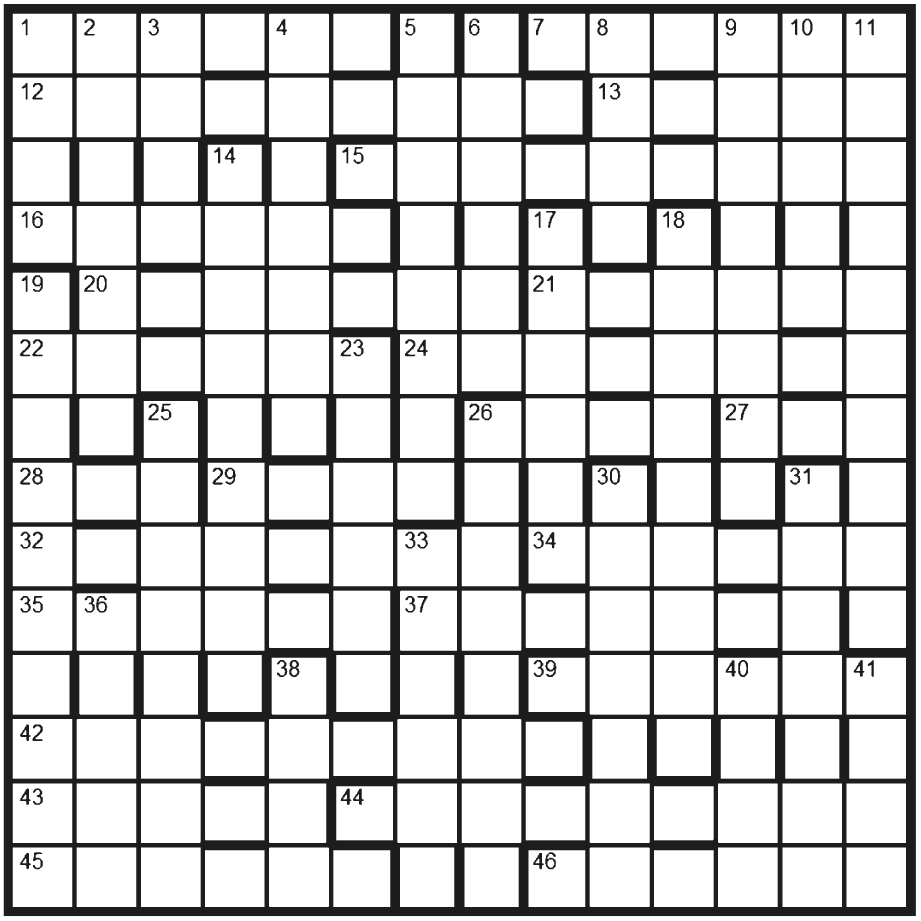
Across
7 Rodent, second seen in store (6)
12 Old Scottish borrowers who show respect about sons (9)
13 Rookie driver owns leading assets capital (5)
16 Bedcovers obtained from Chester’s shopping arcades lacking a touch of elegance (6)
20 Broadcast with singer heard at Brize Norton or Cosford (3,4)
21 An animal doctor admitted company – turned up with bird (6)
22 He has a dog but is driving without a conductor (3-3)
26 Not long until graduates leave one in the woodwind (4)
27 Chess grandmaster reflects his homeland somewhat (3)
28 Fresh out of Pinewood (3)
29 Once paint medium in ravine (4)
32 Former MP Grieve has afternoon on Caribbean island (8)
34 Wild, raging fire has gutted castle (6)
35 Dried fruit exists in wet weather (6)
37 Restless film-maker comes back, having gone outside (7)
39 Those with good memories for bank holiday crosswords, say (6)
43 Forty winks during it would seem unnatural (5)
44 Type of mirror that is right for vaudeville actor (9)
45 Former editor’s hold. Not half! (6)
46 Earlier on had year at convent (6)
Down
1 Summons dwarf regularly to get sex (4)
2 The arms of Ulster embarrassed worker (3,4)
3 Always in the vernacular (4)
5 Poor handsomer loveless farm employee (8)
6 On the radio, dreich 24 hours is top class (5,1)
8 Boy or girl will drink and kiss (4)
9 Island breed for Lio and Lyn, apparently (4,4)
10 Ornamental orange tree becoming very large with time (5)
11 Raconteur or tattler (4-6)
14 Give a clear statement supporting exchange of emails (9)
17 Duplicated and skedaddled (3,3)
18 One Brahms arrangement of Trees (9)
23 Names showing no themeword (6)
25 From corrie in Snowdonia to outskirts of Chepstow and three-quarters of the heart of the country (3,5)
33 Dismissed one of many at Wimbledon, we’re told (6)
36 1300 hours, in agreement (2,3)
38 Forbid some of the five tombolas (4)
40 Energy at the heart of Cambridge and Oxford, for starters (4)
41 A bit sprightly, we hear (4)
A first prize of £30 and two runners-up prizes of £20 for the first correct solutions opened on 15 September. Please scan or photograph entries and email them (including the crossword number in the subject field) to crosswords@spectator.co.uk, or post to: Crossword 2718, The Spectator, 22 Old Queen Street, London SW1H 9HP. Allow six weeks for prize delivery.
Download a printable version here.
2715: Occidentals – solution
The unclued lights reveal the titles of six Westerns: 1A, 1D/38/26, 18/5/43, 20/11, 23 and 45/24.
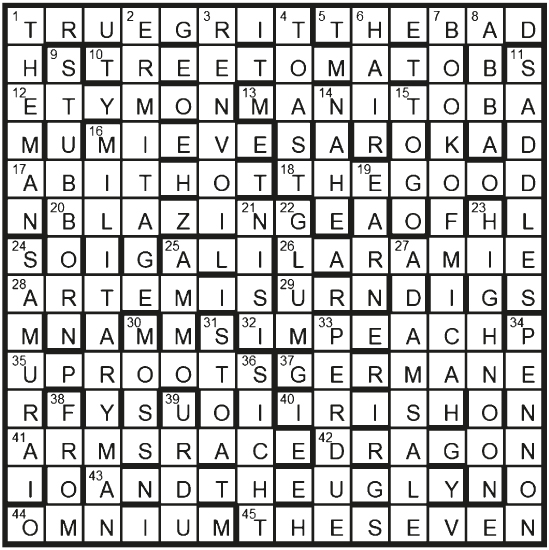
First prize Basia Jones, London WC1
Runners-up Michael Crapper, Whitchurch, Hants; Geoff Hollas, London W12
Dirty work: The Expansion Project, by Ben Pester, reviewed
The Expansion Project, Ben Pester’s debut novel, builds on the satire of corporate culture that he previously explored in his short stories. It centres on Capmeadow, a business park that proliferates with offices, wellness gardens, chalets, convenience stores and even a temple carved with reliefs of ‘collaborative working practices’. Shrouded in creepy mists, it seems to ‘reproduce itself’ with a will of its own, like ‘a -living community fabric’.
Tom Crowley, who writes briefs for fire safety protocol, endures a stressful journey taking his eight-year-old daughter, Hen, to his office, mistakenly believing that it is ‘Bring Your Daughter to Work’ day. She seemingly goes missing. But then Tom is shown CCTV footage which suggests she was never there at all. Even when he learns she is safe at home he never stops looking for her, the sense of loss and panic that has taken root inside him escalating daily.
The bewilderment and alienation that Tom suffers permeate the Capmeadow park. In the employees’ self-contained world where they live, work, shop and leave children at a creche, they are ‘not sure where [they] are in the year’ or ‘whether the day has ended yet or a new one has begun’. The sense of disorientation is compounded by a mysterious archivist who is analysing the recorded confessions of Tom, Steve from reception, an AV technician and others, and attempting to marshal them into a linear narrative. This sort of framing device usually brings order and context to a story, but Pester uses it to layer on confusion. We are left uncertain as to whether the archivist is working in the present looking back at the past, or in the future looking back at the present.
There is much poignancy in the plight of the workers, who struggle to retain a sense of self as Capmeadow erodes their individuality. A technician feels unnoticed – like ‘the crumpled napkins or the pile of coats’. A line manager has ‘no shadow’. Tom’s ‘missing’ daughter comes to represent something he has lost. With her sparkle and quirks she is a ‘blaze of light’ and personality, suggesting Tom’s breakdown is not just motivated by fear but a yearning for the person he once was. The relationship between Tom and Hen is beautifully observed, its heartfelt nature strikingly different to the soulless interactions of group conference calls. ‘Even the smell of an office was the first sensation of feeling myself fade away’, Tom says.
Inevitably, there are outbursts of rage, panic and violence, which the corporation attempts to contain by employing wellness platitudes and harvesting signs of anxiety for data. Tom joins an online meeting in a tropical garden entangled in vines, his hands smeared with slime, watched by a strange eye.
The tradition of the office worker rendered with absurdist humour can be traced from Flaubert’s Bouvard and Pécuchet, Melville’s Bartleby and Kafka’s Gregor Samsa through to the characters in the popular TV series Severance. But whereas Bartleby represents a delicious rebellion, Pester’s characters fail to fight back and descend instead into breakdown and broken acceptance. The result is a fever dream of a novel – disconcerting, strange and unexpectedly touching.
The grand life writ small: a history of modern British aristocracy
One of the facts that emerges from this detailed study of ‘modern British aristocracy’ is that the divorce rate among peers is roughly twice that of the rest of us, although the old unwritten adage that it didn’t much matter how you behaved provided discretion prevailed has long held good among many. Witness the 10th Duke of Beaufort, one of whose many mistresses, Lavinia, Duchess of Norfolk, would even boss the servants and change the menus when she stayed at Badminton. Most of these lady loves attended his funeral – but then, as Eleanor Doughty points out, the Duke’s relationship with the cuckolded husbands suggests ‘that embarrassment was not a word that figured in his dictionary’, since they were frequently invited to shoot at Badminton.
At the other end of the spectrum was the Argyll divorce, which kept London dinner tables humming for weeks. Ian Campbell, the 11th Duke of Argyll, characterised by Chips Channon as ‘a fraud, a liar and a cad’, divorced his second wife, the former Margaret Sweeny, whose money had paid for the refurbishment of Inverary Castle, in a case that featured salacious photographs, including ‘the headless man’. There was also a gasp-making string of co-respondents (88, according to the BBC), identified through Margaret’s diaries, filched by the Duke. ‘A completely promiscuous woman, whose sexual appetite could only be satisfied by a number of men,’ thundered the Edinburgh judge, with all the outraged Scottish puritanism of a latterday John Knox. Another peer, the 7th Marquess of Bath, avoided these complications by maintaining a collection of ‘wifelets’ at Longleat, where he painted erotic murals on its walls.
Today, there are 24 non-royal dukes, 34 marquesses, 189 earls, 110 viscounts and 439 barons, many, if not most, of whom Doughty has interviewed for this book. It tells us much of their family history and charts their progress under headings taken from the novels of Evelyn Waugh (the scandals above come under ‘Vile Bodies’), focussing largely on the period between the end of the second world war and the present.
In earlier days, aristocrats had owned great swaths of the country and took it for granted they would continue to lead the grand life. But high postwar taxation, death duties and sometimes government intervention took their toll, as in the case of Wentworth Woodhouse, a house so huge that guests were issued with balls of string so that they could find their way back to their rooms after dinner. Its park and gardens were unnecessarily destroyed when the Labour minister of fuel and power Emanuel Shinwell turned them into an open-cast mine, despite the pleas of the family and the miners who worked in nearby shafts and strolled and picnicked in the park. It finished the Fitzwilliamses’ tenure. For most others, there was a certain retrenchment, mainly in the form of selling land.
One of the facts that emerge is that the divorce rate among peers is roughly twice that of the rest of us
To the rescue of many of these great and wonderful houses came the National Trust (founded in 1895), often in the tall, angular person of James Lees-Milne, cravat neatly knotted (as I recall, he seldom wore a tie). He would bicycle tirelessly round the country persuading owners to accept the Trust’s proposition – significantly lower death duties and permanent living quarters in part of the house, balanced against a certain number of days open to the public and loss of ownership. Knole, the ‘calendar house’, with its 365 rooms, 52 staircases and seven courtyards, was a notable success.
Others were saved by their owners’ ingenuity. Longleat, for 383 years the home of the Thynne family, with its 43 indoor servants, 50 gardeners and 14 stable hands, was the first stately home to be opened to the public by the family on a commercial basis. Henry Thynne, the 6th Marquess of Bath, sold much land to pay off death duties and opened in April 1949, with the family working as car park attendants and tour guides. When the lions arrived, bought for £10,000 from Chipperfield’s Circus in 1966, that Easter weekend the roads around Longleat were jammed, as people queued for five or six hours to get in. Soon Blenheim Palace was opened by the Duke of Marlborough and then Woburn Abbey, after total refurbishment by Ian Russell, the 13th Duke of Bedford. The house was in such chaos that an 800-piece set of marvellous Louis XV Sèvres porcelain was discovered in boxes in the stables. The safari park was added later. All this is headed ‘Brideshead Revisited’.
There are pen portraits of various peers and much historical perspective. Fascinating nuggets gleam from the densely textured background. So deeply ingrained was the principle of primogeniture that a strong rearguard action was fought against allowing the few female hereditary peers into the House of Lords. Only when female life peers were created did this happen but even then, the welcome was hardly warm. When the 31st Countess of Seaford (one of the few titles allowed to pass through the female as well as male line) entered the Lords on the death of her father, she found that ‘all the chairs were made for men with long legs’.
When Doughty visited the Duke of Bedford at Woburn she was ‘told to call him Your Grace and stand up when he entered the room’ (the telling detail being the ‘told to’). The present Marquess of Salisbury, a member of a political family going back to the reign of Elizabeth I, is described as having ‘speech peppered with unselfconscious signs of a high-powered intellect’, and ‘a sense of ease beyond confidence’ – which, says Doughty, is what makes him a true aristocrat. ‘I’m proud of my ancestors,’ Lord Salisbury says, ‘but I’m not the only one who’s descended from them, so that doesn’t make me unique. But it does make me a sort of flag-waver for them.’
Is there anything that binds this caste of some 800 families together? In her perceptive analysis, Doughty believes that yes, there is still
an aristocratic way of life. There’s also still a definitely aristocratic way of approaching the world, whether it’s in the nature of their family life, or the choice of schools for their children, or in political outlook.
Even the careers chosen are remarkably homogenous. Of the 673 whose professions are a matter of record, more than 100 work in finance and 300 class themselves as landowners. For though the size of estates may have diminished – the Duke of Sutherland’s holdings have dropped from 1.4 million acres to the present 81,367 – they are still considerable. As Doughty points out, that ‘aristocratic way has proved remarkably resilient and slow to alter’. Or as Evelyn Waugh might have put it, decline, certainly – but not fall.
Music to some ears: how 20th-century classical music led to pop
It was Sir Hubert Parry who in 1899 complained about ‘an enemy at the doors of [real] music… namely the common popular songs of the day’, ten years before he put a William Blake poem to music and came up with the most famous classical/pop fusion of all time, ‘Jerusalem’, which even featured on a mid-1970s number-one album by ELP.
I did assume that a book subtitled How 20th-Century Classical Music Shaped Pop would reference such synergies. It does not. Elizabeth Alker’s is instead a competently written, entertaining if scattershot history of avant-garde electronic music, but presented as if some musical chasm separates John Cage from Sonic Youth. In fact one can easily draw a line between the two. Just follow the yellow brick road: the two Johns (Cage and Cale); the Velvet Underground (a chapter); Suicide (no mention); early Pere Ubu (no mention); ‘No Wave’ (no mention of ex-Ubu member forming No Wave trio DNA); Sonic Youth.
Instead, by referencing chart acts such as Donna Summer and Radiohead – beginning chapters ‘about’ these acts that quickly veer off-piste – Alker aims to establish connections I’m not sure are there. Radiohead name-dropping musique concrète in interviews demonstrates no greater link than when David Bowie told Alan Yentob he was influenced by William Burroughs’s cut-up technique before trying to demonstrate the same – and failing.
The chapter on Donna Summer’s ‘I Feel Love’ eventually arrives at the classical innovator Karlheinz Stockhausen via three degrees of separation: her producer Giorgio Moroder to Can’s Irmin Schmidt to Stockhausen, a tad tangential, justified by suggesting they were all part of a ‘typically German’ attempt to ‘jump-start a progressive kind of European pop’.
Er, note from teacher: see me after class. ‘I Feel Love’ came along ten years after the birth of prog, the single most commercially successful form of album-length pop since the invention of sound, containing more classical/pop crossovers than any other popular form. The entire synth-driven genre – and yes, I mean bands like Yes – gets zero mention. Not even Roxy Music!
Parliament, on the other hand, gets a chapter, alongside Lydia Lunch, the Blessed Madonna (no, not that one) and Nils Frahm. All interesting folk, each pushing at the parameters of song. Combined sales? Less than Brain Salad Surgery (see above). A lot less. Perhaps I’m doing Alker a disservice by suggesting she has not done her homework, but she claims to have spent ‘11 years working as a rock journalist for BBC Radio 6’. As someone who chafed at being called a rock journalist by the likes of Richard Hell and Colin Escott, I’m pretty sure such journos write (or wrote) for journals – not radio.
To write a chapter on No Wave and make no mention of Suicide, the electro-pop duo who used the term ‘punk’ nine years before No Wave and directly influenced the Human League (consciously modelled on this New York predecessor), Depeche Mode, Soft Cell and the Pet Shop Boys, suggests this is a collection of articles on music Alker likes and artists she admires, disguised as a history of 20th-century music. Real histories connect dots not some of the time but all of it. Faber published just such a book last year, Joe Boyd’s monumental And the Roots of Rhythm Remain.
The chapter ‘Transported by the Drone’ is where I engage, and where most rock fans will venture in: the Velvet Underground – ‘Venus in Furs’. I have certainly never forgotten the visceral jolt I got when hearing said track on a crappy MGM compilation containing the two VU songs I knew – both via Bowie. Context is for once provided by a pithy quote Alker gleaned from an interview with John Cale in 2017, revealing how it was he who fused Copeland, Cage and La Monte Young and gave pop ‘the drone’:
Lou brought sheets of lyrics… The songs were all written on acoustic guitar… But I wanted to present ourselves as having a vision… We were determined and really stubborn about putting the drone in there.
Now that’s a moment in time; the sound of cathartic collision between classical and contemporary in music’s equivalent of a particle accelerator. Nor need it be alone. Many rivers to cross: like Krautrockers Can, tutored by Stockhausen, influencing post-punk pioneers PiL (whose guitarist used to roadie for Yes), or the seismic impact of early Pere Ubu singles (featuring future DNA co-founder Tim Wright and the classically influenced synth-player Allen Ravenstine) on Joy Division, Gang of Four, the Fall, etc. No need to go through tunnels uptown or down dead-end streets. Some 20th-century electronic pioneers really did influence pop while making records still found in more record emporiums than those of Lydia Lunch.