-
AAPL
213.43 (+0.29%)
-
BARC-LN
1205.7 (-1.46%)
-
NKE
94.05 (+0.39%)
-
CVX
152.67 (-1.00%)
-
CRM
230.27 (-2.34%)
-
INTC
30.5 (-0.87%)
-
DIS
100.16 (-0.67%)
-
DOW
55.79 (-0.82%)
The special relationship between Muslims and Labour is over
Labour is facing a collapse in support among British Muslim voters in this week’s local elections. The votes of many Muslims are instead likely to go to pro-Gaza independents and the Green Party. The bad news doesn’t end there for Labour: if there was a general election tomorrow, only a third of Muslim voters would support the party, according to a poll released ahead of today’s local elections.
If there was a general election tomorrow, only a third of Muslim voters would support Labour
The scale of disaffection with Labour on the part of many British Muslims is laid out in research undertaken by JL Partners for the Policy Exchange think tank. The survey looked at political views among 1,006 Muslim adults in key metropolitan areas including London, the West Midlands and Greater Manchester – parts of the country where support for Labour among British Muslims has traditionally been very strong.
The survey found that the war in Gaza ranks high in their list of concerns: three in five Muslims would consider backing candidates standing on a pro-Palestinian platform to stop Keir Starmer at the elections.
Support for Labour among Muslim voters has fallen sharply since the last general election, dropping from 41 per cent in 2024 to 33 per cent now. Meanwhile, support for the Green Party has risen from 18 per cent to 27 per cent. This survey demonstrates two obvious truths. First, Labour is haemorrhaging support among a voting demographic that has previously supported it in huge numbers. Second, some Muslim votes in the local elections will be cast not on local issues but on what is happening thousands of miles away in the Middle East. That says nothing good about the state of democracy.
Just as troubling are some other trends revealed in the polling. It uncovered a stark difference in British Muslim attitudes compared to the rest of the general public. It found that almost two thirds of Muslims rank their religious identity above their British nationality. It also revealed a greater hostility to Jews among Muslims, with just over a fifth saying they feel unfavourably towards them compared to just 11 per cent of the general population. A quarter of Muslim respondents said they had a favourable view of the proscribed terror group Hamas. Support for gender segregation in public spaces was also higher than among the general population.

What exactly is going on here? The general level of discontent in Muslim communities appears to be high. Many feel that Labour has – for too long – taken their votes for granted. The issue of Gaza, and the wider conflict in the Middle East, is a source of widespread disillusionment, with many Muslims accusing Labour of failing to listen sufficiently to their concerns.
Gaza has become something of a lightning rod, prompting Muslim voters to look for ways to punish Labour. Gaza-focused independent candidates have taken advantage of this simmering anger and discontent. This could prove hugely significant in today’s elections because polling is taking place in several cities and large towns where small shifts or turnout in the Muslim vote could be the decisive factor.
This is the nightmare scenario for Labour, which is already losing ground to parties across the political spectrum. More broadly, Labour is still haunted by what happened in certain key seats with large Muslim populations in the general election in 2024. The Muslim Vote (TMV), a relatively new pressure group formed in 2023, managed to successfully mobilise Muslim voter support to such a degree that five Labour candidates lost to pro-Gaza independents. The most headline-grabbing political scalp on election night was the former shadow cabinet minister, Jonathan Ashworth, who lost his Leicester South seat to independent candidate, Shockat Adam. The group endorsed the successful Green candidate Hannah Spencer in the Gorton and Denton by-election – another constituency with a large number of Muslim voters – in February. The TMV website focuses on seats where this demographic can influence the outcome. “Make the Muslim Vote Count, “it proclaims, offering information on seats where the community can influence the outcome. TMV are confident that independents – or indeed Green candidates – backed by them will win council seats.
What might be called the special relationship between Muslims and Labour is no more. The British Muslim community is much more electorally fickle than before, seemingly determined to punish or reward political parties based on their foreign policy stance on issues like Gaza rather than matters closer to home. It is yet more evidence of how a volatile political landscape is producing seismic changes with far-reaching consequences.
Resist the cult of ‘picky bits’
We are, according to Marks & Spencer, in ‘picky bits’ season. I cannot bear the tweeness of it all. M&S is surely mere days away from launching a ‘Paddington Bear picky bits picnic range’. In search for an antidote to such horrors, I go on my annual pilgrimage to Bouchon Racine, which starts on Westbourne Park Road at midday, sipping Beamish Irish stout in The Cow. It is reputed to be David Beckham’s favourite London pub and is one of an increasing number of English pubs piggybacking on the phenomenal appetite for Guinness by serving alternatives to the Black Stuff. Beamish and Murphy’s are popping up on taps across the capital and we are the better for it.
We raise a glass to the dear old hereditary peers being booted out of the Lords
From there, the short Tube ride to lunch. Just over the road from Farringdon station, above the Three Compasses pub, is Bouchon Racine. Henry Harris opened in this new venue in 2022, having sold up his original Racine restaurant in Knightsbridge in 2015, and it quickly became renowned for its Lyon-inspired cooking and a short, unpretentious wine list. Simon Hopkinson, who first hired Harris to work with him in Hilaire on Old Brompton Road in the 1980s and subsequently brought him to Bibendum to be his sous-chef, described the original Racine as ‘very French, not only in the food, but in the entire atmosphere of the restaurant’. Its new incarnation lives up to the legacy, with traditional, generous and non-fussy food to make the soul sing.
Proceedings open with a French negroni. Having blind-tested Armagnac, cognac and French grape brandies when experimenting with ingredients for this concoction, Harris and his team eventually settled on cognac – specifically the Couprie VS Sélection. In place of the traditional Italian red vermouth is St Raphael Le Quina Rouge. Equal parts of these two, combined with Campari, produce a delightfully refreshing opener to any meal, but here it particularly complements the Lyonnais fare. Soon, thick country pâté, Bayonne ham with celeriac remoulade and cured herring begin to arrive. For mains we indulge in pork jowl, tête de veau and canard with morels, all rich and moreish. Alongside this we enjoy three fabulous offerings from Bordeaux.
One is the 2005 Chateau La Croix de Gay. We open it on arrival to allow it to breathe for an hour or so to bring it to its best. Before tucking into that we have another Pomerol, the 2017 Chateau Feytit-Guillot. It’s a younger, more understated wine, still fresh on the nose, and it eased us into the heavy delights, before it was time to turn back to the La Croix de Gay. Bouchon Racine is a place that celebrates the best of French heritage and, since our country appears to have forgotten how to celebrate ours, we raise a glass to the dear old hereditary peers being booted out of the Lords in a shabby bit of constitutional vandalism.
The star of the show is the 2016 Chateau Cantemerle. With hints of both red and black fruits, this vintage is like the restaurant itself: elegant and full of flavour. It is medium bodied and, relative to the food, surprisingly light. The lunch finishes with a magnificent glass of La Vieille Prune from the House of Louis Roque. For those who can’t make the pilgrimage themselves, the good news is that Henry Harris has distilled much of his experience and wisdom on how to produce this food into a very useful new book called The Racine Effect, which offers the recipes for the classic dishes from both iterations of his bouchon. It’s a world away from the summer of ‘picky bits’, and that is worth celebrating.
What really killed off the traditional B&B
To B&B or not to B&B? That is the question. Whether it’s nobler to offer breakfast to a guest is not in question, but whether it’s possible has been my dilemma since I started my guest house.
After reading Ross Clark on The Spectator website saying that he longs for the traditional B&B, all I can say is I’ve really tried to be that landlady he describes, in pink fluffy slippers, frying bacon in a house with Artex walls.
I’ve tried to take people who roll up late at night, I’ve tried to put the second B back into the enterprise, and I’ve tried to cope with customers who, like Ross, want the option of a cooked breakfast but not a fry-up – porridge, made just the way they want it, which is different for every single customer. Yes, I’ve tried to cope with all this.
It didn’t go down too well. The first issue is the amount customers want to pay me for a bed and psychic prediction of what they want to eat in the morning.
I do not blame Airbnb for killing the traditional B&B. Because it was already long dead
This goes to the heart of why the traditional B&B really died in the first place, with people like me doing Airbnb, the only readily available comparable experience.
I blame Airbnb for a lot of things, like piling all its service fee on me from next month, rather than splitting it between me and the customer. I also blame Airbnb for not standing up to the greedy Irish tourist board now it wants a cut of the profits by charging me a yearly registration fee on top of that.
But I do not blame Airbnb for killing the traditional B&B. Because it was already long dead. And what Airbnb did was give people like me the chance to resurrect it again.
The traditional B&B was killed off by excellent budget hotels like Premier Inn and Travelodge offering near-perfect hotel conditions almost everywhere, with seemingly limitless breakfast opportunities for a price that could not possibly be competed with by people who offer, whether good-heartedly or not, slightly crumby rooms in the buildings where they live.
People like Basil and Sybil Fawlty, with all their faultiness, and people like the builder boyfriend and me with all ours – we are not service industry naturals. We can offer, in order to make a quick buck, heaps of charm and Artex, but we can’t offer the option of ‘everything’, which is what people want. And we can’t offer it for next to nothing, or £37 a night midweek as the Travelodge can, or £60 at the Premier Inn in the branches I’ve stayed in, such as the one in Cobham, which I use when I visit the UK and which is so brilliant it defies logic.
They deal in bulk, you see. Here at Kitey Towers, West Cork, we have a couple of rooms – theme of faded grandeur with modern plumbing – and we want to expand if we can. But that’s only if people manage their expectations. We drive the price down, but we can’t get it low enough, and we know this because people won’t book unless it’s below the €100 a night mark – about £80-90 a night for two, with breakfast.
‘With breakfast’ has become my least favourite phrase in the English language. Breakfast is the end of the world.
You see, I buy all the breakfast items I need for most options, and then a customer arrives and wants coconut-milk porridge or muesli with no nuts or gluten-free bread.
I tried for a while to be this well-prepared, but we slipped into deficit with all the rotting non-dairy yoghurt in the fridge and all the stupid kinds of non-milk, and it would have bankrupted us.
I’ve tried asking people to choose breakfast when they book their room but they don’t want to. They want a hotel experience with a folksy, informal feel.
At the Premier Inn, you have to click the breakfast option when you book and you can’t change your mind, no matter how much you beg the lady at reception. I personally found I had to bribe the lady in the breakfast room with a large cash tip.
But people do what they’re told in big hotels. They wouldn’t dream of turning up and arguing, because they’d get turned out on the street.
Our customers arrive with the abominable confidence of thinking we must be grateful to have them and then start making demands as soon as their feet hit our doormat.
They take possession of their €100 a night room at 9 p.m., preparing to enjoy their two very long hot showers and demand what they want to eat the next morning when the village shop has closed.
Or they wait until the next morning, and when I serve their eggs they don’t care what I say in protest to ‘What, no hot sauce?’ because they’ve decided that a) I am lucky to have them, and b) all the romance of this experience is in the informality.
‘I’ll just pop down to the village to get you that, or drive an hour to Cork city – no, I insist!’ is what I’m meant to say to the American who asks for hot sauce, or the Irish musician who asks for coconut milk, because that is what a lady in pink slippers would do.
In a last-ditch bid to make our place work, I’ve resorted to the dreaded breakfast bar
They want to go home and say to their friends: ‘We stayed in this big old place owned by a writer and she drove miles to get chipotle for our eggs!’
The traditional B&B is dead because of the brilliance of the budget hotel with its Hypnos beds and vast cooked breakfast spreads – and it’s dead because of the abominable confidence of the modern consumer and their infernally capricious demands.
Airbnb, arguably, is the only forum offering the little people the chance to compete at all. But just one person who doesn’t like an Artex ceiling, or the way you’ve made their porridge, drops you into a black hole from which you may never return. The tyranny of Tripadvisor… this too has killed the traditional pink-slippered bacon-frier.
Everything has to be perfect now. In a last-ditch bid to make our place work, I’ve resorted to the dreaded breakfast bar.
The BB has always said a cold buffet is how it has to be done, and with a heavy heart I admit he was right.
I wanted to be the lady in pink slippers frying bacon under an Artex ceiling. I tried. But it cannot be done.
The ‘airport effect’ that’s ruining modern life
The phrase ‘computer says no’ now has its own Wikipedia page. The first recorded use dates back to a Stasi-era 1970s East German film segment titled ‘Der Computer Sagt: Nein’. However, its idiomatic use arose in 2004 via a series of sketches in Little Britain, each illustrating an example of technology-enabled bureaucratic intransigence, typically flying in the face of common-sense human judgment. It is perhaps the 21st-century equivalent of ‘jobsworth’.
To behavioural scientists, the phrase illustrates something known as ‘defensive decision-making’, whereby the primary motivation for a decision is not the likely quality of the outcome but the decision-maker’s often unconscious urge to use any available means to offload accountability for his actions. Unlike many behavioural science findings, this is not a trivial bias: many serious commentators believe that defensive decision-making, with its massive expansion of legalistic rules into every realm of human activity, lies behind the loss of economic dynamism in western economies. As I remarked to a KC friend: ‘The trouble with Britain is that we were a country of really good pirates who then sent their children to law school.’
Defensive decision-making was evident when the appointment of Peter Mandelson degraded into a debate over ‘process’. The use of the word ‘process’ is generally a bellwether for DDM. Following ‘due process’ is hardly proof against making dumb decisions: it simply means the people involved can be absolved of blame. The other problem with ‘process’ is that once such processes are complete, reversing the outcome becomes almost impossible, even when countervailing information emerges.
But the fact that ‘computer says no’ is so widely used should perhaps serve as a warning to us all. For it shows how, placed in the hands of what Lord Glasman calls ‘the lanyard class’ (who are by no means confined to the public sector), any technology has the power to impose a kind of dystopian quality on everyday life by extending legal formalism into facets of it where it has no place, at the expense of common sense and intuitive judgment. It leads to what I call ‘the airport effect’ – that constant low-level anxiety you experience at airports by knowing that any deviation from imposed rules – from an overweight cabin bag to a misheard announcement – can spiral into a nightmare. The larger and more dehumanised the airport becomes, the worse the anxiety.
But there is a reason for airports to act defensively. The problems emerge when technology allows this rule-making tendency to extend everywhere else, with a stringency and intransigence we would not accept from a normal human actor.
Following ‘due process’ simply means the people involved can be absolved of blame
Few traffic policemen would fine a taxi driver £100 for driving at 25mph on a major road at 2 a.m. A speed camera is allowed to do this. The net result is that the poorest in society are being driven off the roads not only by the costs of car ownership but by the heightened risk of fines. Given that owning a car might boost your chances of getting a job more than having a degree, it seems astonishing that a government supposedly preoccupied with social justice is blind to this.
One interesting observation: people are less irked by average-speed cameras than the fixed kind, as they are more consistent with our instinctive idea of fairness. Within set parameters, you can exercise discretionary judgment about your speed, briefly breaking the limit to change lanes, for instance, provided your overall driving speed is safe. This illustrates the difference between a wide-context and a narrow-context rule. Perhaps there is something we can learn from this before we surrender control to our AI robot overlords.
The message behind the US pavilion at the Venice Biennale
“All art is propaganda,” wrote George Orwell, “but not all propaganda is art.” Upon this subtle distinction rests the success or failure of whatever art we see at the Venice Biennale.
The Most Serene Republic’s exercise in art-world Olympics is propaganda by design. A garden of national pavilions – small buildings in various styles as you might find in a zoological park – presents exhibitions that compete with one another for a “Golden Lion for Best National Participation.” Here, in the murky parkland of the Giardini in the city’s eastern Castello district, nationalist and anti-nationalist passions mix with art-market imbroglio into a sordid spectacle. Just how bad will it be this year? To discover the answer is why we keep coming back.
The 61st iteration of this Italian job, which opens May 9 and runs through November 22, is already shaping up to be a casino totale – which we might translate as “hot mess.” On April 30, days before the opening, the five-person jury behind the Golden Lion prize, led by Solange Farkas, a Brazilian curator of no repute, announced their resignation. The cause? They had previously declared that they would not consider the pavilion of any country whose leaders were being investigated by the International Criminal Court. Such a denunciation would include Putin’s Russia. But of course their real target was the Israel pavilion and its artist, Belu-Simion Fainaru.
Having not seen them, I cannot comment on Fainaru’s drip sculptures. Rose of Nothingness, the name of his Venice installation, reportedly consists of a commercial irrigator that pours water on the pavilion floor. What we can already say is that the work has inadvertently revealed, like much else in globalized culture, the art world’s tender embrace of anti-Semitism. For the antifadists, even the river to the puddle must be free.
It tells us something about our state of affairs that the most high-profile contretemps at this year’s Biennale does not involve Donald Trump. Nevertheless, this has not prevented the New York Times and its bigly art reporter Zachary Small from going after the American presentation. “With Trump Novices, Can the US Win the ‘Art Olympics?’” asks a headline of April 19. “After the State Department overhauled the process for choosing an artist for the Venice Biennale,” continues the subhead, “it gave control to a woman who previously owned a pet food store.”
When it comes to Venice’s dog-and-pony show, there’s something to be said for recruiting talent from the pet-care market. Reading down, we learn that this year’s US commissioner, Jenni Parido (fresh “from selling venison nuggets and dried sardines,” sneers the Times), has tapped Jeffrey Uslip (“criticized for being racially insensitive”), who has selected the sculptor Alma Allen (“an under-the-radar American sculptor based in Mexico.”)
From what I can tell of Allen’s contributions, his abstract sculptures are inoffensive. For the Times, this is certainly part of the problem. Another issue is that the US commission “never approached traditional funders… including the Ford Foundation and the Andrew W. Mellon Foundation.” Shock horror. The expected boxes have not been checked.
The US pavilion is historically where our Department of State and its establishment underwriters expect unchallenged hegemony. How this happened says much about American consolidation of cultural power. An American presence in Venice began in 1922, when Walter Leighton Clark organized a cooperative of artists known as the Grand Central Art Galleries to purchase land for an exhibition hall. The great Beaux-arts firm of Delano and Aldrich donated their services for the design of the Palladian-style building that still stands today.
After World War Two, New York’s Museum of Modern Art purchased the pavilion in 1954 and began mounting exhibitions of American abstraction that were secretly underwritten by the Rockefeller brothers and the CIA. When such soft-power financing was exposed in the 1960s, the pavilion fell under the purview of the United States Information Agency. The Fulbright-Hays Act of 1961 is the public mechanism that has enabled the government to demonstrate American cultural interests, developments and achievements overseas.
In 1986, MoMA sold the building to the Solomon R. Guggenheim Foundation and its Venice-based Peggy Guggenheim Collection. With the fall of the Berlin Wall and the closing of USIA, control of the pavilion finally went to the Department of State, where it remains today.
There is much to be said for the role the US pavilion played in the Cold War, pitting the freedom of abstract expressionism against the diktats of Soviet realism. As early as 1950, MoMA’s Alfred Barr was bringing over John Marin, Arshile Gorky, Willem de Kooning and Jackson Pollock, along with other artists of the New York School. In 1964, Robert Rauschenberg won the Gran Premio through a stunning American PR campaign and last-minute amphibious assault, ferrying his large paintings by speedboat to the Giardini (documented in the 2024 film Taking Venice).
Since its takeover by the Department of State, rather than a pro-American message, the US pavilion has increasingly promoted a self-effacing aesthetic. Awash in the mandates of DEI, the presentations have at times become downright anti-American. In 2011, during the early years of the Obama administration, I observed an exhibition by the Puerto Rican duo Jennifer Allora and Guillermo Calzadilla that featured American athletes running on the treads of an overturned tank. In one room, a replica of the Statue of Freedom from the Capitol dome was tipped on its side. In another, a pipe organ spat out money from an ATM machine. And so on with the anti-American, anti-capitalist, anti-religious dross.
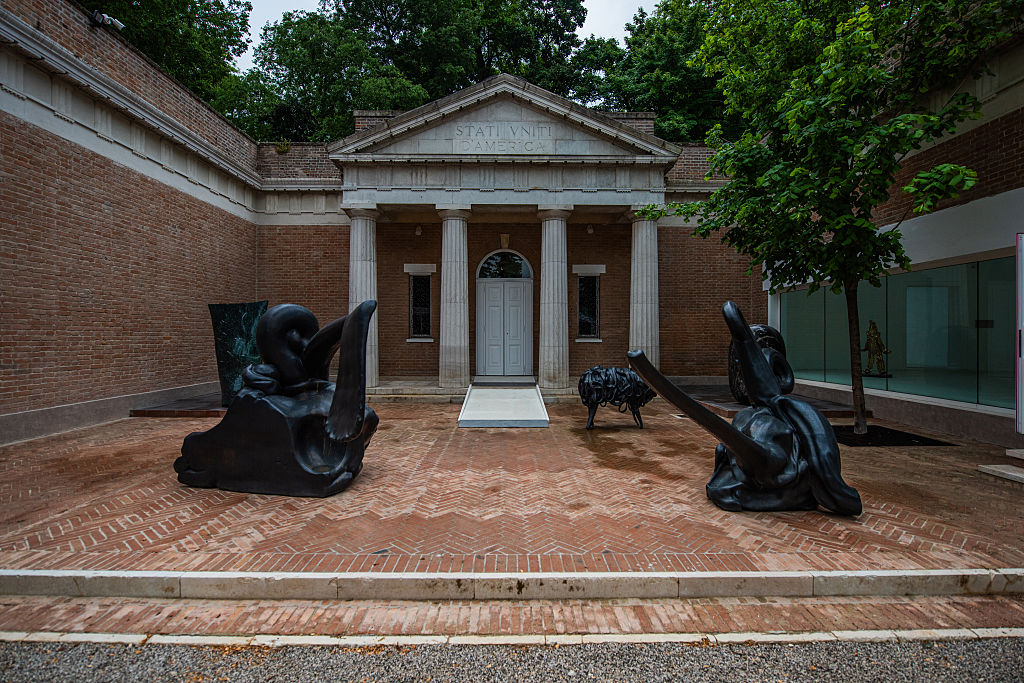
Such a presentation would have made an old Soviet curator blush. According to Lisa Freiman, the organizer at the time, “I chose Allora and Calzadilla because they problematize, or put into question, the notion of American identity at a moment when immigration issues are very important and who is allowed to be a US citizen and who is not allowed to be a US citizen are big debates with the American people.”
Such “art” was not an anomaly. It was the voice of the state. According to Freiman, the State Department’s “decision to select Allora and Calzadilla was unanimous… it was well-timed with Hillary Clinton in the State Department and Barack Obama in the White House.” Maxwell Anderson, then director of the Indianapolis Museum, the commissioning institution, added “everybody in Foggy Bottom down the line to the secretary herself” supported the work. Or as David Mees, then US cultural attaché in Rome, went on to explain: “It’s very important also to cultivate that softer image – what the Obama administration has called ‘smart power.’”
Nationalist and anti-nationalist passions mix with art-market imbroglio into a sordid spectacle
Just what was “smart” about these displays of “power?” In part the debasements of recent years were meant to appeal to the international mindset. See, went the message to those sipping their Aperols at Harry’s Bar, we hate America, too.
But the message was also directed at us back home. No longer there to reflect American freedoms, the propaganda of the Biennale evolved to demonstrate the power of our own unaccountable bureaucracy. They were in charge. They despised us. And there was nothing we could do about it. The nature and quality of the art presented in Venice by our Department of State might have varied over recent administrations, but social justice and race-essentialism were constant themes, “taking over” (often quite literally) the Palladian-style pavilion.
Consider Simone Leigh, the 2022 selection. Lee Satterfield, then assistant secretary of the US Department of State’s Bureau of Educational and Cultural Affairs, heralded Leigh for her “historic achievement as the first Black woman to represent the United States.” Leigh described her work as paying “homage to a long history of Black femme collectivity, community and care.”
Her interventions in Venice included covering the classical pavilion in thatch to resemble a West African palace – meant to remind us of the (racist, of course) 1931 Paris Colonial Exposition. Inside, Leigh presented a sculpture based on “Mammy’s Last Garment,” a 19th-century Jamaican postcard featuring “stereotypes created by the burgeoning Anglophone Caribbean tourism industry,” according to the commissioning institution ICA/Boston. Another room presented sculptures “that send up essentialist ideas of the Black femme body.” The race obsession was total. Naturally, George Soros’s Open Society Foundations provided extra support for the run.
With traditional American values overturned through symbolic acts of desecration, the riotous atmosphere of these aesthetic takeovers came to reflect the real riots that engulfed American cities – stoked by the same racialized psy-ops of supposedly warranted self-hatred. It is the loss of one of their propaganda outlets that our managerial elites now lament and will do anything to restore.
Every presentation at the Biennale is designed to send a message. Today, the Trump era is defined, in part, by its own cold war – one pitting a populist insurgency against a uniparty elite. In choosing Parido, Uslip and Allen – outsiders all – the administration has sent a Sicilian message to the Venetian lagoon: the Deep State swims with the coda di rospo. On the eve of the US semi- quincentennial, the American pavilion has declared its own independence.
Meloni is being haunted by the ghost of Berlusconi
The late Silvio Berlusconi has come back from the dead – momentarily, it is hoped – to torment Italian Prime Minister Giorgia Meloni in the guise of the old rogue’s “bunga bunga” woman-in-chief.
As a result, Meloni’s opponents and their many friends in the media are baying for the blood of her justice minister Carlo Nordio in a bid to cause her fatal damage.
Normal people cannot help but wonder why on earth an Italian president is granting a pardon to someone like her, who has not spent even one single day in prison
Italy’s 69 governments since the foundation of the Republic of Italy in 1946 have lasted on average little more than a year. Meloni’s right-wing coalition government, after three and a half years in power, became this weekend the second longest lasting in the history of the Republic. Yet for the first time it is looking a little shaky.
This is thanks to what seems on the surface to be – even though it is not – a piece of imbecilic incompetence by Nordio inspired by couldn’t-give-a-damn cronyism.
Certainly, her opponents are treating it as such. With shameless dishonesty, they are blaming him for the decision by Italian President Sergio Mattarella to pardon Nicole Minetti – the maitresse of ceremonies at Silvio Il Magnifico’s infamous “bunga bunga” parties – without doing basic checks that would, they insist, have rendered the pardon inconceivable.
The Italian President, who is elected by Parliament not the people, is a largely ceremonial role but he does have the power to grant pardons. The justice minister manages the process but the decision is his.
In 2019, a court in Milan condemned Minetti to two years and ten months in prison for procuring prostitutes between 2010 and 2011 to attend what Berlusconi called “elegant soirées” at his country estate outside Milan. In 2021, another court sentenced her to 13 months in prison for fiddling €19,000 worth of expenses as a regional councilor in Lombardy for Berlusconi’s party (then called Popolo della Libertà). She denied that the money Berlusconi paid these women guests was for sex. As did he and they.
Minetti, 41, is a former dental hygienist from Rimini whose mother Giorgina is British and from Newcastle. She first met Berlusconi in 2008 at a motorbike trade fair in Milan where she was a hostess on one of the stands. He was 71 and she was 23. He subsequently asked her to look after his teeth and much else besides. She fell in love with him, she would say in court, they had an affair and the rest is history.
Hardly anyone in Italy sentenced to less than four years actually goes to prison and Minetti was no exception. Her sentence was commuted to community service.
Normal people cannot help but wonder why on earth an Italian president is granting a pardon to someone like her, who has not spent even one single day in prison. Her partner is the billionaire Giuseppe Cipriani Jr. – heir to the Cipriani deluxe global hotel and hospitality empire which began life at legendary Harry’s Bar in Venice, founded by his grandfather in 1931.
In February 2025, Minetti applied for clemency to the president after she and Cipriani adopted a boy in Uruguay in 2023 where she and Cirpriani spend much of their time. He agreed that if she had to do nearly four years community service she could not look after him.
Mattarella granted the pardon in February this year on humanitarian grounds related to the poor state of health of the nine-year-old boy who has spina bifida. The boy’s health issues, however, do not stop the couple spending most of their time in Uruguay at his ranch, or Montecarlo, or Italy, or else on his yacht, which is called Gin Tonic. Boyfriend Cipriani knew Jeffrey Epstein well, it has also emerged, and is mentioned over a hundred times in the Epstein files.
In particular, the files show that in October 2010, not long after Epstein had completed a prison sentence for prostituting an underage girl, Epstein agreed to lend Cipriani £800,000. The loan – to be repaid at a hefty 10 percent a year interest rate over three years – was to help Cipriani buy a private members club in Hay Lane Mayfair called Rififi. Cipriani changed the name to Socialista and restyled it as a Cuban-themed venue inspired, in the words of its website, by “how the privileged pre-revolution Habaneros lived.”
Well before this crisis blew up Cipriani issued a carefully worded statement in March to the New York Post in which he said of Epstein that he “actually found him unlikable” and had “never made any business deals with him.”
I would have thought that this relationship alone, would have been enough at least to question the merit of Minetti’s plea for clemency, or am I too falling victim of the herd mentality by unfairly baying for the blood of anyone who did business with Epstein?
What caused the affair to engulf the Meloni government was the publication by Il Fatto Quotidiano, a left-wing Rome daily, of evidence that suggests Minetti may not have told the truth in her request for clemency about the circumstances surrounding the adoption and her new life.
The newspaper also interviewed anonymous witnesses, including one claiming to have worked for many years at the ranch, who allege that she runs bunga bunga style parties for jet-setters at the couple’s home in Uruguay.
Not surprisingly left-wing opposition parties and many Italian TV talk shows are pointing the finger relentlessly at Nordio even though only the President, not the justice minister, can grant a pardon.
The justice minister, though he or she expresses an opinion, merely acts as a go between. It is the President alone who decides based on the recommendation of a panel of judges which he can override. So if there has been any fault, it lies with the President and the judges, not the justice minister.
But Meloni’s opponents are not going to let that get in the way of a great story.
That the role of the Italian president is largely ceremonial has made it easier for them to pretend that leftish Mattarella is the victim, not the culprit. The articles in Il Fatto Quotidiano prompted him to ask the judges, via the justice minister, to do “urgent checks” on the case.
When Sigfrido Ranucci, a left-wing investigative television journalist whose programs are notoriously biased, said on live TV last week that “a source at the ranch” had told him Nordio had visited Minetti and Cipriani “in early March” the implication was clear: this was a perversion of the course of justice by the Meloni government.
A furious Nordio phoned in to deny the claim and accused the journalist of “touching rock bottom” “There’s a limit to everything,” he said, “Even to this moral and mediatic degradation.” Ranucci replied that it was only “a hypothesis” that he and his team were still checking.
A defiant Meloni told a press conference last week:
Certainly, if what emerges from the journalistic inquiry is true then something has been missed in the job that’s been done but this is not a job that the Ministry of Justice can do… the ministry does not have the tools to carry out investigations. The ministry relies on the Magistratura to do investigations and the Magistratura relies on the judicial police.
Francesca Nanni, the Procuratrice Generale of the Milan Court of Appeal, which carried out the judicial inquiry in the case, admitted that no checks had been done abroad. “We might admit in the end to not being perceptive, even if diligent,” she said.
As for Minetti, she issued a statement in which she denied that she had ever been the object of formal investigation of any kind in Uruguay. And she denied “categorically” the accusation that she had been involved in legal proceedings against the biological parents of “my son.”
She said the claims made by Il Fatto Quotidiano are “unfounded and gravely damaging to my reputation and that of my family” and she had instructed lawyers to sue the newspaper and any other journalists who write “false, defamatory and damaging” things about her and them.
In an interview with Il Corriere della Sera published on Monday, Cipriani likewise denied the newspaper’s accusations. Asked if they were false he replied: “All of them. Starting with the adoption which they define as illegal. We spent nearly four years respecting the procedure: judges, social workers, psychologists …Uruguay is not a banana republic it’s a serious place where things get done seriously.”
Asked why the adoption tribunal in Uruguay had ignored Minetti’s previous convictions when considering whether to let the couple adopt the boy, he said: “Go and ask the judges and the adoption agency INAU (Instituto del Niño y Adolescente del Uruguay). We told them everything about ourselves. They knew everything. Even if they only had to go on Google to find out.”
What of the claims that his ranch is used for bunga bunga style parties? “It’s a casa normalissima where I have received guests for 30 years,” he retorted. As for Epstein, in the end the pedophile did not lend him any money, he said, and ‘has never been my partner’.
This latest blow to Italy’s first female prime minister, who had seemed invulnerable until little over a month ago, comes hard on the heels of her decisive defeat in a referendum in March on her cherished plans to reform Italy’s sclerotic disgracefully slow, incompetent and politicized justice system. It also follows her bust-up in mid-April with Donald Trump, who called her a coward “who does not want to help get rid of a nuclear weaponed Iran.”
Miraculously, perhaps, Meloni’s Brothers of Italy party is riding more or less as high now in the polls as before these setbacks and still significantly higher than when it topped the ballot at the 2022 general election – which is almost unheard of for a party in power in a western democracy.
Nevertheless, if Silvio il Magnifico wants, as I am sure he must, Giorgia Meloni’s government to beat the record of 1,412 days in power then he really must hot foot it back to Heaven pronto.
The slow death of Diversity, Equity and Inclusion
For the past few years, woke has been on life support. Back in 2020, police officers knelt for Black Lives Matter, children were taught that boys could become girls, and the trans-inclusive Pride flag seemed to fly from every building in the country. Since then, there has been something of a retreat. The Diversity, Equity and Inclusion (DEI) industry still has a pulse and is more than capable of reinvention, but it is less confident and more defensive.
Human Resource officers were able to rule the roost
Why the change? Donald Trump’s second term in office is one reason for the vibe shift. The President punctured all manner of sacred convictions as he signed executive orders to keep DEI out of education and men out of women’s sports. There have been legal challenges in the UK too, such as the Supreme Court ruling that “woman” means a biological female.
The economic downturn is another explanation for the demise of woke. It is one thing to fund white privilege workshops and pay for pronoun badges when times are good; it is more difficult to justify such expenses when times are hard. (Although the National Health Service has clearly not got the memo on this one yet.)
But something else has happened, too. With less fanfare, but surely more impact, employees have been asking awkward questions and refusing to comply with DEI strictures that have nothing whatsoever to do with the job they signed up for.
This opposition was always there, of course. But while woke reigned supreme, criticism could lead to people being dragged through workplace disciplinary processes, losing their livelihoods, or being publicly shamed and canceled. With complaints reduced to eye-rolls and whispers between friends, Human Resource officers were able to rule the roost.
Now comes proof that resistance towards DEI is not only on the rise, but that managers are taking note. A YouGov poll has found that more than one in three HR “decision-makers” have faced pushback against equity, diversity and inclusion initiatives over the past year as both bolshy workers and parsimonious CEOs have made their feelings known.
Gone, it seems, are the days when employees could be compelled to attend Maoist-style struggle sessions and be forced to bare their souls, confess to wrong-think, and repeat mantras (trans women are women, black lives matter) until relenting with pleas for their own rainbow lanyard. With workers less willing to comply, and bosses less confident that this is the best use of company time, HR officers have been forced to rethink their game plan.
Unfortunately, not all companies are learning the right lessons. The YouGov poll was carried out for Working Chance, a charity which aims to secure employment for women with convictions. It is concerned that pushback against DEI could lead to companies scaling back inclusive hiring practices and that this will undermine efforts to get people with criminal records back into work. But when we look at those who came a cropper for challenging DEI during the years of peak woke, it is impossible to find anyone who was disciplined for complaining about companies hiring female ex-convicts.
Few people oppose second chances or rehabilitation. But this was never what woke was about. I’m sure I am not the only one who would far rather share a workplace bathroom with a woman with a criminal record than with a man in a dress. I would rather a woman who has struggled be given an opportunity to work than see her being lectured about white privilege. And I would prefer doors to be opened for female ex-offenders rather than Oxbridge graduates well-versed in identity politics and their own victimhood.
DEI initiatives always focused on currently fashionable groups. Often, this meant middle-class black or brown people, rather than those with physical disabilities. Or men convinced they were women rather than ex-convicts. Or expensively-educated transgender women rather than working-class men. To suggest otherwise, now that the tide is beginning to turn, is simply disingenuous.
Some organizations, it seems, are taking a different lesson from the pushback against DEI. Instead of ditching politicized and divisive initiatives, they are rebranding yesterday’s bad ideas. HR managers now discuss “pivoting away from explicitly using ‘EDI’ language and adopting terms such as ‘engagement’, ‘belonging’ or ‘culture’”. In other words, woke business as usual, but dressed up in new language. Thankfully, the bottom-up challenge to workplace hectoring suggests that HR managers can change words all they like, but DEI will still be rejected.
For too long, the workplace has been tyrannized by the cult of diversity, equity and inclusion. This has been to the detriment of free speech, individual rights and solidarity between colleagues. It is great to see that HR managers are now on the defensive, thanks not just to legal changes and economic pressure, but also to staff resistance.
Does The Odyssey confirm that Christopher Nolan is camp?
Sir Christopher Nolan is many things. The Spielberg/Lucas/Cameron manqué of our time. A double Oscar-winner for Oppenheimer, a picture that is nowhere near his best work. The most acclaimed director of film bros, who somehow ignore his standing as a white, British privately educated filmmaker. But what nobody has ever seriously asked before is “Is Sir Christopher camp?”
I hesitate to say that. The (relatively) newly knighted director is as serious a figure as has ever been seen in the film industry. But after watching the new trailer for his magnum opus, The Odyssey, it is a question that I must ask. We have Good Will Hunting himself, Matt Damon, as Nolan’s conception of Odysseus. All good there; I myself would have cast Michael Fassbender, but hey-ho. Damon rocks a beard of varying lengths and grayness, and wears an expression of becoming seriousness. At various points in the trailer, he makes it clear that he wants to go home. This is becoming a trait of Mr. Damon. He has also made this clear in Saving Private Ryan, The Martian, Interstellar (another Nolan jaunt) and Elysium. Looked at dispassionately, Mr. Damon is the actor who seems keenest to go anywhere, least of all Hollywood.
Well, he’s been lucky with The Odyssey. And the fact that he has slimmed down to near-skeletal proportions suggests that he has committed to the bit. As, indeed, has his co-star Robert Pattinson, playing the villainous suitor Antinous. I am a great admirer of Pattinson, who was the saving grace of Nolan’s solitary misfire Tenet, but I would suggest that no actor alive could deliver the line, “You’re pining for a daddy you didn’t even know, like some sniveling bastard”.
Spider-Man vs Batman (Pattinson vs Tom Holland): how could audiences possibly resist? But whatever happens, there is the suspicion that Sir Christopher has let loose after his earlier exercises in Sturm und Drang and offered audiences a film that they will want to see in some quantity. It’s budgeted at $250 million – some reports suggest that it ended up costing even more – which will make it by far the most expensive film of his career. Oppenheimer was a relatively cheap $100 million, and that featured the biggest bang of them all. Studio Universal no doubt hopes it is his biggest hit yet.
Nolan himself cut his usual calm and collected self on Colbert, praising his stars Holland and Anne Hathaway and talking of the timelessness of the story. In a sop to modern audiences, he said, “Every comic book culture, whether you’re talking about Marvel or DC or all the rest, a lot of it comes directly from the Homeric epics… Homer, in a way, is the George Lucas of our time.” Modesty clearly forbade him from comparing Homer to another A-list filmmaker.
The director said in another interview that he was well aware of the sky-high expectations that people have. He said, with a becoming touch of modesty, that he “really tried to make the best film possible”, and that “anyone taking on The Odyssey is taking on the hopes and dreams of people for epic movies everywhere and that comes with a huge responsibility… [filmgoers] want to know that a filmmaker has gone to the mat with it.”
Judging by this trailer, which features the director’s own additions – most notably a forest-set battle where Odysseus and his men battle armor-wearing giants – this is going to be a picture in which literally everything is going to be on screen. Nolan’s own Spartacus or Vikings, a big-budget, sword and sandals epic that will make audiences thrill to a bygone world all over again. As Russell Crowe declared in Gladiator, “Are you not entertained?” From this, we all will be.
Mockery is the best way to engage with Zack Polanski
Oh dear, it’s all looking a bit glum for Zack Polanski. A string of headlines about both him and his party has been less than flattering. It’s beginning to twig in some quarters that the Greens aren’t just a cuddly group who want to make sure that nature gets a fair hearing – sort of like the National Trust, but less left-wing. Rather, they appear to be a much more extreme political force.
There can be no doubt that Mr Polanski has been transformative for the Greens – it is under his leadership that they have metamorphosed from run-of-the-mill lentil-botherers into a sort of Home Counties Hezbollah. Marrying Maoism to the Mullahs ought not to work electorally, but hey, it’s 21st-century Britain, so nothing ought to surprise us. However, what does seem to surprise Mr Polanski is that his new-found polling success unfortunately means he actually has to face scrutiny.
Robinson succeeded in baiting out the real Polanski; scratchy, irritable and out of his depth
A slot on the Today programme beckoned, and a grilling from Nick Robinson, who began with the claim of Polanski’s that he was a spokesman for the Red Cross. Like much of what he has stated about his past, this has transpired to be false. It turns out that he actually just spoke to people about the Red Cross. Having had a conversation with my husband about butter yesterday, I’m pleased to announce that I am officially now a spokesperson for Lurpak.
Mr Polanski tried to spin his delusions of grandeur as a simple error which was being blown out of proportion by the real enemy; the media. Talking of things being blown out of proportion, Robinson alluded to some of Zack’s greatest hits – which of course included his sensational claim that he could give women breast enhancement via hypnosis. Mr Polanski mumbled that this was not just his fault, but also the fault of the Sun newspaper. To be fair to him, this is nowhere near the maddest conspiracy theory indulged by his party, big breasts being that organ’s quondam USP.
This allowed Mr Polanski to settle into his main defence which was that all criticism of him stems from a rabid and fearful right-wing media who are petrified that he might make good his promises on rent controls. This presents us with the amusing image of the editors of The Spectator, Times, Mail, Telegraph and Express ganging up together in a smoke-filled room to force an elderly Green councillor to say mad things about Jews online. ‘There’s no love lost between me and the right-wing press,’ he whined. Au contraire, Zack: a self-proclaimed titty engorger acting as a Pied Piper for the biggest loons in Britain is a sketch writer’s dream.
Unfortunately for Zack, Robinson had a list of his actual policies which sounded at least as cranky as any of his theories about the media. ‘Ending discrimination against Deliveroo drivers’ was a real doozy, as were legalising prostitution and drugs ‘to help cut crime’. As more policies were listed, it became increasingly clear why the legalisation of drugs is such a totem for the Greens: you’d need a healthy dose of skunk most mornings to even begin to take the party seriously.
Inevitably, Mr Polanski’s clashes with the police came up too. He seemed to stand by his criticism of the Met Police for kicking the man who stabbed Jews in the Golders Green attack – saying it had been distressing to see a handcuffed man subjected to police brutality. And so it might be, except the suspect wasn’t handcuffed, was waving a knife around and, crucially, had just stabbed two people. Again, such an easy mistake to make. Later on, the Greens issued a statement claiming he ‘misspoke’. Quite a lot of that going around it seems!
Robinson asked him about his actual plans for the police should a collective succession of catastrophic head injuries among the electorate see Mr Polanski anywhere near actual power. Apparently, funds would be put towards ‘community prevention’ to stop crime. Again, it was unclear what this meant – arming the Neighbourhood Watch? Gangs of vigilante WI Members roaming the countryside? (Although, this might actually be more effective than some police forces).
Robinson also pushed Polanski on why some would-be Green councillors were making a big deal about Palestine in their literature: ‘you’d think it’d be about bins,’ he said. It’s going to be hilarious when some of these people get elected and find that their intrays are bin laden, just not in the way they were hoping. The anti-Semitism problem was raised. In a stuttering and not very convincing reply an audibly tetchy Polanski accused Robinson of not letting him finish. An exasperated Robinson cried, ‘You can’t just say the words, ‘We’re an anti-racist party!’’’
Robinson succeeded in baiting out the real Zack Polanski; scratchy, irritable and out of his depth. Yet the Green defence is already out there in the open; people pointing out the failings of his party will inevitably be portrayed as not giving him a fair hearing or part of some conspiracy. It becomes very difficult to apply scrutiny to people so utterly convinced of the existence of a shadow world and so minimally cognisant of political reality. Indeed, mockery might be the closest anyone can get to engaging meaningfully with Mr Polanski. Fortunately, the material is abundant, ripe and seemingly renewable.
Is the Green party alliance coming apart?
After a wildly successful first eight months, Zack Polanski is facing a chronic case of boom and bust. The Green leader has endured a fairly torrid end to an otherwise successful local elections campaign, amid a string of stories about his online posts, previous claims and array of candidates standing in Thursday’s local elections. In the past 24 hours, three different stories have dropped. First, the Times revealed that Polanski had once claimed he was a ‘spokesman’ for the British Red Cross. Then, the Daily Mail reported that 30 council candidates were being probed for alleged antisemitism – following Andrew Gilligan’s revelations about Green candidates in The Spectator.
For how much longer can the Greens remain a party of both Caroline Lucas and Mothin Ali?
Now, the Greens have been forced to claim that Polanski ‘misspoke’ when he claimed on Radio 4 this morning that the alleged Golders Green attacker was handcuffed when Met police officers tried to subdue him.
Polanski is facing the classic rut of a bad media cycle. In going on the Today programme, he sought to put the allegations about his past to bed. Yet when Nick Robinson brought up the Green leader’s social media posts about the Golders Green attack, Polanski inadvertently dug himself into an even greater hole. His claim to have been ‘traumatised’ by video footage of the incident has sparked ridicule online and allowed opposition politicians to attack his law-and-order credentials.
Does all this matter? Much of Polanski’s base is instinctively sceptical of the police and he has shown an enthusiasm for attacking press outlets which are hostile towards him. But there are potential indicators that Polanski’s recent missteps have ‘cut through’. A More in Common poll released yesterday suggests his approval has dropped 14 points in a week to a net negative approval rating of 27 points. That puts him significantly below Nigel Farage (-16), Ed Davey (-12) and Kemi Badenoch (-6). One potential explanation is the disproportionately online nature of his support: having based much of his success on social media ‘virality’, those same forces can spread any potential gaffes like wildfire.
Coming at the end of an election cycle, Polanski’s gaffes are unlikely to meaningfully dent his vote on Thursday. Many Greens – including those close to the top of the party – have had their thinking shaped by the experience of Jeremy Corbyn. For them, recent criticism can be dismissed as yet more of the smears which they feel were directed at Corbyn from 2015 to 2020. They can point to projected success in places like Hackney, Haringey, Lambeth and Lewisham – four councils they could plausibly take over in 48 hours’ time. But longer-term, it remains to be seen whether Polanski can retain his party’s traditional voters while gaining new urban support. For how much longer can the Greens remain a party of both Caroline Lucas and Mothin Ali?
Burnham’s Green flirtation angers Labour MP
Andy Burnham has once again sent Labour’s Blairite backbenches into a storm. The wannabe Prime Minister has a knack for infuriating his party’s ‘right’ and today is no exception. His latest wheeze? Signing up to a ‘progressive rally’ in East London, where he’ll be parked alongside such political luminaries as former Green leader Caroline Lucas and Lib Dem grandee Sir Vince Cable.
The Change:Now event, slated for the end of this month, is choc-a-bloc with trade union barons, left-wing think tankers and even the director of an organisation dedicated to ‘building migrant power’. Ministry of Housing minister Miatta Fahnbulleh, an Ed Miliband acolyte, also makes the bill. Talk about a grand coalition: from the left to the, er, even more left…
Lucky attendees are promised a ‘day of debate, disagreement and deliberation between progressives of all parties and none’. Burnham backers get to discuss ‘what policies we need to deliver the change to reset our economy and the political and cultural changes we need to bring about those policies’. Irresistible stuff.
Less enthused are Labour’s embattled moderates, already watching their grip on the party unravel at a rate of knots. In a burst of irritation, they’ve now accused Burnham of undermining campaign efforts ahead of the local elections. Luke Akehurst, a loyal defender of Sir Keir Starmer, fumed:
Anyone in the Labour party who has been advancing the concept of a progressive alliance involving the Greens should surely be reconsidering this at the moment, given the revelations about the extent of antisemitism amongst their council candidates.
Burnham himself has kept quiet about his starring role, though an ally has leapt to his defence in – where else? – the Guardian: ‘It’s ridiculous to suggest Andy is supporting other parties. He is advancing progressive ideas to help the Labour party.’ Sure. Just as his frequent interventions on Sir Keir have been solely about party unity, not, you know, personal ambition.
MAGA isn’t finished. It’s just getting started
What’s the one thing that every pundit and certified member of the Fourth Estate knows? Why, it’s that MAGA is finished.
How many stories have we been treated to about ‘the fracturing of MAGA?’ NPR knows it, Politico intuited it, Salon bet on it and the New Republic salivated over it. ‘Trump’s MAGA Base Splits Dramatically,’ that anti-Trump orifice recently crowed. ‘New poll shows Donald Trump’s support continues to drop.’ Then of course there is the New York Times, which has predicted and rejoiced in the death of MAGA again and again.
That is – that was – the narrative. What is the reality? Yesterday’s primaries tell a very different – in fact, contradictory – story. MAGA’s vitality was reaffirmed, as was President Trump’s potency as a political imprimatur. Across the board, a majority of the candidates he endorsed trounced their Republican in name only (RINO) rivals. At least 26 MAGA Republicans won last night. Indiana, Michigan, Texas, North Carolina. Wherever there was a primary, MAGA triumphed. In Ohio, Vivek Ramaswamy took some 85 per cent of the vote, winning in every single county.
Those are the facts. What is their significance? I think Kurt Schlichter is correct. He wrote:
MAGA’s vitality has been reaffirmed
Inevitably the RINOs will take the wrong lesson from tonight’s brutal discipline. They will think that because they personally offended Trump, they got defeated. That’s not it. Trump is not our leader. He is our avatar. You dummies screwed with the base, and the base, not Donald Trump, made you pay.
Right on cue, the New York Times corroborated Schlichter’s prediction. ‘Rather than a contest between moderates and conservatives,’ this fish wrap of record intoned, ‘the primaries became a test of how much deference Republicans owe Mr. Trump and how much control the President holds over rank-and-file voters.’
I would say that this stunning victory is a wake-up call for RINOs, but it isn’t. Their narcolepsy is terminal. The same can be said of the Democratic party, which, in abandoning their country, also abandoned their electoral prospects. If you don’t know the work of the woman who writes under the name ‘LHGray’, you should. She is as perceptive as she is amusing, though her diction is not for the faint of heart. ‘The Democratic party, as it staggers toward the 2026 midterms,’ she wrote in response to last night’s political dégringolade, ‘is not merely losing.’
It is structurally, psychologically, and philosophically finished… a once-formidable machine reduced to a necrotic loop of obsession, fantasy, and self-sabotage. And the republic is not mourning the loss. It is moving on without them.
The Democrats built this cage. Now they will live inside it. Indiana? A bloodbath… RINOs who dared defy the redistricting will of the people got eviscerated.
All this is true. MAGA isn’t finished. In the important work of eviscerating the Democratic party, it’s just getting started. And let me add that painful process couldn’t happen to a more deserving cohort. Tertullian says that among the pleasures enjoyed by the blessed in paradise is the spectacle of the sufferings of the damned. That celebration of Schadenfreude was later repudiated by the Church, but every red-blooded man and woman will recognise and smile at its psychological acuity.
Polanski grovels over Golders Green (again)
With a day to go before voters head to the polls, Zack Polanski is determined to go out with a bang. Having already issued a quasi-apology to the police after criticising their handling of the Golders Green knife incident, the great Green boob whisperer decided the morning before local elections day would be the perfect moment for a sequel. Cue an appearance on BBC Radio 4’s Today programme, where Nick Robinson invited him to explain why his ire seemed directed less at the man with the blade and more at those trying to stop him.
In a bid to appeal to both the Mothin Alis and Caroline Lucases of the world, Polanski responded:
Two things can be true at the same time. Officers can be incredibly brave when they run towards scenes of crimes, that most people including myself would want to run away from. At the same time, I was also traumatised by seeing someone handcuffed and repeatedly kicked in the head.
But there is a problem with his heartfelt explanation. The attacker in question was, er, not handcuffed. His hands were, in fact, free enough to continue gripping the knife used to stab two Jewish victims, which rather explains the urgency, and force, of the police response Polanski found so ‘traumatising’. Truly, leadership worthy of Churchill.
Robinson also pressed Polanski on another embellishment: his claim to have worked as a spokesman for the Red Cross. He hasn’t. But by lunchtime that particular gaffe was old and out of date. The Greens were back on the defence about the alleged antisemitic assault, insisting that in this instance of fudge-up: ‘Zack misspoke.’
For the many, not the Jew eh?
Friedrich Merz is driving his coalition to breaking point
‘Whoever has visions should see a doctor.’ Dubiously credited to the former German chancellor Helmut Schmidt, this bon mot has become a stock phrase of Berlin political jargon, an unofficial motto for Germany’s sober political culture of pragmatism and restraint. When Friedrich Merz ran for election last year, he tried to reassure voters that he was a doctor of a kind. He had only to open up his ill-fitting blue polyester jacket to reveal a thousand pockets heavy with sensible centrist miracle cures for every kind of populist hallucination and far-right hysteria.
In a country such as Germany whose citizenry are not known for their incredulity towards alternative medicine, Merz’s political naturopathy found willing buyers. Yet, a year on from becoming Chancellor, Merz’s snake oil has ended up proving too bitter for his coalition partner, Schmidt’s old SPD, to swallow. CDU grandees are now weighing up whether the time has come for a more drastic course of action.
Everything points towards fresh elections
Last week, the influential daily newspaper Bild published a damning report on the deteriorating mood within the chancellory. Merz has found himself isolated from his own party, his own staff, and his own better judgement. The CDU is on the brink of revolt. The recent coalition showdown over rising fuel prices once again saw the SPD, led from the rear by its increasingly intransigent left-wing, refuse to give ground. Merz was forced to back down – as he is prone to do – for the sake of coalition harmony.
The Chancellor is reportedly given to adopting the position of whoever he has most recently spoken to. This has consumed his aides in a Sisyphean struggle to prevent him rewriting the agonising compromises hammered out both within his party and the coalition on the fly. Merz has even lost his own back room – the chancellor’s trusted office manager, Jacob Schrot, was sacrificed to appease the grumbling gods of the backbenches in January. Next on the chopping block is ostensibly his chief of staff and longtime consigliere Thorsten Frei, but Merz has so alienated his last remaining allies in the party that he cannot fire him for lack of a replacement.
Getting rid of a chancellor is easier said than done in Germany. The constitution precludes the Bundestag from passing a confidence motion without a successor lined up. This so-called ‘constructive motion of confidence’ has only been used once, in 1982, when Helmut Kohl replaced Helmut Schmidt. This requirement can be avoided if the chancellor either submits the motion himself (as Olaf Scholz did just over a year ago) or tenders his resignation, in which case the German president names a caretaker (ideally the outgoing chancellor) until the Bundestag can settle on a replacement.
The parliamentary arithmetic renders the former option nigh impossible, since the left-wing opposition parties and the right-wing AfD not only have little common ground but categorically refuse to cooperate. The coalition’s majority is already razor-thin, and with Merz emotionally committed to the ‘firewall’ against the AfD, it is hard to imagine where he will find the parliamentary votes to pass any legislation should he lead his party into a minority government.
Everything points towards fresh elections, but this would require Merz to voluntarily step aside. And if there is one position from which this slipperiest of political eels has never once budged, it is that he should be allowed to see out his full term as chancellor in peace.
New elections alone will not break the deadlock, since CDU dissenters have no alternative to cooperating with the SPD (or another party further to the left) so long as the firewall continues to rage. Some influential centre-right commentators – like Ulf Poschardt, editor of the Axel Springer flagship Welt – have begrudgingly come around to the view that the extreme version of the firewall, which precludes the centrist parties from passing any legislation with the votes of the AfD, is unworkable.
The CDU had arguably already breached the firewall in a symbolic parliamentary resolution on migration in the heat of last year’s election. More recently, the Greens did the same in the European Parliament’s vote to ratify the bloc’s Mercosur trade deal.
Germany’s industrialists, who look on with growing dismay at the coalition’s paralysis as the country’s economic performance stagnates and new crises pile up, have quietly begun thinking the unthinkable. In an interview with the centre-left daily Tagesspiegel on Saturday, former Siemens CEO Joe Kaeser criticised the firewall and called on Merz to form a minority government before the AfD becomes too big to contain. Kaeser was once an environmentalist, who gave glowing speeches at Green party conferences and used his Twitter account to inveigh against the AfD in the usual historically loaded terms. That he should turn a new leaf suggests it is not only CO2 raising the temperature at the commanding heights of German industry.
Yet no front-bench CDU figure has so far publicly committed to dousing the firewall. To do so would be nothing short of traumatic for a party whose heart beats to two disjointed rhythms: a pragmatic, pro-business superego and a Merkeloid identity which, shorn of ideas, has made the struggle against right-wing populism its raison d’être. The German state’s lavish expenses on political parties insulates them from the material wants that elsewhere create a symbiosis between politics and economic interest groups. Yet in doing so it has created the most unresponsive political class in all of Western Europe. Dropping Merz will not heal the CDU’s maladies: sometimes the only cure is to grin and bear it and hope the pain goes away.
Trump’s missile cut has left Germany exposed
It has been a choppy 12 months for transatlantic relations since Friedrich Merz was sworn in as chancellor of Germany a year ago today. Fittingly, he is marking one year in office by dealing with the fallout of a spat with Donald Trump which has resulted in very real consequences for German – and potentially European – defense.
On Friday, the Pentagon announced that 5,000 American troops would be withdrawn from German soil over the coming six to 12 months. Additionally, contrary to an agreement struck between Merz’s predecessor Olaf Scholz and Joe Biden, no new intermediate-range missiles would be stationed in Germany in the immediate future.
Germany currently hosts nearly 40,000 active US soldiers on its territory – roughly two-fifths of the total American presence in Europe. Most are based around the city of Ramstein in Rhineland-Palatinate, home to the largest US military base outside the US. The American army also runs a military hospital in Landstuhl (America’s largest on foreign soil) as well as maintaining a presence in bases near Stuttgart, Wiesbaden and the Bavarian town of Grafenwöhr, among others. They have formed a key part of the continent’s security architecture since the end of World War Two, providing a bulwark against the Soviet Union throughout the Cold War.
German officials have long anticipated that something like this could happen
The White House hasn’t clarified yet which troops specifically will be pulled out – although the German government and NATO officials are reportedly currently demanding answers to this. While unlikely to weaken Germany too drastically, the country is still expected to feel the loss of these troops – which will bring the American presence in the country back down to roughly pre-2022 levels. That this sends a message of western discord to Vladimir Putin goes without saying.
There will, additionally, be a substantial economic knock-on effect where American troops are withdrawn: having been based across the country for more than 80 years, their presence has fed into local economies. Still, German defense minister Boris Pistorius sought to downplay the significance of the announcement over the weekend, saying, “It was anticipated that the US might withdraw troops from Europe, including Germany.”
Pistorius is correct. Going right back to Trump’s first administration, German officials have long anticipated that something like this could happen. At the end of his first term in office in July 2020, Trump announced his intention to withdraw 12,000 troops from Germany because the country was not “paying their bills” on defense. Only his loss to Joe Biden at that year’s presidential election prevented him from carrying out the withdrawal; Biden reversed the order. More recently, the White House’s National Security Strategy, published in December, stated that the US would reassess European troop deployments and readjust its “global military presence.”
More concerning for Germany’s security is the Pentagon’s decision to also cancel the stationing of US intermediate-range missiles on its territory. Back in 2024, Scholz and Biden struck a deal that Typhon missile launchers capable of firing Tomahawk cruise missiles would be stationed in Germany by this year. This was a response to the intermediate-range missiles Moscow had transferred to its exclave on the Baltic sea, Kaliningrad, which are capable of reaching deep into Germany and large parts of Europe. It had also been agreed that America would station Dark Eagle hypersonic missiles on German soil, whose range of 2,175 miles would make them capable of striking Moscow.
These American missiles were intended to bridge the gap in Europe’s capability while Germany developed European-grown alternatives with allies including Britain, France, Italy, Poland and Sweden. This grouping has been collaborating on the so-called “European Long-Range Strike Approach” (ELSA) project, with the aim of developing combat drones and a more than 620-mile range weapon capable of eliminating strategic Russian targets. Two years on, ELSA has barely got going. Trump canceling the delivery of Typhons and Tomahawks leaves Germany – and Europe – vulnerable.
Although Trump has threatened to reduce troop numbers in Germany for some time, it appears that his decision to announce this now is also intended to punish Merz following a public dispute between the two leaders over the past few weeks. Since Trump’s attack on Iran at the end of February, Merz has grown increasingly critical of the war in public.
Germany has allowed the US to use its military bases and given permission for overflights through its airspace, but in typical form Merz was unable to hold back speaking rashly. On a visit to a school early last week, he said: “The Iranians are clearly stronger than expected and the Americans clearly have no truly convincing strategy in the negotiations either.” The “entire nation” of America was, he added, “being humiliated by the Iranian leadership.”
Merz’s domestic critics have, unsurprisingly, seized on the opportunity to lambast him for it. But, viewed through the lens of the Iran war, where the US reportedly fired more than 850 Tomahawks in its first four weeks, the cancelation of plans to send missiles to Germany may be as much because America is reluctant to divert crucial resources away from the Middle East.
Intriguingly, the Pentagon’s announcement appears to have polarized German society. According to one YouGov poll, 37 percent of Germans oppose the decision to withdraw US troops, while 34 percent are in favor. A further 29 percent couldn’t decide. The far-right AfD and far-left BSW and Die Linke parties had all campaigned against the expected arrival of Tomahawk missiles in Germany. They have also repeatedly pushed anti-Ukraine, anti-NATO and pro-Russia stances since the invasion of Ukraine four years ago. The YouGov poll reveals that supporters of those parties overwhelmingly support Trump’s decision.
On Sunday, Trump threatened to cut troop numbers in Germany by “a lot further than 5,000.” Whether or not he is able to will rest largely on how cooperative the US Congress is. But with no Tomahawk missiles coming to Germany, Europe has been served another reminder of how unreliable an ally America has become – and how the defense of the continent against Russia has fallen down Trump’s list of priorities.
MAGA isn’t finished. It’s just getting started
What’s the one thing that every pundit and certified member of the Fourth Estate knows? Why, it’s that MAGA is finished.
How many stories have we been treated to about “the fracturing of MAGA?” NPR knows it, Politico intuited it, Salon bet on it and the New Republic salivated over it. “Trump’s MAGA Base Splits Dramatically,” that anti-Trump orifice recently crowed, “New Poll Shows Donald Trump’s support continues to drop.” Then of course there is the New York Times, which has predicted and rejoiced in the death of MAGA again and again.
That is – that was – the narrative. What is the reality? Yesterday’s primaries tell a very different, in fact a contradictory story. MAGA’s vitality was reaffirmed, as was President Trump’s potency as a political imprimatur. Across the board, a majority of the candidates he endorsed trounced their RINO rivals. At least 26 MAGA Republicans won last night. Indiana, Michigan, Texas, North Carolina. Where ever there was a primary, MAGA triumphed. In Ohio, Vivek Ramaswamy took some 85 percent of the vote, winning in every single county.
Those are the facts. What is their significance? I think Kurt Schlichter is correct: “Inevitably,” he wrote, “the RINOs will take the wrong lesson from tonight’s brutal discipline. They will think that because they personally offended Trump, they got defeated. That’s not it. Trump is not our leader. He is our avatar. You dummies screwed with the base, and the base, not Donald Trump, made you pay.”
MAGA’s vitality has been reaffirmed
Right on cue, the New York Times corroborated Schlichter’s prediction. “Rather than a contest between moderates and conservatives,” our fish wrap of record intoned, “the primaries became a test of how much deference Republicans owe Mr. Trump and how much control the President holds over rank-and-file voters.”
I would say that this stunning victory is a wake-up call for RINOs, but it isn’t. Their narcolepsy is terminal. The same can be said of the Democratic party, which, in abandoning their country, also abandoned their electoral prospects. If you don’t know the work of the woman who writes under the name “LHGray,” you should. She is as perceptive as she is amusing, though her diction is not for the faint of heart. “The Democratic Party, as it staggers toward the 2026 midterms,” she wrote in response the last night’s political dégringolade “is not merely losing”:
It is structurally, psychologically, and philosophically finished… a once-formidable machine reduced to a necrotic loop of obsession, fantasy, and self-sabotage. And the republic is not mourning the loss. It is moving on without them.
The Democrats built this cage. Now they will live inside it. Indiana? A bloodbath… RINOs who dared defy the redistricting will of the people got eviscerated.
All this is true. MAGA isn’t finished. In the important work of eviscerating the Democratic party, it’s just getting started. And let me add that painful process couldn’t happen to a more deserving cohort. Tertullian says that among the pleasures enjoyed by the blessed in paradise is the spectacle of the sufferings of the damned. That celebration of Schadenfreude was later repudiated by the Church, but every red-blooded man and woman will recognize and smile at its psychological acuity.
We are closer to AI extinction than we think
A specter is hanging over humanity: the specter of superintelligent AI. While governments busy themselves with the mundane work of politics and putting out the fire of the day, the most consequential technological development since the splitting of the atom is accelerating beyond anyone’s ability to control it.
We are entering an era where the AI systems themselves are threats, not just humans
Anthropic, one of the world’s leading AI companies, recently announced a new AI system, Claude Mythos. The model can autonomously find and exploit critical security vulnerabilities in every major operating system and internet browser underpinning our digital infrastructure, including flaws that survived decades of human review.
Anthropic withheld the model from public release because, in their own words, “the fallout for economies, public safety and national security could be severe.” The UK’s AI Security Institute (AISI) confirmed the assessment: Mythos is substantially more capable at cyber offense than any model it has previously tested.
But the government’s response has been tepid. They have simply had the AISI publish a blogpost about Mythos and had the Technology Secretary tell businesses they should brush up on cybersecurity and sign up for a cyber attack early warning service.
The British government is missing the forest for the trees. Yes, cyberattacks will become easier. But the real significance of Mythos is that it can do all of this on its own: identifying vulnerabilities, developing exploits, and chaining them together across networks, without human direction. We are entering an era where the AI systems themselves are threats, not just humans. And this is the least capable these systems will ever be. The length of tasks AI systems can complete autonomously is doubling every few months.
Think back to February 2020. Covid case numbers were still low in most countries, and governments and the mainstream media were focusing only on that: today’s case count, yesterday’s deaths. At the same time, epidemiologists were sounding the alarm. What mattered to them was not the current number of cases, but how fast that number was doubling. A virus doubling every few days looks manageable right up until the moment the health system is overwhelmed. Only a month later, the world was shutting down.
We are now making the same mistake again. Governments are watching the immediate problem – cyberattacks getting easier – and ignoring the speed at which AI is advancing.
At the current rate of improvement, many AI experts believe superintelligent AI could arrive within the next two to five years. Many of those same experts, including Nobel laureates and AI company CEOs, warn that AI poses an extinction risk to humanity.
The window of opportunity to act and prevent catastrophe is still open. By acting today, we will spare ourselves the need for more drastic measures later. But on AI, governments have lost the nerve to act with conviction.
They have also lost the habit of foresight that is the essence of statecraft. In 1924, when the most destructive weapon in existence was the artillery shell, Winston Churchill published an essay asking “Shall we all commit suicide?” He argued that science was on the verge of producing weapons so powerful that the League of Nations, “airy and unsubstantial, framed of shining but too often visionary idealism,” would prove incapable of guarding the world from them. He was writing 20 years before Hiroshima.
Seven years later, in “Fifty Years Hence,” Churchill described with startling precision the physics of nuclear fusion and the horsepower a pound of water might yield if its atoms could be induced to combine. “There is no question among scientists that this gigantic source of energy exists,” he wrote. “What is lacking is the match to set the bonfire alight.” The match was found in 1945.
Churchill did what serious statesmen are supposed to do. He looked at the trajectory of scientific progress, took the warnings of scientists seriously, and asked what governments needed to do to prevent catastrophe. Today’s warnings come from the very people building these systems, and they are not talking about a risk decades away.
The response must match the scale of the threat, and superintelligent AI should be treated as what it is: a global security risk of the highest order. That starts with governments saying so, openly, and working with allies on how to confront it. It must end with preventing the development of superintelligent AI at home and building an international coalition to prohibit it globally.
If we don’t, there will be no chance for inquiries, apologies, or promises to do better next time. There won’t even be anyone left to blame.
What today’s Iran headlines don’t reveal about ‘Project Freedom’
“Operation Epic Fury is concluded,” declared Marco Rubio, holding his first White House press conference yesterday. The US Secretary of State explained that the new mission – reopening the Strait of Hormuz – would essentially be a humanitarian operation, resulting in military exchanges only if US ships came under fire while clearing the passage of mines and other obstacles. Later, President Trump went further, saying that “Project Freedom” (the Hormuz operation) had been paused “to see whether or not” a “Complete and Final Agreement can be finalised and signed.”
“Project Freedom” is unworkable because the Navy cannot complete the de-mining operation
Today, the markets have rebounded on news that US and Iranian officials are discussing “a memorandum of understanding.” More pertinently, ahead of Trump’s scheduled visit to Beijing next week, China appears to have successfully pressured the Iranians into allowing the strait to reopen.
What the optimistic headlines don’t reveal is that the Trump administration has had to swallow a difficult truth: American forces cannot open the strait, and “Project Freedom” is unworkable because the Navy cannot complete the de-mining operation.
Notionally, the mines are to be cleared by three LCS (aka “Little Crappy Ships”) trimarans dedicated to mine hunting, replacing four “Avenger” class ships built in the 1980s specifically for the task. Unfortunately, the Little Crappy Ships are totally unequal to the task, thanks both to their design and the shortcomings of their equipment. As the Pentagon’s Director of Operational Test and Evaluation reported in 2024, “the Navy conducted no operational testing of the LCS Mine Countermeasures (MCM) Mission Package (MP) on the Independence variant in FY24, leaving the operational effectiveness of components like AMNS (Airborne Mine Neutralisation System,) and ALMDS (Airborne Laser Mine Detection System) undetermined due to insufficient performance data. While the MCM package achieved initial operational capability in 2023, the Unmanned Influence Sweep System (UISS) was deemed not operationally suitable.” Translated, this means the Navy, having totally failed tests of the LCS in 2022, solved the problem for important components of the system by withholding them from the testers.
The LCS bring unique deficiencies to the exacting task of mine-hunting, being magnetic, thanks to their aluminium hulls, and extremely loud, and thus serving as a beacon for magnetic or acoustic-triggered mines. Nor can they manoeuvre with precision at slow speed – no more than 1.5 knots – a vital attribute in mine hunting.
The Avengers had that last problem too. According to the veteran naval architect Kenneth Brower, designer of numerous ships in the fleet, including the Ticonderoga class cruiser. “The Avenger design was badly screwed up” he told me in a recent email. “NAVSEA (Naval Sea Systems Command) had to lengthen [the design] by 2.5 feet at the last minute because alternate main engines could not fit.” Even so, there was room for only one of the power units. The Avengers were at least wooden, and thus protected from the magnetic mine threat. Furthermore their crews, which had no other task but mine hunting, were well trained and experienced. Meanwhile, the Littoral Combat Ship fleet was specifically designed to have interchangeable crews, thereby ensuring that none of them will feel attachment to or responsibility for any particular ship or anything that goes wrong with it. Commensurate with current fashions, the tools they have to find and destroy mines consist of unmanned remotely operated vehicles – drones – designed to operate above, on or under the surface.
Brower drew my attention to an inherent defect of submersible mine-hunting drones. “I wonder,” he wrote in an email, “how any long range underwater remotely operated vehicle (ROV) knows precisely where it is relative to its mother ship and hence can identify the location of bottom laid influence fuzed mines. (I.e. triggered magnetically or by noise or pressure.) The combination of long standoff ROV launched from a mothership that cannot precisely manoeuvre at low speed seems to me to make mine hunting an exceedingly slow process.”
Furthermore, at a 2025 London briefing, a senior US naval counter-mine official gave a doleful account of how the system’s underwater mine-detecting drone required “over four hours of pre-mission maintenance” and “1.5 hours of GPS/sonar calibration once launched.” Often, the official disclosed, the sonar system failed to record any data, which the crews could only discover once the mission was over. The drone’s camera, essential in identifying mines, could not “see” even in clear water. Because of the ship’s multi-mission responsibilities, the crew could never have the time to match the skills of the old Avenger specialists. Getting the various drones into the water depends on a problem-plagued crane. When it fails, the entire mission has to be abandoned.
As might be expected, the Navy’s answer to its mine hunting problems is AI. Last week, the US Navy announced a $99.7million (£73 million) contract to Domino Data Labs, a Silicon Valley enterprise led by a team entirely bereft of military experience, one of the many such jostling for a place at the Pentagon trough. It promises to expand, according to Reuters: “Domino’s role as the AI backbone of the Navy’s Project AMMO – Accelerated Machine Learning for Maritime Operations – a programme to make underwater mine detection faster, more accurate and less dependent on human sailors” (my emphasis). “Mine-hunting used to be a job for ships,” fatuously declared Thomas Robinson, Domino’s chief operating officer. “It’s becoming a job for AI.”
Such fantasies aside, the demining mission, according to Brower, is anyway beside the point unless “we had complete control of the far shore” requiring “a relatively massive forced entry not conducted since World War Two, and an occupying force requiring multiple divisions. Our USMC (Marines) no longer has tanks or artillery and is not capable of significant land combat or manoeuvre. We have very limited ability to conduct an amphibious assault other than a handful of tissue paper thin [landing. hovercreaft]. Our Army now has fewer [tanks] than the IDF, and no heavy [armoured personnel carriers.] Worse, it requires multiple months to prepare and deploy them… and our reserve fleet of specialised military shipping is in very poor shape. So obviously I am not an optimist.”
So there we have it: no “human sailors,” and no ships or tanks either. In recent weeks, the TACO (Trump Always Chickens Out) trrade has been a profitable guideline for Wall Street traders looking to make money out of the volatile Iran conflict. But the smarter bet now, for all the upbeat mood music today, is NACHO – Not A Chance Hormuz Opens.
Starmergeddon: Labour is hurtling further left
There’s a difference between climate and weather. Both change, but at very different tempos. Variations in the weather are seasonal and ephemeral. Alterations in the climate are longer-term shifts – epochal transformations – as we move from ages of warming to cooling to warming again.
I’m writing the day before the country goes to the polls to pass a midterm verdict on the Labour government. I can’t predict with precision exactly what will happen in every Scottish parliament constituency or London borough. The electoral weather will vary from region to region. But I can tell you that our broader political climate has already changed and these elections, in aggregate, will confirm it. Britain is becoming daily colder. For the enterprising. For the young. For the aspirational. For the Jewish community. For genuine liberals. A harder rain is going to fall.
What makes the shift so remorseless is the eclipse of what used to be Labour’s organised right
It may be the Prime Minister who feels most desperate and wrung-out this weekend. But whether or not Keir Starmer survives, the dynamic which will drive Labour for the rest of its time in government is clear – it is moving, injudiciously but inevitably and ineluctably, to the left.
It might seem illogical when Reform are the biggest winners of both seats and vote share for Labour to respond by becoming more Bennite than Blairite. But while defeat at the hands of Reform hurts Labour, the pain is nowhere near as acute as the losses to the Greens.
Labour is no longer a working-class party, heart and soul. It hasn’t been since Gordon Brown dismissed the Rochdale pensioner
Gillian Duffy as a ‘bigoted woman’ for expressing concerns about migration in the 2010 general election. There is, of course, an intellectual recognition among Labour’s strategists that they need Red Wall votes to sustain a majority, but there isn’t the emotional identification with their concerns that makes such an accommodation easy or natural anymore. Consider the vehement opposition which Labour backbenchers have mounted against the relatively moderate efforts by Shabana Mahmood to tighten migration rules. The very fact that Mahmood, the most intelligent member of the cabinet by some way, is considered a non-starter as a future Labour leader is telling in itself.
So defeats in Wakefield, Barnsley and Sunderland may be uncomfortable, but Green advances in Hackney, Haringey, Southwark and Lambeth and across inner London sear the Labour soul. Because these boroughs became the party’s genuine heartlands – the habitat in which Labour felt free from predators. Nowhere was safer for a Labour activist than a postcode where every male under 70 is in a chore jacket and the only drill you hear is Central Cee in your airpods. But what were once secure reservations have now become Labour’s killing fields – as the Greens advance across the capital.
It is the departure of young, idealistic, pro-European, anti-billionaire, sourdough-baking voters which will hurt most of all. The public sector professionals, the creatives – they were Labour’s extended family. They were being given new ‘rights’ – as gig economy employees, as renters, with votes at 16 and a Youth Mobility Scheme in preparation – but they still moved left. How sharper than a serpent’s tooth it is to have a thankless child.
Cool reason might dictate that pursuing these voters risks Labour drifting further away from the coalition which underpinned victory in 2024 and back towards the positions which led to defeat in 2019. But in politics reason is, as David Hume argued, a slave to the passions. And a Labour party that wants to feel passionate about its mission again will find all too many reasons to move even further to the left. Whether Keir stays or goes, Angie, Andy and Ed can be the troika harnessing the energy of every graduate without a mortgage and every public sector worker priced out of the property market.
What makes the shift, already under way, so remorseless is the eclipse of what used to be Labour’s organised right. Many signs of previous ‘centrist’ affiliation are now disabling convictions: association with the Epstein-friendly Mandelson, past sympathy with Trump-adjacent Blair, or membership of Labour Friends of Israel. Blairism is not just the love that dare not speak its name but a sin for which there is now no forgiveness.
The props that were once holding up an Atlanticist, pro-business, market-oriented Labour party are being hacked away. The principal organising group on the party’s right, Labour Together, is in near-terminal disarray. Its founder, Morgan McSweeney, and its former director Josh Simons, the MP for Makerfield, have been ejected from government. The Mandelson scandal, and an ill-judged response to internal leaks, emboldened their enemies on the left. And even though the Labour Together machine had propelled Starmer to power, he knew them not when the assassins came. Just as the luckless Charles I let his most loyal lieutenants, Strafford and Laud, be destroyed by his opponents, so Starmer allowed the men who built his majority to be sacrificed to the most radical voices in parliament. The organisation within Labour which has been the bulwark against any descent into sentimental soft-leftism is now a broken-backed husk. The other caucus broadly on the party’s right, Blue Labour, still has more intellectuals than foot soldiers in its ranks, and has also seen its influence diminish with the departure not just of McSweeney from Downing Street but his most able ally, Paul Ovenden.
It was already the case that the climate within Labour had shifted. On the economy, the initial talk of growth has become so subdued to be scarcely a whisper. Rachel Reeves inaugurated her chancellorship with promises to deregulate and prioritise pro-market policies. Now the Treasury flirts with rent controls, contemplates fuel rationing and shovels subsidies towards loss-making industries. Business leaders who once believed Reeves was serious about private sector investment now buckle under tax increases, labour market regulations and spiralling energy costs.
The only remaining area in which the g-word makes it into her speeches is in increasingly desperate appeals to the European Union for some sort of improved market access. Brussels can smell the desperation across the Channel and is readying to demand more and more for less and less: billions to enter a market which is already a global growth blackspot, restrictions on regulatory freedom in those tech areas which are one of our last remaining hopes of genuine innovation, access for Europe’s jobless young to employment opportunities our own school leavers are finding it ever harder to secure. Since a closer alignment with the EU is a cause which Labour believes can win back its lost progressive voters – a flag beneath which Greens, nationalists, Liberal Democrats and independents can gather – the price will be paid.
Even more seductive than the blue and yellow of Brussels will be the red, green and black of Palestine. No issue has the galvanic, energising, motivating power on the left as much as solidarity with the Palestinian cause. Many of those who have left Labour for the Greens, independents or even Scots and Welsh nationalists have done so for one reason – Gaza.
The way in which activism for that cause now manifests itself is all too apparent. Visiting family in Aberdeen this weekend, just days after the knife attack on two Jewish men in Golders Green, I was met with a poster from the local Palestine Solidarity Campaign depicting the Jewish actress Maureen Lipman as a devil – literally Satanic. The poster demanded Dame Maureen be barred from the city because she was an apartheid-abetting racist who supports genocide. Jews as devils. Jews as killers. Jews not wanted here. And all while Jews lie bleeding on our streets.
Even more seductive than the blue and yellow of Brussels will be the red, green and black of Palestine
Even as ministers have striven this week to empathise with the pain of Britain’s Jewish community, they seem unable to appreciate quite how their actions over time have made Britain a colder home for those citizens for whom the Star of David is a sign of hope. Ritual condemnation of Israel in international fora, restrictions on arms sales to the country’s government, a failure to oppose the anti-Semitic boycott of Jewish goods, support for a declaration of Palestinian statehood which rewarded Hamas aggression – all these have emboldened those hostile to the world’s only Jewish state and what it stands for.
I would like to think that the way in which we can now see how the demonisation of Israel and increased anti-Semitism have gone hand in hand would reverse this pernicious dynamic. But I fear that the casual way in which accusations of genocide are made, the elision of Zionist, Jew and oppressor in radical discourse and the electoral calculations of the Greens and others about the indulgence of this sentiment all generate a dark magnetic pull in the wrong direction.
In recent years it has been the Labour right – the Blairites principally but not solely – which have stood out against this malign trend. But as their influence wanes, so the internal forces holding back the move towards a more radical-left set of positions are weakened. And as Labour activists see their urban citadels fall to the Greens and Gaza independents, so the temptation to take positions which will win back those lost to parties further left becomes more seductive still.
It is notoriously difficult to make accurate predictions about climates changing, as Ed Miliband should know. But the transformation of the political environment in which Labour activists, members and MPs operate is becoming increasingly visible. As the compromises which power requires have become more uncomfortable, so the attraction of old left comforts has grown.
I may well, of course, be mistaken. Labour’s reaction to these elections could be that the Home Secretary toughens migration policy and tightens restrictions on indefinite leave to remain, that a new emphasis on growth prises the door open for a bigger role to be played in our economy by US tech companies and in the NHS by private providers, that taxes are cut to attract back entrepreneurs, that labour markets are deregulated to reverse rising youth unemployment, and an election-winning former PM is – once more – asked to become foreign secretary. But I suspect all those notions have had their seasons in the sun. For Britain’s economy, and our politics, instead winter is coming.
Portrait of the week: Golders Green attacked, borrowing costs soar and rat virus hits cruise ship
Home
Two Jewish men aged 76 and 34 were stabbed in Golders Green, north London. Essa Suleiman, 45, a British man born in Somalia, was charged with their attempted murder and, earlier on the same day, that of Ishmail Hussein (whom he had known for about 20 years) in Southwark. The Golders Green attack was declared a terrorist incident. Sir Mark Rowley, the commissioner of the Metropolitan Police, condemned Zack Polanski, the leader of the Green party, for reposting a message on X accusing the police of ‘repeatedly and violently kicking a mentally ill man in the head when he was already incapacitated by Taser’; Mr Polanski apologised. Asked if he wanted tougher policing of the language used at protest marches, or if he wanted to stop them altogether, Sir Keir Starmer, the Prime Minister, said: ‘I think certainly the first, and I think there are instances for the latter.’ The terrorism threat level was increased from substantial to severe, meaning that a terrorist attack is considered highly likely in the next six months. Four Palestine Action activists were convicted of £1 million of criminal damage at the site of an Israel-based defence company near Bristol; one was found guilty of grievous bodily harm by hitting a police sergeant with a sledgehammer.
Wes Streeting, Angela Rayner and Andy Burnham positioned themselves to take advantage of Sir Keir’s stricken fortunes as Labour leader. Sir Keir and Ursula von der Leyen said that Britain joining a £78 billion European Union loan scheme to support Ukraine would be a ‘major step forward in the UK-EU defence industrial relationship’. In the seven days to 4 May, 894 migrants crossed the Channel in small boats. Lord Harries of Pentregarth, the retired Bishop of Oxford, died aged 89. Dame Shirley Porter, the former leader of Westminster Council, died aged 95. The 14th Duke of St Albans, hereditary Grand Falconer of England, died aged 87.
In a scheme to deal with shortages of aviation fuel, airlines would be allowed to cancel flights in advance this summer without losing slots. The government’s long-term borrowing costs hit the highest level since 1998, with 30-year gilt yields reaching 5.78 per cent. The Bank of England left interest rates unchanged at 3.75 per cent. In the first three months of the year 161 pubs closed. Wu Yize, 22, from China, beat the English player Shaun Murphy, 43, to win the World Snooker Championship.
Abroad
President Donald Trump launched ‘Project Freedom’ to guide stranded ships through the Strait of Hormuz from the Gulf, where about 20,000 sailors had been trapped since the end of February. A US-flagged Maersk vessel, the Alliance Fairfax, passed through the strait. America said it had hit seven Iranian fast boats. Brent crude jumped to $115 after an attack on the oil port of Fujairah in the United Arab Emirates. Mr Trump then said ‘Project Freedom’ would be suspended. Israel bombed southern Lebanon. America said it was to withdraw 5,000 of its 36,000 troops from Germany after Chancellor Friedrich Merz said that the United States had been ‘humiliated’ by Iranian negotiators.
President Vladimir Putin was reported to have been spending weeks in bunkers in southern Russia to avoid assassination. Russia launched drone and missile attacks against Ukraine. Ukraine said it had struck three Russian oil tankers with drones and damaged the terminal at Primorsk on the Baltic. Two people were killed and many injured when a car drove into a crowd in Leipzig; the driver was arrested. The video game retail chain GameStop made a £41 billion offer to take over eBay. In the United States, Spirit Airlines closed down. Amsterdam banned public advertisements for burgers, petrol cars and airlines. California introduced regulations to fine autonomous vehicles from July for breaching traffic laws. A trainee driver drove a bus into the Seine at Juvisy-sur-Orge, 12 miles from Paris; two passengers were rescued from the water.
The Bharatiya Janata party of Narendra Modi won the state election in West Bengal, India; in Tamil Nadu, MK Stalin’s party was swept aside by the actor-turned-politician Vijay’s TVK party. An explosion at a firework factory in Liuyang, China, killed 26. The King visited Bermuda on his way back from America. Three passengers on a ship from Argentina bound for Cape Verde died of suspected hantavirus, contracted from rodents; the Spanish government said the MV Hondius could dock in the Canary Islands, which the local leader opposed. CSH