-
AAPL
213.43 (+0.29%)
-
BARC-LN
1205.7 (-1.46%)
-
NKE
94.05 (+0.39%)
-
CVX
152.67 (-1.00%)
-
CRM
230.27 (-2.34%)
-
INTC
30.5 (-0.87%)
-
DIS
100.16 (-0.67%)
-
DOW
55.79 (-0.82%)
AI porn will spawn a nation of addicts
If there is one safe prediction we can make about 2026, it is this: public debate and global news will be dominated by artificial intelligence and the anxieties that surround it. And near the top of that swelling list of worries will be “AI porn” – the fateful collision between ever more accomplished image-making machines and humanity’s eternal appetite for audiovisual sexual stimulation.
The year has barely begun and already two loud tsunami sirens have sounded. The first is the latest Grok incident. For the uninitiated, Grok is Elon Musk’s AI, conceived a couple of years ago in a fit of pique after Musk’s spectacular falling-out with OpenAI. Despite its inauspicious origins, Grok has advanced at extraordinary speed and now rivals the best AI models – from ChatGPT and Gemini to China’s Qwen, Kimi and DeepSeek.
AI porn will come without all the bleak moral worries that accompany humans in this business
Grok does, however, have a habit of behaving badly. This is partly by design. Musk has loudly proclaimed he wants it to be bolder, freer, less “woke” than other AI. But noble aspirations can have ignoble consequences. A few months ago Grok began spewing anti-Semitic references and referring to itself as “MechaHitler” before being hurriedly muted and retuned. In recent months it became clear that it would generate sexualized images of minors on X in response to user prompts – an episode that’s prompted apologies, emergency fixes and a rapid disabling of specific “capabilities.”
The second klaxon comes from a very different source. In a recent post, Instagram chief Adam Mosseri warned that we are reaching the point at which AI-generated images and video become unfalsifiable – totally indistinguishable from “real” images. Which means the assumptions underpinning visual trust are about to collapse entirely.
This is bad news for Instagram itself, which already risks drowning in a tidal wave of what is lazily termed “AI slop” – a misleading label for content that is often technically dazzling. It is far worse news for those concerned about AI pornography. Combine Grok’s disturbing lapses with the fact that AI has essentially perfected both image-making and video generation, and the nightmare scenario is no longer hypothetical. It is unfolding in real time.
Much digital ink has been spilled on these obvious upfront horrors: artificial revenge porn, illegal or disturbing content, deepfake sexual images of public figures and worse. And, yes, these are serious concerns that will require powerful action. But I suspect the real danger of AI porn lies elsewhere – and it is not at the criminal fringe, but at the mainstream center. With ordinary porn, vanilla porn, basic porn.
Put bluntly, AI pornography is about to become exceptionally good. Indeed, if you are crafty, it already is, and I can show you exactly how and why (Spectator-reading parents might want to hide the next paragraphs from their hormonal teenage kids).
Go to a good image-making AI like, say, Gemini’s Nano Banana Pro. Type in a description of the titillating image you want to see, that fits your erotic tastes. Let’s say, “beautiful curvy young blonde Nordic woman in a tiny summer dress, sitting on a bed, smiling teasingly [etc. etc. etc.].” You have to phrase the prompt carefully, so you don’t trip the guardwires, yet put in enough key terms so the hint is dropped – “make this hot.” As a result, the AI intuits your needs.
Nano Banana will likely then give you a very sexy, but not explicit, photo of a stunningly beautiful and pleasingly curvy young Nordic woman who does not exist but looks totally lifelike, even as she sits on the bed in a tiny dress offering a come-hither smile. Now comes the alchemical part. You take this image and feed it into an AI video-making machine. You prompt what you want the lovely lady in the video to do, for example, “she stretches languidly and lifts her knees and says in a husky voice to the camera [insert whatever dialogue turns you on here].”
These early video-making machines were not designed to produce porn like this, but the fact is that they can, they will, they do. Sometimes the guardrails go up and nothing happens, but often your naughty idea sails through and you get shockingly sexy, quite explicit little videos, lasting ten seconds or so. And, of course, you can go back again and again, and make more and more. And more. Refining them all the time.
If you’ve done all this successfully, congratulations, you’ve just produced and directed your own porn video. What’s more, it is a porn video starring the sexiest woman (or man or couple or throuple) you can possibly imagine, doing and saying exactly the stuff that personally turns you on. It is immaculately curated by you, and perfectly bespoke for you. It is also remarkably arousing. It is the porn of your dreams. For anyone that remembers the 1970s, we have come a dangerously long way from grainy pictures of semi-nude housewives.
What are the likely consequences? I predict this superb AI porn will, firstly, destroy the human porn industry in the coming years. AI porn will be absurdly cheap, if not free; it will have infinite variety; it will be so much better in so many ways – and it will come without all the bleak moral worries that accompany humans in this business.
Secondly, and rather less positively, AI porn will turn many of us into terrible porn addicts, because it is so exquisitely, personally arousing. What’s more, this brilliant AI porn will only improve as the videos get longer and more elaborate. Then come the virtual reality goggles.
As a species, we are not built to resist porn of this quality. Our insatiable desire for erotic stimulation will be met with a ceaseless supply of addictively superb erotic stimuli. We might masturbate ourselves to death, or at least into hospital. And birth rates could further collapse.
Is there any way we can stop this? No doubt we will try, but I fear this is an unyielding tide. Even if big AI firms manage to cage their machines, enemies will steal over the fence and provide this incredible sexual drug that everyone wants. Put it another way: we already have a problem with internet porn. But if internet porn is heroin, this new AI porn will be fentanyl.
The gender hydra is about technology, not ideology
I hope this is the year people fighting the gender hydra, with its proliferation of harms across society, finally recognize that this is not a culture war. It is a war against a rapidly expanding industry built on the deconstruction of sex and, like any profitable industry, it will continue growing until it is stopped. Calling it a medical scandal, misogyny, or social contagion will not create a sustainable resistance unless people understand it as an industry.
At the heart of the matter is the fact that industries in capitalist systems must expand to survive. And once they do, once a market forms, they’re near-impossible to erase. They begin to multiply, as others see opportunity. Consider pornography: despite widespread harm, eliminating it has proven impossible, so far.
The illusion of more sexes must be created and solidified – opening new consumer categories
The business of gender identity has operated in the same way. Even if it is eventually rooted out from institutions, removing it from the market will be nearly impossible – until and unless people begin to recognize it for what it is: an economic engine. People opposed to it focus on gender identity as ideology, but it is foremost a marketing campaign, a fusion of corporate power, political interests and cultural ideology. That is why the concept of “transgenderism” entered the cultural lexicon, reshaped institutions and was written into law.
Corporations, Big Tech, Big Pharma, financial institutions and governments do not pursue unprofitable ventures at industry scale. They remain interested in what they have always pursued: market expansion.
Sexual orientation became a market long before gender identity came along. The early gay civil-rights movement sought legal protection for same-sex-attracted people. That protection was necessary but a political community built around sexual orientation meant a new market too, one focused around sex-based identities. During the AIDS crisis, same-sex-attracted people organized for survival and power, and were simultaneously turned into a political constituency and a pharmaceutical market. HIV/AIDS drug revenue reached billions annually by the early 2000s (for example, $3.8 billion in 2000), and the global HIV drug market is now estimated at more than $34 billion – and still growing.
Global HIV/AIDS spending peaked at approximately $49.7 billion in 2013, just as “transgenderism” exploded into mainstream vernacular. This figure represents total global expenditure on the HIV response, including care, treatment, research and prevention, not just pharmaceutical revenue.
Male consumers of synthetic sex characteristics (transsexuals) are disproportionately affected by HIV, and the same clinics historically serving gay communities expanded to incorporate “gender medicine,” (meaning medical assaults on healthy reproductive systems) alongside HIV services.
LGB civil-rights advocacy was ultimately absorbed into the medical-industrial complex during the AIDS era, creating a permanent market around sexual identity. Same-sex attraction itself requires nothing to sustain it. It simply exists.
But once corporate culture built branding, NGOs and political influence around same-sex attraction, it became a powerful commercial constituency, now valued in the trillions globally. In other words: Big Pharma already had a foothold inside the LGB-focused NGOs and medical system, but to expand further – particularly to youth – it needed a rebrand and transsexualism became the next growth market.
Transgenderism is a corporate narrative built on tech-fantasy claims of changing sex (or obliterating it altogether), pharmaceutical dependency, fetish culture, homophobia projected onto children, and adolescent insecurity. Once the concept took hold, gender identities multiplied – and the market multiplied with them.
Many same-sex-attracted people ask not to be lumped in with gender identity ideology. But gender identity is simply an expansion of commodifiable sex identities, and a market based on sex identities cannot expand very far with only two sexes.
The illusion of more sexes must be created and solidified, opening new consumer categories. And the LGB marketing constituency now works as a human-rights Trojan horse for market expansion, and as a bridge to further identities not based on the reproductive binary. This is why LGB and TQ+ remain fused.
Transsexualism, a fetish that deconstructs reproductive sex characteristics into commodities, and which was already established within the medical-industrial complex, needed institutional validation for market expansion, and diagnostic manuals paved the way. One of the first was published in 1994 (the DSM-IV): “transsexualism” and “gender identity disorder of childhood” merged into “gender identity disorder.” In 2013, DSM-5 renamed “gender dysphoria,” reframing the diagnosis and, in 2019, the World Health Organization’s category system reclassified it as “gender incongruence,” which meant it moved out of mental-health chapters. Today, even some “gender-critical organizations,” inadvertently or not, reinforce the paradigm.
Today, even some “gender-critical organizations,” inadvertently or not, reinforce the paradigm, reinforcing the corporate fiction that “gender identity” is a viable clinical category requiring medical treatment, instead of a corporate myth aimed at profiteering. This cycles the industry back to where it began: defining children as mentally unwell for responding to a marketing system so pervasive it would make Edward Bernays shudder.
An expanding market system that runs on profit and targets children – with a total disregard for ethics
Various interests intersect here, and combine to push the gender industry to keep expanding. There are the tech futurists imagining a post-sex world; the pharmaceutical companies’ wealthy funders with paraphilic interests; and all the new and growing markets for technologically mediated reproduction. Whether consciously coordinated or not, the result is the same: an expanding market system that runs on profit and targets children – with a total disregard for ethics.
The first thing to do this year to fight back against the hydra is to reject the “human-rights narrative” which provides emotional and political cover for the industry.
We should be aware of the connections between the gender business and emerging markets such as technological reproduction (projected revenue growth by 2030-2033: $50- to $80 billion).
When – and if – people detach from the human-rights branding and recognize the industry structure behind gender identity, meaningful resistance will become possible.
In its original form, the article stated that Genspect is proposing the re-pathologization of “gender incongruence.” In fact Genspect’s campaign in fact calls for the re-psychopathologization of the drive to medically transition, defined as “the obsessive pursuit of irreversible body modification.” Genspect explicitly rejects “gender incongruence” as a legitimate clinical construct and does not treat “gender identity” as a clinical category.
How ticks became bioweapons
On December 18 last year, Donald Trump signed into law an order to “review and report on biological weapons experiments on and in relation to ticks [and] tick-borne diseases.” The investigation is long overdue but even so, the facts it uncovers will come as a shock to many. A growing body of evidence shows that during the Cold War ticks were tinkered with and used as delivery mechanisms for biological warfare agents. And these weaponized ticks may have been released both intentionally and unintentionally on an unsuspecting public by the US military.
Ticks and the diseases they transmit (such as Lyme) pose a growing threat to Americans, the military and to agriculture. Record numbers of tick bites have been reported in New York (in 2024), Maine (in 2024), and Wisconsin (in 2023). The Centers for Disease Control and Prevention estimates approximately 500,000 new cases of Lyme disease annually. About one-third of patients do not respond to recommended treatment protocols.
Bioweapons specialists infected ticks with pathogens to cause disabilityand death to potential enemies
If these microbes have been genetically altered, we need to know. If the military harmed civilians through irresponsible experiments, the government has an obligation to acknowledge and remedy those harms. And if the original outbreak near Lyme, Connecticut, in the 1970s resulted from a hostile foreign act, future biosecurity protections must be strengthened. Knowing the root cause of an epidemic is vital in developing treatment strategies, containing the outbreaks and preventing future ones. And then there’s the issue of what else ticks may be carrying.
My own investigation began in 2002 after my husband and I became seriously ill with two tick-borne diseases. It took enormous amounts of money and more than five years to recover from those diseases. My “Eureka” moment about why there was so much mystery and stigma surrounding tick-borne diseases came when I met a man in his seventies who had been in black ops in the CIA. He told me that the strangest thing he ever did was drop infected ticks on Cuban sugarcane workers in 1962. I verified the details of what he told me – it turned out that the dropping of infected ticks in Cuba was a subproject of Operation Mongoose, which aimed to weaken Fidel Castro’s position in Cuba by destroying its economy.
But bug warfare didn’t begin in 1962. After World War Two, the US military discovered that the Germans and Japanese had developed a variety of bug-borne bioweapons. The Germans experimented with malaria-infected mosquitoes and the Japanese dropped plague-infected fleas and flies dusted with cholera bacteria on the Chinese. What’s more, documents obtained by the CIA during the Cold War showed that the Soviets were conducting bioweapons-related experiments on ticks, including exploring ways to get ticks to reproduce more rapidly, selectively crossbreeding tick species so they could carry disease agents that caused tick-borne encephalitis and dropping infected ticks from aircraft and balloons. Intelligence reports on “entomological warfare” stoked fear and paranoia in the Pentagon, and the Cold War bug-borne weapons race began.
The US entomological bioweapons program was directed by the Chemical Corps, headquartered at Fort Detrick, Maryland. The program was almost as large and secretive as the Manhattan Project to develop the atomic bomb. In 1951, Willy Burgdorfer, a medical zoologist with experience working with ticks and Q fever, was recruited from Basel, Switzerland, to conduct feasibility studies for Fort Detrick. His lab was based in the Rocky Mountain Laboratory in Hamilton, Montana, which was home to the largest living tick collection in the US. Burgdorfer often traveled to Fort Detrick, where he worked alongside former Nazi biowarfare scientists who had been allowed into the country through Operation Paperclip.
There are interviews with Burgdorfer in my 2019 book, Bitten, which reveal that he and other bioweapons specialists infected ticks with pathogens in order to cause severe disability, disease and even death to potential enemies in unsuspecting ways.
Weaponized insects (six-legged) and arthropods (eight-legged, like ticks) were considered the perfect stealth weapon. They could be dropped on enemy territory in advance of an air or land invasion to weaken the population and tie up medical resources. The US Army elaborated on the military objective: “In 1953 the Biological Warfare Laboratories at Fort Detrick established a program to study the use of arthropods [i.e. ticks] for spreading anti-personnel BW [bioweapons] agents. The advantages of arthropods as BW carriers are these: they inject the agent directly into the body, so that a mask is no protection to a soldier, and they will remain alive for some time, keeping an area constantly dangerous.”
Burgdorfer’s first assignment was to figure out how to package fleas infected with plague in cardboard tubes so that they could be deployed in cluster bombs dropped from planes. Next, he experimentally determined the lethal dose of Trinidad yellow fever virus in artificially infected Aedes mosquitoes. And like the Soviets, he worked on ways to mass-produce ticks, mosquitoes and fleas.
One of his ongoing projects was to develop more efficient ways of artificially feeding ticks with potential biological agents. He did this by force-feeding them through glass capillary tubes containing agents for diseases such as Q fever, tularemia, Weil’s disease, western equine encephalitis virus, epidemic typhus, Asiatic relapsing fever, leptospirosis and the rabies virus.
History will judge the tick-borne disease outbreak as one of the gravest public health failures of the last century
After thousands of experiments were conducted throughout the 1950s and early 1960s, the US military decided that reliably and safely deploying bombs carrying two living organisms – the bugs and their passengers – was nearly impossible, so this approach was abandoned in the early 1960s. The weaponized bug approach was replaced by Project 112, which included subprojects where biological agents were “brewed” in fermentation tanks, dried, then sprayed over large areas from planes, boats, buoys or vehicles. Some of these biological agents could be spread by ticks after aerosol releases. Later in the 1960s, as microbiological techniques became more sophisticated, bacteria and viruses were genetically combined or modified in military labs to make the agents more virulent, more undetectable and/or untreatable by enemies.
There were many leak points and accidents in the weaponization process of these ticks and tick-borne diseases. These types of accidents can have long-lasting effects on the environment and human health, and this is why I continue to push for declassification of these decades-old military secrets. Knowledge of which diseases got out in which locations will save lives and research dollars. And treatment strategies for diseases caused by genetically modified organisms may be different than treatments for naturally occurring pathogens. I believe history will judge the tick-borne disease outbreak that began in 1968 as one of the gravest public-health failures of the last century. Early on, public-health authorities failed to recognize the simultaneous emergence of three unusually virulent pathogens – Lyme disease, babesiosis and spotted fever, all carried by arthropod vectors.
This outbreak, now global and accelerating, might have been contained through early tick-control measures and a sustained public-education campaign. Instead, the secrecy surrounding the biological weapons program prevented timely investigation and response, costing countless lives.
More than 50 years later, addressing this crisis will require an extraordinary, coordinated effort. Climate change is enabling disease-carrying ticks to expand into new regions. The medical system remains reluctant to diagnose and treat Lyme disease and co-infections aggressively. And chronic underfunding continues to plague tick-borne disease research. If this outbreak resulted from a US accident, the truth must be exposed. Last month, a critical amendment by Republican Representative Chris Smith to investigate whether the US military weaponized ticks with Lyme disease was included in the National Defense Authorization Act. A media release from Smith’s office stated: “Smith’s amendments have been inspired in part by the explosion of Lyme disease in New Jersey and Kris Newby’s book, Bitten: The Secret History of Lyme Disease and Biological Weapons.” The amendment and evidence presented in Bitten was also supported by Health Secretary Robert F. Kennedy Jr., Dr. Jay Bhattacharya, Director of the National Institutes of Health and FDA commissioner Dr. Marty Makary.
Still, significant work remains. Over time, the scope of the amendment was narrowed from all insect-borne weapons to tick-related bioweapons only, leaving unresolved allegations of bug-borne weapons use in Korea and Vietnam. In addition, the military retains broad discretion to redact documents under “risk-management” rationales, citing concerns about reuse, reinterpretation, or recombination of biological knowledge that could enable harm today.
The trouble with Minnesota
In its haste to acquire Greenland, the White House neglects to consider whether the interests of the United States might be better served by contracting rather than expanding the nation’s territory.
Minnesota governor Tim Walz has said the state’s National Guard stands ready to protect citizens if necessary, adding ominously: ‘We’ve never been at war with our federal government.’ Mayor Jacob Frey has told Immigration and Customs Enforcement (ICE), a federal law enforcement agency, to ‘get the fuck out of Minneapolis’. Their remarks come after the fatal shooting of a US citizen by an ICE agent during an immigration raid. The circumstances are contested, with some believing the woman was driving away and posed no threat, and others that she was driving towards the agent who shot her.
The North Star state has been in the news a good deal lately. Federal prosecutors are probing allegations of widespread statewide daycare fraud, with the authorities investigating whether the US government has been making payments to fake nurseries with no children. This comes in the wake of the Covid food poverty fraud, which saw the fraudulent acquisition of $250 million (£186 million) in pandemic-era funds to feed needy children, and amid separate federal investigations into alleged defrauding of benefits for autism support and housing.
A lot of America’s problems could be solved if it just expelled Minnesota from the Union
Reports that some of Minnesota’s alleged frauds have been ‘orchestrated mainly by members of its Somali community’ – though not all accused or perpetrators are of Somali descent – have drawn attention to high levels of welfare dependency and other integration problems among Somali migrants to the state.
A majority (52 per cent) of Somali immigrant children live in poverty, almost seven times the rate for native-born Minnesotans, and 54 per cent of Somali households receive food stamps, eight times the percentage for Minnesota families across the board. Nine in ten Somali households with children are claiming one welfare entitlement or another. Four in ten Somali adults have no high school diploma and half of those resident in the US for longer than a decade still cannot speak English ‘very well’.
Minnesota is also a hotbed of police shootings and riotous backlashes. In the last decade alone, there has been unrest of varying degrees over the deaths of Jamar Clark, Amir Locke, Philando Castile, George Floyd, Daunte Wright, Winston Boogie Smith, and others. A state where the cops kill civilians with such regularity and then have to manage waves of rioting and looting is frankly more trouble than it’s worth.
A lot of America’s problems could be solved if it just expelled Minnesota from the Union. Declare it extraterritorial to the US and let it get on with its destiny of being a mildly more interesting Canada. Either that, or give it to Denmark as a peace offering. Which is a snarky, very roundabout way of saying that, whatever strategic advantage Greenland might offer the United States, there are more than enough troubles to be getting on with back home before going territory-shopping. Before eyeing up other countries’ territory, the US government should try to reassert its authority in the territory it already holds.
Trump won’t back down after the Minnesota shooting
So much for ‘Minnesota nice’, the phrase that Midwesterners like to use to describe their calm dispositions. Three gunshots – fired point-blank in the gelid snows of Minneapolis by a federal immigration officer at Renee Nicole Good, a 37-year-old white woman and American citizen – have plunged the North Star State into renewed political turmoil. The fatal shooting took place only a few blocks from where George Floyd was killed in May 2020.
In responding to the tragedy, President Trump proceeded on his favourite premise – the best defence is a good offence. On social media, he declared that the need for the imposition of law and order by immigration and customs enforcement (ICE) was paramount:
The woman driving the car was very disorderly, obstructing and resisting, who then violently, willfully, and viciously ran over the ICE Officer, who seems to have shot her in self-defense.
The truth is that Trump is riding high
Homeland Defense Secretary Kristi Noem averred that the ICE agent had previously been the victim of an attempted car attack several months ago. The most subdued official was Trump’s border tsar, Tom Homan, who on CBS News called on lawmakers to ‘let the investigation play out’. As it happens, the official report on the US Customs and Border Patrol’s website indicates that ‘officers should be prohibited from shooting at vehicles unless vehicle occupants are attempting to use deadly force – other than the vehicle – against the agent.’
Trump’s chief antagonist is, of course, Minnesota governor Tim Walz, the former running mate of Kamala Harris, whom he regards with particular contempt. This past Sunday, for example, the president disseminated a conspiracy theory video that falsley claimed that Walz was the moving spirit behind the assassination of Minnesota lawmaker Melissa Hortman and her husband in June last year.
Walz, who recently announced that he would not seek a third term in the wake of allegations of widespread social service fraud in the state, has fired back with martial language. A day ago, he declared, ‘I don’t think any governor in history has had to fight a war against the federal government every single day.’ On Wednesday night, he asked Americans to ‘stand with us against this’, called ICE a ‘modern-day Gestapo’, and stated that he was prepared to call out the National Guard to quell any local protests that might turn violent.
Minnesota Democrats are calling upon Trump to withdraw the 2,000 ICE agents that he has sent swarming into the state. But Trump is unlikely to relent. The days of ‘Trump always chickens out’ appear to be over, at least until he experiences a real setback.
The truth is that Trump is riding high. He’s invaded Venezuela. He seized a Russian-flagged tanker. He’s openly musing about seizing Greenland. He’s vowing to raise the Pentagon’s budget to $1.5 trillion (£1.1 trillion) to create a ‘dream military’. He’s given the go-ahead for passage of a draconian Russia sanctions bill in the Senate, to the delight of Senator Lindsey Graham. And he’s just terminated all food assistance to the government of Somalia.
So why would the President back down in Minnesota or other blue states? Trump reckons that he can shore up the support of Maga-world by targeting the tens of thousands of immigrants from Somalia residing in Minnesota whom he has previously dismissed as ‘garbage’. Trump doesn’t do Minnesota nice.
Listen to the latest of Jacob Heilbrunn on Americano:
France’s revolting farmers could bring down Macron
Paris has been invaded this morning by more than 100 tractors driven by furious farmers. Just before dawn, a tree was felled by the protestors in the west of the capital close to the Roland Garros tennis stadium. The farmers have warned more will follow. ‘They want to slaughter our cows, so we’re going to slaughter their trees,’ one farmer told reporters.
This is the France that the Paris elite despises: the France that loves its traditions, that works hard, pays its taxes and despairs at the country’s chronic mismanagement
There have been other acts of rebellion in the country. Access to the southern city of Rodez has been blocked and a fuel depot near Bordeaux has been encircled by tractors. There are also barricades on several motorways. Responding to the invasion of the capital, a government spokeswoman described the farmers’ actions as ‘illegal’, adding that they ‘will not stand for it’.
Bertrand Venteau, president of Coordination Rurale (the second largest farmers’ union), called the comments ‘despicable’ and drew attention to the two-tier response of the government. ‘There are [inner-city] riots everywhere, where there is a high level of tolerance,’ he said. ‘Yet today, it’s a refusal to compromise.’
The protests have been timed to coincide with Friday’s vote in the EU regarding the Mercosur trade deal with South America. Europe’s farmers regard the agreement as unfair and another nail in the coffin of their industry.
Protests erupted in Brussels shortly before Christmas, a time when another crisis hit French farming. An outbreak of Lumpy skin disease prompted the government to order the slaughter of several cattle herds in the south of the country; farmers rallied to support the affected farms and in response the police dispersed them with armoured cars and a helicopter.
This provoked widespread condemnation from the public and most political parties. Several right-wing MPs compared the government’s softy-softly approach to dealing with drug cartels with their robust response to middle-aged farmers.
In an interview this morning, transport minister Philippe Tabarot stressed that the government does not regard farmers as ‘the enemies of the country’. He declared that ‘we agree on a number of issues…whether it be on the common agricultural policy, vaccination, or opposition to Mercosur.’
That will be put to the test in the coming days. Emmanuel Macron has been backed into a very tight corner. Should he defy the EU by refusing to endorse the Mercosur deal, it will severely damage his Europhile credentials and probably wreck his ambition of replacing Ursula von der Leyen one day as president of the EU commission.
But if he supports the deal he will not only enflame the farmers’ still further but it may bring down his fragile government. In an interview on Wednesday evening, Bruno Retailleau, the president of the centre-right Republicans, warned that ‘if the president of the Republic votes for Mercosur, after all his statements, he runs the risk of censure’. A motion of no confidence in the government would be called and it would be supported by most of the left and the right.
In his New Year’s address last week Macron expressed his wish that 2026 will be one of ‘Unity, strength, hope’. Fat chance. A poll this morning revealed that 77 per cent of French people are pessimistic for the year ahead.
None are more gloomy than the farmers. ‘The survival of farmers is what this is all about,’ said Karine Duc, a farmer herself and the president of the Lot-et-Garonne Chamber of Agriculture. ‘It’s not just about Lumpy skin disease and Mercosur. We can’t let our profession die out. We’re heading for disaster. Economically and humanly, it’s unbearable.’
Similar words were heard on the lips of British farmers in November when they staged a protest in their tractors outside parliament. Their grievance was the government’s intention to put inheritance tax on farm businesses worth more than £1million, since watered down. But it was also a cry of rage from an industry which across western Europe feels abandoned by the political class. In the words of one placard seen on a British tractor: ‘Dear London sorry … I’m here to fight for my future!’
In the week before Christmas, French farmers called a truce to their protests so that they and the gendarmerie could be with their families. As one motorway blockade in the Corrèze was lifted, the farmers addressed the gendarmes facing them. ‘We’re going to sing the Marseillaise for you,’ said their leader. ‘We’re proud of our country. We are proud of our France. We are proud of our gendarmerie and our police, and we are proud of our farmers and our agriculture.’
A clip of the incident went viral. This is the France that the Paris elite despises: the France that loves its traditions, is proud of its history, that works hard, pays its taxes and despairs at the chronic mismanagement of the country. This is the silent majority, three quarters of whom according to polls support the farmers.
Should the government mishandle the farmers’ anger they may soon have a much bigger protest on their hands.
Will Trump back down in Minnesota?
So much for Minnesota nice, the phrase that Midwesterners like to use to describe their calm dispositions. Three gunshots – fired pointblank in the gelid snows of Minneapolis by a federal immigration officer at Renee Nicole Good, a thirty-seven-year-old white woman and American citizen – have plunged the North Star State into renewed political turmoil. The fatal shooting took place only a few blocks from where George Floyd was killed in May 2020.
In responding to the tragedy, President Trump proceeded on his favorite premise: the best defense is a good offense. On social media, he declared that the need for the imposition of law and order by ICE was paramount: “The woman screaming was, obviously, a professional agitator, and the woman driving the car was very disorderly, obstructing and resisting, who then violently, willfully, and viciously ran over the ICE Officer, who seems to have shot her in self-defense.”
Homeland Defense Secretary Kristi Noem averred that the ICE agent had previously been the victim of an attempted car attack several months ago. The most subdued official was Trump’s border tsar, Tom Homan, who stated on CBS News “let the investigation play out.” As it happens, the official report on the U.S. Customs and Border Patrol’s website indicates that “officers should be prohibited from shooting at vehicles unless vehicle occupants are attempting to use deadly force – other than the vehicle – against the agent.”
Trump’s chief antagonist is, of course, Minnesota Governor Tim Walz, the former running-mate of Kamala Harris whom he regards with particular contempt. This past Sunday, for example, Trump disseminated a conspiracy theory video that claimed that Walz was the moving spirit behind the assassination of Minnesota lawmaker Melissa Hortman and her husband in June 2025. Walz, who recently announced that he would not seek a third term in the face of widespread social service fraud, has fired back with martial language. A day ago, he declared, “I don’t think any governor in history has had to fight a war against the federal government every single day.” Now, on Wednesday night, he asked Americans to “stand with us against this,” called ICE a “modern-day Gestapo,” and stated that he was prepared to call out the National Guard to quell any local protests that might turn violent.
Minnesota Democrats are calling upon Trump to withdraw the 2,000 ICE agents that he has sent swarming into the state. But Trump is unlikely to relent. The days of TACO appear to be over, at least until he experiences a real setback.
The truth is that Trump is riding high. He’s invaded Venezuela. He seized a Russian-flagged tanker. He’s openly musing about seizing Greenland. He’s vowing to raise the Pentagon’s budget to $1.5 trillion to create a “dream military.” He’s given the go-ahead for passage of a draconian Russia sanctions bill in the Senate, to the delight of Senator Lindsey Graham. And he’s just terminated all food assistance to the government of Somalia.
So why would he back down in Minnesota or other blue states? Trump reckons that he can shore up the support of MAGA-world by targeting the tens of thousands of immigrants from Somalia residing in Minnesota whom he has previously dismissed as “garbage.” Trump doesn’t do Minnesota nice.
What Bazball tells us about Britain’s decline
As many predicted, England has yet again lost the Ashes in Australia. But listen closely to the criticism of the defeat and a curious vocabulary emerges. The problem, we are told, was not simply misjudgement but recklessness; not failure but irresponsibility. England did not merely lose – they behaved wrongly.
This is striking language to attach to a sporting approach. It suggests that something more than tactics or results is at stake: a sense that England should not play like this at all, even if it sometimes works. That British instinct – to recoil from assertiveness when it produces visible risk – runs far beyond cricket.
Australia’s series win has generated a familiar national mood: irritation, self-reproach, and the rapid revival of old certainties. And it comes at the same time as Donald Trump has ratcheted up his country’s assertiveness on the global stage, most strikingly in a recent military operation in Venezuela in which US forces ousted president Nicolás Maduro and brought him to face charges in the United States.
English sporting culture has long prized dignified effort over ruthless success
These two stories appear unrelated – one is sport, the other geopolitics. Yet together they expose a deeper national unease. Across the international system, boldness has become the operating norm for great powers, not only the United States but Russia and China as well. Britain, too, remains a great power by any conventional measure: nuclear-armed, globally deployed, and economically significant. Yet here boldness is treated not as a tool of influence but as a character flaw – something to be justified, hedged, or abandoned at the first sign of discomfort.
Bazball, properly understood, is not a gimmick or a reckless batting manual. It is a deliberate psychological intervention. When Brendon McCullum and Ben Stokes took charge of England’s Test side, they were not merely adjusting shot selection; they were attempting to overwrite a habit of mind. Bazball’s principles are simple and unfashionable: remove the fear of failure, prioritise winning over respectability, and accept volatility as the price of initiative. It rejects the old British bargain in which survival counts as success and draws acquire moral weight.
This approach has delivered results – and not merely statistical ones. Under Bazball, England swept New Zealand, staged a record-breaking chase to draw a series with India, recovered to beat South Africa, and completed a historic whitewash in Pakistan, all while turning Test cricket into a national event again. Crowds returned, interest revived, and a format widely assumed to be in terminal decline briefly felt urgent and alive. That the method has now collided with Australia’s pace and pressure does not invalidate the experiment. It simply exposes its costs.
The backlash, however, has been revealing. Criticism has gone well beyond the technical. Bazball is described as reckless, irresponsible, naïve, even disrespectful of conditions. This is moral language, not sporting analysis. England, the argument runs, should know better. They should play ‘properly’, even if that means losing more slowly.
This instinct runs deep. English sporting culture has long prized dignified effort over ruthless success, gallant failure over ugly victory. Trying hard is treated as an achievement in itself. Risk aversion is recoded as maturity; caution as wisdom. Bazball disrupts that settlement. It insists that agency matters more than consolation and that failure is preferable to timidity. Small wonder it feels improper.
Cricket has always functioned as a register of national psychology, and English cricket in particular reflects Britain’s post-imperial temperament: risk avoidance, status preservation, and moral consolation in defeat. When England has succeeded most decisively, it has often been by temporarily shedding these instincts and imposing itself. Such moments rarely last, because they threaten a comforting self-image, one that is principled, restrained, faintly wronged by circumstance.
This matters because the wider world is no longer organised around British sensibilities. In global politics, assertiveness now sets the tempo. The United States, for all its disorder, remains comfortable with risk. American power tolerates failure because it understands iteration: act, adjust, escalate, recalibrate. Donald Trump is not the cause of this culture but an extreme expression of it – initiative prized over consensus, momentum over decorum.
China practises a different but equally assertive model. It applies relentless pressure, accumulates advantage incrementally, and shows little interest in moral approval. Friction is not avoided but managed; tension is endured as the price of power. Both systems accept discomfort as normal. Both understand that influence belongs to those willing to move first and absorb the consequences.
‘Global Britain’, like Bazball, is less a strategy than an identity project. It is an attempt to sound confident, active and consequential without fully accepting the risks, trade-offs and failures that genuine assertiveness entails. Britain’s political class, by contrast, remains trapped in a process-heavy mindset. Governance is dominated by consultation, procedure, and risk management. Strategy is articulated rhetorically but enacted cautiously. Restraint is mistaken for wisdom; seriousness confused with caution. This is not a partisan failing but a cultural one. Across defence, trade, and foreign policy, Britain prefers careful management to decisive action.
The parallel with Bazball is exact. When boldness produces instability – a batting collapse, a diplomatic setback – the instinct is to retreat. The lesson drawn is not that assertiveness requires refinement, but that it was a mistake to attempt it at all. Process reasserts itself; agency ebbs away.
The cost of this caution is rising. In an assertive world, restraint is no longer neutral. It is structurally disadvantageous. Those who set the tempo shape the environment; those who hesitate become reactive. Assertiveness does not mean recklessness, but it does require psychological readiness: the willingness to act without guarantees and absorb failure without abandoning intent.
Bazball, for all its flaws, grasped this truth. Its real failure would not be losing in Australia but being abandoned because of the pain felt Down Under. Britain faces the same choice beyond the boundary rope. If it continues to mistake confidence for costume and caution for wisdom, it will find that others have already decided its place for it.
The plot against J.D. Vance
The Republican establishment is on the verge of extinction. Donald Trump’s first term wasn’t enough to kill it off: Trump came into office in 2017 with establishment figures such as Mitch McConnell and Paul Ryan leading the party in Congress, and Trump’s own vice president, Mike Pence, had been chosen for that role as a reassurance to the old guard. Trump made some efforts to staff his administration with outsiders, but the likes of Steve Bannon or the ill-fated Rex Tillerson were heavily outnumbered by Republicans who would have been just as happy – or a great deal happier – to serve in another Bush administration.
This time, though, things are very different. Though congressional Republicans have yet to become thoroughly MAGA, there’s no longer a sense that GOP leaders in the House or Senate represent a distinct political brand of their own, as McConnell and Ryan did. Trump’s second administration has been rigorous about vetting potential hires for loyalty, and that rigor was applied early and most critically to the selection of Trump’s running mate. Vice President J.D. Vance is everything Pence was not.
And that makes Vance a marked man in the establishment’s eyes. The GOP old guard’s last, desperate hope for defeating MAGA is to deny Trump’s natural successor the White House in 2028, starting – if they get their way – by denying him the Republican nomination.
The end of last year brought the first major offensive against Vance, using Tucker Carlson as a weapon against him. Carlson chose to play with plutonium on his podcast by interviewing in a less-than-unfriendly manner the outright anti-Semite Nick Fuentes. The fallout burned anyone on the right who defended Carlson, although President Trump dismissed the controversy simply by saying the podcaster was free to interview anyone he wanted.
Vance had nothing to do with Carlson’s actions, but he’d been friendly to Carlson in the past, and Carlson’s son worked for him, so the VP’s enemies saw an opportunity. If Vance wouldn’t denounce Carlson, his foes would simply impute Carlson’s views to him. “When did you stop accepting responsibility for Carlson and his guests” became the new “when did you stop beating your wife?” Vance wouldn’t play along. Without accepting the premise that he had a special duty to opine about Carlson, Vance stated that anti-Semitism and other hatreds were unacceptable in the Republican Party. In the first week of this year, he told CNN’s Scott Jennings, “we need to reject all forms of ethnic hatred, whether it’s anti-Semitism, anti-black hatred, anti-white hatred.”
Anti-MAGA Republicans will inflict whatever harm they can
Jennings himself has acknowledged that MAGA is not in the midst of a crack-up over this. “I think some of the civil war talk is a bit of a mirage when you actually look at the results of the polling among the people in the stands,” he said in December.
Vance, in fact, easily won the straw poll on 2028 presidential candidate preferences at Turning Point USA’s AmericaFest convention that month, with 84 percent of the vote. His closest rival was Marco Rubio with just 4.8 percent. Vance is the overwhelming choice of the young activist right.
And if history is any guide, he’ll be the overwhelming choice of Republicans overall when it comes time to pick the next presidential nominee. No sitting vice president since World War II has been denied his party’s nomination, and even ex-VP’s who seek the presidential nod later – Richard Nixon 1968, Walter Mondale in 1984, Joe Biden in 2020 – usually get it. The only two Republican VP’s of modern times who sought the nomination but didn’t get it are exceptions that prove the rule. George H.W. Bush’s ex-VP, Dan Quayle, dropped out of the 2000 race rather than take on George W. Bush, a man with a stronger claim to be the heir to Quayle’s boss. (Not to mention surveys indicated many primary voters early on thought the two George Bushes were the same man.) And of course, in 2024 Donald Trump’s former VP, Mike Pence, got nowhere in a race that was dominated by Trump himself from the very beginning.
There’s a mistaken belief in some quarters that VP is not a good launch pad to the presidency. More governors and senators have been elected president – but then, there are many more governors and senators than there are vice presidents. Proportional to the numbers that run for the White House, VP’s are best prospects.
Parties nominate VPs because parties are loyal to presidents, a feature of American politics established long before Trump came on the scene. VP’s are typically the most natural successors to the presidents they serve, and Vance – unlike, say, Dick Cheney – was chosen with succession in mind. It’s true that if Donald Trump Jr. were to run, the possible confusion of his name with his father’s might create a situation a little like that of 2000, but then, Don Jr. hasn’t been the governor of a major state, or held any office. Hillary Clinton, as an ex-secretary of state (and wife of a former president), might have had an advantage over Biden in 2016, if he had chosen to run that year.
The Republican establishment would prefer Secretary of State Marco Rubio to Vance in 2028, arguably more out of antipathy toward Vance than sympathy for Rubio. Even Ted Cruz, who has already signaled a desire to run in two years’ time, would be eagerly embraced by Bush Republicans – or Pence Republicans – as an alternative to Vance. The economic populism and less interventionist foreign policy that Vance is identified with – core concerns of MAGA – are anathema to the old guard. So Vance has to be vilified. The campaign to brand him as soft on anti-Semitism has little prospect of stopping him from getting the nomination, but anti-MAGA Republicans will inflict whatever harm they can. They’re already locked out of Trump’s second term. If Trump is followed by another populist Republican – if he’s followed by J.D. Vance – the old guard will be routed for good.
This article was originally published in The Spectator’s January 19, 2026 World edition.
Don’t expect England to learn anything from their Ashes drubbing
England’s cricketers have just lost the final Test match in Sydney. So the five-match series, a dead rubber ever since the Aussies retained the Ashes over a fortnight ago by winning the first three games, has ended 4-1 in Australia’s favour. This drubbing was entirely predictable: we lost the previous series ‘down under’ 5-0, 4-0 and 4-0 and we never learn.
Our bowlers may be inexperienced but our feckless batsmen have no such excuse
Nevertheless, as Sir Geoffrey Boycott says, ‘There is every chance that the suits at the ECB will… carry on as normal.’ Attempts will be made to explain away and put a positive spin on England’s performance. The heavy defeats in the first two Tests can safely be blamed on a lack of preparation – a ‘one-off’ mistake for which coach Brendan McCullum has already accepted responsibility. Much will be made of our consolation victory in the fourth game – the first time England have won a Test ‘down under’ since 2011. And the sublime batting of 22-year-old Jacob Bethell in the match just finished suggests that we’ve finally found a reliable number 3 so don’t worry: everything will be fine next time.
But the important truth is that we were playing an Australian side in transition which was severely weakened by the absence of several of their best players, and yet we still contrived to lose the series in barely 11 days’ play. Our bowlers may be inexperienced but our feckless batsmen have no such excuse.
Underperforming batsmen have been kept in this team far too long. It’s true that Ollie Pope was, finally, dropped after the third Test in Adelaide, but only after 64 Test matches during which, setting aside mammoth scores against Ireland and Zimbabwe, he averaged under 32. Such indulgence is ridiculous. It was clear a year ago that his replacement Jacob Bethell has a better temperament and technique. But at that time Pope was vice-captain which, very conveniently, meant he couldn’t be dropped.
After Adelaide other batsmen who had performed no better than Pope were retained even though the series was already lost, thereby wasting the opportunity to give more youngsters a first taste of Ashes cricket in Australia. You can’t blame the players selected: obviously if you’re picked, you play. And none of them should be cast into the outer darkness never to play for England again. But equally keeping them in the team however poorly they perform is absurd.
This reluctance to give new players a chance is an endemic problem which long predates the current ‘Bazball’ regime. Over the years, numerous specious excuses have been pressed into service to justify retaining the familiar faces. When England win we’re treated to a version of ‘You can’t change a winning team’ (however badly some of its members may have played), when they lose we’re told that ‘Those selected remain the best available’ (even though others have never been tried). Senior players are picked when injured or unfit and, however poor their form, when they’re closing in on a personal milestone (a certain number of runs, wickets or caps). Sometimes the ‘Catch-22’ argument is rolled out: better not to pick a player until he’s got some experience.
How a team fares is determined by the eleven players on the field so it’s essential to select the right ones. To that end England need to operate with a larger, more permeable and flexible squad so that there is genuine competition for places and a team can be selected according to conditions, fitness, form and the strengths and weaknesses of opponents.
But that’s not how England cricket works. In 2024 when opener Zak Crawley broke a finger, McCullum and captain Ben Stokes chose not to pick a specialist replacement – even though there were several promising candidates who might have done well. Rather than risk discovering a rival, they handed the job to Dan Lawrence. Lawrence is a fine cricketer but he had virtually no experience at the top of the order and so little chance of becoming a credible long-term alternative. Sure enough, he duly failed, allowing Crawley to walk straight back in as soon as he’d recovered. That opportunity to find new talent should never have been passed up: Crawley and his fellow opener Ben Duckett only managed one 50-run partnership in this whole disastrous Ashes series.
We should be grateful to the Australians for showing us what a serious team looks like and for repeatedly giving us these drubbings ‘down under’. It’s a shame we never learn from them.
Colombia is the obvious next target for Trump’s narco war
Why exactly Donald Trump ordered that another head-of-state should be kidnapped is up for debate. The official reason for the seizure of Venezuelan president Nicolás Madurowas is drug trafficking: Maduro is the alleged mastermind of the Cartel of the Suns, a drug-dealing branch of the Venezuelan government, and a narco-terrorist. But the US Justice Department has now tacitly conceded that the Cartel of the Suns doesn’t actually exist. Moreover, Trump’s claim of fighting drugs looks peculiar after his pardoning of two narco heavyweights: Ross Ulbricht, the founder of the Silk Road online drugs bazaar; and Juan Orlando Hernández, the ex-president of Honduras who once bragged about up shoving cocaine right up the gringos’ noses.
The most obvious target is Colombia
The war on drugs was probably a smokescreen for something else. A good old fashioned imperialist resource grab, perhaps, with Trump openly boasting about getting the Venezuelans’ oil. Other reports suggest Trump was personally irked by the sight of Maduro dancing to a techno remix of his own speech calling for ‘no crazy war.’
In any case, the quick and bloodless (at least from Uncle Sam’s side) strike reasserted America’s military might. It wasn’t long before Trump, bathing in the glow of his success, turned his gaze elsewhere. ‘Colombia is very sick too. Run by a sick man, who likes making cocaine and selling it to the United States. And he’s not going to be doing it very long, let me tell you,’ Trump told reporters onboard Air Force One.
‘Mexico has to get their act together, because [drugs are] pouring through Mexico and we’re gonna have to do something,’ he continued.
‘Every time I talk to [the Mexican president] I offer to send troops… She’s concerned. She’s a little afraid. It’s not nice to say, but the cartels are running Mexico.’
In his aerial press conference, Trump also threatened Greenland, Cuba and Iran.
Though the Caracas operation may have had ulterior motives, the United States still faces a fentanyl crisis, which Trump has classed as a chemical weapon. Beyond the Cartel of the Suns and another Venezuelan gang, Tren de Aragua, which together formed the pretext for Maduro’s capture and arrest, the State Department has blacklisted several other ‘narco-terrorist’ organisations, including Mexico’s Gulf, Sinaloa, Jalisco, Zetas and La Familia cartels; as well as the Gulf Clan, a Colombian paramilitary outfit.
Where’s next for Trump’s counternarcotics crusade?
The most obvious target is Colombia, where Trump has a long-running feud with its president Gustavo Petro. Petro has been outspokenly critical of the treatment of immigrants in the United States and US support for Israel in the war in Gaza. Trump has fired back, slapping Petro with personal sanctions, revoking his visa, and accusing Petro of being a ‘drug leader.’
Trump’s Department of Defense, now fittingly renamed the Department of War, has spent months blowing up alleged drug boats in the Caribbean, killing at least 115 people: so far, it’s not been publicly proven that any of them were carrying anything stronger than weed, which is legal in dozens of US states. Petro has condemned the strikes as murder on the high seas.
‘[Petro] has cocaine mills and cocaine factories; he’s not going to be doing it very long,’ said Trump.
‘So there will be an operation by the US in Colombia?’ a reporter asked.
‘Sounds good to me,’ Trump replied.
While there’s no evidence the bespectacled Petro is the new Pablo Escobar, the president’s efforts to end the war on drugs in his country have not worked: by 2024, Bloomberg reported that cocaine was now only behind oil as Colombia’s most-valued export. Meanwhile, Petro’s ambitious peace process aiming to bring all the country’s guerillas, gangs and paramilitaries to the negotiating table has stalled, as the various armed factions fail to take the talks seriously.
‘The belief by Trump, Secretary of State, and Republicans in Congress that Petro is a narco-trafficker, drug addict, anti-democratic and aligned with socialist dictators, make it likely that they could attempt to make a statement against Petro using military force,’ said Gimena Sánchez-Garzoli of the Washington Office on Latin America (WOLA).
But unlike Maduro, Petro has been fairly and democratically elected. Even some of his right-wing opponents, such as presidential candidate Vicky Dávila, say any breach of Colombian sovereignty is unacceptable.
The situation is complicated, Sánchez-Garzoli warned, by the intersection with the Venezuela crisis:
‘The Colombo-Venezuelan border is 2,219 kilometres long and extremely porous. Illegal armed and criminal groups cross back and forth with simplicity…In more recent years, the National Liberation Army (ELN) guerrillas have penetrated more deeply into Venezuela, making them, in essence, binational. Given that they are also responsible for narco-trafficking, if the US takes action against them, Colombia will be dragged into the scenario.’
His mangled corpse was dumped in a plastic bag outside Guadalajara
As for Mexico, the foremost source for narcotics in the United States, president Claudia Sheinbaum reiterated that ‘we categorically reject intervention in the internal affairs of other countries.’
Sheinbaum has more than once demonstrated her willingness to co-operate with Trump. Last year, her government fast-tracked the mass extradition of 29 of the most-wanted narcos to the United States, including Rafael Caro Quintero, long-sought by the DEA for his involvement in the death of agent Enrique ‘Kiki’ Camarena in 1985. After leading the army to a massive weed plantation, Kiki was snatched off the street and tortured to death over three days while a doctor pumped him full of drugs to keep him awake. His mangled corpse was dumped in a plastic bag outside Guadalajara.
But for Sheinbaum, a unilateral intervention is a red line. Nevertheless many citizens, frustrated by lawlessness, may welcome US troops. In November, riots erupted following the death of Carlos Manzo, the cowboy hat-wearing mayor of Uruapan in the crime-ridden state of Michoacán, who was gunned down by a hooded assassin while celebrating the Day of the Dead. Manzo was famous for his uncompromising stance against criminals and often called out the government’s inaction against the cartels. Is Donald Trump the man to finish the job?
The Birmingham Maccabi scandal proves multiculturalism has failed
Imagine if a UK police force had information suggesting white supremacists were planning to attack black football fans from overseas. Imagine they suppressed that information. Worse, imagine if their solution to this sickening threat was to ban the black fans from coming here, effectively giving the menacing supremacists exactly what they wanted: a ‘black-free’ zone.
The Maccabi Tel Aviv scandal grows larger and more alarming every day
It would be one of the great scandals of our time. Leftists would be swarming the streets. The front pages of the press would fizzle with furious condemnation. There would be calls for an inquiry. Heads would roll. Well, the moral equivalent of the above has just taken place, and we’re seeing no such reaction. I’ll tell you why: because the victims in the real-world event are ‘just Jews’.
The Maccabi Tel Aviv scandal grows larger and more alarming every day. The latest discovery is that West Midlands Police were not being entirely truthful when they said concerns over ‘Maccabi hooliganism’ were the main reason they banned Maccabi fans from their team’s clash with Aston Villa in November last year. No, they were also aware of a sinister threat from within Birmingham itself against these Jews from Israel.
The force had been informed that elements within Birmingham’s Muslim community felt an intense hostility towards Maccabi fans, and what’s more that it was a bigoted hostility, based on the fans’ nationality. They were also informed that some of these Islamist bigots wanted to ‘arm’ themselves in order that they might bash a few of these Jews from afar.
And yet the police chiefs ‘failed to disclose’ this information. Unbelievably, they chose to focus on the threat apparently posed by the Maccabi fans themselves. They continually said ‘Maccabi hooliganism’ was the reason they barred these foreigners from Villa Park. This ignited a firestorm of Israelophobia on social media, with swarms of haters praising the police and denouncing the ‘racist’, ‘genocidal’ hooligans from the Jewish state.
It can feel hard to comprehend the seriousness of this. A British police force, in the 21st century, post-Macpherson, failed to disclose relevant information about a violent hateful threat against a group of people on the basis of their national heritage. They chose instead to emphasise, incessantly, the supposed threat posed by the targets of this animus that was bubbling up in Birmingham: the Maccabi fans, the Israelis, the Jews.
To respond to information about potential anti-Jewish violence by banning Jews is a moral outrage. It is to do the bidding of bigots. It is to conspire in the creation of the very thing these warped people dream of: a space without Jews. As Kemi Badenoch says, the cops in Birmingham ‘knew extremists were planning to attack Jews’ but their response was to ‘blame and remove Jewish people’.
This was cultural appeasement. West Midlands Police made a choice, consciously or otherwise. They decided that placating the bigoted fury of local Islamists was more important than guaranteeing the safety of visiting Jews. They prioritised the irrational feelings of extremists over the right of Israeli Jews to visit Britain. If they had done this in relation to any other ethnic group, they’d already be out the door.
The mismatch between the size of this scandal and the limp response to it feels alarming. The Times has done a great job digging for the truth. Nick Timothy has been heroic in holding West Midlands Police to account. The Home Affairs Committee made a good fist of grilling the West Midlands chiefs on Tuesday. But where are the protests? Where are the angry thinkpieces in the liberal press? Where are the reports on BBC News at Ten?
Many are saying the police chiefs’ positions are untenable now. I agree. But this goes deeper than that. This scandal makes clear that the ideology of multiculturalism itself is untenable. It confirms that sectarianism is the bastard child of this divisive ideology that too often prioritises ‘cultural stability’ over truth and freedom.
Just as people in power turned a blind eye to the ‘grooming gangs’, lest they should unwittingly stir up multicultural tension, now it seems police downplayed a threat of potentially ‘armed’ violence against Jews in order to placate an Islamist mob. Any ideology that demands the suppression of truth, the silencing of working-class girls and the banning of Jews is an ideology worthy only of contempt. Those chiefs need to go, and so does the ideology that fuelled their scandalous appeasement.
What Trump should learn from the British empire
One remarkable thing about Donald Trump’s adventure in Venezuela is just how old-fashioned it is. It is a world away from George W. Bush’s neoconservative efforts at nation-building in Iraq and Afghanistan. There is little attempt to justify the arrest of Nicolás Maduro in terms of the human rights of Venezuelan citizens. Little attention appears to have been paid as to how the country will now be governed. Nor have we heard much more about the drugs crimes of Maduro, other than the admission that he perhaps isn’t, after all, quite the lynchpin of an international criminal racket (for all his other offenses against his own people). With the seizure of the “shadow fleet” tanker Marinera on Wednesday, and the pronouncements by Energy Secretary Chris Wright about the Trump administration’s intention to control sales of Venezuelan oil, it has become clear that this is really a battle for trade routes in the manner of the proto-British Empire.
According to Wright, the US intends to seek indefinite control of sales of Venezuelan oil. That will involves not just the seizure of sanctions-busting shadow oil tankers but the US handling all oil sales from Venezuela, with the proceeds being deposited in US government bank accounts – before the money is, allegedly, distributed back to the people of Venezuela. But there is a big hole in this plan. While the seizure of Maduro and his transfer to a US courtroom was conducted remarkably efficiently, the US government does not govern Venezuela, and neither does it appear to have much of a plan for doing so. It merely seeks rule over commerce.
But if you do not govern a country, how do you ensure that it plays to your tune on commerce? It might make sense to Trump for Venezuelans to allow the US to control its oil industry and to enjoy a share of the proceeds, but that is not necessarily how it will seem to the armed militias who are likely to take advantage of the absence of Maduro. They are less likely to be motivated by the desire to increase the lamentably low GDP per capita of Venezuela than in the raw exercise of power.
The danger for Trump is that he ends up becoming sucked ever deeper into the governance of Venezuela – a country which, like Libya after the overthrow of General Gaddafi, is likely to become quickly ungovernable. This is what happened with the British Empire, which did not begin with a plan to rule over a quarter of the Earth’s population. That came later, by stealth, as the British began to realize that they couldn’t really control trade without political rule. The high-minded efforts to civilize the people of the Empire, backed by military and civilian administrators, were an afterthought; what came first was the East India Company and its purely commercial intentions.
Trump may well win his battle against the shadow fleet of oil tankers on the high seas, but it is going to be difficult if not impossible to restore Venezuela’s oil infrastructure while surrounded by hostile militias. It will certainly require a hefty military presence. The people of Venezuela, however many of them may have hated Maduro, are not necessarily going to take kindly to the US military taking control – any more than the Iraqi people appreciated the US military after the fall of the hated Saddam Hussein.
The seizure of Maduro was a masterstroke. It is far from clear, however, if Trump or his advisors have really thought through the aftermath.
Why are roast potatoes so hard to get right?
Roast potatoes shouldn’t be complicated. We’re talking two ingredients, plus some salt and maybe herbs if you’re feeling fancy. It’s just shoving some parboiled potatoes in a hot oven, right? Yet I can count on one hand the number of times that I’ve had a decent roast potato in a pub or restaurant.
Bad ones are to be found all over the place. I don’t just mean school dinners, mass-catering, hospital-canteen potatoes here. The most carefully prepared Sunday roasts at charming establishments feature beautiful melting meat and thoughtfully cooked veg, all sitting alongside miserable roasties. Clammy. Dark brown. Soft (but not in a good way). A waste of a good potato.
No one doesn’t like a roast potato; they’re practically our national dish. Done right, they’re transcendental. Glassy. Golden. Crunchy. Yielding. Full of flavour. The ultimate contrast of textures. They’re the potato equivalent of a crisp winter’s morning, the first cold lager of the summer. Near-sensory overload at first bite, shocking and exciting and invigorating, then after just a moment, absolute bliss. So why do we keep getting them wrong?
Firstly, it’s near impossible to have a good roast potato from frozen and it’s tricky to cook them in advance, hold them at the right temperature and maintain the delicious contrast that we’re seeking, which makes it hard to cook them at scale. Secondly, we over-complicate it. Living in an age with unfettered internet access and a rabbit warren of recipes leads us to chase perfection, which can actually just mean culinary angst and indecision. Which potato to choose? How long to parboil it for? Is goose fat better than duck fat? Should you coat in polenta? (No!) Should you coat in flour? (No!) But decent potatoes, lots of good fat and a long roasting time are all you need for the perfect spuds.
Done right, they’re transcendental. Glassy. Golden. Crunchy.
Yielding. Full of flavour
A floury potato is the starting point (although enough fat and a long enough roast will do most of the work for you): Maris Piper, King Edward or Désirée. You’ll find most, if not all, of these in pretty much any supermarket.
When it comes to the fat, there are two rules to follow: firstly, if you eat meat, solid animal fat is the best choice. Lard, beef fat, goose fat, duck fat: it doesn’t hugely matter which one. Each will impart a different flavour, but all have a high smoking point, work well
and taste fantastic. Secondly, more is more. You do need to be generous with whichever fat you choose. You can skimp here, but it’s a false economy, and your potatoes will be the victims.
Honourable mention, however, must go to the latest vegetarian roast potatoes I’ve tried. A new discovery for me. Food writer Madeleine Wilmshurst spent the three months before Christmas working her way through every conceivable cooking fat for roast potatoes in order to discover the best for the big day. It was her clotted cream roast potatoes that took off like a rocket. The natural lactic sugars in the clotted cream will caramelise (just like when you brown butter) and coat the potato. What you may lose – only slightly – in crunchiness, you make up for in fantastic, caramelised flavour. These are now my go-to for the veggies in my life, dividing off a portion of the potatoes once boiled into a clotted cream bath, while the rest are destined for beef or goose fat.
Whichever fat you plump for, the final ingredient is time. Roasties naturally go hand in hand with roast dinners, and that means you’re trying to bring together lots of different components – all of which require different cooking methods, temperatures and times. It’s no mean feat, and loading up the oven with lots of different items only makes it harder to sustain temperature. I can’t count the number of times my meat has been beautifully rested, my gravy is piping hot, and the veg is ready to go, only to find that my spuds are still wan and soft, crying out for another 20 minutes to get them to their golden podium position. Give those potatoes (and yourself) more time than you think they’ll need: the last minutes are the transformative ones.
You can throw in herbs: go for something woody and hardy, like rosemary sprigs or thyme, so they’ll survive the high heat and long cook. But they don’t need it. All that gorgeous potato, bathed in beautiful animal fat, a handful of salt? You’re golden.
Serves: 4
Hands-on time: 15 minutes
Cooking time: 1 hour 15 minutes
- 1kg Maris Piper potatoes
- 4 tbsp lard, beef fat, duck fat or goose fat
- Coarse salt, for seasoning
- Peel the potatoes, slice longways and then chop into smaller chunks depending on potato size. Place in a large pan of cold water.
- Bring the water and potatoes to the boil, then simmer for 15 minutes, until they slide off the point of a knife. Drain, cover with a tea towel and set to one side while you heat the oil.
- Preheat the oven as hot as it will go. Spoon the fat into a large, deep roasting tray, and heat in the oven for 15 minutes.
- Carefully transfer the potatoes to the hot fat using tongs or a spoon, turning them in the fat as you go. Keep the potatoes in a single layer.
- Roast for 45 minutes to an hour, turning and shuffling the potatoes at 20 minutes, and every ten minutes thereafter. Once golden and audibly crisp when tapped on the outside, remove from the oven, scatter generously with coarse salt and serve.
Make mine a Moka pot
It’s strange the things that can trigger amity or affection. At the beginning of the capsule/pod coffee-maker craze, when George Clooney, with his come-to-bed eyes, was seducing the world with Nespresso machines, I bonded with my eldest daughter’s Italian boyfriend over the Bialetti Moka pot. Notwithstanding the expense and waste of the capsule coffee-makers, I need at least three pods to get the lights on in my head in the morning. I’ve never had a good coffee from any of them. Contrast that with the cute, economical, environmentally friendly little Moka, the smallest of which – one cup – costs about £20 and, depending on the quality and freshness of the coffee used, makes a better cup than any café or restaurant.
The original aluminium stove coffee-maker – art deco in style and octagonal for ease of use when wet – was launched in 1933 by Alfonso Bialetti from premises in Crusinallo, Piémont. The name Moka derives from Mokha in Yemen, one of the most famous coffee-producing areas in the world. Production and sales were slow at first. It wasn’t until Alfonso’s son Renato took over after returning from two years in a German prison camp that the company began advertising and sales ramped up. In 1958 Paul Campani drew a cartoon logo for the brand. Based on the by then corpulent and Moka-shaped Renato, the moustachioed man, who holds his right hand aloft in the action of ordering a coffee, is still used on all of its products.
It was estimated that 90 per cent of Italian households owned a Moka pot. But in recent decades, because of competition from newer brewing technology, big expensive bean-to-cup machines and the cheaper pod-based ones, sales have declined. Perhaps an aversion to coffee grounds in the sink, or the perceived difficulty of the Moka – you need to be in attendance to prevent the coffee becoming stewed – have contributed to its decreased popularity. An older American man, who was staying in my little Airbnb cave studio last summer, pulled a face and said ‘Looks a bit European…’ when I showed him the Moka. Even when I set it up for him, he couldn’t get the hang of it. No plug, you see.
My daughter’s Italian boyfriend became her husband in 2017. He’s from Como. His parents were given a Bialetti Moka as a wedding present in 1980 and have used it every day since. I wonder how many Nespresso machines will still be functioning after 45 years. If you get used to the Moka’s funny ways – make sure no coffee grounds sneak into the thread where you screw the two component parts together, pack the coffee down sufficiently and don’t overfill the tank – you can’t go wrong. I set mine up the night before. There’s no glass jug to clean and the filter is easier to empty than a cafetière. Unlike big bean-to-cup machines, which can cost more than £1,000, it never breaks down.
The company is modernising. While still keeping the familiar design in production, there’s the new sleek stainless steel Venus model, an induction version and an expensive collaboration with Dolce & Gabbana. As with most things, the parts are now made in China, and the pot is merely assembled and finished in Italy. But even allowing for that, given the choice between Clooney and the moustachioed man, I’d go for the squat Italian any day.
Don’t blame Ben Stokes
So what was the best bit of this dispiriting Ashes series? Lucky you if you’ve found one, but for me – at the time of writing, before Jacob Bethell was belatedly allowed to unfurl his brilliance – it was the moving homage to the heroes of the Bondi massacre at the start of the Sydney Test. It was flawlessly executed, unlike a great deal of the cricket: a group of first responders, including paramedics, lifeguards, police and Ahmed al-Ahmed, the shopkeeper who disarmed one of the terrorists, were given a guard of honour as applause and cheers flooded the ground. If it didn’t bring a tear to the eye, check your pulse.
Otherwise, what have we learned? The England bowling has often been shocking and toothless, with Matthew Potts, Brydon Carse and Josh Tongue among the more dismal bowling attacks in Test history. Elsewhere, I feel sorry for Ben Foakes of Surrey, the best wicketkeeper/batsman in England, marginalised to make way for Jamie Smith, who is not even his county’s main keeper. And how has that worked out? Smith has become a figure of fun, with one of the worst dismissals in Test cricket. And did Shoaib Bashir deserve to be humiliated in front of two nations in quite the way the England management have handled the 22-year-old off spinner? He could have been left to develop at county level. Why build a kid up in this way and then set him up for a fail? Bazball has always been an odd set-up, often seeming arrogant to the outside world, but it had never felt unpleasant towards its own before.
What of the leadership? Whisperit, but is Ben Stokes actually a good leader? Certainly he has been an amazing cricketer, though out of form with the bat now and tactically exhausted. He has reshaped the way his team play, but it’s not clear that this has been a wholly positive thing. I’m not sure it’s good leadership if you have been leading your troops to slaughter.
Whatever we think of Bazball, icing the skipper is not the best way forward
Stokes seems to care about his players, even with all that ‘weak men’ claptrap (it’s a game of cricket, Ben, not the first days of the Somme), but he has arguably exposed them to more hostile scrutiny than necessary. You have to feel for the lads being called weak by their skipper, not because there’s not an element of truth but because it’s not really their fault. They are simply doing what they have been told to do for the past four years. Anyway, Stokes has now redefined Bazball as a sort of ‘context-dependent’ style of cricket, which I struggle to distinguish from, erm, cricket.
But should he step down? Probably not. He has a great deal of courage and has said he wants to stay on to lead an English team who aren’t that good. He bowled his heart out in Sydney to mask the failings of Carse and Potts. I don’t think anyone would blame him if he said: ‘I’ve done my bit. Now someone else have a go.’ He certainly shouldn’t be made a scapegoat, although we should be aware of his limitations as a leader, and the limitations of his players. But whatever we think of Bazball, icing the skipper is not the best way forward.
Look at football, if you must, to see the difficulties of picking Premier League managers. Liam Rosenior used to be a reasonable player and is clearly a most likeable bloke. However, he was sacked as a manager by Hull in the Championship and his current team is seventh in France’s Ligue 1, which is practically Scottish in its feebleness. Yet across the entire world of football, he’s the man to take Chelsea forward, apparently.
Is a better answer actually lying right under Chelsea’s noses at the academy? John Terry, one of their greatest ever players, might not be liberal London’s favourite dinner guest – but he could in time be just the man for Stamford Bridge.
Kai is the queen of Generation Alpha Trumps
Americans hate to love, or love to hate, the country’s First Family, the Trumps, a melodramatic cast of characters that makes the Ewings, the Carringtons, the Bridgertons or the Roys seem small by comparison. But a gee-whiz protagonist for everyone has emerged in the persona of Kai Trump, the President’s granddaughter and the eldest daughter of Donald Trump Jr.
Kai, 18, stands out among the Generation Alpha Trumps. Barron, the President’s son, is a dark crypto prince who seems to have adopted his mother’s reclusive profile. The rest of the Trump babies have yet to receive their media debuts. But Kai is everywhere.
This week, she appeared on Logan Paul’s Impaulsive podcast, saying that American politics is too divisive – thanks, grandpa. “I don’t want anything to do with politics because politics is a dangerous thing,” she said.
Among Kai’s other words of wisdom: “Radical left, radical right–people get too extreme”, “Social media algorithms push you one way or another” and “If both sides met in the middle, everyone would be happier.” Ah, yes, but then Nick Fuentes and Heather Cox Richardson would be poor. Young Kai, heir to a vast fortune, doesn’t consider that political division is profitable for the world’s second- and third-tier elite.
“There’s not a lot of things on social media where you’re very much in the middle and I think that kinda makes some people crazy and some people buy into it too much,” she said. She also said she has zero “bad blood” with Kamala Harris, though, really, why would she? “I’m very much in the middle. I’m kind of like ‘It is what it is.’ They ran against each other – obviously I’m going to support my grandpa, my family member, but that’s pretty much it.”
This is all very sensible and sane. Cockburn wonders if he can drink whatever Kai Trump is drinking. Though he also wonders if a lot of this has to do with the fact that Kai will never have to worry about money, and that her immediate future involves joining the University of Miami golf team. In fact, her mother Vanessa is dating Tiger Woods, who gave her some advice ahead of her last-place finish in her first LPGA tour event in October.
“I mean, he is the best golfer in the entire world. I would say that. And even better person,” she said. “He told me to go out there and have fun and just go with the flow. Whatever happens, happens.”
What happened was Kai shot an 83, which is 13 above par and probably 30 strokes or more better than what Cockburn would have shot. She didn’t seem to care.
“It was pretty cool because I know I hit it far, but kind of playing with the best players in the world and being literally right there or even outdriving on some of the holes, it felt pretty good,” she said. “Felt like my game is in a good spot, and especially only being a senior in high school.”
Some people have it all. But Cockburn has no bad blood with Kai Trump. Her cheeks are rosy, her perspective sane, her future bright. Kai 2028.
Peter Mandelson: Trump’s lessons for Europe
Donald Trump’s dramatic intervention in Venezuela has achieved much more than to bring a brutal, corrupt dictator and drug trafficker to justice in an American court of law, something which no amount of human rights declarations, international law or indictments in the international criminal court were able to achieve.
It took President Trump deciding it was in America’s interests to helicopter Nicolás Maduro to face justice, and this is the awful truth that Europe’s political leaders are coming to terms with: Trump has the means and the will and they don’t.
Europe’s growing geopolitical impotence in the world is becoming the issue now, and histrionics about Greenland is confirming this brutal reality. The future of Greenland is being misunderstood. Trump is not going to “invade” it. He doesn’t need to. He’s already there. What will happen is that the threats to Arctic security posed by China and Russia will crystallize in European minds, performative statements about “sovereignty” and NATO’s future will fade, and serious discussion will take over. Together, the US, Denmark and other allies will address how the Arctic region is properly secured with a considerably beefed-up role and status and military deployment by America.
European leaders are guilty of a lazy interpretation of ‘America First’ to mean ‘America Alone’
The bigger issue is how both sides of the western coin – America and Europe – are going to establish a modus vivendi in this Age of Trump.
This era (of which, as I argued in September in my Ditchley annual lecture, Trump himself is more consequence than cause) is coming to terms with myriad conflicts going on in the world at the moment. Their handling, and the larger struggles and confrontations on the horizon, are all made more complicated by the fact that, for a long time, the “rules-based system” beloved of foreign offices, think tanks and academic seminars has effectively not existed.
President Trump is not some populist disruptor bent on destroying it; it ceased to have meaning before he was elected. He has not single-handedly broken up the postwar “global order”: if that ever fully existed, it started to evaporate two decades ago when China emerged as a great power contesting the US-led unipolar world. Under Xi Jinping, China is no longer prepared to accept the status of junior partner. The implications of this new bifurcated world can be seen in Ukraine, where colonialist Russia is backed by Chinese diplomatic power, Iranian technology and North Korean fighters.
As ambassador in Washington, I had a ringside seat as the Trump administration made sense of this world and how it is changing America’s outlook and global role. I am afraid I don’t think, even now, that European leaders have adjusted to the revolution under way. They are guilty of a lazy interpretation of “America First” to mean “America Alone,” even though President Trump is expending huge effort to end the war in Ukraine and has acted in a decisive way to halt the conflict in Gaza, where he remains committed to the vital “phase two.”
Europe is transfixed by the Truth Socials coming out of the White House but without following the arguments underpinning them. When these were brought together last month in the administration’s National Security Strategy, Europe’s reaction was one of horror that America’s allies were allegedly being relegated and America’s European security guarantee apparently discarded.
They would do better to ask themselves why the US is making an adjustment and how they, as America’s allies, can mitigate its consequences and offset the transfer of American resources elsewhere. In other words, how and when the piggybacking stops and Europe starts assuming its full military and financial responsibilities beyond fine words – which is what they amount to in most cases at the moment, notwithstanding the future “military hubs” promised by Britain and France to Ukraine.
Presently, Europe’s consideration of the hard military power and reliable diplomatic muscle it needs to bring to the table is being masked by outpourings about a sheriff president who does not follow conventional practice or a traditional diplomatic rule-book. Europe’s leaders need to ask themselves whether this is because it is intrinsically wrong for a US president to take powerful, unilateral actions or because Trump and his playbook trigger a particular and instinctive allergic reaction in Europe’s capitals.
In Caracas last weekend, as earlier last year in the case of Iran’s nuclear enrichment facility at Fordow, Trump did more in a day than orthodox diplomacy was able to achieve in the past decade. This is likely to continue in the Age of Trump, so what are America’s allies going to do: use hard power and hard cash to increase their relevance and influence or continue to slide into unimportance?
Britain’s interests and those of other liberal democracies lie in how we harness the power of the US to continue safeguarding the principles – if not always the letter – of the UN Charter. This will mean accepting that Trump’s decisive approach when faced with real-world situations is preferable to the hand-wringing and analysis paralysis that has characterized some previous US administrations or, indeed, the deadlock and prevarication that so often characterize the UN and the EU respectively.
In the meantime – and this should worry us more in Europe – MAGA reservations about foreign “interventionism” will stiffen as pressure mounts on Trump to focus on pocketbook issues rather than foreign policy. Hopefully, this pressure will not get the better of Trump’s attention to Ukraine, Gaza and, as is coming down the track, Iran’s democratic transition.
The SNP is up to its old referendum tricks
There will not be another referendum on Scottish independence if the SNP wins a majority in May’s devolved elections. We can be certain of this because John Swinney has said there will be one and, as my old granny used to say, I wouldn’t believe a word he says if the Pope had just heard his confession.
Keir Starmer will simply do what his predecessors did: tell the SNP to bog off
The SNP leader was questioned on his independence strategy by ITV Border’s Kieran Andrews, who asked him to ‘guarantee 100 per cent’ his campaign rhetoric about a parliamentary majority for the Nationalists leading to another vote on breaking up Britain. Swinney told him:
‘Yes, because that’s what happened in 2011. It’s important that at the heart of this is a democratic question of the right of the people of Scotland to decide their own future. That’s been accepted in the past and it should be accepted in the future.’
It won’t be accepted. Swinney knows it won’t be accepted. He’s just banking on independence supporters being dumb enough to fall for it and dutifully give the SNP their vote yet again. Some of them will, because a section of independence supporters have IQs that could double for a temperature reading in Aberdeen. This still won’t bring Swinney’s party a majority in the Holyrood elections but it might save a few seats. The Nationalists are all but guaranteed to remain the largest party come May. Scottish Labour stood its best chance yet of ending the SNP’s 19-year reign in the Edinburgh parliament, but its poll numbers have been dropping like American bombs on Caracas military bases.
So Swinney is trying to shore up his vote the only way modern-day SNP leaders know how: breaking the glass and hitting the independence button. There was already a referendum in 2014, you might remember, and a majority of Scots chose to remain British. The SNP refuses to accept the outcome and wants to keep holding referendums until they win. Unfortunately, the Westminster government is not so keen and has consistently denied another plebiscite. Nicola Sturgeon – remember her? – tried going to the Supreme Court but they told her where to go. This leaves Swinney with nothing but the same old pattern about ‘democracy’ demanding another referendum.
Democracy demands no such thing. I addressed this argument a few years ago, pointing out that, far from being improper or unusual, refusing to hold secession referendums is the norm across the democratic world. States are not obliged to cooperate in their own dismantling. Those who insist otherwise are not only wrong on the facts, they are typically rank hypocrites. Most would balk at the idea of Scots being given a say on capital punishment or immigration numbers or gender identity policy. Democracy is when the public does what it’s told and votes the right way on the right issues.
There will be no second referendum after May. Keir Starmer will simply do what his predecessors did: tell the SNP to bog off. The constitution is reserved and the government has enough woes without risking a political crisis and going down in history as the ministry that lost Scotland. John Swinney’s referendum guarantee is a cynical electoral ploy. It won’t happen and more fool anyone who falls for it.
Trump’s lessons for Europe
Donald Trump’s dramatic intervention in Venezuela has achieved much more than to bring a brutal, corrupt dictator and drug trafficker to justice in an American court of law, something which no amount of human rights declarations, international law or indictments in the international criminal court were able to achieve.
It took President Trump deciding it was in America’s interests to helicopter Nicolas Maduro to face justice, and this is the awful truth that Europe’s political leaders are coming to terms with: Trump has the means and the will and they don’t.
Europe’s growing geopolitical impotence in the world is becoming the issue now, and histrionics about Greenland is confirming this brutal reality. The future of Greenland is being misunderstood. Trump is not going to ‘invade’ it. He doesn’t need to. He’s already there. What will happen is that the threats to Arctic security posed by China and Russia will crystallise in European minds, performative statements about ‘sovereignty’ and Nato’s future will fade, and serious discussion will take over. Together, the US, Denmark and other allies will address how the Arctic region is properly secured with a considerably beefed-up role and status and military deployment by America.
European leaders are guilty of a lazy interpretation of ‘America First’ to mean ‘America Alone’
The bigger issue is how both sides of the western coin – America and Europe – are going to establish a modus vivendi in this Age of Trump.
This era (of which, as I argued in September in my Ditchley annual lecture, Trump himself is more consequence than cause) is coming to terms with myriad conflicts going on in the world at the moment. Their handling, and the larger struggles and confrontations on the horizon, are all made more complicated by the fact that, for a long time, the ‘rules-based system’ beloved of foreign offices, thinktanks and academic seminars has effectively not existed.
President Trump is not some populist disruptor bent on destroying it; it ceased to have meaning before he was elected. He has not single-handedly broken up the postwar ‘global order’: if that ever fully existed, it started to evaporate two decades ago when China emerged as a great power contesting the US-led unipolar world. Under Xi Jinping, China is no longer prepared to accept the status of junior partner. The implications of this new bifurcated world can be seen in Ukraine, where colonialist Russia is backed by Chinese diplomatic power, Iranian technology and North Korean fighters.
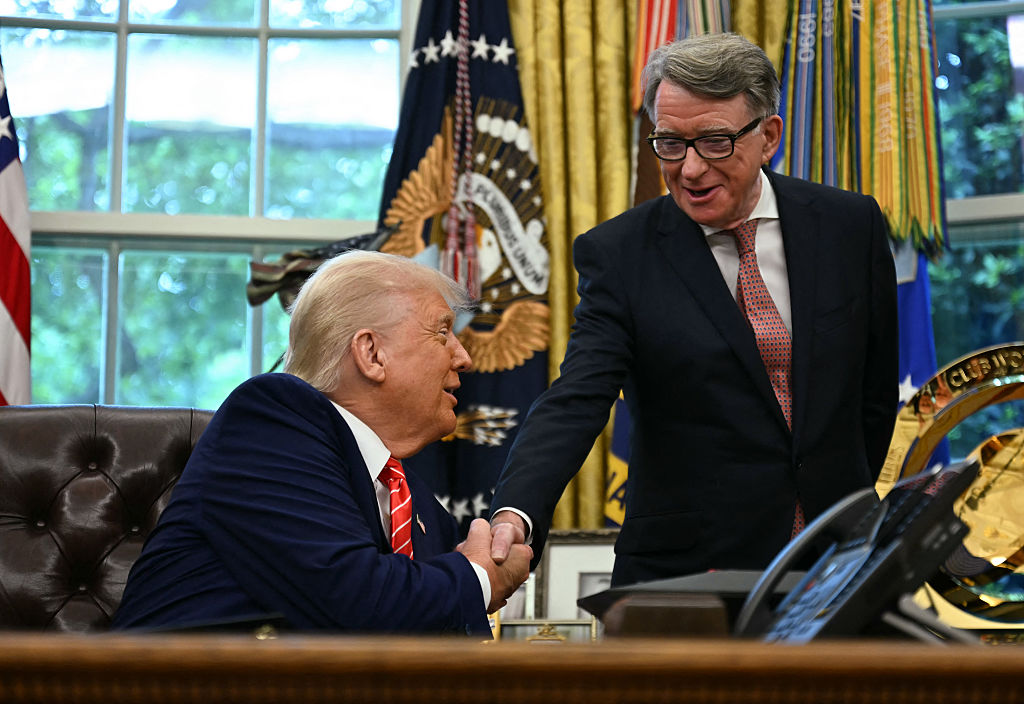
As ambassador in Washington, I had a ringside seat as the Trump administration made sense of this world and how it is changing America’s outlook and global role. I am afraid I don’t think, even now, that European leaders have adjusted to the revolution under way. They are guilty of a lazy interpretation of ‘America First’ to mean ‘America Alone’, even though President Trump is expending huge effort to end the war in Ukraine and has acted in a decisive way to halt the conflict in Gaza, where he remains committed to the vital ‘phase two’.
Europe is transfixed by the Truth Socials coming out of the White House but without following the arguments underpinning them. When these were brought together last month in the administration’s National Security Strategy, Europe’s reaction was one of horror that America’s allies were allegedly being relegated and America’s European security guarantee apparently discarded.
They would do better to ask themselves why the US is making an adjustment and how they, as America’s allies, can mitigate its consequences and offset the transfer of American resources elsewhere. In other words, how and when the piggybacking stops and Europe starts assuming its full military and financial responsibilities beyond fine words – which is what they amount to in most cases at the moment, notwithstanding the future ‘military hubs’ promised by Britain and France to Ukraine.

Presently, Europe’s consideration of the hard military power and reliable diplomatic muscle it needs to bring to the table is being masked by outpourings about a sheriff president who does not follow conventional practice or a traditional diplomatic rule-book. Europe’s leaders need to ask themselves whether this is because it is intrinsically wrong for a US president to take powerful, unilateral actions or because Trump and his playbook trigger a particular and instinctive allergic reaction in Europe’s capitals.
In Caracas last weekend, as earlier last year in the case of Iran’s nuclear enrichment facility at Fordow, Trump did more in a day than orthodox diplomacy was able to achieve in the past decade. This is likely to continue in the Age of Trump, so what are America’s allies going to do: use hard power and hard cash to increase their relevance and influence or continue to slide into unimportance?
Britain’s interests and those of other liberal democracies lie in how we harness the power of the US to continue safeguarding the principles – if not always the letter – of the UN Charter. This will mean accepting that Trump’s decisive approach when faced with real-world situations is preferable to the hand-wringing and analysis paralysis that has characterised some previous US administrations or, indeed, the deadlock and prevarication that so often characterise the UN and the EU respectively.
In the meantime – and this should worry us more in Europe – MAGA reservations about foreign ‘interventionism’ will stiffen as pressure mounts on Trump to focus on pocketbook issues rather than foreign policy. Hopefully, this pressure will not get the better of Trump’s attention to Ukraine, Gaza and, as is coming down the track, Iran’s democratic transition.
Watch the latest Americano from Spectator TV: