-
AAPL
213.43 (+0.29%)
-
BARC-LN
1205.7 (-1.46%)
-
NKE
94.05 (+0.39%)
-
CVX
152.67 (-1.00%)
-
CRM
230.27 (-2.34%)
-
INTC
30.5 (-0.87%)
-
DIS
100.16 (-0.67%)
-
DOW
55.79 (-0.82%)
Watch: The Nixon Revival
The Spectator held its first event in Manhattan on Wednesday September 30 — and you can watch the full discussion above.
Known to many as “Tricky Dick,” Richard Nixon has often had his legacy reduced to the scandal that brought his presidency crashing down: a break-in at the Democratic National Committee headquarters, a criminal cover-up, then his resignation. But what if his story is far more complicated? Why has J.D. Vance described Nixon as a “new icon” for young conservatives? And why do some Gen Zers now see him as an “America First” populist pioneer?
Leading historian and columnist Conrad Black, Daniel McCarthy, editor of Modern Age and the architect of Nixonmaxxing, and Geoff Shepard, former Nixon staffer and author of The Real Watergate Scandal, reassess the legacy of one of America’s most controversial presidents. The discussion is hosted by The Spectator’s US editor, Freddy Gray.
Exclusive: work or face benefits ban, Tories tell under-25s
Kemi Badenoch, like many in the Labour party, is not sorry to see the back of Keir Starmer. ‘I did not find Starmer an interesting person,’ she says. ‘He never said anything interesting.’ Andy Burnham is a different proposition. ‘Quite interesting,’ she thinks. ‘He has more of a clear sense of who he is politically, which makes him more confident in terms of what he wants to do. But who he is politically is so far removed from who I am politically that I think that there’s a sharper contrast between us.’
We speak in her office in Portcullis House with the Labour conference in full cry in Liverpool. ‘It feels very much like student union people who’ve got older, but they still want to do the stuff that they did in the student union,’ Badenoch says. Her verdict on Burnham’s big speech on Tuesday is that the Prime Minister is offering ‘Corbynism with better packaging’, with socialist solutions from the 1970s that ‘will fail again’. But that sharper contrast has energised her. ‘Hearing his speech, it’s clear we are now about to have a battle of ideas. It’s given me more confidence that, even in this messy political era, the Conservatives are going to win.’
‘Even families on benefits know that the system is out of control. But no one wants to get off the treadmill first’
Burnham, she says, ‘likes to say yes to everyone – and that is something which I learned a long time ago is a recipe for disaster’. Nowhere, she believes, is this more obvious than in Labour’s approach to the ballooning benefits budget. ‘They are the welfare party. It’s in their DNA. They’re not the party of the working classes at all.’ If Burnham is a ‘people pleaser’, Badenoch wants to make a virtue of her abrasive reputation – the people displeaser the country needs. ‘No one wants to be the person to say “No”. And I want Spectator readers to know that the person who’s saying “No” has arrived and is leading the Conservative party.’
At Tory conference, which begins in Birmingham this weekend, she will announce plans to ‘put the fair back in welfare’ – both for taxpayers and those condemned to a life on handouts. The Tories will advance two principles: that those who have paid in are entitled to more than those who have not. ‘If you have worked for a very long time, you can be on benefits for much longer because those people are less likely just to sit back and not look for a job,’ she explains. ‘After six months, if you haven’t found a job and you’re just not taking that seriously, you will lose money.’
Second, those who can work should do so. ‘It’s unfair to the people who get up and go to work, having others earn more than them for not working. Even families on benefits know that the system is out of control. But no one wants to be the one to get off the treadmill first. We need to force that. Government has to do that.’ Badenoch is incensed by ‘sickfluencers’ on YouTube teaching people how to claim benefits for ADHD or anxiety. ‘There are a lot of people who do not have a mental disability but claim to have one using low-level conditions… These are conditions you can work with, and so you should be working. We’re not going after the vulnerable. It is the people who can work who aren’t working that are the target.’
One of the most striking policies Badenoch will announce is a ‘tough love’ approach to young people. A Tory government would set up a ‘Get To Work’ programme, banning young people who have not worked from drifting straight onto benefits. Under 25s who have less than six months in continuous employment will no longer be able to sign on to universal credit when they leave school or turn 18.

Those without a job or an apprenticeship will only be able to claim a new ‘Get to Work Allowance’ – and they’ll only get that if they participate in a six-month Get to Work programme. To get the money, they will have to complete work activities, such as daily attendance at a local job centre, work-experience placements, training courses or community work. They will need to apply for jobs and go to interview-prep workshops, plus attend group sessions to develop the communication skills that employers complain young job applicants lack.
Those who complete the Get to Work programme will receive a ‘Ready for Work Award’ recording their skills. But after six months on Get to Work, young people still not working will drop down to a basic Subsistence Allowance. There will also be steps to make young people more the responsibility of their parents rather than taxpayers (with mitigations for those without parents or in the care system). ‘This is a tough love policy,’ a source says. ‘It will provide help as well as enforcement.’ This is the nanny state with menaces; Mary Poppins with an umbrella gun.
Badenoch also signals that she wants to toughen the statutory cap on total welfare spending. ‘That’s certainly something that we are considering,’ she says. ‘MPs just vote for it to increase, an automatic ratchet, because no one wants to be the person to say no.’
Some will doubtless say Badenoch is making the Conservatives the ‘nasty party’ once again. Refreshingly, she doesn’t care. ‘The people who are going to say “nasty party” will always say it. Quite frankly, the reason why we’re in this mess is because we kept pandering to those people and trying to make them like us. And did it work? No, it didn’t.’
Indeed, she attributes a new optimism among Tory MPs to her plain-speaking approach: ‘We’re finally saying what we believe and we’re not scared to say it. We should be more aggressive.’
A year ago at conference she stabilised her leadership with a pledge to abolish stamp duty. She downplays recent speculation she will announce the outright abolition of inheritance tax this time: ‘I’m not someone who likes to play the same movie twice. Inheritance tax – we want to get rid of it, but we’ve got to do our working first.’
Expect far more focus on the economy than Labour. ‘Burnham has no plans to make anybody wealthier,’ she says. ‘He has no plans to get businesses hiring people. Where are the plans for ownership, whether it’s people owning their own property, owning shares, owning businesses? There are none, because he doesn’t want people owning things or being responsible for their own lives. People hated that model so much that it ushered in the era of popular capitalism which we saw in the 1980s and 1990s. That is what people will see at my party conference.’
Badenoch will also emphasise security. ‘Defence and national security are going to be the defining issue of the next few years,’ she says. ‘We have become so complacent as a country, as politicians, and we need to get serious.’ She is critical of Ed Miliband, the Foreign Secretary, who ignored intelligence advice before sanctioning Israel, a country she calls ‘a critical security partner’. She says Miliband’s glad-handing of the foreign minister of Iran, the world’s leading state sponsor of terrorism, was ‘incredibly naive. Gormless, in fact, is probably the word that I would use.’
Badenoch was incredulous when Burnham said at PMQs that he would not promote national security at the expense of social security. ‘I thought I couldn’t possibly have heard him say that. I genuinely couldn’t believe it. I don’t think he will ever say that again.’ She puts Burnham’s mistake down to him not having a leadership contest to hone his lines. ‘He’s now doing all his thinking out loud and this is what he really believes.’
She can’t resist a parting shot at her former leadership rival turned Reform defector. ‘Rob Jenrick never exited leadership contest mode. And he’s now doing it in his new party.’ As a wheeze at conference the Tories have produced an 88ft-long illustration of Labour’s first two years in power in the style of the Bayeux Tapestry. It features 150 taxpayers being shot in the eye with a tax arrow, 14 political journalists, including this one, and numerous images of a tiny wailing Jenrick.
Jenrick and Suella Braverman’s defections in January were a relief: ‘It was like watching someone come in and pick two unexploded bombs that I was working out how to defuse and just take them away. Now in shadow cabinet, we just talk freely. No one holds anything back. No one’s taking notes.’
Badenoch has faced criticism for banning former ministers, such as Grant Shapps, from the list of Tory candidates. Grandees say that Badenoch, despite her seemingly impregnable position, fears a leadership challenge before the next election if she doesn’t turn things around in the polls and that Shapps’s habit of running a spreadsheet of dissenting MPs was a threat to her position. Others see a reluctance to let Penny Mordaunt return in the same light. ‘She was frightened of Grant’s spreadsheet,’ a former cabinet minister says. ‘She’ll let Penny back but is deliberately keeping her waiting.’
Badenoch admits she has ‘slowed down the former MPs who are coming back’, but says that is giving ‘some new candidates a chance’. She is proud that there will be ‘no more Heidi Allens’ (the former MP who tried to overturn Brexit and welfare cuts before joining the Lib Dems). She won’t comment directly on Shapps, but in response to a question about him, she criticises MPs who plot. ‘I am looking for improved standards of conduct. When people have nothing except politics, that’s when the psychodrama comes, when they’re in the bars all the time. They’ve got nothing else to do.’ She says Mordaunt ‘hasn’t been blocked’.
‘We’re finally saying what we believe and we’re not scared to say it. We should be more aggressive’
The Tories overtook Reform in a recent poll but are still below where they were when Badenoch took over. Nonetheless, she is encouraged by Nigel Farage’s recent wobbles. ‘We call Farage “Grumpy Grandpa” because he’s always complaining about something.’ She accuses the Reform leader of ‘trying to intimidate’ journalists who probe his affairs. ‘It’s not fun when the press are all over you and there’s endless scrutiny. But it’s the job.’
She also strikes a different tone to Farage on Donald Trump. The President’s recent call for a united Ireland made her ‘very irritated’. She understood American concerns over Iran’s nuclear programme, but calls it ‘frustrating’ that the Americans ‘clearly hadn’t thought about what could happen in the Strait of Hormuz. I just don’t think these guys think past page one.’ She adds: ‘It’s Trump’s actions rather than the words that I really focus on. If you focus on the words, then we’re all over the place. He’s quite erratic.’
While Reform’s recent receipt of £72 million is a huge challenge to the Tories, Badenoch says: ‘It’s actually encouraged quite a few people to give us a bit more. People who were thinking of splitting their money between the two parties said, “They don’t need my money now”, so that’s helpful.’
Badenoch knows she still has a mountain to climb. ‘My own ratings have improved but the party brand is still not enough associated with me,’ she says. ‘This is a different party from 2024. And I’ve got to show that. I think the public are screaming for a party with common sense. We’ve got sensible plans that are actually going to work this time.’
Sensible plans will help. ‘This time’ is a reminder of the challenge to overcome public scepticism of Tory pledges. But Badenoch wants to make her own luck. ‘I’m not just waiting for other people to fail,’ she says. ‘I think that’s foolishness and I get better every day.’
Burnham has no idea what kind of EU relationship he wants
Labour conference is done and dusted, and Andy Burnham will be a happy man. His speech yesterday went down well in the hall and continues to make waves outside it, too. The Prime Minister’s address was fairly insular, with few references to the world beyond these shores – despite this being a time of global uncertainty, as Tim Shipman notes here.
The one major exception was Europe, with Burnham declaring that ‘Brexit has done more harm than good’. He then suggested, implausibly, that he would try to ‘find consensus’ around ‘Britain’s long-term relationship with our European partners’ – a feat that eluded all his postwar predecessors. Not for nothing is this country still regarded by some Europeans as ‘perfidious Albion’.
Burnham clearly has no idea what kind of relationship he wants
In post-speech interviews broadcast today, Burnham confirmed that he would consider rejoining the European Union. He told the BBC he did not want to leave the question of the EU relationship ‘hanging’ and said he wanted to be clear on ‘where we want Britain to go in the next decade’. Asked whether he wanted the UK to rejoin the trade bloc, he replied that he wanted to ‘look at the options’. ‘We could stay as we are. That’s definitely an option, if people think this is the right place to stay,’ he told the programme:
We could look at what George Osborne has said about a customs union, we could look at what the Liberal Democrats said at their conference about the single market, or we could go all the way.
He added: ‘So there are clearly options that need to be considered, and we have to look at what is doable and what would be the pros and cons of each.’
There are three obvious issues with Burnham’s stated position. The first is that it completely flies in the face of everything he said during the Makerfield by-election. Less than four months ago he was telling Tony Blair that Labour’s ‘relentless focus now should be on domestic issues’ rather than on ‘re-running divisive arguments about rejoining the European Union’.
The second is that he clearly has no idea what kind of relationship he wants, as evidenced by the fact that he is citing Osborne – the supposed architect of austerity – as a guru for Labour thinking. Old government hands ask whether Burnham has properly considered the cost opportunity of considering rejoining the EU: a proper customs union debate would consume much of the oxygen and agenda over the next few years. This leads to the third problem: he is willing to put himself at the mercy of European leaders just as nationalists are rising across the continent.
Incumbent leaders such as Emmanuel Macron and Pedro Sanchez have hailed Burnham’s stance on the EU. The French President said it would be ‘excellent news’ while the Spanish premier said that Britain would be welcomed back ‘with open arms’. Yet with the radical right leading in the polls in both of their countries, and in Germany and Italy, allies of Nigel Farage will probably be much less willing to take Britain back. Even if negotiations were successful, the Europeans would surely demand the abolition of sterling and propose a far more integrated arrangement than we had prior to Brexit.
The ongoing rows in Whitehall about the forthcoming UK-EU summit and Britain’s failure to get access to the continent’s £128 billion SAFE defence fund shows just how hard it will be for this government to achieve a good deal. On the European question, as with so many others, one wonders how much work Burnham has done to ensure his thinking is not already out of date.
Trump relives high school with the tech nerds
Yesterday President Trump and a gaggle of tech barons appeared before the press pack on the White House lawn, fresh from a meeting to sign the “White House Accord” on AI. The atmosphere was jovial. Trump was weaving about, patting the arms of David Sacks and Mark Zuckerberg while the executives chuckled and joked to one another. Anthropic boss Dario Amodei was invited by a journalist to give his précis of the meeting. Amodei haltingly stepped forward, adjusted his glasses, and then began rather frantically chopping the air with his hands as he outlined the benefits and hazards of AI. After he finished he seemed to flee, retreating to the outer edges of the crowd. Trump looked on benignly.
An introverted technologist who is somewhat camera shy? There was more to it than that, apparently. According to the online comments on this brief encounter, Amodei had just relived a sort of teenage trauma. “Some adolescent high school power dynamics at play here. Dario has the best model but he’s the anti-social uncool guy not worth listening to, while Zuck and Sacks are playing the hip friends of Trump,” said one wag on X. Some made out that the other executives were smirking at Amodei’s performance in an attempt to toady up to the “jock” Trump. For all his billions and all his cutting-edge tech, it is implied, Amodei cannot escape who he was in high school: a nerd, whose fate is to be dominated by jocks like Trump and their cronies.
This is all rather typical. For quite a number of Americans, high school is the defining experience of their lives. Their position in its social pecking order marks them forever. Anything a high school nerd subsequently does is merely “cope” for his failure to fit in during adolescence, so the theory goes. Some elements of MAGA cast their movement as a revolt of the jocks against the “theater kids.” It is dismaying to see this kind of witless pop-sociology now being applied to AI, a technology which will transform all of our lives. It’s time to graduate.
The heroes who saved the flydubai flight from disaster
This morning a flydubai flight from Dubai to Tel Aviv appears to have been hijacked by its own co-pilot. It ended with the plane on the ground in Tabuk, Saudi Arabia, and all 174 passengers alive, among them 27 children and many Israelis. Very little has been officially confirmed. But what we do know points to a potentially massive disaster that was averted, thanks to the bravery of Israeli passengers and members of the crew.
Flight FZ1073, a Boeing 737, left Dubai just after 7 a.m. local time this morning, heading for Ben Gurion Airport. It’s one of the everyday routes that have linked Israel and the Gulf in recent years.
By an extraordinary piece of luck, an alternate crew was on board
About two hours into the flight, while cruising at around 34,000 feet over northwestern Saudi Arabia, the plane suddenly dropped about 17,000 feet. Its altitude and speed kept changing before it settled at around 15,000 feet. The plane’s transponder first broadcast 7700, the general emergency code. Then, briefly, it switched to 7500, the international code for unlawful interference, which in plain terms means a hijacking. It went back to 7700 before landing. That brief 7500 signal was enough to set off an Israeli military response. The Israeli Air Force scrambled fighter jets, and Prime Minister Benjamin Netanyahu held urgent consultations with the Defense Minister Israel Katz.
At that stage even Israeli officials didn’t know what they were dealing with. A security official told the news outlet Ynet there was no definitive information about a hijacking and that they couldn’t make contact with the pilot.
The picture that has emerged since then comes mainly from people on board. Passengers say they heard screams coming from the cockpit. According to their accounts, passengers then forced the cockpit door open and found the Emirati captain stabbed with a knife, allegedly by his co-pilot. Israeli passengers and crew members subdued the attacker and helped save the captain’s life. One passenger told Channel 12 the plane began diving fast after the pilot was wounded. A video filmed on board afterwards, which I shared this morning on X, shows the stabbed pilot. It is graphic. One of the men on board has also recorded his own account of those moments, and it’s worth watching in full.
With one pilot wounded and the other restrained, someone still had to fly the plane. By an extraordinary piece of luck, an alternate crew was on board, being flown to a later assignment. Channel 12 reported that these off-duty pilots, in plain clothes, played a crucial part. They are reported to have taken over the controls and flown the aircraft to safety.
It’s still officially unconfirmed who attacked the captain and why. Reports so far point to the co-pilot. A senior Israeli official told Channel 12 there were “growing indications” that the co-pilot tried to take over the plane in order to crash it, in what would have been a suicide attack with 174 people on board. Unofficial reports say the co-pilot is Omani and the captain who stopped him is from the UAE. None of this has been confirmed by the UAE, Saudi Arabia, Oman or flydubai.
The plane was diverted to Tabuk and landed safely. In a short statement, flydubai confirmed that all passengers were safe and accounted for. The airline said it was cooperating with the authorities and would give more information later. Reports say Saudi authorities are now questioning the suspect.
Only days ago Netanyahu was in the UAE. According to the Italian newspaper Il Foglio, during that visit he secretly met Saddam Haftar in Abu Dhabi. Haftar is the son and deputy of eastern Libya’s commander Khalifa Haftar. Senior officials from other Arab states that have no formal ties with Israel are also believed to have met Netanyahu that day, in meetings arranged by the Emiratis, now one of Israel’s closest partners in the region. Neither government has confirmed any of these meetings. But they show how much has quietly changed. Today’s flight connected two of those partners, it came down in a third country, Saudi Arabia, and Riyadh then allowed an Israeli plane in to bring the passengers home.
If the early indications are right, this morning a pilot tried to turn a passenger jet into a weapon on a route that stands for that new relationship. He was stopped by ordinary passengers who ran toward the danger instead of away from it, and by a crew who happened to be in the right place at the right time. We came very close to a very different headline today.
The truth about Earl Spencer
‘Mr Morgan,’ said the faux-regal voice at the end of the line, ‘this is Earl Spencer. I’ve got you now, you bastard.’ Suffice it to say, this call didn’t happen last week after the alleged ‘historian’ was forced to publicly apologise for publishing a lie about me in his new book. (He accused me of being Mirror editor in 1993 when it published gym photos of Princess Diana in a notorious invasion of her privacy that cost £1 million in damages – but I didn’t join the Mirror until 1995.)
However, the irony of what that call was about isn’t lost on me, 31 years later. I was editor of the News of the World at the time, and one of Spencer’s friends passed us a letter from him revealing his plans to leave his ailing wife Victoria and take their kids to America, where he’d be a TV reporter. Spencer waited until our first edition dropped with the scoop before calling to inform me it was a hoax. ‘That letter was all made up,’ he chortled jubilantly. ‘I suspected who your source was, so I wrote it to him knowing he wouldn’t be able to resist passing it on to you. And it’s all rubbish. Ha! What are you going to do now then, eh? Ha, ha!’ ‘Why didn’t you tell us before we printed the paper?’ I replied. ‘Ha! Because if I had, you would’ve pretended I hadn’t caught you out. You’re going to have to admit you’ve printed lies now, aren’t you, and apologise. Enjoy! Ha, ha!’ Like I said, ironic. As I read the Earl’s grovelling apology for printing lies about me, all I could think was: ‘I’ve got you now, you bastard. Ha, ha!’
My unlikely saviour back in 1995 was ex-Sun editor Kelvin MacKenzie – who, when I hurriedly called him for advice, observed: ‘That sounds like a disgusting attempt by Earl Spencer to con News of the World readers, using his family to do so.’ We switched headlines to ‘WHAT A CHARLIE – Althorp invents pack of lies about wife and kids to trick NoW readers’ and Spencer swiftly went from victim to villain in the court of public opinion.
I recently attended Kelvin’s 80th birthday party at Hampton Court. It was the Fleet Street equivalent of a Mafia Five Families reunion, only less aesthetically pleasing. The birthday boy’s most famous headlines adorned the tables, though didn’t include my all-time favourite which is still in my parents’ downstairs loo. It was based on a report about the debilitating effect of alcohol on male sexual performance and cautioned: ‘WARNING: DRINK’LL WRINKLE YOUR WINKLE.’
The weird thing about Spencer’s erroneous attack on me in his book, other than how fact-checkers at Penguin didn’t spot it (not least because they also published my bestselling diaries The Insider which covered that period of my career!), is that in 2000 he came to the Mirror for a surprisingly convivial ‘make-up’ lunch, notable for his failure to recognise a famous fellow guest. ‘Many thanks for an interesting and enjoyable lunch,’ he wrote to me afterwards. ‘A varied guest list, the airing of many subjects, and the Mirror’s hospitality all made for a justifiably long session at the table. I feel bad not remembering Carol Vorderman. Still, she looks a lot better now than I can ever remember her looking in Countdown.’ Memory clearly isn’t his strong point.
Talking of lunch, and memory failures, Diana’s former chef Darren McGrady was quoted in the Daily Mail as saying that after I dined with her at Kensington Palace, she told him afterwards I was a ‘jerk’. To set the record straight, I invited her former butler Paul Burrell – who served the meal that McGrady had cooked – onto my Uncensored show and asked if that was true. ‘No!’ he replied. ‘You got on like a house on fire! I don’t want to blow smoke in your direction, but she liked you.’ Now that’s a historian I can trust.
Of course, my Spencer schadenfreude may be short-lived if the apocalyptic warnings of AI killing us all come to pass. In his last TV interview, Professor Stephen Hawking told me AI was the biggest threat to mankind’s survival. ‘The great danger is if we let it self-design, for then it can improve itself rapidly and we may lose control,’ he explained. That was nine years ago. I fear we’ve either reached that point – or are about to.
‘Any news on the knighthood, yet?’ texted Dame Joan Collins. Well, I’m reliably informed our senior royals are as giddy as Lottery winners at seeing Spencer’s vindictive, disingenuous, King-bashing book causing him global humiliation for getting basic facts wrong. My pleasure to serve, Your Majesty.
Harold Wilson is the new Labour lodestar
After Andy Burnham’s speech at the Labour party conference on Tuesday, one veteran factionalist declared: ‘We are all Burnhamites now.’ Romantics love the rhetoric; cynics respect the ruthlessness. ‘Game recognises game,’ says one Labour figure.
The Prime Minister’s address was pitched at a wounded party seeking support. Emotive and personal, yet also intensely political, it showed a keen awareness not just of Labour’s values, but of its interests too. Right to Buy, which attracted legions to the Tory ranks, will be halted for new homes; a new National Care Service will bring thousands more members into the unions’ fold. Progressivism will be entrenched in the model Burnham chooses, with devolution imposed on his terms: mayors allowed to spend more, but restricted from cutting tax. ‘We have a politician as Prime Minister,’ says a young MP approvingly.
Even by the standards of a party conference, this year’s Labour jamboree was peculiarly nostalgic
The new leader understands that, for all its talk of radicalism, Labour is instinctively a conservative beast. Even by the standards of a party conference, this year’s jamboree was a peculiarly nostalgic affair, full of references to HP sauce, miners’ lamps and northern soul. In his bid to roll back Margaret Thatcher’s 1980s settlement on buses, houses, water and more, Burnham was attempting to construct a 21st-century version of the postwar Labour bargain.
The dominant political operator of that pre-Thatcher age, of course, was the figure who loomed larger over this conference than any other: Harold Wilson, another northern football-lover whose views bounced between the traditions of the Tribune left and the old right. References to Wilson’s government peppered cabinet members’ speeches – ‘the white heat of technology’ featured in no fewer than four. Party officials flocked to buy merchandise commemorating 60 years since Wilson’s 1966 victory. ‘We pretend the first two years didn’t happen,’ jokes a backbencher, seeing parallels between 1964 and 2024.
The Wilson comparison is instructive. Labour lore recalls him as the champion of gay, ethnic and women’s rights – rather than the man who devalued the pound in 1967. Burnham, too, is full of talk about reform and plans, even as Britain’s economy is at the mercy of unfavourable world events. There was an uncomfortable irony in John Healey’s speech on Monday: it was 50 years to the day that his namesake, Denis, had to beg the party to back a £2.3 billion IMF bailout. The day after the current Chancellor’s speech, UK borrowing hit its highest rate this century.
Some of Burnham’s cabinet also consciously see themselves in the party’s lineage. Louise Haigh, his effective deputy, talks often of Barbara Castle: ‘A diminutive Yorkshire redhead with a grit and determination that occasionally found herself in trouble,’ as she says. Haigh has been handed responsibility for growth by Burnham and there is an echo here of Wilson’s short-lived Department of Economic Affairs, set up to constrain the power of the Treasury. Already, officials fear that a clash with the Chancellor is looming, with predictable Labour criticisms mounting about Healey and his department’s ‘lack of imagination’. Burnham has said he wants ‘No. 10 leading on that growth mission’ to ‘unlock the blockages’ in Whitehall; Wilson said similar of the DEA, just weeks before devaluation.
Kanishka Narayan, the AI minister, cites Tony Benn as a fellow public-school, techno-enthusiast – even if Narayan is of a different intellectual tradition. ‘The Labour right’s future is Kanishka,’ says a former Wes Streeting backer. Intelligent and industrious, Narayan did an estimated 70 conference events, with his role being to present an alternative political economy to the Prime Minister’s more insular world view. ‘Burnham is offering 20th-century solutions to 21st-century problems,’ says a former civil servant. Marrying AI to the reindustrialisation agenda could be the government’s best chance of success.
Others are still adjusting to fluctuating party moods. Shabana Mahmood, the Home Secretary, has been christened ‘Subana’ by colleagues, such is her diminished public profile after the backlash over her legal migration reforms. Health – so often the great Labour rallying cry – featured little in this conference either. Both Yvette Cooper, the current Health Secretary, and Bridget Phillipson, the demoted equalities minister, face losing their seats to Reform as Burnham mulls reopening the European question. ‘The Midlands’ sparkies are the new Durham miners,’ says a sceptical figure, pointing to the key battlegrounds.
For now, the Labour tribe is united, amid fears the next right-wing government will resemble some grotesque fusion of Selsdon men and Powellite bastards. Hopes are high for next week’s Holborn and St Pancras by-election, with most in Labour expecting a triumph over Zack Polanski, the Green leader who put himself forward. ‘Next Thursday we pop his bubble,’ boasts a 2024 MP. Activists on the ground report that a key moment was Ed Miliband’s sanctions on Israeli settlements last month. ‘That really went down well,’ says one involved, reflecting on the Foreign Secretary’s speech in parliament. Tellingly, no cabinet minister attended the Labour Friends of Israel’s party at the conference.
After that, the Budget looms. ‘It’s the most important Budget this parliament,’ explains a government aide. ‘If it falls apart, if you can’t defend it on Kuenssberg that Sunday, then that’s it.’ After £75 billion in tax rises in 2024 and 2025, a similar scale is not envisaged this time, with Healey taking care to consult widely with parliamentary colleagues. ‘Dip their hands in the blood,’ suggests one ex-Treasury staffer. Next spring’s spending review is expected to be a chastening experience for the revised cabinet. ‘Let’s see if it is happy families after that,’ says one Tory aide.
Like Wilson, Burnham has inherited a dire economic outlook, not of his own making. But having raised the hopes of his party in Liverpool, the challenge now is to be more than yet another transient political figure, condemned by history as little more than a mere tactician. His party has cause to hope again – yet offering just a ‘better yesterday’ will not be enough.
Portrait of the week: the end of the triple lock, odd happenings in Gloucester and Pope Leo in France
Home
Andy Burnham, the Prime Minister, announced the end of the pensions triple lock from 2030, when the link with earnings would be broken. Wearing a suit but no tie, he told the Labour party conference: ‘I will make a break with the direction of the past 40 years.’ He said that houses would be confiscated if left unoccupied or if rented out but not well maintained. He said he would ‘repeal Margaret Thatcher’s ideological ban on public ownership of water companies’; he would reduce electricity prices by establishing the Great British Grid, a publicly owned company. He tearfully promised a National Care Service, after a review by Baroness Casey of Blackstock. Ties with the EU would be explored and electoral reform would be in the next Labour manifesto. John Healey, the Chancellor of the Exchequer, promised ‘a new age of industrialisation’, exemplified by the building of a £115 million research ship at Faslane. Diesel prices hit record levels. Household energy prices were expected to jump in January by a typical £276 a year, even with a government cut in VAT. Heathrow expected a third runway by 2039, instead of 2035.
Something odd happened in Gloucestershire. Five men, British nationals from London in their twenties, were arrested on suspicion of preparation of a terrorist act and of offences under the Explosives Act near RAF Fairford, used by the US Air Force for strikes against Iran. Three white vans had turned up in the village of Whelford, where 85 households were evacuated. One of the men had phoned 999. No explosives were found. The men were released on bail. President Donald Trump of America said: ‘We had them under investigation. They were looking to do big damage.’ Marco Rubio, the US Secretary of State, said the incident ‘clearly involves the hands of a foreign actor’.
Michelle O’Neill, the First Minister of Northern Ireland, joined protestors in the Garvaghy Road in Portadown to block Orangemen given permission in an overnight court hearing to march for the first time in 28 years. Sir Chris Bryant, the Northern Ireland Secretary, hurried back from the Labour conference and a stalemate developed. Between pleading guilty on 6 August and being sentenced on 24 September, Zafer Dogan, 32 (convicted of taking thousands of pictures of women and girls before using AI to sexualise the images), was granted bail to the flat (overlooking a playground) where he had committed the crimes. Daniel Thomas, known as Danny Tommo, the anti-migrant campaigner, pleaded not guilty to criminal damage after a video appeared to show him slashing at a dinghy in the Channel. Manchester City arranged ‘sham contracts’ to disguise secret funding of more than £830 million, the Premier League said; the club is to appeal.
Abroad
Saudi Arabia intercepted six ballistic missiles fired by Yemen’s Iran-backed Houthi militia. Yemen’s government forces fought the Houthis around Taiz. Oil prices rose. Mr Trump rejected a proposal by Iran to reopen the Strait of Hormuz. US long-term borrowing costs hit their highest level since 2002. The US banned the import of wine and whey from Canada. Mighty Sparrow, the calypso singer, died aged 91.
Russia destroyed Ukraine’s National Academy of Sciences in the historic heart of Kyiv and hit a data centre, severing internet connection for 100,000 households. Estonia said Russia was behind an arson attack last month on a Tallinn defence company, Milrem Robotics, supplying Ukraine with unmanned military vehicles. Cyber-criminals who hacked the FBI said they had sensitive medical data such as allergies and blood test results for thousands of its special agents. Fatima Ezzahra El Mansouri was appointed Morocco’s first woman prime minister. Eighteen people were killed when eight gunmen stormed a bar near Johannesburg; hours later, ten people were killed outside an entertainment venue near Cape Town.
Pope Leo said Mass for a crowd of 700,000 filling the Place de la Concorde and the Champs-Élysées in Paris. The American archbishop Fulton Sheen (1895-1979) was beatified during a Mass at Peoria, Illinois. In France 400 people were arrested in two days as secondary-school pupils demonstrated against a shortage of teachers. Spain’s coalition government issued a decree banning evictions until 2030, after thousands demonstrated against the eviction of an 87-year-old Madrid woman unable to pay rent rises. CSH
Andy Burnham begins the long march left
When the Social Democratic Party was launched in 1981, its prospectus was dismissed witheringly by the liberal thinker Ralf Dahrendorf as a plan for ‘a better yesterday’. Andy Burnham has gone one better. He plans to rerun Labour’s last term in office. But this time with feeling.
The Prime Minister’s address to his party conference was many things – fluent, passionate, moving, politically effective. But one thing it was not: forward-looking. The quality of the delivery invited comparison with Tony Blair but, unlike Blair, our current PM was not promising modernisation. He was instead seeking to revisit the Blair years and pursue the road not taken by Labour in 1997 – the long march left.
The heart of the Burnham programme is a rejection of the New Labour belief that an accommodation had to be made with Margaret Thatcher’s own modernisation of Britain’s economy. The Blairites believed that they needed to demonstrate moderation and discipline before Labour could be trusted to govern again. They had to accept the erosion of union power, embrace a bigger role for the market and reject their own activists’ obsessions before they could pursue their central project of public-sector reform. Above all, a vigorous private sector had to be supported to generate growth – with taxes set at a level that encouraged entrepreneurship – and education policy reformed to match global competitors.
Every single one of those Blairite principles was comprehensively trashed by Andy Burnham this week. Thatcher’s (and John Major’s) privatisations should be reversed; the historic crime of council house sell-offs atoned for. Far from reforming the National Health Service, with greater market discipline, accountability, choice and contestability, its monolithic model should be extended with the creation of a new bureaucratic behemoth – the National Care Service. Paid for with more public money.
Because, whatever the merits of amending the pension triple lock, the Burnham proposals will cost additional billions at a time when public debt is still escalating. The PM clearly regrets that he was never able, as health secretary in 2009, to build back Bevan, but now he is seeking to make good on those ambitions just when the nation’s finances are growing weaker by the day.
The repudiation of Blairism and the embrace of an older, more left-wing path for Labour were there in the promise of state control of utilities and state direction of investment. Largesse for the trade unions was announced by John Healey in a speech which celebrated the solidarity displayed during the miners’ strike but said next to nothing about the real problems of rising energy prices and the real opportunities offered by technological transformation. We are entering an age where AI is transforming our world but the Chancellor would rather channel Dennis Skinner than Demis Hassabis.
The prostration before the household gods of the left continued with Ed Miliband’s endorsement of the campaign run by Gaza independents to put Israel in the dock, and Burnham’s own suggestion that he would like an electoral system more congenial to Zack Polanski’s dreams of power. Blair knew that bowing to left-wing pressure groups moved Labour further away from the mainstream, further away from government and further away from deserving power. But for those within Labour who chafed against the constraints he imposed, who wanted to empower the ‘broad’ left and who hated his resolute stand against Islamism and with Israel, the Burnham revisionism is sweet indeed. It’s a northern soul revival calculated to appeal to Labour’s ideological heartlands.
But while the Burnham Restoration has a certain shrewd political logic – uniting left-wing voters under a ‘progressive banner’ just as the right is divided – it is a policy disaster for the country. The central challenges facing the nation are either ducked or made worse. The few promising policies of the Starmer era are diluted. The worst are exacerbated.
Every Blairite principle was comprehensively trashed by Andy Burnham this week
Britain suffers at the moment from low growth, ballooning debt, high energy costs, low investment, inadequate preparation for technological change, uncontrolled migration and invertebrate defences. On these huge and unavoidable problems the government is hopelessly unequal to the task. Its policies will add costs to business, hike taxes on enterprise, deter investment from abroad in infrastructure, do nothing to reassure lenders, drive up the cost of debt, force energy bill payers to subsidise yet another quango, leave oil and gas unexploited in the ground, make data centres unaffordable, generate a hostile environment for entrepreneurs, offer innovators only more regulation, make it easier for terrorist sympathisers to enter the country, do nothing to stop small boats, keep the military underfunded and dismay our allies in the fight against extremism.
There is a sad irony in that the more sensible ministers within the Starmer government – Wes Streeting and Shabana Mahmood – who agitated for Starmer’s removal are now themselves diminished figures. Streeting’s plans for NHS reform are dead. And he has to endorse a spending settlement which leaves the country unable to defend itself. The Home Secretary, meanwhile, has had to row back on reforms that would have toughened migration rules and has now been forced to introduce a fast track for more Hamas sympathisers to settle safely in Britain. She will know these are mistakes. But her voice, and her supporters, have been eclipsed by the new power in the land.
The King in the North has given his bannermen cause to cheer like never before. But for the rest of us, winter is coming.
How long has Ranulph Fiennes been under some sort of control?
It is repeatedly pointed out – I have probably written it myself – that the triple lock on the state pension is ruinous. There is a genuine difficulty, though, political and moral, about getting rid of it. No one likes to lose a benefit they already possess. The abolition will annoy 99 per cent of its recipients, of whom there are 13.2 million. Besides, we pensioners have retained a traditional skill almost entirely lost to younger generations, called voting. We know how to go to a polling station and put a cross on a ballot paper. We therefore have the power to slay any party we think is making us poorer. The Tories invented the triple lock. If they abandoned it, they would be hit even worse than Nick Clegg was hit when he reversed Lib Dem policy against tuition fees as the price of coalition. That is the political argument. The moral argument is that pensioners feel they have earned their pension. This is not literally the case, because the National Insurance we have paid in our working lives is not, in reality, insurance. Our pensions come out of current funding. Morally, however, we have earned it by working, and it is not, even triple-locked, outstandingly good. I suggest opposition parties would be wise to hold off and let Labour trip up on the triple lock. By freezing tax thresholds, it will soon tax pensioners on their triple-lock gains because their income exceeds the £12,570 tax threshold. In his speech to his party conference on Tuesday, Andy Burnham tripped. He said the triple lock will be sacrificed to pay for his scheme for a social care service modelled on the NHS. Many millions receiving, or about to receive, a pension will now fear losing the clear financial advantage of the triple lock in exchange for the highly uncertain, undated promise of state-provided social care.
The railways are trundling back towards nationalisation, to shouts of joy at the Labour conference. Rail privatisation has many faults (Margaret Thatcher always fought shy of it because of monopoly problems: it was introduced by John Major after she left office), but why should complete state control improve the service? Under nationalisation from 1948 to 1995, British Rail failed to expand passenger journeys significantly. In 1950, there were roughly 32 billion passenger kilometres travelled. By 1994, that figure had fallen slightly to just below 30 billion, despite that fact that the population had increased by nearly 9 million. Since privatisation – except, unavoidably, during Covid – passenger kilometres have shot up, roughly 63 billion in the latest annual figure.
The Daily Telegraph’s scoop about the distressing circumstances of the great explorer Sir Ranulph Fiennes is remarkable. If a famous, well-connected man can be so cut off from the outside world by his second wife in a succession of care homes, what must be happening to thousands, without powerful friends, in a similar situation? The story reminds me of a hunch I had ten years ago. Until then, Sir Ranulph had been a gentle supporter of hunting, allowing hunts on his Exmoor farm, and speaking in Westminster for the Countryside March. Suddenly, in 2016, he denounced hunting. In advance of a Tory conference fringe meeting organised by the League against Cruel Sports (LACS), he was reported as being about to say that his mind had been changed by discovering a fox on the couple’s Cheshire farm that had been injured during a hunt: ‘After my wife and I saw the fox’s injuries, we called the vet. We laced food with medicine… to prevent infection setting in from bites to her rear.’ The vixen later died. ‘The Cheshire Hunt chased that fox before our eyes and she took six days to die,’ he said, ‘Do not believe hunters when they say the fox has a quick and painless death… You try being chewed to death by hounds.’ This sounded inauthentically ignorant to me. Sir Ranulph would have known that hunted foxes were never ‘chewed to death’. One hound is bigger than one fox. A pack of hounds is 30-strong. In fox-hunting (now banned in Britain), the lead hound kills the fox almost immediately with a bite to the back of the neck. The animal is torn apart, but only when dead. It is also – as I have often witnessed – all but impossible for a fox to escape from a pack wounded. A fox can often evade its pursuers, but only if it is not wounded and therefore fit. Any ‘chewed’ fox that the Fienneses found must have been bitten in a fight with another fox, a badger or (less likely) a dog. Sir Ranulph’s phrases, like ‘the so-called tradition of terrifying wild animals for pure enjoyment is now, as it always has been, a brutal and insupportable self-indulgence’ sounded ventriloquised. Checking on what he said in 2016, I notice that contemporary press accounts report only the pre-briefing, not the meeting. In a strange TV interview, he appeared to read out a prepared script. It is not clear to me that Sir Ranulph actually delivered his fiery speech in public. Was he, even ten years ago, under some sort of control?
His name is still being used. A Facebook page called ‘Sir Ranulph Fiennes’ is reposting numerous accounts of alleged violations of the Hunting Act as recent as last month, all in the heated and inaccurate language of antis (e.g. calling hounds ‘dogs’). Sir Ranulph, cognitively frail and confined in care homes for two years, surely cannot be doing this. ‘Sir Ranulph Fiennes’ cannot be Sir Ranulph Fiennes. Friends from the south-west say that Sir Ranulph was most unhappy to leave Exmoor to support his wife’s 60-odd Arab horses on the Cheshire farm, but worried he might lose access to their daughter if he did not. Apparently his first wife’s memorial stone is on the Exmoor farm, and his own name is on it too, awaiting his death. ‘My name will always be there,’ he told friends. His situation is strange and sad. A Fiennes friends and family WhatsApp group seeks a legal challenge to the lasting power of attorney in this case, to release the prisoner.
Inside the Green party’s Orwellian language guide
The Green party has produced an Orwellian glossary of ‘unacceptable’ language ahead of its conference this weekend. Its new ‘Inclusive Terminology Guidance’ instructs members to stop using words and phrases including ‘elderly’, ‘female politician’ and ‘mothers and fathers’. Also discouraged are ‘able-bodied’, ‘sex-change’, ‘homosexual’, ‘lady doctor’, ‘youngster’ and ‘sexual preference’.
The guidance recommends replacing ‘gendered job titles’ with ‘gender-neutral terms wherever possible’. Members should say ‘chair’ instead of ‘chairman’, ‘police officer’ instead of ‘policeman’ and ‘parents and carers’ rather than mothers and fathers. They are also instructed to ‘avoid language which is harmful to people with mental health conditions’. The terms ‘a nutter’ and ‘a lunatic’ therefore fall foul of the rules because they ‘reinforce negative stereotypes and stigma about mental health’.
The guidance provides a helpful list of approved terminology
Alongside detailing which words should be avoided, the guidance provides a helpful list of approved terminology. When discussing race, members are encouraged to use the term ‘global majority’. This is described as ‘an umbrella term for people of Black, Asian, Brown, Indigenous and Latin American heritage’ which ‘reflects the fact that these groups make up the majority of the world’s population, but are often minoritised in countries such as the UK’.
While ‘Brown’ itself should be ‘used with caution’, the phrase ‘racially minoritised’ is encouraged because it ‘emphasises that minority status is created by social and power structures, rather than being inherent’.
The Inclusive Terminology Guidance warns that using the wrong words, as determined by the party, ‘can create environments that feel unwelcoming or exclusionary’. This, in turn, can contribute to bullying and harassment – a breach of the Green party’s code of conduct. According to the document, its approved vocabulary ‘reflects common usage in the UK’.
A substantial section is also devoted to what members should do if they inadvertently commit a linguistic transgression. In a relief to those who may struggle to navigate the party’s lexicon, the guidance reassures them that ‘it’s okay to make mistakes from time to time’ – provided they are trying. Those who fail to use the sanctioned language are advised to apologise, thank whoever pointed out their error and ‘adjust your language moving forward’.
Responding to the language rules, Conservative Party Chairman Kevin Hollinrake said: ‘The Greens are obsessed with policing people’s language and thoughts in the name of their increasingly bizarre crusade against ordinary Brits. Last week they were dictating who people spend time with and what jokes they make. Now they’re attempting to prohibit perfectly normal words like ‘mother’ and ‘father’. This extraordinary obsession with censoring how people speak and behave in their everyday lives is made even more nonsensical by Polanski’s inability to get a grip of the vile antisemitism within in his own party.’
He added: ‘Zack Polanski should look closer to home before lecturing others about what they can and cannot say.’
The guidance document comes as the Green leader and his followers prepare to descend on Brighton for the party’s conference this weekend. Andy Burnham’s significant shift to the left has placed considerable pressure on Polanski, who has sought to reshape the Green party as a refuge for Corbynites and Islamists.
With the Prime Minister fashioning himself as a more acceptable – or ‘cool’ – face of Corbynism for the broader progressive left, the Greens’ appeal risks being considerably weakened. Polanski will be forced to embrace increasingly fringe positions if he is to distinguish his party from the traditional home of the left and retain his support base.
A still harder line on Gaza is one tactic likely to be deployed this weekend. But beyond the Islamist vote, Ed Miliband’s own enthusiasm for the Palestinian cause has made the issue less effective as a means of drawing middle-class progressives towards the Greens. The party may have produced a comprehensive guide to the language its members should use, but finding a distinctive political language of its own will prove rather more difficult.
What the CIA and MI6 really talk about
The Special Relationship has seen more special days. Earlier this year, President Trump delivered his verdict: ‘How is the relationship? It’s the relationship where, when we asked them for help, they were not there. When we needed them, they were not there. When we didn’t need them, they were not there. And they still aren’t there.’
Trump was referring to divisions between the US and UK over the wisdom and conduct of the war in Iran. (Even amid a spat, though, he can dish out praise. Just this week, following the arrest of five men outside RAF Fairford, used by American bombers to strike Iran, the President said the UK authorities had done an ‘amazing job’.) But his remarks landed at a moment of divergence in the US-UK relationship that extends well beyond Iran. Washington has imposed and reimposed tariffs on Britain. Last year the UK paused intelligence-sharing that could have assisted American strikes against suspected drug boats in the Caribbean, which London views as illegal. Trump has branded the deal to hand the Chagos islands to Mauritius an ‘act of great stupidity’.
All this has resulted in a great deal of hand-wringing about the resilience or otherwise of the Special Relationship. There is a great fear of change, given how historically close the relationship is, particularly in intelligence. The Special Relationship’s entire origin story, in fact, is a cryptographic exchange over German and Japanese codes at Bletchley Park in 1941. Eighty-five years later, the intelligence connection between the US and UK remains central; having the same set of eyes and ears means you see the world similarly and act accordingly.
Britain is the decidedly junior partner. When push comes to shove, the CIA wins out
But might gathering political headwinds blow hard enough to damage it? To understand how – or if – the intelligence partnership might come apart, it is helpful to examine how it actually works.
This is the subject of my new novel, London Station, in which I imagine a scenario where the CIA and MI6 begin spying on each other. There is a historical precedent for this. Prior to the second world war, Britain intercepted US diplomatic traffic and conducted influence campaigns on American soil. In one instance, British spies drew up and disseminated a supposed Nazi map depicting Germany’s vision for a partition of South America in a bid to frighten US policy-makers into entering the war.
This is not how the relationship works today. Now, the CIA and MI6 share extensively and conduct joint operations. The same is true of the two domestic security services, the FBI and MI5. Though details about the Fairford plot are still emerging, Trump’s praise and his cryptic claim that ‘we had them under view for a long time’ hints at another example of US-UK intelligence cooperation.
The CIA and MI6 share a lot of human intelligence – HUMINT – even if they don’t always offer the names of their sources. There is no published percentage of exactly how much they share. In my conversations with current and former officials, it’s obviously not 100 per cent, but I’d wager it’s fairly close to that.
The two services also don’t conduct operations on one another’s soil without the consent and participation of their opposite numbers – although my contacts did acknowledge both sides’ occasional naughtiness. Perhaps, in theory, an MI6 officer under commercial cover might be dispatched to the US to hobnob with interesting targets, and the Americans might not be informed.
On signals intelligence – SIGINT, referring to intercepted communications – the two countries are even closer, and there is very little naughtiness. The US National Security Agency (NSA) and its British equivalent, GCHQ, often work off shared systems and collect the intelligence together. As Richard Kerbaj notes in his fabulous book The Secret History of the Five Eyes, the NSA has even paid the operating expenditure for some GCHQ sites.
But if the Americans have more money, geography still matters for intercepting satellite communications and tapping fibre-optic cables. Britain’s imperial legacy creates unique value through a network of installations across Europe, the Middle East and south-east Asia. After 9/11, when the US was considering contingency plans if a terrorist attack took the NSA offline, the answer was to use GCHQ as the backup. That level of trust is likely without equal in the espionage business.
Underlying the HUMINT and SIGINT ties is a web of personal relationships. When I was researching for London Station, I asked my CIA contacts for warm introductions to their British counterparts and found dozens of officers who were in close touch, many after retirement. The scale of these networks is beyond those US officers share with any other western intelligence agency. I attempted a similar feat for my last novel, about Mossad, and found it much harder to find CIA officers in close contact with their Israeli equivalents. John Brennan, former director of the CIA, has said that he ‘had no qualms whatever about sharing our most sensitive secrets with my British counterparts’.
This is not to say that the interaction is frictionless. My research turned up cases in which the two services compete to recruit the same assets, jostle for primacy and are sometimes – shock, horror – less than forthcoming with one another over the targets they’re pursuing. And Britain is the decidedly junior partner. Several former CIA officers have told me that when push comes to shove, the CIA wins out. If it wants a thing – a case, some assistance – it almost always gets it. The reverse is not true, and this can rankle.
Tension aside, the overarching logic is simple but powerful. Let’s say the combined value of the US-UK intelligence relationship is 100 units. The US contributes 80, the UK 20 (these figures are estimates for the purpose of demonstration), and both partners receive the full 100. The US grumbles that the UK does not pull its weight: ‘The Brits are pickpockets’, in the uncharitable words of a former senior CIA officer I interviewed. And UK intelligence officers might complain about the damn Yanks throwing their weight around and ignoring the British contribution, which can be significant. But 100 units is greater than the individual contributions of both nations.
This all adds up to a relationship that is both deep and flexible. First, the depth. Political bluster aside, the two countries share largely overlapping geopolitical interests. Public spats over, say, the means of dealing with Iran hide basic agreements over the nature of the threat from the regime. The same could be said for China and Russia.
Flexibility is also an advantage in an era when, as a recent House of Lords report aptly puts it, the ‘once easy cultural bonds between Britain and America are beginning to fray’. The Special Relationship is not a formalised and rigid arrangement. A president cannot withdraw from it, nor rip up a piece of paper, because one does not exist. This flexibility means that cooperation can continue or even deepen in one domain even as it weakens elsewhere. The two nations’ intelligence services will keep open lines of communication amid any public mudslinging.
So what, if anything, could splinter the partnership? Over its long history the Special Relationship has experienced strain. Consider policy differences over the Suez crisis in 1956, the Vietnam war (Britain did not send troops) and the extent of Britain’s tilt toward Europe in the early 1970s. The last of these led President Nixon to temporarily cut off some intelligence sharing; the Brits retaliated during the Yom Kippur war of 1973 by placing restrictions on US intelligence activities and overflights from bases in Britain and Cyprus.
Similarly, we should now expect divergence, in at least in some areas. The two countries are decades from the shared experiences of the second world war and Cold War. Elements of the US political class, particularly in MAGA-world, are sceptical of global entanglements and increasingly see the UK as weak and irrelevant. In London Station, I imagine a CIA run by a character named Bobby Jerome, the founder and CEO of the nation’s largest residential home-building business, a commercial animal with strong political instincts, a cultural distaste for the Brits and a desire to review the agency’s foreign partnerships. This is perhaps not so unbelievable; Trump appointed Bill Pulte, heir to a home-building fortune, as acting director of National Intelligence (this happened, I should note, after I’d finished the novel).
But even Bobby’s reign of terror runs into the cold logic of the US-UK intelligence relationship: he discovers that the CIA is getting more out of the partnership than it puts in. There can be more divergence, more tension and less shared affinity even as the relationship remains close. It does not have to be ‘special’ to deliver benefits to both countries.
This means that even if a J.D. Vance or Alexandria Ocasio-Cortez administration – both likely to be sceptical of European commitments – takes power in Washington, the relationship is primed to adapt and shift, not to break. If policy disagreements widen, as they probably will, over the wisdom of military American interventions, the value of Nato, the geopolitical competition with China or Washington’s more go-it-alone, abrasive diplomatic attitude, the machinery exists to continue delivering military, security and political benefits that advance the interests of both nations.
The flexible, adaptable and mutually beneficial intelligence partnership is exactly the sort best positioned to evolve and survive amid stormy political seas on both sides of the Atlantic. Let’s hope it does.
The game you are not allowed to win
Some years ago I heard a moving story about Roy Jenkins. An unpromising start to any anecdote but stay with me. It involved a croquet match during the late period of his life – as Chancellor of the University of Oxford – when Jenkins had become one of the grander, not to say more pompous, figures in our public life. According to someone playing with him, his Lordship had appalling luck. Although he wielded his mallet with all requisite skill, his ball would not go through the hoops. Eventually the grand old man stormed off the pitch in a great huff. Only after he had left did the other players discover that the ball Lord Jenkins had been working was from a different croquet set, and too big to fit through the hoops.
I have been thinking of the incident of Lord Jenkins and the crooked croquet match lately. Not just because I enjoy the image of his Lordship puffing off the pitch in a fury, but because it feels like something similar is going on at a national level. Someone has queered the game, forbidding us from winning even on home turf.
It seems that absolutely anyone can turn up in Britain and tell us what is or is not British
Our much overpraised Home Secretary used her party conference speech to condemn the ‘racists’ who marched in the south of England the other week with their faces covered. She had nothing to say about the far larger number of people from her own Muslim community who have marched through Tower Hamlets and elsewhere, covering their faces and being infinitely more thuggish. On Question Time a panellist whose grandmother came here from Bengal claimed that the men on that south of England march were not just racist but exhibiting ‘small penis behaviour’. What’s more, this woman – a self-described communist – said the people objecting to illegal migration were not patriotic and not British.
We seem to be facing a slew of similar pronouncements of late – often from people who have either arrived in the country recently or whose parents arrived comparatively recently. It seems that absolutely anyone can turn up in Britain and tell us what is or is not British. But if we quibble with this lack of manners we are, of course, called ‘racist’. This is deeply unfair.
As I have pointed out before, if my parents had chosen to move to, for example, Pakistan and given birth to me there, I think I’d regard my position in the country as something like a visitor or a guest. I can say with considerable certainty that the entire population of Pakistan would regard me in such a light. But if I went around telling the Pakistani people what their country was or should be, and what Pakistani values were or were not, then I think people would think me a little presumptuous, to say the least. Yet the British public have to hear arrival after arrival tell us who we are or who we should be and they do so with the confidence that comes from knowing that most British people are too polite to clear their throat, say ‘ahem’ in a meaningful manner, and then give them both rhetorical barrels.
But it isn’t just recent arrivals who have joined this game of telling us what we are or should be. This week the Labour government’s under-secretary for nature, one Jenny Riddell-Carpenter, warned that the ‘far-right’ are likely to co-opt the countryside in the next election. Specifically she said that they will summon up ‘a Britain that never really existed’. She continued: ‘It’ll be that warm ale, a black labrador by your feet in a pub that doesn’t exist. It’ll be a very far-right nostalgic vision of Britain that we don’t want to have, [that] never really existed.’
About which there are many eloquent things to say. One of which is ‘WTF?’ Are the presence of black labradors around the feet now another dog-whistle? Must our ale only ever be cold? And who is Jenny Riddell-Carpenter to tell us that we are ‘far-right’ if we engage in any of these activities?
More importantly, the image of Britain she tries to evoke is not some ‘far-right’ mirage of a country that never existed. It is in fact a small part of a Britain that exists very nicely for many of us. A Britain that exists and is neither political nor invented.
And all this happened in a week in which any opportunities to object to the disaster this country is being led into seemed to contract yet again.
On Tuesday, an activist known as ‘Danny Tommo’ was refused bail. The crime of which he stands accused, and to which he has pleaded not guilty, is damaging a migrant boat. Tommo is alleged to have slashed the dinghy having taken matters into his own hands, apparently as a result of British government claims that it can do nothing to stop boatloads of illegal migrants arriving each day. If he’s found guilty, the full force of the law – the same force that takes no interest in your own burgled property – is likely to come down on him in predictable fashion and he could well spend the coming weeks in jail because he harmed the property of an illegal smuggling gang.
It is not surprising. This week we also learned that a Muslim lecturer has been teaching British police officers about ‘Islamophobia’ and the threat of Nigel Farage. Meanwhile, our Foreign Secretary, Ed Miliband, was sucking up to his counterpart from the world’s number one terrorist-sponsoring state – Iran – and declaring himself ‘humbled’ in the presence of the Palestinian representative to the UK.
Which brings me back to Roy Jenkins. By all accounts, Jenkins’s fellow players didn’t realise their error. But it seems to me that as a nation we are playing on a pitch that has been deliberately queered. I have this lovely column in which to voice my own frustrations. But most of the British public do not, and as they notice that the game is rigged they may do more than simply leave the pitch in a huff.
I’m a Manchester City fan – but we deserve absolutely no mercy
Fifty-nine years ago this month, a barrel-chested footballer called Francis Lee left Bolton Wanderers for Manchester City, and an impressionable eight-year-old followed him. Within a year ‘the City’ were First Division champions, and ‘Franny’, my childhood hero, had become an England international.
Early memories are usually the most vivid. FA Cup winners in 1969, the men from Maine Road completed a trifecta of domestic pots the following year with the League Cup – and added a dollop of cream with the European Cup Winners’ Cup. The years of plenty didn’t last. In those days prizes were distributed more widely. But what larks.
Manchester City’s transformation, it appears, was facilitated by persistent rule-breaking by a foreign state
Last week the club Lee served as a star player and, two decades later, as chairman, found itself chained in the doghouse. A Premier League investigation, conducted over three years of laborious fact-checking, found it guilty of 114 charges relating to financial jiggery-pokery.
Cooking the books, in other words – and in the eyes of their accusers, City then smothered them with a Béarnaise sauce. Beyond east Manchester, great was the rejoicing. A club once regarded as a variety act – the disgraced broadcaster Stuart Hall habitually referred to Maine Road as ‘the theatre of base comedy’ – have been widely resented since the Abu Dhabi United Group, led by Sheikh Mansour, rode into town 18 years ago, carrying bags of gold. The Etihad Stadium, their home since 2003, is seen as a den of cheats.
City have vowed to challenge any punishment and, as they have unlimited funds, the claims and counter-claims may stretch on like the Great North Road. As far as the footballing world is concerned, however, they have been judged bang to rights. A significant points deduction, and even relegation from the Premier League, are possible.
It’s a grubby tale of a game that has sold its soul, and City are by no means the only offenders. The Premier League fined Chelsea £10 million four years ago, Everton and Nottingham Forest were docked points, and the Glazer brothers – Americans who own a majority share in Manchester United – have run up £1 billion worth of debt since they took over England’s biggest club in a leveraged buyout 21 years ago.
But City is the main story, on account of their decade and more of glory. Champions of England eight times since 2012, they became European champions in 2023 when victory in the FA Cup landed them a remarkable treble. A club that went 35 years without winning a trophy has come in from the cold. Except, it now appears, the transformation was facilitated by persistent rule-breaking by a foreign state.
The fans don’t care. Fans never do. So long as ‘their’ team is winning, the scarf-twirlers will tolerate everything: the reflexive dishonesty of players, the shrieking of one-eyed managers and the shenanigans of agents. Since the Premier League was created in 1992, all parties have frolicked in a land of milk and honey. The traditional English game has been marketed as ‘entertainment’ for an international audience, promoted by biddable television pundits.
When City topped the old First Division in 1968, all 11 players were English. So was the manager, Joe Mercer, and the coach, Malcolm Allison. The chairman, Albert Alexander, was a local man who had given his life to the club. Lee cost City £60,000 when he travelled ten miles down the road from Bolton. Colin Bell, the finest player to represent the club since the war, joined from Bury for £45,000. Other members of that champion team were recruited from Doncaster Rovers, Plymouth Argyle, Stockport County and Swindon Town. Never such innocence again.
Now there are few English players in the Premier League and most clubs are owned and managed almost exclusively by foreigners. Commercially, it has been a roaring success. Morally, it brings to mind Mickey Duff’s maxim. ‘In this game,’ the boxing promoter said, ‘you can fuck a flea if the money’s right.’
It wasn’t always a land of enchantment, even when England were winning their only World Cup in 1966. The players were paid poorly and the grounds, while characterful, were dismal. At Maine Road there was a malodorous cavern called the Kippax Stand, which could have passed for Nibelheim, the subterranean home of wretches in Das Rheingold.
Was the game better in those days? Well, it produced men like Gordon Banks, Jimmy Armfield, Ray Wilson, Bobby Moore, Bobby Charlton, Jimmy Greaves, Martin Peters and Alan Ball, who would walk into an England XI today. Not one wore a tattoo, crashed a Bentley or lived in a mansion. Between 1959 and 1976, no team retained the First Division title, so the game was certainly more competitive. And those men played on heavy pitches, with old-fashioned leather balls, when referees took a more tolerant view of what constituted foul play.
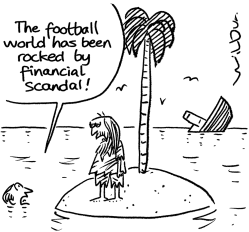
Three years ago, after City had won that treble, I wrote my hero a letter. ‘I have drifted away from the club,’ I told him, ‘but I’m grateful to you for providing so many golden memories. For at least one person it’s still the club of Colin Bell, Francis Lee and Mike Summerbee, and it always will be.’
He replied in an unsteady hand, which suggested something was wrong. A week later Franny died, at the age of 79, after a battle with cancer. He’s still my hero, and I remain temperamentally a Blue. But modern cocky Manchest-oh has got the club it deserves, and Manchest-oh can keep it.
Sport, the great Hugh McIlvanney liked to say, should never be more than ‘a glorious distraction’. We have come a long way since then, but even in the squalid world of contemporary football there are standards to observe. Throw the book at ‘Citeh’. They deserve no mercy.
Happiness is a warm rifle
Earlier this week, I made my annual pilgrimage to the Cairngorms National Park to go deer stalking, an activity I was introduced to in the 1990s and quickly fell in love with. There are few better feelings than seeing a stag in your rifle’s telescopic sight, his antlers silhouetted against the skyline, having stalked the beast for several hours, much of it on your belly. It’s a challenging sport and not just because of the physical discomfort. Red deer can see, hear and smell you from thousands of yards away, so there’s no alternative but to sneak up on them downwind.
Some people will recoil at the thought of deriving pleasure from shooting such a majestic animal, but if they’re not killed by the ‘guests’, they’ll be shot by the professional stalkers employed by the estates or the park rangers. In 2020, the Deer Working Group, which was set up by the Scottish government, recommended that there should be a maximum of ten red deer per square kilometre over large areas of open range, and an estimated 200,000 are culled every year – more now that the SNP government has scrapped seasonal restrictions, making it possible to shoot stags all year round. Visitors like me account for a tiny fraction of the total, but it’s a storied tradition that has inspired some of Scotland’s finest paintings (see the Landseers in the National Gallery of Scotland in Edinburgh) and provides employment to an army of stalkers and gillies, with the trade being passed down from one generation to the next. The large sporting estates are also responsible for a lot of Highland tourism, sustaining thousands of small businesses.
But stalking is under siege and is gradually dying out. The principal cause is the lucrative carbon credit market, making it more profitable for landowners to embark on large peatland regeneration schemes at the expense of traditional Scottish sports. It’s particularly profitable because this ‘rewilding’ is paid for by the Scottish taxpayer, with Holyrood having committed £250 million to restoring 250,000 hectares of peatland by 2030. The landowners happily fill in the drainage ditches that, 60 years ago, they were paid to dig in the hope of improving the grazing. They sell the carbon credits each year to businesses that want to offset their emissions, and watch their land rise in value thanks to the carbon gold rush.
According to the stalker that took me out on Monday – a 65-year-old who was the fifth generation of his family to take it up – a neighbouring estate was sold recently for £19.5 million, triple what it’s worth as measured by how many deer and grouse are shot by paying guests each year, which used to be the way sporting estates were valued. Since the purchase, grouse shooting has been stopped altogether and stalking is being phased out, with the new owners aiming to keep the number of deer down to two per square kilometre. It’s safe to say he was unimpressed.
‘There are no teachers in the schools, no nurses in the hospitals,’ he said, ‘but the Scottish government can find £25 million a year to fill in some ditches that will have little or no effect.’ As we passed various pools of water, he scoffed at the idea that the uplands would benefit from being even wetter: ‘At the end of today we’ll be absolutely bloody soaking.’
It’s hard to dismiss the suspicion that the real motive is a hatred of the sports associated with the landed gentry
One argument conservationists make is that peatland regeneration will reduce the risk of wildfires, but that is disputed by those who make their living on the land. You now need a licence to carry out a controlled burn and NatureScot is parsimonious about granting them, not wanting the carbon to be released into the atmosphere. In addition, the declining number of grouse shoots means fewer gamekeepers, so fires are less likely to be nipped in the bud. My stalker pointed out that the largest fire in the Cairngorms this year was on land that had been ‘rewilded’ by the RSPB.
Given how threadbare the evidence is that these regeneration schemes will have any impact on climate change, it’s hard to dismiss the suspicion that the real motive of the SNP is a hatred of the sports associated with the landed gentry. Instead of just banning them, which would be difficult given their importance to the rural economy, they’ve filled the landowners’ mouths with gold. Alas, most of the large estates are only too happy to embrace the carbon cash giveaway.
My visit to the Cairngorms was bittersweet. As we returned to the lodge in a Hilux with a dead stag in the back, my sense of wellbeing was tempered by the knowledge that this may be the last stalk I’ll ever do. Like so much of what makes Britain such a civilised place to live, this fine tradition won’t be with us much longer.
The hunt for Britain’s wokest bar
Annalisa Quinn is an editor at the Boston Globe magazine, and through a mixture of good fortune, good journalism and good writing, she published the perfect story for our times last week.
On 31 August, a lesbian bar in western Massachusetts called Last Ditch posted on Instagram that ‘it is with love we inform our immuno-compromised disabled divas we will be opening Saturday nights as mask optional’. Previously, KN-95 face masks were the minimum level of protection required to attend the bar at all times.
The owners were swiftly accused of being eugenicists. One commentator said: ‘People like you kill disabled people in the name of your own leisure and convenience.’ Another wished the venue to be firebombed. Last Ditch attempted an apology. It wasn’t good enough, since they posted an Instagram card without alt-text for the visually impaired. Two of the three founders had left the business, one to enrol in clown school. The remaining founder, Jackie Matellian, began to cry under her mask in a meeting. Soe Noire, a black lesbian who goes by ‘he/him’ pronouns, said Matellian’s crying was ‘racist’, and demanded payment to keep going to ‘community meetings’.
What does a bar have to do with your identity? The answer, of course, is everything
Everyone found it funny, even on Bluesky. The Boston Globe got an extra thousand subscribers in the 24 hours after it posted the story. This was wokeness at its most defeated, its most exhausted. You don’t need to combat it with defunding, anger or debate. You just need to tip off a Boston Globe reporter.
But there was one sentiment going around that was plainly wrong. It was expressed in the Atlantic: ‘Reminder: this is a bar. You know, the place where you go to drink beer.’ But nowhere is just a bar. That argument says: what does a bar have to do with your identity? The answer, of course, is everything.
All pubs and all bars are left- or right-wing, woke or unwoke. That much is obvious. But where is this country’s Last Ditch?
There are two types of woke bars: evidence-based woke and vibes-based woke. At the Attic in Leeds, you’ll find a good example of the former. Clean Air Socials have run events there throughout the year, and have another one coming up this month. The entry criteria are thus: you need to wear a ‘high quality respirator (FFP2 or FFP3) at all times whilst indoors’, and show proof of a negative lateral flow test at the door. It’s also recommended you use a valve to drink through your mask. On these nights, there will be several HEPA purifiers in the venue, and a far-UVC lamp, which is meant to reduce how many viruses can be airborne in a room. There is clearly little wrong with running a dance night where the immunocompromised can party. But why is Covid the main virus mentioned?
Another example from Leeds: in June this year, a Queer Cinema for Palestine event at Wharf Chambers was ‘masks mandatory’. No FFP2 mask, no admission. A ‘Sickening Cabaret’ night at Watershed in Bristol in January had the same edict. Masks were encouraged at an Andro and Eve event at Crookes Social Club in Sheffield, but the club itself said it was ‘apolitical’ after it was slammed for letting Restore Britain host a meeting in August.
Intersectionality (remember that?) explains why pro-Palestine = mask up. The original argument about intersectional discrimination, made by Kimberlé Crenshaw in 1989, used an analogy of a motorway intersection to argue that different forms of prejudice can hit someone at the same time (to be hit by two cars at once would be unlucky, but it’s within the laws of physics, I guess).
But intersectional solidarity has often been elusive, and we saw that in the capital this summer, when Breathe Easy London, a ‘Covid–safe’ events group, accused the London Dyke March of harming the participants by not insisting on ‘dykes’ and their allies wearing masks outside. Trans people, Breathe Easy argued, have a 48 per cent long-Covid rate, and said that one marcher had been ‘permanently injured’. It concluded that London Dyke March was ‘personally responsible for disabling their attendees’.
You don’t really see the Breathe Easy folks in the pub. Wokeness isn’t generally found there, but it does survive in other venues. The Common Press in Shoreditch, a ‘queer bookshop’ I visited (they were out of decaf coffee, which I genuinely wanted), is probably the most famous. Nothing wrong with a gay bookshop, needless to say, but Priyamvada Gopal’s Insurgent Empire and Tariq Ali’s Winston Churchill: His Times, His Crimes are given as much promotion as anything to do with sexuality.
So the woke bookshop survives, but pubs are more impregnable. There are plenty of unwoke pubs across the country. Your favourite pub, I assume, isn’t particularly woke. Though there is such a thing as too unwoke. In March, ten people at the Chequers in Hornchurch got involved in a mass fight, where chairs were thrown and heads kicked. Staff, funnily enough, refused to give statements.
The Dog and Partridge in the suburbs of Birmingham was pretty unwoke too. It’s being considered for demolition after it closed in 2020, following a meat cleaver attack at a ‘family-friendly’ beach party. Perhaps not terribly woke either is a rumoured East End pub which claims there’s a private event on if a non-white person walks in.
Sipping my Guinness Zero in the Auld Shillelagh in Stoke Newington (never have I been more confident that somewhere would have that in the fridge), I reflected on the upsides of the British left. Yes, the aesthetics here were woke: plenty of mullets, caps and roll-up cigarettes. But this Irish pub in the middle of Diane Abbott’s constituency is still excellent.
Our divisions are class-based, not identity-based like America’s. Our left-wing pubs descend from old working-class traditions: miners’ pubs, Irish pubs and the like. America doesn’t have that, so it’s corporate identarian insanity like Last Ditch. In London, there were until fairly recently two main lesbian bars. One, La Camionera, doesn’t have any rainbow flags. The other, Goldie Saloon, has now closed, having ended its days as a dog-grooming business run by a straight man from Essex. What would the Last Ditch crowd make of that?
The Battle for Britain | 3 October 2026
Dear Mary: How can I flirt without flirting?
Q. If flirting is out of the question, is there another way to show someone you like them? My situation was a lunch at which a really attractive girl was on my right, but on her right was a man who obviously fancied her too. Because this man had shown interest in investing in my start up, I didn’t want to compete with him and wreck the chances of his coming on board. So I played it cool and she left without any idea I was interested in her. How could I have handled this better?
– Name and address withheld
A. When the other man had safely turned, you should have made up a fictional book title and asked the girl e.g. ‘Have you ever read “Bertha” by Deirdre Squill?’ Still wearing an unflirtatious expression, continue coldly, ‘It’s an obscure book, but the character of Bertha is fascinating – very much in the same way as you are. I happen to have a spare copy. Can I get your address from our host and I will put it in the post to you?’ Later send a card saying you are so sorry, the book seems to have disappeared, but would she like to meet for a drink?
Q. I feel you ought to do some kind of public service announcement regarding Save the Date alerts. I am 28 and, in the course of planning my own nuptials, I have found that older generations don’t realise that Save the Date is now an invite. In the past they marked the date down with a pencil in their diary and waited for the invite without RSPV-ing. But now, if you can come, you respond by sending your postal address so the proper invitation can be sent. My generation, of course, don’t have our friends’ land addresses. You have to give them the date months, if not a year, in advance, as people get so booked up.
– O.E., London SE5
A. Thank you for drawing this to readers’ attention. Traditional wedding invitations would have gone out no earlier than 12 weeks beforehand. Today, due to friend inflation and the death of spontaneity, bridal couples are forced to seek acceptances much further in advance.
Q. Some friends who come shooting ask us to dinner but it’s always just us and one other couple, the de Koonings (fake name). We think they always ask the de Koonings with us because they don’t know many other ‘smart’ people. We don’t want the de Koonings. We would much rather it was just the four of us. How can we achieve this?
– Name and address withheld
A. One of you should confide that you have taken on ‘what’s called a side hustle. But I’m not allowed to talk about it yet. The only problem is that, tragically, it means we won’t be able to have dinner with the de Koonings as that could infringe the non-compete rules I’ve signed up to.’
The heroes who saved the flydubai flight from disaster
This morning a flydubai flight from Dubai to Tel Aviv appears to have been hijacked by its own co-pilot. It ended with the plane on the ground in Tabuk, Saudi Arabia, and all 174 passengers alive, among them 27 children and many Israelis. Very little has been officially confirmed. But what we do know points to a potentially massive disaster that was averted, thanks to the bravery of Israeli passengers and members of the crew.
Flight FZ1073, a Boeing 737, left Dubai just after 7 a.m. local time this morning, heading for Ben Gurion Airport. It’s one of the everyday routes that have linked Israel and the Gulf in recent years.
By an extraordinary piece of luck, an alternate crew was on board
About two hours into the flight, while cruising at around 34,000 feet over northwestern Saudi Arabia, the plane suddenly dropped about 17,000 feet. Its altitude and speed kept changing before it settled at around 15,000 feet. The plane’s transponder first broadcast 7700, the general emergency code. Then, briefly, it switched to 7500, the international code for unlawful interference, which in plain terms means a hijacking. It went back to 7700 before landing. That brief 7500 signal was enough to set off an Israeli military response. The Israeli Air Force scrambled fighter jets, and Prime Minister Benjamin Netanyahu held urgent consultations with the Defence Minister Israel Katz.
At that stage even Israeli officials didn’t know what they were dealing with. A security official told the news outlet Ynet there was no definitive information about a hijacking and that they couldn’t make contact with the pilot.
The picture that has emerged since then comes mainly from people on board. Passengers say they heard screams coming from the cockpit. According to their accounts, passengers then forced the cockpit door open and found the Emirati captain stabbed with a knife, allegedly by his co-pilot. Israeli passengers and crew members subdued the attacker and helped save the captain’s life. One passenger told Channel 12 the plane began diving fast after the pilot was wounded. A video filmed on board afterwards, which I shared this morning on X, shows the stabbed pilot. It is graphic. One of the men on board has also recorded his own account of those moments, and it’s worth watching in full.
With one pilot wounded and the other restrained, someone still had to fly the plane. By an extraordinary piece of luck, an alternate crew was on board, being flown to a later assignment. Channel 12 reported that these off-duty pilots, in plain clothes, played a crucial part. They are reported to have taken over the controls and flown the aircraft to safety.
It’s still officially unconfirmed who attacked the captain and why. Reports so far point to the co-pilot. A senior Israeli official told Channel 12 there were ‘growing indications’ that the co-pilot tried to take over the plane in order to crash it, in what would have been a suicide attack with 174 people on board. Unofficial reports say the co-pilot is Omani and the captain who stopped him is from the UAE. None of this has been confirmed by the UAE, Saudi Arabia, Oman, or flydubai.
The plane was diverted to Tabuk and landed safely. In a short statement, flydubai confirmed that all passengers were safe and accounted for. The airline said it was cooperating with the authorities and would give more information later. Reports say Saudi authorities are now questioning the suspect.
Only days ago Netanyahu was in the UAE. According to the Italian newspaper Il Foglio, during that visit he secretly met Saddam Haftar in Abu Dhabi. Haftar is the son and deputy of eastern Libya’s commander Khalifa Haftar. Senior officials from other Arab states that have no formal ties with Israel are also believed to have met Netanyahu that day, in meetings arranged by the Emiratis, now one of Israel’s closest partners in the region. Neither government has confirmed any of these meetings. But they show how much has quietly changed. Today’s flight connected two of those partners, it came down in a third country, Saudi Arabia, and Riyadh then allowed an Israeli plane in to bring the passengers home.
If the early indications are right, this morning a pilot tried to turn a passenger jet into a weapon on a route that stands for that new relationship. He was stopped by ordinary passengers who ran toward the danger instead of away from it, and by a crew who happened to be in the right place at the right time. We came very close to a very different headline today.
From Crotch Crescent to Wetwang – Britain’s ‘rude’ place names are anything but
Would you blush to admit you lived in Crotch Crescent in Oxford? Once again, newspaper stories have sprouted about rude-sounding place-names. It all seems rather artificial.
What happens is that a company seeking publicity (this time a financial products outfit) finds a list of place-names that could be taken as rude. They get a survey company to show the list to innocent bystanders, who say which they find rudest. Newspapers obligingly publish the graded list as though it were news: Fanny Avenue, Crotch Crescent, Titty Hill, Wetwang, Shitterton… down to Jackass Avenue and Great Snoring. (Are those two even rude?)
In truth, Crotch Crescent is named after a child prodigy and composer, William Crotch (1775-1847). He had a terrible time as a child being led about like some musical bear. Then at 21 he was appointed Professor of Music at Oxford, a post he held until his death.
I’d assumed that Crotch was connected in origin with cross; a street in the City of London is called Crutched Friars, after an order with a cross on their habit. But crotch is of unknown origin according to the OED.
If crotch is irresistibly funny only to Finbarr Saunders in Viz comic, what of Wetwang? To my surprise its meaning is given as ‘field of summons for the trial of a dispute’ (from Old Norse vetvangr) by Victor Watts in the Cambridge Dictionary of English Place-Names. The –wang is definitely ‘field’, though the OED lists the word under wong (in which form it appears in Beowulf).
But Tolkien, who knew of such matters, uses Wetwang as the English equivalent of the Sindarin (elvish) Nindalf, where nin– means ‘wet’. The Yorkshire village of Wetwang has a pond and is distinguished from Driffield nearby, which is the ‘dry field’ – though again Watts gives a different derivation, from drit (‘dirt’).
My husband has just told me that I’ve spoilt the joke, but I’m not sure there was much of one in the first place.