-
AAPL
213.43 (+0.29%)
-
BARC-LN
1205.7 (-1.46%)
-
NKE
94.05 (+0.39%)
-
CVX
152.67 (-1.00%)
-
CRM
230.27 (-2.34%)
-
INTC
30.5 (-0.87%)
-
DIS
100.16 (-0.67%)
-
DOW
55.79 (-0.82%)
SNP rule has been disastrous for Scotland’s schools
This week was supposed to be Humza Yousaf’s big relaunch for the SNP. His speech on Tuesday was designed to show how he was combining his adopted role as the ‘son of Sturgeon’ with his ability to be his own man. Alas, it was not to be: the arrest of SNP treasurer Colin Beattie completely and utterly derailed the new First Minister’s best-laid plans.
Yousaf had wanted to show he recognised that the relationship between the Scottish government and the business community had fallen into a ditch, to make clear it needed a ‘reset’. His willingness to compromise came in his announcement that the deposit return scheme would be delayed, and plans to ban alcohol advertising would return to the ‘drawing board’. This can’t have been easy: Yousaf’s talk of ‘A New Deal for Scottish Business’ will have ruffled more than a few Green feathers. And though he was demonstrating that he could process and respond to criticisms that had been levelled at him for not espousing such sentiment during the leadership contest, no one outside of the Holyrood bubble was listening. Beattie’s arrest stole Yousaf’s TV top slots and front pages.
Scottish state schooling has become allergic to excellence
But the First Minister will get another go at the business reset. More important to focus on then is the movement seen in Scotland’s education policy. This week, Yousaf announced that Scotland would rejoin the Trends in International Mathematics and Science Study (TIMSS) and the Progress in International Reading Literacy Study (PIRLS), the leading international comparators of how education systems are performing. These studies are the only way for countries to benchmark themselves against one another, to avoid the confirmation bias politicians often succumb to as they tell themselves they are doing a wonderful job.
But nearly 15 years ago, Scotland withdrew from these studies. Opponents both in the political arena and in education suggested that the government didn’t like the answers, and therefore stopped asking the questions. Since then, in truth we know very little about how Scotland’s children are faring amongst their global peers. We rely on the anecdotal, school-by-school evidence of teachers and parents.
My own experience as a parent adds ballast to the well-expressed fears of many independent education experts. Scottish state schooling has become allergic to excellence and instead obsessed with mediocrity and uniformity. The blame for what appears to be a rapid decline lies at the door of an exceptionally well-meaning aim to close the poverty-related attainment gap. Human nature has kicked in, and with no discernible evidence that those children in the poorest schools, with the poorest attainment, are improving, it is as inevitable as night following day that those with targets to meet will close the attainment gap from the other end of the spectrum. If you can’t lift up the bottom, squash down the top.
Prevent kids from moving onto the next textbook until all their classmates have finished the previous one. Seen it. Make kids take a book to school so they have something to do while their classmates finish their work. Seen it. It doesn't help the kids who are struggling, and it doesn't help the kids who are excelling.
Scotland has an educational and intellectual history to rival any country in the world, with a rich history of medical discovery, inventions and of course the Enlightenment. It cannot be allowed to flounder as a result of tick-box processes and unhelpful targets. The Scottish government needs to get rid of this attainment gap goal and devise a new system that ensures all children can excel.
How useful is a Twitter blue tick?
Alex Salmond was one of the first to fall victim to Twitter’s blue tick cull. An account with the same name as his began sending out disparaging tweets about his sub-optimal bowel movements. The account was tweeting shortly after Elon Musk removed 400,000 ‘legacy verified’ blue ticks, little badges that sit next to a user’s name, which were originally designed to stop impersonation.
Musk’s removal of the verified ticks – previously given to celebs, politicians and journalists to prove they are who they said they are – makes way for a free market approach to verification. Any tweeter can now pay £9.60 a month for the blue tick (provided their email address has been verified). As well as profile clout, they get access to extra features such as the ability to edit tweets, have an NFT as your profile picture and be prominently shown in the ‘For you’ feed that almost nobody uses.
Some journalists were outraged by the loss of their verified status
Some journalists were outraged by the loss of their verified status. One BBC journalist called the decision ‘dangerous’. Hysterics aside, how useful were blue ticks in the first place? One study from 2019 found that having a blue tick badge had no influence over whether the account was trusted. Instead, the researchers said, the anonymity of a user was more likely to result in negative perceptions of the page. Twitter users are already good at spotting the real and the fake accounts without a verification system in place at all. The same study found around 40 per cent of users don’t even notice if an account has a blue tick or not anyway.
This is perhaps why journalists and media organisations aren’t all rushing to get Twitter blue. One researcher has estimated that just 5 per cent of those with ‘legacy’ ticks have bothered to sign up for the new paid-for verification system.
That said, last month Twitter published its recommendation algorithm – the computing code that helps decide what tweets you’re more likely to engage with and what content to show you first. It suggests there may be engagement value in subscribing to Twitter Blue. Arvind Narayanan, professor of Computer Science at Princeton University, looked at the code and found it gives a 2 to 4x boost in the ‘ranking formula’ (though that doesn’t directly translate to the same increase in reach).
Many users are happy about the end of exclusive verification. Twitter first launched badges in 2009, in part because it had been sued by a retired American baseball player after an account pretending to be him was used to make fun of players in the team he managed. The power of the blue ticks grew from then on until the unverified were given light relief in 2020 when verified users were temporarily banned from tweeting as the company tried to clean up a Bitcoin hacking scam. They, along with Elon, hope Twitter will become a more ‘democratic’ place under the new paid-for order.
It’s likely that Musk will make the engagement benefits even greater to encourage people to subscribe. Already the new blue ticked accounts appear further up in my feed. But it’s not the only option for those reluctant to pay up. There are two other kinds of verification marks Twitter is dishing out: grey for government organisations and gold for large companies. The top 100,000 accounts get to keep theirs for free too. They can then pay an extra monthly fee to grant verification to their staff.
The truth is that Musk is in a bit of a hole. Not one that will cause him any real financial difficulty, but he doesn’t want to run the company he bought for £35 billion at a loss forever. So, he has to do what he can to increase revenue streams on the platform. But he’s having fun too. The author Stephen King had made a point of saying he’d never pay for Twitter Blue so Elon decided to buy it for him: when the blue ticks vanished from the platform, those who had already bought Blue were exposed, with King looking like he was among them.
The clout of the tick has moved to the Musk fans and the hardcore tweeters – those happy to pay the monthly fee for a service they spend hours on. The platform’s power users are no longer the Pestons, Kuenssberg and Morgans. They’re now those users with a string of numbers, Union Jacks or EU flag emoji in their usernames. The anons have inherited the earth.
Here comes Hunter
So far in his presidency, Joe Biden has largely been able contain the political fallout of the misdeeds of his son Hunter. He has been helped by a pliant press that, with some honorable exceptions, is reluctant to do anything so indecent as reporting on the president’s family. But another crucial factor has been a Justice Department investigation that has progressed at a snail’s pace.
That ongoing investigation into possible tax evasion and a firearms offense, launched more than five years ago, has left Hunter in a holding pattern that suits his father: the White House has been able to bat away questions about whether Hunter had done anything illegal.
That stalemate is now over. Not because the Justice Department has made a decision on whether or not to indict Hunter, but because a senior IRS agent overseeing the agency’s portion of “an ongoing and sensitive case” is asking Congress for whistleblower protections in order to disclose “examples of preferential treatment and politics improperly infecting decisions and protocols that would normally be followed by career law enforcement professionals in similar circumstances if the subject were not politically connected.”
Republicans on the Hill have specified that the case in question is Hunter’s. The letter from the whistleblower’s lawyer, Mark Lytle, claims he has evidence that contradicts “sworn testimony to Congress by a senior political appointee.” The New York Post reports that the senior appointee in question is Attorney General Merrick Garland. Last month, Garland said in an oversight hearing that David Weiss, the Trump-appointed prosecutor in Delaware who is leading the investigation, had independence to pursue charges against Hunter.
The bombshell letter threatens to transform the White House’s Hunter headache from an annoyance to a far bigger problem. Republican lawmakers are understandably very eager to know more, while their Democratic counterparts will struggle to dismiss a whistleblower who appears to have pursued all the proper channels to air his concerns.
Disclosing taxpayer information is illegal, but the whistleblower is seeking to make use of special provisions that allow for disclosure to certain congressional committees if it relates to possible misconduct.
This year, with Republicans in control of the House of Representatives and with Hunter in their crosshairs, the president’s son has been on the offensive, hiring new lawyers and suing John Paul Mac Isaac, the beret-wearing owner of the Delaware laptop repair shop where Hunter dropped off, then never collected, his laptop and external hard drive back in 2019. (We know what happened next.) Meanwhile, congressional inquiries into the Biden family’s finances are underway.
Add this whistleblower into the mix and you have a very combustible situation indeed.
On our radar
IS SU SUNK? Biden labor secretary nominee Julie Su underwent a Republican grilling in her confirmation hearing yesterday. But Su will be more worried about whether she has the support of Democratic senators. Right now, West Virginia’s Joe Manchin, Arizona’s Mark Kelly and Kyrsten Sinema and Montana’s Jon Tester haven’t made their minds up.
FLORIDA FALL GUY Think you’ve had a bad week? It probably wasn’t as bad as Ryan Tyson’s. Puck’s Tara Palmeri identifies Tyson as the Ron DeSantis consigliere charged with swinging the Florida delegation behind the governor before his trip to Washington. How did that work out, Ryan?
ELDER STATESMAN? Conservative talk radio fixture and 2021 California gubernatorial candidate Larry Elder announced he is running for president Thursday. “We can enter a new American Golden Age, but we must choose a leader who can bring us there. That’s why I’m running for president,” he tweeted.
*** Sign up to receive the DC Diary in your inbox here ***
Mood inside Fox ‘ebullient’ after Dominion settlement
This week’s biggest surprise was Tuesday’s last-ditch $787 million settlement of the Dominion v. Fox News lawsuit. Despite the eye-watering payout, Fox sources tell Cockburn that the mood internally at the network was “ebullient.” This is perhaps unsurprising, given how Fox’s foes were slavering at the prospect of Rupert Murdoch, Tucker Carlson, Sean Hannity et al being hauled before the court.
Also Cockburn understands that Fox will only end up shelling out around half of the settlement fee, due to insurance liability coverage. Plus, the payout is tax deductible: what a bargain! Cockburn guesses we’ll have to wait for the next trial of the century…
–Cockburn
This item is taken from Cockburn’s new newsletter, a round-up of mischief, mayhem and Washington gossip delivered to your inbox every Friday. Sign up here.
Meet the Democrat threatening a journalist with jail
When Twitter Files journalist Matt Taibbi testified before Congress last month, he was given a very frosty reception by Democrats on the House Weaponization subcommittee. But if exchanges on the day weren’t bad-blooded enough, Congresswoman Stacey Plaskett has sent a letter to Taibbi warning that providing false information to Congress is “punishable by up to five years imprisonment.” The letter follows a visit to Taibbi’s New Jersey home that coincided with his trip to Washington. Taibbi explains the farcical saga here.
–OW
From the site
Kevin Dahlgren, Why ‘harm reduction’ is no match for fentanyl
Spectator Editorial, Make tech great again
Bridget Phetasy, A lament for the Los Angeles we lost — and why I’m off
Poll watch
PRESIDENT BIDEN JOB APPROVAL
Approve 42.7% | Disapprove 53.5% | Net Approval -10.8
(RCP average)
GOP 2024 PRESIDENTIAL PRIMARY
Donald Trump 48% | Ron DeSantis 24% | Nikki Haley 5% | Tim Scott 3%
(WSJ)
Best of the rest
Matthew Continetti, Washington Free Beacon: The paradoxes of post-Roe abortion politics
John B. Judis, the Liberal Patriot: Florida man turns state from purple to deep red
Walter Russell Mead, Tablet: American crisis
Ben Smith, Semafor: The end of the BuzzFeed era of news
Nancy Scola, Politico: Washington’s angriest progressive is winning over conservatives
Conor Friedersdorf, the Atlantic: Gavin Newsom is not governing
Sign up to receive the DC Diary here.
Newsnight stoops to a new low in its climate protest coverage
Has the BBC been invaded by a cabal of Extinction Rebellion protesters who have tied up the Director General in his swivel chair? I ask because of a remarkable interview on Newsnight which marks a new low in the objectivity of the BBC’s climate coverage.
The flagship BBC Two news programme last night covered the threatened disruption of the London Marathon by Just Stop Oil protesters. Given that activists from another organisation did indeed carry out leaked plans to disrupt the Grand National – which delayed the start of the race – it is a threat to be taken very seriously. It was entirely proper that the subject be covered, and that the programme highlight an apparent split between climate protest groups; Extinction Rebellion has pledged not to disrupt the event, while Just Stop Oil has so far refused to make any such assurances.
However, what followed was an extraordinary one-sided item. Newsnight’s presenter, Victoria Derbyshire, proceeded to hold a three-way discussion between herself, a Just Stop Oil activist, Indigo Rumbelow, and, er, Rupert Read, formerly of Extinction Rebellion. Read now leads an embryonic organisation called the Climate Majority Project, whose web page suggests it has a strikingly similar outlook to Extinction Rebellion.
Newsnight has often been caught out for biased coverage
There were obvious questions to ask Rumbelow: namely, who do you think you are, thinking you have the right to ruin a sporting event that is enjoyed by millions, either as participants or spectators? And why target a running event, which is surely all about doing something of which you ought to approve: getting about on foot?
There were questions to be asked of Extinction Rebellion, too – given that it has offered to ‘police’ the event. Are climate pressure groups now operating as a kind of protection racket, to which we are also supposed to go and negotiate before we are allowed to go about our day-to-day business?
None of these questions got asked. Rather, Newsnight first ran a short video in which it asserted that ‘violence’ was being shown towards climate protesters; it illustrated this partly with a police officer doing his job and arresting a member of a mob vandalising a building with red paint.
Rumbelow was then introduced. She asserted that ‘we need to move into civil resistance against our criminal government which is pushing for new oil and gas’. Derbyshire failed to challenge this remark and ask the obvious: what criminal law is the government supposed to have broken?
Rumbelow also went on to assert that juries were refusing to convict climate protesters. This may have happened in a few cases, but there are plenty of climate activists who have been found guilty.
Derbyshire did read out a government statement explaining why it was issuing new oil and gas licences. She also challenged the views of Rumbelow and Read in places. But there was no-one there to represent the opinions of many, many people in Britain, who think Just Stop Oil and its like are a bunch of entitled, spoilt kids who are making totally impractical demands – and who are making exaggerated claims about the climate in the process.
Instead, the interview cut to Read, who claimed that it is ‘absolutely clear now that…we must stop having new oil, new coal etc if we are going to have any chance of…any kind of liveable future’. Could he justify that claim with a few facts? He wasn’t even asked.
Newsnight, as so many BBC programmes are apt to do, simply presented the hysterical claims of climate protesters as if they were scientific truth and the views of Extinction Rebellion, Just Stop Oil as if they represented the full breadth of public opinion in Britain.
Newsnight has often been caught out for biased coverage, such as the monologue by Emily Maitlis (who no longer works for the programme) in 2020 declaring Dominic Cummings guilty of breaking lockdown rules. But Thursday’s item on climate protesters was so brazenly one-sided that you wonder whether the programme is any longer even trying to fulfil its duty to provide balance.
Not Zero: How an Irrational Target Will Impoverish You, Help China (and Won’t Even Help the Planet) by Ross Clark is published by Forum Press
Sunak opts for loyalty first in reshuffle
What does Rishi Sunak’s mini-reshuffle reveal? When Nadhim Zahawi was sacked as party chairman, the Prime Minister took his time in deciding who would succeed him – eventually appointing Greg Hands. This time around Sunak has moved quickly in the wake of the report into bullying allegations that led to Dominic Raab’s resignation. Sunak hopes to move the news agenda on with a string of ministerial appointments.
As James Heale reports on Coffee House, Alex Chalk – a one nation Tory who backed Sunak in the leadership contest – is the new Justice Secretary. On top of this, Oliver Dowden takes on Raab’s deputy prime minister brief – while keeping his current role in the Cabinet Office. This is an unsurprising appointment, with Dowden one of Sunak’s closest political allies. He is already a regular face in meetings at No. 10 and had been tipped to be Sunak’s Chancellor had the Prime Minister not inherited Jeremy Hunt as a result of the demise of Liz Truss’s premiership. Over the summer, Dowden played an instrumental role in Sunak’s unsuccessful leadership campaign. Dowden also resigned as party chairman near the end of Boris Johnson’s premiership following disappointing local election results.
With the Secretary of State for the new science department Michelle Donelan going on maternity leave, former work and pensions secretary Chloe Smith has been appointed as her maternity cover. This is an interesting appointment as Smith has already signalled she plans to step down at the next election. John Whittingdale – the former culture secretary – will cover for Julia Lopez on maternity leave as a minister of state for both DCMS and the science department.
As often tends to be the case, the various briefings about a potential reshuffle were more exciting than the reshuffle itself. The Prime Minister will likely be criticised for failing to appoint a woman to either position. Sunak has taken a safety first approach with these appointments. The two key appointments – Dowden and Chalk – are Sunak loyalists who are regarded as safe pairs of hands. The hope will be that both men are sufficiently scandal-proof to avoid a repeat of what sparked the reshuffle in the first place.
Sunak names Alex Chalk as Justice Secretary
One man’s loss is another’s gain. Rishi Sunak has acted swiftly to fill the gap left by Dominic Raab’s resignation, appointing 46-year old barrister Alex Chalk as his new Justice Secretary. Like Sunak, he is a Wykehamist who quit Boris Johnson’s cabinet back in July, citing the Paterson, Partygate and Pincher scandals. The appointment flies in the face of reports which suggested that Sunak would appoint a woman to the post, with men occupying three times as many cabinet posts as women.
Awaiting Chalk is an in-tray full of problems. He is the tenth Lord Chancellor in eleven years and inherits a ministry widely regarded as a troubled department, even by Whitehall standards. He will have to deal with a lengthy courts backlog, overcrowded prisons, parole reform and widespread discontent in the legal profession. Labour have sought to make political capital out of the woeful rate of rape prosecutions while Chalk will also have to decide if he wants to keep Raab’s pet project of a British Bill of Rights, at a time when some Tory backbenchers are urging the UK to leave the ECHR. He has some useful relevant experience – with previous posts in the MoJ and the Solicitor-General brief – but has never previously held a cabinet post in his eight years in parliament.
Chalk shares two striking similarities with the man he replaces. The first is, like Raab, he occupies an ultra-marginal seat in the south of England which is currently under threat from the Liberal Democrats. Chalk held onto his Cheltenham seat by just 981 votes last time – the 24th most marginal seat at the 2019 election. The second similarity is Chalk’s loyalty to Sunak, backing him in both contests last year and praising his ‘brains, integrity, stamina, and judgment.’
Sunak was judged to be the best candidate by the bulk of Gloucestershire MPs in last summer’s election. Some of his biggest supporters are found in so-called ‘Blue Wall’ seats in the south west and south east of the country, where Sunak is judged to have the greatest appeal. Today’s appointment can be read as one very much in Sunak’s own image and an attempt to show that loyalty and competence are rewarded in his administration.
BBC hires Corbynista political fact-checker
Can the BBC ever get it right? Just weeks after the Beeb was embroiled in an impartiality row over the rogue tweets of their star presenter Gary Lineker, another spat over bias has reared its ugly head. In September, the broadcaster hired a new political fact-checker, Oscar Bentley, to comb through political debates in the run up to the next general election. But the Daily Mail has now revealed that Bentley might not quite be the bastion of impartiality one would hope.
According to the Mail, he is a ‘lifelong Labour supporter’ who canvassed for disgraced former Labour leader Jeremy Corbyn at the last general election and has in the past regularly taken to bashing Tories on social media. Indeed, a choice selection of Bentley’s tweets supplied by the Daily Mail, found before his account was made private (much to Mr Steerpike’s disappointment), makes for enlightening reading.
It appears the former University of York student, who proudly proclaimed himself a ‘lefty student journo’ during his time there, has taken much joy over the years from mocking those who support the Conservative party. One tweet by Bentley from 2017 when Theresa May failed to get her Brexit deal through the House of Commons read: ‘Tory government just defeated in parliament, what an early Christmas present’. In another from 2019, Bentley warned his followers to ‘never trust a Tory’, while in a third from 2018 he said ‘There are vertebrates, invertebrates, and then there are Tory MPs.’
In case there was still any doubt about Bentley’s political leanings, on election night in 2019, he tweeted ‘Please win Jeremy Corbyn, I love you so much, be my Prime Minister, please.’ Pass the sick bag. In 2019, he also expressed ‘solidarity’ with Extinction Rebellion activists when they ‘occupied’ parts of central London, including Parliament Square and Oxford Circus, causing mass disruption across the city. Some of the BBC journalist’s tweets also, reportedly, date from after he was hired by the broadcaster, with one tweet from October 2022 quoting Keir Starmer when he said ‘We’re a government in waiting and they’re an opposition in waiting.’ Uh oh.
Unsurprisingly, these spiky tweets have had Tory MPs up in arms, with one accusing Bentley of having a ‘clear and obvious bias’. Former minister Jacob Rees-Mogg has also weighed in, asking ‘how can it be right’ for the broadcaster to have hired Bentley in light of this.
The BBC has defended their hire. Their spokesperson said, ‘Once people are BBC employees, they are bound by the BBC’s editorial rules of impartiality, but any opinions they’ve expressed before working for the BBC, in this case when they were at university, are completely irrelevant.’
Perhaps too little, too late, but might Mr S suggest that Bentley give his social media a spring clean before he puts himself up for any more jobs?
The social media era of news is over
On Thursday, BuzzFeed CEO Jonah Peretti announced that the company is shuttering its news division. Starting in 2012 under the editorship of Ben Smith (then of Politico, now running Semafor), BuzzFeed News never made a profit — but it did win lots of journalism awards and became a large part of the digital journalism ecosystem. More people than I can count worked there at some point in the last twelve years.
The writing had been on the wall for BF News for a while, but the speed with which its demise occurred is still sort of a shock to the system. Places don’t often just cease to exist. Rockets may experience “rapid unscheduled disassembly,” but newsrooms mostly don’t.
This post isn’t really about BuzzFeed, as I never worked there and have no deep insider knowledge about the goings on. But I do want to talk about this moment for publishers.
“It’s the end of the marriage between social media and news,” Smith told the Times.
That sounds right to me, and though it going to be hard for publishers, I find it difficult to say it’s a bad development for the world. It probably should have happened sooner, and I worry that it has now happened too late to be any good.
“This shutdown announcement for BuzzFeed News — a popular and Pulitzer-winning news organization — highlights the failings of the online information economy,” tweeted Kat Tenbarge. “People may *want* information that is newsworthy and accurate, but by design platforms don’t value it.
On the one hand, this tweet is true. Some people do want some of these nice things. And many people ambitiously say they want them though they themselves will, in the quiet solitude of their own kitchen, forswear the broccoli and indulge in the KitKat.
But on the other hand, that tweet misunderstands the relationship between social networks and news. That relationship is mostly not about giving people, in a meaningful sense, what they want. It’s about creating a false desire, getting people hooked on it, and then giving them the drugs they shoot up into their arms.
In terms of news, ‘social media’ means ‘Facebook’
First off let’s be clear about something: this is all about Facebook. Twitter and Instagram et al. are important in different ways but when we talk about the actual business plan of digital media companies that prospered a decade ago and then waned towards the turn of the decade, we are talking about the traffic funnel that came from Facebook. None of these other platforms provide meaningful traffic to anyone. (They can be monetized in different ways, but not advertising revenue derived from digital ads on the site.)
Facebook was a game-changer for journalism, not because it gave publishers a new medium to reach news consumers, but because it gave them a new medium to reach non-news consumers. The difference is important.
For as long as news has existed, there have been people who like to read it. They subscribe to newspapers, listen to NPR and buy general interest news magazines. This group of people likes news and is willing to seek it out. At no point in history has this number of people ever been enough to actually make news profitable for an extended period of time. That’s why newspapers also have “soft news” and advice columns and cartoons and movie listings; why magazines have interviews with celebrities and photos of beautiful women on the cover. That brought in enough other people to make publications sustainable and profitable for decades.
Then the internet disrupted everything and a lot of those people started to get that content in free-ways online, which caused a huge problem for publishers. These were the layoffs and contractions of the mid-Aughts. Many very smart people thought that was going to be the end of journalism as we knew it.
But around that time, Mark Zuckerberg started a social media network that allowed you to keep tabs on your friends from high school, and to see photos of your grandkids, and to contact the crush you met at a party. The audience for this project was very large. It succeeded on a scale unheard of to any sort of operation in the history of the world.
The people on that site liked to share their thoughts and their photos and what they were reading. Instead of forcing you to go to someone’s specific page to get the latest updates, Facebook unveiled the Newsfeed, which took all of these things and, with algorithmic sorting, put it in one place, which you could scroll endlessly.
The gift and curse of the Newsfeed
The Facebook Newsfeed was crack. You couldn’t stop scrolling. I like to think of it like an endlessly long highway with billboards advertising things at every exit. You can drive down it until a billboard really struck your fancy. Those billboards were based on an algorithm that sorted the activities of your friends and Pages that you indicated some affection for. It also would recommend some billboards that it thought you might like based on those other factors.
Most potential billboards — which is to say the updates of those pages and friends — are boring garbage that the algorithm doesn’t even bother to show you. But even of the posts that were engaging enough to make your feed, most of them you don’t click on. You don’t care. It’s a billboard for something you’re not interested in and you drive happily by. But some of them you do want, just because of basic necessity. They’re context-specific. Some are billboards for gas stations or restrooms — and when you need gas or to go to the bathroom, you are grateful for them. If this was all it was, that would be great. People getting what they want.
But what journalists like myself realized — and advertisers have known forever — was that giving people what they want when they want it is small potatoes.
Better than waiting for your organic wants and needs to, fortunately, match up with our content is convincing you that you want something you hadn’t thought about yet. Maybe it’s a tourist trap. Maybe you are actually interested in seeing the World’s Largest Cotton Ball, but no one had ever asked before. If you have time, might as well take it in. These are good billboards.
A great billboard is different still. A great billboard is so compelling that it gets you to change your plans. Some of these are obvious: it’s a casino. People love casinos! It’s Ozempic. People love weight loss!
You are not a monk, and eventually, you will click on one of these Facebook posts. You will take the exit and get off the highway. Facebook will then infer that you like posts like that and start showing more of them to you. You will end up “liking” Pages unthinkingly and then see more of their content and over and over again until you can’t get where you’re going because there are too many exits filtered and sorted to appeal to some part of you.
And once you “like” a page and start engaging with any of its content, you’re done. Churn is pretty low. You probably won’t unlike it.
You do not know how many things you click on. People are terrible at reporting their own smartphone usage and their own clicks.
So far, this is not really news-specific. This is just how the Newsfeed works. But for social media editors at publications, this was very important.
Imagine it’s the 1960s, and you aren’t someone who subscribes to the New York Times or any other paper. You pick up a copy at the newsstand when the headline above the fold is really a big deal. “JFK ASSASSINATED,” you buy. “APOLLO 13 SUFFERS CATASTROPHIC FAILURE,” you buy. But the other basic daily ones you ignore. The entire decision of purchasing that paper — and gaining access to pages and pages of other stories — really rests on the A1 section above the fold.
The other analogy here is a magazine cover. You buy it when it looks like it has something you really want. But you don’t subscribe.
Now say it’s 2014, and you drive down the Facebook billboard highway. There will be dozens of news stories a day, and none of them will be as important as “JFK shot” or “Apollo 13 saved,” but people will have put as much energy into optimizing the packaging of those posts as they used to for A1 newspaper headlines. There are many elves working to make each individual story grabby enough to get you to click.
And click you did! And click you do! And you don’t know why or how many times. People are famously bad at self-reporting their smartphone usage and their clicks .Facebook turned people who had never deliberately sought out the news before into news consumers.
You had become a news consumer. Millions of others had too. This may have been a thing that made journalists a little queasy but it also meant that suddenly people weren’t anticipating their imminent demise as much. Facebook had tricked non-news consumers into caring about the news and that newly inflated group meant that news could survive without classifieds.
The smart people in the room knew that this would not last forever. It couldn’t. No one knew when but eventually, Facebook would decide “x,” “y” or “z” and this would stop. So everyone talked about using Facebook as a funnel to drive audiences to become subscribers ideally. Some places succeeded at this, but other places failed completely.
Now, if you go back and look at this era, you will find that not all news publications benefited from this in the same way. Some categories of news were more likely to experience rapid growth from these audiences. Here’s why: the best billboards will make you take a detour even if you are driving your pregnant wife to the hospital. Those billboards are ones that play on your identity. Those billboards are political. And everyone turns off for them.
The Facebook era of news supercharged the culture war
The historian Barbra Tuchman described the Renaissance as when “the values of this world replaced those of the hereafter,” and you could say something similar about this era in which the values of the internet became paramount. If that sounds like an exaggeration to you, I agree, but also, look at Instagram. Better yet, go to any beautiful place in the world and watch people experience that beauty. They come to create the content that they share online.
The internet has become the smithy in which our identities are forged and the battlefield on which they are deployed. And if it is a battlefield — which it is — then it’s one of those World War One battlefields where trenches were dug and lives were churned for no discernible gain.
Take an ounce of societal pessimism, two squirts of internecine partisan warfare, a jigger of self-righteousness, shake it up, add two olives, and you get a culture war. A culture war is something that doesn’t matter unless you squint and have a drink.
The culture war is a pyramid scheme of emotion and grievance. At the top are media personalities and politicians with direct interests in it. Every following level decreases in participation until, at the bottom rung, you have people who are caught up and consumed in it but don’t have really any true agency in it. Think of someone who watches MSNBC all day, doesn’t work in politics and has a life completely unrelated to it. They gain nothing from caring about politics as much as they do. It stresses them out. It occupies their time. But it has no ends. They are not soldiers in the culture war so much as they are casualties of it.
But the internet allows people to climb one rung up the pyramid. You can post your opinion on Facebook or retweet your favorite news anchor. At this point, you become someone who, in some very small way, is actively participating. This is a good feeling! You have purpose! You are a part of something larger! There is a war raging, and your contribution is a little bullet you’re firing for your side. But now you bear a responsibility. You have decided that you are doing something meaningful, and if you stop doing it, something bad will happen.
So everyone got politicized and everyone became addicted to political news.
But addiction to the news makes people stronger partisans and the strongest partisans are the worst at describing the attributes of their political opponents. Highly engaged Republicans are worse at describing Democrats than low-engagement Republicans, and the same goes for Democrats — exposure to politics has warped their perceptions. What an utterly devastating indictment of our political culture and the news media! The media’s job is to convey the world, not to distort it.
I’m not talking about distorting in a malicious or intentional way, though that can happen to. But even in the innocent way, where it’s just a consequence of these dynamics, it’s still bad!
The carrot of this deal — the revenues from these outsized Facebook audiences — started to fall apart in the latter half of the decade. Some of that is directly related to changes Facebook made after 2016 when they were subject to so much criticism for the role they may have played in the election that they completely reworked how the Newsfeed handled news. But not all! People discovered that it wasn’t just their favored ideologically aligned news sources that were growing; it was also the ones they detest. An equal number on both sides was activated. And it’s exhausting. The pandemic then changed the economy completely and the era of loose money, which had made it possible for lots of startups to grow at an exponential rate, ended.
The curtain falls
In Peretti’s note about the shuttering of BuzzFeed News, he says he should have demanded profitability earlier. But news by itself has never been profitable and BF News was never profitable even at its height. It was merely losing only enough money that it could be subsidized by the other parts of BuzzFeed.
BuzzFeed is a public company now. It answers to Wall Street — and Wall Street is tired of letting companies lose money until the Revelation.
The end of the social media era of news is also the end of news organizations trying to grow like tech companies.
Now, if you had a time machine and could unplug Facebook in 2013, I think there is a good chance a lot of this would have been avoided. Not all of it! But some of it. But an entire generation of journalists now experiencing the collapse of their industry would have simply experienced it a decade sooner. The unfortunate reality is that now Facebook could shut its doors tomorrow or ban news entirely and it probably wouldn’t make a difference, because an entire universe of other companies and services and publishers has sprung up to satiate that addiction.
The social media era of news may be over — but the dysfunction it wrought is something we’re still going to have to deal with.
This article was originally published on Calm Down, Ben Dreyfuss’s Substack.
Rishi Sunak distances himself from Raab’s resignation
Rishi Sunak seems keen to stand back from the row about Dominic Raab, offering more of a commentary on it being ‘right’ that the deputy prime minister and Justice Secretary has quit government, rather than accepting that Raab was a bully. His reply to Raab’s resignation letter suggests this, and this afternoon his official spokesman said the Prime Minister thought it was ‘right’ to make the commitment to resign if there was a finding of bullying and that the former Secretary of State had ‘kept his word’. ‘He thanks him for his work and it has allowed him to form a judgement and he will now be focused on the work of government,’ the spokesman said.
The timeline of what happened between Adam Tolley KC’s report arriving and Raab quitting is as follows: the Prime Minister received the report yesterday morning, then spoke to Tolley and his independent adviser to answer a number of questions about the report. He then spoke to Raab this morning, before Raab announced his resignation. Number 10 sources have emphasised to me that the Prime Minister did not ask Raab to quit.
The main takeaway from the report for Sunak seems to be about the processes around problems between ministers and civil servants, rather than anything about Raab himself. He has asked the Cabinet Office to look at how the government can better handle some of the issues the report has raised around concerns about working practices, and how they are dealt with, the spokesman said.
As for the report itself, it is not constantly excoriating about Raab. But it does say that he:
Acted in a way which was intimidating, in the sense of unreasonably and persistently aggressive conduct in the context of a work meeting. It also involved an abuse or misuse of power in a way that undermines or humiliates. He introduced an unwarranted punitive element. His conduct was experienced as undermining or humiliating by the affected individual, which was inevitable. It is to be inferred that the DPM was aware that this would be the effect of his conduct; at the very least, he should have been aware.
The second finding that goes against Raab is that he engaged in a ‘form of intimidating behaviour towards an individual by referring to the Civil Service Code in a way which could reasonably have been understood as suggesting that those involved had acted in breach’.
It does also undermine his previous claims that no issues had been raised with him about his behaviour. Tolley says:
Overall, I conclude that the DPM’s conduct during the MoJ period was on some occasions “abrasive”, in the sense of a personal style which is and feels intimidating or insulting to the individual but is not intended to be so. His conduct was not, however, “abusive”, in the sense of behaviour which is intended and specifically targeted. He has been able to regulate this level of “abrasiveness” since the announcement of the investigation. The DPM should have altered his approach earlier, and in particular after certain concerns had been flagged by Sir Philip Barton and Antonia Romeo.
Tolley examined the contradiction between Raab and Romeo’s accounts, and said that the permanent secretary at the Ministry of Justice had ‘produced notes of these conversations, which I was satisfied were derived from her contemporaneous records.’
Sunak will likely announce a new Justice Secretary later today, with the department widely considered a basket case in Whitehall – a sign that perhaps Raab’s management style wasn’t even particularly effective. The civil service world is trying to push back against claims that the allegations in the report just weren’t that serious – suggestions which are being made by a number of Tory MPs and Raab himself, who has warned it sets a ‘dangerous precedent’ for the way ministers and civil servants work together. Sunak, though, doesn’t seem to see the need to push back against the suggestion that all this has happened with him watching, rather than leading.
Is Dominic Raab really a ‘bully’?
Who is the real victim in the Dominic Raab bullying saga? I know the story is that he was a monster in his various departments, allegedly barking instructions and wagging a finger at his stressed-out minions. But the anti-Raab revolt smacks far more of bullying to me. Civil servants clubbing together to drum an exacting minister out of his job? It definitely has a whiff of Mean Girls to it.
Raab has resigned as deputy prime minister following the findings of an investigation into his alleged bullying. In his resignation letter he says the investigation dismissed all but two of the accusations against him. The findings are ‘flawed’, he says. They potentially set a ‘dangerous precedent’. If ministers are not able to give ‘direct critical feedback’ – a euphemism for stern criticism, perhaps – they won’t be able to do their jobs properly, he said.
He has a point. None of us knows for sure what went on under Raab’s rule first in the Foreign Office and later in the justice department. It is entirely possible he sometimes crossed the line from ‘direct critical feedback’ into Malcom Tucker territory. And yet as he points out in his resignation letter, Adam Tolley, the barrister who carried out the bullying investigation, did not find any instances of him shouting or swearing or physically intimidating staff.
I can see how this might make for a tense workplace, but bullying?
What is he accused of, then? One former civil servant said he could be ‘rude and aggressive’. He would ‘raise his voice’. And sometimes he engaged in ‘hard staring’ – he’d look at people with ‘cold fury’. He always expected people to turn up to meetings ‘very, very quickly’. And he expected them to ‘have the answers to all his questions’. Tolley’s investigation found Raab would sometimes bang loudly on the table and use hand gestures to indicate that ‘a person should hold off from speaking’.
Is this serious? I can see how this might make for a tense workplace, but bullying? Expecting staff to be punctual and to have the information you need to do your job is not bullying – it’s work. Raab is surely right that ‘setting the threshold for bullying so low’ – so that even looking at people ‘coldly’ or waving your hand at them is redefined as tyrannical behaviour – will make it harder for ministers to enact change and get things done.
The Guardian spoke to officials who said civil servants in Raab’s departments often felt ‘physically sick’ before meetings. That’s bad, of course. No one should feel like that at work. But what is the real problem here: Raab’s behaviour, or a new generation of mandarins who seem too fragile for the rough and tumble of political life? There have always been ministers who are severe and demanding. What’s changed, it seems to me, is the level of resilience among civil servants. It seems to have plummeted.
Surely the problem in Whitehall is less a culture of bullying than a culture of fragility. Government departments are necessarily high-pressure workplaces. They’re responsible for very serious matters indeed. Matters of life and death in the case of the Foreign Office. If ministers cannot enforce high standards and a rigorous pace for fear that some civil servants will feel wounded and offended, then we have a serious problem on our hands.
I’m worried that accusations of bullying are being used to push out ministers that the civil-servant blob disapproves of. Remember when Priti Patel was likewise accused of bullying during her time in the Home Office? Apparently she had a habit of storming out of her office and asking: ‘Why is everyone so fucking useless’. That’s not bullying. It’s a good question. Many Brits will be wondering the same about our often sclerotic civil service.
Boris Johnson stood by Patel. Raab had no such luck – he appears to have caught wind of Rishi Sunak’s plan to sack him and decided to beat him to the pass by resigning instead. He has been demonised as a tyrant, his name has been sullied, and he’s been forced out of his job for daring to have high expectations of his workforce. Sounds like bullying to me.
Mood inside Fox ‘ebullient’ after Dominion settlement
Mood inside Fox ‘ebullient’ after Dominion settlement
This week’s biggest surprise was Tuesday’s last-ditch $787 million settlement of the Dominion v. Fox News lawsuit. Despite the eye-watering payout, Fox sources tell Cockburn that the mood internally at the network was “ebullient.” This is perhaps unsurprising, given how Fox’s foes were slavering at the prospect of Rupert Murdoch, Tucker Carlson, Sean Hannity et al being hauled before the court.
Also Cockburn understands that Fox will only end up shelling out around half of the settlement fee, due to insurance liability coverage. Plus, the payout is tax deductible: what a bargain! Cockburn guesses we’ll have to wait for the next trial of the century…
Bertrand’s big day
Congratulations to CNN’s Natasha Bertrand, who, per her old employer Politico’s Playbook newsletter “got engaged on Thursday in Bellport, New York” to a software engineer. The engagement capped off a big day for Bertrand: earlier, former CIA deputy director Michael Morell told the House Judiciary Committee of how, following discussions with Biden campaign advisor Antony Blinken, he “organized a group of fifty former intelligence officials” to sign a letter saying that the Hunter Biden laptop leaks bore the hallmarks of “Russian disinformation.” This letter was given as an exclusive to… Politico’s Natasha Bertrand.
Cockburn has some questions about the engagement. Did Bertrand’s fiancé plan for Thursday in advance and find himself upstaged by Morell? Did the Biden administration feed the idea for the proposal to the fiancé? Anyway, all the best to the happy couple!
*** Sign up to receive Cockburn’s Friday gossip in your inbox here ***
Boots on the ground
Fashion news now. Trump attack dog Alex Bruesewitz has fixated on Ron DeSantis’s feet for some time, going after the Florida governor for his choice of boots. Cockburn can reveal DeSantis’s favorite brand: Lucchese. Apparently, the governor has multiple pairs: when he wears one out, they get cut up and auctioned off, much as he did with his military boots during the 2022 campaign.
Bongino blindside
Dan Bongino is out at Fox News. The former cop and congressional candidate had been at the network for a decade, but as he told his podcast listeners Thursday, “we just couldn’t come to terms on an extension.” His show Unfiltered had consistently been the top-rated cable news hour on Saturdays — and his exit is understood to have taken staff by surprise. Bongino leaves just two weeks after Sean Spicer left Fox rival Newsmax, also over failed contract negotiations. Cockburn hears Spicer’s next move will be launching his own show online — watch this space…
For sale: Josh Hawley’s Manhood
Have you seen Josh Hawley’s Manhood? At 256 pages, it’s perhaps shorter than anticipated. If you’ve not viewed Hawley’s Manhood yet, fret not: it hits shelves on May 16, so you can grab it then. Cockburn was lucky enough to get a sneak preview: on the outside it’s redder than you might expect, and undeniably hard — but take a deep breath, relax a little, and you’ll be able to take in Hawley’s Manhood in one sitting.
Sign up to receive Cockburn’s Friday gossip in your inbox here.
Don’t blame the rain for the drop in high street shopping
Did retail sales really fall in March because of the wet weather? This is the excuse being trotted out by the ONS and many others this morning. Or is it really more a case of February’s surprise rise in sales being too good to be true, and the economy not being as perky as we have fooled ourselves into believing?
Sales volumes have been recorded by the ONS as plunging 0.9 per cent in March, nearly cancelling out the rise of 1.1 per cent in February (which itself was revised down from 1.2 per cent). Sales volumes are still up a modest 0.6 per cent over the past three months, but in March they were 3.1 per cent lower than they were a month earlier.
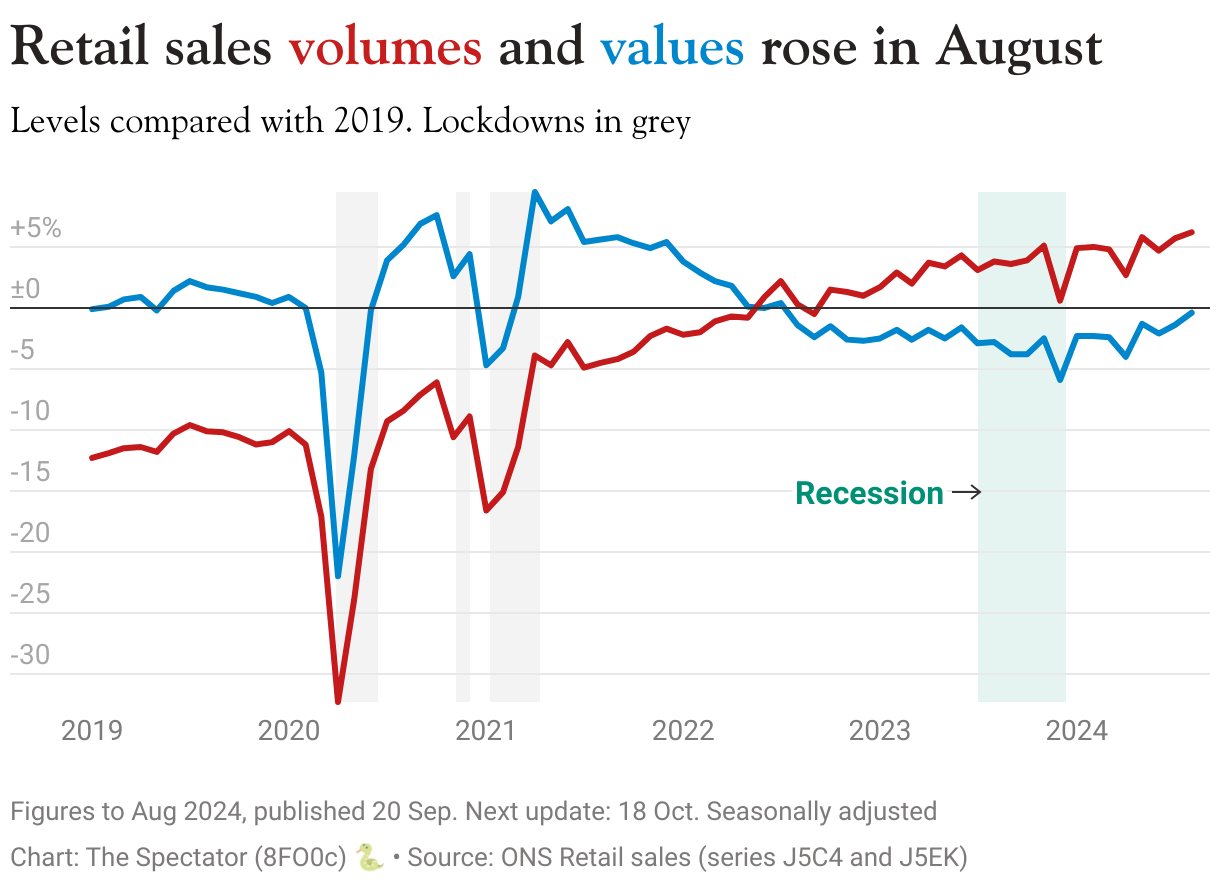
It ought not to really be a surprise. Inflation is eating away at consumers’ buying power, and wages are not keeping pace. The Consumer Prices Index (CPI) is up 10.1 per cent over the past 12 months but regular wages only 5.9 per cent. Moreover, rising interest rates have imposed their own burden on consumer finances. Today’s retail sales figures show the same story across food and non-food sales: people are spending more but getting less. That is likely to remain the picture for as long as inflation eats into real incomes.
We may have escaped recession so far, but economic growth remains deep in the doldrums
But the weather? According to Darren Morgan, director of economic statistics at the ONS, ‘Department stores, clothing shops and garden centres experience heavy declines as significant rainfall dampened enthusiasm for shopping’. Blame the rain for declining high street sales if you want, but the figures show that non store retailing – i.e. over the internet – also fell in March, by 0.8 per cent. Apparently, it wasn’t just too wet to go off down the high street, it was too wet for us to get our laptops out and sit on the sofa buying stuff.
I don’t think we should be fooled. We may have escaped recession so far, but economic growth remains deep in the doldrums. We have flaccid productivity (down 7 per cent in the public sector since before the pandemic according to the ONS) and a large number of people seem to have gone missing from the workforce, either through early retirement of apparent sickness.
April has seen pretty lousy weather so far, too, but if the sun does come out in May, don’t expect too much of a rebound in sales. February’s unexpectedly strong rise in sales is looking a bit of a statistical blip. We are unlikely to see a genuine recovery in retail activity until inflation and interest rates embark on a lasting fall which restores real-terms buying power.
Tories attack the Raab report
Adam Tolley’s report has finally been published, with Dominic Raab firing off an angry letter to mark his resignation. And that sense of anger has not been restricted to just the former Justice Secretary. A steady stream of Conservative MPs have been tweeting their disgust this morning, arguing that the claims in Tolley’s report were not serious enough to merit Raab’s resignation. Below is a list of Tories who have gone public with their criticisms:
- Paul Bristow, MP for Peterborough: ‘We are not a serious country’
- Joy Morrissey, MP for Beaconsfield: ‘Sadly, we now live in a country where the definition of bullying includes telling someone to do their job. Where the slightest upset or annoyance is indulged with endless reports and inquiries. Where whining, taking offence and narcissistic victimhood have become the defining characteristics of our times – as the uncomplaining and silent majority look on in disbelief…’
- Nadine Dorries, MP for Mid Bedfordshire: ‘To add context to what I’ve already said today – the least desirable qualities in any politician are disloyalty, weakness, self preservation and a lack of principle.’
- Robert Goodwill, MP for Scarborough and Whitby to Times Radio: ‘I’m very sad for Dom because he always comes across to me as a really genuine, decent guy who is determined to get things done and if you’re determined to get things done maybe you’re less than sympathetic to people who maybe don’t share that determination.’
- Craig Mackinlay, MP for South Thanet to the Telegraph: ‘I really do worry that if this is the new approach, a scalp of a Conservative minister by various civil servants – I think it’s quite a dangerous precedent, if I’m honest.’
- Philip Davies, MP for Shipley on GB News: ‘I wonder whether or not this could lead to a spate of other complaints going in about other ministers, because I suspect that if the threshold has been set so low there will be other examples out there as well.’
- Ben Bradley, MP for Mansfield to Politics Home: ‘In future if you disagree with a Minister just stick a complaint in and get rid of him!’
Two tips for the Scottish Grand National
Scottish trainer Lucinda Russell has her string in such fine form that she might win a race at Ayr this weekend if she entered the stable cat. From her five runners at Aintree last weekend, she ended up with two wins, two seconds and a sixth – quite an achievement.
Pride of place went, of course, to Corach Rambler who landed the Randox Grand National. No tipster rightly gets many plaudits for putting up the favourite in a big race but I am pleased to say that loyal Spectator Life readers were put on him before Christmas – three and a half months before the race – at 20-1.
At the odds on offer today, I am happy to leave things in the hands of Lucinda Russell and her team
Of course, I put up some losers too but Penworthy followers certainly showed a nice profit – 19 points overall – on the Grand National to recommended bets. Onwards and upwards to… the Coral Scottish Grand National.
I am not going to desert Lucinda Russell this weekend as she loves bringing some of her best horses from her base in Perth & Kinross to Ayr, some 80 miles away, for the course’s two-day spring meeting. In fact, I am very happy to back both her horses each way in the Scottish National, a contest over four miles, even though they have very different profiles for the race.
As a novice chaser – that’s a first season tackling the larger obstacles – YOUR OWN STORY is open to plenty of improvement now and going forward. He is a true stayer too having won at Wetherby in March over a trip just a furlong short of four miles.
He is a sound jumper and is nicely handicapped off a rating of 127, meaning he will be one of the bottom weights tomorrow. Derek Fox, fresh from his Aintree win on Corach Rambler, will be in the saddle and should be able to do the light weight. I suggest backing Your Own Story each way at 8-1, six places, with one of several bookmakers, including bet365, William Hill, Betfred, Paddy Power and Betfair.
Russell’s other horse in the race, MIGHTY THUNDER, is a veteran at ten years old. He won this very race two years ago off a rating of 144 and can now race off a rating of just 125, after two poor years on the track and some breathing issues that required wind surgery.
However, his last run at Kelso last month was more promising than most of his recent efforts and he will have the benefit of young Patrick Wadge, superb value for his 5lbs claim, in the saddle. This gelding is also a good jumper who will relish the quick-ish ground. Back him each way too at 25-1, six places, with bet365.
There are plenty of dangers in the race, including the two horses at the head of the market: Kitty’s Light and Monbeg Genius. Both have strong chances but I wouldn’t touch either with the proverbial barge pole at their current prices of 5-1 or less in a competitive 23-runner marathon contest.
Kitty’s Light is still well handicapped on his best form of last season and was second in this race a year ago to his stablemate, Win My Wings. But his jumping left a lot to be desired last time out, eventually winning the Vertem Eider Handicap Chase at Newcastle off a throwaway mark of just 132 – last season he was running off as high a rating as 149 and tomorrow he runs off 140.
The form of the Ultima Handicap Chase at Cheltenham last month received a boost when the winner, Corach Rambler, won the Grand National at Aintree last weekend. Monbeg Genius ran a superb race to be a close third but he is up 5lbs in the ratings to 145 tomorrow and he is not guaranteed to stay the marathon trip, especially after a hard race at the Festival. He is already in my ‘horse tracker’ for next season, being only seven years old but on ground faster than ideal for him tomorrow, he is poor value.
At the odds on offer today, I am happy to leave things in the hands of Lucinda Russell and her team. I have no doubt that both of her runners are capable of capping a memorable season for her by winning her second major ‘National’ in the space of just eight days. Provided one of them is in the first six there will be little to no damage done to the overall bank balance. Good luck, as always.
Pending bets:
1 point each way Your Own Story at 8-1in the Scottish Grand National, paying 1/5th odds, six places.
1 point each way Mighty Thunder at 25-1 in the Scottish Grand National, paying 1/5th odds, six places.
1 point each way Annsam at 16-1 in the bet365 Gold Cup, paying ¼ odds, four places.
Settled bets:
1 point each way Hill Sixteen in the Becher Chase at 11-1, paying 1/5 odds, six places. Unplaced (7th). – 2 points.
2 points win Annsam at 8-1 for the Howden Silver Cup. Cancelled meeting. Stake returned.
1 point each way Eldorado Allen at 20-1 in the King George VI Chase, paying 1/5 odds, 3 places. Unplaced (4th). – 2 points.
1 point each way The Big Breakaway in 20-1 for the Welsh Grand National at 20-1, paying 1/5 odds, five places. 2nd. + 3 points.
1 point each way The Big Dog at 12-1 in the Welsh Grand National, paying ¼ odds, four places. 3rd. + 2 points.
1 point each way Grumpy Charley at 12-1 in the Newbury 2.25pm paying 1/5 odds, five places. 1st + 16.4 points.
2 points win Midnight River at 5-1 for the Cheltenham 1.55pm, with Skybet. 1st. + 10 points.
1 point each way Coconut Splash at 12-1 in the Cheltenham 1.55 on Sunday, with William Hill, paying 1/5 odds, six places. Unplaced (P). – 2 points.
1 point each way Sir Ivan at 20-1 in the Sandown 3pm tomorrow, paying 1/5th odds, 5 places. Unplaced. – 2 points.
1 point each way Lord du Mesnil at 8-1 in the Warwick 3pm race, paying 1/5th odds, 5 places. Unplaced. – 2 points.
1 point each way Dubrovnik Harry at 8-1 in the Kempton 2.40pm race, paying 1/5th odds, 7 places. Unplaced. – 2 points.
1 point each way Mister Coffey at 15/2 for the Doncaster 3.15pm, 1/5 odds, five places. Non Runner. Stake returned.
1 point each way Back On The Lash at 7/1 for the Cheltenham 12.40pm, 1/5 odds, five places. 1st. + 8.4 points
1 point each way Empire Steel at 12-1 in the Sandown 3.30pm, paying 1/5 odds, 5 places. Unplaced. – 2 points.
1 point each Small Present at 25-1 for the Grand National Trial (Haydock 2.40pm) paying 1/4 odds, four places. Unplaced – 2 points.
1 point each way Homme Public at 9-1 for Ascot 3pm, paying 1/5 odds, four places. Unplaced. – 2 points.
1 point each way Party Business at 20-1 NRNB for the Pertemps Network Hurdle Final, paying 1/5 odds, five places. Non Runner. Stake returned.
1 point each way Benson at 16-1 in the Morebattle Hurdle, paying 1/5th odds, five places. 1st. + 19.2 points.
1 point each way Monviel at 17/2 for the Imperial Cup, paying 1/5th odds, six places. 5th. + 0.5 points.
1 point each way Saint Segal at 20-1 NRNB for the Grand Annual, paying 1/5th odds, five places. Non Runner. Stake Returned.
1 point each way Elixir de Nutz at 20-1 NRNB for the Plate Handicap Chase, paying 1/5 odds, five places. Non Runner. Stake Returned.
1 point each way Doctor Bravo at 22-1 for the Sky Bet Supreme Novices’ Hurdle, paying 1/5 odds, four places. Unplaced. – 2 points.
1 point each way Nassalam at 20-1 NRNB for the Ultima Handicap Chases, paying 1/5th odds, five places. Unplaced. – 2 points.
1 point each way I Like To Move It at 20-1 for the Unibet Champion Hurdle, 1/5 odds, three places. Unplaced. – 2 points.
1 point each way Metamorpheus at 16-1 NRNB for the Boodles Juveniles Hurdle, paying 1/5th odds, 5 places. 6th. – 2 points.
1 point each way Mister Coffey at 25-1 for the National Hunt Chase, paying 1/5th odds, three places. 3rd. + 4 points.
1 point each way Camprond at 20-1 NRNB for the Coral Cup, paying 1/5th odds, five places. 3rd. + 3 points.
1 point each way Elixir de Nutz at 14-1 for the Grand Annual Chase, paying 1/5 odds, five places. Unplaced. – 2 points.
1 point each way French Dynamite at 14-1 NRNB for the Ryanair Chase, paying 1/5th odds, three places. Unplaced. – 2 points.
1 point each way Dashel Drasher at 28-1 for the Stayers’ Hurdle, paying 1/5th odds, four places. 3rd. + 4.6 points.
1 point each way Gin Coco at 14-1 NRNB for the County Hurdle, paying 1/5 odds, five places. Unplaced. – 2 points.
1 point each way Hewick at 20-1 NRNB for the Cheltenham Gold Cup, paying 1/5th odds, three places. Unplaced. – 2 points.
1 point each way Royal Pagaille at 50-1 NRNB for the Cheltenham Gold Cup, paying 1/5th odds, three places. Unplaced. – 2 points.
1 point each way Magic Daze at 11-1 for the Mares Chase, paying 1/5th odds, three place. Refused to race. – 2 points.
1 point each way Might I at 10-1 NRNB for the Martin Pipe Hurdle, paying 1/5th odds, five places. 4th. + 1 point.
1 point each way Iroko at 9-1 for the Martin Pipe Hurdle, paying 1/5th odds, five places. 1st. + 10.8 points.
1 point each way The Galloping Bear at 14-1 for the Midlands Grand National, paying ¼ odds, four places. P. – 2 points.
1 point each way Notachance at 33-1 for the Midlands Grand National, paying 1/5th odds, five places. 3rd. +5.6 points.
1 point each way Secret Reprieve at 10-1 for the Midlands Grand National, paying 1/5th odds, five places. P. – 2 points.
1 point each way Dans Le Vent at 33-1 for the Uttoxeter 3.35pm, 1/5th odds, three places. U. – 2 points.
1 point each way Panda Boy at 16-1 in the Irish Grand National, ¼ odds, four places. 5th. – 2 points.
1 point each way Gesskille at 16-1 in the Topham Chase, paying ¼ odds, four places. Unpalced. – 2 points.
1 point each way Corach Rambler at 20-1 in the Aintree Grand National, paying ¼ odds, four places. 1st . + 25 points.
1 point each way Lifetime Ambition at 33-1in the Aintree Grand National, paying 1/5 odds, five places. U. – 2 points.
1 point each way Any Second Now at 20-1in the Aintree Grand National, paying 1/5 odds, five places. Unpalced. – 2 points.
1 point each way Francky Du Berlais at 100-1 in the Aintree Grand National, paying 1/5th odds, six places. Unplaced. – 2 points.
My gambling record for the seven years: I have made a profit in 13 of the past 14 seasons to recommend bets. To a 1 point level stake over this period, the profit of has been just over 469 points. All bets are either 1 point each way or 2 points win (a ‘point’ is your chosen regular stake).
Dominic Raab resigns over bullying report
In the last few minutes Dominic Raab has announced that he has resigned from government following the findings of an investigation into allegations of bullying against him. Rishi Sunak received the report – by the barrister Adam Tolley KC – on Thursday morning and spent the evening consulting advisers on the best path forward as he pondered its contents. In the end, Raab made the decision for him.
In his letter, the deputy prime minister says he called for the inquiry and ‘undertook to resign, if it made any finding of bullying whatsoever’. Raab goes onto say that he believes it is important to ‘keep my word’ and the report has found against him on two counts.
That’s not to say, however, that Raab accepts the reports findings
That’s not to say, however, that Raab accepts the reports findings. He highlights that the report dismissed all but two allegations against him but that when it comes to those two ‘adverse’ findings, he believes they are ‘flawed’ and set a dangerous precedent. He says in his defence that ministers must be able to exercise direct oversight over senior officials and that they must be able to give ‘direct critical feedback’. These comments will be put into wider context when more details of the report’s contents emerge. It’s clear Raab plans to fight to defend his reputation even if he has chosen to leave government as a result of the findings. He has penned an article for the Telegraph in which he says ‘the Kafkaesque saga I endured was shorn of the safeguards most people enjoy’.
So, where does this leave Rishi Sunak? The Prime Minister was facing accusations from opposition MPs last night that he was dithering, weak and indecisive. Had the saga dragged into the weekend, Tory MPs might have started to say that too. But Raab’s criticism of the process – he is yet to criticise Sunak directly – means that the story will run on.
Sunak and his team are understood to have been genuinely torn over the report’s findings. That Raab has chosen to go – despite excited briefings from ‘allies’ that he would ‘fight to the death’ – has made things much simpler for No. 10. The fact that Raab is a close ally of the Prime Minister who campaigned for him in the summer when it was distinctly unfashionable to do so suggests that the long serving cabinet minister in the end chose to make it less painful for Sunak. However, the fact that Raab has raised concerns about the inquiry itself will lead some MPs to ask whether Sunak should have stood by his loyal minister.
As for what comes next, the Prime Minister needs to appoint a new Justice Secretary. This is expected to happen later today – the full (very lengthy) report could also be published before the weekend. He does not have to have a deputy prime minister so this position could end as of today. Sunak may use Raab’s departure as an opportunity to tie up other loose ends such as maternity leave cover for the new science department – with the secretary of state Michelle Donelan due to go on maternity leave.
So far, Sunak has said nothing publicly of Raab’s departure. When he does emerge, the Prime Minister will be pressed on whether he backs Tolley’s finding as legitimate or agrees with Raab that they set a dangerous precedent.
Full text: Dominic Raab’s resignation letter
Dear Prime Minister,
I am writing to resign from your government, following receipt of the report arising from the inquiry conducted by Adam Tolley KC. I called for the inquiry and undertook to resign, if it made any finding of bullying whatsoever. I believe it is important to keep my word.
It has been a privilege to serve you as Deputy Prime Minister, Justice Secretary and Lord Chancellor. I am grateful to have had the opportunity to work as a minister in a range of roles and departments since 2015, and pay tribute to the many outstanding civil servants with whom I have worked.
Whilst I feel duty bound to accept the outcome of the inquiry, it dismissed all but two of the claims levelled against me. I also believe that its two adverse findings are flawed and set a dangerous precedent for the conduct of good government.
First, Ministers must be able to exercise direct oversight with respect to senior officials over critical negotiations conducted on behalf of the British people, otherwise the democratic and constitutional principle of Ministerial responsibility will be lost. This was particularly true during my time as Foreign Secretary, in the context of the Brexit negotiations over Gibraltar, when a senior diplomat breached the mandate agreed by cabinet.
Second, Ministers must be able to give direct critical feedback on briefings and submissions to senior officials, in order to set the standards and drive the reform the public expect of us. Of course, this must be done within reasonable bounds. Mr Tolley concluded that I had not once, in four and a half years, sworn or shouted at anyone, let alone thrown anything or otherwise physically intimidated anyone, nor intentionally sought to belittle anyone. I am genuinely sorry for any unintended stress or offence that any officials felt, as a result of the pace, standards and challenge that I brought to the Ministry of Justice. That is, however, what the public expect of Ministers working on their behalf.
In setting the threshold for bullying so low, this inquiry has set a dangerous precedent. It will encourage spurious complaints against Ministers, and have a chilling effect on those driving change on behalf of your government — and ultimately the British people.
Finally, I raised with you a number of improprieties that came to light during the course of this inquiry. They include the systematic leaking of skewed and fabricated claims to the media in breach of the rules of the inquiry and the Civil Service Code of Conduct, and the coercive removal by a senior official of dedicated Private Secretaries from my Ministry of Justice Private Office, in October of last year. I hope these will be independently reviewed.
I remain as supportive of you and this government, as when I first introduced you at your campaign leadership launch last July. You have proved a great Prime Minister in very challenging times, and you can count on my support from the backbenches.
Yours sincerely,
Dominic Raab
The case for cold weather
Pennsylvania experienced a heat wave last week, with temperatures soaring into the mid-80s. It was not to last. This morning it was a balmy 33°F, with that bone-chilling dampness and threat of snow showers that can only mean one thing: spring!
When friends and family who live in warm places send me photos of the beach and brag about taking long walks in the sunshine, I block out their bragging with a defiant flip of my hood and insist that people who live in cold places are tougher. We have more character. True grit. And it turns out that may actually be true. “Cold temperature extends longevity and prevents disease-related protein aggregation,” according to a new peer-reviewed study from Germany’s University of Cologne. Longevity, i.e., surviving, takes a lot of tenacity, especially these days, when beer isn’t even a reliable recourse anymore.
The researchers credit the cold with preventing the accumulation of “harmful and damaging protein deposits” that accelerate such diseases as Alzheimer’s and Parkinson’s. Exercising in cold weather is especially beneficial, as you burn more calories through the activation of brown fat, something that sounds gross but that helps us expend more energy and burn more blubber when the temperature dips.
Have you ever wondered why the California coast, with its paradise weather, is constantly coming up with some of the most harebrained political policies in the country? I have a couple theories for this trend, partly based on scientific evidence and partly formed from climate envy.
Minus an engulfing mudslide and raging wildfire now and then, California’s atmosphere is pretty much perfect, making the state’s inhabitants less productive. According to the Medium, “Bad weather actually increases your productivity… [and] research indicates that when the weather is nice, people just can’t focus on their work.” Colder air has also been proven to “boost your brain activity, improve focus, and help you think more clearly. Numerous studies show that our cognitive functions improve in colder weather.”
This research would help explain why the California legislature is always passing laws without pausing to consider their consequences. It’s too nice outside to think for very long about how forcing 100 percent electric vehicles by 2035 would affect American families and the nation’s economy, for instance.
As the weather warms up and summer rears its muggy head, I am clinging desperately to the last of this chilly season, which is not only superior for physical health and mental performance, but for aesthetics as well. Compare the soft pink flush of a cheek blushing from Old Man Winter’s kiss to the shiny ruddiness of a bloated face (cold also reduced inflammation!) assaulted by the sun and heat. Consider also the clothes associated with each time of year. Dressing for winter is inherently much more interesting because there are so many more pieces of apparel required. What bundling up does to the human form is also often a favor to everyone, especially as our obesity rate balloons here in America.
As you cheer increasing temps and are tempted to put your lawn furniture out a little too early, consider the gift that is cold weather. And as you plan your vacation to a hot, sundrenched, tropical island, remember what P.J. O’Rourke, who was only ever wrong about one thing (Hillary Clinton in 2016), opined about summer: “For everyone this side of Nome, summer vacation in the summer is like having a coffee break at 2 a.m.,” and consider heading north.
Rishi Sunak knows the Tory rebels are right about small boats
When the Rwanda migrant removals programme was torpedoed by a European judge at a hastily-convened hearing one evening last summer, the notion that Britain had ‘taken back control’ of its borders crawled away to die.
The anonymous judge at the Strasbourg-based European Court of Human Rights issued a controversial ‘Rule 39’ instant order. This blocked the removal of the few failed asylum seekers who had not already been sprung from the proposed inaugural flight via appeals made to British courts in the preceding days.
It is likely Sunak himself is genuinely convinced that the current global asylum regime is unsustainable
One Tory MP on the cultural right of the party sought out the then-PM Boris Johnson. They pleaded with him to ignore the ruling, which strayed far beyond the ECHR’s original powers, and just get a plane with some illegal immigrants on it in the air and heading for Rwanda. To fail to do that would destroy faith in the Tories among millions of voters, he warned.
That MP was told by Johnson that, no, the order could not be ignored and that he needed to develop some ‘strategic patience’. Yet it turned out that the man calling for patience was running out of time much faster than he realised. A few weeks later the herd moved against him and his former Praetorian guard of right-wing MPs did nothing to stop it. Indeed, many joined in with the stampede.
Rishi Sunak has clearly resolved not to make the same mistake that Johnson did and instead is letting the traditionalist wing of his party set the pace on ‘stopping the boats’. After receiving representations from the likes of Sir John Hayes and Danny Kruger from the Common Sense Group of backbenchers, the Prime Minister has agreed to toughen up the Illegal Migration Bill. The measures will help prevent future flights to Rwanda from being grounded either by British judges or European ones.
First, the criteria for permitting a British judge to block a deportation is going to be very significantly narrowed. Only where a judge is persuaded that a removal will lead to ‘serious and irreversible harm’ will a deportation be able to be blocked.
Secondly, and more provocatively still, as far as liberal establishment opinion is concerned, the Bill is now going to expressly authorise the Home Secretary to disregard interim orders from Strasbourg of the sort that put the kybosh on the debut flight to Rwanda.
It is not as if Suella Braverman has gone freelance in imposing these changes to the flagship legislation. They have been agreed with the Hayes-Kruger set, which also features the Ipswich MP Tom Hunt and Johnathan Gullis from Stoke-on-Trent North as influential members, by Immigration Minister Robert Jenrick, the Prime Minister’s trusted ‘fixer’ on this issue.
Predictably enough, the legal establishment has already signalled its alarm. The former Lord Chief Justice Lord Thomas, who sits as a cross-bench peer, told the BBC that ignoring interim ECHR judgments would be ‘an immensely serious step’ setting ‘an extraordinarily bad example’.
‘This is a step a government should never take because it is symbolic of a breach of the rule of law,’ he added. That last comment seems illogical given the power is dependent on it being contained in primary legislation that will have completed its parliamentary stages and made it on to the statute book. But in any event, Lord Thomas will not be the last establishment figure to launch into hyperbole against the government’s hardball approach.
So why has Sunak agreed to the Common Sense Group’s wish list? Some will say he has become its prisoner, though his willingness to compromise with the EU over the trading regime applying to Northern Ireland casts doubt on that, as does his relaxed attitude to levels of legal immigration.
Much more likely is that Sunak himself is genuinely convinced that the current global asylum regime is unsustainable. He likely believes that the UK must step away from it quickly if illegal immigration is to be prevented from reaching levels that will lead to catastrophic social consequences.
No doubt he will also have received advice telling him that on the one hand, failing to stop the boats as a result of being blocked by opposition MPs, the House of Lords and ‘lefty lawyers’ may leave him with a fighting chance of retaining support among migration-sceptic voters. But on the other, failing because of not going as far as some of his own MPs thought necessary would be fatal. So he must be seen to ‘strain every sinew’, as he put it in his five key pledges press conference in January.
Sir John Hayes and his band of traditionalist die-hards are making the running because on this key issue at least, Rishi Sunak knows that they are right.
AI and the end of immigration
There are many things to be learnt from visiting an airport. A trip to Stansted Airport, for instance, will teach you that Stansted is a really dim place to locate an airport. Meanwhile, JFK in New York City will inform you that America is becoming seriously pricey for European tourists.
But a recent trip to Bangkok airport taught me something more profound. There I was, supping some pleasant Singapore Laksa, and I saw this thing hove into view. It was an autonomous robot cleaner, busily keeping all the shiny floors of Suvarnabhumi airport in pristine condition.
Instead of desperately needing more workers to make up for low birth rates and ageing populations we are going to need far fewer workers
It was not the technology that surprised me – you can of course buy domestic robot vacuum cleaners on Amazon – it was the fact I had not anticipated this development, despite it being obvious, in retrospect. On all my previous visits to Bangkok, this cleaning job was always done by teams of women, probably quite low-paid women from Myanmar, say, or Cambodia (where Thailand sources a lot of workers for low-skilled jobs).
Now those women have been replaced by robots. Where have they gone? What jobs are they doing now? Airport cleaning does not equip you for many other roles. You don’t leap from swabbing out a Duty Free concession to teaching physics or trading Treasury bonds.
The more I stared at the robot cleaner, doing its job tirelessly, effortlessly, and 24/7, the more I realised I was staring at a future that almost everyone seems to deny. And that future is a world where, instead of desperately needing more workers to make up for low birth rates, ageing populations, and all that, we are going to need far fewer workers. Fewer people in general. And definitely fewer migrant workers.
Because it ain’t just the cleaners of Bangkok departure lounges that are threatened by robots, automation and the advent of Profound AI. As has been discussed for several years now, almost every human role, from the most humble to the most exalted, is in danger of being robotised, and many careers face near-certain extinction.
Let’s run through them, and get depressed. Though the advent of the self-driving car has taken much longer than expected – they are, it turns out, really hard machines to get right – they are now finally here. Autonomous cars can be seen buzzing around San Francisco, and various Chinese cities. Self-drive buses are now a thing in Japan – and, soon, Edinburgh. Lorries and vans will eventually go the same way. Put that all together and it’s an awful lot of people and an awful lot of jobs – truck drivers, bus drivers, Uber drivers. All gone. What will these millions of people do instead?
As on the roads, so with the arts. In this magazine, I have already described how AI will replace writers. The intelligent chatbot ChatGPT is right now churning out decent poetry, in a few years it will be outmatching Milton. I have, likewise, in these pages described how AI will come for painters, illustrators, photographers, and graphic designers, via image machines like Stable Diffusion and Dall-e. If you don’t believe me, consider this: an AI just won a Sony World Photography Award, without the judges realising an AI ‘created’ the photograph.
The future for the legal profession is not exactly rosy, either. In a recent paper, it was shown that the latest version of ChatGPT can not only pass the US bar exam, it can ace it, better than 90 per cent of human examinees. Other studies have shown that ChatGPT is a better coder, better sub-editor, better research assistant, than any actual person, and so on.
Nor, ironically, is the future overly bright for the scientists who made these machines: one recent paper on the scientific capabilities of the new AI concludes: ‘[this] Intelligent Agent system [is] capable of autonomously designing, planning, and executing complex scientific experiments. Our system demonstrates exceptional reasoning and experimental design capabilities, effectively addressing complex problems and generating high-quality code.’ So that’s the boffins gone, as well. They’ve boffined themselves into the bin.
Some people, hearing all this, may be tempted to take comfort from the experience of previous technological leaps. That’s not unreasonable, at least at first glance. For instance, when farming was mechanised, rendering men with scythes redundant, the result was that new urban roles were created higher up the scale, making people more productive and eventually more prosperous; the workers of the countryside moved to the city, where they toiled in profitable factories.
Then, when the factories got automated or moved abroad, the factory workers moved up the scale again, shifting into knowledge jobs: becoming managers, bankers, clerks, teachers, accountants, doctors, researchers, actors, advertising executives with extrovert bow-ties and Spectator journalists given to writing pessimistic columns about ominous technology.
The difference with this latest industrial revolution – the robot-AI revolution – is that the new technology is going to threaten every single job at every level, simultaneously: menial and managerial, basic and bourgeois. So there will be no shift up to more productive tasks fit only for uniquely gifted humans. And this is because it is genuinely hard to think of any task – apart from vicar, stripper, and care worker – that sophisticated robots and highly advanced AI could not do.
All of which brings me back to Bangkok airport and those robot cleaners, replacing the nice migrant ladies from Mandalay. That is the future for all of us: watching AI do our jobs. In which case, why on God’s newly-automated earth are we arguing about the need for more migrants, the urgent search for workers around the world, amid the panic of a low birth rate and the desperation of ageing demographics?
What AI offers is a precious escape from this problem, avoiding the friction and stress which accompanies mass immigration. Freed of the need to import people, openly acknowledging that we need fewer workers, allowing our population to gently decline, we might even find our environment is less pressured, our rivers cleaner, and our housing a lot cheaper. Young British people will be able to buy homes in nice places. This is a major upside of the robot-AI revolution, even as there are serious downsides, still to be navigated.
And yet, no one ever seems to discuss this. Instead, we have immigration of net 500,000 a year and evermore debates about how to import evermore people. We are like Londoners sagely discussing the need for extra stables in Piccadilly and the necessary training of a million blacksmiths in 1898, even as the first cars are rolling out of the factories. It is surely time to think a lot smarter about this. Alternatively, if we are incapable of grasping these basic truths, we could get the machines to think it through. They are good at it.
In defence of the hash brown
The English Breakfast Society has cancelled the hash brown, calling it a ‘lazy American replacement to bubble and squeak’. Guise Bule de Missenden, the society’s founder (sounds European to me), warned that giving hash browns the stamp of approval would only encourage the adoption of other ‘unsuitable fillers like chips’, or worse ‘fish fingers’ and ‘kebab meat’. (Seriously Guise, unless you are an infant or a drunk, the latter two are not part of any normal diet.)
The boffins at the English Breakfast Society need to get with the times
‘Someone has to draw the line and say no to hash browns,’ he said. ‘They are served by those who lack pride in the full English breakfast tradition.’ Well, I’ve had enough. I’m taking a stand.
First off, we should be able to customise our morning plate of protein, carbohydrate and fat however we like, thank you very much. All are welcome as far as I’m concerned; black pudding, white sourdough, hey, even haggis there’s no discrimination here. Part of the beauty of a full English is its heft, its might – so why not let a crunchy slice of golden spud join the party? England is a happy multicultural country and that should be reflected in our greatest contributions to world cuisine. According to YouGov, as many as 60 per cent of us – the British public – believe hash browns are the most important part of the meal.
The EBS is slating them for not being traditional and threatening the continued existence of bubble and squeak. But what even is bubble and squeak? And do you know anyone who has ever eaten it? I certainly don’t. As Felicity Cloake, author of Red Sauce Brown Sauce: A British Breakfast Odyssey, pointed out, the full English has ‘already absorbed baked beans into its fold’. Speaking to the Times, she said: ‘I suppose us old-fashioned types must reluctantly accept this new phase of its evolution.’
Exactly Felicity, the boffins at the English Breakfast Society need to get with the times. An English breakfast typically consists of sausages, bacon, eggs, beans, tomatoes and fried mushrooms. And it’s not even that traditional. The earliest mention of a ‘full English’ is from 1933. The hash brown, however, has been around for much longer, with ‘hashed brown potatoes’ mentioned in Victorian-era cookbooks.
‘They seem to have first popped up as a breakfast item in the 1980s, which I suspect probably has something to do with McDonald’s serving them for breakfast from 1982 onwards,’ Cloake said. But that’s enough with the history lesson. Food isn’t about rules. It’s about much more than that. It’s personal. The full English is comfort food. It’s about nostalgia and familiarity.
Our sense of smell and taste are registered in the oldest parts of our brains. One of the reasons smell and taste trigger the strongest feelings of déjà vu is because these senses are processed near the part of our brain where memory is stored.
A hash brown takes me back to my childhood, having just about made it to McDonald’s before the 10.30 a.m. (or is it 11 a.m.?) cut off; holding this glorious little thing in its individual paper sachet, covering it in ketchup and chomping through its crisp outer layer into a fluffy core of steamy hot potato. Pure joy. If I can be reminded of that as part of my full English on a Sunday morning, who’s to tell me I’m wrong?