-
AAPL
213.43 (+0.29%)
-
BARC-LN
1205.7 (-1.46%)
-
NKE
94.05 (+0.39%)
-
CVX
152.67 (-1.00%)
-
CRM
230.27 (-2.34%)
-
INTC
30.5 (-0.87%)
-
DIS
100.16 (-0.67%)
-
DOW
55.79 (-0.82%)
The Biden family dog’s biting spree
The Biden family seems to care more about its dogs than the men and women who work to keep them safe every day. After numerous biting incidents, often but not exclusively of Secret Service agents, their dog Major was expelled. Now it may be Commander’s turn to hit the road — the question is how many agents need to get bitten first.
The New York Post reports that over the course of four months, September 2022 to January 2023, the German Shepherd bit seven people, and there are likely more incidents outside that block of time. Cockburn finds it a bit strange that neither Joe nor Jill are willing to take the proactive step of muzzling their dogs — after all, hasn’t this White House been all too eager to muzzle Americans?
According to the Post, the worst attack occurred on November 3, when a Secret Service agent was bitten on his arm and thigh and had to go to the hospital. Shortly thereafter, on November 10, another agent was bitten on the thigh; a month after that on December 11, yet another was injured on the arm and hand. That just scratches — or bites? — the surface of the pain Commander has inflicted on his victims. Cockburn is just speculating, but could the cocaine found in the White House be Commander’s…?
The White House released a statement saying that it “is a unique and often stressful environment for family pets, and the First Family is working through ways to make this situation better for everyone.” Those “ways” supposedly include “additional leashing protocols and training, as well as establishing designated areas for Commander to run and exercise.”
That is all well and good, but Cockburn has a better idea: get a dog that doesn’t snap at every living thing that isn’t its owner — and let the German Shepherds live with a family who will dedicate the time to show them discipline and tend to their needs.
The White House is surely stressful, but Cockburn can’t recall this kind of violence from many of the (quite numerous) pets that have previously inhabited the property.
Labour’s self-ID mess
Scottish Labour lined up behind the SNP’s bungled attempt to reform the Gender Recognition Act last year and in doing so the party set itself firmly against the majority of voters. Around two-thirds of Scots are opposed to the SNP’s gender bill, but Labour chose to ignore their views and back the nationalists’ controversial legislation instead.
When Scottish Secretary Alister Jack intervened to block reform of the gender bill by Holyrood — on the grounds that changing the law in Scotland would negatively impact on the UK-wide equality act — the Labour party found itself unable to cash in. While the Scottish Tories loudly proclaimed their support for the majority view on self-ID, Labour MSPs preferred not to discuss it at all.
‘Anyone who dared speak critically about self-ID was being smeared as a bigot, so Anas took the easy decision to back the reform. He did this out of loyalty to the party and now he’s been thrown under the bus.’
But if Scottish Labour leader Anas Sarwar and his team thought this controversial issue would simply blow over, they were sorely mistaken. The UK Labour party has this week loudly changed its position on self-ID, cutting colleagues in Scotland adrift. Writing in the Guardian, shadow secretary of state for women and equalities Anneliese Dodds announced that the party is no longer in favour of self-identification. While Labour is committed to reforming the gender bill, it will crucially not scrap the need for someone applying for a gender resignation certificate to obtain a medical diagnosis of gender dysphoria.
Unsurprisingly, this change of tune has upset a number of members of the party in Scotland. MSPs Paul O’Kane and Monica Lennon have, alongside former Scottish Labour leader Richard Leonard, all expressed disappointment at the u-turn. Those Scottish Labour politicians who remain committed to self-ID see the party’s new position as a humiliating climbdown. Those who have never been in favour of self-ID think the new stance is too little, too late.
One gender critical Labour MSP said: ‘The Labour group at Holyrood is horribly divided on this subject but it was made absolutely clear to us that we were expected to support the reform of the GRA, so people bit their tongues and voted. We did this even though all the polls — and lots of our constituents — were telling us that self-ID was massively unpopular. Now our colleagues in London have realised it’s a bad policy, we look like idiots.’
And Sarwar was not, party insiders say, fully engaged with the issue when he whipped his MSPs to back the SNP. Another source said: ‘It seemed pretty obvious that Anas just wanted this whole thing to go away. Anyone who dared speak critically about self-ID was being smeared as a bigot, so he took the easy decision to back the reform. He did this out of loyalty to the UK party and now he’s been thrown under the bus.’
Sir Keir Starmer seems to be making a habit of upsetting his colleagues in Edinburgh. Last week, he announced it was no longer his party’s intention to overturn the Tories two-child benefit cap, a policy that Sarwar has labelled ‘heinous’. Labour MSP Mercedes Villalba argued that Starmer had been elected on a pledge to get rid of the limit while her colleague Pam Duncan-Glancy has called the policy ‘horrific’. While Starmer may have been pitching to small ‘c’ conservative voters who hold fears that a Labour government would be reckless with the public purse, he has also managed to hand ammunition to the SNP, which has already introduced a weekly child payment for poorer Scottish families.
A Scottish Labour insider said: ‘Starmer either didn’t think of the implications for us, or he didn’t care but whatever his thinking, the upshot is that the Nats have spent the past week attacking us for supporting Tory austerity. It’s a pretty miserable place to be.’
The SNP will legally challenge the block on the proposed gender bill reforms when MSPs return to the Scottish Parliament in September after summer recess, and some Scottish Labour MSPs would like Sarwar to row in behind Starmer on the subject before then.
‘We made a political mistake backing the SNP’s legislation,’ one says. ‘No matter how embarrassing it might be, we need to be where the voters are on this. Starmer has clearly realised that voters are deeply sceptical about self-ID. We should be sending the same signal from Scotland.
‘Regardless of where you stand on the GRA, the smart political position is opposition. We’re in the wrong place because Starmer used to be in the wrong place. Now he’s come to his senses, Anas needs to make clear that concerns about self-ID are legitimate. We can try to make life easier for trans people without turning our backs on voters who think self-ID is dangerous.’
Will these issues be the first of many cracks in Labour’s shiny exterior? Certainly Sarwar seems to face problems either way he turns: he can stand up to the policy changes made by his Westminster counterparts, highlighting divisions in the party — or he can back down to Starmer, and risk being labelled a weak leader. What seems certain is that this will not be the last area of contention to cause a north-south split in his party…
Humza Yousaf’s attempts to woo Scottish business have fallen flat
The latest shock to hit the nationalist blogosphere is the revelation that the First Minister Humza Yousaf has recently broken bread with the billionaire Sir Brian Souter, the Stagecoach bus magnate. The encounter took place at a prayer breakfast last month and is regarded by some as a sign that Yousaf is trying to build bridges with the business community.
No one knows what transpired in Yousaf’s meeting with the independence-supporting philanthropist. It may simply have been an attempt by the First Minister, a practising Muslim, to show his ecumenicism. Souter, after all, attends the evangelical Church of the Nazarene in his home town of Perth. However, there may also have been a more pecuniary motivation for the head-to-head.
Souter used to be one of the SNP’s biggest donors, contributing at least £1 million to SNP coffers before 2014, at which point Nicola Sturgeon became leader. He hasn’t contributed a penny to the party since then. Indeed, the SNP has managed to alienate nearly all of its wealthy supporters. As The Spectator reported last month, the SNP hasn’t had a significant donation from a living person since 2021. Those it has received have been bequests from SNP supporters who’ve passed away. This has left the party increasingly dependent on public money and subscriptions from its dwindling membership base. This is in contrast to the party under Sturgeon’s predecessor: business-friendly Alex Salmond, a former economist for the Royal Bank of Scotland, managed to attract over £8.2 million in donations from individuals and companies in the seven years he served as First Minister.
This donor drought may not be unconnected with the fact the SNP has hardly enamoured itself with the business community since Salmond stood down. Sturgeon showed little interest in the private sector, though she went through the motions, and was clearly more concerned with redistribution of wealth than its creation with measures like the Scottish child payment and free childcare. She opposed development of the North Sea oil industry and, in her 2019 TED talk, called for economic growth to be deprioritised in favour of the ‘wellbeing economy’.
Sturgeon’s deposit return scheme, which has been postponed again until 2025 ‘at the earliest’, alienated thousands of small businesses who said that the charges could drive them to the wall. The circular economy minister Lorna Slater has insisted that the scheme is ‘based on the polluter pays principle’, a statement that was interpreted by drinks manufacturers and others as an attempt by the SNP government to blame them for choices made by consumers. Meanwhile property owners feel like they’re having a hard time of it too: private landlords took the Scottish government to court over the 3 per cent cap on rent increases, which doesn’t apply to social landlords. The minister for tenants’ rights, Patrick Harvie, has also threatened to ban the letting of private properties that don’t meet tough new environmental standards.
During the March leadership election, Yousaf’s main rival former, finance secretary Kate Forbes, upset the Scottish Green party and the nationalist left by campaigning on an explicitly pro-business agenda for which she was criticised as a closet Tory. She promised to ‘reset the relationship with business’ and ‘make Scotland an attractive place to do business’. Forbes ran Yousaf close in the final leadership vote and he now appears to be adopting her rhetoric word for word, insisting he too wants a ‘reset‘. To that end, he set up a New Deal for Business Group.
But the actions of the ‘First Activist’, as Yousaf likes to call himself, go some way short of a reset. Admittedly, he has paused plans to curb advertising of alcoholic drinks and toned down his rhetoric on oil and gas — yet David Lonsdale, director of the Scottish Retail Consortium and who initially praised ‘the new accord with commerce’, is already disillusioned. Retailers are angry that Yousaf’s promised review of non-domestic rates hasn’t lowered them to be on par with those in England. And, in more bad news for the SNP, it has been predicted that businesses will likely demand millions of pounds in compensation from the Scottish government over the deposit return scheme. The party’s own politicians aren’t happy either: the failure to deliver promised upgrades to roads like the A9 has provoked threats of resignation from SNP MSP Fergus Ewing.
The Scottish government is also committed to increasing taxation on higher earners. Yousaf and his wellbeing economy secretary Neil Gray — there is no dedicated minister for business since the resignation of Ivan McKee in April — promise more progressive taxation. The Scottish budget was forecast to face a billion pound ‘black hole’ following increased spending on social security alongside other policies. However the awkward truth, as the independent Fraser of Allander Institute has pointed out, is that there just aren’t enough wealthy individuals left in Scotland to pay the higher taxes necessary to close it. Unfortunately, wellbeing doesn’t pay the bills.
Allan’s big moment: discontinued doll’s price rises thanks to Barbie
If you saw the Barbie movie this week, chances are you enjoyed Michael Cera’s performance as the long forgotten Allan doll. Cockburn must admit he doesn’t have much experience with kids’ toys (thanks to his lawyers, who fight paternity suits like pitbulls), but even he’s surprised at how lucrative a market the doll market is becoming.
After its opening weekend, where Barbie raked in an estimated $155 million, now anyone with an Allan doll can make their own small fortune by selling it. Over the weekend, several eBay listings for old Allan dolls increased their prices. Before the film came out, some were priced as low as $30; now, the valuation has increased to over $300.
Since the movie’s release, Allan has turned into a fan favorite. But despite his newfound fame, Mattel recently announced that they will be keeping Allan off store shelves. The Allan, which was modeled after Barbie creator Ruth Handler’s son-in-law, was first rolled out in 1964 as a friend of Ken’s, but was discontinued a couple years later due to low sales.
In an interview, Michael Cera said, “Allan is sort of like a person without a group that he belongs to, he’s kind of a loner, in a way. I think the joke about that, at least how I interpret it, is that Allan the doll… didn’t have a very successful run. He’s sort of this marginalized person in this world of Kens.”
Last year, Out speculated that Ken and Allan were, er, more than friends. “According to his original packaging, he’s Ken’s ‘buddy.’ You know, the kind of buddy you hang out with shirtless. The kind of buddy you share all your clothes with. That kind of ‘buddy.’”
Cockburn isn’t too fussed about the implication, but rest assured: he’ll be rooting through his nieces’ old toyboxes on a hunt for the week’s whisky fund the next chance he gets…
Why the media is pushing climate lockdown fantasies
Back in February 2021, I wrote a piece here at The Spectator headlined “Are you ready for the climate lockdowns?” It concerned the predictability of where the climate alarmist movement was heading, and their eagerness to explore using the model for Covid lockdowns in Europe and the United States to address environmental issues. The movement has been inching its way toward the idea ever since. Now as heatwaves roll across the globe in the prime months of the summer season, news outlets aren’t being so subtle about the idea anymore — and neither is the Biden administration.
The kind of lockdowns I’m referencing, and that climate-conscious hacks are hinting at, aren’t the action of direct government enforcement (yet), but rather the strong suggestion to “stay home and stay safe.” Another idea being given oxygen is that full blackouts in major metropolitan cities, not just rolling blackouts, could play a role in combatting climate change.
At the Los Angeles Times for example, Sammy Roth offered a piece this past weekend titled “Would an occasional blackout help solve climate change?” In it, Roth also makes the case for “tens of millions of electric vehicles on the road, and tens of millions of electric heat pumps in people’s homes.” Roth either doesn’t realize the dilemma of electrifying every home appliance, including thermostats, water tanks and stoves, while also advocating for major electric power grid outages — or worse, he does.
Over at the New York Times, Alisha Haridasani Gupta took the usual fear-mongering over hot days to another level by asking directly “Is It Safe to Go Outside? How to Navigate This Cruel Summer.” Gupta hyperventilates over “a summer of weather extremes in the United States, in which going outside can be riddled with perils.”
This week at the University of Colorado at Boulder, campus tours were canceled with temperatures barely breaking 90 degrees. In a notice to attendees, the university wrote “Following your information session, we will not be conducting the campus tour for the safety of you, our guests and our student ambassador tour guides.” CU-Boulder replaced the tours with a listening panel.
Expect this trend to catch on, with more Zoom-style panels and meetings and stay-at-home orders from institutions brimming with the blanket-snuggling members of the pajama class.
Point out the media’s trend toward articles suggesting soft climate lockdowns, and you will see them pushing back in their usual fashion: by declaring that any acknowledgement of these stories is the result of a conspiracy theory, as NBC News claimed earlier this month.
None of this is to suggest that the Biden administration, the president or his climate envoy and health officials are going to come out tomorrow and suggest a “fifteen days to slow the heat” platform, but they don’t need to. They know their allies in corporate media have taken on a strategy of scaring people from even attempting to go outside on hot summer days, while blaming political opponents for the temperature. That’s exactly what Hillary Clinton did in a tweet, blaming “MAGA Republicans” for the weather. Her post came shortly after New York Times columnist Paul Krugman wrote “Why we should politicize the weather.”
Just pay attention to the words and actions of the climate alarmists, and watch as their allies in the media amplify them, to create the grounds for our politicians to enact them — then tell me who the “conspiracy theorist” is.
NatWest, Farage and the decline of corporate behaviour
The story of NatWest Group’s rogue behaviour goes far deeper than Nigel Farage. It now emerges that many more customers have been de-banked, had their lives turned upside down, and businesses destroyed as a result of a rogue and rotten culture affecting the financial system.
Take Baz Melia, army veteran and decorated war hero. The consulting business he started upon leaving the military could not function after NatWest closed his account. They wouldn’t tell him why and his paid work dried up as result. Or Alexandra Tolstoy, a single mother of three, whose only crime appears to be guilt by association with a former partner from Russia.
Debanking can destroy lives
None of these people, or indeed the many others, ever had a chance to defend themselves. It has been a principle of English law for nearly a thousand years that if accused of a crime, you have a right to know what for, and to a defence.
NatWest responded to Tolstoy after she wrote a desperate letter to Alison Rose, by telling her: ‘Following my investigation, I can confirm we’ve followed the right process, and we’re not obliged to enter into any discussion or provide a reason for our decision.’
NatWest is very keen to trumpet its precious values. Running through the dossier of emails released by Farage’s subject access request, and all over their own website, you’d be forgiven for thinking this bank is, in fact, a paragon of integrity and morality. ‘We set high standards’, ‘we prioritise wellbeing’, ‘we show empathy’, ‘we act with integrity’. It goes on.
The golden rule of reputation is that it’s what you do that matters, not what you say. Actions speak louder than words. All the rest is merely spin.
In NatWest and Coutts’ case, what the bank’s actions seem to have demonstrated are contempt for customers, failure to follow fair process, political posturing, double standards and unkindness.
Alison Rose ‘has forged a reputation as a champion of women in business’ according to her chums at the BBC, ‘leading a review of female entrepreneurship for the government in 2019’. But how does that square with NatWest’s role in de-banking a single mother who relies on her bank to pay rent and feed her children?
Rose’s mealy mouthed half-non-apology to Farage hides behind the rules and regulations. The problem is presented as a banking sector issue to do with rules imposed on the bank; she has invoked ‘wider change’ and ‘reviews of regulatory rules’. Did anybody at the bank ever consider the consequences of their actions?
Debanking can destroy lives. If you cannot pay staff or receive payments, your small business goes bust. If you can’t pay your rent, you’re homeless.
We all have an interest here. As taxpayers, we own 38 per cent of NatWest. It takes four minutes to change banks, thanks to the brilliant ‘Switch’ system (imposed on the banks to challenge anti-competitive behaviour) that automatically transfers direct debits. If this mess isn’t cleared up fast, NatWest will haemorrhage customers, and billions of pounds of taxpayer money will be destroyed. As we enter the holiday season this story is not going to go away.
In the past, reputation and accountability went hand in hand and leaders would resign of their own accord when things went wrong. It showed integrity. On precedent we can take a good guess at how NatWest’s leadership will behave: fighting to save their skin rather than doing what is right. That has to change, and fast.
Will the Tories learn from Coutts’ mistake in taking on Nigel Farage?
Not for the first time in his colourful life, the perennial rebel Nigel Farage has the establishment on the run. This time it is the financial establishment and its media allies. The former Ukip leader has already garnered apologies over conduct or coverage from NatWest, which owns Coutts bank, the high-profile podcaster and former BBC man Jon Sopel, the BBC’s business editor Simon Jack and the chief executive of BBC News Deborah Turness.
Farage is currently circling NatWest chief executive Dame Alison Rose in the manner of a hungry shark who has scented blood in the water. Not his, but hers. Dame Alison appears to be Farage’s prime suspect in the leaking of confidential details about his financial standing. ‘I will find out the absolute truth about who leaked my personal financial details to the BBC,’ Farage has said.
He is also making a beeline for Coutts CEO Peter Flavel, whom he accuses of ignoring him. ‘Did he take the decision to close my account for political reasons? We need to know,’ Farage has demanded.
Messing with Farage is a dangerous business
The key lesson to be drawn from this episode is not just that messing with Farage is a dangerous business, but that his ability to connect with public opinion and shape the agenda has actually grown since Brexit. Partly this is down to the sheer number of hours of live TV broadcasting he has clocked up after becoming a GB News anchorman two years ago. He has learned to calibrate his utterances more carefully since his Brussels-bashing days, during which he once accused the then president of the European Commission Herman Van Rompuy of having ‘the charisma of a damp rag and the appearance of a low-grade bank clerk’.
While it is high-grade bank clerks who tend to get the rough end of his tongue these days, he is as likely to deploy under-statement as exaggeration on his early evening show and has gained in authority and broadened his appeal as a result.
Before he got his teeth into shocking conduct within the banking system, it was he more than anyone else who pushed the issue of illegal small boat crossings of the Channel to the top of the news – to the point where it became a major electoral headache for the Conservative government. He can – and no doubt will – do the same in regard to the costs of achieving carbon Net Zero under the schedule inherited by Rishi Sunak from Boris Johnson.
The one mercy for the Tories is that Farage is currently out of electoral politics. One very senior Conservative MP told me recently that Rishi Sunak feels that his right flank is fairly safe at the moment, with none of the challenger parties such as Laurence Fox’s Reclaim or Richard Tice’s Reform gaining much traction or momentum. But this person added: ‘Were Farage to go and lead Reform again then that would be something which would greatly concern the Prime Minister.’
It is not overdoing it to say that Nigel Farage has it within him to make certain that the Conservatives are badly defeated at the next general election. There are sufficient important issues on which he has become the standard bearer for staunch conservative views – from immigration to taxation, ECHR membership and the importance of resisting the relentless advance of leftist wokery – to ensure any party led by him would gain a double-digit vote share. Farage achieved that before in a general election as Ukip leader in 2015 and it just so happened that in key battleground seats this hampered Labour as much as it did the Tories. That is not likely to be the case in 2024. It is overwhelmingly people who voted Conservative in 2019 who respond favourably to his stances.
Whether he chooses to jump back into the fray this time or not, it hardly seems sensible for the Conservatives to have to deal with an uncontrollable ‘Farage Factor’ every time they approach an election. Binding in a figure who was, after all, a Tory member until the great schism caused by the Maastricht Treaty would surely be a cannier approach.
While the very idea will bring ‘liberal’ Tories out in hives, it is no longer unthinkable that the Conservatives might soon be led by someone who chooses to harness his appeal by inviting him into the tent. Home Secretary Suella Braverman, for whom he has a high regard, is the most plausible such figure.
Perhaps the political price he would demand would be too high for her to pay, but the costs he can inflict on the Tories by running a rival ticket are also extremely high. And they do not seem to disagree about very much to me.
Violence overshadowed my Yorkshire childhood
We might be twins, Catherine Taylor and I. We were both girls growing up in Yorkshire in the same decades – I in the West Riding (where an alley is a ‘ginnel’), her in the south (where it’s a ‘gennel’). We are children of the Yorkshire Ripper years, conditioned to be constantly scared of the murderer, the dark, and our independence. We were both fatherless too young – mine dead, hers departed to another household; and we both had strong mothers keeping the remaining family afloat and forced to take in lodgers – in our case, Polish, German and French, in hers, Japanese and Senegalese. Much of this bookis familiar – but not all of it. There is still room for surprise and stirring.
Its title derives from the Sheffield Outrages known locally as ‘The Stirrings’, a period in the mid-19th century when aggrieved trade unionsts murdered and bombed. Taylor duly writes of violence – of Peter Sutcliffe, the Battle of Orgreave, the Hillsborough disaster and the quiet Cold War terror of the Bomb, although this is usually at a remove and oddly passive. She sometimes calls events ‘an uneasy backdrop’ – and that is what they were, no matter that she was living through them. The NUM is based in Sheffield, where she grew up, but she watched the Battle of Orgreave and the tragedy at Hillsborough on the news like everyone else.
This muted tone can be powerful: the departure of Taylor’s father is vivid because dampened, the mutism conveying her childish inability to express her distress. She sees one lodger, Henriette, a Senegalese woman, extravagant in her outward grief at the death of her mother and marvels at it. To describe her own feelings she has to reach for a bird, remembering a starling trapped in a chimney which resisted help in its fright: ‘The moment the frantic flapping ceased was even worse than the pitiful sound of invisible agitated wings inside the chimney breast.’ When she discovers a letter her mother is writing and realises that her father was leaving them, ‘it felt as if that starling were trapped in my body’. Gradually her father recedes, until she finds herself getting into a stranger’s car every second Saturday, exactly what she’s not supposed to do, except the stranger is her father. ‘Schrödinger’s Dad, half dead, half alive.’
Her slow understanding of what it means to be a young woman, to be careful and ‘frit’ of men, is also well done. Every woman and girl will recognise this. On a train as a teen-ager, quietly reading her book, she is harassed by a passenger and the conductor, both male, and hides in the toilet. At a party she wears a pretty dress and feels beautiful, until an older man tells her: ‘‘‘Soon you’ll be able to have any man you want”… after admiring the dress and staring for too long at the neckline.’
Some of life’s landmarks – first bra, first period – are efficiently but not memorably conveyed. Others are startling, such as her account of the abortion she had in a women’s hospital in Cardiff – ‘a low-level building of red brick, with tall, stiff, angry lupins standing to attention in well-ordered flowerbeds. No question of anything out of control here.’ Relieved of the foetus, she goes for a shower: ‘I noticed a small pool of fresh blood on the floor as I entered the cubicle. I stepped over it. It wasn’t mine.’ She identifies with Europa of myth, ‘being herself, daydreaming, picking flowers’ when she is raped by Zeus; and with Cassandra, cursed with the gift of prophecy and murdered by Clytemnestra. ‘Cassandra foretold her fate, of course; she smelled blood.’
Taylor’s greatest stirring comes from inside her. Her ‘nice little goitre’, her butterfly-shaped thyroid gland, goes awry in her late teens, leaving her exhausted and ravenously hungry to the point of putting on five stone in a year, a trauma for anyone. But even after the shamefully late diagnosis of Grave’s disease, the drugs don’t work, so that in ‘early May… the garden wall was warm to the touch once more. I was in hospital. Tomorrow I would be having my throat cut.’ She nearly dies from an allergic reaction to the anaesthetic and her thyroid is mostly excised.
The Stirrings essentially halts after her university years in Cardiff with a tragedy in her shared house, which is when adulthood truly begins. We leave Taylor in London, in a relationship, with different stirrings – ones that all women perpetually navigate in a way that men never quite comprehend. She was only picking flowers.
Two sinister siblings: The Mountain Lion, by Jean Stafford, reviewed
Many of the best literary children – think the creations of Henry James or Elizabeth Bowen – have something creepy about them. These are girls and boys who see through the hypocrisy of adults, and there’s going to be something unnerving about their precocity. Jean Stafford’s Mollie and Ralph took their place in a lineage with James’s Flora and Miles and Bowen’s Henrietta and Leopold when she flung them, bespectacled and prone to nosebleeds, into the world in 1946.

Stafford was the first wife of Robert Lowell, and it’s the main thing most people know about her now – unsurprisingly. Lowell was a man who made his mark on his wives, and in Stafford’s case the marks were literal – he drunkenly drove her into a brick wall. She became a novelist in his orbit and her often violently embattled books emerged from her pugnacious, volatile marriage and the end of the second world war.
Her first novel, Boston Adventure, sold a staggering 380,000 copies when it was published in 1944. The Mountain Lion appeared two years later, and took Stafford back to the landscapes of her childhood in California and Colorado. When the book opens, Ralph and Mollie have just been sent home from school. Since contracting scarlet fever, aged eight and ten, they’ve had a propensity for nosebleeds. They tend to get these at the same time, in their different classes, and are dismissed from school together, telling jokes that they then compete to claim ownership of, and bleeding over the dusty, sinisterly idyllic neighbourhood that Stafford describes so pungently. (There’s a grapefruit tree that bears one grapefruit every year, smaller than a golf ball and almost as hard.)
The plot gets going with the annual visit from their step-grandfather, who conveniently dies the next day, precipitating a division in the family when his youngest son, Uncle Claude, arrives for the funeral and invites Mollie and Ralph to spend the first of many summers in Colorado. There, Ralph attempts to keep up with his uncle’s horse-buckling machismo (his spectacles are abandoned, leaving him with migraines), while Mollie shuts herself in her room, writing, taking refuge in becoming even more of an outsider. Back in California, their mother and elder sisters grow more ludicrously frivolous in their femininity and end up taking a trip around the world, leaving the pair discarded in Colorado.
Sex undoes them – a slow awakening that they squirm their way into, alongside each other and apart, with Mollie feeling a ‘brilliant hatred’ for her brother that ‘had spread over her exactly like bathwater’. Stafford’s gift in this book is her ability to write from the perspective of the children. Even the raw brilliance of her descriptions of the landscapes feel authentically from their point of view. These are children whose absence of feeling is as striking and moving for us as their feelings – they have not been sufficiently loved to know they love.
In the middle of it all is a mountain lion, glimpsed in her ‘wasteless grace’ in the sun and then streaking away across the flat land, leaving Mollie envious of her yellow hair and Ralph and Claude determined to kill her. Once the lion takes over, the book gets less convincing; it loses its luridly incandescent realism and becomes mythical in a way that Stafford doesn’t succeed in making all that interesting. But Mollie and Ralph remain gifts to the world in their watchful awkwardness, their humour and especially in Mollie’s darkly mischievous preparedness to set the adults around her right.
Russia’s complex relationship with the ruble
The most impressive banknote I have ever seen is the 500 ruble note produced by the Imperial Bank of Russia between 1905 and 1912. About four times the size of a modern £50 note, it is magnificently emblazoned with a portrait of Peter the Great and a profusion of cupids and classical pillars. It looks as high-denomination money should look – luxuriant, confidence-inspiring and valuable.
The ruble (from ‘rubit’, to chop) was originally a chopped-off piece of Viking silver ingot
Appearances can, of course, be deceptive. My Russian wife’s great-great-grand-father, the owner of the Volga Bread Bank of Saratov, unwisely chose to keep his considerable savings in the form of trunkloads of such 500 ruble notes. Sadly for the banker (and for his descendants), after the revolution those bills ceased to be worth the paper on which they were printed. By the time those ancestral stacks of rubles finally went up in flames in a dacha fire in 1993, no fewer than five subsequent versions of Soviet and post-Soviet rubles had come and gone, every old issue abruptly consigned to instant worthlessness by the stroke of a central banker’s pen.
An image of that handsomest of banknotes adorns the cover of Ekaterina Pravilova’s history of Russia’s currency. Money may seem passive, she writes, but in truth it is ‘a silent witness to the deeds and misdeeds of its holders… Through its history intimate dramas and grand historical processes can be told.’ Sadly, Pravilova’s history of the ruble skips over its earliest days as a chopped-off piece of a Viking silver ingot (rubit, to chop, being the origin of the currency’s name). Also absent is the numismatic history of early Russia, where silver Arabic dirhams and their local copies and equivalents testified to the origins of Kyivan Rus as a major Viking entrepôt for Slavic slaves traded across the eastern Mediterranean. Pravilova – a native of St Petersburg and a professor at Princeton – picks up the story with the first moves towards the introduction of paper money by Peter the Great, who ruled from 1682 to 1725.
Peter, a great enthusiast for all things modern and foreign, became interested in the ideas of the Scotsman John Law – simultaneously the greatest financial visionary and fraudster of his age, who came close to bankrupting the French state with his experiments with government bonds and state lotteries. Peter offered him the Order of St Andrew, 200 serfs and (tellingly) 100 personal bodyguards to move to Russia, plus an opportunity to colonise Russia’s Caspian seashore and develop its maritime trade. Law declined the offer –though his Money and Trade Considered: With a Proposal for Supplying the Nation with Money was translated into Russian by a senior courtier.
It was only in 1769 that Catherine the Great introduced Russia’s first banknotes, or assignats. Accepting paper money as the equivalent of coin requires a suspension of disbelief that tests a people’s confidence in their government and sovereign profoundly. Accordingly, Catherine’s banknotes were inscribed with the motto ‘love for the fatherland works for the benefit thereof’ and the words ‘unharmed’ and ‘guards and protects’.
The bills were issued not in the name of a central bank (unlike pounds sterling) but in the name of the empress herself. By vouching for the convertibility of assignats and pledging to preserve their value, Catherine ‘endorsed the perception of [paper] rubles as the ruler’s personal promissory notes’. Significantly, the 18th-century Russian word for value (dostoinstvo) was synonymous with ‘honour’, and the term for state treasury synonymous with the empress’s personal fortune. Assignats were, Pravilova writes, ‘at once an invitation for the emperors’ subjects to participate actively in economic and political life and a declaration of unlimited autocracy’.
Despite a few inflationary wobbles caused by the expense of endless wars against the Turks (by 1772, paper ruble supply was double the amount of coinage), the Russian state generally stuck closely to the implied, and later practical, gold standard that the sovereign’s promise affirmed. Thanks to the discovery of rich gold mines in Siberia, by the end of the 19th century gold covered 150 per cent of the face value of all paper rubles in circulation.
This ultra-literal insistence on the soundness of money, however, had two major drawbacks. One was that the state banks allowed nobility to take out long-term mortgages on estates with serfs as collateral, while not allowing what today would be called leverage in the form of loans to merchants. Pravilova writes:
The government was pumping money from the accounts of all depositors to the accounts of noble borrowers. Instead of being invested in production and commerce [there was a] de facto prohibition on the crediting industry and entrepreneurship.
Russia, unlike England or the Dutch Republic, never developed fundamental financial instruments such as maritime insurance – thereby stunting attempts by the Russian American Company (Russia’s equivalent of the East India Company) to colonise Alaska and California due to a chronic lack of ships and specie. And the absence of a regulated credit market led to the strange phenomenon of Old Believers – a persecuted sect who adhered to an unreformed Orthodox liturgy – developing into Russia’s wealthiest merchant class in the late 19th century. Like Quakers or Jews in the West, Old Believers such as the Mamontovs, Morozovs, Ryabushinskys and Shchukins formed a closed system of mutual credit based on community trust.
The other major disadvantage was that Russia’s rulers became convinced that vast reserves of gold (and, later, oil) was the same as power. The reforming prime minister Sergei Witte reported to Tsar Nicholas II in 1900 that ‘Russia has never been as well-prepared for a big, all-European war as now,’ thanks to its legendary bullion stocks. That false confidence – just like Vladimir Putin’s when he calculated that Russia’s strategic wealth fund would allow him to ride out western sanctions indefinitely – did not survive contact with the enemy in 1905, 1914 or 2022.
The Soviets, in theory at least, did not believe in money at all. The USSR attempted to negate the workings of the free market altogether by regulating wages and the prices of goods and services. The result, by the 1960s, was that the economy was kept going by a vast network of fixers employed by factories to travel the country searching for raw materials and parts that would be obtained by exotic chains of barter. Ultimately the inability of the ‘wooden’ Soviet ruble to actually purchase basic goods proved fatal to the people’s confidence in the state. Catherine’s promise that the ruble, c’est moi had finally come home to roost.
Disappointingly for the general reader, Pravilova’s account is exactly what it says on the cover – not an economic history of Russia but a study narrowly focused on Russian fiscal policy. Hence we hear nothing of Egor Gaidar’s fascinating theory of the fall of the USSR being fatally linked to the price of oil, the export income which helped the Soviet state cover up the fundamental flaws of the command economy until prices crashed in the 1980s. The history also ends in 1991, depriving the reader of perhaps the most interesting period of the ruble’s life in its wild days of freedom in the 1990s. Hyperinflation, the rise of get-rich-quick schemes such as MMM, the dollarisation of the economy, the rise and fall of Russia’s banking sector, IMF bailouts and sovereign default in 1998 all lie outside the scope of the book.
Also, oddly, Pravilova fails to mention probably the most famous Russian literary episode that features rubles – the moment in Dostoevsky’s The Idiot when Nastasya Filippovna, the adopted sister of Prince Myshkin, throws a suitor’s 100,000 rubles into the fire. The destruction of the filthy lucre is Nastasya’s declaration of defiance and moral purity; the suitor Ganya’s indecorous scramble to retrieve the burning packet from the flames a symbol of his greed and corruption.
Money in Russia has always been more than just an instrument of government control and a symbol of confidence or otherwise in the state. It’s also a moral hazard, standing ready to ruin the temptation-prone Russian soul.
From persecuted to persecutors: the story of early Christianity
Dante travels through the circles of Hell, guided by Virgil. At the summit of the mountain of Purgatory, Virgil abandons him, leaving him with Beatrice, the woman Dante loved. With Beatrice’s smile, Dante is transported to Paradise, experiencing astral bliss as he soars through the cosmos. But Beatrice must leave him at the approach to the Eternal Fountain: for him to glimpse her smile further would be to incinerate him with its divinity.
The relationship between humanity and divinity lies at the heart of this new history of the Middle Ages. Mark Gregory Pegg’s vignettes of martyrs, theologians, scholastics and secular figures illustrate the development of Christianity in the West after the collapse of the Roman empire, and the making of Latin Christendom.
The period that Pegg covers begins in 203 and ends in 1431 – with two young women, Vibia Perpetua and Jeanne la Pucelle (Joan of Arc). Their commonality is their demise, martyrdom – Perpetua as a Christian and Joan as an accused heretic. Both women believed they were in direct communication with God. Perpetua’s divine visions were so powerful that she embraced her end in the cruel confines of the Roman amphitheatre in Carthage ‘singing, indifferent to her nakedness’, welcoming it as she was gored by a bull before she helped the gladiator ‘slice her throat’. But there is no redemption in Pegg’s account of the western transition from Rome to Christendom. Christians were hunted down and brutally murdered until the reverse happened, when paganism was branded as ‘impious and morally craven’.
A penitential culture that persisted from the 7th century onwards transformed how Christians believed they were judged by God, and Pegg traces the stories of those who lived in a perpetual state of remorse and atonement. A 7th-century Syrian monk named Theodore regarded oral sex with ejaculation as ‘the worst of evils’, meriting ‘penance to the end of life’. In the 14th century, flagellants, or ‘flail-brothers’, whipped themselves ‘until the blood pooled around their feet’.
Jews were frequently on the receiving end of shattering inhumanity, as were those deemed heretics. In 1209, a ‘genocidal moment’ erupted at Béziers in southern France – the first battle of the Albigensian Crusade. This saw 20,000 Provençal men, women and children put to the sword. These were the good people, writes Pegg, who ‘modern scholars erroneously call Cathars’:
After 1220… they became wandering refugees, barely clinging to memories of who they had once been in a world that no longer existed. The inquisitors had transformed these clandestine figures into a ‘heresy’ by transforming them into a ‘religion’, or more correctly transfiguring them into a sect or an ecclesia, a church.
Over time, they came to perpetuate the identity forced on them by their oppressors.
Ending the story, Jeanne was also the victim of violent persecution as a heretic. Pegg notes, however, a distinct change since 203, since ‘Jeanne never actually thought she had achieved a sense of divinity’. By the 15th century ‘it was becoming harder and harder to imagine Christ and humanity as having any real compatibility’. What replaced this, following the Black Death, was the increasing Europeanisation of Latin Christendom, when identity correlated with culture. Jeanne understood herself to be ‘first and foremost a Christian French woman’.
This narrative of the Middle Ages undertakes the monumental task of chronicling an extensive period of time with, inevitably, numerous characters and fluctuations. Pegg gives little explanation of why he chose to begin his history in 203, and the relationship between the human experience and the divine – which is the connection to Dante’s pilgrimage from the outset – sometimes gets lost. Without a gloss on complex terms, readers outside the academic sphere are in danger of finding themselves confused or alienated from what is a gripping story.
Beatrice’s Last Smile is undeniably well-researched. Pegg includes often marginalised groups, such as women and Jews, and the chapters on the later Middle Ages from the Albigensian Crusade to the Black Death are a particular highlight. His examination of the almost global spread of Yersinia pestis, the bacterium that caused the plague, shows his skill as a medieval historian in handling the various sources. With a few more authorial markers in place, and awareness of the limitations of the general reader, Beatrice’s Last Smile could serve as a fine example of the scope of narrative history.
Games of love and jealousy: Ariane, by Claude Anet, reviewed
‘The world might condemn me, but what’s the world? A gathering of fools and a pile of prejudices.’ Thus, with all the certainty and absolutism of youth, does the 17-year-old Ariane reflect on the prospect of selling herself. There would be an element of épater les bourgeois in this sentiment in almost any age, but to see it so freely expressed at the dawn of the last century comes as something of a surprise.
Written in Russia while its French author chronicled the immediate aftermath of the Bolshevik revolution, Claude Anet’s Ariane is a striking, if now largely forgotten, account of a young woman’s pursuit of self-realisation in a world of rapidly changing social mores. Following the death of her mother, the irrepressible, irresistible Ariane is sent to live with her forward-thinking aunt, under whose tutelage she develops ‘the habit of, and taste for, freedom’ – so much so, in fact, that she resolves to ‘dispose of herself’ as she sees fit, without the least regard for the consequences.
Against the sweeping, elegiac backdrop of a Russia that is about to vanish forever, Ariane moves from one man to the next, playing sophisticated games of love and jealousy that for a woman of such tender years would raise eyebrows now. An eventual dalliance with a wealthy businessman willing to meet her on her own terms, however, pits her modern belief in ‘extreme liberty’ against good old-fashioned romance (once dismissed by her aunt as ‘the cause of all ills’).
By turns passionate, callous and not a little unnerving, Ariane is an astonishingly fresh object lesson in the perils of permissive morality, one that time and again invokes the reader’s own assumptions and prejudices, only to confound them. Yet for all the overt sensationalism of the plot, there is genuine tragedy in the details, and much beauty and artistry in the telling. Jean Schopfer – the man behind the pseudonym – may have been better known in his day as a tennis champion, international adventurer and playboy, but he certainly knew how to write.
A succès de scandale in its day, Ariane was one of the first truly international bestsellers of the 20th century, and it isn’t hard to see why. Now revived vigorously and credibly in English by the translator Mitchell Abidor, this exquisite novella will speak to new audiences, who will, I suspect, marvel at how little things have changed in more than a century.
How a small town in Ukraine stopped the Russians in their tracks
The other day, John Simpson, He Who Cannot Be Removed From The BBC, tweeted something purportedly about Volodymyr Zelensky. What it was really about, though, was John Simpson – how many world leaders he had interviewed (200), over how long (more than 50 years), and who he most admired (Zelensky, Nelson Mandela and Vaclav Havel). It is difficult to imagine Andrew Harding, a veteran BBC foreign correspondent, tweeting something like that. He is a much more understated reporter, and less prone to foreground himself at the expense of his interviewees. He is just as likely to be on receive as transmit and understands that he is not the story.
The starring role is taken by Svetlana, a magnificent, arthritic, round-shouldered babushka
A Small, Stubborn Town showcases his storytelling talents. Unlike most of the current crop of books about Ukraine, this pleasingly slim volume takes the narrowest focus. It is not a general history and nor does it dwell at length on the fraught and complicated story of Russia-Ukraine relations. It is instead the stirring tale of how one small southern town took it upon itself, with a motley collection of defenders young and old, male and female, civilian and military, to stop the Russians dead in their tracks. It is, in other words, the story of the war writ small.
Voznesensk, a farming community in the Mykolaiv region, lies close to where two rivers, the Southern Buh and Dead Water River, come together. That places it directly on the intended Russian route to the port city of Odesa, whose capture would have given Moscow control of the Black Sea coast.
When news breaks that the Russians have invaded Ukraine, a plan is quickly hatched. Yevhenii, the thirtysomething mayor, and Andrii, his deputy, rally the ‘troops’, setting up a makeshift civil defence team in short order. The defenders will funnel the invaders into town, then blow up the bridge behind them. Like most plans, this one doesn’t last long and the bridge is blown too early.
Before a small detachment from the 80th Airborne Assault Brigade arrives to shore up the town’s defences – think hunting rifles, knives, bricks, sandbags and Molotov cocktails – Voznesensk’s fortunes rest, improbably, on the shoulders of a hastily assembled Dad’s Army, ‘a shabby parade of pot bellies, grey beards, baseball caps, trainers and tracksuits’. A few AK-47s and grenades are doled out to them. It doesn’t look like much against an armoured Russian column.
But much to the bewilderment and fury of the Russian forces, who have drunk Putin’s Kool-Aid and expect a rapturous welcome for ‘liberating’ the Ukrainians from (non-existent) Nazis, the town’s defenders manage to inflict a stinging defeat on them. Even better, and with the help of British anti-tank weapons, they destroy virtually every Russian vehicle in sight.
Harding’s small-town cast of characters is engagingly brought to life. A couple of the men, Misha and Petya, are hopeless but likeable drunks. Serhii is a ne’er-do-well who oversleeps on the eve of battle, Valentina more enterprising lawyer-turned-defender, and ‘Ghost’ a charismatic fighter who is one of the few people in the town with a proper military background.
The starring role, though, is taken by Svetlana, a magnificent, arthritic, round-shouldered babushka, a onetime Soviet slaughterhouse butcher who lives among an ‘archipelago of stranded, pensionless pensioners’. The book starts with a Russian soldier thrusting his gun at her stomach demanding she give up her mobile phone. After seeing a tank and armoured personnel carrier destroy her pear tree, vegetable garden and outhouse, she is in no mood for compromise. Gloriously defiant, she snorts in contempt at a soldier’s suggestion that they are liberating Ukraine from fascists and Nazis. On the contrary, they are ‘just destroying everything’, she tells him. Her cottage becomes a blood-soaked field hospital.
Within a few days the Russians have been beaten back. Voznesensk somehow has prevailed. Had it not, Harding wonders, who knows how the war might have unfolded. Perhaps Odesa would have fallen, paving the way for an amphibious landing.
Writing 2,500 years ago, Herodotus reckoned the Battle of Marathon of 490 BC was critical to the ultimate triumph of the Greeks over the Persians because it shattered their longstanding dread of the mightier invader’s invincibility. Perhaps it is over-egging it to suggest something similar of plucky Voznesensk; but there can be little doubt that the refusal of this town to roll over before the Russians was an exhilarating shot in the arm for a nation suddenly at war with its larger, more powerful neighbour. A small, stubborn town comes to represent, then, the energising resistance of a large, stub-born country.
Harding has a television correspondent’s eye for a cracking story and he relates this short-lived but important encounter with a cinematic flourish. The shifting perspectives of his protagonists in the white heat of street-by-street fighting, when the battle ‘splinters into a thousand smaller shards of individual drama’, are handled deftly and with compassion. It is a rattling good yarn that never loses sight of the ‘murderous absurdity’ of Russia’s war, a conflict which has torn families apart, forced those with mixed identities to choose a side and sent tens of thousands of young men and women into the pitiless meat-grinder.
A vision of what it means to be blind
To give us a sense of precisely how blind Selina Mills is she asks us to cover our right eye completely with our right hand and put a fist up in front of our left eye, so it blocks our central sight. ‘Now imagine the remaining sight is murky and blurry, as if covered in Vaseline or clingfilm.’
That really is quite blind. Born completely blind in one eye (a hand-painted glass eye was fitted when she was ten), Mills has been gradually losing sight in the other. Now, with just 15 per cent of her sight left, she is ‘legally blind’ and has had a social services person round to her house to give her ‘cane-training’, including a choice of cane tips (‘pencil’, ‘marshmallow’, or ‘rolling marshmallow’), and lessons on how to swish efficiently. What she most misses, she tells us, is the colour blue, which she now sees as ‘a sort of dirty-elephant-grey’.
Happily married to an ‘eccentric Oxford academic’, as she fondly describes her husband, who is also her ‘guide dog’, Mills, who has worked as a senior reporter for Reuters and the Daily Telegraph, sets about in this spirited book – part memoir and manifesto, part history of blindness from Neanderthals to Helen Keller – to get this message across to the sighted population: not all blind people are (a) saintly, like St Lucy, (b) visionary, like the mythical Greek seer Tiresias, (c) pitiful and helpless, like John Everett Millais’s ‘Blind Girl’ or (d) tragic, like Oedipus or Mr Rochester.
Of the 350,000 blind people in Britain, the 12 million in the USA and the 250 million in the world with serious visual impairment, the vast majority, she reminds us, are normal people who tread in dog poo (hence, partly, Mills’s own unwillingness to have a genuine guide dog in the house) and live ordinary, non-tragic lives, not existing in ‘blackness’ or ‘darkness’, just not-seeing, which is different. They have precisely the same electrical activity in their brains while dreaming, but those who are blind from birth simply have different references and experiences with which to articulate that brain activity.
Also, she says, please don’t presume to know what blind people want or need. It happened in the 19th century, when sighted people were convinced that blind Louis Braille’s six-dot, one-finger-touch system would not work, and an Edinburgh printer, John Gall, was adamant that his Roman relief alphabet system worked better. Gall managed to get a whole New Testament published in this form, but it didn’t catch on. Braille was always the choice of blind people. And it happens now, when strangers are forever coming up to blind people to suggest apps they must use or telling them about cures they should try. As Oliver Sacks recounted in his famous 1993 New Yorker piece, a blind man from Oklahoma called Virgil became depressed and withdrawn after his sight was restored. He suffered from ‘acute visual fatigue’ and missed the touch world he’d inhabited for so long.
Mills (who is strident, with reason) rejects the theory, common among the sighted, that blind people must have an especially strong sense of touch, hearing or taste. Not necessarily. She certainly enjoys some recent inventions that have enhanced the daily lives of blind people, such as audio description (AD) which runs alongside the dialogue in films. Typical, from Amadeus, is: ‘Mozart’s wife looks at the palms of her hands sadly, and turns away.’ Unintentionally hilarious, from Fifty Shades of Grey: ‘Christian pulls down her underwear. He spanks her bottom. He spanks her again. She smiles.’ This is spoken over the heavy breathing ‘in a bored English voice with the enthusiasm of someone reading their tax return’. But blind people, Mills writes, don’t want to be bombarded with news about the latest gadgets. Nor do they like it when you make a fuss of their guide dog and take no notice of them.
There’s one invention – speech-to-text technology – which Mills has embraced, but which appears not to work at all well. The book is riddled with typos (‘litergical’, ‘hypocrasy’) and non-grammatical sentences that are sometimes gobbledygook. It doesn’t do Mills any favours that this kind of thing found its way into the final version:
Missionaries in Africa and China relied heavily on Moon As we will see, type as it was easy for the sighted to translate for ‘natives’.
Or this:
I hate the idea that blindness is a word which implies that blind people are entirely relying on others continues to this day.
Those are just two examples of myriad nonsense sentences which come across as messy and convoluted thinking. One just goes: ‘As much as.’ This editorial sloppiness has the effect of making blindness seem far more pitiful than it is.
Barbie’s critics are the real snowflakes
Hold on: I thought it was the wimpish new left that loses its rag over ‘offensive’ culture. Aren’t snowflakes usually self-styled radicals, with multicoloured hair and pronouns in their bios, who rage like overgrown children against movies or books or jokes that rattle their fragile sensibilities? Yet now it’s men on the right, blokes who no doubt consider themselves resilient, who are bawling like babies over a film they don’t like.
The mad overreaction to a movie about a life-sized doll speaks to today’s culture of fragility and intolerance
The film is the Barbie movie. The men are Ben Shapiro, Piers Morgan and an army of unwoke bros on the internet. They’re all flapping with fury over Barbie’s ‘man-hating agenda’. The speed with which these blokeish critics of snowflakery have themselves turned into snowflakes – getting swept up in a blizzard of fainthearted horror over a film they don’t like – has been extraordinary. Perhaps the poor dears need a safe space?
First out of the gate was Shapiro, an American conservative commentator. He made a YouTube video titled ‘Ben Shapiro DESTROYS The Barbie Movie For 43 Minutes’. That’s a hard pass from me. Mr Shapiro felt so wounded by Barbie, especially by the pot-shots it takes at the patriarchy, that he filmed himself burning Barbie and Ken dolls. It brings to mind those watery-eyed trans allies who burn Harry Potter books as a form of medieval protest against the speech-crimes of the witch JK Rowling.
Shapiro, of course, has criticised Potter burnings. ‘Leftists are now burning Harry Potter books because they are triggered by JK Rowling’s alleged “transphobia” and “fatphobia”’, he huffed on Facebook in 2020. And yet now you, my friend, are burning dolls because you’re triggered by a movie. In both cases a pre-modern purging is being carried out, with snowflakes sacrificing to Vulcan’s flames the source of their emotional pain in the hope that it might help alleviate their suffering.
What the right-wing snowflakes hate about Barbie, directed by indie-film queen Greta Gerwig, is its swipes at the patriarchy. In a nutshell, Barbie, played by the dazzling Margot Robbie, lives in Barbieland, where women rule. She then goes to the real world – well, California – where she discovers that, actually, men mostly rule. Ken (a superb Ryan Gosling) quite likes the real-world patriarchy, so he brings it back to Barbieland and all kinds of camp chaos ensues as a result.
‘It’s brain cancer in movie form… it’s just a man-hating propaganda film’, wail bros on the internet about Gerwig’s storyline. Piers Morgan’s critique is a little more sophisticated, but only just. The moral of this horrible ‘woke’ movie is that ‘men are evil oppressors [and] women are unimpeachably perfect victims’, he laments. He reckons that if he made a film in which the men were brilliant and the women idiots, ‘I wouldn’t just be cancelled, I’d be executed’. Really? Surely you can maintain some perspective even during a fit of the vapours.
Are the Barbie-bashers right? Is the film ‘woke’? Well, yes and no. Of course it has a pop-feminist storyline. If you’re surprised that an official Barbie movie made in the year 2023 has a girl-power message, you can’t be very culturally clued-up. But it’s a nuanced film. It takes digs at ‘wokeness’ too. When one of the girls in the real world yells at Barbie, calling her a fascist and an avatar of the excesses of modern capitalism, it’s clearly a mick-take of the hyperbole and pomposity of the TikTok generation.
What’s more, that things are perfect in Barbieland but less so in the real world feels like a calling into question of one of the key shibboleths of the 21st-century left: namely, that ‘representation’ can help bring about equality. In Gerwig’s story, women are represented perfectly in Barbieland – as presidents, judges, astronauts and whatnot – while in reality things are not so clear-cut. Perhaps the politics of representation is not enough, this clever film ponders.
More important than all of that, though, is that Barbie is fun. You remember fun, Ben, Piers, everyone? Gerwig has given us a ridiculous riot of pink and campness and caricature and song. The molten fury some right-wing men feel towards this film brings to mind the protests against Life of Brian in 1979 or The Last Temptation of Christ in 1988. Indeed, some Christians are also boycotting Barbie on the basis that it is ‘demonic’. Everyone needs to calm down, and fast.
The mad overreaction to a movie about a life-sized doll speaks to today’s culture of fragility and intolerance. The great irony of Shapiro and Morgan damning Barbie as ‘woke’ is that their sad, frail response to the film is what’s really ‘woke’. If ‘wokeness’ means anything, surely it means a censorious sensitivity to culture and ideas that do not accord with your own values? I see that far more in the self-pitying backlash against Gerwig’s fun film than I do in the film itself.
The power and the glory that was Belfast
What should we make of present-day Belfast and its compelling, fractious backstory? English visitors have long found the city invigorating, confusing or exasperating – often all three – but undeniably characterful. Philip Larkin, who lived there for five years in the 1950s, noted its ‘draughty streets, end-on to hills, the faint/Archaic smell of dockland’ and found himself enjoying the ambiance: ‘the salt rebuff of speech/ insisting so on difference, made me welcome’. Not so Sir Reginald Maudling, on his first visit as home secretary amid the escalating sectarian insanity of 1970. He boarded the plane back to London with the words: ‘For God’s sake, bring me a large Scotch. What a bloody awful country!’
Those who grew up there, as I did, have a tendency to absorb its history more by inhalation than education, leaving gaps in the detail. To read Feargal Cochrane’s wide-ranging account of the city, therefore, is to ricochet pleasurably between recognition and surprise. I knew, for example, that the name Belfast derives from the Irish words Béal Feirste, but not that Feirste refers directly to the river Farset, a dwindled tributary of the river Lagan now trapped and hidden underground: ‘The main artery of the Farset still flows up High Street today, contained within large pipes under the road, some of which are so big you could drive a bus through them.’
‘For God’s sake, bring me a large Scotch. What a bloody awful country!’ said Reginald Maudling
The reminder of this subterranean force seems fitting for a place with its own fluid seam of metaphorical darkness: the sectarian tensions that have sporadically burst forth in streets or shipyards to engulf its citizenry. Their origins go back to the man widely regarded as Belfast’s founding father, a wily Elizabethan brute called Sir Arthur Chichester, who built up the city as a bastion of English control while pursuing a scorched- earth policy with regard to the native Catholic Irish. Early 17th-century Protestant plantations from the north of England and the Scottish lowlands complicated identities and allegiances.
Some historical alliances may surprise students of the political landscape today, as in the late 18th century when Belfast Presbyterian merchants such as Henry Joy McCracken – part of a radical, dissenting culture fired by the French revolution – made common cause with the Catholic Irish to challenge the Anglican Protestant ascendancy and British rule. But their United Irishmen’s 1798 rebellion went chaotically wrong, and wavering Presbyterians shifted back to loyalty to the Crown.
The Troubles grew out of a different context: a post-partition Ireland in which Belfast was the capital of a predominantly Protestant, unionist state, partly defined by its difference to the explicitly Catholic, nationalist Republic of Ireland. As a result, many northern Catholics felt marginalised and resentful within it. Yet even as Belfast erupted into sectarian mayhem – with a speed that shocked the majority of its residents – the lunacy was unevenly distributed throughout the city. The author, himself a Catholic, describes a ‘wonderfully happy childhood’ in a mainly Protestant east Belfast street which included some Catholic families. But as he got older, like most Belfast children of that era, he also acquired an instinctive wariness in territories where a name or school uniform might disastrously betray one’s status on ‘the other side’.
Before the Troubles hijacked the name of Belfast worldwide, however, it was known for its great industries – linen and shipbuilding – which pulled in its working classes from ‘beleaguered rural communities’ and often devoured them in industrial accidents or disease. In early 20th-century Belfast, before Ireland’s 1921 partition, my great-grandfather died after a ship’s bell he was engraving dropped on his foot, triggering a fatal infection. Another set of great-grandparents perished from tuberculosis, and my paternal grandmother began work in the mill as a ‘half-timer’ aged 12, alternating schooldays with 12-hour days spent ‘wet spinning’ in bare feet. It’s fascinating here to absorb the context around these dramatic, precarious lives, but also the sheer scale of their productivity. By 1914, Belfast’s ‘Wee Yard’ and the Harland & Wolff shipyards alone were ‘responsible for an eighth of the global shipbuilding trade’.
It was Harland & Wolff that built the Titanic, of course, now commemorated in the Belfast Titanic museum, the city’s top tourist attraction. To outsiders it might seem odd that Belfast should take such pride in constructing one of the world’s best-known disasters, but it chimes with a flamboyantly melancholic streak in the city’s psyche. Belfast City airport is named after the footballer George Best, whose spectacular early talent was also scuppered by a dramatic collision, in his case with alcohol.
A portrait emerges from these pages of a city alive with contradictions: roaring sectarian preachers and lyrical poets; building and wrecking; friendliness and murder; an obsession with history and shameful neglect of it (the 18th-century Assembly Rooms, in which Henry Joy McCracken was tried for treason, have been ‘left to rot unloved’, along with many other decaying period properties in once celebrated areas).
As to the city’s future, Cochrane is confident that despite ‘significant’ divisions and challenges ‘it has surely never been better placed to face them over the past 100 years than it is today’. I find myself more worried. The author sees hope in the newly cordial relations between Sinn Fein and the British royal family, but what of the deteriorating ones with their Protestant, unionist neighbours? The combination of a paralysed power-sharing government, an increasingly isolated, defensive Unionism and an electorally buoyant Sinn Fein – now arguing there was ‘no alternative’ to past IRA violence – seems dangerous in a historically volatile city still criss-crossed by ‘peace walls’.
I hope I’m wrong. For residents and émigrés alike, Belfast gets under the skin and maddens it. The author, an academic who lives in England but often returns to his home city, describes this book as ‘a love letter of sorts – but written from the point of view of someone who is repeatedly vexed by the relationship’. I know the feeling.
The Teutonic goddess who ‘created’ the Rolling Stones
Feminism? Pfft! Marianne Faithfull practically spat the word at me when I interviewed her in 2017. Then she rowed back, conceding that she’d spent most of her life ‘standing up for women’s rights… I’ve had to.’
Pallenberg humilated, seduced, empowered, educated, bonded and divided the band as the whim took her
In chronic pain with arthritis, she’d struggled into a comfy chair while directing me to squat on the mucky floor at her feet. Who could blame her? From the moment the record producer and impresario Andrew Loog Oldham first packaged her as a teenage ‘angel with big tits’, the media had refused to treat her with respect. She’d been sold first as a virgin, then as a whore – the posh convent girl corrupted by Mick Jagger, found wrapped in only a rug at the Redlands drug bust. While the Stones’ wild behaviour saw them celebrated as rock’n’roll pirates, their women’s ambitions and reputations were tossed overboard.
That sexist narrative is crisply corrected in Elizabeth Winder’s deliciously gossipy Parachute Women. It tells the story of the four clever, charismatic women who, between 1965 and 1972, helped forge the sound and style of the macho Rolling Stones: Marianne Faithfull, Marsha Hunt, Bianca Pérez-Mora Macías and Anita Pallenberg. Winder, an American poet, has also written books about Marilyn Monroe and Sylvia Plath, so she’s got form when it comes to restoring complex humanity to 20th-century muses. But she writes more as swooning fan than scholar, her prose prostrate at Pallenberg’s gladiator-sandalled feet from the off.
The 23-year-old Pallenberg first met the Stones backstage in Berlin in 1965. Winder invites us to picture the ‘Teutonic goddess’ leaning against the spotty lads’ dressing room door, ‘her smile cocky, revealing flashes of fanglike teeth’. She dug into her pocket for a vial of amyl nitrate, then asked: ‘Vant to smoke a joint?’ The Stones had never taken drugs before. Nor had they met a woman as intimidatingly experienced as Pallenberg. Winder notes they were used to ‘Carnaby Street’s trendy dolly birds with their knee socks and baby-doll dresses’. But Pallenberg had grown up ‘skipping school with the street kids and artists in Rome, grave-digging, beach drinking, boyfriends with Vespas, Caffè Rosati with Federico Fellini and living in Warhol’s Manhattan as a Factory girl’.
Faithfull has always credited Pallenberg with creating the Stones. She brought them swashbuckling, gender-bending flair and the cosmopolitan confidence to flout the rules. She zipped them into skirts, slipped them drugs and took them to galleries. Winder calls her a ‘pythoness’ – a satanic majesty who humiliated, seduced, empowered, educated, bonded and divided the band as the whim took her. She goaded them into the swagger they carried into their music and they remixed tracks on her instructions.
But they all struggled with her freewheeling power. Brian Jones eventually responded by blacking her eyes and ripping up the film scripts she was offered. Keith Richards initially loved her from afar, while the competitive Jagger was irked that she out-cooled his own girlfriend, the Buckinghamshire farm-raised model Chrissie Shrimpton (whom he controlled with strict curfews and gifts of children’s toys). Jagger withdrew his offer of marriage to Shrimpton and upgraded to the more intellectual Faithfull.
Winder offers an insightful chronicle of the incestuous mess that followed: Richards getting together with Pallenberg; Pallenberg cheating with Jagger; stately homes turned into grimy, gothic theatre-set opium dens with their chatelaines at first enjoying the sexy high jinks before sinking into druggy domestic drudgery; Richards spending days playing guitar on the lavatory while Pallenberg fretted over grocery orders for all his hangers-on. He offered her money to turn down film roles.
Meanwhile, Faithfull (who claims to have spent the best night of her life with Richards) suffered a miscarriage and attempted suicide – her troubles soap-operafied by the tabloids. She wasn’t given credit for co-writing the song ‘Sister Morphine’ until the 1990s. But the albums she’s been making in her seventies outshine anything the Stones have written in decades. Her brilliant 2018 Negative Capability finds her paying blunt sisterly tribute to Pallenberg (who died of cancer in 2017). ‘I do understand why you want no more treatment,’ she sang, ‘but please stay a while with those who love you, my little rebel.’
Such deep, knowing affection is a world away from the ongoing bitching between the Stones themselves, with Richards continuing to snigger about Jagger’s ‘tiny todger’ in his 2010 memoir. But Winder doesn’t pretend that the Wags all supported each-other. Pallenberg was ruthless in her attempts to chase Bianca Macías from the scene (eventually resorting to voodoo). Meanwhile, the feminist Macías didn’t encourage Jagger to support his daughter by Marsha Hunt. It was about Hunt that he wrote ‘Brown Sugar’ (removed from the band’s touring set list in 2021). The Berkeley-educated, actor-turned-author emerges as perhaps the most enviable (because most independent and happiest) of the women in the book. Hunt never took drugs, and wasn’t that interested in the ‘bad lads’ or their band.
As a reader you’re swayed between boggling at the outlaw glamour and eye-rolling at the drama and double standards. The women certainly emerge as more original and dynamic personalities than Mick’n’Keef. So it’s frustrating to read of their slide into addiction and the sidelines as their exes rolled off to stadium tours in corporate limos. You’re left wondering what albums these women might have made during that period, had any label given them the same licence as the lads. Had the world not insisted they remain under the thumb.
‘We cannot turn back’ from the League of Nations, said Woodrow Wilson – but did just that
It was a vision that President Woodrow Wilson could not resist. The Treaty of Versailles, and the League of Nations founded during the negotiations, were meant not just to end the first world war but all future wars by ensuring that a country taking up arms against one signatory would be treated as a belligerent by all the others. Wilson took his adviser Edward ‘Colonel’ House’s vision of a new world order and careered off with it.
Against advice, Wilson attended Versailles in person and let none of his staff in during negotiations
Against advice, he attended Versailles in person and let none of his staff in with him during the negotiations. He was quickly overwhelmed, saw his principled ‘14 points’ deluged by special provisions and horse-trading, and returned home convinced that his dearest close colleagues had betrayed him (which they hadn’t). He was also sure that the League of Nations alone could mend what the Treaty of Versailles had left broken or made worse (which it didn’t); and that he was the vessel of divine will – that what the world needed from him at this crucial hour was a show of principle and Christ-like sacrifice. ‘The stage is set,’ he declared to a dumbfounded and sceptical Senate; ‘the destiny is disclosed. It has come about by no plan of our conceiving but by the hand of God who has led us into this way. We cannot turn back.’
Winston Churchill had Wilson’s number: ‘Peace and goodwill among all nations abroad, but no truck with the Republican party at home. That was his ticket and that was his ruin and the ruin of much else as well.’ When it was clear that Wilson would not get everything he wanted, he destroyed the bill utterly, needlessly ending US involvement in the League before it had even begun.
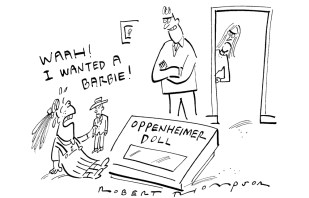
Several developments followed ineluctably from this. Another world war, of course; also a small but vibrant cottage industry in books explaining just what Wilson had thought he was playing at. Patrick Weil’s The Madman in the White House captures the anger and confusion of the period. His evenness of manner sets the hysteria of his subjects into high relief. Take, for example, Sigmund Freud, who blamed Wilson for the break up of the Austro-Hungarian empire: ‘As far as a single person can be responsible for the misery of this part of the world, he surely is.’
Anger and a certain literary curiosity drove Freud to collaborate with William C. Bullitt, Wilson’s erstwhile adviser, on a psychobiography of the man. Freud’s daughter Anna hated the final book, but one has to assume she was dealing with her own daddy issues. Delayed by decades so as not to derail Bullitt’s political career, Thomas Woodrow Wilson: A Psychological Study was published in bowdlerised form, and to no very positive fanfare, in 1967. Bullitt, by then a veteran anti-communist, was chary of handing ammunition to the enemy, and suppressed the book’s most sensational interpretations involving Wilson’s latent homosexuality, his overbearing father and his Christ complex. In 2014, Weil, a political scientist based in Paris, happened upon the original 1932 manuscript.
Are the revelations contained there enough on their own to sustain a new book? Weil is circumspect, enriching his account with a detailed and acute psychological biography of his own – of Freud’s collaborator. Bullitt was a democratic idealist and political insider who found himself pushed into increasingly hawkish postures by his all too clear appreciation of the threat posed by Stalin’s Soviet Union. He made strange bedfellows over the years. On his deathbed he received a friendly note from Richard Nixon: ‘Congratulations, incidentally, on driving the liberal establishment out of their minds with your Wilson.’
In fact John Maynard Keynes’s 1919 book The Economic Consequences of the Peace had chopped up Wilson long before, tracing ‘the disintegration of the president’s moral position and the clouding of his mind’. Then there was the 1922 Wilson psychobiography that Freud did not endorse, though he wrote privately to its author, William Bayard Hale, that his linguistic analysis of Wilson’s prolix pronouncements had ‘a true spirit of psychoanalysis in it’. And Alexander and Juliette George’s Woodrow Wilson and Colonel House, a psychological portrait from 1964, argues that Wilson’s father represented a superego whom Wilson could never satisfy. There are several others if you go looking.
So, is Madman a conscientious but unnecessary book about Wilson, or an insightful but rather oddly proportioned one about Bullitt? The answer is both – and this is not necessarily a drawback. Bullitt’s growing disillusionment with the president, his hurt and, ultimately, his contempt for the man shaped him as surely as a curiously unhappy childhood and formative political debacle at Princeton shaped Wilson.
‘Dictators are easy to read,’ Weil writes. ‘Democratic leaders are more difficult to decipher. However, they can be just as unbalanced as dictators and can play a truly destructive role in our history.’ This is well put, but I think Weil’s portrait of Bullitt demonstrates something broader and more hopeful: that politics – even realpolitik – is best understood as an affair of the heart.
A cherry orchard, three sisters and a summer romance: Tom Lake, by Ann Patchett, reviewed
Two plays guide the reader through Tom Lake, Ann Patchett’s ninth novel: Thornton Wilder’s Our Town, the story of ordinary lives in a small New Hampshire community in the early years of the 20th century, which, with its radically stripped-back staging, sets time and place in the context of all time and place, and enjoins its audience to ponder what is truly valuable in human life; and Anton Chekhov’s The Cherry Orchard, the story of the battle for an estate that throbs with conflict, violence and, ultimately, destruction. Patchett’s mind is on the twin forces of preservation and entropy: our desperate attempts to cling to the local and the familiar as the wider world threatens and besieges us; our need to both depart and return, to embrace and exclude.
Between bouts of furious harvesting, Lara recounts her life as a Hollywood starlet and her thunderclap romance
Our Town, which premiered in 1938, its themes foreshadowing the immense losses about to engulf multiple societies, initially struggled to establish itself as the classic it would become. The Cherry Orchard was met in similarly equivocal fashion, with Chekhov dispirited by its first production in 1904, in which the director, Konstantin Stanislavski, dialled up the play’s mournful seriousness and intimations of societal and ideological turbulence, and all but dispensed with the farcical elements. Tom Lake, set during the pre-vaccination pandemic but recalling a summer production of Our Town in 1988, is preoccupied throughout with its characters’ troubles in discerning whether they are living through a tragedy or a comedy, and of their part in proceedings whichever is the case.
Its contemporary story takes place in an actual cherry orchard, in Michigan, belonging to a former actress, Lara Kenison, (she has dropped the ‘u’ in her given name after reading Doctor Zhivago and in pursuit of something a little more exotic) and her husband Joe, who are joined for the duration of lockdown by their daughters, Emily, Maisie and Nell, all in their twenties. Deprived of their seasonal staff by the pandemic, the family is galvanised by a race against time to pick the season’s cherries before they rot on the trees. A longer-term threat slowly makes itself felt, as Emily – the natural farmer among the three sisters, and about to marry the scion of another cherry-growing family – declares her intention to remain childless as a response to the climate emergency. Who will inherit the farm decades down the line and, with the cherry trees shocked into premature blooming by mild winters, will there even be a farm to inherit?
With a killer virus on the loose and global warming on the near horizon, it is far more cheering to listen to old stories. The second storyline takes the form of Lara’s retelling, at her daughters’ insistent behest, of her summer-long relationship with a young actor called Peter Duke, whose star waxed as hers waned, earning him worldwide fame, an Oscar and – just a couple of weeks before the novel opens – premature death over the side of a yacht in Capri.
Between bouts of furious harvesting, Lara recounts her early life as a Hollywood starlet, her arrival at the bucolic theatrical community of Tom Lake and her thunderclap romance – all tangled sheets and Burton and Taylor smoking and drinking – with the clearly troubled Peter. He was, she tells her daughters, crazy – ‘and by craziness I do not mean talent of eccentricity but something deeply nuts’. They immediately chide her for her language; rather, they insist, she must say that he had things to overcome in his life, or that she should pay due attention to the form mental health issues took: ‘But you really shouldn’t talk about another person’s diagnosis,’ Maisie says. ‘Unless he wanted you to.’
Needless to say, Lara goes in for a degree of narrative cherry-picking. Her daughters won’t want to hear about the sex, she reasons, and nor, in any explicit sense, does Patchett imagine her readers craving such titillation. Peter and Lara’s erotic relationship is subsumed into their passion for acting, which gets ever more fraught as curtain-up approaches. The cast’s mishaps – a snapped Achilles; tendonitis; a senior actor too freely relying on his gin stashes – threaten not only the opening night of Our Town but the season’s other productions, of Cabaret and Sam Shepard’s Fool for Love.
Patchett’s talent for comedy makes itself felt in these scenes; but there is a terrible sense, too, of discovering one’s personal limitations. Lara’s acting gifts, it transpires, are confined to her extraordinary ability to inhabit the character of Emily, the tragic heroine at the heart of Our Town. When she is called on to play the hard-drinking May in Shepard’s doomed lovers’ tale, she founders horribly. Peter’s insistence, in another nod to Stanislavski, that she method-acts her way out of her dilemma by joining him in draining a bottle of tequila, is not helpful. (Neither, in the long run, is it helpful to him. He’s well on the road to a grim rehab centre.)
A notable twist as the story unfolds revolves around us not realising the identity of a major player
Lara has named her eldest daughter for Emily, the part that defined her early attempts to create a life, and present-day Emily is one of Tom Lake’s finest, most subtle creations. As a child, Emily had been obsessed with Peter Duke, convinced he was her real father; and she is still a walking encyclopaedia of his life and work, which sits weirdly with her more wholesome, responsible persona as guardian of the cherries. It is here that Patchett’s ability to capture family dynamics – perhaps seen to best effect in her generational novel, Commonwealth – particularly impresses. Her portrait of an eldest child, filled with doubt and difference, loved and loving but nonetheless crucially separate, is delicate and powerfully poignant.
So, too, is her ability to give life to marginal figures: the once-famed actor and company drunk, Uncle Wallace; Lara’s understudy, Pallas, who is black, and recognises that this will limit the roles she will be offered despite her immense talent; Peter’s limitlessly patient guardian-brother Sebastian, a tennis player who once faced the 17-year-old John McEnroe and now tutors the rich patrons of a country club. There is a notable twist as the story unfolds (and even then it is more of a jigsaw piece slotting in than a genuine jaw-drop) that revolves around us not realising the identity of a major player – as, Patchett seems to say, is so often the case in life.
Elon Musk slams Barbie, echoing the right’s lamest pundits
Elon Musk joined the war against fun this week. After changing Twitter’s iconic blue bird to a boring X, the eccentric billionaire bandwagoned on joyless conservative hate for the Barbie movie’s “feminist” messages. Cockburn wants to know: would it kill just one middle-aged man to admit that he liked the movie?
“If you take a shot every time Barbie says the word ‘patriarchy,’ you will pass out before the movie ends,” Musk tweeted Monday, in a rip-off of someone else’s joke. He was responding to a “Barbenheimer” meme mocking his decision to rebrand Twitter’s logo from colorful and playful to somber and gray, much like the difference between Barbie and Oppenheimer. Twitter users quickly accepted Musk’s challenge with confidence. “Weird way of admitting to being a lightweight,” one responded.
Musk was perhaps inspired by Daily Wire founder Ben Shapiro who released a forty-three-minute diatribe against the movie on Saturday. The video starts with Shapiro burning a Barbie in a trashcan bonfire before attacking the movie’s frequent invocation of the “patriarchy.” Shapiro claimed his producers “dragged” him to see the movie, but Cockburn isn’t buying it. Since the review was almost half as long as the movie itself, Cockburn knows he secretly enjoyed it — or, maybe just maybe, confected outrage is good for the Wire’s profits? His baby pink T-shirt and jean jacket were giving off some serious “kenergy” as well — nowhere near as good as Ryan Gosling, of course.
Other conservative figures that have weighed in on Barbie include Ted Cruz, who accused the move of pushing Chinese propaganda; Charlie Kirk who called it trans propaganda; and Fox News contributor Raymond Arroyo who said it was a “Trojan horse” for the feminist agenda. Cockburn thinks these grown men are just jealous that they will never be Barbie girls in a Barbie world. He is also at pains to remind these leading lights of the right that they often argue that it’s the left that are the joyless dullards these days: don’t stoop to their level!