-
AAPL
213.43 (+0.29%)
-
BARC-LN
1205.7 (-1.46%)
-
NKE
94.05 (+0.39%)
-
CVX
152.67 (-1.00%)
-
CRM
230.27 (-2.34%)
-
INTC
30.5 (-0.87%)
-
DIS
100.16 (-0.67%)
-
DOW
55.79 (-0.82%)
Should we pay for Harry and Meghan’s security?
After a period of several months in which attention has been mainly focused not on Prince Harry but on his uncle, Andrew Mountbatten-Windsor, the pendulum looks as if it is swinging back to Montecito all over again. The news over the past week or so has not been good.
Firstly, it was announced that the Sussexes’ much-ballyhooed deal with Netflix is spluttering to a close. Their last few projects have failed spectacularly, chief among them the ridiculed With Love, Meghan.
Secondly, Tom Bower’s latest exposé of all things Brand Sussex, Betrayal, is about to be published. Harry and Meghan have already denounced the book as a ‘deranged conspiracy’, but that hasn’t stopped it selling briskly on Amazon. Thanks in part to the helpful endorsement by its subjects, it will undoubtedly be a bestseller, bought in its tens of thousands by the same people who delighted in Andrew Lownie’s Entitled.
Added to all this, the ever-vexed issue of Harry’s security has arisen again – and it doesn’t look promising for the Duke of Sussex. The mood music a few weeks ago was that Ravec, the royal and VIP committee responsible for assessing security threats to individuals and assigning taxpayer-funded protection accordingly, was minded to decide that Harry and his family should have this protection restored to him. Lest we forget, Harry went through several long, expensive and ultimately fruitless court cases in order to obtain it. It was being briefed to the Mail on Sunday by hopeful insiders that ‘it’s now a formality. Sources at the Home Office have indicated that security is now nailed on for Harry’.
The defence of ‘not being as bad as Andrew and Fergie’ is not going to sway many hearts and minds
Well, things have (apparently) changed. The same sources have twigged that the idea that the British public should fork out for Harry and Meghan to be given this protection is not going to go down well. From a straightforward security perspective, the risk assessment remains the same, but from a political or public relations one, the idea of police officers being drafted in to be the Sussexes’ personal bodyguards is catastrophic. No wonder a source told the Daily Telegraph that:
There is nervousness among certain members of the committee who fear a public backlash. The political side believe there is too much political risk while the police and security chiefs believe that he absolutely must have it due to the extant threat.
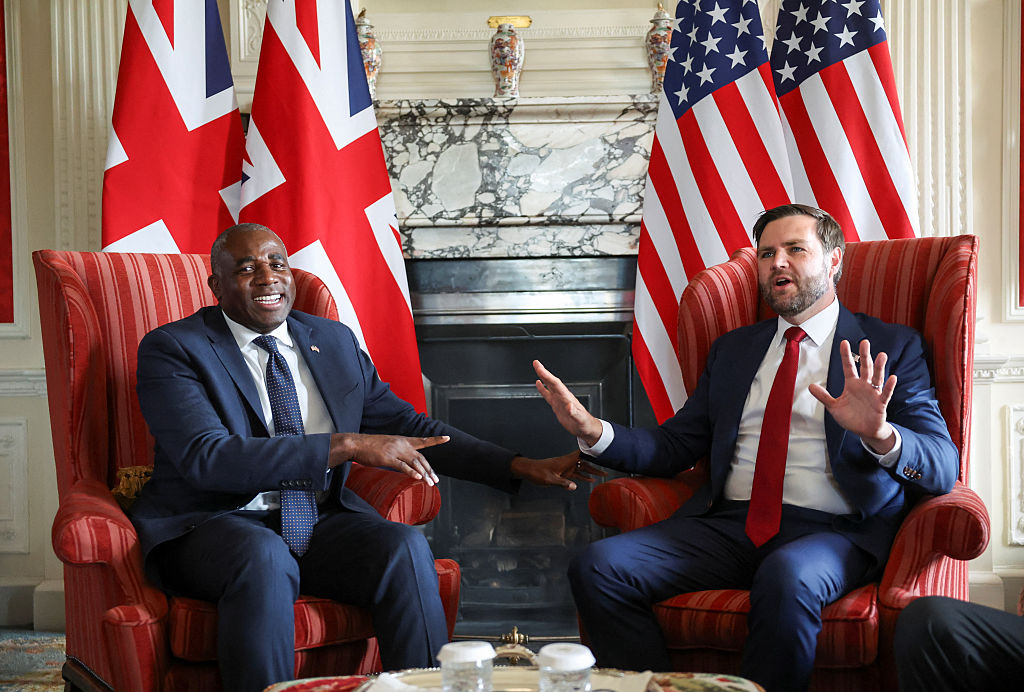
No decision has yet been made; Camp Sussex is making threatening noises about further legal action if Ravec should once again rule against them. Yet even for a serial litigant such as Prince Harry, there might now be a moment of room-reading rather than yet more fighting and fuss. It remains to be seen what the outcome of his privacy intrusion case against Associated Newspapers Limited is. But should he and his fellow litigants lose, it will not only be financially catastrophic but reputation-shreddingly embarrassing, too. In this circumstance, it is hard to imagine the Sussexes ever wanting to return to Britain, regardless of who funds their security detail.
It is saying a lot about the dire situation that the royals currently find themselves in that the best that can be said about Harry and Meghan is that they are not Andrew Mountbatten-Windsor and Sarah Ferguson. Harry has, after all, not spent a considerable amount of his free time consorting with Jeffrey Epstein and Peter Mandelson; Meghan, meanwhile, has been paying for her A-list lifestyle through her own efforts rather than putting out her hand to the British taxpayer and expecting them to cough up. Still, for all that, it is doubtful that the defence of ‘not being as bad as Andrew and Fergie’ is going to sway many hearts and minds.
The big test for Harry in Britain will come next year, when the Invictus Games take place in Birmingham. If, by then, his security has been restored, the privacy case has gone in his favour and the Andrew situation has been resolved in some definite fashion, he might feel that there is a chance that he will once again be welcome in the country of his birth. But if one or all these things do not take place, then he might be forgiven for skipping the event altogether. Whether Britain would be a poorer place for his absence remains, very much, to be seen.
Has Trump averted an energy crisis?
Have markets and governments horribly underestimated the fallout from the Iran war, or is it the doomsters who have got it horribly wrong? President Trump’s announcement has rather caught the world off guard. This morning, he posted on Truth social saying that he is seeking a negotiated settlement with Iran and has postponed his planned attacks on energy infrastructure. Many expected a huge escalation in hostilities this week. Could this be yet another example of TACO (Trump Always Chickens Out), or was his threat to bomb energy infrastructure another crafted bluff – and that order to the global economy will be swiftly restored?
At the end of this crisis, the the world ought to emerge with a restored faith in global capitalism
It certainly does not seem to be what the president of the International Energy Agency (IEA), Fatih Birol, was expecting. He claimed yesterday that the world is underestimating the risks. He said that the effect of the closure of the Straits of Hormuz is the equivalent of the 1973 oil crisis and the 2022 gas crisis, provoked by the invasion of Ukraine, combined. The 1973 crisis, he said, removed five million barrels of oil per day from global markets and the Ukraine crisis removed 75 billion cubic metres of natural gas. The current crisis, he says, has removed 11 billion barrels of oil and 140 billion cubic metres of gas. The IEA has started to sound a bit like the World Health Organization during Covid, calling for governments to launch emergency measures, such as lower speed limits on the roads and restrictions on air travel in order to save fuel.
Birol may well be right in that many people have underestimated the harm that would follow an extended closure of the Straits of Hormuz. There are going to be hard times ahead over the next few months. Inflation will rise, interest rates will remain high, and the global economy will be struck. Britain will be especially badly affected as the government has borrowed to the hilt and has voluntarily run down the oil and gas industries which could be protecting us from the worst. Fortunately, this crisis has come at the end of the northern winter, when heating demand is falling. It is not just energy, though, which has been undermined by the present crisis: fertilisers and plastics also rely on crude oil, while helium from Qatar is essential to the production of microchips.
Even so, it is not hard to foresee the reaction to this crisis. Industrialized nations are not going to stand around shivering. Capitalism, where it is allowed to, will ride to the rescue. Oil-producing nations outside the Middle East will increase their output in response to higher crude oil prices, whatever happens wit these negotiations. This will help counter the loss of the 20 percent of the world’s oil supply that until recently was flowing through the Straits of Hormuz. More marginal oil reserves will suddenly become more profitable to exploit. Who knows, maybe Britain will develop the guts to issue new licences for the North Sea, currently being attacked even by green energy entrepreneurs.
Saudi Arabia has already redirected 3.8 million barrels per day of oil production towards ports in the Red Sea, via an existing pipeline which is estimated to have a capacity of seven million barrels per day. It will surely find the means to transport more in this way, perhaps doubling up the pipeline. By comparison, Saudi Arabia has in recent years been exporting six million barrels per day through the Straits of Hormuz. It is astonishing how quickly the petrochemical industry can react when it does not have green zealots standing on its throat; remember how quickly floating liquefied natural gas (LNG) terminals were built off the coast of Germany to increase supply after the Ukraine crisis.
Meanwhile, consumers will respond by using less oil and gas. They will not need the IEA or their own governments to do this; price alone will persuade them to use less. Compared with the current moment, by the end of the year we will see increased oil and gas supply and reduced demand. The current surge in oil prices will be seen as just one more historic oil spike – just as the surge in gas prices in 2022 now shows up on graphs as a sharp spike rather than the permanent step-up in prices that many feared at the time.
It is true that oil prices did not rapidly fall after the 1973 crisis; it took a decade for them to fall back to where they had been on the eve of that crisis. But the global economy is a much more open and dynamic beast than it was then. The response times of the global petrochemical industry are likely to be rather quicker. At the end of this crisis, the world ought to emerge with a restored faith in global capitalism – as the machine that, once again, has kept us warm and fed.
Why did this Brazilian politician black up in parliament?
Fabiana Bolsonaro, a member of Brazil’s São Paulo state assembly, last week used makeup to darken her face and arms in what can only be described as a crude attempt at blackface in the middle of a parliamentary session. Her performance appeared to be a doubling down, in distinctly embarrassing fashion, on her earlier insistence that she is of mixed race – parda, in Brazilian-Portuguese.
Fabiana’s birth surname is Barroso. She is a white woman, the daughter of the politician Adilson Barroso. Like her father, she belongs to the Liberal party of former President Jair Bolsonaro, whose name she adopted in 2022.
Her blackface performance was reportedly intended as a protest – not only against what she perceives as preferential policies for people of colour, but also against the progressive transgender agenda associated with Erika Hilton, a fellow São Paulo politician. Hilton (not her original name – which is reportedly Felipe Santos Silva) is parda and a transgender woman.
Race remains a delicate subject in South America’s largest country. Brazil’s history of casual and overt racial discrimination is beyond dispute, though matters have improved somewhat in recent years. At the same time, Brazilians have long had a certain informality – even bluntness – in assigning nicknames based on physical traits. A blue-eyed or fair hared individual might be dubbed alemão (German), while a large black man will more often than not be called negão. Nor is it unusual for politicians to take on the surname of a political idol – particularly among Bolsonaro’s supporters. One of Fabiana’s colleagues in Rio de Janeiro state’s assembly, a retired army officer named Hélio Barbosa Lopes, combines it all: he is known as Hélio Bolsonaro and as Hélio Negão.
There is, of course, a distinction to be made between resisting woke politics and other excesses of progressive orthodoxy in Europe or in the United States, and engaging in blackface in a country where a majority of the population identifies as black or pardo. The latter is not merely unforgivable; it is electorally reckless for the political right.
Brazil is set for a general election in October 2026. Voters will choose a president, vice-president, members of congress and state governors. Of these, it is the presidential contest that commands the greatest attention.
At present, just two principal candidates have emerged: the incumbent, Luiz Inácio da Silva (better known as Lula), representing the left-wing Workers’ party, and Flávio Bolsonaro of the right-wing Liberal party and son of the former president. Jair Bolsonaro himself is barred from standing, having been sentenced to more than 27 years for his role in a failed coup attempt following his 2022 electoral defeat. Even so, he remains the pre-eminent figure on the Brazilian right.
Brazil may well tire of an ageing and increasingly unconvincing Lula, who is – in his words – only running for a fourth term in order to prevent the Bolsonaros from returning to power. More moderate, centre-right or centre-left figures have so far hesitated to enter the fray, perhaps waiting for a more opportune moment.
After its leader was convicted late last year, the veteran political analyst Bolívar Lamounier predicted that the Bolsonaro movement would swiftly lose relevance. That prediction, for now, appears premature. Though Flávio Bolsonaro has trailed Lula in the polls, the gap has narrowed a bit in recent months.
Tarcísio de Freitas, the technocratic and widely respected governor of São Paulo, a member of Brazil’s Republican party, is frequently cited as a figure capable of uniting a fractured right. Some polls suggest he may be better placed than Flávio Bolsonaro to defeat Lula in a second round. Less ideological and more managerial in temperament, Tarcísio draws support from urban and middle-class voters, as well as backing from Brazil’s influential business and political elites. The Bolsonaros, by contrast, retain a strong following in rural areas and among Brazil’s expanding evangelical electorate.
While Jair Bolsonaro has endorsed his son, the final line-up of the race remains uncertain. Tarcísio may yet strike an accommodation with smaller right-wing parties – or even with the Bolsonaro camp itself. Much will depend on controversies such as Fabiana Bolsonaro’s blacking up, if they are seen as symptoms of the Bolsonaro movement being unfit for stable government. That perception could persuade Brazil’s political dealmakers on the right to reorganise the playing field, pave the way for Tarcísio’s candidacy and throw the country’s presidential race wide open again.
When is prayer in public a crime in Britain?
When thousands gathered in Trafalgar Square last week to break their Ramadan fast, we were told this was Britain at its best. The message was that the UK is diverse, tolerant, and confident enough to make space for public expressions of faith. Islamic prayers were performed openly and unapologetically. Mayor of London, Sadiq Khan, took part, and Labour MPs, including Keir Starmer and Stella Creasy, defended the event vigorously on the grounds of a person’s right to freely express their religion.
The asymmetry could not be starker. Britain tolerates public religion – but only in some forms
But if this acceptance of those with deeply-held religious faith is truly a hallmark of Britain – and if we are indeed a country where people are free to pray openly in public – then it is a principle honoured with remarkable selectivity.
While Muslims are welcomed to pray loudly and openly in large groups in the centre of London, under the “buffer zone” legislation championed in 2024 by MPs, including Stella Creasy, those who pray publicly in the street outside abortion clinics – even if they do so alone, and even if they pray silently in their own minds – could swiftly find themselves in trouble. Under Section 9(1)(a) of the Public Order Act, if their presence is perceived merely to ‘influence’ someone considering going into the abortion clinic, they are likely to be arrested. Individuals have been questioned, fined, and dragged through court after standing, thinking, in a public space within 150 metres of an abortion facility.
Take Adam Smith-Connor. The Christian army veteran and father of two was tried, found guilty, and ordered to pay £9,000 after he paused across the road from an abortion facility in Bournemouth. Adam had lost a child some twenty years earlier to an abortion. It was a decision he deeply regretted. And so, in November 2022, he stopped for just a few minutes in a public area outside a clinic to pray for his unborn son. He didn’t talk to anyone, other than an officer who asked him to leave. He simply stood by a tree, obscured from view to most people, and prayed silently.
Adam’s conviction marked the first time a person had been penalised under British law after praying since the conviction of Oliver Plunkett, the last Catholic martyr, in 1681. Adam’s legal battle is ongoing. An appeal is expected later this year. But even if he wins, the four-year legal battle he has faced has been punishment in itself.
He isn’t alone. Isabel Vaughan-Spruce – a Christian volunteer from Birmingham with a long history of supporting pregnant women in need – awaits trial for the same “offence” after standing silently, praying imperceptibly, bothering nobody.
The asymmetry could not be starker. Britain tolerates public religion – but only in some forms.
Supporters of the buffer zones insist these laws are not about stamping out Christianity, but about protecting women from harassment. They argue that even silent prayer can “influence” a woman’s decision whether or not to access an abortion service. But this defence collapses under scrutiny. Longstanding laws already exist to prevent women from experiencing any form of harassment. It is not the role of the State to determine what factors, however peaceful, should influence a major personal decision such as having an abortion.
If standing in the wrong place and silently praying can be deemed a form of unlawful “influence”, then we have crossed a serious line. Whether or not you are breaking the law appears to be based, no longer on what you do in public, but on what others believe you might be thinking. That is a principle with no natural limit.
Britain has long prided itself on protecting not only popular speech, but unpopular conviction. That tradition is under threat when the state decides which beliefs are acceptable, which are not, and where you are allowed to express what you believe.
The anti-Christian bias of the British establishment now seems undeniable.
Religious freedom is a right, not a political prop. Britain cannot claim to be liberal while tolerating some expressions of faith in public and suppressing others. The asymmetry of protection – Islamic expression in Trafalgar Square embraced, Christian prayer outside an abortion clinic penalised – is a norm we might expect abroad, not at home.
If Britain is to remain a free nation, it must treat all faiths equally. Silence is not a crime. Prayer is not a threat. Liberty demands no less than tolerance for those who want to pray in public – wherever they want to do so.
Livestream: BBC – defund or defend?
Editorial errors, ideological bias and partisan presenters – what has happened to the BBC? Watch The Spectator’s Charles Moore, who was fined after refusing to pay his licence fee, and the Telegraph’s Allison Pearson go up against Spectator editor and former BBC journalist Michael Gove and former BBC America editor Jon Sopel to debate whether we should defund – or defend – this once great institution.
The event took place on Tuesday 24 March and you can watch the full live recording here.
The intifada has arrived in London
At first I thought it was a scene from one of the battlefronts in the Middle East. The hellish glow of an out-of-control fire. A thunderous explosion. And innocents fleeing in terror. Only this was no warzone. It was Golders Green. It was that peaceful Jewish enclave in north-west London. And last night it was subjected to what seems to have been an act of apocalyptic Jew hatred, a fiery pogrom designed to terrify London’s Jews.
This was a blazing statement of loathing for Britain’s Jews
Actually, scrap that – this was a warzone. Last night’s sickening assault was the latest vile strike in a war on the rights of Jews. Four Hatzola ambulances were set on fire. Hatzola is a non-profit organisation that provides emergency medical care to the Jewish community and others. In the dead of night, three masked men approached the ambulances, doused them in flammable liquid, and destroyed them. All that remains this morning is twisted, blackened wreckage – the debris of racial hatred.
The Metropolitan Police are treating it as an anti-Semitic hate crime. If they are right – and there’s no reason to doubt that they are – then we need to speak plainly. This was an act of fascistic savagery. This was a blazing statement of loathing for Britain’s Jews. It was an act of staggering disregard for the sanctity of Jewish life: homes surround the carpark where the fascist fire was lit, and it is thanks only to merciful luck that no one was injured.
Today we will hear much stern criticism of this brutish terrorising of London’s Jews. Keir Starmer has rightly called it “horrific” and “deeply shocking”. Yet condemnation without reflection is worthless. Every decent Brit whose mind and soul have not been fried by the malady of Israelophobia will know this was a despicable act. The question we need to ask ourselves is why things like this are happening in 21st-century Britain.
The barbarous assault on Hatzola did not take place in a vacuum. It follows two-and-a-half years of surging anti-Semitism. In the wake of Hamas’s 7 October pogrom, acts of Jew hatred in the UK reached dizzying and terrifying new heights. Jewish schoolkids were attacked. Synagogues were daubed with bloodcurdling graffiti. And two Jews were slain by a knife-wielding Islamist at a synagogue in Manchester on Yom Kippur.
Then there have been the hate marches. Almost every weekend, unholy assemblies of affluent socialists and radical Islamists trudged through our cities to damn the Jewish nation as the most evil nation. From behind their keffiyehs they barked about the evils of Zionism. They called Zionists “baby-killers” – the same words Jews would have heard in twelfth-century England before they were murdered by the mob. They agitated for the destruction of Israel all the way “from the river to the sea”. They hollered for more intifada just weeks after an intifada had laid waste to more than a thousand Jewish lives in Israel.
“It’s just criticism of Israel”, they said. Stop it. The anti-Semitism crisis is too pressing for such slippery moral evasion. The truth is as bright as those fires that engulfed Golders Green: when you demonise the world’s only Jewish nation as the world’s wickedest nation, you endanger Jews. When you brand Zionism as a uniquely murderous ideology, you hang a target sign around the necks of Zionists – and the majority of Britain’s Jews identify as Zionists.
Even more chilling than the rise in Jew hate has been the nonchalance about it in polite society. Self-styled “anti-racists” said nothing as Jewish schoolkids were pelted with bottles and Jews were advised by cops to hide their Star of David necklaces. That section of society that sees “fascism” everywhere – in the vote for Brexit, in Donald Trump’s oafish commentary – has had nothing to say about the truly fascist vibe of this swirling animus for the Jewish homeland and the Jewish people.
For me it was summed up by the events of the past week. At the Al Quds gathering in London a week ago, I saw with my own eyes a mob of Islamists singing the praises of an anti-Semitic tyrant (the late Ayatollah Khamenei) and chanting for the death of Jewish soldiers. And yet what have the chattering classes been wringing their manicured hands over this past week? Nick Timothy’s polite, principled criticism of mass Muslim praying in public. We live under a cultural establishment that is more horrified by criticism of Islamic practices than it is by mob bloodlust for the violent demise of the Jewish state and its people.
Last year I visited the site of the Nova music festival massacre. The young woman who showed me around – a survivor – told me the horrific story of Hamas firing a rocket at an ambulance. The young Jews who had taken refuge in the ambulance were burnt to death. And now we have anti-Semitic ambulance attacks right here in London. Listen. If you said “Globalise the intifada” after an intifada that entailed the burning of Jewish ambulances, then we don’t want to hear a word from you about the burning of Jewish ambulances in London. For here it is, in all its fiery horror, your intifada.
Why the Iran oil crisis might not be as bad as we feared
Have markets and governments around the world horribly under-estimated the fallout from the war in Iran? That is the claim made by the president of the International Energy Agency (IEA), Fatih Birol, who says the effect of the closure of the Straits of Hormuz is the equivalent of the 1973 oil crisis and the 2022 gas crisis, provoked by the invasion of Ukraine, combined.
Industrialised nations are not going to stand around shivering. Capitalism, where it is allowed to, will ride to the rescue
The 1973 crisis, he said, removed five million barrels of oil per day from global markets and the Ukraine crisis removed 75 billion cubic metres of natural gas. The current crisis, he says, has removed 11 billion barrels of oil and 140 billion cubic metres of gas. The IEA has started to sound a bit like the World Health Organisation during Covid, calling for government to launch emergency measures, such as lower speed limits on the roads and restrictions on air travel in order to save fuel.
Birol may well be right in that many people have under-estimated the harm that would follow and extended closure of the Straits of Hormuz. There are going to be hard times ahead over the next few months. Inflation will rise, interest rates will remain high, the global economy will be struck. Britain will be especially badly affected as the government is borrowed to the hilt and has voluntarily run down the oil and gas industries which could be protecting us from the worst. Fortunately, this crisis has come at the end of the northern winter, when heating demand is falling. It is not just energy, though, which has been undermined by the present crisis: fertilisers and plastics also rely on crude oil, while helium from Qatar is essential to the production of microchips.
Even so, it is not hard to foresee the reaction to this crisis. Industrialised nations are not going to stand around shivering. Capitalism, where it is allowed to, will ride to the rescue. Oil-producing nations outside the Middle East will up their output in response to higher crude oil prices, helping to counter the loss of the 20 per cent of the world’s oil supply which until recently was flowing through the Straits of Hormuz. More marginal oil reserves will suddenly become more profitable to exploit. Who knows, Keir Starmer may finally discover the guts to over-rule Ed Miliband, whose refusal to issue new licences for the North Sea is being attacked even by green energy entrepreneurs.
Saudi Arabia has already redirected 3.8 million barrels per day of oil production towards ports in the Red Sea, via an existing pipeline which is estimated to have a capacity of seven million barrels per day. It will surely find the means to transport more in this way, perhaps doubling up the pipeline. By comparison, Saudi has in recent years been exporting six million barrels per day through the Straits of Hormuz. It is astonishing how quickly the petrochemical industry can react when it does not have the likes of Miliband standing on its throat; remember how quickly floating liquified natural gas (LNG) terminals were built off the coast of Germany to increase supply after the Ukraine crisis.
Meanwhile, consumers will respond by using less oil and gas. They will not need the IEA or their own governments to do this; price alone will persuade them to use less. Compared with the current moment, by the end of the year we will see increased oil and gas supply and reduced demand. The current surge in oil prices will be seen to be yet one more oil spike – just as the surge in gas prices in 2022 now shows up on graphs as an sharp spike rather than the permanent step-up in prices which many feared at the time.
It is true that oil prices did not rapidly fall after the 1973 crisis; it took a decade for them to fall back to where they had been on the eve of the crisis. But the global economy is much more open and dynamic beast than it was then. The response times of the global petrochemical industry are likely to be rather quickly.
At the end of this crisis, I sense that the world may emerge with a restored faith in global capitalism – as the machine which, once again, has kept us warm and fed.
Old France defies the far-left – but for how much longer?
The left achieved a rare success in Paris on Sunday with the victory of Emmanuel Grégoire in the capital’s mayoral election. The Socialist candidate saw off the challenge of the centre-right candidate Rachida Dati in the second round. Grégoire is the third consecutive Socialist mayor of the French capital, a run that stretches back to the election of Bertrand Delanoe in 2001.
‘Paris has decided to stay true to its history,’ exclaimed Grégoire in his victory speech. ‘Paris will be the heart of the resistance against this alliance of the right, which seeks to take away what we hold most precious and fragile: the simple joy of living together.’
But is it the right in France that seeks to divide people or the alliance of Socialists, Communists, Greens and, in particular, Jean-Luc Melenchon’s la France Insoumise (LFI)?
Grégoire was one of the few Socialist candidates who refused to form a coalition with LFI after last-week’s first-round of voting in municipal elections across France. So, too, did the candidates in Marseille and Pau – and their principled stand was also rewarded with victory. In Pau, the Socialist Jérôme Marbot defeated the former centrist prime minister Francois Bayrou, who had ruled the southern city since 2014.
But where Socialist candidates did ally with LFI – the party that sends a shudder down the spine of French Jews – they lost. In the cities of Limoges, Toulouse, Brest and Clermont-Ferrand, the left lost to the centre-right as voters rejected the aggression and division of LFI.
Brest has been controlled by the left for 37 years and Clermont – famous for its manufacture of Michelin tyres – since 1919. Toulouse is home to Airbus, and traditionally votes centre-right. But after last week’s first round, the Socialists and LFI announced a ‘fusion’ in the expectation of winning the city.
The prospect of the far-left running Toulouse terrified Airbus so much that they mooted the possibility of relocating. Prominent figures connected to the city’s rugby club – the French champions – urged people to vote for Jean-Luc Moudenc, the centre-right candidate.
It is not just the economic policy of the far-left that alarms voters. Like the Green Party in Britain, LFI are the party of immigration. Last year Jordan Bardella, the president of the National Rally, even suggested the party should be renamed La France Islamist.
Melenchon has for several years talked of building ‘a New France’ of immigrants to replace the Old France, what he appeared to mock in a speech last week as ‘white and ugly’.
This ‘New France’ was referenced last week when LFI achieved a rare mayoral victory in Seine-Denis, the sprawling area north of Paris.
Seine-Denis was once a white working-class heartland. In 1968, only ten per cent of children in the department were non-European. As of 2017 (the most recent statistics) this figure is now 66 per cent.
The supporters of Bally Bagayoko celebrated his becoming mayor of Seine-Denis by chanting: ‘We are all the children of Gaza’.
The only other notable success of LFI was the second round victory of David Guiraud in Roubaix, a city that in recent years has been tainted by rumours of Islamist infiltration. Guiraud gained notoriety in 2024 when he was filmed in the National Assembly shouting ‘pig’ at a Jewish MP.
It is victories in areas such as Roubaix and Seine-Denis that will console Melenchon and his party this morning. They have achieved little this time around, but the demographics are tilted heavily in their favour; the ‘New France’ remains a work in progress, a dream that could be realised in a generation or two.
‘Old France’, as personified by Marine Le Pen’s National Rally and the centre-right Republicans, enjoyed much more success. The National Rally were thwarted in their attempt to win the Mediterranean cities of Nimes, Marseille and Toulon, but their ally, Eric Ciotti, is the new mayor of Nice and they also took control of Carcassonne, Castres and Montauban, to go with their victory in Perpignan last week.
The Republicans won the cities of Besançon, Brest, Limoges, Cherbourg and Clermont-Ferrand and a host of villages and towns across the country. Their leader, Bruno Retailleau, attributed the party’s success not just to the strength of their candidates but also the ‘shameful alliances’ concocted on the left.
‘We remain the leading local political force in France,’ added Retailleau.
Retailleau, who will run for president next year, declared on Sunday evening that his party’s strong showing demonstrates that there is another option for voters.
Describing it as a ‘demanding path’, Retailleau said it was for those voters who ‘want neither the social chaos towards which LFI is leading us, nor the fiscal disorder into which the RN’s economic programme would plunge us’.
The problem for the Republicans nationally is their reputation. Like the Tories in Britain, they ran France for years (from 1995 to 2012) and in that time immigration, insecurity and deindustrialisation become institutionalised. Emmanuel Macron has failed to tackle any of these issues.
That is why future elections in the Republic are less likely to be between left and right and more a confrontation between LFI’s ‘New France’ and the National Rally’s Old France.
How Trump can ‘win’ in Iran
The United States is once again in a terrible predicament: a war where the definition of ‘victory’ grows murkier by the day, against an adversary whose advantages lie in the tyranny of geography and its determination to fight. While the US and Israel enjoy overwhelming conventional superiority, a handful of cheap Iranian drones or weaponised IRGC dinghies have been able to take America’s Gulf oil allies offline and render the strategic Strait of Hormuz unnavigable. Donald Trump faces what we might call the ‘Corleone problem’: the don can end the war, but only if peace looks like a gift he’s granting, not a price he’s paying.
America has been trapped by this logic before. The Kennedy and Johnson administrations did not stay in Vietnam because they believed in the domino theory but because they could not be seen to lose. The operative concept was ‘credibility’, the idea that American commitments ranging from Nato to the Taiwan Strait depend on Washington demonstrating it would pay any price to honour its pledges, or that the US remains the world’s top dog. The credibility trap is springing again. If the US walks away while Iranian missiles are still falling on Gulf infrastructure, the signal to every revisionist power – China above all – is that asymmetric pressure works. Washington does not merely need an exit, but one that looks like a victory. How?
Trump’s ‘I knew nothing’ routine is likely the opening act of an exit strategy
Washington needs to put (at least rhetorical) distance between itself and Jerusalem. This is already happening. Trump’s public admonishment of Benjamin Netanyahu over Wednesday’s Israeli strike on Iran’s South Pars gas field was not an accident, nor was his implausible claim to have known ‘nothing’ about it in advance. Trump’s ‘I knew nothing’ routine is likely the opening act of an exit strategy. By publicly hanging Netanyahu out to dry over the gas fields, the White House is effectively building a firebreak between American interests and Israeli escalation. It’s a calculated performance of ‘the adult in the room’ restraining a trigger-happy ally. If Trump can successfully sell the narrative that he is the one keeping the lid on a regional meltdown, he transforms a messy military withdrawal into a feat of global statesmanship.
Trump must also declare victory on the nuclear front. Netanyahu has handed Washington this gift in his press conference on Thursday, where he declared that Iran’s capacity to enrich uranium and manufacture ballistic missiles had been destroyed. If joint strikes have genuinely destroyed Iran’s enrichment capability, this is the most significant nonproliferation achievement since Libya abandoning its nuclear ambitions in 2003. The original sin of the Iran crisis was always its nuclear programme. If that programme is finished, the US can claim, with considerable justification, that the core objective has been achieved. Mission accomplished, although this time, perhaps, without the premature triumphalism of President Bush’s aircraft carrier in Iraq in 2003.
Hardest of all, Washington must build a deal that Tehran and regional states can accept. Iran holds cards that no amount of bombing can remove. Geography is permanent: the Strait of Hormuz will still be there when the last cruise missile has been fired. The regime survived eight years of war with Iraq. It will not submit because of a few weeks of American air power.
Since 1979, the Gulf’s security order has been built on Iranian exclusion, and it has manifestly failed to produce stability. The Gulf states themselves have recognised as much. The China-brokered Saudi-Iranian rapprochement of March 2023 was a real step towards a different regional order: embassies reopened, foreign ministers exchanged visits, and the détente held even after 7 October.
When Israel struck Iranian territory in October 2024, the Gulf states refused to allow Israeli or American aircraft to use their airspace. Saudi Arabia condemned the strikes as a violation of Iran’s sovereignty. These are the actions of states that have decided accommodation is preferable to permanent confrontation. A durable settlement would build on this foundation, offering Tehran what it has always sought – acknowledgment as a major regional power with legitimate security interests – in return for constraints on its missile programme and an end to infrastructure attacks.
And Israel? The cold strategic logic is more favourable than it appears. The existential threat was always the nuclear programme, and that has been destroyed. Hezbollah is severely degraded. Hamas is a shell. The proxy architecture that constituted the ‘ring of fire’ has been dismantled more thoroughly than at any point since its construction. Israel has emerged from the horror of 7 October as a strategic regional hegemon. Israeli prime ministers have walked back maximalist war aims before: for example, after the 2006 Lebanon war and after each Gaza operation. The public has accepted the gap between rhetoric and outcome, provided the security gains are tangible. Destroying Iran’s nuclear capability is about as tangible as it gets.
Would Iran’s leadership accept such a deal? Perhaps not today. But the point is less about what is achievable than about what is frameable, and thus builds momentum towards a deal to settle this devastating conflict. The US needs an exit narrative, and ‘we destroyed their nuclear programme and brokered a new regional security order’ is a considerably better one than ‘we got scared of $120 oil’. The lesson of Vietnam is not that America should never fight. It is that America should never fight without knowing what victory looks like and how to get home. It is now time to go home.
Is Britain braced for Iranian missiles?
Where’s your nearest bomb shelter? And how long would it take you to get there? What about at work? Have you downloaded an early warning app for alerts when there’s an incoming missile attack?
If you live in Britain, you probably can’t answer most of these questions. I have no idea where my nearest shelter is.
So what will you do when the time comes? All this might be purely theoretical. But it is not impossible
Israelis can answer all these questions and have been able to for years. Of course – they live under the constant threat of missile attack. They’ve had to implement effective monitoring, alerts and shelter provisions. And they’ve invested massively in anti-missile defence systems which despite the two mass casualty strikes they experienced on Saturday in Arad and Dimona, have been 92 per cent successful during an Iranian assault of over 400 ballistic missiles over the last three weeks. Since their current war with Iran started, there have been only four destruction sites in Israel.
Britain has never had to deal with all that. Not since 1945, anyway. But this week the Islamic Republic of Iran proudly demonstrated its long range ability, aiming its missiles at British territory – Diego Garcia in the Chagos Islands. We now know (as we had suspected before) that Europe is also within range, including London. So what is our government doing to protect us?
Commenting from the southern Israeli city of Arad which was hit over the weekend, Israeli Prime Minister Benjamin Netanyahu spelled it out for us: Iran targets civilians, and Europe should take note, especially after Iran fired an intercontinental ballistic missile on Diego Garcia. “That’s 4,000 kilometres,” he said. “I’ve been warning all the time, they have now the capacity to reach deep into Europe. They already have fired on European countries – Cyprus. They are putting everyone in their sights.”
Perhaps Keir Starmer thinks his appeasement of Iran, Hamas, and the Islamic Republic regime itself will prove to be air defence enough. He shouldn’t: they’ve already attacked gulf states who have been their traditional allies or sought to remain neutral in this conflict. Like Britain, they have not been directly involved in striking Iran, but that didn’t buy them immunity from the theocratic lunatics. Perhaps Starmer thinks his loving caress from the now Palestinian ambassador in Westminster hall, filmed for all to see as the sounds of ‘Allahu akbar’ rung through the historic parliamentary location, will have calmed the mullahs’ ire for us British infidels. Perhaps Sadiq Khan’s Adhan in Trafalgar Square, now seen around the world, will have placated the Islamic Revolutionary regime to act as an inoculation against Islamic fundamentalist missiles. Perhaps not.
Inexplicably, it fell to Housing Secretary Steve Reed to reassure us of the UK’s military abilities. “We have systems and defences in place that keep the United Kingdom safe, and that will continue to happen,” he told Sky News. “We will take necessary defensive action to protect British interests,” he said. I hope you’ll forgive me for not believing him, but I don’t have much faith in this or previous governments having prepared in advance for this threat. Just remember how, when the Covid pandemic broke out, we discovered that successive governments had been all too ready to forfeit expensive forward planning for disasters in favour of saving a bit of money.
If the necessary measures are already in place, they need to tell us, rehearse us, prepare us. Israeli society is well versed in such matters. I’ve sat in restaurants in Israel and had to cross the road to an underground car park to seek shelter before casually returning for desert afterwards. Meetings are planned around the closest shelters. Mobile phones deliver localised warnings and even timings to help you get to a shelter when needed. Neighbours help each other out if they don’t have private shelters at home. But what can we do here in Britain if we have to take shelter, and when will our government decide to tell us about it?
Some might think this alarmist, or over the top, but the Brits and others living in Dubai never thought they would need to take shelter, until Iran attacked them without hesitation or warning. And the regime in Iran is willing to target civilian targets without hesitation. In the strikes over the weekend on Israel, they hit yet more Israeli civilian areas, wounding around 175 people across the two cities. Are we ready for this in Britain?
It’s not that they didn’t know. There has been a real and long standing concern that Iran might launch longer range missiles for years. As early as March 2019, the permanent representatives of France, Germany, and the United Kingdom to the United Nations addressed a letter to the Secretary-General (and circulated to the Security Council), expressing serious concern over Iran’s ballistic missile developments. They highlighted the Khorramshahr missile’s new conical warhead design, which appeared smaller and lighter than previous versions. Such a modification could significantly extend the missile’s range by reducing payload weight while preserving or enhancing propulsion and accuracy, potentially allowing much longer range strikes. Follow-up letters in November 2019 reiterated worries that these advances made Iran’s missiles more capable of delivering nuclear payloads. The Islamic Republic’s actions in recent weeks can only have made those concerns greater.
But our country’s defences have been neglected and degraded for years. We have nothing like Israel’s missile defences. While we officially have six Royal Navy Type 45 destroyers, recent reports confirm that only about three are currently operational or readily deployable, with the others tied up in long-term maintenance and power improvement upgrades that won’t fully conclude until around 2028. One has been sent to the Middle East to defend Cyprus. That leaves us just one to protect us back home. Our defences are not designed to protect against ballistic missiles. Successive governments have allowed this situation to arise.
Our country’s defences have been neglected and degraded for years
We are unprepared for what could happen, and our current government is officially in denial, which only makes it worse. In fact, it was the Americans and the Israelis who told us about the missiles launched at Diego Garcia, not our own Defence Secretary or Prime Minister. It has been left to foreign countries to both warn us of the dangers, and to fight against the adversary potentially posing them, all without our proper willingness to help.
Suitable civilian protection can be done outside Israel. Switzerland stands in stark contrast to Britain’s limited preparations, boasting one of the world’s most comprehensive shelter systems rooted in law since the early 1960s. Following a 1959 referendum and the 1963 Federal Protective Shelter Law, Switzerland mandated that new residential buildings include reinforced shelters or that owners contribute fees to fund nearby public ones, ensuring every resident has access to a protected space. This Cold War-era policy was designed primarily against nuclear fallout, blasts, and weapons of mass destruction, but has endured with updates, including a new civil protection ordinance effective in 2026 that modernises around 200 larger bunkers at significant cost amid renewed global threats like the wars in Ukraine and the Middle East. Today, the country maintains approximately 370,000 shelters – mostly private basement rooms in homes and buildings, plus public facilities – providing over nine million spots. That is more than 100 per cent coverage for its roughly nine million inhabitants. Britain’s public or private bomb shelters were largely dismantled after the Cold War. We have no Swiss or Israeli style plan to offer population-wide protection.
So what will you do when the time comes? All this might be purely theoretical. But it is not impossible. We can hope for the best, absolutely, but that is not a defence strategy. Unless we also prepare for the worst, we might well need to run for shelter, but we’re unlikely to find it.
Dubai is a city built on sand
Dubai is like the dazzling partner some people enjoy being seen with, but know deep down they would never marry. Style without substance. Attraction without culture. All the confidence but none of the charisma. A place associated with glitz and glamour, not class and intellect.
The carefully cultivated influencer-led depiction of Dubai as the best place in the world is falling apart
What attracted many Westerners to Dubai was the absence of income tax. In more recent years, as the quality of life in Britain has been declining, clean and safe streets have been pull factors for some Brits. But the Iranian regime’s drone attacks on the United Arab Emirates has shattered the illusion of Dubai as a safe haven. The carefully cultivated influencer-led depiction of Dubai as the best place in the world is falling apart like the ceiling of its international airport after another strike.
This hasn’t stopped the Emirati authorities from desperately trying to deny what is plain to see. A 60-year-old British man has been charged under cyber-crime laws after allegedly filming Iranian missiles over Dubai. For a place so popular with influencers, it’s ironic that the UAE has such strict laws around what is posted on social media. But it should hardly come as a surprise: it’s a stark reminder that the city is part of an authoritarian Islamic dictatorship run by families who ruled over little more than livestock, fig trees and sand until a few generations ago.
Enlightened thinking comes from centuries and millennia of richness of culture, ethnological depth and diversity and inter-ethnic tolerance and harmony. But these things don’t spring to mind when I think of Dubai. You are more likely to find easy money, fast cars and even faster relationships in the Persian Gulf.
It isn’t completely over for Dubai, of course. While the city’s image as a safe haven and holiday destination has suffered badly – perhaps irreparably – as a result of the fallout of the Iranian war, money still talks. And the government of the Emirati city – and that of other Arab countries in the Persian Gulf – has enormous oil and gas reserves, and therefore immeasurable wealth, along with their formidable portfolio of European and American real estate and (tech) companies.
The UK government has allowed plenty of British real estate to be owned by the governments of Arab nations in the Persian Gulf. This includes key parts of central London, from Mayfair to the de-Anglified areas of Knightsbridge and Belgravia, with institutions like Harrods, the Savoy Hotel and the Shard, and properties across Canary Wharf propping up Gulf Arab influence on British soil. As a venture capitalist, I can only applaud the investment decision makers of these nations – particularly as real estate in their own countries has relatively little fundamental resilience. The Dubai (DFM) Real Estate Index indicates the Dubai property market has lost a third of its value since the start of the conflict in the Middle East, while Dubai’s main share index, the DFMGI, has fallen by more than 18 per cent, wiping $229.61 billion (£170 billion) off its value in the same period.
Capital will continue to flow in and out of Dubai after this conflict, but it’s unlikely to do so at the same extent as before – particularly when Iran becomes a liberated, democratic country that is freely trading with the world.
People talk about how safe Dubai is – and it is – but they conveniently forget that, along with proper policing resources (unlike in the UK), they also impose excessively strict penalties for suspects and criminals, including the death penalty.
From what I’ve been told from friends who have lived there for many years, the (romantic) relationships are as artificial and superficial as the environment in which they start.
If you want to get an idea of the mentality, grace and honour of some of those people who choose a life in Dubai just google “Dogs Dubai”. You will see reports of residents abandoning their “beloved” pets in the street as they flee this once safe-haven for colder, safer, shores. Images of pets left tied to lamp posts or without water have been circulating on social media with vets said to be overwhelmed by the sheer number of abandoned pets. Not even beautiful and vulnerable creatures like dogs are safe from the shorttermness of an Emirati relationship.
The Iran war has exposed the shallow sands on which Dubai is built. But there’s another issue for the Emirates as a result of what is unfolding in Tehran: the Islamic Republic in Iran will fall at some stage, and, when it does, nobody will choose to live in Dubai.
The rise of Turkey and Arab nations in the Persian Gulf like the UAE, Saudi Arabia and Qatar have all come – directly or indirectly – as a result of the 1979 Islamic Occupation in Iran and the downfall of the Iranian nation and economy. The leaders of these Arab countries in the Persian Gulf know and fear where their countries would stand should Iran and its people return to the world’s stage as a free country.
The rise of Turkey and Arab nations in the Persian Gulf like the UAE, Saudi Arabia and Qatar have all come – directly or indirectly – as a result of the 1979 Islamic Occupation in Iran
The emergence and rise of the Arab nations in the Persian Gulf has been a temporary substitute for a suppressed civilisation. A sleeping giant of a civilisation that is on the precipice of its second awakening.
Iran, the oldest still existing nation state, with millennia of rich history, will welcome those who considered Dubai exciting and exotic. Though I think the country would prefer to do so for those who prefer somewhere with history, culture and depth – and those who didn’t abandon their dogs. After all, in Persian culture and Zoroastrianism, the true religion of Iranians, mankind was divinely mandated to care for dogs.
Situated between four biological regions, Iran’s varied geography includes Caspian rainforests, snowy mountains and arid deserts. Ranking among the world’s top nations for ecological and biodiversity due to its position at the intersection of major zoogeographical zones, Iran boasts exceptionally rich flora and fauna.
With its twenty-five ski resorts, Iran has some of the best and highest skiing in the world, and at altitudes of 3,500 metres, the season goes on until late May. In theory, if you wake up early enough, you can ski in the morning and scuba dive with turtles and dolphins in the afternoon, without leaving Iran.
From the ashes of the Islamic Republic, a free and democratic Iran will rise. The 170-page Iran Prosperity Project, the comprehensive, multi-phase proposal developed by HRH Iranian Crown Prince Reza Pahlavi alongside experts, and overseen by the National Union for Democracy in Iran (NUFDI), has outlined a roadmap for rebuilding Iran’s economy in a post-Islamic Republic transition period. It proposes tax breaks and economic reforms designed to be highly attractive to foreigners as well as the four-million-strong Iranian diaspora to reverse one of the largest brain drains in modern history.
The country with the second largest STEM graduate population per capita will build the Silicon Valley of the Middle East, if not Asia. And where the tax breaks lie and the innovation takes place, foreign talent and financial institutions alike will follow.
Iran will be the future hub of the Middle East and this great, historic nation and its talent will retake its place on the global economic and cultural podium as it once again becomes the gateway between East and West.
Is Prince William really a shy Christian?
So Prince William is a good Anglican after all. He has told the Times, through an aide, of his commitment to the Church, on the eve of attending the installation of the new Archbishop of Canterbury. But does he consider himself a Christian believer? The statement awkwardly dances around that question. It leaves the impression that he does not really consider himself a Christian, but knows that he must keep this semi-veiled.
We then hear that ‘his relationship with the Church will “evolve” from that of previous monarchs, whose strong faith underpinned their reigns.’
The statement is difficult to analyse because the words are not quite his. They come from an aide; he presumably signed them off, but there is an air of vagueness and deniability in such a not-quite-statement. Absurdly, the aide says that this statement ought to clear up any muddle, ‘draw a clear line in the sand’ concerning his religious commitment.
The article begins thus: ‘The Prince of Wales has revealed his “quiet faith” and “commitment to the Church of England”, in a significant move redefining his role as future King and supreme governor.’ But the phrase ‘quiet faith’ is not repeated in a full quote later on. Is it the aide’s impression that he has a ‘quiet faith’, or is the phrase William’s?
The aide ‘clarifies’ thus: “His feeling is, ‘I might not be at church every day but I believe in it, I want to support it and this is an important aspect of my role and the next role and I will take it very seriously, in my own way’.” Believe in what? The Church, as a cultural good thing? Or the religion?
We then hear – in the words of the Times reporter – that ‘his relationship with the Church will “evolve” from that of previous monarchs, whose strong faith underpinned their reigns.’ The muddle increases: is this a quote from the aide, or is just the word ‘evolve’ a quote? It seems to contrast William’s position with the ‘strong faith’ of previous monarchs – which seems to mean that he does not really claim to have Christian faith.
A further ‘clarification’: “Those who know him well recognise that his connection to the Church, and to the sense of duty that comes with it, runs deep and is grounded in something personal and sincere. Faith, service and responsibility are themes that have long shaped the role he will one day inherit, and they are things he approaches in his own thoughtful way.”
The statement wants to imply – to some readers – that he is a deep but shy Christian. But it also wants to let other readers know that he is an honest agnostic who won’t fake a faith he doesn’t have. One senses a tense conversation behind this statement. It sounds like the aide has tried to get William to call himself a believer, and he has refused. And so the aide has worked hard to come up with a wording that leaves it ambiguous, that reassures some of us that he is more than an agnostic cultural Christian.
Another anti-clarification from the aide: “At a time when institutions can be seen simply through a social or cultural lens, he understands that the Church’s role goes beyond this. It is not only part of the nation’s heritage, but a living expression of faith, rooted in prayer, compassion and a belief in grace and redemption.” In other words, he is not just a cultural Christian, he really believes in Christianity as something rooted in people’s religious faith. Other people’s?
Maybe this finally clarifies things: ‘The aide added: “True to his character, he approaches these relationships as his authentic self. As he looks ahead to the responsibilities he will one day assume as supreme governor, he is keen to build a strong and meaningful bond with the Church and its leadership, one that respects tradition while speaking to a modern Britain, and reflects his broader belief that institutions must continue to remain relevant and connected to the people they serve.”’
The key thing that comes across is the insistence on William’s sincerity and authenticity. He refuses to claim to be a Christian for convenience’s sake. Also, he wants this role to ‘evolve’ in some unspecified way.
One feels for him. What an odd fate, to inherit a role that requires a certain specific religious allegiance. Every fibre of one’s being would surely cry out: ‘No! I must decide for myself what I believe – just as everyone else does.’ I therefore have some respect for his semi-honesty about his agnosticism. Our age prizes authenticity and rightly so goddammit. Christianity prizes it too, especially the iconoclastic Protestant version.
This, for the record, is what the Prince should have said:
‘To be honest my personal faith is a grey area, a work in progress. Part of me is uncomfortable with the fact that I am expected to be a good Anglican, that the job requires it. It’s almost enough to make one a Satanist! But I am sure of this: British values are deeply rooted in our Christian tradition. The Church of England has played a huge role in making Britain the most influential liberal state in history, and it continues to play that role, quietly but surely. I am proud to serve this tradition, and I hope that my personal understanding of it will continue to deepen.’
Japan’s fascination with Andrew Mountbatten-Windsor
The Japanese are fascinated by the scandal concerning the aristocrat formerly known as Prince Andrew. The main themes resonate powerfully. The concepts of duty, shame and being a burden to one’s family are deeply woven into Japanese culture and so embedded in the language that it is hard to express yourself without touching on them. There are at least four expressions for ‘black sheep of the family’ in Japanese and one of the very first kanji I learned was for the word ‘muru-hachibu’ (eight against one) which means ‘sent to Coventry’ (shouldn’t that be Norfolk now?).
There might also be a sense of ‘there but for the grace of god’ relief for the Japanese in watching a fellow constitutional monarchy floundering. It reminds them how unlikely a scandal of that nature and magnitude would be in their 2,000-year-old monarchy. For 80 years on from a point when the arguable zenith of the British monarchy coincided with the arguable nadir of the Japanese – the end of the second world war, the two royal houses have bifurcated in their style and popularity to the point where one is fairly secure (republicanism hardly exists here) and the other appears to be in serious trouble.
How did this happen? Having been allowed to survive (the occupying Americans felt the Emperor was useful and without him the country might descend into anarchy), the Japanese monarchy spent time on the naughty step of history. It was downsized, with 51 royals purged/downgraded to commoners. Assets were seized and their status of divines was revised to mere symbols of the nation. They became entirely benign and almost liminal figures. They are ‘like ghosts’ was the writer Donald Ritchie’s assessment of former Emperor Akihito and Empress Michiko.
They have been well-managed and kept – or been kept – well, well away from politics the military, preferring serious, worthy, if rather dull, pastimes. Emperor Hirohito focused on marine biology and had a laboratory in the grounds of the Imperial Palace where he kept collections of hydroids and slime molds. His son Akihito took on his father’s research, becoming a world expert on goby fish publishing 30 academic papers on the topic. The current emperor Naruhito plays the viola and is ‘passionate’ about the history of transportation and ‘water issues’. It keeps them occupied.
Meanwhile, over in the UK, the Windsors have surrendered to – and in some cases embraced – modern celebrity culture. Comparatively unaccomplished, they have had lots of time on their hands to develop bad habits and make inappropriate acquaintances. They have allowed themselves to become globally recognisable, marketable commodities. Predatory operators like Jeffrey Epstein would hardly have been interested in the globally unknown Prince Akishino or Princess Tsuguko but an English prince known as ‘Randy Andy’?
There is a sense of relief for the Japanese in watching a fellow constitutional monarchy floundering
The Japanese have also been tenacious in protecting their monarchy. A friend who occasionally mixes in royal circles tells me the radius of the innermost circle, that surrounding the royal personage is wide indeed and ringed with a forcefield. ‘You can’t get anywhere near even the most minor royal,’ she tells me.
The protection is provided by the formidable Royal Household Agency, a 1,000-strong Praetorian Guard that monitors every move the Japanese royals make and approves their every utterance. The idea seems to be not just to protect the royal personages from unwanted attention and keep them on a righteous path but to ensure that they never develop a personal profile to rival or outshine their public, symbolic one. They are almost exquisitely boring.
This sounds excruciating and it is. Several members have left including most famously Princess Mako, the closest the Japanese have had to their own celebrity royal. Mako quit to marry a commoner and escape the stultifying royal rigmarole. It was a huge story in Japan and has been likened to that of Harry and Meghan. But it really isn’t that similar. Mako now lives an ordinary, anonymous life in New York. The Japanese royal family’s formerly most famous member, their star, now takes the subway, shops alone in supermarkets and is hardly ever recognised. Would you recognise her?
Then there is the media. Having decided to enter the arena of celebrity and enjoy its dubious privileges, the Windsors could no longer expect any mercy from the third estate. In Japan, such a Devil’s bargain was never struck and save for the fringe ‘weekly magazines’ which leak out the occasionally mildly juicy tidbits, there is virtually no negative royal coverage at all. The media don’t want to report it and the public, conscious perhaps of how close they came in the not-too-distant past to losing their monarchy, don’t especially want to hear it.
A friend of mine tells an anecdote of a confrontation with a senior executive of NHK (Japan’s version of the BBC). My friend took him to task for not covering a story of a man who set himself on fire outside Shinjuku station to protest against the Japanese government deployment of troops overseas. The media man became increasingly irate and finally blew up. ‘It’s not my job to report negative things about Japan!’ he snapped, before storming off. Compare that with the BBC’s glee at every detail, even the trivial ones, of Andrew’s story. And therein lies the difference.
What would the Japanese do with Andrew Windsor? Nothing, the problem would never have arisen in the first place.
Yes, women still want to have children
Nearly one in three British women are now predicted to have no children, compared to around one in 20 in 1970. The assumption is that this is because young women have simply lost interest in becoming parents. But on the contrary, nine out of ten say they hope to become mothers one day, and the desire for a home and a family to call their own remains stubbornly persistent.
Striking new analysis by the Centre for Social Justice published this month found that more than three million women aged 16 to 45 may miss out on having the family they hoped for – 600,000 more than if fertility patterns matched their grandparents’ generation.
Make no mistake, this is one of the forgotten tragedies of our time. Motherhood remains one of the most meaningful experiences in many women’s lives. And families provide the backbone of a stable society, shaping the next generation and – more prosaically – ensuring our economy does not collapse.
Given the individual desire and the wider importance of family formation, one would think it a fundamental priority of any government to ensure the right conditions are in place for people to have children. Yet while countries such as France, Australia, Singapore and Poland have acted, Britain has buried its head in the sand.
This is gravely concerning. The UK’s economic model relies on future workers to fund an ageing society. Yet the Office for Budget Responsibility warns that, on current trends, public debt could rise to over 270 per cent of GDP by the early 2070s, driven largely by demographic pressures. The current model simply will not hold. Immigration has masked the impact but it is not a long-term solution. Fertility rates among migrant populations fall over time and migrants, like everyone else, grow old, too.
But this is about more than economics. It is about the lives people expected to lead. Of course, many women choose not to have children and deserve respect for that. But for others, not having the children they hoped for brings a deep sense of loss – a ‘silent grief’, as shadow minister Claire Coutinho has put it – often accompanied by loneliness later in life.
In the CSJ report, women cite a range of reasons for not having children: not finding the right partner (34 per cent), wanting to advance their career first (38 per cent), and the cost of childcare (44 per cent). But most strikingly, over half (54 per cent) said it is because motherhood is seen as unappealing.
The culture surrounding marriage, family and motherhood portrays them as a hindrance
Part of the reason is the culture surrounding marriage, family and motherhood, which often downplays their value or portrays them as a hindrance. Over time, this has had profound consequences. Today, around half of children are not living with both parents by age 16, compared to around 20 per cent in the 1980s.
I often wonder how things might look if equality had come to mean valuing family life alongside career success. Instead, many women feel they must justify prioritising motherhood, as though it were a lesser choice.
Widespread misunderstanding about fertility compounds the problem. Many young women believe it is possible to have a baby at almost any age before menopause. But this is not the case. IVF and egg freezing can help but they are expensive, emotionally demanding and far from guaranteed. Hollywood must accept some share of the blame for setting such unrealistic expectations.
So what can be done? First, the conversation needs to be reopened. At a parliamentary event on the subject of family just a few years ago, the reaction was so extreme that one of our panel members had to pull out. We can see the green shoots of a mainstream debate today but these must be encouraged.
Second, policymakers should look across the world for inspiration. The data shows, counter-intuitively, that free childcare does not appear to significantly increase birth rates. By contrast, strong family benefits and tax relief, recognising families rather than individuals in the system, have shown more promising results.
Above all, this requires a culture change. Women and men should feel free to question what progress and equality really mean and challenge the assumption that this relates to career success alone. A society that values choice should also value family life. Until that happens, the chasm between the families people hope for and the lives they end up living will continue to grow, with troubling consequences for all of us.
Hell is a treadmill
Life is riddled with things that impersonate something in a hideously disappointing way: the regret of Pepsi, the affront of the rail replacement bus and, for runners, the tedium of the treadmill.
They are one of the most tiresome inventions to scar this planet, offering a mind-numbing bastardisation of one of life’s joys. I’m a long-distance runner and I can run blissfully in the open air for hours on end but, on a treadmill, I want to give up after less than a minute.
Running in the great outdoors is a blessed experience. The air is fresh and cooling, the scenery keeps changing and nature is all around you. The birds are singing and the time passes in that dreamy, accidental way – like when you’re deep in a brilliant conversation. It’s glorious. We run not just for the body, but for the mind, as I explored in my book Running: Cheaper Than Therapy.
Treadmills are more likely to make you want therapy. The fresh air is replaced by air conditioning. The ever-changing scenery is swapped for the rotational hell of rolling news channels, transforming what should be an escape from life’s doom into a front-row seat in the carnage. The sound of birdsong is replaced by grunting weightlifters and personal trainers who shout ‘Come on, push!’ as if someone’s having a baby.
And if another runner is panting next to you, you can’t speed off and get away from them like you can outside. On a treadmill, you’re trapped beside them in a bizarre cardio marriage, panting in grim unison, bound together by sweat and poor life choices.
Yes, you’re technically moving on a treadmill, but you actually feel stuck and the miles never seem to pass. A run in the outdoors is a welcome respite from the tyranny of screens but a treadmill puts yet another screen right in your face and its numbers move forward only reluctantly. I’ve known minutes on a treadmill that contained entire chapters of regret.
Perhaps this doom shouldn’t surprise us because the treadmill has sinister origins. In the 19th century, it was used as a form of punishment – prisoners sentenced to hard labour were ordered to trudge endlessly upon it, advancing nowhere, achieving nothing and presumably reflecting on where it had all gone wrong. They’d probably be astonished to learn that, in the fullness of time, people would queue up and pay a monthly fee for the same experience.
Even Oscar Wilde endured a treadmill punishment during his time in prison, which feels like the bleakest possible episode of a niche reality show: Victorian Literary Icons Do Fitness. But at least he wasn’t splashing £52 a month for the experience.
There are some scenarios where the treadmill earns its keep. Winter can make pavements treacherous, and, as boring as treadmills are, broken legs are even more of a grind. For beginners, the treadmill offers a controlled introduction to running, free from hills, weather and the worries of overly energetic dogs or rogue swans.
And if you’re in outer space then I suppose a treadmill is your best option if you suddenly want to run. In April 2016, the British astronaut Tim Peake ran a marathon while aboard the International Space Station, finishing in three hours and 35 minutes. To deal with the microgravity, he was strapped to the treadmill with a harness and elastic bungee ties.
If you’re in outer space then I suppose a treadmill is your best option if you suddenly want to run
How do you know someone has run a marathon? They’ll tell you. How do you know if someone is about to run their fifth marathon? I’ll tell you. I confess that I’ve been using a treadmill as I prepare for next month’s big run because for my speed sessions and hill work, it’s a safe and convenient option.
There are ways to make the treadmill experience less painful. I save particularly gripping podcasts for treadmill sessions, which turn the experience into something more-or-less survivable. Interval training helps, too, by breaking the monotony into smaller, more manageable bursts. I’ve noticed that some friends even run on neighbouring treadmills and use the time for a good catch-up.
But ultimately, the question lingers: why would anyone choose this? When there are parks and riversides and winding paths waiting patiently outside, offering air and space and the gentle sense of freedom, it seems bizarre to choose the mechanical imitation. We’re humans, not hamsters.
Last waltz for Trump’s Hungarian friends?
Walking by Hungary’s immense neo-Gothic parliament building in Budapest’s Kossuth Square, one of Cockburn’s traveling companions sidles up to him. “For a certain kind of right-winger,” he grins, “Hungary is their Rojava.”
‘We were Trumpists before Trump,’ Orbán often says
There’s something to this idea, for sure. Since 2010 the premiership of Hungary’s Viktor Orbán has – like the proto-government of the Kurds in Syria – given certain groups in America a space to see their ideas implemented that they do not enjoy at home. The Orbán government is rebuilding Budapest in the traditional Baroque style, and there are generous cash payouts to mothers. Hungary has experienced virtually no immigration; the country is almost entirely Hungarian, save for certain historical minorities like Germans and the Roma. The southern border has been fenced off since 2015.
And like the Rojava, it may all be about to come to a very abrupt end. Polls vary significantly, but most foreign observers expect the liberal opposition Tisza party, led by a sort of Hungarian Gavin Newsom by the name of Peter Magyar, to win the general election on April 12. Should Magyar carry the day, the Orbánists warn, the work of the past sixteen years will all be undone. The Fidesz (Orbán’s party) ministers Cockburn speaks to are alternately defiant and elegiac.
The Orbánists are keen to keep up this “populist international” connection, even amid the general gloom. Yesterday they descended on CPAC Hungary, the local offshoot of the American Conservative Political Action Conference to hear speeches from the likes of Dave Rubin and Dinesh D’Souza.
Before the Prime Minister takes the stage, a recorded video message from Trump is beamed in. Budapest is a “great place in a great country,” said the President from the Resolution Desk; he also sent his best wishes to Orbán, “who I am endorsing, as you know… he has my complete and total endorsement, as a matter of fact.”
Orbán is the one of the few world leaders who never fell out with Trump. This may be because, with a population of 10 million, Hungary does not count in world affairs; it may also be that Orbán is one of the few people who the President will acknowledge as an influence. “We were Trumpists before Trump,” the Hungarian Prime Minister often says. The President often prides himself on having no fixed allies in the world – he may be about to lose the one person who he has ever honored as such.
Why did the NHS employ a dietician who didn’t know what the large intestine was?
Here’s a mark of our times. A dietician who apparently ‘bluffed’ her way into a top NHS job has been sacked for knowing less about the body and medicine in general than a reasonably well-trained spaniel.
The woman claimed great experience in working with nutrition based diseases and even cancer – but colleagues soon discovered she could not identify a feeding tube, did not know what or where the large intestine was, had seemingly never heard of a gall bladder and believed radiology was used to treat heart disease. According to colleagues she lacked even basic knowledge of anatomy.
She was struck off the register and Manchester University NHS Foundation Trust said it was reviewing its recruitment procedures. Quite right, too. Because it would be interesting to uncover the great, befuddling, mystery as to why Ifenyinwa Chizube Ndulue-Nonso was given the job so quickly in the first place…
Iran’s strike exposes the danger of the Chagos handover
In a sharp escalation, Iran attempted to strike the joint UK-US base Diego Garcia with two intermediate-range ballistic missiles. Both failed: one broke apart in flight and the other was targeted by an SM-3 interceptor from an American warship. The base was left untouched. The significance, however, lies less in the failure than in the fact that the attempt was made at all, which has expanded the scope of the existing conflict zone beyond all expectations.
Diego Garcia forms part of the Chagos Archipelago – sovereign British territory – and is one of the most critical platforms for American power projection anywhere on earth. It functions as an unsinkable aircraft carrier for US heavy bombers and as a deep-water harbor for nuclear submarines operating across the Indian Ocean and into the Indo-Pacific. Yet as Iran targets the islands with missiles, British Prime Minister Keir Starmer continues to press ahead with his plans to hand over sovereignty to Mauritius, rather than to reinforce British control over it.
Britain should be reinforcing control over its territories, not handing them away to countries whose interests sit in stark contrast to its own
The Chagos handover proposal was already a serious error of political judgment before this conflict began. The proposed treaty would hand sovereignty of the archipelago to Mauritius, while Britain would lease Diego Garcia back for 99 years at a cost of roughly £3.4 billion ($4.5 billion). Now, this arrangement looks even more inconceivable for the British government to defend. The strike attempt has exposed what the policy means in practice: Britain abandoning control over a key strategic asset precisely as it is being drawn into a live conflict.
The attempt shows that Iran’s missile capabilities may be more advanced than many observers had assumed. For years, Tehran has insisted its missile range was limited to roughly 2,000 kilometers. Diego Garcia sits at double that distance. The decision to attempt the strike with systems never before used operationally is deeply unsettling. British sovereign territory that has relied on sheer remoteness for safety is now within enemy reach.
Starmer’s lackluster approach to Britain’s defense during this conflict has already undermined his credibility. Following an Iranian-backed drone strike on RAF Akrotiri on Cyprus earlier this month, which damaged a hangar, the Cypriot government renewed calls for talks that could threaten the future of the British sovereign base areas. At the same time, the British government faced criticism for moving too slowly to permit full American use of UK facilities. President Trump was blunt: Britain “took far too long” to grant access, and despite weeks of American military build-up there had been no Royal Navy warship in position to support operations. The pattern has been consistent: weakness, hesitation and increasing exposure.
Chagos brings that pattern into sharper focus because of who Britain proposes to hand it to. This is not a neutral transfer. Mauritius has backed Iran and condemned western strikes, while pressing for control of the territory even as Iranian missiles target the base Britain plans to lease back. Starmer is proposing to transfer sovereignty over a critical strategic asset under attack to a country whose positions are directly opposed to its own and the United States, amidst a rapidly escalating conflict. When the threat level rises, Britain should be reinforcing control over its own territories, not handing them away to countries whose interests sit in stark contrast to its own – and those of its indispensable American partner.
Tellingly, concerns over Chagos are no longer confined to London. American officials are already considering how to guarantee the base’s long-term security if confidence in Britain’s position continues to erode. For any British government, the fact that such scenarios are being contemplated – that Washington is beginning to consider securing a British sovereign asset because London appears unprepared to do so itself – should be profoundly sobering.
This is the moment for Britain to reinforce Chagos, not relinquish it. The Iranian strike attempts have settled the question beyond doubt. Handing away sovereign territory is a dangerous and irrational indulgence that Britain and its partners cannot afford.
The truth about Robert Mueller
In the pantheon of Trump adversaries, Robert Mueller may rank at the very top. Everything about Mueller – his rectitude, his formality, his blueblood ancestry, his lifelong marriage to his high school sweetheart – was anathema to Trump who has sought, as far as possible, to disestablish the Washington establishment. Yesterday, Trump engaged in a round of gloating over Mueller’s death at age 81, declaring on social media that it couldn’t have come soon enough: “Good, I’m glad he’s dead.”
Gee whiz. No crocodile tears from him for the G-Man who had devoted his life to public service. “It is clearly wrong and unchristian behavior,” Republican Rep. Don Bacon wrote. It should, however, come as no surprise.
When a wan Mueller testified about the report in 2019, it became clear that he was a spent force
When it comes to his real and perceived foes shuffling off their mortal coils, Trump has always offered something other than sympathy. When John McCain died in 2018, Trump initially kept White House flags at full mast and said that he was “never a fan.” Three years later, when former secretary of state Colin Powell passed away, Trump denounced him as a RINO and upbraided him for his “big mistakes on Iraq, and famously, so-called weapons of mass destruction.”
If anything, Trump’s latest animadversion seems likely to help burnish Mueller’s record. He fought in Vietnam, which Trump, diagnosed with bone spurs, shirked. He was head of the FBI during 9/11, which Trump falsely claims that he, Trump, had predicted would occur. Then Mueller took on the role of special counsel in the investigation of Trump’s Russia ties during the 2016 election. Trump called the investigation a hoax and a witch-hunt. After Mueller submitted the report on the investigation, Trump’s then-attorney general William P. Barr offered up a bowdlerized version of it that exonerated Trump, much to Mueller’s stupefaction.
As it happens, I played a walk-on role in the Mueller investigation that provided me with a glimpse of its cautious methods and practices. The National Interest magazine, which I edit, hosted a foreign policy speech in April 2016 that Trump delivered at the Mayflower Hotel in Washington, DC, where he pronounced his fealty to a revived America First doctrine (which he appears to have jettisoned like so much useless ballast with his current foray into Iran). Mueller’s minions, who conducted the actual inquiries, were interested in whether Trump’s first attorney general, Jeff Sessions, had interacted at the Mayflower in some secret or untoward way with the then-Russian ambassador, Sergey Kislyak. I felt constrained to observe that, as best as I could tell, nothing so exciting appeared to have occurred. I didn’t have anything of consequence to convey and ended up in a few footnotes in the report, which was sober and factual.
The real mystery was why Mueller allowed himself to be rolled by Barr. When a wan Mueller testified about the report before the House Intelligence Committee in 2019, however, it quickly became clear that he was a spent force. Indeed, Mueller was never the satanic force depicted by Trump, but resembled the angels in Paradise Lost who “found no end, in wandering mazes lost.”
This helps to explain why Trump’s wrath about the Mueller investigation has never really seemed all that persuasive. The truth is that his campaign did share polling date with a Kremlin agent, as a bipartisan Senate Intelligence Committee report affirmed in 2020. What’s more, Trump did call upon Russia, publicly, to lend him a helping hand in his quest for the presidency. Today, Trump is depicting Ukrainian President Volodymyr Zelensky, not Russian President Vladimir Putin, as the true obstacle to peace. At the same time, he is seeking to bolster, in tandem with the Kremlin, his longtime chum Viktor Orban, the President of Hungary, in his mission to secure a fresh term in April. As Mueller fades into the past, Trump believes, more than ever, in Russia.
Saturday Night Live is a major breakthrough in British TV
The news that a British version of Saturday Night Live was in the offing raised an enormous gestalt groan throughout the land. A US show that was last a reasonable proposition in about 1996, reimagined for the UK? Why stop with SNL – there’s also Home Improvement, Murder She Wrote or Dr Quinn Medicine Woman. The besetting sin of firing Norm Macdonald is a stain from which the American SNL has never truly recovered. This offshoot had the air of a calamity in the making.
The biggest surprise was that SNL UK was quite an upbeat, silly, jolly affair
And the trailer released last week felt like the death of hope. I didn’t think it was possible to make Tina Fey (SNL veteran and host of the first show) unfunny, but they managed it. Worse, the British cast came across as insufferable, a sort of vacuum sapping canker, a convocation of talentless talent vampires.
The trailer took place on the climbing frames and scaffolding beloved of 1970s children’s favourite Why Don’t You? (they should rename this Why Did You?, I thought.) Though in its content, it was more reminiscent of another TV treat of the same vintage, the BBC’s funky Christian kids show The Sunday Gang, all dungarees and painfully strained conviviality.
Assembling totally unfamiliar faces for 75 minutes of live comedy television – this is indeed ambitious, in the same way that attempting to climb Mount Everest wearing court shoes and culottes is ambitious. The trailer swiftly went viral because of its sheer excruciating horror. It’s hard to create a word-picture of how bad it was – a renunciation of the human race, the inevitable triumph of entropy. Ashes in the mouth of a pitiless universe.
When Coffee House asked me to review the first actual episode, I jotted down a few notes; ‘That was weak, that was.’ ‘And now, dead from London.’ ‘Not as good as The Mash Report’, etc.
Still, I had to go in positive. Honestly, I did. I tried to banish the foreboding I felt. I told myself ‘it could be ok. It might even be good. There’s nothing to actually say definitively that it won’t be. Perhaps the marketing people are just idiots (always a consideration with modern television.) Perhaps I’ll be taken by splendid surprise.’ Maybe I would finally get to write one of those columns with a quirky twist – ‘to my astonishment the Lidl Easter egg was by far the best’, ‘some have called it woke but I found it positively Rabelaisian’, you know the kind of thing. I didn’t really, seriously think for a moment that it might be any good.
But – it was quite good. Parts of it were actually good. I laughed several times. There was not a sign of the scaffolding and the performers were amiable and likeable. It’s not fantastic, no – about up to the standard of forgotten also-ran sketch show schedule fillers like Naked Video or Three Of A Kind. But by contemporary British TV comedy standards, that makes it phenomenal.
There are some big issues. It is too long. The inheritance of an ancient American format sits uneasily in the UK, with the whooping and squawking audience very irritatingly un British. The pop guest slot feels like it’s from another, long lost age when anybody cared. (It didn’t help that Wet Leg, the opening group, are just awful.)
Oddly, after a sparkling first part, with an inventive Downing Street sketch and a monologue from Fey – thankfully restored to funny again – it got weaker as it went on. The topical news desk section, an SNL standby, was dreary, but at least not smug or self-satisfied. There are political jokes, but they were even-handed and – thank God – neither superior nor insufferably pleased with itself à la Frankie Boyle, Russell Howard et al. I counted one approving ‘whoop’ from an overexcited audience member at a Trump gag, but that was the only tiny trace of what is known as ‘clapter’ – when the audience applauds or cheers in agreement with a statement, rather than laughing at a joke.
But all the good stuff was up front. The last half hour was merely rather dull, with Shakespeare and Paddington sketches that lingered far too long on the repetition of one rather obvious gag. But still, they were not offensively dull. That feels like a major breakthrough.
Humour is subjective. I’ve always frowned, mildly, when people say that a professional comedian is ‘not funny’, because they must be funny for somebody – mustn’t they? I mean, The Last Leg is as appealing to me as necrotising fasciitis but it does good numbers, at least by contemporary standards.
Are the members of this young cast the next wave of broadcast TV comedians? Probably not, but then I suspect nobody is. TV comedy is merely one among many formerly reliable aspects of British life that just seemed to conk out almost simultaneously about twelve years ago.
Back to SNL UK. How did that trailer happen? We need to know. If I was one of the cast, I would want whoever promoted their show like that subjected to a full judge-led public inquiry with statutory powers.
The biggest surprise was that SNL UK was quite an upbeat, silly, jolly affair. It made the predictable, sneery progressive comedy that’s dominated British TV for far too long seem mean-spirited and old-fashioned. That was the last thing I expected – for which, three cheers. Well, two cheers at least.