-
AAPL
213.43 (+0.29%)
-
BARC-LN
1205.7 (-1.46%)
-
NKE
94.05 (+0.39%)
-
CVX
152.67 (-1.00%)
-
CRM
230.27 (-2.34%)
-
INTC
30.5 (-0.87%)
-
DIS
100.16 (-0.67%)
-
DOW
55.79 (-0.82%)
Will this stop players mobbing the referee?
The European football governing body Uefa has informed competing nations at this summer’s Euros that only team captains will be allowed to approach referees to dispute decisions. It is hoped this will reduce the amount of pressure placed on referees and allow for smoother and more orderly officiating. So, two’s company but three or more will be deemed an unlawful assembly and could result in yellow or even red cards. It’s a bold move, but is it necessary and will it work?
The already crucifying difficulty of refereeing is not helped by having a throng of excitable prima donnas ready to encircle you at any moment
The idea comes from IFAB (the International Football Association Board) who describe themselves as the ‘guardians of football’s laws and regulations’. Their proposals appear to have been fast-tracked into a top-tier international tournament by an image-conscious governing body, leaving little time for objections. Roberto Rosetti Uefa’s managing director of refereeing described the rationale for the no-go zone around the officials as being so that ‘the decision can be relayed in a timely and respectful manner’.
Fair enough… perhaps. Refereeing high-profile football matches must be one of the most stressful occupations there is. The intense pressure of making instant ultra-high-stakes decisions while much of the planet is watching you work requires an almost preternatural coolness and resilience. The already crucifying difficulty of the job is not helped by having a throng of excitable prima donnas ready to encircle you at any moment to press their case.
Mobbing the referee, as it is known, is certainly a feature of the modern game and can be spontaneous or, some allege, a deliberate tactic – one thinks of Jose Mourinho’s first spell at Chelsea, where the notoriously aggressive squad would surround the referee to within almost touching distance whenever a decision went against them. This perhaps wasn’t an attempt to get a referee to change a specific decision, which almost never happens (though Jimmy Greaves used to tell a story of Spurs players moaning so much about one particular call that the poor man snapped ‘Oh all right then’ and changed his mind) but to intimidate, to menace, making the referee think twice the next time a crucial but marginal call has to be made.

In the UK, despite VAR, with the real decision-makers safely ensconced in a portacabin near Heathrow, it has endured and may even be getting worse. The body responsible for refereeing the Premier League reported last November that instances of player dissent had more than doubled from 165 to 347 compared to the same point in the previous season. And it’s certainly not just an English disease. The Champions League has seen much on-field ugliness in recent years and the sight of Ronaldo looking like he could hit a referee in a match in the Saudi Super League recently did the game no favours at all.
Players screaming at officials is an unedifying spectacle. Along with all the other abuse refs have to put up, from coaches – and a certain excitable and soon-to-depart premiership boss springs to mind here – journalists, pundits, and of course fans, it has led to many officials quitting the game, sometimes succumbing to mental health problems in the process. One thinks of Anders Frisk who was hounded out of his profession after vicious abuse that included threatening phone calls to his home. Any idea that may give the refs a bit more protection is to be welcomed.
Whether it will work is another matter. After all, strictly speaking, no players should be approaching the referee to dispute a decision, so allowing only the captain to do so might be read as an invitation that the more unscrupulous armband wearer may seek to exploit. And in an international tournament, there is a real danger of misunderstandings, a player could claim his comments or actions were misconstrued given the potential language issues. Suddenly empowered refs could also overreact and go card-happy when faced with a new offence. It’s happened before (think of Gazza having his name taken for playfully booking the ref with his own dropped yellow card).
But perhaps this is mainly about Uefa signalling intent, firing a warning shot across the bows of the competing teams and making plain that no abuse of officials will be tolerated so don’t even think about it – a deterrent in other words. If so, fair enough, and it may even work. Certainly, the FA thinks so; it claims that sin bins led to a 38 per cent reduction in abuse of officials in the testing phase of their project.
Others will take some convincing that this isn’t just more meddling from people who feel they need to justify their positions by making, or at least proposing, regular tweaks to the laws of the beautiful game, many of which either flop or are abandoned. As Jurgen Klopp once said: ‘I can’t remember if IFAB has ever had a fantastic idea. Nope, and I’m 56.’
Well, we’ll soon find out if this is the first time.
France is spiralling out of control
The cold-blooded execution of two prison guards at a Normandy motorway toll on Tuesday has shocked France. It is for many commentators and politicians incontrovertible evidence of the ‘Mexicanisation’ of the Republic.
Prime Minister Gabriel Attal has told the escaped prisoner and his accomplices that they will be hunted down and punished, but it better be done quickly. With every passing hour that they remain at liberty it reinforces the image of a state that, in the words of Senator Bruno Retailleau, ‘has lost control’.
Other politicians are talking of a ‘war’. Eric Zemmour told an interviewer the country was engaged in ‘a civil war’, while Francois-Xavier Bellamy of the centre-right Republicans said that the ‘state is in the process of losing the war’.
France is not yet a failed state, but with its surging debts, soaring violence and crumbling infrastructure it feels increasingly like that day might not be far off
This is not political hyperbole. Last week, two policemen were shot and wounded in their station in the 13th district of Paris, and in the east of the country three officers were injured when a driver rammed a vehicle checkpoint. A few weeks ago in northern Paris a mob of 50 attacked a police station with Molotov cocktails and other projectiles.
Exactly three years ago a warning of civil war was sounded by members of the French military. First a group of retired senior army officers wrote an open letter to Emmanuel Macron, outlining their fears for the country because Republican law was being so routinely flouted.
That was followed by a second letter, this one from serving soldiers, who told Macron that ‘civil war is brewing in France and you know it perfectly well’. Do something, they urged the president, before it is too late. ‘We are not talking about extending your mandates or beating opponents,’ they said. ‘We are talking about the survival of our country, the survival of your country.’
Nothing has been done. France is not yet a failed state, but with its surging debts, soaring violence and crumbling infrastructure it feels increasingly like that day might not be far off.
A disturbing glimpse of what may await France has this week been unfolding in New Caledonia, a French overseas territory in the Pacific.
Macron declared a state of emergency on Wednesday evening after two days of urban warfare that has left four dead, including a gendarme, scores wounded and dozens of building firebombed or looted. Terrified residents have described a state of ‘civil war’ with armed militias taking control of parts of the island.
Hundreds of police reinforcement are on their way from France with orders to restore ‘Republican order’.
The violence erupted suddenly on Monday over an issue that might at first glance appear trivial: an electoral reform that will extend the suffrage to include residents from mainland France who have settled on the island this century.
The violence is allegedly being orchestrated by a radical left group committed to independence, even though three referendums have been held in the issue in the last six years, all returning negative results.
The rioters claim that the electoral reform has been concocted by Paris in order to build a strong base of voters opposed to independence. Essentially, then, the conflict is one of identity.
Eric Zemmour has for a number of years referred not to the ‘Mexicanisation’ of France but its ‘Lebanonisation’. He first made the comparison in a television debate in 2021, predicting that France will be a bigger version of the Lebanon where communities no longer peacefully live side but confront each other face to face. He predicted this will be the case by 2050 but he may have been too conservative in his estimate.
Though Zemmour was pilloried by much of the press for his prognosis, a similar scenario had been sketched in 2018 by Gérard Collomb when he resigned as interior minister from Emmanuel Macron’s first government.
Collomb didn’t reference Lebanon but he did warn of a bleak future for France unless the country confronted the insurrectional element within.
Macron shirked the responsibility, just as his predecessors have done this century. In 2011 President Nicolas Sarkozy declared multiculturalism ‘a failure’ and said the priority in future must be the promotion of French identity.
This never materialised, prompting president Francois Hollande to confess in 2016 that levels of immigration, particularly from Islamic countries, was far too high. ‘That there is a problem with Islam is true, no one doubts that,’ he said. ‘How can we avoid partition? Because that’s what’s happening: partition.’
Sarkozy was from the centre-right, Hollande from the centre-left and Macron is a pure centrist. None of them have had the courage, honesty or will to confront this ‘partition’.
For Macron this is turning into the bleakest of weeks. It had begun so well, with the announcement of record investment in France, but the days since have been anarchic and bloody.
In Thursday’s edition of Le Figaro, the paper quotes a ‘heavyweight’ member of the government assessing the weakness of the president: ‘He was a banker and a former minister of the economy, and that’s why he was elected. His premise was that growth and full employment would solve the country’s problems.’
Macron loves the glamour and the power that comes with being president. He gets a thrill from rubbing shoulders with royalty and he enjoys doing deals with business leaders. But when it comes to law and order his political inexperience and his social naivety have been brutally exposed.
That is why France is spiralling out of control.
The power of restorative justice

David Shipley has narrated this article for you to listen to.
In a week when the Chief Inspector of Prisons published an Urgent Notification detailing the horrors of HMP Wandsworth, I found myself revisiting memories of being jailed there for the crime of fraud. Clanging doors, rattling chains, men screaming at night in anguish or despair or because their cellmate was assaulting them. No help coming. Emergencies unattended for far too long, and people dead as a result. No purpose, no hope, not even the possibility of redemption. Wandsworth is a miserable prison, one which does as much as possible to brutalise, punish and hurt those it jails, and nothing to heal or change them for the better.
The process does provide a different model, where victims and offenders recognise one another as people
My mind full of memories of pain, I then travelled to Nottingham to see James Graham’s new play, Punch, an adaptation of Jacob Dunne’s memoir, Right From Wrong. Aged 19, Jacob threw a single punch at a stranger, James Hodgkinson. James fell to the ground, struck his head and died in hospital nine days later.
Jacob went to prison for manslaughter. In that environment, surrounded by drugs and angry young men, where staff and other prisoners ‘just reinforced… negative feelings’, he might have continued down the path of crime after release. But something changed; Jacob is now a married father of two who campaigns for healthier cultures in and outside of prison. He credits restorative justice with changing the direction of his life. This process offers victims the opportunity to contact the person responsible, with the intent of asking them questions and expressing the harm caused.
Jacob was put in touch with James Hodgkinson’s parents, David and Joan, via Remedi, a restorative justice organisation. They eventually met, and ultimately Jacob worked with Joan to raise awareness of the risks of throwing even one punch. Jacob described restorative justice to me as ‘all about questions… it’s about getting to the bottom of what people’s needs are’.
Punch dramatises this painful, difficult and powerful story with sensitivity. Graham’s dialogue is astonishingly real. In the second act, when we finally see the meeting between James’s parents and Jacob, I forgot I was watching a dramatisation.
I knew little about restorative justice until I started speaking to people who had participated in these schemes. ‘Michael’, for instance, suffered a particularly traumatising robbery. After the offenders had been sentenced to three years, a probation officer approached him to see whether he’d be open to restorative justice, as an opportunity to ask questions and to allow the perpetrators to explain. Michael thought it sounded useful and he hoped he’d get some answers.
More than 75 per cent of all criminal prosecutions in England and Wales result in a guilty plea. This means there’s no trial and little or no explanation of what happened or why. Victims I spoke to found this very hard. They often feel the criminal process focuses on the offender; at the end, the victim still has no idea why the crime happened. ‘Matt’ is a probation worker I spoke to who has also experienced a restorative process as a victim. He believes ‘most victims have questions which don’t get answered in a normal justice process, such as “Why me? Was I unlucky? What’s happening to the offender now?”’
Michael’s restorative process began with him writing a letter to one of the offenders, via an intermediary. The offender’s explanation and apology helped, although Michael acknowledges: ‘I keep changing my mind – what he did was terrible.’ Even so, he likes to think the man has ‘moved on with his life’.
Nicola Fowler has worked for Remedi since 2005. She was the restorative justice practitioner who worked with Jacob, David and Joan. She told me that good restorative justice must be ‘focused on the needs of all participants’ and ‘entirely voluntary and informed’. There is no requirement for victims to meet those who have wronged them. They may simply wish to have messages or letters passed back and forth.
The data supports Remedi’s approach: almost all the victims who participated said it helped them feel safer and recover from the offence, and that it increased their satisfaction with the criminal justice system. If this was all restorative justice did, it would be enough. But it can also help offenders change.
As Jacob explained to me, the power of restorative justice is ‘it doesn’t allow you to remain ignorant’. For most offenders, it increases their understanding of the harm they’ve done and motivates them not to re-offend. And as Graham remarked, restorative justice is far from the ‘soft, liberal and woolly’ process people might imagine. In fact, to go into a room with your victim, or with the person who has hurt you, is – as he put it – ‘hard… muscular and robust’.
Fowler says that the best way to understand restorative justice is to sit in and watch it take place. That is unlikely to be possible for most people, and Punch may be the closest most of us will come to experiencing the power of the processes. I’ve often wondered how a post-Christian society could build a mechanism for forgiveness and reconciliation when even many Christians struggle with these acts. Punch shows us the power of forgiveness, and of the better world we could make.
The process isn’t always smooth, though, and the play doesn’t shy away from that; while Joan managed to forgive Jacob, David didn’t. It is not a panacea, but it does provide a different model, where victims and offenders recognise one another as people, in all their complexity.
The play made me think about my own crime and my victims. Victims of fraud may be less obvious than someone who is punched or robbed, but they suffer all the same. I waited 18 months between confessing all to the police and being sentenced. In that time, I often thought about how much I wanted to pick up the phone or send an email trying to explain. Perhaps restorative justice would have helped both my victims and me heal. Perhaps it still could.
Why are so many young people ‘asexual’?
Who could have foreseen that half a century after the sexual revolution we’d be facing its exact opposite: an asexual revolution? There’s a crisis of fertility across the West, with birth-rates and sperm counts in free fall. But this isn’t only about microplastics, oestrogen in the water or tight underpants. It’s also that the children of the West are choosing to have less sex – even no sex. A growing proportion actually identify as asexual, and rather than wait to see if the absence of lust is just a reasonable, youthful response to all the porn around in schools, they announce their asexuality solemnly to their friends and family.
It is aphobic, I’ve learnt, for anyone in a relationship with an asexual to ever ask them to put out
A fortnight ago a Gen Z journalist, Freya India, wrote a fascinating piece for The Spectator’s Life website suggesting that the boom in asexual kids is being caused by antidepressants. More than half the people who take happy pills are thought to experience some form of sexual dysfunction, she said, and in the UK a third of all teens have had them prescribed.
Freya makes a good case, but peering down from a few generations above, it’s hard to see what wouldn’t push a teen towards asexuality these days. There’s the exciting new fashion for strangling during sex, all the deathly dating via text, the absolute terror of ‘toxic’ masculinity. If you’re taught that fight or flight is the appropriate response to what we once called flirting, asexuality would be an obvious choice. So the kids, mostly the girls, ‘come out’ as asexual and then find themselves stuck with it; pinned in place by the label like moths on a collector’s board. No wonder they’re not procreating.
Last week Emmanuel Macron announced a set of incentives that he said was bound to encourage young people to breed – as if the right combination of tax breaks will crack some code and release a flood of babies. But all that the kids seem really keen on cooking up are ever more esoteric asexual identities. I learnt from a terrible Netflix series for teens that asexuals are known as ‘aces’. In this drama, all the straight boys were portrayed as either impotent or mentally ill (natch) and the gay hero was an ‘ace’. He had considered that he might be ‘greysexual’ (the odd flicker of lust on special occasions) but to his boyfriend’s serious disappointment decided not. Never mind. Love won the day and they stayed together – though as Douglas Murray has pointed out, it’s hard to find two groups with less in common than gay men and asexuals. Oddly an ace can also be ‘demisexual’ which means that they can be attracted to another person, but only after a strong emotional bond has been formed. The asexuals have reinvented women!
It’s all very teen girl, these ever-changing in-groups and out-groups, but the trouble is that teen-girl thinking is now embedded in adult society. In 2010 a civil servant called Robin who identifies as ace successfully persuaded the civil service to add the ‘A’ to its official LGBT group, which then became the LGBA&T network. Robin has made several contributions to increasing the visibility of asexuals within the service, she says, and if you can’t see why someone with no interest in sex would want to be more visible, then that’s your aphobia talking. It is also aphobic, I’ve learnt, for anyone in a relationship with an asexual to ask them to put out, even on your birthday, and definitely aphobic to suggest that they seek therapeutic help. That counts as ‘conversion therapy’. Asexuality brought on by trauma is its own separate identity thanks very much: caedsexuality, from the Latin caedere, to chop or cut out.
Aces have a history of persecution. Of course they do. You can’t be a legitimate minority without an oppression story. But what’s interesting is that their oppressors are often from within the queer ‘community’ (watch the revolution eating itself). As far as I can gather, the As weren’t instantly welcomed into the LGBTQIA+ gang because the Ts and the Qs weren’t quite sure that the As were discriminated against. Aggravating as the Ts often are, this does seem fair. How would any aphobes tell an ace from a non-ace? And how would they set about stopping one from not having sex?
But this pushback from the Ts gave the A-team just the break they needed. The fact they’d been excluded from LGBT groups, they said, proved that they were an oppressed minority – perhaps the most oppressed because they’d been rejected even by queer people. That’s some next level rainbow reasoning. I’ve now found various versions of this argument online and they’re all delightful, like the different formulations of St Anselm’s ontological argument. ‘Often times, people within the LGBT community gate-keep asexuals, their reasoning for this is that we haven’t experienced oppression,’ said one older Ace to an ace-curious girl. ‘This is quite ironic since gate-keeping the community is a prime example of oppression.’

I bring you asexuality because it’s Pride month shortly and for me it’s a relief just to know that there are committed celibates marching amid the leather men in pup masks. Also because it’s clearly not a coincidence that asexuality is growing fastest in the places where free love was once most widely proclaimed. In the same Bay Area haunts where men in fringed suede gang-banged stoned teens during the summer of love, you can now find the Ace SF [San Francisco] Book Club who this month are reading You Are Asexual by A.C. Evermore, a choose-your-own-adventure fantasy book: ‘A dragon-riding, vengeance-seeking lesbian! A cake themed asexual speakeasy! A fatal car chase! And the nefarious Consortium, hiding the truth behind Orientation Day! You get to choose! Where will your journey take you?’
‘Just the representation I was looking for,’ wrote one ace reviewer. ‘A good read but the sex scenes were too tame,’ wrote another. I honestly don’t think she was joking.
Watch Mary Wakefield and Mary Harrington discuss why Gen Z are choosing celibacy on Spectator TV:
The Church of England’s volunteering crisis
Patrick Kidd has narrated this article for you to listen to.
John Betjeman knew that a church cannot run on prayers alone. ‘Let’s praise the man who goes to light the church stove on an icy night,’ he wrote in his poem ‘Septuagesima’, going on to celebrate the ‘hard-worked’ wardens, cleaners, treasurers, the organist and, most of all, ‘the few who are seen in their accustomed pew’ come rain or shine. ‘And though they be but two or three,’ he concluded. ‘They keep the church for you and me.’
In smaller churches, filling voluntary vacancies is a headache, not helped by ever-increasing bureaucracy
Some vicars today may feel fortunate to garner two or three volunteers. A recent Church Times survey found a worrying decline in numbers taking on the lay roles of warden, secretary and treasurer. Between a quarter and 40 per cent of churches in each diocese had only one warden, not the required two, while more than a fifth were missing one or more other key officers.
In rural areas, where clergy numbers have been cut and congregations have fallen, meaning that one over-stretched vicar can be responsible for a dozen parishes, this is stark. In the diocese of Norwich, famed for its number of churches, 267 of them have fewer than a dozen worshippers; in Hereford, 250 get below 20. Reducing clergy, some have observed, does not help to swell numbers.
Even in my own parish in Blackheath, south-east London, where I am one of two wardens, we need more help. The vicar ran through a Betjemanesque encomium at the recent annual parochial church meeting, praising the cleaning team, the sides-people, the readers, those who do the flowers or serve tea et al (some appear several times), but only one of five vacancies on the parochial church council (PCC) was filled.
Our flock, though, is lucky to have many sheep. In smaller churches, filling voluntary vacancies is a headache, not helped by an ever-increasing bureaucracy from the centre. Consider the following recent tweets from C of E clergy and volunteers. ‘No one will be a warden,’ wrote Michael Roberts, vicar of St Michael’s, Cockerham. ‘The volume of stuff from on high puts them off.’ Daniel Thompson, rector of Icknield Benefice, wrote: ‘I am trying to explain the complexity of safeguarding portals and online dashboards to a 76-year-old.’ From Matt Triggs, PCC secretary at St Mary the Virgin in Nottingham: ‘Just had an email from our diocese to put reducing climate emissions on PCC agenda. We really don’t have the time or manpower.’
The C of E does love forms. My co-warden and I recently had a two-hour ‘visitation’ by the archdeacon. We had to fill out a 16-question form on our make-up and attendance figures; answer 55 more on parish finance; fill out a third form on when the drains were cleaned and the lightning conductor checked; and answer the questions ‘Do you have a plan for if the boiler breaks down?’ and ‘How will you make lighting more sustainable?’. My co-warden spent a weekend converting the emails by which our maintenance programme is run into a logbook as required. It wasn’t looked at.
The important thing for volunteers to realise if they want to stay sane is that they can say no to a lot. Our vicar is blessed (he may not always feel so) that a source in the diocese described my church to a colleague as ‘the one with the difficult wardens’. When our diocese was urging churches to close during Covid, we stood firm and worked out how to stay open. It was worth it and only possible because we made our own decisions rather than having to follow a diocesan blueprint. ‘Never forget: the parish is not the branch office of the diocese,’ says Marcus Walker, rector of Great St Barts in the City of London, and the co-founder of the Save the Parish campaign group. ‘It is an independent charity that occasionally sends “voluntary” grants to the diocese.’ He adds that the mentality of some leaders of the C of E towards volunteers is ‘they’re bloody lucky to be allowed to help and if they don’t like it they can just…’ Here he uses a vulgate phrase that may be translated as Nunc dimittis.
Vanishing volunteers is not just a church problem. The Department for Digital, Culture, Media and Sport reports that numbers of regular volunteers has fallen by 11 per cent in eight years. My vicar, Nicholas Cranfield, says there has been a noticeable shift in availability. Early retirees are on grandparenting duty and more women work full time. Some employers ban staff from volunteering in case it damages their professional reputation. ‘There are not so many qualified accountants out there,’ he says.
At the same time, there is a risk that in some places the church can look like a closed club, Cranfield adds. ‘The church was once seen as part of the community and people helped out, even if not worshippers, because it was something valuable that needed help to preserve.’ Some of them generously donated to our organ restoration fund because they felt a church should have a good instrument. As the 1,500 people in Blackheath who attend our Christmas Eve carol service outside church attest, there are more who feel drawn to church than those who make up the congregation on Sundays.
I see this call to serve in my aunt, who has no religious faith but lives near a church in East Budleigh, Devon, and has joined the cleaning roster and mows the churchyard. She sees it as her community duty to help her neighbours to worship while she drinks coffee and listens to the bells. We need to encourage more like her. I believe that more people will help if you ask them, if you make it easy for them and if you thank them.
At Easter a Church Times article compared the composition of the C of E to an egg. The focus is always on the bright, rich, colourful yolk – the clergy – but it is the volunteers in the pews who form the transparent part that binds the Church together. And if you are not careful, it can so easily run away.
Letters: how to get the uni protestors out
Soft left
Sir: I read with a certain wry amusement in Yascha Mounk’s piece that ‘activists’ occupying Columbia were demanding the university administrators should supply them with food and water (‘Preach first’, 11 May). How times have changed.
In winter 1976 I was the president of the student body at Edinburgh University. A group of ultra-left activists occupied a building of the social science faculty. The administration sent two members of staff to speak to me in the hope that I might be able to dislodge them.
I explained very patiently to them that given my own unashamed Conservatism, there was unlikely to be any meeting of minds on this matter. However I also pointed out that it was in the middle of a Scottish winter and that perhaps simply turning off the heating would be a rather more effective deterrent. It was: the protestors departed less than three days later.
Tim Davies
Winchfield, Hampshire
Fear eats the soul
Sir: Your article by Yascha Mounk makes interesting reading. I am however confused as to why this particular war should draw such a large and vociferous audience. Where were the tents on campuses during the height of the wars in Syria and Yemen? In both countries hundreds of thousands of civilians were killed, but no one went on the barricades for them. Could it be because in Yemen the supporting force is Iran and in Syria it is Russia and students don’t want to risk their cosy lives and future careers by protesting against regimes that would have no compunction in silencing their critics by any foul means?
Jacky Hayward
Maidenhead, Berkshire
Plastic unfantastic
Sir: Matthew Parris is correct in thinking that disposing of plastic tree guards may pose a problem (‘Save us from this plastic plague’, 11 May). A local environmental group very kindly offered to bring some volunteers to our woods to help remove hundreds of plastic tubes from young trees which had outgrown their need for them. The tubes were cut off with Stanley knives, flattened out and stuffed into recycled dumpy bags, the intention being to take them to the local recycling centre.
We were, however, turned away, in spite of the fact that the centre had skips the size of supertankers and we arrived in a family estate car, because they suspected we were bringing commercial waste.
I tried to contact the Woodland Trust who had given us a grant to plant the trees in the first place to see if they had a solution but received no help from that quarter. Neither was there any useful advice coming from the Forestry Commision. So dumpy bags full of trashed plastic tree guards are still sitting by the gate in our wood, waiting for someone to tell us where to take them.
Mary Stastny
Barnard Castle, Co Durham
Naked ambition
Sir: I heartily agree with Julian Spalding on the art establishment’s disdain for Beryl Cook’s work (Arts, 11 May). Surely one major aspect of good art is that it brings joy to people’s lives. Her paintings do that in spades. To paraphrase a 1960s Liverpool poet: ‘When I am sad and weary,/ When I think all hope has gone/ I think of Beryl Cook’s ladies/ with next to nothing on.’
Martin Brown
Coventry
Down – and out
Sir: I share Bob Calver’s conclusion that a spell in opposition will allow the Tory party to change its mindset (Letters, 11 May), but he mischaracterises the problem when he says that with Brexit the Conservative leadership shared ‘populist right-wing views … convinced that the country supported them in all their beliefs’.
In fact, as of the referendum in 2016 and even now, the majority of the parliamentary Conservatives and the civil service were against Brexit. It was only those pesky voters who were in favour, and the people wanted their will executed.
What has done for the Tories is a succession of the worst leaders we have ever had. Rishi Sunak isn’t too bad, but it’s too late. They need a good electoral kicking.
Tim Hedges
Panicale, Italy
Forked tongue
Sir: The leading article ‘Tories for Starmer’ (11 May) states that Zac Goldsmith, given a peerage by the Tories after losing his seat, says he may vote for Keir Starmer. A cursory glance at Erskine May shows that peers with seats in the House of Lords are disqualified from voting at a parliamentary election. Another example of a politician promising something that they have no hope of delivering?
Darren Stevens
Howden, East Riding of Yorkshire
Ghouls galore
Sir: Your review of Judith Flanders’s Rights of Passage (Books, 4 May) is very relevant if you live in Haworth, a grave from whose churchyard you use as an illustration.
I’m a guide in Haworth church and when we established the service we carefully crafted tours to cover the entire church. But a few weeks in, it was obvious what the demand was for and, generally, the more macabre the better. Where people know of the Brontës the demand is to see their ‘vault’, which we have to disappoint; there isn’t one, just a two-shafted high-capacity grave. Many ask if they can see inside and money is sometimes offered for such an opportunity (you can’t, because there’s no vault). People are fascinated and often repulsed at the thought of bodies being buried in the church – but if we really want to rivet them, a few stories of the occasional bones that emerge in the graveyard does the trick.
David Pearson
Haworth
Stresses and strains
Sir: I share Dot Wordsworth’s concern over the mispronunciation of certain words (Mind your Language, 11 May). Particularly noticeable in some circles today is the use of past-oral instead of past-oral – although thankfully I have not yet heard of Beethoven’s symphony referred to in the wrong way.
Peter Bannister
Bridgwater, Somerset
Leases of life
Sir I have to take issue with Charles Moore’s criticism of Michael Gove’s forthcoming legislation concerning the cost of extending leases of flats (Notes, 4 May). Eighty or maybe 100 years ago the owner of the hypothetical Eaton Square flat sold a 90- or 120-year lease of the flat. The owner received the same price as they would have received had they sold a virtual freehold. Don’t take my word for it, ask a valuer! Since then, the service charges have maintained the fabric of the building in which the hypothetical flat is situated so the freehold owner has not spent anything so cannot say that owning the block of flats has cost him anything. All those years ago the owner got paid for what he had. Why would the law help him sell it once again?
Jon Redding
Wandsworth SW18
Can Starmer and Reeves add some fizz to the economy?
If the 0.6 per cent first-quarter GDP uplift reported by the Office for National Statistics is sustained for the rest of this year, Rishi Sunak will be able to claim – as he waves goodbye – that he and Jeremy Hunt have succeeded against their naysayers in dragging the UK economy from pandemic depths back to the level of ‘trend growth’, around 2.5 per cent per annum, that used to be thought of as normal. That’s spookily in line (as is the path of inflation) with Ken Clarke’s achievement as Tory chancellor in 1996 ahead of the election that swept Blair and Brown to power the following May. How lucky is today’s untested, unloved and mostly unknown Labour front bench to be riding to power on a tsunami of anti-Tory sentiment in which a recovering economy, including rising real wages, apparently has no tangible impact on voters’ intentions?
Meanwhile, I’m intrigued by ONS chief economist Grant Fitzner’s claim that ‘you could say the economy is going gangbusters’. Did he pick the right word? Perhaps he meant ‘ghostbusters’, in the sense that, however many economic demons Sunak and Hunt succeed in chasing away, there’s still (to quote Ray Parker Jr’s memorable 1984 lyrics) ‘an invisible man sleepin’ in your bed’: his name is Keir Starmer.
Outside Labour’s box
Labour’s ‘ten policies to change Britain’, published to not much media attention in March, said absolutely nothing about growth or productivity. Other signals so far from Keir Starmer and his shadow chancellor Rachel Reeves have added little: they won’t increase the rate of corporation tax and they will ‘bulldoze’ the planning system to allow more house-building on greenbelt land. But they’ll also add extra costs for employers by enlarging workers’ rights.
So what else might they do to add fizz to the economy without looking like irresponsible incomers on course for a clash with the gilts market? How about some pragmatic pick-and-mix reforms of the VAT system to help smaller businesses that are the bedrock of growth and to boost UK spending by foreign visitors?
Borrow a policy from the Reform party and raise the threshold for VAT registration from £90,000 to £120,000. Borrow a policy from this column and slash the VAT rate for hospitality, so that pub-owners and restaurateurs can make a living and create more jobs. Embrace the Sunday Times campaign for reinstatement of VAT-free shopping for foreign tourists – as announced by Kwasi Kwarteng but rescinded by Jeremy Hunt. And drop the class-war wheeze to impose VAT on private-school fees, the abandonment of which would encourage wealthy foreigners to despatch their kids to our world-class educational establishments while the parents shop till they drop in Bicester Village and Bond Street.
There you are, Sir Keir: if you want a prosperous private sector to generate sufficient tax revenues to fund real Labour public-spending plans, start policy-picking outside the Labour box.
The airport experience
The measure of a civilised and ambitious country – I used to think, in my more exotic travelling days – is the airport arrival experience. Potholed highways into town, rip-off taxis with psycho drivers, even attempted kidnappings straight from the terminal (as befell a friend of mine visiting Kazakhstan), all send bad messages to potential spenders and investors. But nothing’s worse than an airless, hour-long immigration queue – and on that test New York’s JFK Terminal 8 last week really took the biscuit.
There were six or eight desks open in a row of 50, and no e-gates. The snaking queue overfilled the hall until an elderly marshal said with a sigh, ‘Oh look, another plane just came in’, followed by ‘Any o’ you folks have a connecting flight in the next 60 minutes?’ To which the best-dressed woman in the line – Goldman Sachs or hedge fund princess perhaps – said: ‘Yes, I do, on Blade.’ ‘OK honey, come on through.’
With a smile of entitlement, the woman overtook at least a hundred of us: Blade, I googled, is a seven-minute $195 helicopter ride from JFK to mid-town Manhattan. This scene from Succession made me smile too – but boy, do they need to sharpen up that airport.
How was early-morning Heathrow by comparison? Remarkably painless. But that was pure luck, because hours earlier every e-gate in every UK airport had simultaneously failed for the second time in a year, once again without explanation from Border Force officials or allocation of blame to software suppliers.
So here’s another note to Sir Keir. Yes, ‘stopping the boats’ matters – but so does welcoming the visitors you want to impress. Make sure our airports are slick.
The next superfood
And what – we need to know – is Starmer’s policy on avocados? The price of the favourite breakfast item for centre-left millennials is set to skyrocket as hotter, drier weather afflicts growers in Chile, Mexico, Peru and elsewhere, according to a report from Christian Aid. Crops will drastically reduce as temperatures rise and water becomes scarcer – a single avocado needing up to 320 litres of water to bring it to ripeness.
That being so, next-generation Islington-ians are no more likely to order smashed avocado on toast than they are to follow it with foie gras and wear real fur coats while doing so. The smooth green icon of dietary virtue will gradually disappear from our menus – to be replaced by what? There’s an obvious gag here about mushy peas. But observation from my last visit to California tells me the next bien pensant superfood will be the sprout, formerly associated with Brussels but widely grown in my native East Yorkshire – where, this year at least, the rain never stops.
Confessions of a catnapper
As Christopher Snowdon recently pointed out, the past few governments have had a habit of passing laws that are either wildly ambitious or incredibly trivial, while neglecting the real problems Britain faces, such as the housing shortage, the productivity crisis and the eye-watering dysfunction of the NHS. An example of the former is the net-zero emissions law passed in 2019, as if the energy policy of a small island in the North Sea can affect the world’s climate. An example of the latter is a bill that will make it a criminal offence to get cats to follow you down the road. Believe it or not, this had its second reading in the House of Lords last week and will enter the statute books later this year.
Had the Pet Abduction Bill been passed 13 years ago, I myself could have been
sent to jail
I don’t doubt the good intentions of Anna Firth MP and Lord Black, the two sponsors of this private member’s bill. And to be fair, it doesn’t just criminalise efforts to abduct cats by, for instance, saying ‘Here, kitty, kitty, kitty’ as you walk backwards down the street. It also makes it an offence to steal a dog or a cat by removing it from its lawful owner. Nevertheless, it’s an example of what Snowdon calls a ‘petty prohibition’ and will end up exacerbating two of the bigger problems that successive governments have failed to address, namely, the ever-increasing workload of the courts and our overcrowded prisons.
Had the Pet Abduction Bill been passed 13 years ago, I myself could have been sent to jail. That’s when my six-month-old cat Trixie went missing. Now, it’s possible she was stolen and had this law been in place she wouldn’t have been – so there is that. But I think it’s more likely she went to live with a neighbour, was run over by a passing car or was chased into unfamiliar territory by an urban fox. It was this last possibility that I clung to and every evening I would set off with my three-year-old son Charlie, who was very fond of her, and comb the surrounding streets, crying out Trixie’s name. One of the things I remember about those nights is Charlie calling her name, too, his high-pitched voice echoing mine.
Then, one night, about two weeks after she’d disappeared, we found her. At least, I thought we had, and so did Charlie, who started jumping for joy. This was about half a mile away in a part of Acton known as Poet’s Corner. She was the same size and sex as Trixie, had an identical white patch under her chin and seemed to respond to her name. But the only way to be sure was to take her to the local vet where the microchip in her neck could be scanned. I’d got her from an animal shelter in Queen’s Park where she’d been chipped and when I registered her at Medivet Acton they scanned her and noted down the serial number. Unfortunately, the vet wouldn’t re-open until the following morning.
What to do? I couldn’t risk leaving her there, lest I never see her again. But on the other hand I didn’t want to catnap her in case she wasn’t Trixie. I decided to knock on half a dozen doors to see if anyone recognised the cat, partly in the hope of finding the family who were currently looking after her and who would tell me she’d suddenly appeared on their doorstep two weeks earlier. Although, had that happened, we might have had a tussle over who was entitled to keep her. Turned out, no one knew anything about her, although I dutifully left my phone number in each home in case one of the neighbours reported a cat missing the next day.
Having satisfied myself this wasn’t a case of mistaken identity, I then, in effect, walked backwards down the street, saying ‘Here, kitty, kitty, kitty’ and got her to follow us home. Once there, we coaxed her inside and shut the door behind us.
You can probably guess how this ends. Charlie and I took her to the vet in the morning where she was given a quick scan and declared to be… a completely different cat. Yikes! We drove straight back to Poet’s Corner and put her back where we’d found her. Or we tried to. By this point, she’d become quite attached to us – particularly Charlie – and didn’t want to be released into the wild. My last glimpse of her was in the rear-view mirror, sprinting to keep up as we sped off down the street.
Would this be an offence under the Pet Abduction Bill? I fear it would. In section 2, subsection (6)(a), it is a crime punishable by up to five years in prison to ‘cause or induce’ someone else’s cat to ‘accompany’ you. I had an excuse, but would it have been ‘reasonable’? Possibly not, particularly if said cat was never seen again. I just hope this new law isn’t enforced retrospectively.
The Battle for Britain | 18 May 2024
Is pro-golf eating itself?
Spare a thought for Manchester United’s Erik ten Hag. He’s got a fairly crummy, injury-hit team who appear to have given up running (apart from Alejandro Garnacho who is still young enough to think that it’s OK to belt down the left wing and then deposit the ball somewhere, though not in goal). His new owner is pictured in the stands with his head in his hands and he has to cope with the choleric visage of his predecessor Sir Alex Ferguson watching on with an expression of scarcely controlled contempt, while two former United godfathers, Gary Neville and Roy Keane, fulminate in the Sky commentary box about how crap the manager is.
His new owner sits with his head in his hands and he has to deal with the choleric visage of Alex Ferguson watching on
But let’s face it: in the past 20 completed seasons only two Premier League managers have done consistently well – Ferguson and Pep Guardiola at Man City. The two Manchester sides have between them won the title 12 times in this 20-season period, five of City’s seven wins achieved under Guardiola, and all five of United’s under Ferguson. In other words, Ten Hag might not have done well but none of the other managers apart from Guardiola and Ferguson – and Jürgen Klopp – have either.
So what is the triple-X factor that separates the best from the rest? All three have brilliant football brains. More, they have put extra emphasis into man management, with Klopp and Guardiola especially establishing strong bonds with each individual player, while Ten Hag is remote and critical. If the players don’t like you, they won’t play for you. Marcus Rashford seems to have stopped even pretending to show the crowd he’s trying when he ambles back.
Contrast that with the level of motivation at City who are now playing with such cool fluency they make even quite a good team like Fulham look like a pub team. I think whoever takes over at United is going to have his work cut out and whoever can build a team that doesn’t seem happy to nestle at around eighth in the table deserves to operate in a decent stadium, not some decrepit, leaky old dump that’s practically falling down.
Much more fun to think about the upcoming Champions League final. No English clubs but a tale of two English talents: Dortmund’s Jadon Sancho and Madrid’s Jude Bellingham. Jude’s rise has been smooth, steady and irresistible. He has a bit of everything: the class of Brazilian midfielder Socrates, the technique of Beckham and the fierce competitiveness of Roy Keane. Jadon’s journey has been more bumpy: much praised at first, he had a very rough patch at United and you can’t help thinking Ten Hag could have handled him so much better. But now he is flowering in Germany, and in contention for the Euros. What a game to look forward to.
On the eve of another major, it’s time to ask if pro-golf is eating itself. There is much blather about ‘growing the game’ but the game is already a bloated monster. Last weekend an American pro called Eric Cole finished last at the Wells Fargo championship, 35 shots behind Rory McIlroy, and trousered $41,000. Rory pocketed $3.6 million. The total prize money for this week’s PGA Championship is $17.5 million. In the ongoing schism with the Saudi-backed LIV tour, sponsors are pulling out of PGA events amid the continuing uncertainty.
McIlroy compares the split in golf to his homeland’s troubles: ‘I sort of liken it to when Northern Ireland went through the peace process in the 1990s. Catholics weren’t happy, Protestants weren’t happy but it brought peace.’ Quite how a plane-load of pampered golfers jetting off to Riyadh to pick up their millions is comparable to sectarian violence in Belfast is another matter, but that’s Rory for you.
Dear Mary: how should I thank a friend for dead flowers?
Q. I left fashion school last year and since then I’ve spent most of my time applying for jobs and being rejected. (That’s only if they’re kind enough to send a rejection – most simply ghost me.) I finally have a job (the company does fast fashion) but when I tell my friends, who are all recent graduates, they mostly say: ‘Well I’m happy if you’re happy but I could never work for such an unethical brand.’ How should I reply without sounding unethical myself?
– C.P., London SW18
A. Next time you meet with this response you can test the naysayers’ pomposity by replying: ‘Oh that’s a shame. Because they were asking me if I knew of any other talented young designers who were looking for work.’
Q. I was sent a huge bouquet of flowers for my birthday from a friend. When I opened them they were almost dead. In fact the leaves were so brown that I could not even send my friend a photo of them. I contacted the florist directly and sent them a photograph. They said they would replace them but their rules are that they always have to tell the sender this has happened. Unfortunately, because I did not want to seem ungrateful to my friend for such a generous gesture, I had already just thanked her profusely and said that the flowers were wonderful. What should I have done?
– P.S., London W3
A. You could have covered yourself by telephoning the friend the next day to say: ‘The bad news is that the flowers dropped dead the day after my birthday. The good news is that I rang the company and they have sent a beautiful replacement bunch, free of charge.’
Q. I’m in the process of setting up a website for a new business venture. Because cash flow is limited, my father-in-law said he would love to do it. He has now shown me what he has designed and it doesn’t look at all professional – both the text and the pictures he has used are simply not good enough. I’m fairly recently married and I don’t yet have the relationship with him where I can say that it’s not what I want but thanks anyway. What should I do?
– Name and address withheld
A. Find a smart website for a company in a parallel, though non-competing, field to your own. Then spare your father-in-law’s feelings by gushing to him that you had a stroke of luck in running into an acquaintance who works for this company. He kindly looked at your own website and advised you exactly what tweaks it needs to maximise efficiency. In this way you launder the criticism through someone other than yourself.
‘Great restaurants can’t thrive in Hampstead’: Ottolenghi reviewed
Ottolenghi is an Israeli deli co-owned by Yotam Ottolenghi, an Israeli Jew, and Sami Tamimi, a Palestinian Muslim. They met in Baker & Spice in London, where they bonded over the dream of persuading more British people to eat salad. This is an ideal story of co-existence (I have met a group of Israeli Jews and Arabs dieting for peace) and I thought the new Ottolenghi in Hampstead might be picketed by idiots shouting for peace but meaning war. (Martha Gellhorn was right about slogans. Never shout them: even ones you agree with.)
It is fine in that I wish I were in the Middle East to eat the original
But this is Hampstead, not Bloomsbury, and there aren’t any pickets. Politics barely makes it here – I think it’s the hill – which is why mid-20th-century socialists loved it and bought idealised cottages from which to tell the working classes what to think. I lived here during the Foot Locker riots of 2011 and the Hampstead variant lasted about four seconds. There is an old gag about seeing a police car in Hampstead: it means someone’s garden furniture has been stolen. This is a depoliticised land and the photographs of the hostages by Sainsbury’s are only half-peeled off. That’s a happy outcome nowadays.
London’s eighth Ottolenghi is on Rosslyn Hill, surrounded by the eerie boutiques and generic coffee shops that signify any gentrified area. It used to be Carluccio’s and, before that, John Keats lived around the corner. It is decorated in the common style of the modern international rich: that is, barely at all. The tables are white plastic. The walls look like chipboard and plaster. The only colour is an alarming orange banquette. It feels as if you could close your eyes, and it would all be gone. The blurb, which is cheeringly bonkers – ‘low intervention wine list… cocktails change with house shrubs’ – is in denial about this. It thinks Rosslyn Hill is cobblestone. It isn’t.
Salads, then. Ottolenghi specialises in salads (aubergine, green bean, cauliflower, cabbage, beetroot) and it knows how to dress them. Idiots call them stolen salads, or occupation salads, or maybe genocide salads – an idiot has invented the concept of genocide oranges, though any genocide that involves the population quintupling is one any Jew will take. There are also pastries, which are less morally fraught than salads – for now.
We eat shakshuka with braised eggs and smoked labneh, and farinata with roasted mushrooms and green tahini, and scrambled eggs with smoked salmon and grilled focaccia, and buttermilk pancakes, and fruit salad. It is fine in that I wish I were in the Middle East to eat the original. Perhaps it is the closeness of Keats’s ghost, or the fact that perfect tomatoes don’t exist in Britain, or that great restaurants can’t thrive somewhere as shrivelled and uncertain of itself as Hampstead. (That’s the rich for you.) Instead, we have something that feels like a pop-up with brightly coloured food: good enough, but itinerant, and more visually pleasing than anything else. (That’s the rich for you.)
Even so, I’m glad I came. The Jew exists to be projected on to, and part of this ongoing passion play is expecting us to like pickled herring. I don’t like pickled herring. If I must have a slogan, I’ll take that one.
Can you ‘go gangbusters’?
‘Is it anything to do with cockle-picking?’ asked my husband, confident he was on the right track. Naturally he wasn’t.
We’d just heard that the economy, growing by 0.6 per cent, was ‘going gangbusters’. The nearest my husband could get was gangmasters, a word we had both learned in 2004, when at least 21 Chinese migrants drowned in Morecambe Bay while picking cockles for a gangmaster, later sent to prison. The Gangmasters (Licensing) Act 2004 then made it a crime to be in charge of people harvesting shellfish or agricultural produce without a licence.
Twenty years earlier, the name of the film Ghostbusters was added to the world’s vocabulary. An accompanying song went: ‘If there’s something weird/ And it don’t look good/ Who you gonna call?’ The answer was Ghostbusters, but I wonder whether this formulation subconsciously lay behind the annoying train announcement in which the answer is to text 61016.
Ghostbusters was a blockbuster. As a name for a successful film it was coined in 1942 soon after the phrase blockbuster bombs.
Busting things was an American preoccupation. In the 19th century, pestiferous weevils brought a reaction from bug busters. In the 1920s, Prohibition saw booze-busters. In 1924, William Wyler’s first silent film short was called The Crook Buster. So in 1936 when a ‘true crime’ radio series began, it was called Gang Busters. In its coverage of the phrases like gangbusters or go gangbusters, the Oxford English Dictionary doesn’t discuss the success of this 21-year series. At the beginning of each episode, an impression of energy was conveyed by sound effects of sirens, shooting and squealing tyres. But the OED does quote the writer Zora Neale Hurston, in 1942: ‘Man, I come on like the Gang Busters, and go off like The March of Time’ (a cinema newsreel series). Last week, Grant Fitzner, chief economist at the ONS, said: ‘To paraphrase the former Australian prime minister Paul Keating, you could say the economy is going gangbusters.’ Keating often used the phrase in the 1990s. My husband might not understand it, but he does know a parallel phrase from a century ago: going great guns.
All boys should own a Swiss Army knife
Last week, Carl Elsener of Victorinox, makers of the Swiss Army knife (all other manufacturers must refer to their products as ‘Swiss-style knives’), announced that the company is working to develop a knife without any blades in anticipation of modern legislation and safety-conscious consumers. A cutting-edge Swiss Army knife will no longer have a cutting edge.
I’m glad this proposal didn’t come out before Christmas: 2023 was the year my wife finally agreed our son could have a knife of his own. She has friends who won’t let their children wash up knives in case they injure themselves, but let them watch YouTube unsupervised. My son and I were firmly of the view that all small boys should have a Swiss Army knife – as advised in paragraph one of The Dangerous Book for Boys, where it tops the list of ‘Essential Kit’, above even a really good marble or a pencil and paper to write down the car numbers of criminals. Apart from the Swiss flag, which is a big plus, you never knew when you might need to loosen a screw or open a wine bottle. The only thing he has yet to find a single purpose for is the ‘multipurpose hook’ on the back – most guides to the knife suggest it can be used to carry packages tied up with string, but they’re not one of his favourite things. He is saving the fish-scaling tool until Halloween, as he’s heard that it’s perfect for carving pumpkins.
The Swiss Army has always been confident of victory – when the Kaiser asked what its 250,000 soldiers could do if Germany invaded with an army of half a million, a member of the militia replied, ‘Shoot twice, then go home’ – but including a corkscrew in their standard kit always seemed slightly cocky. In fact, this was only part of the officers’ version, the Schweizer Offiziersmesser invented by Carl Elsener’s great-grandfather, which the GIs buying them as souvenirs for the folks back home couldn’t pronounce and renamed the Swiss Army knife.
Billy Connolly may have always wanted to visit Switzerland, just to see what the army does with those wee red knives, but the original version did actually serve a military purpose. The service rifle used at the time, the Schmidt-Rubin, had screws that needed to be undone to strip and oil them, and soldiers’ rations came in cans. The original army issue pocket-knife had a screwdriver, can opener and reamer, with grips made from oak – and a blade.
The fact that the blade folds makes it practically useless as a weapon: if you tried to stab anyone with it, you’d do more damage to yourself than your opponent when it snapped shut on your fingers. According to American survivalist websites – which, possibly due to the influence of the TV series MacGyver (where it was the hero’s tool of choice), devote a lot of discussion to what they call ‘SAKs’ – the only way to use them in self-defence is by deploying the awl as a makeshift knuckleduster.
Recruits to the Swiss Army still receive a Swiss Army knife after basic training – but, after previous models failed health and safety, a new version was designed in 2008. It’s as much a rite of passage for them as it is for proper small boys in Britain. Have you ever cut yourself with it, I asked my son. (My wife had thought that the possibility that he might do so if he wasn’t careful was a bug, not a feature.) Oh yes, he said. But not since Boxing Day.
What makes MPs special
On Monday, the House of Commons passed, by one vote, a motion to allow MPs to be suspended from parliament (a ‘risk-based exclusion’) if arrested for sexual or violent crime. The government had preferred that the trigger should be charge, not arrest, but there were enough Tory rebels, including Theresa May, for the lower threshold to be chosen. Jess Phillips, supporting the change, asked rhetorically, and contemptuously: ‘Why do we think we’re so special in here?’ There is, in fact, an answer to her question, and it has nothing to do with any unmerited self-esteem which MPs may feel. King Charles I entered the Commons in person on 4 January 1642. His purpose was to arrest five MPs. He said: ‘Gentlemen, I have accused these persons of no slight crime, but treason, I must have them wheresoever I find them.’ They were not there. The King famously said: ‘I see the birds have flown.’ Equally famously, the Speaker refused to ‘say anything but what the House commands’. As the King retreated from the chamber, members shouted out: ‘Privilege, Privilege.’ They were not referring to generous expenses (a late-20th-century excrescence), but to the privilege of the proceedings of the House over any other authority, including the King (or what we nowadays call the executive, since King Charles III would quite rightly not dream of attending in person). Because MPs have been duly elected, they have the absolute right of attendance. This is what is implied in the phrase ‘the High Court of Parliament’. That right has never been withdrawn from an individual member – as is now proposed – by a committee, but only by the decision of the whole House.
It is strange this is not obvious to all MPs, because it is the basis on which they must operate and almost always have. In her speech in the Commons on Monday, the Leader of the House and thus the responsible minister, Penny Mordaunt, seemed not to understand it. Yet if the executive, in any form, has the power to decide that an MP be suspended or expelled from parliament, it thereby becomes a higher authority than parliament, so nullifying the voters’ choice. The new rule means that henceforth the police have only to arrest an MP on a sex or violence accusation for a committee to get him or her out. That power is wrong in principle and will, in practice, corrupt.
Applications have just closed for the editorship of Conservative Home, the most important independent website for Conservative news and debate. But why did the vacancy occur? No one knows. Conservative Home was very well edited by a former colleague of mine, Paul Goodman. In February, it was announced that he had been made a life peer. The boss of Conservative Home, Lord Ashcroft, immediately tweeted his congratulations to Goodman on becoming ‘a working peer’, but continued: ‘Paul has been Editor of Conservative Home for ten years for which I thank him for his professionalism in that role as he leaves us for the next stage in his career.’ Goodman has made no public remarks about his departure, and no one has been told why Lord Ashcroft chose to remove him from his post in this oblique way. After all, there is no rule of honour, ethics or employment which says that only one life peer can be involved with Conservative Home. So it may be of interest to note that Goodman has recently put down a written question in the House of Lords to the Department for Business and Trade asking the government about its policy on employment tribunals and unfair dismissal.
As I write this column, my wife is working steadily away in her role as churchwarden and treasurer of the parochial church council in our village. She is filling in answers to laborious inquiries about who she and her fellow PCC members are from Churches, Charities and Local Authorities (CCLA) Investment Management Limited, which does what its name suggests. She must do this work to comply with laws about money-laundering. She bitterly regrets that her parish has no money to launder. If she had it, she says, adapting Psalm 51, she would wash it and it would be whiter than snow. Meanwhile, the Church Commissioners are setting up a £100 million programme of ‘impact investment, research and engagement’ to atone for the earnings from slavery amassed 300 years ago by its predecessor, Queen Anne’s Bounty. It turns out, however, that almost all the Bounty’s earnings came not from slavery but from British government debt, paying out interest on annuities, a fact which the Commissioners discovered once they had investigated it, but in effect ignored. Please could this non-dirty money be quickly recycled into the function for which it was intended – the Christian life of the parishes of England?
The other week, I mentioned Oblomov, Ivan Goncharov’s wonderful 19th-century novel about a man who does nothing. I have been reading it, suitably slowly, and have just finished. One day, Oblomov, trying feebly to learn what is going on in the great world, asks a few desultory questions of a friend, Alexeyev. The talk peters out: “‘Well,’ Oblomov said after a pause, ‘what other news is there in politics?’ ‘They write that the earth is cooling down: one day it will be all frozen.’ ‘Will it indeed? But that is not politics at all, is it?’ said Oblomov.” No, it isn’t, and nor is the belief that the world is warming up. What misery, money-wasting and bad policy have resulted in our time from our failure to understand this.
I find the phrase ‘deep dive’ useful. As soon as you hear it, you know that the person offering it is not to be trusted. It is one of a growing collection of official words and phrases which mean the opposite of what they state. Others include, ‘We welcome the report’, ‘We take allegations of x very seriously’, ‘Your call is important to us’, ‘We’ve been very clear’ and ‘diversity’.
The day Keir Starmer cried on me about his childhood
I have had a good idea. It may even be an important idea. See what you think. The other day I interviewed Keir Starmer for my weekly podcast, Rosebud. It’s so called because of the Orson Welles film Citizen Kane. Rosebud, you will recall, was the trade name of the sledge on which Kane, as a boy, was playing the day he was taken away from his home and his mother. My podcast is about the early memories of people in the public eye. I wanted to talk to Sir Keir because he aspires to be prime minister and I didn’t know much about him. We met at St George’s Park, the FA’s national football centre, near Burton upon Trent. He had had a full morning, chairing a shadow cabinet meeting, giving soundbites about football and avoiding giving soundbites about Angela Rayner. He came in, smiling but a little weary; he sat down and, for 40 minutes, we chatted.
I always start with my guest’s first memory. Sometimes it’s a moment of trauma (Nicola Sturgeon as a toddler falling down the stairs); occasionally it’s wonderfully Freudian (Rupert Everett as a baby being sprayed with a fantastically phallic garden hose). For Keir the toddler, it was the day the family’s long-anticipated Ford Cortina arrived. Starmer told me about his mother, a victim of Still’s disease, an incurable condition that causes painful swelling of the joints and organs, and how his father’s devotion to her kept him emotionally distant from his children. He had tears in his eyes for much of our conversation and when I asked him for his first recollection of profound sadness, he cried. The whole conversation gave me a flavour of the man. At the end when we stood up, we hugged. It wasn’t contrived. I did not feel I was being conned. I am still a Conservative.
This brings me to my bright idea. The general election is coming. In the run-up, we are going to get hours (days! weeks!) of political argy-bargy. There will be phone-ins and debates and fierce forensic cross-questioning from Laura Kuenssberg and the rest. Mishal Husain on her high horse, Robert Peston all over the shop. You know the form and you may love it. Many do. There are folk who like Question Time. I loathe it. The cheering and jeering, the virtue-signalling from the audience, the politicians desperately playing to the crowd: it’s all so predictable. What we don’t get in pre-election coverage is the leading players talking reflectively about themselves. We could tell if what they offered was just an act. We are not fools. When much of the political offer from the main parties is indistinguishable, the only real difference is the people. What’s Rachel Reeves all about, I wonder?
I’d pitch it to the BBC, but by the time the idea had worked its way through the labyrinthine bureaucracy of ‘the offers round’ and been worked over in something called ‘development’, the election (and probably the one after) will have been and gone. If there is a broadcaster out there who likes the idea, let’s make it happen and change the face of pre-election coverage for good.
I trust they still have a U list in the government whips’ office. In my day as a whip (in the 1990s when John Major’s government appeared to be going the same way as Rishi Sunak’s now), U stood for ‘unstable’ and the highlight of the week was reviewing the list, trying to decide which of our wobbly colleagues was most likely to defect next. We did our best to keep them onside with a smorgasbord of threats, flattery, bribery and promises of preferment, but it gets more difficult as the election approaches and you are running out of road. In the coming weeks, other MPs may follow Natalie Elphicke and Dan Poulter’s example. The only consolation is that you are united in your contempt for the defectors. As a rule, it’s vanity, arrogance, disappointment or mental instability that makes them go Awol. When they do, you never miss them as people (they are not nice people) and you have the comfort of knowing they are never really welcomed by the other side.
I went to a wonderful memorial service at St Bride’s Church in Fleet Street this week. The music was sensational (it always is there) and the event was unusual because we were remembering not one person but two: a married couple, both writers, Christopher Hudson and Kirsty McLeod. Christopher was an old Spectator hand, many years ago its film critic and literary editor. He was also the easiest, most delightful company. In his eulogy, his friend Sir David Bell told us why. Christopher was non-judgmental. That’s what the world needs now: more non-judgmental people.
Portrait of the Week: Natalie Elphicke defects, wages rise and Switzerland takes Eurovision
Home
The parliamentary Labour party shook itself uneasily after Natalie Elphicke, the MP for Dover, crossed the floor of the Commons and joined it, because she found the Conservatives too left wing. Monty Panesar, the former England cricketer, left George Galloway’s Workers Party of Britain a week after being announced as a parliamentary candidate. Some Liberal Democrat party members complained to the Equality and Human Rights Commission about the deselection as a candidate for Sutton and Cheam of David Campanale, an Anglican. The Commons voted by 170 to 169 for MPs arrested for serious sexual or violent offences to be banned from attending parliament. The government bruited plans to stop sex education for under-nines and restrict teaching about gender.
Rishi Sunak, the Prime Minister, said in a speech that ‘the next few years will be some of the most dangerous yet most transformational our country has ever known’, so Britain would be safer under the Conservatives. Three people – a Border Force officer, a former Royal Marine and a former Hong Kong policeman – appeared in court charged with ‘foreign interference’ and assisting the intelligence service of Hong Kong. Walid Saadaoui, 36, and Amar Hussein, 50, who had been arrested in Wigan and Bolton, appeared in Westminster magistrates’ court, charged with planning a gun attack against the Jewish community in the north-west. Russia has found vast oil and gas reserves in the Antarctic, much of it in the British Antarctic Territory, with reserves of 511 billion barrels of oil – ten times the North Sea’s entire 50-year output – the Commons Environment Audit Committee heard. Asda announced plans to build 1,500 flats above a supermarket between Park Royal and Harlesden in north-west London.
Real wages rose by about 2 per cent in the year to March. Unemployment in the first quarter of 2024 rose to 1.49 million, from 1.32 million in the previous quarter. Universities would have to cut courses if the government scrapped post-study visas for foreign students, according to a report by the Migration Advisory Committee. A High Court judge in Northern Ireland ruled that much of the UK’s Illegal Migration Act should not apply there because it breaches the Windsor Framework. In the week up to 13 May, 877 people arrived in England in small boats. Dame Shirley Conran, the author of Superwoman (1975), died aged 91.
Abroad
Russia made an unexpected incursion across the Ukrainian border near Kharkiv, seizing at least nine villages, and claimed it had entered the town of Vovchansk. Fighting continued as Ukrainian forces gave ground. Antony Blinken, the US Secretary of State, visited Kyiv and told President Volodymyr Zelensky that military aid was ‘on its way’. President Vladimir Putin of Ukraine made his defence minister Sergei Shoigu secretary of the Security Council, replacing him with an economist, Andrey Belousov.
More than 400,000 people had fled Rafah, according to the UN, a week after an Israeli offensive began there. Another 100,000 had fled the Israeli military’s return to Jabalia, in northern Gaza, where Hamas had regrouped. Israel opened the Western Erez crossing point, and 36 flour trucks entered the territory on Sunday. America had suspended the delivery of 1,800 2,000lb bombs and 1,700 500lb bombs, fearing loss of civilian lives in Rafah. Benjamin Netanyahu, the Prime Minister of Israel, said that ‘if necessary we will fight with our fingernails’. Two French prison officers were killed in an ambush of a prison van in Normandy and the escape of a criminal, Mohamed Amra. At least 14 people died when an advertising hoarding collapsed in a suburb of Mumbai. The lawyer Michael Cohen gave testimony at a New York court in the trial of his former client Donald Trump. The Duke and Duchess of Sussex’s Archewell Foundation was temporarily listed as ‘delinquent’ by US authorities and banned from operating until a cheque for its registration arrived. The United States closed its embassy in Tanzania because of a loss of internet connection, which also affected Kenya, Rwanda and Uganda. Christie’s website went offline after a cyber attack interfered with auctions of items valued at £670 million. At the Eurovision Song Contest, the Dutch contestant was disqualified; the Irish contestant, Bambie Thug, a non-binary practising pagan, swore at the European Broadcasting Union; and the winner was Nemo, for Switzerland, who identifies as pansexual.
Will Labour fall into the migration trap?
Brexit was the issue that won the last general election for the Tories but botching it may well lose them the next. The Red Wall was attracted by the promise that after sovereignty was wrested back from Brussels, the UK would be able to control its immigration policy and employers would have to pay their workers more.
Instead, net immigration – the legal kind, nothing to do with small boats – hit 745,000 in 2022. This is double pre-Brexit levels and far higher than the government expected. No one knew quite how the new visa toolkit would work, and ministers are now scrambling to curb numbers. Higher salary thresholds have been imposed and rules on bringing over dependants have been tightened. The quarterly immigration figures published next week will be vital to Sunak’s claim to be making progress.
Labour has the inverse problem to the Tories: the leadership is more migrant sceptic than its backbenchers
Asylum claims fell by about a third over the course of last year, with an even faster drop for health and social care visas. After peaking at 18,300 a month the summer before last, these had collapsed to 2,400 last month. This strategy may leave the NHS depleted and universities howling at a drop in foreign students paying higher fees, but right now many Tories remain indifferent. ‘I wouldn’t give a damn if ten mediocre universities dependent on dodgy visas collapsed,’ says one former cabinet minister.
James Cleverly, the Home Secretary, has promised ‘the biggest ever cut in net migration’. He’s keen to stress that the UK’s Rwanda scheme is closely in line with mainstream European opinion. Just last week, Friedrich Merz, the leader of Germany’s Christian Democrats, said that Britain’s Rwanda plan is ‘something we can emulate’. ‘It’s a long way from the open borders of 2015,’ remarks one minister.
If Labour comes to power after the general election, the party could find itself on the wrong side of a global trend. Governments on the centre-right and centre-left are moving fast to reduce migration. Even the ultra-liberal Justin Trudeau now warns that immigration has ‘grown at a rate far beyond what Canada has been able to absorb’. New Zealand’s visa rules are being tightened after net migration hit ‘unsustainable’ levels. In Australia, the ruling Labor party plans to halve the migrant intake over the next two years. The common cause between these three nations is a housing crisis, triggered by rising demand and inadequate supply.
Canada in particular is a source of inspiration for younger members of Rishi Sunak’s party. Pierre Poilievre, the opposition leader, has explicitly wedded migrant-scepticism to his pro-growth philosophy. He wants immigration to be cut so population expansion can be slowed to a level that can be met by the supply of new homes. ‘We need to make a link between the number of homes built and the number of people we invite as new Canadians,’ he said earlier this year. By framing lower numbers as an appeal to younger voters’ self-interest, polling suggests the Canadian Conservatives will win over 40 per cent of under-thirties. In Britain, three millennial Tories, Simon Clarke, Bim Afolami and Robert Jenrick, have praised Poilievre as a model for the future.
Even One Nation Tories privately concede that the political centre of gravity appears to be tilting to the right on migration. Before, the common assumption in the party was that immigration had a positive net economic impact and only a minority argued otherwise. The view was that, in the words of one Conservative, ‘if you were anti-immigration, you had to compromise on growth’. Yet now, increasingly, there is a right-wing consensus that high levels of net migration damage productivity and are therefore bad for GDP per capita (which is 1.2 per cent smaller than it was before the pandemic).
A slew of thinktanks are churning out research to buttress this view. The 30 New Conservative MPs are working on a paper that warns that Surrey risks being ‘concreted over’ if migration remains high. New alliances are being formed as the torch shifts from what one Tory calls the ‘libertarian right’ to the ‘provincial right’.
When they were in government together, Suella Braverman and Liz Truss fell out over the question of whether to liberalise work visas, yet both share a frustration with the Office for Budget Responsibility’s working assumption that every 100,000 immigrants mean £1 billion more ‘headroom’ to lift spending or cut taxes.
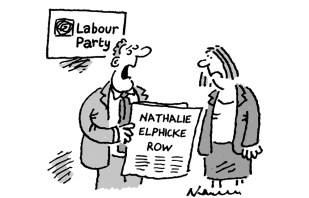
Keir Starmer’s party has the inverse problem to the Tories: the leadership is more migrant sceptic than many of its backbenchers. The thinktank Labour Together will soon publish a series of reports that explore the lessons from five centre-left governments that struggled in power. One will argue that failure to control migration can do more damage to a centre-left government than any other issue. With net migration expected to even out at around 300,000 next year and for the two following years (a rate which far outpaces the housing supply), Labour will have to do something.
The shadow cabinet is split on how best to approach the question of legal migrants. Jonathan Reynolds, the shadow business secretary, talks about migration being just one part of a broken economic model that can only be fixed by a holistic approach that includes policy in areas such as industrial strategy. Others, such as Yvette Cooper, the shadow home secretary, are happy to acknowledge that numbers are too high but prefer not to give an arbitrary target – like David Cameron’s infamous ‘tens of thousands’ figure. The danger is that a bolder approach could lead to missteps such as Darren Jones’s interview which suggested Labour wanted to see a ‘couple of hundred thousand a year’ in net migration, which does sound horribly like a Cameron-style target.
The incentives within Labour are for higher, not lower, immigration. Its three biggest trade unions – Unison, Unite and GMB – all represent workers within the social care sector. Most university cities will be represented by Labour MPs after the next election. In opposition, Cooper can call for lower numbers but in government, the Home Office is often outgunned by spending departments and the Treasury.
With sensitivities running high, Starmer needs to take care in how he handles migration. A glance across the House of Commons will remind him what happens to parties that get it wrong.
Ahmad Massoud: ‘I’m 100% sure I can topple the Taliban’
Max Jeffrey has narrated this article for you to listen to.
It’s fighting season in Afghanistan again. When the Americans were in charge, after the poppy fields had been harvested in late spring, and the madrassas in Pakistan that supplied the Taliban with fanatical soldiers had finished for the term, the Islamists kicked off the fighting. Between 2001 and 2021, around 200,000 people died, including 453 Britons. Now an insurgent group called the National Resistance Front (NRF) are starting the annual springtime assaults, this time against the Taliban government.
‘The Taliban do not possess the support of the mass of the people. We do’
‘In the past 31 days, we have staged 31 attacks on Taliban, only in Kabul,’ Ahmad Massoud, the NRF leader, cheerily tells me from Tajikistan, where he directs his troops in exile. ‘We have not even had one person captured.’ The NRF’s latest hit, he says, was 500 metres from the presidential palace. With proper support – ideally western arms – he says he can destroy the country’s Islamic Emirate and install a democratic republic. ‘I’m 100 per cent sure it is possible to defeat the Taliban.’
The NRF came together when western forces fled during the Taliban takeover. As the Islamists swept from Kandahar, in the south, up to Kabul, Afghan army soldiers joined a group of fighters in Panjshir, in the north. Now, from a small area of land they still hold, they conduct guerrilla operations in half of Afghanistan’s 34 provinces. Massoud says he doesn’t have the firepower to launch a total assault on the Taliban administration, so his NRF missions are limited. A couple of men with AK-47s may carry out a drive-by shooting on a checkpoint; a squad might ambush a Taliban camp at night. The NRF uses weapons left behind by the Americans and the Soviets, and tops up its supplies from Afghanistan’s black markets.
Massoud says his guerrilla operation is ready to do more. ‘I don’t need soldiers from the Pentagon or from the Ministry of Defence,’ he says. ‘However we are all alone and empty-handed.’ The NRF runs a serious lobbying operation, with an office in Washington DC and friendly US senators such as Lindsey Graham making their case in Congress. Helpfully, Massoud appeals to western sensibilities. He is an alumnus of King’s College London and Sandhurst. He is friendly with Emmanuel Macron. He dresses in a white Oxford shirt. He’s also out to promote In the Name of my Father, his book, available for £7.49 on Amazon Kindle.
Massoud trades on the reputation of his father, Ahmad Shah Massoud, a hero of Afghanistan’s resistance against the Soviets. Back in the late 1970s and 1980s, Commander Massoud repelled several attempted invasions of Panjshir, and when the Taliban tried to take over Afghanistan in the 1990s he led the ‘Northern Alliance’ of rebel groups against them. The US and UK worked with the Alliance to depose the Taliban in 2002.
Massoud Sr had been supported by western intelligence for decades. MI6 had helped train his troops early in the war with the Soviets, and by the late 1980s American operatives were hand-delivering him a monthly stipend of £400,000 in today’s money. Three years ago, French and American intelligence services considered backing Massoud Jr against the Taliban. His bloodline clearly attracted them.
But not enough. Massoud Jr says he met with ‘a lot of military personnel’ before the Taliban’s assault, including Nick Carter, the then head of the British Army, but says he wasn’t given weapons or intelligence. ‘We were left completely alone.’ He fled Kabul as the Taliban closed in on the capital, and from there tried to negotiate with the Islamists in return for a ceasefire. He asked for free nationwide elections, but says he was told to ‘surrender or die’. He took a helicopter to Tajikistan.
Massoud met the Taliban’s foreign minister, Amir Khan Muttaqi, for talks in Tehran in 2022, mediated by the Iranians. Massoud was told if he dropped his resistance and returned to Afghanistan he could take charge of a Taliban ministry. ‘You say that I should return to Afghanistan, very good!’ He recalls his reply: ‘Let’s all agree on a transition period, a constitution and an election.’ Muttaqi said Massoud’s demands were un-Islamic and the talks ended there.
Massoud’s position seems obviously unrealistic (why would the Taliban give him anything?) but he thinks he’s right to keep fighting for a democratic republic. Afghans are desperate for elections, he claims. ‘The Taliban do not possess the support of the mass of the people. We do.’
When we talk, Massoud barely mentions poverty or education. In the last two years, Afghanistan’s GDP has shrunk by a quarter. Half of the population is now in absolute poverty. Education for girls stops at the age of 11. Perhaps he should be fighting for social reforms instead of regime change.
Massoud says he has a proposal for Britain. If we fund the NRF, it would help sort out Britain’s problem with illegal immigration (last year, more small-boat arrivals were from Afghanistan than any other country). ‘I know that one of the main concerns Europe feels is immigration,’ he explains. ‘If immigration is an issue, then help us not with boots on the ground but help those soldiers… They would rather die fighting for their freedom in their country than emigrating and dying in the seas of Greece and crossing the Channel,’ he says. ‘How many more million will be spent on Rwanda? Is this really a solution?’
It’s unclear that Afghans would welcome the West having a second go at installing democracy. Resentment still lingers from the last attempt. In Helmand, in southern Afghanistan, the US employed a brutal local warlord, Amir Dado, as their chief of intelligence. When ordinary Afghans crossed him, Dado murdered them and strung their bodies from trees. The US thought him a useful resource for catching terrorists. Coalition airstrikes, particularly in the south, killed civilians, and the SAS is currently being investigated for war crimes. The coalition troops were not liberators then, and Massoud may not be seen as one now.
‘Why didn’t it work out before?’ asks Massoud. ‘Because the military strategy and doctrine adopted by our friends and the international force and the Afghanistan army, it was completely wrong.’ The NRF can depose the Taliban using the same tactics his father deployed, he says. Massoud Sr studied Che Guevara, Mao Zedong and Régis Debray, a French academic who wrote a manual on guerrilla warfare based on the Cuban revolution. Massoud Sr followed Debray’s ‘three golden rules: constant vigilance, constant mistrust, constant mobility’.
If Massoud Jr gets the weapons he wants, and starts a nationwide war against the Taliban, he will fight alongside once-feared warlords such as Ismail Khan and Abdul Rashil Dostum. In 2021, Khan cut a deal with the Taliban and escaped to Iran while Dostum’s forces in Mazar-e Sharif were
easily beaten. Dostum now lives in Turkey, and in interviews refers to himself in the third person as ‘General Dostum’. In the 2000s, he was accused of locking captured Taliban in shipping containers and letting them suffocate to death.
‘We all believe and we all agreed on certain values which is the liberation of Afghanistan, implementing and believing in a process to bring an election based on a legitimate process,’ Massoud insists. He wants to reassure me he has consulted ‘the new generation’ and ‘the leaders among the women’, but our time is up. There’s no time for the details. We’ve had an hour. Massoud says goodbye, and his iPhone 15 leaves the call. That evening, an NRF spokesman messages: ‘The book will be mentioned, right?’
Shabana Mahmood: The disgraceful treatment of Kate Forbes
It was like a scene from the Blair government: a minister admits inmates are being released before their sentence ends, to free up space. The opposition is furious, saying that ‘never in this country has a government ever been forced to release prisoners over two months early’. But in this instance, the minister is Tory and the opposition comes from Shabana Mahmood, Labour MP for Birmingham Ladywood and the shadow justice secretary.
When we meet in The Spectator’s offices, the 43-year-old seems to be channelling her inner Michael Howard. ‘Prisons are overcrowded, we just don’t have enough places,’ she says. ‘This country hasn’t built enough prison places for a long time and certainly not for the last 14 years.’ Labour would remedy this, she says, by building more prisons and locking more people up. ‘If you break our rules, you do have to be punished. Prison has a place.’
But Mahmood is no red Tory. Her last assignment was running Labour’s political campaign machine. By the time she handed the job over to Pat McFadden, the party had a 20-point lead over the Tories. She joked to him that ‘if it all goes well, I’m taking credit because the foundations are all me’.
The former barrister says the Tories should be very concerned about prisons. ‘You could have a big system failure on any day,’ she says. ‘I’m sure Alex Chalk [the Justice Secretary] is losing sleep over it. I’m sure if we win, I’ll be losing sleep over it.’
While she is now prepared to talk, Mahmood has been quiet in recent months. She is the only Muslim shadow cabinet member and was reported to be unhappy about Keir Starmer’s delay in calling for a ceasefire in Gaza.
Until recently, Muslims had been the single most likely group to vote Labour, but Muslim councillors have been resigning from Labour in protest over Gaza. Some have stood as independents and won by a significant margin in the local elections in places like Oldham. The concern within Labour is that this particular movement could grow during a general election campaign.
‘The situation in Gaza, the perception of our position… things that have happened, have obviously led to a loss of trust between us and large numbers of people,’ Mahmood says. ‘These are Labour voters who we want to work with and earn their trust back. We have heard the message that they have sent.’ How will Labour respond? ‘Our policy position has changed,’ she says. But the rift may be deeper. ‘When you have a schism, it is very hard to win that trust back. But that’s what we have to do. It is individual conversations. House by house, street by street.’
Is religion important to her? ‘My religion, my faith, my belief in God is the absolute centre point of who I am,’ she says. ‘It’s the thing from which I draw my purpose in life and also my sense of identity.’ Her faith doesn’t come in and out ‘like Magic FM in the Chilterns’ as David Cameron once put it when discussing his own Christian beliefs: for Mahmood, religion is a driving force.
Born in Birmingham, Mahmood spent much of her early life abroad as her father worked on engineering projects in Nigeria, Kuwait and Saudi Arabia. ‘We spent most of our weekends either in Mecca at the main mosque or at the Prophet’s Mosque in Medina, which as a family of Muslims was a really special experience,’ she says. She went to an expat school until the age of seven and ‘came back with a very, very posh Home Counties accent’. She credits ITV’s Kavanagh QC for encouraging her interest in law.
She went on to study law at Oxford. Her time at Lincoln College was, she says, ‘the very first time where I was meeting people for whom I was literally the first Muslim they’d ever met in their life. That was very odd. Everyone used to ask about arranged marriages. I used to think: God, I can’t answer this just as myself. I have to answer for about a billion people.’ I had to google a lot about what Shias think about XY and Z because it got a bit complicated!’
Her father had been a Labour activist in Birmingham. She ran for president of the Junior Common Room at Oxford and persuaded the young Rishi Sunak to vote for her (‘I was mobilising the geek vote’). She started a legal career but was offered the chance to become an MP in 2010. Sunak followed five years later.
The Prime Minister describes Britain as a multi-faith rather than secular democracy and Mahmood agrees. She says Kate Forbes, a Presbyterian with traditional views on gender and marriage, suffered ‘disgraceful’ abuse in her campaign to be SNP leader. ‘I think the way that some people reacted to Kate Forbes’s first campaign and then also the second-time round, that’s disgraceful frankly,’ she says. ‘Would you really say that the people who are from orthodox traditions of Christianity or the Free Church… that they are not allowed to have any political representation? ‘She’s explained where her religious beliefs would and would not affect her decision on policy issues. What more can you do than be honest? I think the way people reacted to that was really out of order. It’s not British.’
Mahmood refused to serve under Jeremy Corbyn. ‘You could say I am a bit to the right of the Labour party,’ she says. ‘On social issues and broader society, I’d probably be described as a small-c conservative.’
While many of her colleagues have struggled to answer what makes a woman Mahmood is clear. ‘I believe in the importance of recognising biological sex, it’s immutable and it is fundamental to how the vast majority of women understand their existence.’ She would have opposed a bill on self-ID on demand, she says, or indeed, any loosening of time limits on abortion.
If Starmer holds a free vote on assisted dying, as he has suggested, Mahmood says she’ll oppose it. ‘I don’t intend to support it in the future,’ she says. ‘I know some of the MPs who vocally support this issue think, “For God’s sake, we’re not a nation of granny killers, what’s wrong with you”… I feel that once you cross that line, you’ve crossed it forever. If it just becomes the norm that at a certain age or with certain diseases, you are now a bit of a burden… that’s a really dangerous position to be in.’