-
AAPL
213.43 (+0.29%)
-
BARC-LN
1205.7 (-1.46%)
-
NKE
94.05 (+0.39%)
-
CVX
152.67 (-1.00%)
-
CRM
230.27 (-2.34%)
-
INTC
30.5 (-0.87%)
-
DIS
100.16 (-0.67%)
-
DOW
55.79 (-0.82%)
Israel’s Rafah operation is tragically necessary
There is, as Ecclesiastes reminded us, a time for war and a time for peace. In its 76-year history, Israel has rarely selected the time for war, almost always reinforcing its position and responding in self-defence to Arab attacks. The invasion of Rafah will be another such tragic chapter in the tragic history of the Jewish state. Hamas has made it a time for war.
The tanks went in after volleys of rockets were fired by Hamas
Has it started already? Last night, Israeli tanks entered the southern town after a last-ditch ceasefire proposal from Hamas was rejected as inadequate. But the operation has so far fallen short of a full invasion. The Israeli Defence Forces took control of the Gazan side of the Rafah Crossing on the Egyptian border as part of a ‘pinpoint operation’ against the terror group in ‘limited areas of eastern Rafah,’ the IDF said, after ‘intelligence information [suggested] that terrorists were using the crossing area for terror purposes.’ Before the attack, the IDF said it had carried out ‘coordination with the international organisations operating in the area, with a request to move towards the humanitarian area as part of the effort to evacuate the population that has been taking place.’
The tanks went in after volleys of rockets were fired by Hamas from the Rafah crossing at Kerem Shalom in southern Israel, killing four soldiers and wounding others. The terror group then appeared to back off from its game of chicken by making a surprise offer of a ceasefire; according to the New York Times, however, the 33 elderly, infirm and child captives that it offered to release – which had been reduced from 40 because seven had been killed – included several bodies. This depravity, combined with the audacious rocket attack, forced Israel’s hand.
The events continue to unfold as I write. Footage leaked online this morning showed an armoured personnel carrier flying the Israeli colours alongside the flag of the 401st armoured brigade rumbling along the Philadelphi corridor, a narrow buffer zone that runs along the border between Gaza and Egypt. Israeli flags were also seen above the Rafah Crossing, where Gazans have previously been able to escape into Egypt by paying Cairo about $5,000 (£4,000) a head. (A Palestinian friend sheltering in the south recently got his wife and children out this way, after raising money from friends overseas. This aptly illustrates Egypt’s intransigence in the face of impending humanitarian suffering, a fact strangely overlooked by the world’s media.)
The Rafah invasion, if this is indeed what we are witnessing, will come after months of intense international pressure directed at the Jewish state. With their eyes on their restive progressive publics and looming elections, almost every aspiring and serving world leader, from Sir Keir Starmer to Joe Biden, has been wagging their fingers at Israel, insisting that this is a time for peace, despite all the evidence to the contrary. According to the Wall Street Journal, the United States has even been delaying the sales of thousands of precision weapons to Jerusalem, including MK-82 bombs, fuses and JDAM guidance kits, as part of the pressure campaign to head off the attack on Rafah.
This move is emblematic of the myopia of the international community. Without precision weapons, Israel will be forced to resort to far less accurate munitions, increasing the civilian death toll considerably. Call me cynical, but the White House appears to be overtly applying Hamas’s playbook: a higher civilian death toll would mean a larger volume of disturbing pictures coming out of Rafah, which would lead to greater international pressure, which would legitimise further strongarm tactics by the Biden administration.
This is just the latest frustrating chapter in the story of the world’s democracies folding under wave upon wave of propaganda from Hamas, amplified with deplorable enthusiasm by international television outlets. We have all known the strategy since the start of the war. Hamas has designed the battlefield to produce as much footage of suffering civilians as possible. This is its force multiplier; the aim is to harness western public opinion so that Israel’s campaign is curtailed by the international community before Hamas is obliterated, allowing it to commence plans for the next October 7.
Of course, the international media, from the BBC down, should be informing viewers that Hamas censors much of the footage coming out of Gaza. This censorship is the reason we never see any pictures of dead or wounded Hamas terrorists, leaving western audiences with the false impression that Israel is waging war solely against civilians.
Israel has been doggedly taking huge lengths to spring this trap, including dropping hundreds of thousands of leaflets warning people to move away from the battlefield prior to attacks. So we find ourselves in a surreal dynamic where the attacker attempts to protect the defender’s civilians while the defender tries to get them killed. It is true that the suffering in Gaza would be lighter had Israel’s governing coalition not been so dysfunctional. Excesses and failures occur in every war and this one is no different, particularly on the political level. But Hamas started this conflict and Israel – being a flawed democracy like all others – had no choice but to respond with the cabinet it had.
However intense the international pressure becomes, Jerusalem’s first duty remains to the security of its citizens. None of the world’s political leaders, from Starmer to Biden, has been able to adequately explain how cancelling a Rafah operation will make Israel safer. It is quite obvious that allowing a rump of Hamas to survive will only shore up further massacres for the future, followed by further wars. Without addressing that fact, hand-wringing about Rafah just sounds like moral posturing.
Of course, in the longer term there must be a political solution. Israeli leader Benjamin Netanyahu is an infuriating leader, in hock to the most unpleasant characters ever to have sat around an Israeli cabinet table. Of course, military operations produce resentment in the local population, some of whom will turn to terror. Of course, in the heat of war, soldiers don’t always act how they should, and command chains don’t always keep them in line. Israel must keep trying to improve these things. But ultimately, what is the alternative to this conflict?
The IDF commenced the Rafah incursion just after Holocaust Memorial Day. Before the attack, the Kfir brigade commander said: ‘On this day 80 years ago, the Nazis led Jews to the ovens for the sole crime of being Jewish. Today, at the end of Holocaust Memorial Day, we, the IDF, are going on the offensive to attack and to win. Never again is now in our hands…All stations, this is the Commander, onwards and after me until the end, until victory, until we win. On my command, go.’
Nobody – with the obvious exception of the jihadis – wants bloodshed. But it should be blindingly obvious to any observer that the writer of Ecclesiastes was right: however tragic, a time for war is not averted by pretending it is a time for peace.
Milei asks: who is Liz Truss?
Since coming to office in December, Javier Milei has won right-wing fans across the world for his bombastic rhetoric and fervent championing of libertarian ideas. Among them is Liz Truss, who sees Milei as very much an ideological ally. In a recent interview to promote her book, she was asked by GB News to name her favourite Tory leader other than ‘Churchill and Thatcher’. Truss thought for eight seconds and then replied ‘Well, I like Javeir Milei.’
Sadly for her it seems that the admiration is not mutual. For Milei has just done a sit-down interview with the BBC’s Ione Wells at which he was informed of the former PM’s remarks. The exchange went thus:
Wells: ‘Liz Truss recently said that you were her favourite conservative leader. Do you admire her?’
Milei: ‘Who?’
Wells: ‘Liz Truss, the former UK Prime Minister.’
Milei: ‘I don’t have elements to give an opinion but what in the UK is defined as conservative, well, we libertarians have a lot of common ground with that. ‘
Ouch. Sounds like Liz needs to get a Spanish copy of Ten Years to Save The West over to the presidential palace in Buenos Aires pronto…
Macron is deluded if he thinks he can persuade Xi to change
Try as he might Emmanuel Macron and his party are unable to arrest the popularity of the National Rally. A month out from the European elections, the latest poll has their principal candidate, Jordan Bardella, on 32 points, double the score of Macron’s representative, Valerie Hayer.
The latest head of state with dubious ethics to be courted by Macron is Xi Jinping
Hayer and Bardella have clashed twice in recent days in live television debates, and on both occasions Hayer has condemned as ‘shameful’ the National Rally’s benevolence towards Vladimir Putin in the years leading up to Russia’s invasion of Ukraine.
That this strategy doesn’t appear to be working for the presidential camp is not a surprise. As Bardella has pointed out, the National Rally wasn’t the only party to have made eyes at Putin in the last decade; Macron wined and dined Putin at Versailles in May 2017, just weeks after being elected president.
It is a challenge for Macron to play the arbiter of morality when he was the first western leader to welcome Crown Prince Mohammed bin Salman back into the fold after his implication in the murder of the dissident Saudi journalist Jamal Khashoggi in 2018.
There is also Macron’s enthusiasm for Qatar – with whom he recently signed a £8.6 billion trade deal – and his satisfaction at the election victory last year of Recep Erdogan in Turkey’s presidential election. Qatar and Erdogan are both supporters of Hamas, responsible for the murder last October of dozens of French citizens when they attacked Israel.
The latest head of state with dubious ethics to be courted by Macron is Xi Jinping, who arrived in France on Monday on a state visit. Human rights groups do not approve of the presence of Xi. Maya Wang of Human Rights Watch called on Macron to ‘make it clear to Xi Jinping that Beijing’s crimes against humanity come with consequences for China’s relations with France’, a reference to the oppression of China’s Uyghur Muslim minority.
In a radio interview on Monday, Valerie Hayer described China’s treatment of the Uyghur’s as a ‘genocide’; it was a bold criticism from Hayer but one that surely will undermine any future attempt on her part to attack Bardella. How can she accuse him of cosying up to one dictator when her own president is dishing out gifts to a president she has accused of genocide?
One of the gifts Macron gave Xi on Monday was an 1861 edition of Contemplations by Victor Hugo. ‘I know that you are very fond of Victor Hugo, and you have often paid tribute to him,’ said Macron as he handed the present to the Chinese president.
One would like to think Macron was being ironic, though he probably wasn’t. Hugo was a fierce defender of free speech, declaring in an address to the National Assembly in 1848 about the muzzling of French newspapers that ‘Censorship and confiscation are two monstrous abuses’.
At the same time as Macron and Xi were exchanging gifts, France’s Press freedom body, Reporters Without Borders, were driving a lorry through central Paris with the names of 119 journalists it claims are in detention in China. They called Xi ‘one of the great predators of press freedom’.
At Monday’s State Banquet, Xi toasted the ‘special’ friendship that exists between China and France and he hailed the ‘fine tradition of mutual appreciation and mutual attraction’.
Rather awkwardly for Xi and Macron, hours before the banquet, Francois-Xavier Bellamy, the centre-right Republican candidate in the European elections filed a legal complaint alleging that he has been the victim of a recent cyber attack linked to Beijing. ‘At a time when Chinese president Xi Jinping is embarking on a state visit to Paris, we have the feeling that we have not appreciated is at stake today in terms of foreign interference,’ said Bellamy.
Similar accusations of hacking are disclosed in today’s British media – a fortnight after police charged two Britons with spying for China. According to Sky News, China has hacked the Ministry of Defence, accessing a payroll system. Tory MP Tobias Ellwood said that China may have wanted to target ‘the financially vulnerable with a view that they may be coerced in exchange for cash’.
Today Macron and Xi, and their wives, will visit the Pyrenees in the far south of France. The French press report that in between showing his guest the sights their president will hold private talks with Xi during which he will urge him to use his influence with Putin to halt the war in Ukraine. Global trade rules are also on Macron’s agenda.
That is Macron’s justification for hosting the Chinese president. Will his realpolitik pay dividends? The French press are sceptical. Increasingly these days, the only person who takes Emmanuel Macron seriously is Emmanuel Macron.
Will John Swinney end the SNP’s war on business?
Accepting the leadership of the SNP on Monday, John Swinney said his political priority as Scotland’s seventh First Minister would be the eradication of child poverty. If he is sincere in his desire to achieve this ambition, then Scotland’s economic growth – just 0.2 per cent last year – needs be a great deal better.
As soon as Swinney gets his feet under the First Ministerial desk, he must throw open his doors to Scotland’s business leaders and show them the love his party has been withholding for the last decade.
Shortly after the SNP won its first Scottish parliamentary election in 2007, new First Minister Alex Salmond fired off a chummy letter to a major player in Scottish business. Salmond, then leader of the SNP, wished the recipient to know not only that he was watching his latest deal closely but that the First Minister’s office was ready to assist with the process.
Five years later, Salmond performed a whiplash-inducing reverse-ferret. He regretted ever writing the letter. It had been a terrible mistake
The reason for the then First Minister’s sudden volte face was understandable. Salmond’s letter had been addressed to Sir Fred Goodwin – at the time of the missive’s delivery, chief executive of the Royal Bank of Scotland and negotiating the takeover of Dutch bank ABN-Amro – and now the banker was being stripped of his knighthood.
The SNP’s relationship with business is as weak as it’s ever been
A year after Salmond’s election victory, RBS stood on the brink of collapse. Had the UK government not stepped in with a £45 billion bail-out, the bank’s implosion might have crashed the UK economy. Goodwin, once a business hero, became a pariah, the focus for public and political anger and so it was hardly surprising Salmond suddenly wanted nothing to do with him.
The truth is that there was a huge amount of hypocrisy among those opposition politicians who taunted Salmond over his offer of assistance to Goodwin. No mainstream politician – either at Holyrood or Westminster – had criticised Goodwin as the RBS rapidly expanded under his leadership. Rather, all were perfectly happy to associate with and encourage him. Goodwin was a success to be celebrated right up until the moment he became a failure to be shunned.
Throughout the many decades during which the SNP was a fringe party, a frequent – and entirely legitimate – criticism was that its leaders neither understood nor cared about the priorities of business. This was a perfectly understandable state-of-affairs. Down the years, a series of influential business figures had spoken about their opposition to Scottish independence and the SNP had done little – other than do dismiss their concerns – to engage.
Sure, there was the occasional outlier – the Stagecoach tycoon Brian Souter, for example, who was as regular donor to the SNP throughout Salmond’s years in charge – but the majority of serious businessmen willing to speak out on the constitutional question were firmly of the view that Scottish independence was a bad idea.
In advance of the SNP’s first Holyrood election victory in 2007, Salmond made a real effort to build bridges between his party and Scotland’s wealth creators.
This charm offensive – backed up with presentations by SNP economists in boardrooms across Scotland – may not have encouraged many business leaders to line up behind Salmond when it came to the independence question, but he did persuade even the staunchest unionists in the Scottish business community that he took seriously their needs.
Salmond’s letter to Goodwin was – when he wrote it – proof that he saw the importance of good relationships between business and political leaders.
The fragile new relationship between the Scottish nationalists and business was to take a battering during the 2014 referendum campaign. Salmond burned another bridge every time he felt compelled to dismiss the concerns of any high-profile figures who dared question the wisdom of breaking-up the Union. By the time he’d lost that referendum, Salmond’s diplomatic skills had deserted him. Increasingly frustrated that things weren’t going his way, his attacks on critics and narrative of victimhood rendered him petty and ridiculous.
Salmond’s successor, Nicola Sturgeon, who took office in 2014 had a radically different approach to the business world: she pretended it didn’t exist. During the Sturgeon years, when the Scottish government’s twin obsessions were winning the right to run a second referendum and legislating on ‘social justice’ issues, business was neglected by the SNP.
In recent years, a resurgent Scottish Labour party has been wooing business leaders, hundreds of whom have met with both Scots party leader Anas Sarwar and Sir Keir Starmer at events across the country.
Neglected by both Nicola Sturgeon and Humza Yousaf, the SNP’s relationship with business is as weak as it’s ever been. The next First Minister must make a priority of fixing that and ensuring his government understands – and can swiftly respond to – the needs of employers.
Greens embroiled in anti-Semitism row
Oh dear. The Green party is in hot water after it emerged that one of its newly-elected councillors labelled a rabbi a ‘creep’ and a ‘kind of animal’. The party is under fire for failing to suspend Mothin Ali, who was elected to Leeds city council in last week’s elections, after the new councillor was revealed to have directed an angry tirade at a Jewish chaplain during a self-made YouTube video recorded in February.
Ali labelled rabbi Zechariah Deutsch an ‘absolute low-life’, ‘absolutely disgusting’ and ‘shameful’ in the clip he made three months ago about the rabbi’s return to his IDF unit. On the day of the 7 October attack by Hamas, Ali also wrote on X that ‘white supremacist European settler colonialism must end’. Golly. Despite the revelations, Ali – who yelled ‘Allahu Akbar!’ when he won election last week – still managed to stand as a local candidate for the Greens. Talk about falling standards…
Green co-leader Carla Denyer refused to answer questions on the party’s vetting procedures in an interview last night, before saying she was ‘not familiar with all of the details’. Mr S is curious about her claim, given the Mail reports that it highlighted comments made by Ali as far back as February. The Greens still haven’t managed to suspend their new councillor for the videoed remarks, which it says it is currently ‘investigating’. You could hardly accuse them of being too quick to jump to conclusions…
What Rishi Sunak can learn from Gordon Brown’s golden mistake
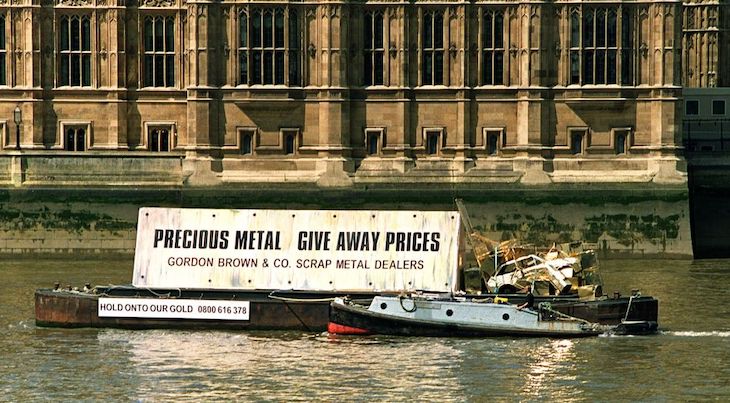
Gordon Brown is a historian by education, so he might just appreciate the fickleness of posterity. Over a decade at the Treasury from 1997 to 2007, he did many things that he might believe should be widely remembered. Yet few, if any, of his decisions live as clearly in memory as ‘Gordon Brown sold the gold’.
Brown sold the gold. He raided pensions. He put 75p on pensions
Exactly 25 years ago, Brown’s Treasury stunned the gold markets by starting to sell of much of the UK’s gold reserves. In total, 395 tonnes of gold were sold over three years, yielding $3.5 billion (£2.8 billion) in revenues. That’s a big number, but far smaller than the current value of 395 tonnes of gold, which would be somewhere north of $25 billion (£19.9 billion).
Those numbers mean it’s hard to view the gold sale as a great move, even if it was in keeping with conventional economic wisdom at the time. Hindsight is a great teacher, but when you review the Treasury papers and economic commentary of those times, you don’t find many people saying ‘Don’t be daft Gordon, gold is about to enter a multi-decade bull market’.
I’m probably not qualified to debate the economics of the gold sale, so I’ll confine myself to politics. Here, I think the ‘Gordon Brown sold the gold’ offers two harsh lessons to other politicians.
First, simplicity rules. Human beings are small and limited creatures. We all understand and navigate and remember the world in simple terms, not least when it comes to politics. This is especially true of economic policy and performance. Because economics is complicated, it’s generally easier for us to grasp a few simple ideas or claims and overlook the nuance.
Brown can reasonably claim to have been a fairly good chancellor, at least measured by outcomes. Possibly more by luck than skill, he oversaw a decade of solid growth. His independent monetary policy framework persists to this day, as does the minimum wage. He flunked the opportunity of greater supply side reform, but as prime minister he arguably saved the world from a worse financial crisis is 2007/8 by galvanising international responses.
Sadly for him, a lot of that will be forgotten in favour of simpler, starker stories. He sold the gold. He raided pensions. He put 75p on pensions. He called Mrs Duffy a bigot. When he left office, a note left in the Treasury confirmed ‘there is no money’.
The point is that politics is harsh and simple. Something that sticks in the public imagination matters for your position and legacy, while more subtle and complex things don’t. Just ask John Major. No one remembers the economic recovery that was well underway in 1997 when Brown arrived at the Treasury. They remember Black Wednesday.
More recent politics follows the same rule. David Cameron: austerity, then running away after losing a referendum he didn’t need to call. Theresa May: dementia tax, coughing and dithering. Boris Johnson: parties that broke his own lockdown laws. Liz Truss: market meltdown, and a lettuce.
If he’s not already worried, the lesson of Brown and the gold should scare Rishi Sunak. He can claim to have done some sensible, worthy things. He stabilised government and markets after the Truss debacle. His tax cuts (National Insurance instead of income tax; and especially full expensing of investment) aren’t mad. His lifetime tobacco ban will likely be his only significant legacy. But it seems utterly unlikely that he can do anything in his remaining time to offset those simple and negative stories voters remember about his party, or the one simple thing they know about his time in office: everything got more expensive. In political communication, simplicity is powerful.
The other golden lesson for politicians is simple too: don’t try to call the markets. Brown’s decision to sell made perfect sense under the circumstances of the time. But circumstances change: Brown – like almost everyone else – failed to anticipate twenty years of low interest rates, so the bonds he bought with the money from gold underperformed, while gold itself soared.
This shouldn’t surprise. We don’t hire politicians to be asset managers, after all. Generally, decisions on the allocation of public assets and forecasts about markets are best left to professionals – officials, economists and investment managers aren’t, of course, perfect. But really, who would you rather have deciding where your money goes: a bunch of technocrats, or politicians thinking about the next general election?
Yet our current political leaders, both Conservative and Labour, show alarming interest in taking such decisions. Both Jeremy Hunt and his Labour shadow Rachel Reeves have come close to telling pension funds where they should invest the money they manage on behalf of pension savers. Sometimes it’s a simple bit of economic nationalism – ‘buy more British equities’ – and sometimes it’s insisting on asset classes. See Hunt’s exhortations to pensions to invest more in private equity and illiquid assets, for example.
It’s probably inevitable that politicians, especially smart, powerful and ambitious ones, feel the confidence to call the markets and dictate investment choices. But Hunt and Reeves alike should take a minute today to reflect on Gordon Brown’s golden legacy.
What Charles Darwin got wrong
Have you noticed that whenever the conversation turns to the subject of Charles Darwin, an extraordinary amount of dogmatism is often on view?
What’s curious is that the dogmatism is patent on both sides of the debate, on the side of the Darwinists just as much as the side of Darwin’s critics.
I have often noted with amusement how sensitive to criticism the Darwinian faithful are. Any hint of a shadow of dissent and they rush for the garlic, the wooden stake and a signed copy of On the Origin of Species.
I think I understand the psychology of the response. They are terrified lest acknowledging the strength of this or that criticism start them down the road toward creationism and teaching the Book of Genesis in Biology 101.
Where does the truth lie? Are the main doctrines of Darwinian teaching as impregnable and well established as proponents claim?
One good place to start for an answer is with Darwinian Fairytales, the last work of the Australian philosopher David Stove. By the time of his death in 1994, Stove had earned a distinguished place for himself in the pantheon of intellectual demolition experts.
His targets, one admirer wrote, are many: “the Enlightenment, feminism, Freud, the idea of progress, leftish views of all kinds, Marx… metaphysics, modern architecture and art, philosophical idealism, [Karl] Popper, religion, semiotics, Stravinsky and Sweden… Also, anything beginning with ‘soc’ (even Socrates got a serve or two).”
High among Stove’s antipathies was irrationality in the philosophy of science, which he detected not only in overt irrationalists such as Paul “Anything Goes” Feyerabend but also in more seemingly respectable figures such as Thomas “Mr. Paradigm Shift” Kuhn.
If you believe (as your teachers doubtless told you) that Kuhn or Karl Popper was a friend of honest scientific inquiry, read Stove’s book Scientific Irrationalism: Origins of a Postmodern Cult. I guarantee that it will change your mind.
A century ago, William James wrote a book called The Varieties of Religious Experience. Had Stove lived long enough, he might have written something called The Varieties of Irrational Experience. His hilarious but disturbing essay “What is Wrong with Our Thoughts?,” reprinted in The Plato Cult and Other Philosophical Follies, would make a splendid introduction to such a work.
I want to pause to emphasize the hilarity. Stove was one of the greatest philosophical stylists of our, perhaps of any, time. That is a large claim, I know, but don’t take my word for it: read his work. You will see why one commentator wrote that reading David Stove is like watching Fred Astaire dance: the elegance, the seeming effortlessness, are breathtaking demonstrations of consummate artistry.
Stove’s skeptical cast of mind (David Hume was his philosophical hero) naturally endeared him to the enemies of cant, the exposers of naked emperors, the puncturers of academic gasbags, poseurs and charlatans.
How surprising, then, that David Stove should turn out to be an ardent anti-Darwinian.
Wasn’t Darwin on the side of all us Enlightened, no-nonsense, scientifically educated folk? If David Stove criticizes Darwin’s theories, doesn’t that make him an irrationalist, an ally of those school boards in Kansas that (or so we are told) want to replace science with scripture?
No, it doesn’t.
For one thing, Stove is not a creationist or proponent of “intelligent design”; indeed, he is careful to point out that he is “of no religion.”
Moreover, Stove admires Darwin greatly as a thinker, placing him at the top of his personal pantheon, along with Shakespeare, Purcell, Newton and Hume.
Stove furthermore believes that it is “overwhelmingly probable” that our species evolved from some other and that “natural selection is probably the cause which is principally responsible for the coming into existence of new species from old ones.”
Indeed, he believes that “the Darwinian explanation of evolution is a very good one as far as it goes, and it has turned out to go an extremely long way.” Its explanatory power, Stove noted, was obvious from the moment it was published in 1859. Darwin wrote before the discovery of genetics, but that science only increased the explanatory strength of Darwinian theory.
At the same time, though, Stove maintains that “Darwinism says many things, especially about our species, which are too obviously false to be believed by any educated person; or at least by an educated person who retains any capacity at all for critical thought.”
Examples? Here are a few: that “every single organic being around us may be said to be striving to the utmost to increase its numbers”; that “of the many individuals of any species which are periodically born, but a small number can survive”; that it is to a mother’s “advantage” that her child should be adopted by another woman; that “no one is prepared to sacrifice his life for any single person, but… everyone will sacrifice it for more than two brothers, or four half-brothers, or eight first cousins”; that “any variation in the least degree injurious [to a species] would be rigidly destroyed.”
All of these quotations are from Darwin or his orthodox disciples. A moment’s reflection shows that none is even remotely true, at least of human beings.
Take the last named: that anything in the least injurious to a species would be “rigidly destroyed” by natural selection.
What about abortion, adoption, fondness for alcohol, anal intercourse or asceticism, just to start with the “A”s? As Stove notes, “each of these characteristics [tends] to shorten our lives, or to lessen the number of children we have, or both.” Are any on the way to being rigidly destroyed?
Again, if Darwin’s theory of evolution were true, “there would be in every species a constant and ruthless competition to survive: a competition in which only a few in any generation can be winners. But it is perfectly obvious that human life is not like that, however it may be with other species.”
Priests, hospitals, governments, old-age homes, charities, police: these are a few of the things whose existence contradicts Darwin’s theory.
Some of Darwinism’s defenders respond by arguing that although human life may not now exhibit the brutal struggle for subsistence that Darwin’s theory postulates, it once did.
Stove is very good on this canard: “In the olden days (this story goes), human populations always did press relentlessly on their supply of food, and thereby brought about constant competition for survival among the too-numerous competitors, and hence natural selection of those organisms which were best fitted to succeed in the struggle for life.”
“That is,” Stove continues, “human life was exactly as Darwin’s book had said that all life is. But our species (the story goes on) escaped long ago from the brutal regime of natural selection. We developed a thousand forms of attachment, loyalty, cooperation and unforced subordination, every one of them quite incompatible with a constant and merci- less competition to survive.”
This is what Stove calls the “Cave Man” attempt to solve “Darwinism’s Dilemma.” (The other attempts he calls the “Hard Man” and the “Soft Man” gambits).
But the problem is that Darwin’s theory is not meant to be something that was true yesterday but not today. It claims to be, as Stove puts it, “a universal generalization about all terrestrial species at any time.” And this means that “if the theory says something which is not true now of our species (or another), then it is not true — finish.”
Stove writes: “If Darwin’s theory of evolution is true, no species can ever escape from the process of natural selection. His theory is that two universal and permanent tendencies of all species of organisms — the tendency to increase in numbers up to the limit that the food supply allows, and the tendency to vary in a heritable way — are together sufficient to bring about in any species universal and permanent competition for survival, and therefore universal and permanent natural selection among the competitors.”
But this is clearly not true of our species now. Nor, Stove points out, can it ever have been true of our species.
“It may be possible, for all I know, that a population of pines or cod should exist with no cooperative as distinct from competitive relations among its members. But no tribe of humans could possibly exist on those terms. Such a tribe could not even raise a second generation: the helplessness of the human young is too extreme and prolonged.”
Stove shows in unanswerable detail that, despite its enormous explanatory power regarding “cods, pines, flies,” etc., Darwin’s theory of evolution is “a ridiculous slander on human beings.”
He is particularly good at exposing the “amazingly arrogant habit of Darwinians” of “blaming the fact, instead of blaming their theory” when they encounter contrary biological facts.
Doctrinaire Darwinists have an answer for everything, always a bad sign in science, since it means that mere facts can never prove them wrong.
Does it regularly happen that increasing prosperity leads to lower birth rates? And does this directly contradict Darwinian theory? No problem, just announce that the birth rates in such cases are somehow “inverted,” evidence of a “biological mistake.”
Even more amusing is to watch a sociobiologist tie himself in knots trying to explain — or explain away — the phenomenon of altruism among human beings. The latest wheeze is something called “inclusive fitness” which attempts to deal with the “problem” of altruism by transforming it into a surreptitious form of selfishness.
Darwinian theory says that really, deep down, altruism cannot exist: we’re all engaged in a war for survival, after all.
And yet, as Stove points out, our species “is sharply distinguished from all other animals by being in fact hopelessly addicted to altruism. It will be time to think otherwise when, and not before, adult wolves or kookaburras or rats pool their resources in order to relieve the illness, or improvidence, or ignorance, of conspecifics to whom they are unrelated.”
Stove is also very good at exposing the mind-boggling claims of sociobiology — aka evolutionary psychology — a school of neo-Darwinism whose fundamental tenet is that an organism is epiphenomenal to its genes: that a human being, for example, is nothing more than a puppet manipulated by his genetic makeup.
If this seems like an exaggeration, consider the statement by the eminent sociobiologist E. O. Wilson that “an organism is only DNA’s way of making more DNA.” It is worth pausing to ponder the implications of that adverb “only.”
Or consider Richard Dawkins, another eminent sociobiologist and author of The Selfish Gene, a hugely popular book whose basic message is that “we are… robot-vehicles blindly programmed to preserve the selfish molecules known as genes.” (Yes, Dawkins really says this.) Of course, as Stove points out, “genes can no more be selfish than they can be (say) supercilious, or stupid.”
The popularity of Dawkins’s book lies in the powerful appeal that puppet-theories of human behavior always exercise on those who combine cynicism with credulousness; but genetic puppet theories are no more credible than those propounded by Freudians, Marxists or astrologers.
In the end, Stove’s discussion of Darwinian theory shows that, when it comes to the species H. sapiens, Darwinism “is a mere festering mass of errors.”
It can tell you “lots of truths about plants, flies, fish, etc., and interesting truths, too… [But] if it is human life that you would most like to know about and to understand, then a good library can be begun by leaving out Darwinism, from 1859 to the present hour.”
It is not a pretty picture that Stove paints; but then the exhibition of gross error widely accepted is never a comely sight.
The great posh food con
I had taken a friend out for a significant birthday, to a high-end French joint in London. We ordered the tasting menu, an eight course extravaganza with wine pairings. It was not a cheap date, but a special occasion. The third course was a tiny bowl of herb risotto, and as it was served, a waiter appeared holding a large white truffle and a tiny grater, asking if we would like some shavings from the magnificent looking beast. I politely declined, but my friend answered, ‘Of course, why not?’
Please do not confuse me with the likes of Jack Monroe
Why had I turned down this luxurious offering? Not only because of the £30 supplement on the already monumental price of the meal, which of course the waiter didn’t mention to my dining companion (only my menu contained prices). The main reason was because I can’t stand the stuff – it smells and tastes a bit like wet dog. As the waiter shaved off a few translucent slithers with great aplomb, I caught a whiff of exhaust fumes and old leather.
The market price for white truffle is up to £600 for 100g. Extraordinary. Does anyone actually like the taste of truffle? Perhaps what they are impressed with is the cost and the rarity. But it’s not just this ingredient, it’s also, for example, gold leaf. At approaching £100 for a gramme of the ‘good stuff’, and often found on poncy desserts, such as cupcakes and chocolate mousse, edible gold leaf is supposed to bring glamour to a dish. The type of restaurant filled with perma-tans and Gucci would serve it on an overcooked steak, or add it to cocktails.
Basically, it is a very expensive decoration, and fairy tricky to use. The leaves are delicate, so they tear and wrinkle and can be blown away into oblivion. In other words, they are the biggest fuss known to humanity, and have absolutely no taste at all.
Which brings me to saffron, one of the most expensive spices in the world. It has a pungent, metallic flavour, and for me, it’s only value is the strong yellow colour that’s immediately noticeable in food such as pilau rice. But in any dish where there are strong flavours, it simply gets lost. It is a bit like food colouring with a nasty aftertaste. Sargol saffron market rate is £9.00 per gramme.
And now the biggest cliche in luxury ingredients: caviar. I tried it once when on a story in Russia, expecting to be hugely impressed. It was served with frozen vodka, on a thin cracker, and it tasted a little bit like the stuff that comes in a jar in Waitrose for about three quid, but not nearly as nice. The prices for black caviar range from £50 to £300 per 100g. This caviar is listed in the Guinness Book of Records as the most expensive in the world. Trout caviar is £6.50 for the same amount. I defy you to tell me the difference.
But please do not confuse me with the likes of Jack Monroe. I am not about to start cooking from cheap, out of date tins and setting fire to myself to keep warm. Anyone that reads my columns here will perhaps have worked out that much of my expendable income goes on good quality food and booze.
So, what is it worth splurging out on? Really good quality tomatoes for example, the best cheese from a proper outlet rather than supermarket, olive oil, coffee beans, and sea salt. Cheap coconut milk always diminishes a dish, and vinegar is far better if you go high-end. Cheap tinned tomatoes are horrible, bitter and watery, so I always buy the most expensive. Same with butter: the best Guernsey is far superior to the cheap variety. I have a rule that any wine I use in cooking has to be good enough to drink.
But gold leaf, caviar and truffles tend to remind me of the rather crude, sexist phrase popular in the north of England, ‘all fur coat and no knickers’, meaning a posh appearance and no substance. That £30 supplement for the few shavings of truffle at my friend’s birthday meal was left off the bill, by accident. It restored my believe in natural justice.
My strange hobby: a life in search of death
As George Orwell astutely observed, England is a nation of hobbyists – and their sometimes eccentric private pursuits are one of the reasons that this country did not follow the rest of Europe into totalitarian dictatorship during the 20th century. A people bent on taking a fishing rod to stream or canal every weekend, or hanging around railway platforms to note the numbers of passing trains, or laboriously sticking stamps into albums, are unlikely to have the time or temptation to fall for political extremes.
The English devoted their leisure time to hobbies, though it should also be noted that such peaceable pastimes are mostly the preserve of men. Women are generally far too practical and don’t have the spare time to practice an interest that has no material reward beyond the satisfaction of merely accomplishing it.
I would often find rusty but live shells and grenades and once even the bones of an unknown soldier
The male propensity for hobbies often goes together with an acquisitive drive to collect: many hobbies such as stamp collecting or beer mat assembling are associated with the simple desire to go one better than your neighbour in building a collection of objects that no one else in their right minds would want to own. The man with more Georgian silver teapots than his chief competitor has stolen a march in the race for life.
The rise of hobbies went hand in hand with the industrial and technical revolutions of the 19th century. Before then, the struggle for sheer survival took up all the time and energy of the vast majority of the population, leaving only the tiny drone class at the top with the leisure and money for such frivolity.
The 21st century may witness the decline and death of traditional hobbies, thanks above all to the rise of the internet. The future of stamp collecting, for example, must be in jeopardy now that people send texts or emails rather than letters. These days, the young devote their time to computer gaming rather than train spotting or glueing together plastic model aircraft like their fathers and grandfathers.
Although immune to the usual hobbies, I must admit to having a couple: I ‘collect’ famous graves and I enjoy visiting battlefields and the sites of notable assassinations. (I’m too impatient to watch a float while waiting for that elusive pike to bite and too uncoordinated to enjoy ball games like football, golf, tennis or cricket.)
The graveyard visits were a spin-off from reading biographies and the verse of leading poets. I have knocked off, among others, Yeats, Keats, the two Thomases (Dylan and Edward), Rupert Brooke, Wilfred Owen and Siegfried Sassoon.My passion for poets gradually expanded to take in politicians and other writers. (Orwell and H.H. Asquith conveniently lie in the same Oxfordshire country churchyard.) I find my visits to the last resting places of such famous figures strangely satisfying, and recently discovered that Mervyn Peake, author of the Gormenghast fantasy novels, shares a village cemetery in Sussex with spymaster Sir Dick White – the only man to have headed up both MI5 and MI6/SIS.
My visits to battlefields started even earlier than my discovery of famous graves. As an only child, my parents were remarkably accommodating in going off route on motoring holidays to meet my desire to view the Civil War battlefield of Naseby or the Great War killing grounds of Ypres and Passchendaele. As an adult I was delighted to find a French friend who had a family house in Verdun, scene of that war’s most notorious slaughter. As a result, I spent several happy holidays tramping the tracks through the haunted forest that now mercifully cloaks the shell scarred moonscape of that holocaust, and the nine villages totally that were obliterated in 1916 and never rebuilt. I would often find rusty but live shells and grenades and once even the bones of an unknown soldier on that battlefield.
Some may find my obsession – it was far more than a casual interest – unhealthy or even ghoulish. In mitigation, I can only plead that for me battlefields are sacred spaces, and represent, in the late actor Robert Hardy’s words:
places where great skill, great courage, great loyalty, great perfidy great cowardice and great stupidity have been shown. They are places where men in the grip of beliefs or discipline codes so strong that they have fought and gone to their deaths rather than relinquish them. They are also tombs and shrines that should engage our thoughts and our reverence.
As an adjunct to my battlefield visits I became keen on seeing the scenes of notable assassinations. A family holiday in the Black Forest was interrupted by my insistence on taking a detour to see the spot where the politician Matthias Erzberger was cut down in 1921 by the bullets of proto-Nazi gunmen who had hated and hunted him down for the ‘crime’ of signing the Armistice that ended the Great War.
The same bewildered family accompanied me to the Normandy spa town of Bagnoles de l’Orne, where in 1937 two exiled Italian anti-fascists, Carlo and Nello Rosselli, were shot and stabbed to death by French fascists in the pay of Mussolini. We paid our respects. I find such numinous places at least as compelling as ordinary galleries and museums.
When I was working for the Daily Mail, a freebie trip to Prague to mark the Anniversary of Mozart’s Don Giovanni, which had its 1787 premiere in that city, turned into a tour of sites linked to a rather more sinister figure. I asked my charming Czech guide to show me the spot where ‘the man with the iron heart’, SS overlord and Holocaust mastermind Reinhard Heydrich, was ambushed by British trained partisans in 1942, the hospital where he died of his wounds, and the Orthodox Church where his brave assassins met their ends.
In 2010 I turned my hobby into a business when, with two other historians, I co-founded a travel company to take fellow history buffs on trips round Nazi Germany, Fascist Italy, and the France of the two world wars. At that point my hobbies ceased. When hobbies become a job, they can no longer really be considered hobbies.
The desperate world of babytech
In the penumbra cast by the light of my phone, I can dimly see the wreckage of a night with a newborn baby: half-drunk bottles of milk, the tangled cord of the monitor, muslins strewn across the bed. It is 3 a.m. and the baby has gone back to sleep. I, however, am wide awake. Or rather, the consumer in me is wide awake. I decide to buy a Dreamland Baby weighted sleep sack costing £79. Its promises are seductive, outrageous even, to my crazed mind: ‘Our mission is to help your baby feel calm, fall asleep faster & stay asleep longer, so your whole family can get the sound sleep they deserve!’ The sleep they deserve. Yes, I think, we are owed sleep and I’m prepared to pay over the odds for it.
I use an old-fashioned audio monitor – the video one drove me crackers
Welcome to the strange, quilted world of the baby marketplace. Like any good consumer journey, it starts on Instagram. Fed by the frantic searches new mothers make on Google – ‘how much sleep does a newborn need’ or ‘can you die from sleep deprivation’ – it is then digested into your Instagram feed quite seamlessly. Behold pictures of peacefully sleeping babies for long enough and you will, eventually, buy the sleep sack. In the big bucks of the baby bazaar (worth $46 billion in the US according to Forbes), I am down as a prime target for sleeptech: apps such as Huckleberry and Pampers Smart Sleep Coach that promise to get your baby to sleep through the night, bamboo-fibre sleep suits that promise to regulate your baby’s temperature to avoid unnecessary waking, pink light diffusers to soothe, cots such as the Snoo that replicate the conditions of the womb and rock your baby back to sleep when it stirs. All in all, sleep porn.
And yet these products are relatively primitive compared to sleeptech’s evil twin: fear gear. Fear gear manifests as concern – tracking oxygen levels, heart rate, temperature and movement – wrapped up in one giant price tag. One such product, Owlet, is a sock that will connect to your phone via an app for the princely sum of £289. But don’t be fooled. It’s not the sock itself that will make its entrepreneurs money, but the data it will emit. Kurt Workman, the Owlet creator based in Utah, says that the sock is designed to quell anxious parents’ fears, aiming the technology at the ‘pain points’ of parenthood.
If you’ve ever woken up every hour in the night to check that your child is still breathing, then this product may be for you. Several questions spring to mind. Firstly, where does all the data radiated by the Owlet babies go? Into a central AI bank for all to access? Secondly, and perhaps more worryingly, if you’re only checking on your baby via an app from your phone, what happened to touch and proximity, two fundamentally important aspects of the mother and baby relationship? A study of ‘remote parenting’ and the Owlet device conducted by Bristol University in 2017 found that remote devices ‘potentially separated mothers from their babies’ and ‘aggravated anxiety while providing some perception of security’. Maternal instinct has disappeared, lost somewhere between a smartphone and a Silicon Valley billionaire.
I use an old-fashioned audio monitor – the video one drove me crackers with my first child when I could see that she was not asleep – and very often switch it off if I think I can hear the baby from my room. Sleep, however, is my consumer weakness and the good people of Dreamland Baby et al have me firmly in their sights. Not one day after my 3 a.m. purchase of the weighted sleep sack, it arrives. One week later, after it has not given either me or my baby the sleep we deserve, it lies discarded in the nursery. Eventually, I sell it on eBay to another mother, further fuelling this desperate market.
I haven’t completely lost all hope though; I’ve ordered a myHummy teddy bear with integrated white noise and light to help little Constance ‘fall asleep peacefully’. I just know it’s going to work.
Can Netanyahu afford to reject Hamas’s ceasefire deal?
A day after it seemed that a ceasefire deal between Hamas and Israel was all but dead, the terror group has issued a surprise statement announcing that it has accepted the deal offered by Egypt and Qatar. Optimism, though, would be premature at this point.
Israeli prime minister Benjamin Netanyahu, who is under considerable public pressure to reach a deal that will secure the release of Israeli hostages, has said the proposal for a new Gaza ceasefire is ‘far from Israel’s basic requirements’. Meanwhile, late on Monday, the Israeli Defence Forces (IDF) said it was conducting targeted strikes against Hamas targets in eastern Rafah.
Despite this military action and Netanyahu’s rejection of the ceasefire, negotiations are continuing. The latest sticking point between the two countries arises from the fact that the deal accepted by Hamas appears to be somewhat different to the one they had been considering in the last few days. It was offered by the mediators without first approving the terms with Israel, and may include conditions that Israel cannot accept. Israeli officials confirmed that they received Hamas’s response this evening, and that the terms of the deal are being looked at by the government.
If Netanyahu rejects this deal, he will have to prove that his reasons were good enough
Netanyahu has already agreed to make significant concessions, including in the number and nature of the prisoners Israel would release from prison and the length of a ceasefire. He may be required to make more concessions now. However, there are two issues that, if they are present in the current deal, would kill it dead in the water.
The first is a demand by Hamas for a permanent ceasefire. Allowing Hamas to keep control of Gaza and rebuild its military strength and influence poses an unacceptable risk for Israel. Nearly seven months into the war, Hamas still presents a major threat, which means that Israel cannot afford to stop fighting.
The second issue, which Hamas has demanded in the past, is giving the terrorist organisation a free hand in choosing which prisoners will be released from prison without giving Israel veto rights. If this happens, Hamas could demand the release of dangerous arch-terrorist who would form the next generation of the group’s leadership.
A deal with terms that are more acceptable to Hamas is only one possible reason that the organisation agreed to a deal after months of repeated rejections. If Israel rejects the deal, Hamas will point the finger at Israel as the sole reason that the war is continuing. Israel is facing immense global criticism and pressure, and Hamas hopes that Netanyahu rejecting the deal would lead to even greater pressure on Israel to succumb to a permanent truce, throwing Hamas a desperately needed lifeline.
Hamas’s leaders are possibly also alarmed by Israel’s recent move to start an invasion of Rafah. The southern city holds roughly 4,000 Hamas terrorists – by far the largest concentration of the group’s forces in the strip. It therefore holds major strategic importance to Israel in their fight against them. However, they hope that as Israel considers the deal, an operation might be postponed.
After weeks of dithering, the IDF was given the order to evacuate Palestinian civilians from parts of the city in preparation for a pending offensive. Significant forces have been massing by the border, ready to go.
The IDF has been moving roughly 100,000 civilians out of Rafah’s eastern neighbourhoods. At this point Israel doesn’t intend to conquer the entire city but is planning to launch a slow and gradual operation, which could be halted at any point in the event a ceasefire deal is reached. This leaves Hamas with the possibility of negotiating while the fighting goes on.
As part of the offensive, Israel plans to take control of the Rafah crossing, situated on the border with Egypt. This terrifies Hamas. It would allow Israel to stop the smuggling of weapons from Egyptian territory to Hamas. It could also prevent Hamas’s leaders from escaping into Egypt.
All eyes are on Netanyahu. If he rejects this deal, he will have to prove that his reasons were good enough. Otherwise, it would likely trigger widespread condemnation from the Israeli public, the international community and from Israel’s allies. Israel’s relations with Egypt and Saudi Arabia, both of immense importance, also hang in the balance.
Hamas has made its move, and it’s a smart one: it has now set the board for Israel to damage its own reputation further. As Israel weighs up its response, it faces the tricky task of balancing national security needs with domestic and international pressure.
Chicago plans to keep the DNC migrant-free
The Democratic National Convention is set to take place in downtown Chicago in a little over three months and Democrats are hard at work scheming to prevent handing any easy political wins to their Republican opponents. It’s already a problem that Chicago is a poster child for the left’s failed gun-control policies (nearly three dozen people were shot, at least seven of whom were killed, over the weekend and gang violence prompted the city to cancel its West Side Cinco de Mayo celebrations despite the city having some of the strictest firearm regulations in the country).
Chi-town is also notorious for its political seediness, and the shamelessness with which its party bosses operate is on full display in DNC preparations. Mayor Brandon Johnson, who took over for everyone’s favorite Gotham villain, Lori Lightfoot, has a plan to prevent any inconvenient stories or images of illegal aliens camping out in the areas surrounding the United Center. Alderwoman Nicole Lee, who represents Chicago’s 11th ward, revealed Friday that her office was told Johnson intended to build a temporary migrant shelter on the South Side ahead of the DNC. The current downtown migrant shelter at Standard City sits about three miles east of the convention center near the Loop, a popular downtown neighborhood and tourist destination; the new shelter would move the migrants about six miles south to an area unlikely to be frequented by DNC attendees. Lee said she opposes the plan.
“As our city grapples with this unprecedented influx of migrants, it is crucial that we handle the migrant crisis safely, responsibly, and with full transparency. The wellbeing of our communities must be the top priority,” a statement from Lee’s office said. “The administration has not provided us with an adequate justification for why this proposed relocation of migrants from the Standard Club shelter to this property is appropriate, necessary or fiscally responsible.”
Chicago has taken in about 40,000 illegal immigrants in the past two years, and about 900 of them reside in the Standard City shelter. There are seventeen active shelters housing 8,200 residents, according to the Chicago Tribune.
In addition to the headaches caused by the migrant crisis, DNC convention planners are also preparing for protests over the Biden administration’s handling of the Israel-Hamas war. Unruly protests on college campuses over the past month have Democrats more worried than ever that their progressive base, which is mostly pro-Palestine and advocating for an immediate ceasefire in Gaza, could project party disunity at the August convention.
“This last week has taken the demonstrations to a different level,” William Daley, son of Chicago mayor Richard J. Daley and a former US secretary of commerce, told the Washington Post. “It portends that you have the potential for big demonstrations. Whether they get violent — that’s more imaginable today than it was a year ago.”
-Amber Duke
On our radar
RNC LAWYER OUT The new chief counsel for the Republican National Committee, Charlie Spies, was pushed out of the job over the weekend due to concerns over his past work for Trump opponents. Spies is a longtime GOP lawyer who advised candidates like Ron DeSantis, Jeb Bush and Mitt Romney.
CEASEFIRE NOW? Hamas said in a statement Monday that they are approving a ceasefire deal negotiated in Cairo, Egypt. Israel said it is “considering” a response — with one official suggesting Hamas had agreed to a “softened” proposal that was “not acceptable” to the Jewish state — while continuing plans for its ground invasion into Rafah.
ABC IN TURMOIL ABC News president Kim Godwin resigned from her post three years after she was named the first black woman to head up a national news network. Recent reports suggested the network had lost faith in her leadership.
Sign up here to receive the DC Diary in your inbox on Mondays, Wednesdays and Fridays.
Judge to Trump: shut up or go to jail
Judge Juan Merchan, who presides over Trump’s “hush money” case in New York City, is threatening the former president with jail time. Trump was fined $1,000 Monday for violating his gag order for the tenth time (Trump says the fines take away his “constitutional rights”).
“It appears that the $1,000 fines are not serving as a deterrent. Therefore going forward, this court will have to consider a jail sanction,” Judge Merchan said before jurors were brought into the courtroom.
“[Trump’s statements] threaten to interfere with the fair administration of justice and constitute a direct attack on the rule of law. I cannot allow that to continue,” Merchan added.
Back in Florida, Trump is going on offense in the classified documents case, calling for Apecial Counsel Jack Smith’s arrest. Prosecutors admitted Friday that “there are some boxes” seized during the Mar-a-Lago raid last fall “where the order of items within that box is not the same as in the associated scans.” This contradicts a previous statement made by prosecution: that the boxes are “in their original, intact form as seized.”
This is music to Trump’s attorneys’ ears, helping them cast doubt on — if not the strength of the evidence itself — the intentions and honesty of prosecution. Or, as the former president put it on Truth Social Friday: “These deeply Illegal actions by the Politicized ‘Persecutors’ mandate that this whole Witch Hunt be DROPPED IMMEDIATELY. END THE ‘BOXES HOAXES.’ MAGA2024!”
In the Georgia election fraud case, ex-Fulton County prosecutor (and Fani Willis lover) Nathan Wade tells ABC that despite the months of controversies, a “day of reckoning” is coming for the former president. Meanwhile, in the nation’s capital, the Supreme Court is poised to make a decision over whether executive immunity applies in the January 6 case, potentially closing the case entirely or finally setting the date for the trial.
–Juan P. Villasmil
Karma for Cuellar?
Democratic congressman Henry Cuellar and his wife were indicted by the feds Friday on conspiracy and bribery charges amid allegations that the power couple accepted hundreds of thousands of dollars in bribes from an Azerbaijani oil and gas company. Now, Republicans want to make Democrats pay for ousting the first (out) drag-queen congressman last year in a bipartisan vote.
After the House’s historic vote to expel Congressman George Santos prior to his conviction of any crime, there are bipartisan calls for the legislative body to remove Cuellar — including from Santos himself.
Congress must “expel Cuellar NOW!” Santos texted me earlier today. Cuellar, of course, voted to expel the colorful now-ex lawmaker last year.
But what comes next is anyone’s guess. While Democratic congressman Dean Phillips called for Cuellar to resign, others, including Cuellar’s fellow Texas Democrats, are mum. Over on the Senate side, Democrats outside of John Fetterman have been mostly content to just wait out Senator Bob Menendez following the staggering accusations of gold bar-filled corruption against the New Jerseyan.
Cuellar did have one surprising defender today: former president Donald Trump, who wrote that the feds went after Cuellar, the only pro-life Democrat in the House, “because the Respected Democrat Congressman wouldn’t play Crooked Joe’s Open Border game.”
Working further in Cuellar’s favor is that he already has defenders in the media seeking to downplay the charges against him, at a time when every single vote in the House matters. Politico wrote about how the allegations against Cuellar are “stunning but nowhere near as jaw-dropping as Santos’s kaleidoscope of lies and grifts.” Santos told The Spectator, “Politico is so bias[ed] they struggle to hit it. According to Politico, being a corrupt rep shilling for foreign nations is ‘not big deal’!”
With Cuellar’s future up in the air, there are already murmurings of a write-in Democratic campaign to try and keep the seat blue, but nothing has been formalized as of yet…
–Matthew Foldi
From the site
Charles Lipson: Marjorie Taylor Greene’s strategery
A.G. Hamilton: Choosing mob rule at UCLA
Sign up here to receive the DC Diary in your inbox on Mondays, Wednesdays and Fridays.
Susan Hall’s defeat was avoidable
It didn’t have to end this way.
In more than two decades of campaigning I never encountered a politician more personally unpopular than Sadiq Khan. Even Labour voters seem lacklustre in their support. Against a backdrop in London of rising knife crime, hollowed-out night life, unpopular driving charges, increasingly unaffordable homes, endless divisive protests and a failing police force, it was easy to understand why.
Sadiq Khan, seeking a third term, was beatable. That the Conservatives pulled defeat from this potential victory makes me, a former Conservative Member of the London Assembly and an activist for over two decades, both sad and angry. This was avoidable. Victory in London would have been a huge moment, giving pause for thought to those ready to count the Conservatives as dead and buried.
At one point, Judge Rinder’s name was being thrown around. This just wasted time
No longer a party member, I feel I have a duty to be candid and offer my inside view on the process, policy and campaign failures that led to this defeat. I’ve always been a bit of a nerd about London issues, policing, transport, housing and so on, and had always liked the idea of running for Mayor. I threw my hat into the ring, very quickly yanking it back out when I saw how this particular game would be played.
In fact, once the process was underway I had a moment of clarity about the direction of travel of the Conservative party in London and nationwide. I realised that politics no longer sparked joy and that there were other things I wanted to do with my life. That’s how I came to stand down from the Assembly last Friday.
Alarm bells sounded from the outset with the Mayoral candidate selection process. This began far later than hoped, itself an error. The small number of candidates who came forward were sifted into a longlist, to be further whittled down to a shortlist of three by a committee of party apparatchiks.
This is where things began to go badly wrong. The committee was a closed group of local activists with varying levels of political acumen. There was a fruitless, misguided search for candidates with vaguely-defined ‘name recognition’, which led the party down some strange cul-de-sacs: at one point, Judge Rinder’s name was being thrown around. This just wasted time.
All sorts of wheeling and dealing went on, with activists playing off different candidates and their teams against each other. Would-be campaign managers went from candidate to candidate hawking their wares, ambitious activists offered support to multiple camps in the hope of landing on the winning side, a message from my own supporters WhatsApp group was leaked to the press. Rather than engaging in a serious process to select a credible candidate for the capital’s mayoralty, it felt as if some were simply acting out their Machiavellian fantasies.
Despite these shenanigans, I was told numerous times by those who were there that the shortlist vote was based on the candidates’ performance in the interview room on the day. If true, this is frankly crazy. Looking back, it was a monumental strategic blunder not to shortlist MP Paul Scully, who I am told could have given a better interview on the day but who overall would have been an excellent candidate. The decision displayed a worrying short-sightedness.
In the end, the three shortlisted candidates were Mozammel Hossain, Daniel Korski and Susan Hall, the only one to have held elected office. Korski, who had no real political footprint, dropped out after historic allegations against him resurfaced. That left just Hossain, a likeable but utterly unknown lawyer with even less of a political footprint than Korski, and Susan Hall. CCHQ would not reopen the selection process. The result was a foregone conclusion.
I don’t ‘blame’ Susan Hall for this outcome. I like Susan and enjoyed working with her on the Assembly. She did what politicians do – she ran for something. It is not her fault that the mismanaged processes around the selection led a situation where members were bounced into a decision.
My views on the attributes of an effective candidate remain the same: they must be someone who can speak to the core vote while growing the electoral coalition just that bit wider. Someone with the ability to run a slightly different, eye-catching campaign. Someone with a bold offer for younger voters (read, under 50s) and the capacity to promote an optimistic vision for the city, while not letting Sadiq Khan get away with his mistakes.
Sadly, what emerged was a narrow and negative view of London from a campaign that appeared nervous to say anything that might frighten an ever-shrinking core vote. Hence the overuse of tired ‘war on motorists’ language and an outsized focus on Ulez and pay-per-mile driving which, while important issues, were never going to be enough to secure victory.
Too much was made of the 2023 Uxbridge and South Ruislip by-election victory, ascribed to a strong anti-Ulez campaign. The lesson should have been that the Conservatives barely clung on to a previously solid constituency. But groupthink prevailed and I believe this informed the Mayoral campaign far more than was healthy.
I am not alone in being disappointed with the campaign’s thin policy platform. While size isn’t everything, Hall’s manifesto was less than half the length of Shaun Bailey’s 2021 offer. It contained almost nothing for the younger, professional voters the party absolutely needs to win over. It contained almost nothing for renters either, said very little about the collapse of London’s night life and in fact stuck fairly closely to bureaucratic, GLA orthodoxy.
This narrow mindset was visible in the execution of the campaign itself too. Sadiq Khan’s unpopularity was correctly diagnosed, but the Conservative prescription – a highly negative campaign – was wrong. The result, again, was that the campaign spoke only to that dwindling core vote. Londoners love their city and it’s just plain bad politics to talk down something people consider so precious.
It wasn’t just the messaging. The campaign team was too ready to believe their own hype; I was told countless times how utterly convinced they were of victory. Confidence is essential, but it’s important, too, to stay grounded and listen to what voters, and the polls, are telling you and respond accordingly. The bizarre briefing on Friday before the votes were counted that Susan was actually going to win was symptomatic of this. Expectations management is important and it was disappointing that these rumours were allowed to spread.
In fairness, the campaign was hampered by the dire, declining state of the Conservative party in London. A dwindling activist base in much of the city means that the party can field only a fraction of the army that Labour enjoys.
I’m old-school: online campaigning is essential but you need that personal contact with voters. But in London the Conservatives simply do not have enough activists to make this a meaningful exercise. To Susan’s credit, her personal campaign schedule was full; she definitely put in a shift.
The result was never in doubt. A fumbled selection process, narrow and negative vision and lacklustre campaign meant that despite what some excitable local activists – and some who should have known better – said, Sadiq Khan was always on course for a third term. It is depressing.
For the Conservatives, the problem is wider than London. The kinds of voters the party failed to connect with in this campaign are precisely those it needs to reach across the country in order to prevent a nationwide extinction level event. I was saying this during my brief Mayoral bid last year, but few were prepared to listen.
I write this article, knowing it represents a personal burning of bridges, in the hope it will spark a much-needed debate about the Conservatives’ approach to London. CCHQ must conduct a full and honest appraisal of the campaign and start applying the lessons immediately. Sadly, I expect this will be lost in the imminent national deluge and that in 2028, they’ll be right back where they started.
It doesn’t have to end this way.
Listen to Katy Balls and James Heale analyse the local election results on the Coffee House Shots podcast:
How progressive will the new Doctor Who be?
The fourteenth series of Doctor Who returns to international screens imminently — and this time there’s a twist. Thanks to the heavy financial investment of Disney+, who have become co-financiers with the BBC, the show now has a considerably higher budget than it has done before, of around $130 million per season. Little wonder that the BBC’s director-general Tim Davie commented, only slightly tongue in cheek, that “we’ve got to thank – a lot – our partners, Disney+, who came on board so that the Doctor can travel even more widely across the planet in a slightly flashier Tardis.”
Still, the show has undergone something of a reboot, after the largely unsuccessful and unbeloved previous three seasons, starring Jodie Whittaker as the first female Doctor and with Broadchurch’s Chris Chibnall as showrunner. They were widely criticized alternately from the right being too “woke” and for pandering to excessive political correctness and from the left, brilliantly enough, for this political correctness only being skin-deep. Just as Loki was deservedly panned for suggesting that Tom Hiddleston’s character was bisexual but failing to indicate that he could ever fall in love or (God forbid) have sex with a man, so LGBTQIA+ characters duly and regularly appeared in the Chibnall universe, only to be killed off or marginalized immediately.
There was also the sense that, despite the apparently right-on casting of Whitaker, that the show needed greater diversity. Sir Lenny Henry, who had a guest appearance in one episode, publicly criticized the casting of the lead, saying “Why have we never had a black Doctor Who? They would rather have a dog do Doctor Who than a black person.”
It may have been with this in mind that Ncuti Gatwa, best known for his role in Sex Education, was cast as the Fifteenth Doctor, making his debut appearance in last year’s Christmas special, after a trio of specials in which the ever-popular David Tennant reprised his role as the Tenth Doctor, this time newly incarnated as the Fourteenth Doctor. The new showrunner Russell T Davies — nobody’s fool — has kept Tennant’s Doctor alive and well and presumably ready for more adventures, while ensuring that the focus now lies with Gatwa for the foreseeable future.
This was a smart decision, just as the three special episodes in which Tennant appeared opposite Catherine Tate’s Donna Noble felt like a tacit reboot of the show after the increasingly dismal Chibnall incarnation of it, letting fans have more of what they wanted. Yet even in the specials, all scripted by Davies, there was a sense of tokenism writ large; it was suggested, utterly gratuitously, that the Doctor was bisexual after finding none other than Isaac Newton hot. After he announced “Oh! Is that who I am now?” Noble replied “Well, it was never too far from the surface, mate.”
Davies has many skills as a writer, as anyone who has seen the recent A Very English Scandal or It’s a Sin can attest. He writes excellent, witty dialogue, has a real interest in big issue-led drama at a time when his colleagues are thinking smaller and his dedication to Doctor Who, which he rebooted in 2005 after it had been thought to have disappeared forever, is commendable. Yet his interest in LGBTQ (etc) issues can at times verge on self-parodic.
The antagonist in the second episode of the new series, for instance, is a strange-looking character called Maestro, played by none other than the drag queen Jinkx Monsoon, a regular on Ru Paul’s Drag Race. Gatwa is, of course, both black and gay — a first for the actor playing the Doctor — and Davies suggested that his casting tipped its hat both to mental health issues (“The one thing I keep seeing now is the fragility of the mental health of young people. So that’s the hero I wanted for them. If that younger audience is feeling so much, I wanted the Doctor to feel it on screen as well”) and Gatwa’s exuberant image, as seen to great effect in Sex Education, saying “I cast the man who couldn’t hide his emotion if he tried.” The cynical might suggest that such a concealment might be a prerequisite of a great actor.
It would be churlish not to look forward to the new installment of Doctor Who, mega-budget and all, but at a time when social and gender issues are causing furious debate, Davies has firmly placed his flag in one particular camp, establishing his show as perhaps the most overtly liberal mainstream entertainment in the English-speaking world. There is nothing wrong, and plenty right, with the casting of a diverse Doctor, but the emotional Gatwa is taking on a considerable legacy and will have to prove — as, alas, Whitaker largely didn’t — that he is up to the role on his own merits rather than through showrunners trying to make A Statement. We shall see if this is indeed the case shortly.
John Swinney’s three worst moments in office
And so we have it: a nationalist coronation, as yet another First Minister resigns. John Swinney, formerly Nicola Sturgeon’s deputy FM and onetime leader of the SNP himself, has been elected – unopposed – as the new leader of the Scottish National party. Thought to have been parachuted in by the party establishment, Swinney’s coronation was almost foiled by ‘flatulence in a trance‘ SNP activist Graeme McCormick who, by some quirk in the SNP’s constitution, had enough nominations to stand against the MSP for the leadership. But, at the eleventh hour, the renegade backed down after having ‘lengthy and fruitful’ talks with Swinney himself.
Branded the ‘unity’ candidate, the new SNP leader is thought to have made a pact with Kate Forbes, who was expected to run against him for the top job. Forbes announced she would not be standing on Thursday, endorsing Swinney instead as offering a vision of ‘competent, candid government earning the trust of the people’. Mr S will believe it when he sees it…
The Scottish parliament is still to vote Swinney in as First Minister – but before it does, Mr S would be keen to take a look at some of the former leader’s worst moments…
Covid WhatsApps
When Humza Yousaf became First Minister in 2023, he promised Scots that he would usher in a new era of ‘openness and transparency’. Then followed three arrests in relation to SNP finances, an £11,000 iPad scandal and, of course, a rather unedifying Covid inquiry that revealed Nats had been routinely deleting their WhatsApp messages – after slamming senior figures in the UK government for doing similar. Awkward…
One of the key SNP figures at the heart of the Covid WhatsApp scandal was, you guessed it, Swinney himself. Once it emerged that Sturgeon hadn’t retained her pandemic messages, it wasn’t long before her former deputy was outed for not holding onto his either. Swinney admitted he had been ‘periodically’ deleting his message exchanges, adding that to his mind, this approach had always been government policy. Since entering Holyrood in 2007, Swinney said that he’d ‘deleted material after I had made sure any relevant information was placed on the official record of the government, and that was the approach I was advised to take’. Golly.
However his former boss and then-first minister Alex Salmond was quick to rebuke the claims:
Honest John, as John Swinney used to be called, said he was doing this manually and that he said he was doing it since 2007. As First Minister between 2007 and 2014 can I assure everyone that no such policy was in existence in these years and John was doing it off his own back.
How curious…
Education record
An accolade that Mr S is rather sure Swinney won’t be putting on his CV is his reputation as one of Scotland’s worst education ministers. When he was education secretary between 2016 and 2021, Swinney’s tenure was far from a smooth success. He faced two confidence votes, had to scrap plans for his own education bill and was responsible for the Scottish exam results scandal during the pandemic.
Sturgeon was adamant she was going to close Scotland’s poverty-related education gap – but the former FM’s right-hand man was of no great help, with the attainment gap even widening in some areas. Not content with the damage he’d already caused Scotland’s schooling, Swinney narrowly faced off a confidence vote in 2020 – after it emerged his Covid scoring system (that graded pupils who were unable to take exams due to restrictions) led to children from poorer areas being penalised.
And Swinney presided over Scotland’s new ‘Curriculum for Excellence’ education strategy that, er, saw a remarkable nosedive in schooling standards and international league tables. As the Times Educational Supplement put it, ‘it highlighted a disconnect between the ambitions of CfE and the qualifications in upper secondary, where the focus is on traditional exams’. Displaying a disconnect between fantasy and reality? Not the SNP, surely…
Named persons law
The Scottish government faced immense backlash after it tried to introduce a radical ‘Named Person’ law in 2016. Its objective was to have a ‘named person’ act as a point of contact between every child under 18 years old and the authorities. But the planned bill was criticised by judges for making ‘perfectly possible’ the chance that a young person’s confidential information could be disclosed to authorities without the child or their parents knowing. Crikey.
Slammed as a ‘snooper’s charter’, the proposals were found to breach human rights laws – namely the right to privacy and a family life – by the Supreme Court. The bill was ditched in 2019 with the clumsy U-turn dubbed a ‘complete humiliation’. Its architect? John Swinney.
Hamas is playing for time
Israeli, international and Hamas officials are currently awaiting the decision of Yahya Sinwar, the terror group’s military leader on a proposed ceasefire deal. Egypt has put forward a phased release of Israeli hostages and a temporary end to the fighting in Gaza. Sinwar is looking at the deal. As the talking and the diplomatic manoeuvring continues, two IDF combat divisions, the 98th Airborne and the 162nd Armoured, are making their final preparations for entry into Rafah. Failure to reach agreement on Egypt’s proposal is likely to set an IDF operation into motion.
Egypt’s proposition would commit Israel to a long and open-ended ceasefire. Over time, Israeli hostages would be swapped for Palestinian prisoners, and the number of Israeli armed forces in Gaza would be reduced. Israeli media has reported that the current stumbling block is whether the ceasefire should be temporary or permanent. The Gazan Hamas leadership wants a permanent conclusion of hostilities, but look a little deeper and it is easy to see why maintaining the current situation might well be preferable to them.
A battle in Rafah would not necessarily represent Sinwar’s last roll of the dice
From their point of view, refusing a deal does not make imminent strategic defeat at the hands of Israel inevitable. Contrary to what Israeli Prime Minister Benjamin Netanyahu might wish, Sinwar, his brother Mohammed, and the Hamas military leader Mohammed Deif are almost certainly not currently besieged in a bunker in Rafah, surrounded and obliged to either agree to the Egyptian proposal or be crushed beneath the treads of the 98th and the 162nd. In fact, it is not even certain if the Hamas leaders and their hostages are even still in the Rafah area, or if through the intricate Gaza tunnel system, they are now already in some other part of the strip.
An IDF incursion into Rafah is meaningful, in that this remains the only major area still containing a major conventional deployment of forces available to Hamas. But a battle in the town would not necessarily represent Sinwar’s last roll of the dice. While a failure to go into Rafah more or less guarantees an Israeli strategic defeat in the war, entry into the town does not make Israeli victory a sure thing. Victory requires the taking of Rafah, but also additional successes.
The situation in Gaza is subjecting Israel to an ongoing erosion in its international standing. It has returned the Palestinian issue to front and centre; it is causing enormous suffering to the people of Gaza (but the Islamist leadership demonstrably doesn’t care about that). The prospect of indictments of Israeli leaders at the International Criminal Court is a realistic one and will become more likely the longer the fighting continues. Sinwar and his cronies are also no doubt observing the steady erosion of national unity within Israel, due to Hamas’s heartless but effective exploitation of the concerns of Israeli hostages’ families over the fate of their loved ones.
Hamas will also be aware of the waves of pro-Hamas protests in European and American campuses and capitals, bringing together supporters of political Islam and those of the radical left. Hamas’s Gazan leadership is doubtless also aware of the strains being placed on relations between the US and Israel, as a result of sharp differences over next military steps. It is in Hamas’s interest to allow all these processes to continue and deepen.
Lastly, no coherent Israeli plan to break the central nervous system of Hamas rule in Gaza appears to have been formulated. Such a plan could take the form of renewed Israeli occupation and military rule of the strip, deploying a couple of divisions for this purpose, until a future arrangement for Gaza’s administration could be formulated. Or, conversely, it could involve the swift implementation of a new political and security system, probably involving some combination of Israeli security presence, local Palestinian self-rule, and participation of Arab forces – probably those of Egypt, Jordan and perhaps the UAE. At present, neither option has been chosen.
Maintaining the current situation involves probable limited cost for the Hamas leadership in Gaza (in terms of things it cares about), and will allow it to continue to maintain the gains that it has made since it carried out the massacres of 7 October. As a result, a full affirmation of the Egyptian proposal on the part of Sinwar and those around him appears unlikely. Rather, they will continue to play for time, confident, not without justification, that it is at present on their side.
Israel is committed to fighting on in Rafah
As last week drew to a close, it seemed that the intense efforts of Egyptian and American mediators might result in a ceasefire deal between Hamas and Israel being reached. Then on Saturday, a ‘high ranking source in the Israeli government’ announced that Israel would invade Rafah whether a deal was reached or not, meaning an agreement would only delay an operation into Hamas’s last stronghold.
In response, Hamas hardened their position. They demanded further guarantees from mediators that the deal would lead to a permanent ceasefire allowing the terrorist organisation to keep control over Gaza and to continue attacking Israel.
Israel cannot allow Hamas to keep control of Gaza and to continue to attack Israelis
Yesterday, negotiations collapsed with both sides blaming each other. It’s entirely possible that Hamas never intended to sign a deal with Israel. They may have been relying on Israeli Prime Minister Benjamin Netanyahu to do what he usually does – self-sabotage – so they could blame him when the negotiations collapsed. He played right into their hands.
Israeli Defence Minister Yoav Gallant issued a statement shortly afterwards that an operation in Rafah will happen ‘in the very near future’. To make matters worse, Hamas launched a barrage of rockets at the Kerem Shalom crossing, where humanitarian aid goes into Gaza, from Rafah, killing 4 Israeli soldiers and injuring 11 others.
Hamas is extremely worried about an operation in Rafah, but is hoping that Israel will refrain from launching one due to international, and particularly American, pressure. President Biden has warned Israel against an operation in Rafah, saying there would be ‘consequences’. It seem that those consequences are already in motion: Biden reportedly delayed an arms shipment to Israel last week, possibly to put pressure on Netanyahu to accept a ceasefire deal.
This should concern Israel. The country has relied heavily on American aid, including continuous shipments of arms. A report by Israel’s finance ministry shows that half of all defence deals associated with the war in the last quarter of 2023 were made with American suppliers. If Biden places restrictions on that aid, it’s unlikely that Israel can make up for the loss of American support from a different source.
The main point of contention in ceasefire negotiations is Hamas’s insistence that a deal has to bring an end to the war. Israel’s position is that it can live with a temporary ceasefire, but that fighting will have to resume in order to defeat Hamas. Israel cannot allow the organisation to keep control of Gaza and to continue to attack Israelis, as it has vowed to do. The 7 October attack made it clear that this is a threat that has to be eliminated, or at the very least reduced to an acceptable level.
To achieve this, Israel has to tackle Hamas in Rafah. Israel has been preparing for the operation by establishing humanitarian quarters for Palestinian civilians to stay in during the fighting. There, they will be able to receive aid, shelter and medical services. Israel is now calling on civilians in Rafah to leave certain areas for their own safety.
Informing Hamas of roughly when and where they will be hit is likely to make things harder for the Israeli Defence forces (IDF). But having a high number of civilian casualties will draw criticism from Israel’s allies and risks isolating Israel even further. Despite its reputation, the IDF doesn’t seek to harm civilians and employs extensive methods to reduce civilian casualties regardless of outside pressure.
So far, it seems that no mediator is capable of placing enough pressure on Hamas to reach a ceasefire agreement, leaving only the military option on the table – for now. The IDF’s call for civilians to evacuate a specific part of Rafah could indicate that the initial operation may be limited – an attempt to pressure Hamas into a deal that’s acceptable for Israel, and to ease American concerns.
On Sunday, Jews marked Holocaust remembrance day. The saying ‘never again’ has received a renewed meaning as Israel fights enemies that wish to annihilate it and Jews suffer an immense rise in worldwide anti-Semitism and threats against their safety. Israel is committed to fight on, and hopes its allies will support, rather than obstruct, its efforts.
Draft dodgers are undermining Ukraine’s plea for help
Emmanuel Macron warned recently that Europe is in ‘mortal danger’. The French president said that Russia cannot be allowed to win its war with Ukraine. He reiterated the idea he first floated in February of sending soldiers to Ukraine, saying: ‘I’m not ruling anything out, because we are facing someone who is not ruling anything out.’ Macron’s comments come amid reports of an upsurge in draft dodgers in Ukraine. They are frightened because their government has launched a crackdown on men avoiding the draft.
In November last year it was reported that as many as 650,000 Ukrainians of military age have left the country since the war began. ‘Some men paid up to $10,000 (£8,000) for a certificate confirming their unfitness for military service,’ explained the BBC, which said the huge numbers of draft dodgers ‘is a serious problem for Ukraine’.
If Ukrainians aren’t willing to defend their country then why should France or any other Nato country?
The New York Times quoted Lt. Vladyslav Tonkoshtan, whose job it is to prevent Ukrainian men skipping the country. ‘We cannot judge these people,’ said Tonkoshtan. ‘But if all men leave, who will defend Ukraine?’
But they are being judged. Mykhailo Podolyak, a senior adviser to Zelenskyy, declared at the start of this year: ‘Everyone must determine for themselves the price they are willing to pay. To either live in a prison camp or in a free country.’
One could understand why young Americans dodged the draft in the 1960s to avoid being sent to Vietnam, a war on the other side of the world in which their country wasn’t threatened. But Ukraine has been invaded. Its survival is at stake.
When Russia invaded Ukraine in February 2022, there were approximately 250,000 men and women in uniform, a figure that rapidly soared to 880,000 and now stands at an estimated one million. The average age of Ukraine’s combat soldier is 43 (in the Second World War it was 26) and so the focus of Zelensky’s team now is on the younger generation.
But there appears to be a general reluctance ‘to do their bit’. One young Ukrainian, Artem, a 28-year-old from Kiev, told Politico: ‘I’m young and want to live my life, and to go there [the front] without knowing when I will return to my normal life is hard.’
When Macron first mooted the idea of sending soldiers to Ukraine in February, he was roundly condemned by his domestic opponents. Olivier Faure, secretary of the Socialist party, accused the president of conveying a ‘worrying lightness’ on a subject of such gravity; Marine Le Pen said Macron was ‘playing the part of the warlord, but it’s our children’s lives he’s talking about so carelessly’.
This point cannot be avoided by Macron. Imagine the reaction in France, or any other Nato country, if their soldiers are sent to fight for a country whose own young men are too feckless to take up arms against their invader.
This may explain why in recent weeks Ukraine has started to address the issue of draft dodging. At the start of April, Zelensky finally signed a bill lowering the mobilisation age from 27 to 25. He had prevaricated over the legislation for nearly a year because he was aware it was a contentious issue. The bill that he did sign into law had been subjected to nearly 4,500 amendments.
Another measure signed into law was the establishment of a digital database of men of military age, a move designed to enable the authorities to track those who have fled the country. The law requires all Ukrainian men of fighting age to present themselves at a draft office to update their papers, remotely or in person within 60 days. The law takes effect on 18 May and until that date Ukraine has suspended all consular services to military age men. Additionally, 27 new recruitment centres will be opened in cities across Ukraine, allowing volunteers to select the unit in which they serve.
Ukraine’s Foreign Minister Dmytro Kuleba posted a message on Twitter saying: ‘Our country is at war… Staying abroad does not relieve a citizen of his or her duties to the homeland.’
Some human rights groups in Ukraine have criticised the new measures. Oleksandr Pavlichenko, executive director of the Ukrainian Helsinki Human Rights Union, described the lowering of the mobilisation age to 25 as a violation of individual rights. ‘It’s just an emotional step, not a legal one,’ he said. ‘It will not bring the results.’
Comments such as those undermine Macron’s declarations that Europe is in mortal danger. If Ukrainians aren’t willing to defend their country then why should France or any other Nato country send their soldiers? ‘I think that many Poles are outraged when they see young Ukrainians in hotels and cafes and then hear about how much we’re doing to help Ukraine,’ said Polish Defence Minister Władysław Kosiniak-Kamysz recently.
There are an estimated 200,000 Ukrainian men in Poland, and the government has said it will cooperate with Ukraine to return them. Lithuania has said it will also repatriate Ukrainians of fighting age.
A recent biography of Zelensky revealed that the president prefers Charlie Chaplin to Winston Churchill. That’s a shame because right now hundreds of thousands of young Ukrainians could do with a Churchillian speech about blood, toil, tears and sweat.
Republicans are embracing the left’s victim culture over antisemitism
For years, Republicans have claimed that theirs is the party of free speech. They have correctly amplified instances of the intolerant left cracking down on conservative speech, particularly on campuses, often under the bogus guise of combating “hate speech,” racism, sexism, homophobia, transphobia and other scourges they grossly exaggerate. Many of us on the right have mocked safe-space-craving Gen Z and millennial students and their expansive needs to feel “safe” by insulating them from speech that hurts their feelings. But now Republicans are conflating legitimate criticisms of Israel with antisemitism and essentially embracing the left’s victim culture in calling for safe spaces — if not by name — for pro-Israel Jews on college campuses.
Protests have unfolded on dozens, perhaps hundreds of college campuses — and many thousands of people are involved in them. Republicans are making grossly hyperbolic comparisons to 1930s Germany and have portrayed the protesters as antisemites, amplifying video clips featuring the most extreme elements in crowds. Of course, some of the protesters are likely sociopaths, but just as not all the J6 protesters were the violent insurrectionists the left told us they were, not all of the pro-Palestinian protesters are the same.
Are antisemites involved in the protests? As Sarah Palin used to say, “you betcha.” But I don’t buy the notion that many or most of the protesters are Jew-hating antisemites. In fact, there are Jewish groups involved in the protests and Jewish students have been suspended and arrested for their actions. Perhaps the most famous person arrested in the protests so far, Green Party candidate Jill Stein, is Jewish. But Republicans would like us to believe that there’s a sudden explosion of antisemitism on college campuses.
This supposed explosion of antisemitism coincides with Israel’s deadly counteroffensive in Gaza, where tens of thousands of Palestinians have been killed, most of them women and children; 196 aid workers have also been killed in the conflict, according to the US-funded Aid Worker Security Database, along with at least ninety-seven journalists, ninety-two of them Palestinian, according to the Committee to Protect Journalists. Most of the population has been rendered homeless — and the UN says some 577,000 Gazans face imminent famine, largely because the Israeli government hasn’t allowed enough aid in, as documented by the Israeli human rights group B’Tselem and many others.
Republicans aren’t outraged by any of this; in fact, they’ve voted to send even more aid to Israel despite the carnage. But the students are outraged, and they don’t want their tuition dollars going to Israel, even indirectly. CNN published a poll this week indicating that 81 percent of Americans under thirty-five disapprove of Biden’s handling of the conflict in Gaza. And Gallup published a poll a month ago indicating that only 36 percent of Americans approve of Israel’s military actions in Gaza, while 55 percent disapprove. So the students aren’t the only ones concerned about Israel’s war and our support for it.
If you have Gen Z children, you know that calling someone in this generation a racist is about the worst thing you can accuse them of. Say what you will about this cohort — but they are the least racist generation in American history. Yet we’re supposed to believe that they’re more prejudiced against Jews than older Americans? The evidence that antisemitism is exploding on college campuses is mostly anecdotal — look at this sign here, or that chant over there. The left has built a similar case that there’s an epidemic of racism and police brutality, nearly all of it based on anecdotes and social media clips featuring inflammatory incidents. In some cases, they’ve embraced outright hoaxes. Now the right is doing the same to silence or intimidate critics of Israel.
Take, for example, perhaps the most gruesome reported incident of the protests so far, where a Jewish student, Sahar Tartak, was allegedly “stabbed in the eye” with a Palestinian flag at a protest on the campus of Yale University. In denouncing what he claims is a “virus of antisemitism” that is “spreading across college campuses,” this was the key example House Speaker Mike Johnson gave to prove his point in a recent speech. The day after the incident , the Free Press published a piece by Ms. Tartak claiming she was stabbed in the eye “because (she) is a Jew.” She conducted many interviews but didn’t publish her own footage of the incident, though several popular YouTube channels did, including The Jimmy Dore Show, The Majority Report and Breaking Points.
The clip shows a man walking by her waving a small flag on a wooden stick. He may have bumped into her but it’s clear that if the man’s flag contacted her eye, it was clearly accidental, as the man was just walking by her and wasn’t even looking in her direction. So she wasn’t “stabbed because she’s a Jew” any more than Jussie Smollett was beaten up by MAGA bros in Chicago.
It wasn’t the first time Ms. Tartak claimed she was a victim of antisemitism on campus. In December, she made headlines with a claim that the word “Israeli” was removed from a salad in the Yale dining hall. But the Jerusalem Post and other outlets pointed out that the incident had nothing to do with anti-Israel sentiment and the word “Israeli” was quickly restored to the menu. In January of this year she got more media attention with claims that a pro-Israel column she wrote was “censored” (read: edited) by the campus newspaper at Yale.
The Daily Beast reports that a pro-Israel student at Northeastern University tried unsuccessfully to goad the crowd into chanting, “Kill the Jews.” He was booed but ended up getting about 100 other protesters arrested in the process. In another bogus incident, a woman lampooned on social media as a “Karen” walked into a protest encampment at Northwestern University with her dog and called 911, claiming that she was “a Jewish American who needed help” and was being surrounded by protesters, even though video shows she was in no danger whatsoever.
The point of bringing up these incidents is that Republicans purport to oppose victim culture but are happy to promote the claims of dubious “victims” when it suits their needs. Meanwhile, if you listen to what Republicans are saying and how they’re voting on this issue, they don’t sound like a party committed to free speech, or one opposed to cancel and victim culture.
This week, Trump “truth”-ed, “STOP THE PROTESTS NOW!!!” There were no caveats: just shut it all down and to hell with the First Amendment. If only Trump had been so emphatic when J6 protesters were breaching the Capitol.
I believe in the rule of law and there’s no question that some of the protests have gotten out of hand. The First Amendment guarantees their right to protest, but it doesn’t give them the right to take over campuses and prevent other students from attending classes. And some Jewish students have been threatened or harassed — and that’s unacceptable. But again, there’s a difference between ensuring the physical safety of students and creating safe spaces where students don’t have to hear things that upset them. And it’s worth noting that in some protests, like the one at UCLA this week, pro-Israel counter-protesters have also engaged in violent acts. The Jewish Federation of Los Angeles acknowledged this in a statement condemning the violence perpetrated by what they probably correctly call “the abhorrent actions of a few counter protesters.”
Trump’s rhetoric has been matched by others on the right. Senator Marsha Blackburn from Tennessee claimed on X that college protesters were “Hamas sympathizers” who are “promoting terrorism right here in the US.” She said they should be “treated like the terrorists they are supporting.” And in another tweet, threatened to put students on the terrorism watch list and the TSA no-fly list if they “promoted terrorism or engaged in terrorists acts on behalf of Hamas.” What constitutes “promoting terrorism” and which students does she think belong on the lists? She didn’t say.
In the current Republican context, Blackburn is quite mainstream considering what other Republicans have said about Palestinians and their supporters in recent months. Representative Max Miller, a Republican from Ohio, said of Palestinians: “They’re not a state, they’re a territory that’s about to be eviscerated and go away here shortly as we’re going to turn that into a parking lot.” Republican representative Brian Mast of Florida has said that terrorism is “absolutely supported by the Palestinian people from elementary school all the way up into the elderly,” argued that humanitarian aid to Palestinian civilians “should be slowed down,” and compared ordinary Palestinian civilians to Nazi collaborators during the Holocaust.
With that level of animosity toward Palestinians, it shouldn’t be surprising that Republicans want a harsh crackdown on the protests. The House passed a resolution to brand the slogan “From the River to the Sea” antisemitic. Perhaps it is, but Mr. Netanyahu’s Likud Party has a very similar slogan in its party platform — and in any case, Congress has no business policing speech. There’s also currently a bipartisan bill to install antisemitism monitors on college campuses. Imagine if the left wanted to install transphobia monitors or racism monitors at campuses. I bet not a single Republican would agree to it.
The House also just passed a bipartisan “Antisemitism Awareness Act,” that will mandate that when the Department of Education enforces federal anti-discrimination laws it uses a definition of antisemitism endorsed by the International Holocaust Remembrance Alliance. It passed 320-91, with all but twenty-one Republicans voting for it. Representative Jerry Nadler, a Jew, voted against it, arguing that it could have a chilling effect on speech, particularly criticism of Israel. Echoing the ACLU’s concerns, he says that if the bill becomes law, colleges may err on the side of caution in suppressing pro-Palestinian speech to avoid Title VI investigations that could result in the potential loss of federal funding.
I hardly ever agree with Representative Nadler — and politically, I have little in common with the college protesters. But I also don’t believe in simply aligning with the a designated “side” and supporting that side as though it was a sports team regardless of the facts. According to the Gallup poll, 30 percent of Republicans don’t approve of Israel’s war in Gaza, but you’d never know if the way Republicans are acting.
As a conservative, I’m concerned that when it comes to Israel, the GOP tosses aside all of its supposed bedrock principles — fiscal conservatism, commitment to free speech, opposition to cancel culture, victim culture and intellectual safe spaces — in order to shield Israel from (often) legitimate criticism. American taxpayers have funded Israel to the tune of $300 billion since its founding. Legitimate antisemitism must always be condemned, but Americans must always retain the right to protest what their tax dollars are being spent on overseas.
Suella Braverman has made herself look silly
Did Suella Braverman run her latest op-ed by No. 10 for approval? That was the question asked at the end of last year when the then Home Secretary wrote an inflammatory article accusing the Met of being biased towards left-wing protesters. The answer then was that she hadn’t, and she lost her job (for a second time).
This time round, nobody needs to bother to ask the question. She doesn’t have a job. No. 10 will have been dismayed but probably unsurprised to read her article in the Telegraph yesterday in which she blamed the Prime Minister for the catastrophic local election results. She implied he should have been dumped months ago and warned that the general election will be even more of a rout if the party doesn’t immediately do the things Suella Braverman has always wanted it to do.
You don’t need a politician to have fancy prose, but you do want to feel that there’s an intelligent mind at work
Who knows: perhaps she’s right. But she weakens her case by making it in such a wretchedly clumsy piece of writing: so posturing, so silly, so riddled with cliché and so full of implausible and unpersuasive assertions. If she’s to present herself after the election as a plausible candidate to lead the Tory party forward, she’ll need to show a lot more in the way of intellectual and rhetorical quality than that.
She starts, intending to sound tough and no-nonsense, with an unmoored cliché: ‘Let me cut to the chase so no one wastes time overanalysing this: we must not change our leader.’ It gives the reader a little head-wobble. Overanalysing what? The election results, presumably, but it would have been good to say so. And how does cutting to the chase prevent us overanalysing them? It seems a little hubristic to imagine that once Suella has spoken, the matter is settled. Will an ambitious backbencher asserting, ex cathedra, that we shouldn’t change the leader really cause the entire apparatus of the Conservative party to settle down and stop ‘overanalysing’ things? Should it?
She continues: ‘Changing leader now won’t work: the time to do so came and went. The hole to dig us out is the PM’s, and it’s time for him to start shovelling.’ Immediately, the reader’s head wobbles again. Far from being a statement of support, we now realise, this is a statement of regret. She’s saying we shouldn’t change leader, but we should have changed leader – to Suella, presumably. Is this ‘cutting to the chase’? Or is it, to use another cliché, ‘crying over spilt milk’?
Whatever. Now we’ve missed our chance, and ‘the hole to dig us out is the PM’s’? Is there a missing ‘of’ there? Are we in the hole, or is the PM in the hole? Are we all in the hole, but the hole belongs to the PM? Is ‘shovelling’ what you need to do in the bottom of a hole? Proverbial wisdom suggests otherwise.
‘I’ve lost count of the number of election counts I’ve attended over the decade,’ she continues, ‘count’ rhyming with ‘count’ with a terrible clunk. On she goes to claim that she and her supporters cried first ‘tears of sadness’ when they thought they were going to lose and then ‘tears of relief’ when they realised they had, after all, won. Are you buying that scene? I know I’m not.
‘From the south coast to the Midlands or London,’ she declares (bathos: it’s not exactly from sea to shining sea, is it?), ‘wherever I knocked on doors and spoke to our voters, the message was too often: “We’re lifelong Conservatives but you’re not a Conservative party anymore. We can’t vote for you. Show some backbone.”’ That categorical ‘wherever’ is deflated by the limp ‘too often’. The quotation, even as paraphrase, is at once implausible and too specific. Donald Trump’s habit of meeting never-named voters who call him ‘Sir’ and say exactly what he’d like them to say comes to mind. Funny that she didn’t seem to meet the voters many of her colleagues met on the doorstep, who said they won’t vote Conservative because they’re fed up with the childish infighting.
She went on: ‘If we continue like this, we will hand over the keys of power to Labour without much of a fight, either because we have failed in the scramble for the centre ground or because we are destroyed from the right by Reform?’ ‘Keys of power’ is a phrase redolent of a sub-Tolkien fantasy novel – she means ‘keys to No. 10’, maybe, or ‘reins of power’. And the whole sentence is miasmic. Are we handing the keys over on a battlefield? If we’re scrambling for the centre ground is that because we’re in flight from the people destroying us from the right? How do you fail in a scramble? Can you scramble without a fight?
After some mad nonsense about Keir Starmer’s ‘hard left fanatics’ and what she imagines they will do in government (spoiler: it’s quite unconnected to anything they’ve said they’ll do in government), she has a bash at a zeugma. ‘We need to demonstrate strong leadership, not managerialism,’ she wrote. ‘Make a big and bold offer on tax cuts… Place a cap on legal migration… Leave the EHCR…’ That’s all going well enough: each phrase an implied continuation of ‘we need to…’ Then, clunk: ‘Tangible improvement to our NHS’. A random noun phrase where a verb phrase was needed.
And on, hopelessly, it goes. Now she’s claiming that ‘it pains me to say’ that Rishi Sunak’s Tories are a dead loss (when it obviously gives her nearly as much pleasure as it gives me). Then she says ‘instead of paying lip service in guidance on transgender ideology in schools, let’s actually change the law’ (lip service to? And ‘lip service’ denotes a grudging and cursory obeisance, when her complaint is that we’ve given in wholesale to woke). And look out, here comes another electoral ‘earthquake’.
This is not nitpicking, or not just nitpicking. A literary style is the window to a writer’s mind. Orwell, who wrote that ‘the slovenliness of our language makes it easier for us to have foolish thoughts’, was one of many who have pointed out that clarity of writing is connected to clarity of thinking. You don’t need a politician to have a fancy prose style, but you do want to feel that there’s an intelligent mind at work behind the prose: one that seeks to connect with its audience, one that recognises that words mean something and have a relationship to one another. You are entitled, at least, to hope for something that would come back from a GCSE summative assessment marked ‘working at or above the expected level’.
Here, instead, was an argument bolted together from second-order clichés and dead metaphors, which gave us in no more than ten paragraphs ‘cut to the chase’, ‘bucked the trend’, ‘pains me to say it’, ‘deep trouble’, an ‘earthquake’ (that was also ‘a wake-up call’), ‘path to victory’, ‘delivery’, ‘crushing result’, ‘heartlands’, ‘change course’, ‘hard left fanatics’, ‘all is not lost’, ‘we need to be frank’, ‘strong leadership’, ‘bold offer’, ‘stop the boats’, ‘take back control’, ‘our NHS’, ‘lip service’, ‘ploughing on regardless’, ‘troops on the ground’, ‘crying out for’, ‘sparing blushes’, ‘no-one else to blame’.
You get a rough sense of what she’s trying to convey: that the PM has messed this up, and he needs to fix it. But you also get a rough sense of someone typing prompts into ChatGPT while wearing wicket-keeper’s gloves.