Opera

Role reversal

Considering how close, if mysterious, the links are between being gay and loving opera, it could seem surprising that there are almost no operas explicitly on gay subjects. Many of Britten’s operas heave with homoerotic subtexts, but his only opera to come out is his last, Death in Venice, and that’s paedophiliac. Tippett, always wackier and more courageous, has a gay couple in The Knot Garden, but they’re tangential. There is Harvey Milk, but that is best forgotten. Perhaps it isn’t so surprising, since what seems to appeal most to the gay sensibility is the suffering diva, suffering preferably both in life and art.

Thrills and chills

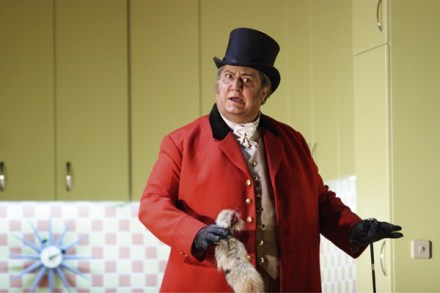
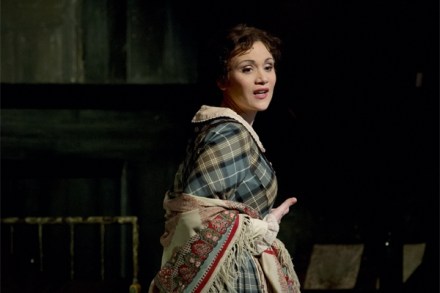
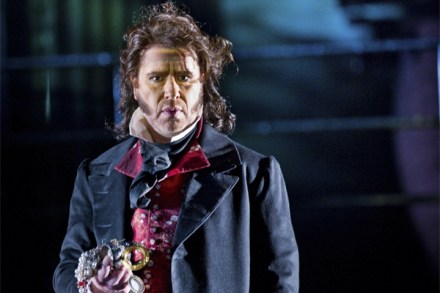
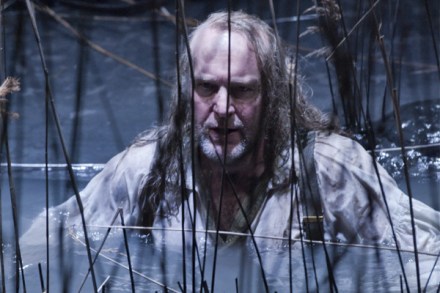
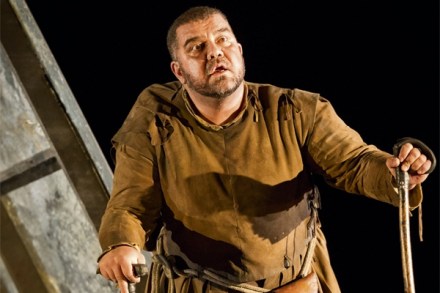
Lightning struck, after what must surely be one of the most dreary seasons at the Royal Opera, with a revival of Rigoletto. You never know. I haven’t been an admirer of John Eliot Gardiner, either in the pre-classical repertoire in which he made his name, or in his excursions into more recent orchestral and operatic music, for instance Puccini’s Manon Lescaut at Glyndebourne. With the opening bars of Rigoletto, however, it was immediately clear that his tight grip on proceedings was going to have thrilling results, even though the orchestra took a little time to settle. David McVicar’s production of decrepit Mantua is itself looking pretty decrepit by now, and the opening orgy sorely needed a generous hand-out of Viagra.

Standing room only | 7 April 2012

Of all the operatic ventures that have sprung up in England in the past 20 years, Birmingham Opera Company may well be the most remarkable. Its artistic director is Graham Vick, who is well acquainted with opera at its most elitist — he was artistic director of Glyndebourne from 1994 to 2000. BOC is at the other extreme, in that productions now regularly take place in a disused steel foundry on the outskirts of the centre of Birmingham, and the aim is to involve as many local inhabitants as possible. Over the past few years there have been impressive performances of Verdi’s Otello (it was televised, and survived the scrutiny extremely well), Idomeneo and, most movingly to me, Ulysses Comes Home, a wonderful version of Monteverdi’s greatest opera.

Straying from the brief

‘Praising! That’s it!’ Rilke exclaims in one of his ecstatic Sonnets to Orpheus. It seems to be an unconditional injunction, but he hadn’t tried being an opera critic, and I’d like to see anyone even try plausibly to praise either  of the two productions I saw this week. One was new and absolutely terrible, the other was old, neglected and may or may not be good — it wasn’t easy to judge. Tête à Tête is an opera company and enterprise that I have often admired and enjoyed, but its speciality is very brief works, which could hardly be staged alone, and which don’t demand of their librettist and composer that they write an extended piece with all the problems that involves.

Fatal flaw | 24 March 2012

Judith Weir’s Miss Fortune, whose UK première was at the Royal Opera last week, has received the severest critical panning I can recall for any new opera. It is no masterpiece, but I wonder why it has been rounded on when so many new — not to mention old — pieces with no more going for them, so far as I can tell, get greeted warmly or at least tepidly. Admittedly, it takes an ambitious subject — Fate — and treats it in a largely unpretentious way. But Verdi’s La Forza del Destino takes the same subject and treats it in an utterly preposterous way, and has some dreadful passages of music, yet has survived for a century and a half.

The unkindest cut | 17 March 2012

Tristan und Isolde is a perfect opera, but where are the perfect performers and, just as important, the perfect listeners to do it justice? What very often happens to me in a fine performance is that I am wholly caught up in the drama of Act I, which, for all its revolutionary musical means, is a readily comprehensible confrontation of two people who half-know what they feel but are determined to conceal it, until that is no longer possible. Then in Act II, when we meet a quite different Isolde, equally determined but now ecstatically lyrical, the exorbitant demands the work makes on me are ones I can rarely meet, because for the most part conflict is replaced by unimaginable rapture.

Sturdy specimen

A few weeks ago I was speculating anxiously on the possibility that even the greatest masterpieces, in opera or other art forms, might be exhaustible, or that anyway I might not be able to find anything fresh in them, and therefore might succumb either to a state of mild boredom, or else, like some critics, irritably demand that every production ‘break new ground’, as if it is the job of directors and performers to cater primarily to jaded palates.

Offenbach hotchpotch

Is any opera more frustrating than Offenbach’s The Tales of Hoffmann? It persistently arouses hopes which it almost as persistently fails to realise. Because there is no such thing as an authoritative text, one always hopes that a new production will have hit on a solution to its numerous problems. I’ve seen enough accounts of it now to feel miserably confident that any production will be a mixture of pleasures and let-downs. This new effort by ENO, a co-production with the Bavarian State Opera, is as good an attempt as any I ever expect to see, and its shortcomings are emphatically not to be attributed either to Richard Jones and his team, or to the performers, the strongest cast that ENO has had for anything for a long time.

Man about the House

They are lighting the candles at Covent Garden to honour one of the great singers of our age. Thomas Allen (as he was then) first appeared on the stage of the Royal Opera House in 1972, as Donald in Billy Budd, when Benjamin Britten was alive and his opera not nearly so highly thought of as it is today. This month he returns as a long-standing knight of the realm and, so far as our major house is concerned, a monarch to boot. He may have been born a commoner in County Durham 68 years ago but the baritone’s stellar international reputation granted him regal status many moons ago, particularly in the great Mozart roles.

Great expectations | 11 February 2012

Bellini’s Norma is an opera that I not only adore: it obsesses me, too. Whenever I listen to it, I have to hear it again very soon, and parts of it lodge in my mind, playing over and over again, to an extent that very few other pieces do. It was the work through which I first came to realise Callas’s lonely greatness, and it was through her that I came to see how great Italian opera could be, too, having childishly dismissed it tout court as superficial compared with the great German traditions. I still think that Norma operates on a level different from any other work by Bellini or his contemporaries, or even, I am inclined to think, Verdi. The only Italian composer who rivals it for purity and passion is Monteverdi, to whom Bellini owes nothing and has no resemblance.

Devoid of ideas

When you see two of the undisputed masterpieces of the repertoire in one week in one of the world’s leading opera houses, competently performed, and remain largely unmoved, you’re bound to ask yourself the question: have I been to these things, and heard them on record, too many times? It is, after all, possible to get tired even of the greatest works if you have experienced them regularly in the same productions, and without any special ‘magic’ ingredients, such as can bring back to life, or sustain, a standard work. It was a question I found myself asking with special poignancy this week, after seeing two of Mozart’s greatest works in the space of four days at the Royal Opera House: Don Giovanni on Tuesday and Così fan tutte on Friday.

Mixed messages

The Enchanted Island is a baroque concoction at the New York Met which has been widely touted and last Saturday was relayed worldwide to cinemas, a transmission that went less smoothly than any I have seen before, with some sharp variations of volume and a temporary complete breakdown. On the whole, the sound level is very high, as if everyone is singing at the top of their voice; while it’s nice to have ample volume, it is clearly and disconcertingly a misrepresentation. Danielle de Niese, for instance, has a small voice which just about fills Glyndebourne’s house. Here she sounded like a Wagnerian on the make, with coloratura sounding like ‘Hojotoho!’.

Look at life

Giulio Cesare was the first of Handel’s operas to return to general favour after more than a century and a half of neglect, and I suppose that it is still the most frequently performed. That isn’t surprising, since its plot is, by Handelian standards, simplicity itself, and the level of inspiration in the arias is astonishingly high. There is a problem with it, at least in the UK at the moment, and that is that David McVicar’s Glyndebourne production of 2005 has been so widely and wildly acclaimed, and distributed, that new productions are bound to be seen in its shadow.

The opera of all operas

As I’m not the first person to have pointed out, the Royal Opera has indulged in a truly phenomenal number of performances of La Traviata this season, in the largely traditional production by Richard Eyre, which opened in 1994 with Angela Gheorghiu making her name. The three main roles have been cast differently for these three runs of performances, of which the last has just begun.

Special relationships

‘It is impossible that you should not have sensed,’ wrote Wagner to Ludwig II shortly before the first performance of Die Meistersinger von Nürnberg, ‘under the opera’s quaint superficies of popular humour, the profound melancholy, the lament, the cry of distress of poetry in chains, and its reincarnation, its new birth, its irresistible magic power achieving mastery over the common and the base.’ The King, and anyone else, might well not sense that in the latest revival of Graham Vick’s production of the opera at Covent Garden.

Beyond compare

Bernard Levin once wrote an article in the Times called ‘But seriously, how can anyone compare Verdi with Wagner?’ (or something very like that). I can’t remember the article in detail, but its drift was ‘No one can seriously compare them’, something that I had and have always felt. Yet there is the temptation: they were born within a few months of one another in 1813, they were indisputably the two greatest opera composers of the 19th century, and each of them is thought to embody some of the most striking characteristics of their country.

On top form

Having seen and been most impressed by two New York Met relays of Wagner operas on the big screen, I was interested to see how the largely close-up medium would cope with a Handel opera, where the challenges are quite different. Both composers have single characters singing for large stretches of time, but, while Wagner’s are always involved in a process of feeling, so that there is a sense of exploration at every moment, Handel’s are immersed in states of feeling.

Highs and lows

This year’s Christmas offering at the Royal Opera is yet a further revival of Richard Eyre’s production of La Traviata, which began the season and is being revived again early in 2012. The main reason I went again to an opera for which I usually feel distaste was to see and hear Simon Keenlyside in the role of Germont père, hoping that he might make me see the opera in a different light. And, with a few gestures and in magnificent vocal form, that is exactly what he did. Normally I object strongly to Violetta’s giving in to the old bully, and then asking him to bless her, when if there is any blessing to be done it should be the other way round.

Ticking boxes

Dante didn’t have the foresight to create or depict a circle of the Inferno designed expressly for opera critics, with intrepid explorers of new operas with social agendas as an extra. That was left for almost seven centuries until the Royal Opera House came up with the idea of the Linbury Studio Theatre, which answers the most stringent requirements for such a place of torment. You go down, down again and then down, sit in acute and always freshly experienced discomfort, and try to concentrate on yet another exploration of inequality, multiculturalism, a variety of shocking discriminations.

Concealed passion

ENO’s new production of Tchaikovsky’s Eugene Onegin has created something of a stir by departing from the house almost-tradition of postmodernist, stunningly intrusive and invariably grotesquely irrelevant presentations that began in earnest sometime last year. The set designs for this opera, by Tom Pye, and the costumes, by Chloe Obolensky, update it to the late 19th century, but that is just a nervous tic. More surprisingly, Deborah Warner’s direction of the characters and actors is so unobtrusive that one wonders if she told anyone to do anything in particular. The most sensational departure from what we normally see is that Lensky wears glasses (not sunglasses) for the duel, gently stressing his bookish otherworldliness; and one other touch, to be mentioned later.