Latest from Coffee House

Latest from Coffee House

All the latest analysis of the day's news and stories

Let Greece go

From our UK edition

The campaign to keep Greece in the euro has resulted in five years of groundhog days. The unfortunate country seems to be forever approaching a day of repayments it cannot afford. Ministers and diplomats assemble to thrash out a deal. Meetings collapse in bad temper, and markets sink. Then, at the eleventh hour, a deal is somehow forged. Greece agrees to reforms which seek to cut spending and balance the books in return for billions of pounds of bailout cash. Markets rebound. The money is paid, the debt repayments met. And then all starts to go wrong again. A few months later we are back where we began. Anyone who hoped the election of Greece’s Syriza government in January would break the cycle has been disappointed.

Pedant’s revolt

From our UK edition

It used to be that the most annoying thing in academic life was political correctness. But a new irritant now threatens to supplant it: the scourge of correct politicalness. The essence of correct politicalness is to seek to undermine an irrefutable argument by claiming loudly and repetitively to have found an error in it. As with political correctness, which seeks to undermine arguments by declaring the person making them a bigot, correct politicalness originated in the US. But it now has its exponents here, too. Foremost among them is Jonathan Portes. Portes’s career recalls that of the character Kenneth Widmerpool in Anthony Powell’s Dance to the Music of Time.

Why the UK should should be subject to different rules on European migrants

From our UK edition

The rest of Europe has, predictably, reacted negatively to the suggestion that the UK should be able to impose some kind of cap on free movement while remaining in the EU. At first glance, it does sound as if David Cameron wants the UK to stay a member of the European club without subscribing to one of its founding rules. But there’s actually a very good argument for why the UK should be treated differently. As I say in my column this week, Britain is the one major EU economy that is never going to join the euro. This makes Britain a special case. If there is no limit on the number of EU migrants who can move here, the UK - with its different business cycle - is going to become the main safety valve for the Eurozone when it goes into recession. This is already beginning to happen.

Europe will reconcile with Russia, and soon. It can’t afford not to

From our UK edition

After months of escalating tensions over Ukraine and talk of a new cold war, Russia and the West could soon reach a surprising rapprochement. The eurozone economy is suffering badly and sanctions against Russia are partly to blame. Winter is also upon us, and that reminds every-one Vladimir Putin still holds the cards when it comes to supplying gas. The clincher, though, is that Ukraine is heading towards financial meltdown. Unless an extremely large bailout is delivered soon, there will be a default, sending shockwaves through the global economy. That’s a risk nobody wants to take — least of all Washington, London or Berlin. Sanctions against Russia were always going to hit western Europe hard.

Forget about saving British big pharma – it’s little pharma we should be helping

From our UK edition

Readers in all sorts of places — at the club bar, over a birthday lunch, even along the church pew — had been telling me I was wrong not to subscribe to the ‘save AstraZeneca’ campaign, and too complacent about the future of British science when I wrote: ‘the game is Pfizer’s for the taking, as soon as the price is right’. Now Pfizer has retreated, it looks like the battle has been won by the bandwagon I missed, whose crew included Ed Miliband, the Unite union, and former AZ chief Sir Tom McKillop — better remembered as the chairman of RBS who presided over its catastrophic merger with ABN-Amro, so at least speaking from rueful experience. But the reality is that the game was not taken because the price was wrong.

David Cameron must tackle the optimism deficit

From our UK edition

[audioplayer src="http://traffic.libsyn.com/spectator/TheViewFrom22_24_April_2014_v4.mp3" title="James Forsyth and Alex Massie explain why we need more optimism in Scotland and Westminster" startat=1538] Listen [/audioplayer]There is an optimism deficit in British politics. Politicians seem incapable of making a positive argument for anything, including the country itself. The British government’s case in the Scottish independence referendum has been almost entirely negative. Those looking for an uplifting defence of the United Kingdom have been left sorely disappointed as the government has instead stuck to technocratic arguments about why Scotland would be worse off on its own.

While Britain stagnates, America is roaring back

From our UK edition

Predicting the decline of the United States has been in vogue since the birth of American hegemony. Sputnik, Vietnam, stagflation, budget deficits, trade deficits and even the end of the Cold War all triggered predictions of the end of America. With the 2008 financial crisis, however, there seemed to be a sense that this time was different. Tomes with titles like The Post-American World and The End of Influence began to appear on bookshelves. Germany’s finance minister confidently predicted that the United States was entering its last days as a financial superpower. Serious commentators spoke about how a ‘Beijing consensus’ would supplant the ‘Washington consensus’. America looked as if it would disappear in a vortex of debt.

Sir Andrew Motion, there’s much more to rural life than housing

From our UK edition

Five years of living in squalid parts of London has made me appreciate my rural upbringing. I grew up on a small farm on the borders of West Sussex, Surrey and Hampshire. It’s an area of outstanding natural beauty, a stretch of wooded undulations pocketed between the North and South Downs. The house is perched on one of these small hills, facing south east with a view across the flat expanse of East Sussex. On a clear day such as this, you can see the shadow of the Low Weald, the hills which divide Sussex and Kent, through the haze. There’s nowhere I’d rather be. It is a quiet corner of England; but it has much more to offer than beauty.

Stop shouting at Hilary Mantel – there are real outrages to address

From our UK edition

It started the other week, when David Cameron was in India. Although it started like a bout of malaria starts, so I suppose the more precise term would be ‘recurred’. There he is in Amritsar, touring the site of a massacre, possibly in that hat. And all Britain wants to know is what he thinks about what Hilary Mantel thinks about the Duchess of Cambridge. What, I thought to myself, the hell is wrong with us? It’s a pretty expansive ‘us’, this, and it includes Cameron himself.

Whisper it, but the British economy may in better shape than you think… – Spectator Blogs

From our UK edition

Doom and gloom is all around. This is another winter, if not of discontent, then certainly of persistent grumbling. Optimism is as rare as a Scottish victory at Twickenham and, frankly, just as fanciful a thought. That, at any rate, is today's conventional wisdom. Fleet Street looks to a Triple Dip recession and ponders what side dishes will best complement the Chancellor's broiled reputation. And yet, and yet, I wonder - hesitantly, I grant you - if all this is quite accurate. Fleet Street, like Westminster, is often fighting the last war. Worse still, it tends to presume that what has happened will continue to happen and that present trends will last forever and a day and so on. No wonder the press is always surprised when this proves to be not the case. It is almost touching.

Worst recovery in history: British GDP shrinks by 0.3 per cent

From our UK edition

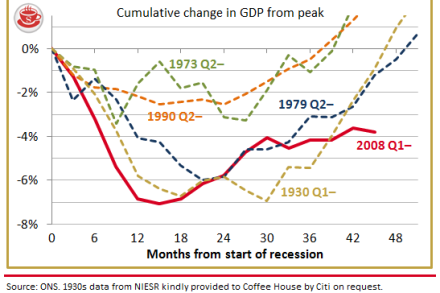
Now we know why David Cameron delivered his Europe speech on Wednesday. It’s time for bad headlines again: the GDP figures just announced show that the British economy is contracting yet again — by 0.3 per cent in the final three months of last year (see above graph). Now, you’ll hear a lot of people tell you today that quarterly data does not matter. The ONS say this is a fallback from the Olympics, which sucked economic growth forward. And they’re right: the ONS usually revises quarterly data, often dramatically. What matters more is the long-term trend, and this is pretty appalling. It now seems inarguable that Britain is going through the worst recovery in history. Slower and longer even than the 1930s.

The recession: four years and counting

From our UK edition

It is now four years since recession hit the UK. It took just over three years for GDP to return to pre-recession levels in the much milder downturns of the ‘70s and the ‘90s. Even after the Great Depression of the 30s, the economy had fully recovered by this point. By contrast, economic output in 2011 Q4 was still 3.8 per cent down on 2008 Q1. And it’s going to take a while longer to get back. The OBR’s projections suggest the economy won’t have fully recovered until the end of 2013. Other forecasts are gloomier still. But even if we do manage it by then, it’ll have taken us two years longer than it did to recover from the Great Depression.

Eurozone enters double dip recession

From our UK edition

The Eurozone is now in recession – this, at least, is what is implied by today’s avalanche of dire economic data. Eurostat has not (yet) made this calculation; but Capital Economics has. Take into account the relative size of the Eurozone economies who have declared figures and it suggests a fall of 0.1 per cent for Q3 which, which, coming after the contraction of 0.2 per cent in Q2, would meet the test for recession (two consecutive quarters of negative growth). So, like Britain, a double-dip recession. Greece and Portugal are still in meltdown. The Germans are doing okay, with growth of 0.2 per cent for Q3. This is mainly because of the fact that their currency would be worth about a third more if they had the Deutschmark.

Employment returns to pre-crash levels

From our UK edition

Employment has almost entirely recovered to its pre-recession peak, according to today's new figures. Total employment for May to July stood at 29.56 million — up 236,000 on the previous three months and just 12,000 shy of the 29.57 million peak of April 2008. This recovery is thanks to the expansion of the private sector, which has added over a million new jobs in the last two years, and now employs 381,000 more people than it did before the crash. Public sector employment, meanwhile, has been cut by 628,000 since the coalition took over, and is now at its lowest level since 2001.

City retribution

From our UK edition

When City AM editor Allister Heath was leaving the BBC’s Westminster studios on Friday, the last thing he would have expected was to be 'arrested'. Out popped an overexcited viewer of the Daily Politics who I hear accosted Heath declaring: 'I've got a warrant for your arrest'. The white envelope was quickly discarded. but a frothing anti-city rant ensued. A BBC snout tells me that Heath returned upstairs and was later smuggled out of the building while a quick-thinking BBC staff member distracted the lunatic. The irony of it all being that Heath had just spent the last hour slamming the banks and generally turning on the City, but this one was beyond reason.

Balls’s argument is detached from reality

From our UK edition

So who killed the recovery? Ed Balls points to a ‘recession made in Downing St,’ and has gone on a victory tour today. ‘I have consistently warned David Cameron and George Osborne for over a year that going too far and too fast on spending cuts would backfire,’ he says. ‘Arrogantly and complacently they ignored those warnings, and the country is paying a heavy price.’ Facts are always the remedy to an outbreak of Balls. The government releases monthly spending figures, which show an increase overall. That’s due to the rising cost of debt and dole, you might say, but strip those two out and you have what the ONS calls ‘core government spending’.

Britain’s longest downturn

From our UK edition

As of today, we now have four years’ worth of GDP figures since the UK first went into recession — and they don’t look pretty. By this point in the 1930s, we’d already fully recovered from the Great Depression.

The economy adds to Cameron’s woes

From our UK edition

This morning brought the economic news that the coalition has been dreading: the country has double dipped. Now, this is based on preliminary figures which may well be revised up. But, as Pete says, the political impact of this story will be huge. The government’s handling of the economy has now been caught up in this whole argument about competence. It provides quite a back-drop to Rupert Murdoch’s testimony today. PMQs today has now taken on a special significance. Ed Miliband has two massive targets to aim at, the Jeremy Hunt revelations from yesterday and these GDP figures. For Cameron it will be his most testing appearance at the despatch box yet. One other thing to watch is what effect these developments have on the polls in London.

Our economy fell back into recession

From our UK edition

Or at least technically-speaking it did. The figures released this morning suggest that the economy shrank by 0.2 per cent in the first quarter of this year, which is the second quarter of shrinkage in a row after last winter's 0.3 per cent fall. The numbers are tiny, but the politics is huge. It's a double dip — and you can expect Ed Miliband to mention that fact again and again in PMQs later, with dread accompaniment from Ed Balls and his hand gestures. There are some caveats, of course. This is only a preliminary estimate, so the Office for National Statistics could revise it upwards at some point. It's also the slightest of slight downturns.

Bringing the squeeze into focus

From our UK edition

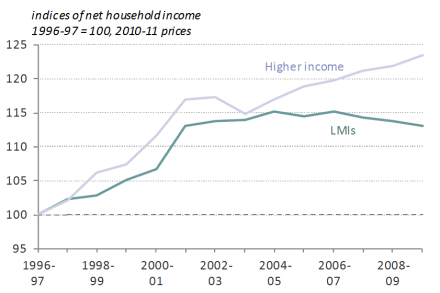
The ‘word of the year’ for 2011 is already featuring prominently in 2012. Yep, the ‘squeezed middle’ is the focus of the Resolution Foundation's latest report, which they launched in central London earlier today. It’s a fascinating and nicely presented study, and I’d recommend you read it in full: this think tank really is very good at choosing the most revealing metrics to bring some clarity to an often vague debate. But, in the meantime, here are some of the things that stood out to me from today’s event:   1. The squeeze started long before the recession.

Osborne visits China, but can’t escape Europe

From our UK edition

Yet another day here in Westminster that's all about the economy. Nick Clegg has just delivered a speech on the subject to Mansion House, focusing on ‘responsible capitalism’, which we'll blog shortly. And two prominent forecasting groups, the Ernst & Young ITEM Club and the Centre for Economic and Business Research, have suggested that we're effectively back in recession. They both reckon that the economy shrank in the final quarter of last year, and is wilting even further in this current quarter. But, like the OECD, they also predict that this ‘double dip’ will be relatively short-lived and relatively mild. Against that backdrop, enter George Osborne.

Behold post-Putin Russia

From our UK edition

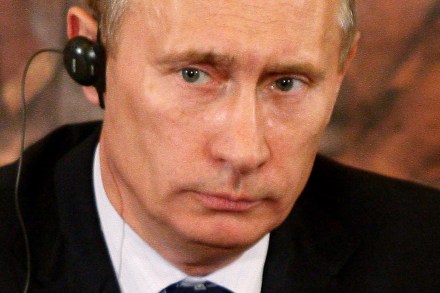
Sunday's parliamentary elections in Russia marked the beginning of the end of the Putin era. It won't feel like it for another few years, as the Russian strongman ascends to the nation's Presidency again and bestrides the international stage. But when future historians come to examine post-Putin Russia, the end of 2011 will be seen as the point at which the transition began. Exit polls showed Prime Minister Vladimir Putin’s United Russia party with less than 50 per cent of the vote. United Russia held a two-thirds majority in the outgoing State Duma.

Those gloomy OECD projections in full

From our UK edition

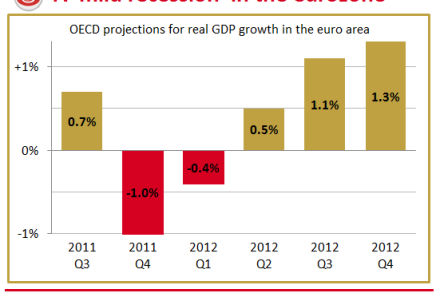
Thanks to the tremors along Westminster's grapevine, we already knew that today's OECD Economic Outlook would make for pretty dreary reading. But now that the report is actually out, we can see the organisation's numbers for ourselves. The headline point appears to be that the eurozone is in, or is facing, ‘mild recession’. Or to put it in graphic form: And the current situation isn't look particularly encouraging for the UK either. The first heading in the section on us reads ‘The economy is weakening sharply’. And a subsequent pair of graphs predicts, first, that we'll experience a mild recession of our own across the next two quarters, and then that unemployment will keep on rising to a peak in 2013.

Cable can’t make any promises

From our UK edition

Did you realise that today is the first anniversary of the government's Spending Review? Neither did I until the politicians started making a fuss about it, starting with Vince Cable on the TV last night. We'll post video footage of the Business Secretary's performance when we can, but this write-up here just about covers it. He made a few earcatching remarks — among them that "we didn't know that there would be a major crisis in our export markets and that energy prices would shoot up" — but one has captured the headlines more than any other. Asked whether he could promise that we wouldn't experience a double-dip recession, Cable replied: "I can't do that. We know conditions are very difficult but the government is doing the best it can to protect people.

Euro-zonked

From our UK edition

Well, so much for that. The FTSE 100 fell as much as 1.7 per cent this morning, while overnight the euro and Asian stock markets tumbled, after Europe’s leaders announced their grand 2-trillion-euro plan over the weekend to drag the Eurozone out of the mire. It appears the markets are well past the point of believing that political leaders can get us out of this mess. The consensus is that the plan is not concrete enough. Of course, equities may recover a bit later, as they have been prone to do in past days. But the whipsawing itself is the worst sign of all; stock investors and retail-end funds are confused, panicky and probably still in denial.

Time for the QE gamble, again

From our UK edition

It's time to warm up the printing presses. When growth evaporates and governments feel politically unable to cut spending or raise taxes, there's only one tool left: printing more money. We can expect more of it soon. As James says today, Osborne believes he has created the conditions where the Bank of England can do some more Quantitative Easing and it could start as early as next month; an unusual move, given how high inflation is. But the Bank is (as ever) forecasting a return to the 2 per cent target soon – and may now claim that economic weakness makes an undershoot likely. And so (the logic will run) it’s time for more QE so as to keep inflation to target. The other arguments for QE are harder to make.

Darling lifts lid on Brown’s chaotic government

From our UK edition

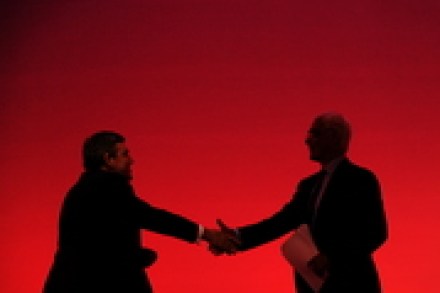
Tieless, Alistair Darling appeared on Marr this morning to discuss his memoir. As with so many of these New Labour autobiographies, there was the strong whiff of a therapy session. At one point, Darling said "if Gordon is listening to this" before remarking that he still felt a huge amount of "residual loyalty" to him. It is not news that the Brown government was dysfunctional. But it was striking that Darling did not dissent when Marr suggested that under Brown, Labour had – collectively – not been fit to govern.

Shaking our faith in money

From our UK edition

Addictive though the hacking inquiry is, the average Brit is probably more worried about the slow decimation of his spending power at a time when salaries are flat. Against this backdrop, the price of gold today has broken $1,600 an ounce.  With inflation and the Fed's printing presses whirring, faith in paper money is taking a knock – and this is reflected in the price of gold.  Fears of a debt crisis in Europe add to it too, with a disaster scenario all too easy to imagine. Over the last decade, the West blew a bubble fuelled by low interest rates and debt-financed consumption. The bubble burst. Solution: even lower interest rates, and even more debt-financed consumption – but this time, with added inflation.

A nation of shareholders?

From our UK edition

The great sleeper issue in British politics at the moment is what to do with the state owned bank shares. The money that could be generated by a sale of these bank shares is massive. The state’s stake in RBS is bigger than all the privatizations of the 1980s combined. Nick Clegg’s proposal (£) that everyone in the country be given shares in the banks is one option. But I suspect that would overly depress the value of the shares and would reduce the amount of money that the government would have in its pre-election war-chest. A more likely option is still a scheme where these shares are sold at heavily discounted rates to the public. I understand that this remains George Osborne’s favoured solution.

Why Belfast is ablaze

From our UK edition

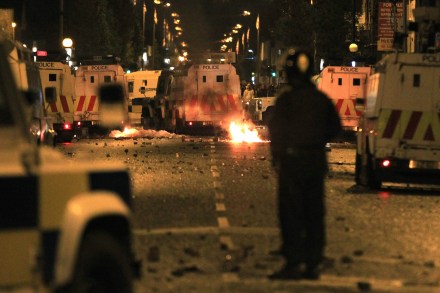
I live three miles away from where the rioting was happening in East Belfast last night, and heard the helicopters whirring overhead. It was the kind of sound that anyone living in the city hoped never to hear again. As a child, I'd lie in bed and hear bombs and sirens and helicopters — and we had all hoped that dark chapter had been closed. A tipping point of violence has now been reached. A press photographer has been shot, another given a fractured skull after a second night of riots. And in the aftermath, the blame game cacophony begins: Who started it? It was them. No it was them … ad infinitum on BBC Radio Ulster's Stephen Nolan Show. While the most important question in all of this is not addressed. Why is this happening? Why now?

Miliband and the past

From our UK edition

Labour's simmering resentments and self-doubts have been boiling over recently — and today is no different. Compare and contrast The Sun's interview with Tony Blair with Andrew Grice's article on Ed Balls in the Independent. For Blair, Labour ought to be claiming more credit for their preparatory role in some of the coalition's reforms, such as the Academies programme. For Balls, they ought instead to be dodging blame for the state of the public finances. As Grice reports, "Ed Balls has rejected demands from allies of Ed Miliband that he admit Labour spent too much when they were in power." From the rest of the piece, the shadow chancellor's position sounds rather like that of John Wayne's Captain Nathan Brittles: "Never apologise.

Osborne comes to a decision on the banks — but the story doesn’t end there

From our UK edition

In his speech to Mansion House last year, George Osborne asked a question of his frosted and cumberbunded audience: "Should we restrict or split the activities of banks?" In his speech tonight, he looks set to deliver an answer of his own. As Robert Peston reports, the Chancellor is to announce that the investment and retail arms of banks will be ringfenced off from each other, so that the dice rolls of the Masters of the Universe cannot tumble across everyday savers' cash. This does not mean a complete, Glass-Steagall-style separation between the two halves.

Ed Balls opens a new front in the same old way

From our UK edition

There are plenty of pressing issues at the moment, but two in particular stand out: the cost of living and youth unemployment. Ed Balls lost no time in latching onto the first issue. On becoming shadow chancellor, he immediately attacked the government’s VAT rise and benefits changes, which he judged to be the main contributors to rising inflation. It has been a  successful tactic, sustained by rising inflation and determined political pressure. Now Balls seems to be turning his full gaze at youth unemployment. In article for the News of the World, Balls launches his campaign to save "Britain Lost Talent". At the root of this is a plan to create 100,000 new jobs funded by a £2bn tax on bankers’ bonuses.

Stop Gordon Brown

From our UK edition

Gordon Brown's friends have launched a shameless effort to compel the government into nominating him for the IMF post. The government would be mad if they did. Mad. This is not about petty score-settling, as yesterday's Evening Standard would have it. This is about qualifications to lead, and the former Prime Minister, despite his intellect, does not have those skills. He led the country to ruin and remains in denial about it: he saved the world, don't cha know. The UK should be smarter about using talent from across the House, but there are limits. And it is a bit rich for the ex-PM's friends to argue that David Cameron should back him. This is the man who gave lukewarm support to Paddy Ashdown's candidacy to run the UN in Kabul back in 2008.