Society

The day Tilda Swinton came to stay

An exhibition at the Eye Film Museum in Amsterdam devoted to the multi-talented and award-winning actress Tilda Swinton, runs until February. Reading about it prompted me to think back to the mid-2000s, when I got to know her slightly. Through work, her then partner, the artist and playwright John Byrne, came down from Nairn to stay in Glasgow for a few days. I’d first heard of him when I was a teenager – he was responsible for his friend Gerry Rafferty’s 1970s album covers, and later went on to write The Slab Boys trilogy and the 1987 TV series Tutti Frutti, which starred Robbie Coltrane and Emma Thompson. Because Tilda

Dear Mary: Can I retract a party invitation without causing offence?

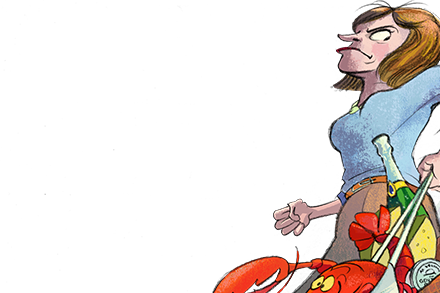
Q. A very likeable woman has joined the company I work for and also just moved to my village. I said I would give a drinks party for her so she could meet a few people. My husband told me we should have a cap of 20. Now my colleague has asked if she can bring her two twentysomething children and their partners. This skews the numbers slightly, but the bigger problem is that she has also asked three neighbours of mine who have never been in the house before. She said she ‘assumed they would be welcome’. Well, there is a reason these three have never been in my

Wine to toast the fallen

Solemn, moving, serious: British. As silence fell and the wreaths were lain, even teenagers joined in the mood of reverence. Suddenly it did not matter what the gossip columns were saying about Andrew Mountbatten Windsor, or what latest mischief might arise from the Duchess of Sussex. The great ship of state and of history sailed on serenely. The sacrifices of a previous generation were saluted. They had paid the price for their Britishness. We, their successors, unworthy as we might feel, could at least salute them, especially as good bottles were about to be opened, to toast the fallen. Yet there was a problem far more important than princely indiscretions.

The last B&B guests of the season

‘Where are you off to now?’ I asked the fellow from Hong Kong as he and his wife stood in the hallway ready to leave, their many suitcases beside them. At first it sounded like he said ‘Ukraine!’ very cheerfully, but he couldn’t have said that, obviously, so I asked again. ‘I mean, now you’re leaving West Cork, where are you off to next on your holiday? The Ring of Kerry? Killarney? The Cliffs of Moher?’ He stared at me like I was stupid. ‘Ukraine!’ he said, and then when I stared back he shouted: ‘U-KRAINE! You know Ukraine? Big war Russia Ukraine! Ukraine?’ ‘Yes, I understand you keep saying

How binding are Rachel Reeves's 'pledges'?

‘Pop goes the weasel!’ my husband exclaimed, expertly muddying the waters. We had just been listening to another news bulletin that referred to the Chancellor of the Exchequer being expected to ‘break her pledge’ in the Budget. It seemed to me that the ink on pledges were scarcely dry before they became aspirations that came to nothing. We are told that not raising income tax was ‘a key manifesto pledge’. Why don’t we imitate the Anglo-Saxon attitudes of our forebears and resort to frithborh or frank-pledge? It was a system making each householder of a tithing (ten households) responsible for the other nine. This fits in with the root meaning

Susanna Gross (1967-2025)

Michael Gove writes: The Spectator asks only one thing of its writers: that they entertain. Susanna Gross, who wrote our bridge column in this space for 25 years, never failed. She played the game expertly, and with panache, representing England in international competitions. But formidable as her skills at the table were, she was even more accomplished as a writer. And unforgettable as a friend. Susanna made every encounter memorable. Over cards or drinks, in these pages, or during her time as literary editor of the Mail on Sunday, she was captivating. She had an unerring eye, both for opponents’ weaknesses during play, and for the quirks of character which

Spectator Competition: A letter from Jane

Competition 3425 was prompted by Gill Hornby, a biographer of Jane Austen, telling an audience at the Cheltenham Literature Festival that Jane’s sister Cassandra did the novelist’s reputation a favour by burning most of her letters, and if that hadn’t happened she might have been cancelled: ‘She has become this very vague, hazy figure, like God and Shakespeare…’. You were invited to ‘find’ a letter that had escaped the bonfire.     There was a strong response, though a few entries crossed into sacrilege. The best got something of the tone while casting her in an unexpected light. Tom Adam found her channelling thunderers de nos jours: ‘I grow quite weary

2729: Spelled out

Unclued lights (one of two words, the others paired) at length have something in common. Across 1 Faced bombs near end of life (7) 11    Museum spending pounds to acquire English works (6) 12    European body said to be a biblical tribe (7) 14    Losing sides destroy poetic inspiration (5) 15    First person on chimney reaching heavens (5) 16    Shrewd to hide roubles in crevice (6) 17    Mum unfortunately sent back spicy paste (6) 18    In which to deliver good wine? (7,3) 20    Given day off, study papers for research (7) 23    In sleeper perhaps women used to wear these (9) 26    Pristine yellow filling cryptically suggests having green edges

2726: Two against one - solution

The combined fleets of France and Spain met that of England at TRAFALGAR (13) on 21 October 1805. Vice-Admirals NELSON (30) in the VICTORY (27), and COLLINGWOOD (16dn) faced Vice-Admiral VILLENEUVE (19), in the BUCENTAURE (12), and Admiral GRAVINA (22). A COLUMN was later erected in Nelson’s honour. First prize Jamie Thomson, Hungerford, Berks Runners-up Magdalena Deptula, Eton, Berks; John Cottrell, Clifton, Bristol

Labour isn’t working

Labour: the clue should be in the name. In March, Keir Starmer branded Labour the ‘party of work’. If ‘you want to work’, he declared, ‘the government should support you, not stop you’. Even as his premiership staggers from crisis to crisis, that mission remains. If Labour doesn’t stand for ‘working people’ – however nebulously defined – it stands for nothing. As such, this week’s unemployment figures are more than just embarrassing for Starmer; they are a betrayal of his party’s founding purpose. Unemployment has risen to 5 per cent – its highest rate since February 2021, in the middle of the third lockdown. There has been a 180,000 reduction

America thinks Britain is finished

‘What’s missing?’ the tech titan Peter Thiel asks me, over lunch on the hummingbird-infested patio of his house in the Hollywood Hills. He gestures at the city of Los Angeles laid out in the haze below us. ‘Cranes!’ he explains. Thiel has argued for years that America has done most of its innovation in digital ‘bits’ instead of physical ‘atoms’, because bureaucracy, regulation and environmentalism have got in the way of the latter. While software has exploded, transport and infrastructure have stagnated. But over the next few days in Austin, Texas, and around San Francisco Bay, I see evidence this is changing. Travelling with the upbeat co-founders of the Rational

Portrait of the week: BBC vs Trump, a plot against Starmer and a weight loss deadline for North Sea oil workers

Home Tim Davie, the director-general of the BBC, resigned, as did Deborah Turness, the CEO of BBC News. Samir Shah, the chairman of the BBC, apologised for an ‘error of judgment’ in the editing by Panorama of a speech by President Donald Trump that made it look as though he was urging people to attack the Capitol in January 2021. This had been criticised in a 19-page memorandum to the BBC board by Michael Prescott, a former standards adviser, who also set out failings over Gaza and transgender matters. The leaked memo was published by the Telegraph. Trump wrote to the BBC threatening to sue it ‘for $1 billion’; he

Ireland is looking for its own Nigel Farage

A few years ago, I watched an Irish-made drama on Netflix called Rebellion. Given that it was about the 1916 Easter Rising, I expected it to be somewhat anti-British but was pleasantly surprised. I knew the basics of what happened, but the series made me question why I knew so little about Irish history and politics more generally. I could name each taoiseach (prime minister) going back to Jack Lynch but, apart from Eamon de Valera, none before him. So I began to read voraciously about our nearest neighbour. Having edited books about British prime ministers and American presidents, I decided that one of the (now) 16 men who have

The true cost of the Chagos deal

When the BBC denies ‘systemic bias’, it denies the main, the crucial thing exposed by Michael Prescott’s now-famous leaked internal memo. Prescott was not presenting a ragbag of mistakes, but examples from many different areas of subjects where an institutional view prevailed – against Donald Trump, pro-trans, pro-immigration etc, all of them defensible views but none of them following rules of impartiality or accuracy. For this reason, the Prescott material about Israel/Gaza coverage is the most important by a long way, though less expensive for the BBC than its doctoring of Trump’s words. It is about a systemic failure, which can only be accounted for by bias, failure to explain

The army is too woke for war

Last month, in a two-page letter to colonels of corps and regiments, the Deputy Chief of the General Staff, Lieutenant-General David Eastman, inadvertently exposed the moral confusion, panic even, possessing parts of the British Army. Invited to dine by retired and serving officer members of the private London club Boodle’s, Eastman was dismayed to discover that there were ‘restrictions on the rooms that can be accessed’ by women. In his subsequent letter, he expresses concern that, even in mixed clubs, ‘rules, policies or cultural practices may not align with the army’s commitment to inclusivity’. And so, like Widmerpool in his pomp, he calls for corps and regiments to review their

What Andrew's Norfolk exile will look like

When Russian dissidents were bundled off into exile under the tsars, they were sent to Siberia, the ‘prison without a roof’, and disappeared from society, never to be seen again. Many residents of Norfolk, where the King has exiled his brother, Andrew Mountbatten Windsor, will be hoping he follows the same route. ‘There may be a certain thrill about having him, like presenting Liz Truss in your sitting room’ Norfolk likes to call itself a ‘royal county’, as the Visit Norfolk website proudly proclaims. Sandringham, the family’s private home, is well known. But the royal connection pre-dates Queen Victoria’s purchase of the country retreat for her son Albert in 1862

How to fix the BBC

Assuming the BBC is still in existence by the time you read this, the scale of the task facing the next director-general would have been evident by listening to the output on Monday, the day after Tim Davie and Deborah Turness resigned. This was an organisation in utter denial. It began with Nick Robinson, puffed up with even more pompous self-regard than normal, treating Today listeners to a psychedelic monologue in which he disappeared down several capacious rabbit holes, jabbering about a sort of palace coup at the BBC, an assault by sinister right-wing forces. In doing this, Nick handily confirmed the case for the prosecution – something he would

The golden thread between Donald Trump and Nero

Donald Trump has knocked down the east wing of the White House and is turning it into his Golden Ballroom. Might he be tempted to go a step further and build a Golden House (Domus aurea), as Nero did? Nero was as besotted with gold as Trump is. He wrote poems in gold, preserved his first beard in a golden box, possessed a golden fishing net, had a golden box of poisons and golden chamber pot, and shod his second wife’s mules in gold. When the king of Armenia visited, he had the theatre of Pompey – the stage, the walls, everything – somehow gilded. In 64 bc a devastating