Politics

Read about the latest political news, views and analysis

Biden has learned nothing from his foreign-policy experience

Historically, ex-presidents spend their golden years on the speaking circuit, writing their memoirs or planning for the inauguration of their presidential libraries. What they don’t do is lash out at their successors when they disagree with a policy or decision. Joe Biden, however, has no intention of keeping quiet. A little more than three months after vacating the White House, Biden is unencumbered from conventional decorum and feels free to speak his mind. Last month, he gave his first post-presidency speech in Chicago, where he blasted the Trump administration for taking a sharp hatchet to the federal workforce, including the Social Security Administration.

biden russia
shiloh hendrix

Is Shiloh Hendrix the new Luigi Mangione?

When a white mom called a black kid the N-word the immediate expectation was that she’d be canceled, possibly arrested. It was not that just a few days later she would have $700,000 in the bank.Shiloh Hendrix accused a five-year-old Somali boy of rummaging through her diaper bag in Rochester, Minnesota, last week. “Did you call that child the N-word,” a man who filmed her asked. “Yeah,” Shiloh snarled back, “if he’s gonna act like one.”She didn’t back off. She repeated the accusation, then turned on the man filming her with a string of insults. The video quickly went viral. But Shiloh didn’t follow the usual playbook of hunkering down to weather the online storm. She fought back. On GiveSendGo, Shiloh painted herself as the victim.

real id

Real ID is a legislative wisp from the Bush-era War on Terror

The Real ID moment is here, the Y2K panic of 2025. Today is the deadline to update your driver’s license, leading to frantic predictions of something no one alive has ever seen before – long lines at the DMV. Will the center hold, or will the need to have a digitally embossed star on a piece of plastic finally bring the Republic down once and for all? I predict a quiet day. The fact is, though you now need a Real ID, you technically don’t need one today, unless you do. People must now deploy these enhanced IDs any time they’re entering a federal building, which most people don’t do on the reg, or a nuclear-power plant, which most people never do, and, most significantly in the lives of the general public, if they’re trying to get through airport security.

Crypto

Who is funding Trump’s billion-dollar crypto empire?

By one recent estimate, Trump’s foray into crypto has made his family almost $3 billion in six months and now accounts for up to 40 percent of his wealth.At the same time, his administration has been quietly dismantling guardrails around the crypto industry. Trump has slashed funding for key Treasury initiatives, scrapped proposed anti-fraud rules, and even pardoned crypto felons. Much of the hype – and money – comes from $TRUMP and $MELANIA, two so-called meme coins: cryptocurrencies driven by branding, jokes, or online fandom rather than real-world use. Yet despite having little practical function, the pair has already generated over $140 million in trading volume in just four months.

Mark Carney rebuffs Trump’s marriage proposal

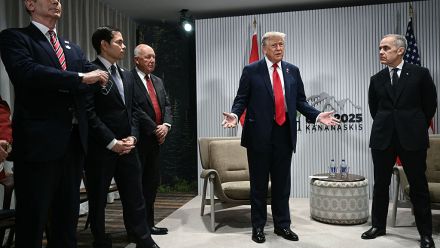
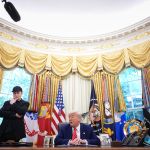
The White House press conference between President Trump and newly-elected Canadian Prime Minister Mark Carney shows that every generation gets the summit it deserves. World War Two had Yalta, the 1970s the Camp David Accords. Barack Obama had a beer with the cop who arrested Henry Louis Gates, Jr. And Trump bragged about the new 24-karat White House gold décor and said, about Canada, “I think we have a lot of things in common.” The half-hour press scrum veered between mutual respect and Trumpian disdain, while Carney struggled to get a word in, flopping his hands in his lap like fish on a deck. He called Trump a “transformational President” and said, “We’re stronger when we’re together.” Trump said, “I have a lot of respect for this man.

Carney

Exclusive: FAA issues autopilot warning after major airline crashes

Federal aviation regulators have issued a stark safety warning to airline pilots: think twice before switching off autopilots and other computerized flight controls at the country's busiest airports. The Federal Aviation Administration’s alert cautioned pilots about the dangers of excessive reliance on their own manual flying and visual approaches in congested airspace. The bulletin, issued in response to hazards revealed by recent “notable and high visibility” commercial aviation accidents and harrowing close calls in the US, is couched in technical jargon and was largely overlooked by the national media when it was released in early April.

FAA

The reviving of the American mind

In his 1987 book, The Closing of the American Mind, Allan Bloom argued that higher education no longer taught US citizens how to think. “We are like ignorant shepherds living on a site where great civilizations once flourished,” he wrote. “The shepherds play with the fragments that pop up to the surface, having no notion of the beautiful structures of which they were once a part.” Now, almost 40 years later, we’re even more clueless. The rot in academia has spread throughout the education system and can be found all over American life. Rational thinking has now been almost entirely usurped by the baser passions of anger and grievance, as we saw all too clearly in the collective insanity of the Black Lives Matter riots of 2020.

Trump

The Trump administration is giving us excellence, not equity

Americans are not a naturally gloomy people. We don’t necessarily expect things to go our way, but when they don’t, we can laugh it off. In my part of Vermont there’s a place called Hateful Hill, for example, so-named by stagecoach drivers who had a tough time with the steep road. But Hateful Hill is also a beautiful elevation. Today, even those who don’t “get” Donald Trump need to start seeing the upside. He doesn’t always get his way, which is probably a good thing, but he is leading a long-overdue revival of the American spirit and allowing for the return of optimism and the pursuit of excellence.

Trump
Rufo

How Christopher Rufo is changing American education

As fire-breathing counter-revolutionaries go, Christopher Rufo seems notably mild-mannered. Perhaps it’s his northern California roots and Pacific Northwest home that keep him from embracing the based lifestyle pursued by so many conservatives in the Trumpian era. He doesn’t like sports. He doesn’t enjoy UFC. He allows his four kids to watch Disney movies and admits he was once a vegetarian. Yet it’s also possible that the Georgetown-educated PBS documentarian turned right-wing iconoclast is effective precisely for that reason: he knows the people he is criticizing.

IQ

Why is intelligence declining?

In 1906, the famous polymath Sir Francis Galton visited a country fair on the edge of Plymouth, England. A bullock had been tethered for slaughter and almost 800 locals were invited to guess its dressed weight: how heavy it would be after butchering. Galton – an obsessive measurer of people, weather and intelligence – gathered the entries, calculated the average and found something remarkable. The crowd’s collective estimate came within a single pound of the ox’s actual weight. This elegant experiment would become one of the founding truisms of modern democratic thought. Galton had shown that while individuals may err, the group, in aggregate, can reason with uncanny accuracy and prescience. He had discovered “the wisdom of crowds.

ADHD

We shouldn’t downplay the risks of ADHD medication

I was diagnosed with ADHD in my freshman year of college. I’d suspected as much in high school, but I disliked the idea of taking medication. College was different. No matter what I tried, I kept finding gaps in my notes – and therefore gaps in my knowledge on test day. While I was prescribed so-called “smart drugs,” I didn’t delude myself into thinking they would magically make me more intelligent – which is why I laughed when I saw the ADHD research industry perform a volte-face in the pages of the New York Times, in a piece headlined: “Have we been thinking about ADHD all wrong?” The obvious answer is yes.

Europe

The real battle for Europe

Donald Trump hates Europe – that suspicion had grown so widespread by mid-April that J.D. Vance was moved to declare in an interview: “I love Europe.” Even its people, he claims. Of course, Americans have taken sides in European rivalries from the outset: Thomas Jefferson was a France man after the French Revolution, while John Adams preferred England. FDR preferred Pétain, while Eisenhower preferred de Gaulle. But hate Europe outright? The idea is absurd. Though our ancestors are not 100 percent European, our country is. You can imagine President Trump calling for a Wienerschnitzel and a tub of mayonnaise more easily than you can imagine him calling for a bowl of hủ tiều nam vang and a bottle of nưởc mắm.

Kennedy

Has Trump’s Kennedy Center overhaul worked?

When Donald Trump installed himself as chairman of Washington’s Kennedy Center, the progressive arts community reacted with predictable hysteria. Artists threatened boycotts and donors withdrew their support. The Guardian reported the news as “anti-woke MAGA populism on a collision course with America’s progressive cultural scene,” while the usual suspects emerged from their Brooklyn brownstones and Malibu beach houses to decry the “assault on democracy” and predict the death of artistic expression as we know it. But as with most things Trump, the reality has proven far more interesting. Since opening in 1971 as a memorial to John F.

Blue Dogs

How the Blue Dogs have evolved

In every iteration of the American National Election Studies since 1952, respondents have been asked to name their biggest “like” and “dislike” when it comes to the two main parties. From 1952 to 2004, voters’ biggest “like” about the Democratic party was that it was the “party of the working class,” whereas the biggest “dislike” that voters had of the Republican party was that it was the “party of big business and the upper class.” Today, the parties’ reputations have shifted dramatically, mirroring the changing composition of their electorates. In the 1990s, nearly 60 percent of Democratic voters were white and didn’t have college degrees. For the 2020s, that proportion has fallen to 25 percent.

trade

Why Trumpism won’t fix Clintonomics

As a longtime critic of the Clinton administration’s “free trade” agreements, I’ve lately been mocked by liberal friends who suspect I’m sympathetic to the “plan” hatched by Donald Trump and his senior advisor on trade, Peter Navarro, to “ruin” the country with indiscriminate import tariffs. This sort of jokey ridicule goes with the territory when you jab at neoliberalism from the left. Bill Clinton still has legions of fans among the Democratic party establishment and its media acolytes, and it’s hard for them to face up to the fact that the former president’s economic policies have led directly to Trump’s election as president not just once, but twice.

supreme court trump

Why Trump should put himself on the Supreme Court

Legend has it that after subduing Greece, Egypt, Persia, wide swaths of India and what’s now Afghanistan, Alexander the Great wept, lamenting “there are no worlds left to conquer.” Donald Trump is close to knowing how that feels. “I run the country and the world,” he declared in a recent Atlantic interview. Trump’s second term has barely begun, but already the thought must cross his mind: “What next?” Alexander was lucky to die young, at 32 and at the peak of his power. The President is in rude health and leads a charmed life. The grim reaper missed him last year when an assassin’s bullet grazed his ear in Butler, Pennsylvania. As it stands, Trump can look forward to leaving office, aged 82, in January 2029. He’s conquered the world only to lose it to term limits.

cities

Why cities have lost their appeal

Over the past half century, media and academic sources repeatedly suggested that increasingly dense cities would dominate the future. Places such as London, San Francisco and Chicago would dominate an economy. Today, this assessment seems grossly dated. Even in the pages of the urbanista New York Times there are widespread fears of an “urban doom loop.” But this, too, is a stretch. Great core cities will not go the way of post-imperial Rome, but their role is being recast as the urban frontier shifts increasingly to the periphery. What we are seeing mirrors H.G. Wells’s vision. He predicted that most economic life, and most families, would shift to the suburbs and exurbs.