Politics

Read about the latest political news, views and analysis

Left-wing violence is being normalized

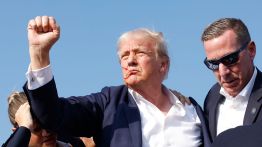
Something has changed in America’s psyche. Violence has become more acceptable. It’s not just that we’ve seen two attempted – and very nearly successful – attacks on Donald Trump’s life, it’s that a worrying number of young Americans cheered on those attempted assassinations and still wish they had succeeded. Since early this year there has been widespread public support for smashing up Tesla dealerships – and for shooting Elon Musk. An unprecedented 10,000 new threats have been made against Senate and congressional members just this year, according to Capitol Police. Applause for the actual murder of UnitedHealthcare CEO Brian Thompson in December goes on, unabated, online.

luigi mangione political violence

Are antidepressants making Americans violent?

On April 20, 1999, Eric Harris and Dylan Klebold entered Columbine High School in Colorado, armed to the teeth, and set about murdering their fellow classmates and teachers. When the shooting was over, 12 children and one teacher lay dead. Harris and Klebold were dead, too, and 20 others were wounded. Within a little over a week of the atrocity, there was already speculation that psychotropic drugs might have been a factor, specifically the powerful and relatively new antidepressant Luvox (fluvoxamine), which Harris was known to have been taking. Fluvoxamine is a selective serotonin reuptake inhibitor (SSRI), a class of antidepressant medication that was first trialed in the 1970s and then brought to market in  the US in the late 1980s.

antidepressants

Who can bring the Democrats together by 2028?

“Why is the Democratic party viewed as toxic by so many? Even people inside the party acknowledge that,” journalist Tara Palmeri recently asked the Democratic Senator from Pennsylvania on her ominously titled Somebody’s Gotta Win podcast. John Fetterman’s answer was blunt: “I think their primary currency was shaming and scolding and talking down to people and telling them, ‘Hey, I know better than you’ or ‘You’re dopes’ or ‘You are a bro’ or ‘You’re ignorant or you know it, don’t you’? You know, ‘How can you be this dumb?’ I can’t imagine it. And then, by the way, ‘They’re fascists, how can you vote for that?’ When you’re in a state like Pennsylvania, I know and I love people that voted for Trump and they’re not fascist.

Democrats

How Trump’s favorite anthem became the barometer for his policies

“The so-called ‘nation-builders’ wrecked far more nations than they built,” said Donald Trump on stage in Riyadh at the joint US-Saudi Arabia investment conference in May. “The interventionists were intervening in complex societies that they did not even understand themselves.” Calling time on the neoconservative framework for diplomacy – also known as waging war – was jaw-dropping enough. But President Trump wasn’t done. He wanted to celebrate. Wrapping up his speech, the self-proclaimed President of “common sense” brought his friend, the Saudi Crown Prince Mohammed bin Salman, onto the stage to commemorate the moment. Naturally, the speakers blasted out the President’s favorite anthem: the Village People’s “YMCA.

YMCA
Meloni

How Giorgia Meloni became Donald Trump’s EU whisperer

Henry Kissinger once complained: “Who do I call when I want to speak to Europe?” Today the answer would be Giorgia Meloni, Italy’s first female Prime Minister, who has emerged as the most important leader in the European Union. No Italian leader has filled this unofficial role before: it is usually reserved for the heads of the bloc’s two largest economies, Germany and France. Yet Meloni has capitalized on the weakness of their leadership. French President Emmanuel Macron may delude himself that he is Napoleon or Jupiter, but in reality he is the deeply unpopular head of a lame-duck government. To borrow a phrase from Donald Trump, he doesn’t “have the cards.” Meanwhile, Germany’s Chancellor, Friedrich Merz, heads up a flimsy coalition.

Ukraine

Can Ukraine secure its military survival?

The Trump-Putin honeymoon is over. After three months of lengthy one-on-one phone calls, a handful of false starts on negotiations and flashes of Trumpian boosterism over the prospect of great commercial deals with the Kremlin, a fourth summer of war in Ukraine looks inevitable. Vladimir Putin will pretend to negotiate, while at the same time continuing to pound Ukraine’s cities with missiles and pressing forward on the ground. The Ukrainians will continue to scramble for men and resources with which to defend themselves. And the White House will continue to blame both sides for not reaching a deal. Over these three months of false hope, Putin has made two things very clear.

war

America no longer knows how to fight a war

When educated Americans think about war, they’re apt to think of it in ideological terms. Wars are fought between dictatorships and democracies and the goal is to establish one form of government or the other in the defeated opponent’s territory. That’s certainly been the way American policymakers have thought about the wars of this century and it was the framework during the Cold War as well, when the conflict was said to be, fundamentally, a clash of ideologies. The French Revolution is probably the source of this concept, as the wars it set off were indeed largely about regime change, if not that alone.

Eric

The rise of Eric Trump

For years, Eric Trump perfected the art of strategic invisibility. In the grand theater of Trump family politics, he played the understudy: the dutiful son who minded vineyards and managed golf courses while his older brother courted Twitter controversies and his older sister pursued power. It was a calculated public persona. Eric appeared refreshingly uncontroversial and unbothered – and relatively non-political – compared to the rest of his family. But here’s what everyone missed: while his siblings were soaking in the limelight, Eric was quietly orchestrating moves of far greater consequence. His dutiful pose, it turns out, was the perfect cover for building an empire.

Cambridge charlie kirk

Trump’s revolution is coming to the UK

In May, Charlie Kirk, who died today from a gunshot wound, visited the United Kingdom to debate the students of Oxford and Cambridge, Britain’s two most prestigious universities. The Spectator asked him to write about the experience. The result was this well-observed, funny and now strangely prophetic-sounding piece about the condition of England. Charlie Kirk believed in free speech. He died speaking freely. RIP. Oxford and Cambridge When I was growing up, people often said British politics were where America’s would be in five, ten or 20 years. What this meant was that Britain was more to the left of America: more secular, more socially liberal, more environmentalist, more globalized.

Joe Biden’s puzzling legacy

The commentariat is awash with experts on prostate cancer. What precipitated this sudden acquisition of specialized medical expertise? Why, the announcement that former president Joe Biden is suffering from stage four of the big PC which, the news reports are gasping, has metastasized to his bones. Let me pause to join Donald Trump in expressing my best wishes to the former president for “a fast and successful recovery.” Let me also recall how suddenly the world became populated with epidemiologists after the Wuhan flu led Anthony Fauci, Deborah Birx and the entire bureaucratic establishment to discover their inner totalitarian hankerings. The revelation about Biden’s health is a sort of synecdoche for a much larger universe of pain.

Biden

The frightening advance of China’s military capabilities

“The number (of kills) could have been higher. We showed restraint.” – Pakistan’s Air Vice Marshal Aurangzeb Ahmed “Godzilla 3? Godzilla 3? ... Explosion in Air.” – Indian Air Force flight radio “China’s hypersonic missiles could destroy US aircraft carriers in just 20 minutes.” – US Defense Secretary Pete Hegseth Historians of the future will need a word or phrase to describe the shock and the disorienting anxiety the West will feel in the coming months as it realizes that China has caught up with – even surpassed it – in technological capability. We could call these “DeepSeek” moments, named after the recent jolt to the western psyche caused by the astonishing capabilities of Chinese artificial intelligence.

China

Inside the struggle for technological control in South Africa

In the dawn light of a South African savanna, a team of rangers huddle around a satellite dish aimed skyward. Their phones spring to life with a signal – an unthinkable result just months earlier in this remote, off-grid conservation zone. The source is Starlink, Elon Musk and SpaceX’s satellite internet service, offering encrypted, high-speed connectivity far from state-controlled networks. But in South Africa, this signal didn’t just connect – it disrupted. And that disruption provides some subtext to the extraordinary “Wild West Wing” showdown between Donald Trump and South African President Cyril Ramaphosa in May, which played out in the Oval Office – with Musk looking on.

South Africa
Pendant

The architects of ‘AI rights’ are a threat to humanity

It’s easy to see that gender ideology is being used to undermine biological truth – but what’s harder to fathom is why. I am persuaded that the end goal is, in fact, to pave the way for human symbiosis with artificial intelligence, which Silicon Valley has been promising us since the early 2000s. Encouraging children to embrace macabre rituals like medical castration convinces them that they can mix and match parts of their anatomy, which makes it a simple matter for them to accept AI augmentation. We are at the beginning of more extreme changes to humanity than we have ever seen before. The gene-editing technology CRISPR now allows us to genetically alter human beings.

Is ‘eating the tariffs’ good for business?

When President Trump told Walmart to “EAT THE TARIFFS,” he implied that to not do so was a profit-mongering conspiracy against the American people. He noted Walmart’s extensive trade relationships with China and its large profit margin. But Walmart maintained that tariffs made price rises unavoidable. And when Amazon flirted with noting on some of its products the precise amount of cost increases attributable to tariffs, Trump called Jeff Bezos to complain and Amazon backed away from its plan. After observing Trump’s hostility to Walmart and Amazon, Home Depot took a different approach and asked: what trade war? Unlike numerous major American corporations, Home Depot has not rescinded its 2025 guidance for investors because of the uncertainty from tariffs.

George Floyd

Black families suffered after white college kids used George Floyd to dismantle society

Five years ago, we watched a man die under the knee of a police officer. The footage of George Floyd gasping for breath wasn’t just horrifying – it was galvanizing. For a brief moment, America stood still, and it felt like we all agreed: this was wrong. This shouldn’t have happened. And something needed to change. But instead of coming together, we fell apart. What should’ve been a rare moment of national consensus turned into yet another front in the culture war. The left veered toward revolution, and the right veered toward denial. And somewhere in the wreckage of hashtags, riots, cable news rants, and billion-dollar DEI schemes, the real moral clarity of that moment was lost. Let’s start with the obvious: what happened to George Floyd was a tragedy.

The fight to make science great again

If one were looking for dismal assessments of the Trump administration’s contributions to the vitality of American intellectual inquiry, the editorial eructations of Holden Thorp would likely be at the top of the list.   Thorp is the editor-in-chief of Science, the weekly journal of American Association for the Advancement of Science (AAAS). This makes him one of the most influential figures in the academy and in American science as a whole. Few weeks go by without an editorial from Thorp denouncing the havoc wrought by Trump. The May 8 issue is mildly titled, “The New Reality for American Academe,” but the mildness ends there.

science
Pam Bondi

The DoJ is wise to deploy the False Claims Act against colleges

Like Papal encyclicals, many statutes are known by the opening words of their Latin formulation. One that I just learned about is known as a “Qui tam” action. By itself, it is an enigmatic expression, since it just means “Who so” or “Who as.”   If you look it up, though, you will discover that “Qui tam” is shorthand for “Qui tam pro domino rege quam pro se ipso in hac parte sequitur,” which makes much more sense: “Who prosecutes in this matter both for the King and for himself.” That tam, as is often the case, is balanced with quam, “as x, so y.” Spinoza contains a famous example toward the end of the Ethics: “Sed omnia praeclara tam difficilia quam rara sunt”: “For all things excellent are as difficult as they are rare.

Why President Trump shouldn’t pardon Derek Chauvin

Five years ago this month, anarchists set on fire my adopted town of Minneapolis in the wake of Derek Chauvin’s murder of George Floyd. Now, as President Donald J. Trump has made a triumphant return to the Oval Office, some of the blogosphere are calling for him to pardon Chauvin for his crimes. Article II, Section 2, Clause 1, of the United States Constitution grants the President the “Power to grant reprieves and pardons for offences against the United States, except in cases of impeachment.”  President Trump should respect the verdict of the people and protect his own legacy by rejecting the ignoble calls to absolve the fired officer of his guilt.

chauvin