China

From the archives: Peregrine Worsthorne on Bush 41

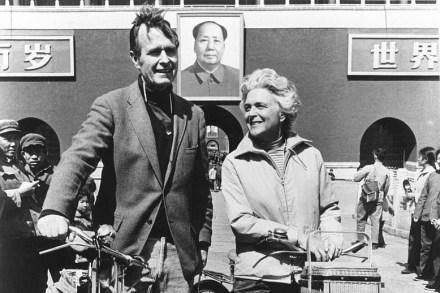
Four years ago, Peregrine Worsthorne wrote about his various experiences with American presidents forThe Spectator magazine. He concluded with this anecdote about George H.W. Bush from the mid-Seventies... The only thing I remember about George Bush senior was an exceptional act of kindness. He was then the American representative in Peking — as it was still called — and had asked me to lunch. It was a scorching day. In the course of the conversation I mentioned I was going on to sleep that night in Mao’s favorite village in the south, a place of pilgrimage for the faithful. ‘Don’t forget to take a good overcoat,’ he warned. ‘It’s mighty cold down there.

george h.w. bush 41

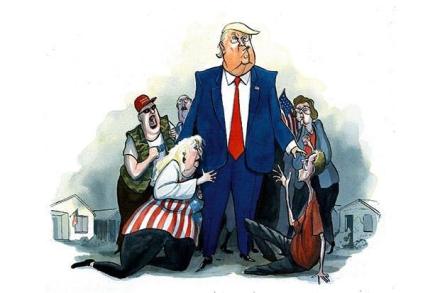
The US and China are headed for a showdown. Do the American people care?

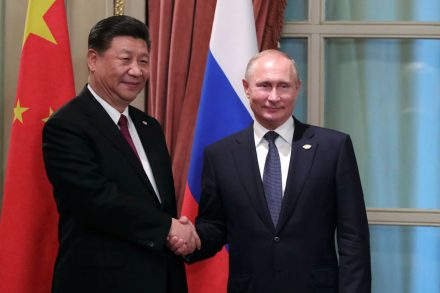
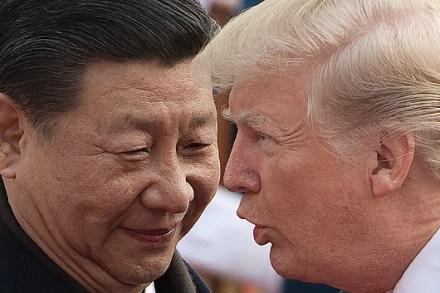
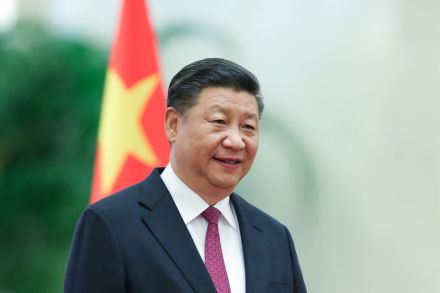
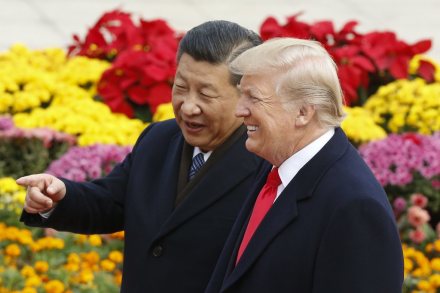
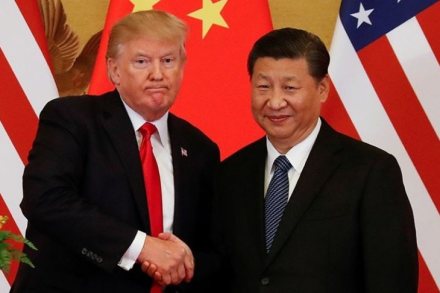
Know this: It doesn’t matter what happens during what can only be described as ‘dinner diplomacy’ between Donald Trump and Xi Jinping at the G20 — good, bad or breakthrough. That’s because the course of US-China relations — a complex relationship that blends cooperation, competition and geopolitical slugfest — is set in stone. The reasons are obvious. From tensions all around China’s near seas, to the final status of Taiwan, to the flow of hundreds of billions of dollars in trade to an arms race in Asia that will soon feature sci-fi like hypersonic weapons the future is frighteningly clear.

donald trump xi jinping showdown

Peter Navarro slams Wall Streeters as ‘foreign agents’ hindering the White House

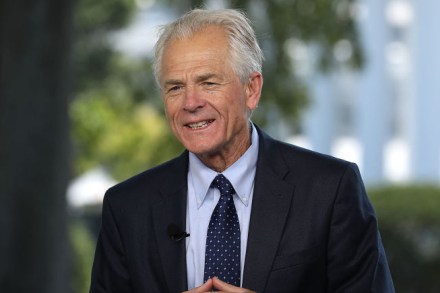
‘Wall Street and Goldman Sachs…here’s the most important thing,’ said Peter Navarro, the White House trade policy pointman, at a Washington think tank Friday. ‘When these unpaid foreign agents engage in this kind of diplomacy – so-called diplomacy – all they do is weaken this president and his negotiating position.’ The factionalism within the White House itself and the in-fighting over Washington’s China policy was on full display. The president’s encouragement of rival camps battling it out has often spilled over into plain view during the first two years of this administration.

peter navarro

The failure of globalization and the return of inflation

Most of today’s political debates are at heart about globalization. Terrorists, tree huggers, and Trumpists have their cultural complaints, but the great wave of Western populism is fueled by economic anger. Owing to the large amount of money that has been printed, financial asset prices have risen. But median incomes have stagnated. There is much truth in the claim that metropolitan elites have prospered, while the unvisited hinterlands have lost out, and much danger in the myth that all stakeholders benefit equally. Has globalization failed? On its economic merits, globalization can stand tall — not through increasing everyone’s income, though it has done this in many emerging economies, but by reducing everyone’s costs.

globalization

How China sees the trade war

What started out as one of those trade wars that Donald Trump believes are ‘easy to win’ has turned into a far broader confrontation between the US and China which is set to expand and deepen further. In his no-nonsense manner, the President has brought the era of ‘constructive engagement’ between the world’s two largest economies to a shuddering halt. Gone are the days when successive administrations thought economic growth would make the Chinese and their leaders ‘more like us’. Instead, the last major country ruled by a Communist Party is identified as a strategic competitor whose further economic political and military expansion has to be checked in America’s national interest.

china xi jinping

Why ‘we’ got Turkey wrong (and China. And Russia. And Iraq)

In addition to warning us of the growing tide of populism and nationalism, and bashing Donald Trump, Pundits in Washington and other Western capitals have been also spending also a lot of time, debating ‘How the West got China wrong,’ as The Economist put it, which was just another way of asking, well, ‘How The Economist got China wrong.’ The West – or to use the first person plural ‘We’– so favoured by the intellectually modest Washington ‘foreign policy expert’ – had bet that China would head towards democracy and the market economy.

turkey china iraq

How blockchain can beat state censorship

The concept of blockchain is popularly associated with cryptocurrencies, Bitcoin in particular. But there is another function of the technology which could have huge repercussions for states which attempt to censure the internet – as well as improving inline security and even tackling fake news. It is called ‘Proof of Existence’ (PoE) – the least talked about but perhaps most powerful application of this nascent technology. Earlier this year, a blog post by a Chinese student documenting the intimidation she’d suffered from school officials trying to block her investigation into an incident of sexual assault went viral.

Australia’s choice: Chinese trade – or American security?

 SydneyFor decades, Australia has been known as ‘the lucky country’. At the end of the world geographically, we are separated from the global troublespots by vast oceans. We have recorded 27 years of uninterrupted growth, partly because of a surge in exports of commodities to China. At the same time, our tough border protection policies boost public confidence in, as John Howard put it, ‘who comes to this country and the circumstances in which they come’. As a result, our politics have not been profoundly affected by the kind of populist forces dismantling established parties across Europe. Nor have we witnessed an anti-globalisation backlash. Not for us any Trump- or Brexit-like insurgencies.

Steve Bannon: ‘We have to end the Cold War with Russia’

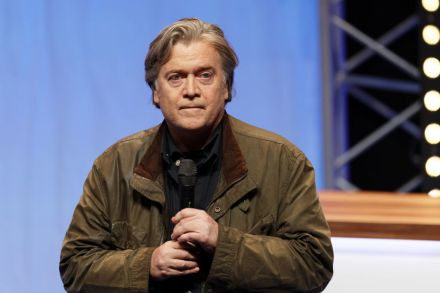
Yesterday, in central London, I spent an interesting hour with Stephen K. Bannon, discussing the fall out from President Trump’s Helsinki summit. We recorded a podcast which you can listen to here: https://audioboom.com/posts/6936042-steve-bannon-why-china-is-a-bigger-threat-than-russia I asked Bannon whether he felt the media were right to be working themselves into such a lather over Trump’s apparent siding with Russia over American intelligence services over the 2016 election – this was before the Commander-in-Chief’s peculiar ‘double negative’ volte-face in the afternoon. In reply, Bannon reiterated the now fairly standard – nonetheless fair – point that the media conflates Russian meddling with Russian collusion.

Trump’s ZTE talks have Congress wondering if he’s putting America first

It doesn’t happen often, but it happened this week: Republicans in Congress made it officially known that they disagree with their party leader, President Donald Trump, on an important issue of policy.On Thursday, the House Appropriations Committee voted unanimously to accept an amendment to the 2019 Commerce, Justice, and Science Appropriations Bill. That amendment, introduced by Democratic Maryland congressman Dutch Ruppersberger, forbids the Commerce Department from renegotiating the sanctions it enacted last month on Chinese telecom company ZTE.It’s a real reprimand of the president, who started sending tweets in support of the company on Sunday.

AI

Has Kim Jong-un finally grown up?

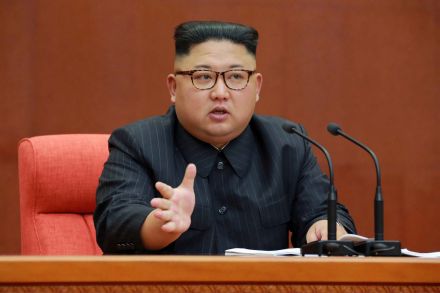
Given the mutual bluster, threats and sabre-rattling we got used to from Donald Trump and Kim Jong-un, it may be hard to credit the air of sweet reasonableness that has spread over the Korean peninsula in recent weeks leading to the weekend announcement of an end to weapons testing by the North. The potential for a reversion to confrontation is all too evident. Pyongyang has a long record of reneging on agreements and its announcement contained no mention of a reduction in its arsenal that includes missiles which can hit Japan and South Korea even if it stops development of ICBMs aimed at the USA.

Are you a winner or a loser in Trump’s trade war?

China’s imposition today of tariffs on 128 imports from the US was inevitable – and is no doubt exactly the reaction that Donald Trump wants, giving him the excuse to announce yet more tariffs in addition to those on steel and aluminium imports which he has already imposed.  After all he did say, even before China announced any form of retaliation:  “trade wars are good.  It should easy for the US to win one”.  A trade war is what he wanted, and what he has got. But does he have any more of a strategy for his trade war than George W Bush had a plan for winning the peace in Iraq? There is an argument for saying that China will come off worse – on the basis that it exports far more to the US than travels in the other direction.

A trade war with China sounds terrifying – but the US is doing the right thing

Nobody likes the sound of trade war, and rightly so. China’s new retaliatory tariffs against US products feel like the beginning of something bad: an escalating tit-for-tat trade conflict between the world’s richest countries which could choke the global economy. But there are good reasons to think that, far from being another silly move by a hothead president, Trump’s right about trade with China and that, as he has with North Korea, he is grasping a dangerous nettle that other presidents dared not touch. It may be scary, but it needs to be done. And it’s not just necessary for America, but perhaps the rest of the world as well. China is deeply protectionist, and is rapidly becoming the most powerful country on earth.

What are Kim Jong-un’s motives in meeting Xi?

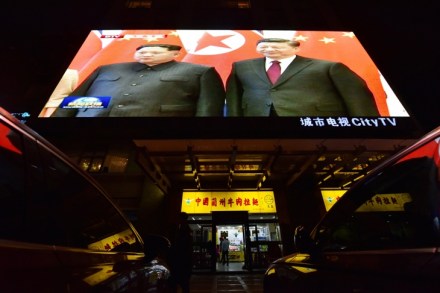
Kim Jong-un surprised the world—once again—by making an unannounced trip to China earlier this week, and observers in the United States still haven’t come to any agreement on what it means. The North Korean leader traveled to Beijing by bulletproof train to meet with Chinese president Xi Jinping ahead of a planned meeting later this spring between Kim and American president Donald Trump. Georgetown University professor and American Enterprise Institute scholar Oriana Skylar Mastro told Vox it was “Kim’s desperation”—as well as both leaders’ fears of war—that precipitated the China meeting.

Isolationist? Donald Trump appears to be assembling a war cabinet

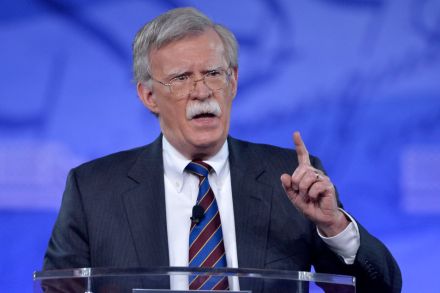
Is the third time the charm? President Trump has already run through Mike Flynn, who enjoyed the shortest tenure in history of any national security adviser. Next came three-star General H.R. McMaster. Now John Bolton, the former George W. Bush ambassador to the United Nations who has been angling for the job ever since Trump won the 2016 election, has gotten the nod. Bolton’s ascension is temporarily eclipsing other events such as the 700 point stock market plunge today thanks to the imposition of tariffs on China or the resignation of Trump’s lawyer John Dowd. No one personifies the hawkish wing of the GOP better than Bolton whose appointment is being greeted with hosannas by neocons such as Senator Marco Rubio. Diplomacy, in Bolton’s mind, is for wussbags.

Not my president: meet the Chinese students standing up to Xi Jinping

At last, some students in the West are campaigning for freedom and democracy. Following years of supposedly rad students banning pop songs about sex, and force-fielding their campuses against offensive speakers, and even expelling certain newspapers from their common rooms as if they were heretical abominations, a group of students has emerged to demand more liberty, not less. They’re Chinese students, studying in Western universities, and the target of their youthful liberal ire is Chinese President Xi Jinping. This week, Xi convinced the annual sitting of China’s parliament, the National People’s Congress, to scrap the two-term limit on presidency. They didn’t take much convincing, by the looks of things.

Is Donald Trump, like Bush, being taken over by neocons?

The Trump administration’s foreign-policy team is beginning to look a lot like a Marco Rubio foreign policy team. It’s not hard to imagine a generally hawkish Republican like Mike Pompeo serving as Secretary of State under Little Marco, and John Bolton - widely tipped to replace H.R. McMaster as national security adviser - would have turned up sooner or later in any GOP administration, except one led by Sen. Rand Paul. Nikki Haley at the United Nations, meanwhile, has been hailed by neoconservatives as heartily as Bolton was when he served as George W. Bush’s UN ambassador from 2005-6. The hawks don’t like to be called 'neoconservatives', but the neoconservative worldview is their worldview.

Why Trump’s ‘trade war’ makes strategic sense

Has Donald Trump sparked off a trade war? His plans for a 25 percent tariff on steel imports and 10 percent tariff on aluminum have shocked friend and foe alike. China is outraged; so are Canada, Japan, and South Korea—allies that in fact export more steel to the U.S. than China does. They stand to be hurt worst if they aren’t granted exemptions or cut special deals by the president. Trump accuses the Chinese of 'dumping' steel into the American market, while the legal grounds for his new tariffs rest in the idea that strategically critical manufacturing is endangered by a diminished U.S. metals industry.

China vs America: the espionage story of our time

Why aren’t spy stories sexy anymore? The revelations last year that Beijing destroyed America’s espionage ring inside China a few years ago, including executing a number of US informants, got a brief flurry of attention and then subsided beneath the waves. News reports of American bureaucrats arrested for passing information to the Chinese have also barely raised eyebrows. Now the ex-CIA agent suspected of being the mole that led to the collapse of America’s spy operations in China has been arrested, though on a lesser charge of simply possessing classified information. How long before Americans turn back to Donald Trump’s tweets or the latest #MeToo charges?

If China backs Trump on North Korea he won’t like the quid pro quo

The first election day since Donald Trump was elected president a year ago brought a funereal mood to Washington that you could feel on the streets. The swamp, apparently, remains undrained. Elections for governor in Virginia and New Jersey and for mayor in New York City cheered the locals a bit, producing the expected victories for Democrats. Virginia was the most consequential of these. It seemed a harbinger of the next presidential race. The moderate, decidedly un-Trumpian Republican Ed Gillespie was accused of making ‘ugly racial appeals’ — this for expressing the opinion that the statues of Virginia’s Civil War heroes should not be razed in a frenzy of revisionism.