You Can See Everything is a brilliant and deeply evil film about the utterly cursed world we live in. It is the only world we have, so it’s worth getting good at living in.
I am going to be free with the spoilers. There is nothing to spoil. There is actually no true content in this 3-hour film. Well, about 90 seconds. You can see it twice and you probably should. The concept, editing, cinematography and performances are absolutely superb. It should teach you that, in an evil world of lies, only the truth can save you – and not always.
The starting point of You Can See Everything is charisma. Nathan Fielder, the director, and Elizabeth Holmes, the subject, both have it, to Jedi mind power-level. They can look into your eyes and make you believe. Hitler had this too. There are accounts of German generals who commanded armies in the Great War coming to Hitler, this mountebank corporal, with their full professional contempt and skepticism, meeting one on one (it always works best one on one), and walking out as true believers. While not in this league, I have enough of the knack to know how it’s done. Like any talent, charisma can serve both good and evil.
In Ernst Topitsch’s thin, forgotten book Stalin’s War, his conclusion is simple. “Hitler was a master. But Stalin was a grandmaster.” So indeed it proves with Holmes and Fielder. The grandmaster is in control of his natural talent. The master is not.
Nathan Fielder and Elizabeth Holmes both have charisma, to Jedi mind power-level
From the start, the film shows you the cruel, predatory expression on Fielder’s face when his subjects aren’t looking. A good sociopath can play a character he isn’t. Fielder, mostly off camera, has formed a real human bond with his subjects – and the bond is connected to nothing at all, except the burning need to make a good movie and get an Oscar and earn ten million bucks. He can fake feeling. He’s great at it. It’s scary AF.

Yet this is a normal talent of good journalists. The First Amendment, at least as restated in NYT v Sullivan (1964), leaves us ruled by utterly unaccountable sociopaths. But we normally don’t see the sociopathy. You Can See Everything shows it, revels in it, implicates the audience in it. And the audience loves it. Yet there is a case for it: there will always be sociopaths, so shouldn’t they be working for us? For we, the people, for Our Democracy?
Let me start with the truth about Theranos and Holmes. No one will tell you this truth, so why not here?
Theranos was a real company which was also a shitshow. It was built by a mid-tier, fake-it-till-you-make-it Indian scammer named Sunny Balwani, with Holmes (his two-decade younger girlfriend) as a frontwoman, seer and ringmistress. Holmes and Balwani went to jail for wire fraud – for lying to investors and taking their money. She is certainly guilty. And yet, there is context.
One of the great unknown startup memoirs is Slide Rule, the autobiography of Nevil Shute, a British aviation engineer better remembered as a novelist. Shute, who designed the R100 zeppelin and cofounded the aircraft startup Airspeed, writes that every new venture is “caught between palace and prison.”
When you’re raising money, the right level of fake-it-till-you-make-it is never zero. A naive technical founder will go into a pitch meeting and lead with the warts. It’s what he’d want to hear on the other side of the table. But the investor will assume he is running a limited hangout. If you lead with the warts, it probably means you have tumors. Don’t do that. Don’t hide the warts, either – there’s a middle way.
Instead of the social or cultural capital to find this middle way, Holmes had Sunny Balwani. And a giant media machine with an insatiable hunger for a character she could play: Steve Jobs, but a hot girl, with a real knack for ingenuous charisma. It was absolute fire. And she got high on it. Who wouldn’t? Steve got high. Elon gets high. But they’re natural managers, and Holmes seems anything but. So Balwani and Holmes got ahead of their skis. Way, way ahead.
Holmes saw her job as simple. Dream up a vision that will change the world. Raise as much money as possible. Give it to engineers. Bully the engineers into producing. What’s not to like? She was good at raising, bullying, and probably even hiring. A caricature of the very subtle thing that is Silicon Valley. But every caricature is drawn from life.
Let’s be clear: the degree of investor puffery here was not normal. It was top 5 percent. Maybe top 2 percent. It was real fraud. Even so, ten years in jail is an outlier outcome. Normally the money machine just spits you out, counts its losses and learns its lesson.
Especially when the money goes into a real company, not wild living. Theranos had hundreds of engineers trying to build a small, general-purpose benchtop analyzer that could run common medical tests, as well as the much larger, specialized equipment that Labcorp or Quest uses. Each test came with a cartridge of chemical tools. They got about twelve cartridges to work, but never at real clinical quality – after half a billion dollars of engineering.
One aspect of the project that was (given my limited understanding) silly was the idea that blood tests should be run on a drop from a finger stick. Not only does a finger stick hurt more than a venous draw – the problem is harder. The blood is low quality and inconsistent.
Someone should have told her this. But everyone was giving Holmes positive feedback. It made a great story. Everybody loves a great story. But the story was in charge. The finger stick, the drop of blood – what is the story without them?
And then the story reversed. A counter-story appeared, ten times as exciting and ten times as true. Live by the story, die by the story. Amanda Seyfried played Holmes in a schlocky Hulu miniseries. Seyfried herself makes an unlovely appearance in You Can See Everything, roped into reenactments after Holmes goes to jail. Her predatory, even sadistic, vibe is not mitigated by much of Fielder’s charm. She oscillates between defending her portrayal as true and absolving it as (legally) fiction. Both positions are defensible, but I find their conjunction distasteful.
A measure of the film’s artifice is a name never mentioned: Ian Gibbons, Holmes’ chief assay scientist, who actually tried to build the thing. Gibbons, forced to testify in a patent lawsuit where he would have to lie under oath or burn down the company, killed himself in 2013. Holmes never even called his widow, but tried to silence her with legal threats.
Instead of pressing Holmes on this, Fielder confuses the audience for ten minutes with the difference between “this machine can run any test” and “this machine could run any test.” Yes – it was a general-purpose platform without working applications. Holmes exaggerated its progress. The end.
No investor thought it could run “any” test. They thought it was much further along. Holmes’ revenue projections were fantasies; her customer relationships absurdly oversold; she put logos from big companies she’d barely spoken to on her reports. This is not cool. You can’t do that. And yet – it was a real company. Just a shitty company.
Fielder wastes another five minutes showing Holmes and Evans the Abbott and Costello routine “Who’s on First?” then makes a big psychological deal of her not getting it. To me, Occam’s razor suggests that this mildly non-neurotypical woman, about to go to prison and be separated from her baby and toddler for ten years, has simply tuned out Fielder’s weird mind games. Who cares.
The 90 seconds of real content is an interview with a silverback engineer named “Joe,” whom Holmes’ new partner, Billy Evans, has hired for his benchtop-analyzer company Haemanthus. Fielder asks how he feels about carrying on the Theranos legacy. Joe loves it. Theranos is a treasure-trove of engineering history – what to do, and what not to do. I would crawl over glass to hire Joe, if I was making a benchtop analyzer.
Asked about the fraud, Joe tells the truth. Elon Musk promised self-driving cars in 2017. “Full Self-Driving” was a joke – often a lethal joke – for eight more years. He kept selling this defective, dangerous product. Now it works, and his competitors don’t have it. You’d be an idiot to buy a Rivian now.
(What’s the difference? Elon is a grandmaster. He controls his talent. He knows where the line is. Though a generalist, he is as strong an engineer as anyone at his companies. Holmes, an amateur, hired good scientists to solve an unsolvable problem. Elon would have seen this and changed direction. Holmes let her story, which was compelling, raise money for an engineering project that was driving into a wall. $900 million will get you through a lot of walls. Not this wall, though.)
Joe starts to express something like this. Then Billy cuts him off and ends the interview. Billy does not want to tell the truth, at least not this truth. Billy, no master of charisma, but seemingly no more narcissistic than your average founder, is the real target of the film. His new startup, using Raman spectroscopy, seems legit. It will probably fail. Most startups do.
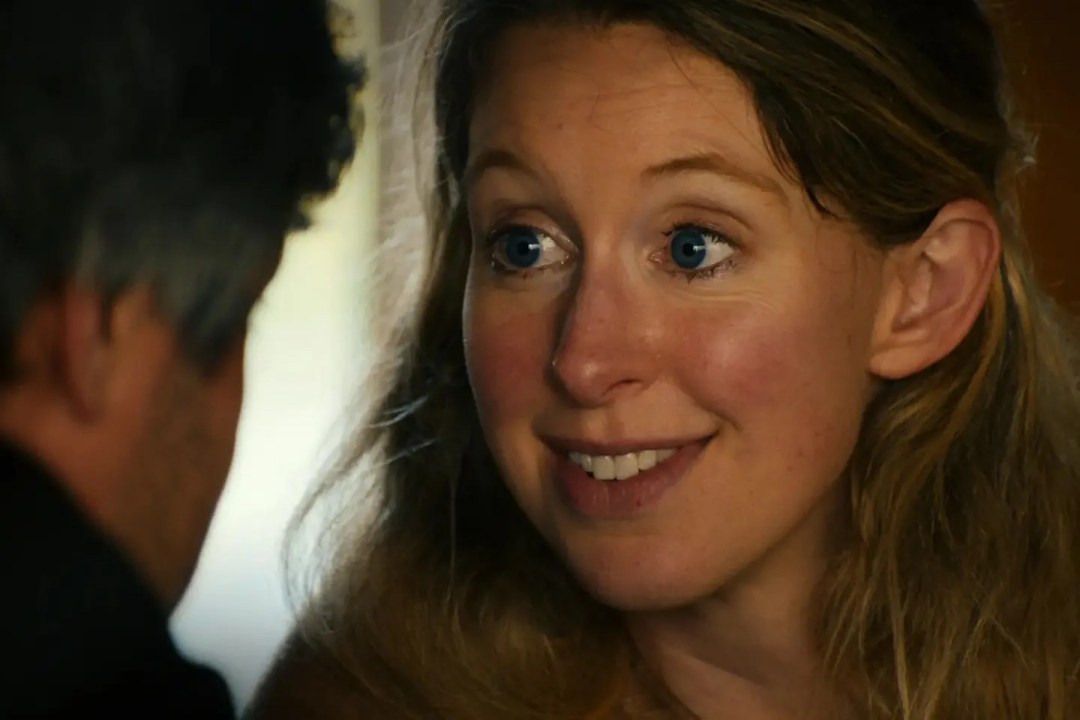
Holmes says, with her ingenuous eyes, that she won’t profit from the film. Is she lying?
The motivation for Fielder’s cruelty comes in the plot twist driving the second half. Billy, with Holmes out of the room, demands points in the film – which is not normal. He has the leverage. He gets them. Points add up to 100 – so Billy is taking money out of Nathan’s pocket. (At the end, Billy somehow gets euchred out of his points. Don’t play chess with a grandmaster. Not for money.)
Holmes says, with her ingenuous eyes, that she won’t profit from the film. Is she lying? She tells Fielder she never lies. This is a well-known tell. Polygraph examiners use it. I believe her. It’s common for a narcissist to “never lie.” Often, they don’t lie. They mislead. They spin. Holmes’ capacity to spin is powerful, but limited in range and not really under control. True lying is not, as Holmes says, “deliberately saying something untrue.”
True lying is persuading someone to believe anything you know is untrue. Holmes certainly did plenty of that. With investors. Big investors. But as she repeatedly says, she never sold a share of Theranos. She knew the money wasn’t real. She was raising money to make it real – not to make money. Holmes believed in herself and her story all the way. That’s the definition of a narcissist: anyone who believes in a fantasy of themself. A tiny percentage can make this fantasy real – and, as George Bernard Shaw said, all progress depends on them.
The truth about Billy’s deal is obvious and not worth an hour of suspense. Holmes has a $400 million restitution bill. She can’t profit from the film. She can’t profit from anything. Billy can. Holmes needs to keep her financial and legal distance. She can’t say this, so she bats her eyes.
It’s unclear who refused to discuss anything substantive. Liz’s father starts to. Billy cuts him off. You would expect Fielder to prosecute Holmes, but he is not a prosecutor. His shtick revolves around vibes and mind games. He’s great at that. He cuts her off too. God only knows what he actually knows about Theranos. And only God and his editor (also a master, with the irritating trick of changing a dialogue’s vibe by cutting its timing) knows what Fielder didn’t use.
After realizing we are ruled by sociopaths, or at least sociopathic journalism, the next disturbing realization is the sociopathic nature of our culture itself. A common tell in liars is “duper’s delight” – a flash of joy at misleading you. Holmes and Fielder are too good to show it involuntarily, but the sick genius of the film is Fielder’s willingness to show it to the camera when his subjects aren’t looking.
When Fielder tells Holmes that, regardless of the truth, she can never recover her reputation, there is a subtle, gloating, sadistic note. Amanda Seyfried brings it even more strongly. Fielder invites the audience to share and celebrate it.
When Fielder tells Holmes that she can never recover her reputation, there is a subtle, gloating, sadistic note
In a packed house of Oakland hipsters, the note was not subtle. When Billy gets mad at Amanda and mentions the Twitter storm she caused by insulting Charlie Kirk right after his murder, I heard a collective snarl of joyous rage. A human universal. Ah, the one race. The human race. (In this theater, the white race.) Feels so good to be a naked chimp.
You Can See Everything opens with Evans and Holmes complaining about Amy Chozick’s New York Times profile, which is more sympathetic than the film and arguably more acute. They say she fabricated a quote: “They’re not playing me. They’re playing a character I created.” At the end, Fielder includes a note: the NYT could not substantiate it. Yes, that means it was made up.
It was made up for a reason, which is that it was true. Chozick also quotes Holmes saying: “I believed it would be how I would be good at business and taken seriously and not taken as a little girl or a girl who didn’t have good technical ideas. Maybe people picked up on that not being authentic, since it wasn’t.” Holmes apparently never contested this. Like any good journalist doing a profile, Chozick made up a better line than her subject uttered. Evans and Holmes had no reason to fight it. It was true, honest and even redeeming: the most sympathetic part of the interview.
This is You Can See Everything in a nutshell. Evans and Holmes had a chance. With Fielder, they could have made a redemptive film. But only by living in the purest, most unsparing truth. People like Holmes and Evans, who in power strut and swan and boast, lose because they are weak. They must live in their narrative. When truth intrudes, they feel “narcissistic rage” – terror and anger.
I am sure Fielder could have triggered this rage in Holmes, as he did in Evans. I don’t know why he didn’t hit her hard on camera. Perhaps he tried, and she was so good the footage was useless. Perhaps it wasn’t his style or his vibe. Let’s face it: Fielder’s vibe is excellent. Top tier. He’s great at making movies. But then again, she was great at fundraising.






Comments