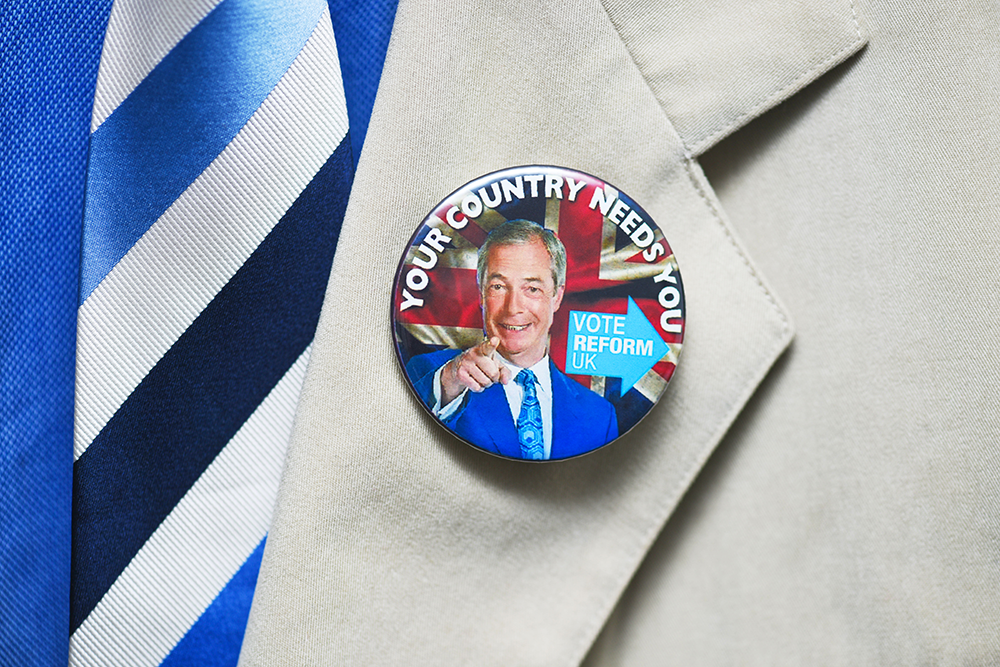


A couple of weeks ago, the Guardian published an article entitled: ‘“I feel like I’m losing her”: the families torn apart by older relatives going far right’. It was full of heart-rending tales from metropolitan liberals about how their dim-witted parents had been duped into believing anti-Muslim conspiracy theories by following people like Rupert Lowe on social media. One particularly exasperated man suggested a course of therapy for his mother, fearing that she might want to join Reform.
But is it really the online radicalisation of elderly parents that’s putting families under pressure in the run-up to the local elections? I suspect it has more to do with their children, particularly their daughters, embracing a toxic strain of identity politics imported from America. A recent poll of 2,000 18- to 30-year-old women in the New Statesman by Merlin Strategy lends weight to that theory.
One man suggested a course of therapy for his mother, fearing she might want to join Reform
Only half of the women surveyed feel positively towards men, a figure that drops to 35 per cent among the under-25s. A quarter say their partner having different political views would be a red flag, while six in ten say they couldn’t be in a relationship with someone who disagreed with them about the Palestine-Israel conflict or Donald Trump. A whopping 74 per cent say they couldn’t date anyone who didn’t attach the same importance to ‘social justice’ as they do.
The reason political differences are putting a strain on family relationships, then, is not because boomer parents are becoming increasingly worried about uncontrolled mass immigration and rising energy costs. It’s because their daughters have been captured by radical progressive ideology. Moreover, the intolerance is all on one side. Parents are perfectly willing to overlook the fact that their daughters are planning to vote Green on 7 May, but the pink-haired fanatics are consumed with rage over their Reform-voting parents. As one mother said about her estranged daughter on rejectedparents.net: ‘Not talking about political issues was not enough – she demanded total capitulation.’
In the US, a survey by the Public Religion Research Institute found that 23 per cent of Democrats reported spending less time with family members because of political disagreements – making them five times as likely to reduce contact as Republicans. An American psychologist called Joshua Coleman has written a book about this phenomenon, documenting the increasing intransigence of younger women, some of whom boast about severing contact on social media. ‘It’s seen as a virtuous act of protecting your identity and mental health,’ he told the Guardian. ‘All of that’s pretty new.’

The most high-profile example in the UK of this narcissistic preening is Zack Polanski’s rejection of his family’s belief in Israel’s right to exist. Asked by Iain Dale on LBC about the ‘Zionism is racism’ motion due to be debated at the Greens’ spring conference and whether that meant he thought his mother, a proud Zionist, was a racist, he said: ‘I am equivocating, actually, and I’m openly equivocating.’ Typical of Polanski to brag about doing this ‘openly’, as if that was a virtue. In fact, it reveals just how performative the entire process is. During China’s cultural revolution, the Red Guards were equally ‘open’ about denouncing their parents as capitalist running dogs.
I have a visceral fear of being publicly condemned by my own children. Their views are all to the left of mine, but then that’s true of my wife and every member of my extended family. Perhaps the fact that my children have witnessed us airing these political disagreements without falling out has taught them that they can be managed amicably.
It also helps that political discussions in our household are generally shot through with sarcasm, irony and humour. We tease each other constantly, sometimes quite cuttingly, and that creates a useful pressure valve. If one of my four children announced they were cutting off all contact with me for reasons of ‘self-care’, the other three would ridicule them mercilessly. At least, I hope they would.
I wish I had some useful tips for readers facing an inquisition from their own nose-ringed Torquemadas this weekend. I sought the advice of my 17-year-old son Charlie, who suggested children and their parents swap phones for half an hour and scroll through each other’s social media feeds. He doesn’t think that will change anyone’s mind, but it might give each side a better understanding of where the other is coming from. In this polarised age, that’s probably the most we can hope for.



Comments