
As Israel prepared to mark Yom HaShoah last night, remembering the Holocaust, the American blockade of the Strait of Hormuz moved into enforcement. At Yad Vashem, Israel’s Holocaust remembrance centre, Prime Minister Benjamin Netanyahu tied the present conflict directly to historical memory, declaring that Israel had ‘crushed the evil regime in Iran to dust’, framing the campaign as the fulfilment of a promise that there would not be another Holocaust. His language placed the current war in existential terms, in a clear continuum of Jewish history – a marked contrast with the sceptical and critical tone that continues to dominate much western coverage.
At the same time, President Trump confirmed that the United States was now actively enforcing the blockade, in lieu of fighting: ‘Right now, there’s no fighting,’ he said. ‘Right now, we have a blockade … Iran is doing absolutely no business, and we’re going to keep it that way very easily.’
All of this looks like part of an ongoing negotiation process, rather than a replacement for it. The collapse of talks in Islamabad did not end engagement. Accounts from participants suggest the two sides came close to a framework, even as core disagreements remained unresolved. Speaking to Fox News, Vice President J.D. Vance articulated the American position in blunt terms, linking Iranian behaviour in the Strait directly to nuclear risk: ‘If they’re willing to engage in economic terrorism on the entire world, what would it mean, what leverage would they have, if they had a nuclear bomb in Tehran?’ President Trump revealed he had been called by the Iranians, who he said want a deal.
Pressure on the ground is being used as leverage to force movement round the negotiating table on the nuclear question.
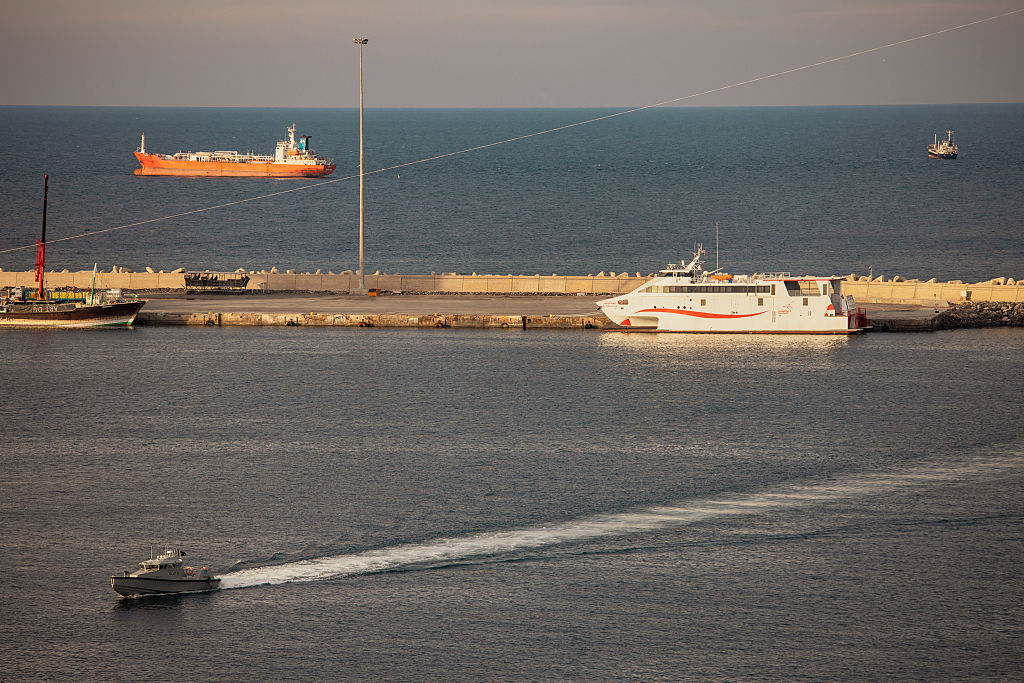
The nature of the blockade itself also reflects that approach. It is not a total closure of the Strait of Hormuz. Instead, it targets Iranian trade while allowing transit to and from non-Iranian destinations to continue. Guidance issued through United Kingdom Maritime Trade Operations confirms that restrictions now apply across Iranian ports and coastal waters, covering the Arabian Gulf, the Gulf of Oman, and adjacent areas. The enforcement is described as applying ‘without distinction to vessels of any flag’ engaged with Iranian infrastructure. Overnight, tracking data appeared to show two vessels attempting to cross the strait before being turned away by the US. The tanker Rich Starry, destined for China, and the Ostria were not able to cross the strait. Both were carrying oil and chemicals.
Vessels transiting the Strait are subject to military presence, communications and possible inspection under the right of visit. A grace period allowing ships to leave Iranian ports has ended, and vessels entering or departing without authorisation are now liable to interception, diversion, or capture. Humanitarian cargoes are permitted, subject to inspection.
The effect is already being felt. Tankers have reversed course near the Strait shortly after approaching it. Some others appear to be operating under false registries or manipulating tracking data, indicating attempts to evade the US measures.
Alongside enforcement, the United States is maintaining and expanding its military posture. Naval forces in the region include multiple carrier strike groups, amphibious units, and destroyers. The aircraft carrier USS George H.W. Bush is approaching via a route around southern Africa rather than through the Mediterranean and Red Sea – a decision which avoids areas where Houthi forces have previously targeted shipping. The message is clear: additional strike capacity is moving toward the region and can be used if needed.
Mine-clearing operations are underway in the Strait itself. U.S. ships are using sonar to locate Iranian naval mines and neutralising them with controlled charges. Earlier movements by US destroyers were described as ‘setting conditions’ for this phase. The presence of mines, along with the continued relevance of small Iranian fast attack craft, means the area is still a high-risk zone.
As the ceasefire endures, continuous flights by US C-17 transport aircraft into regional bases, including Israel, indicate ongoing resupply. The infrastructure for sustained operations is being maintained rather than wound down. This may still only be a pause.
The blockade is being used as a lever inside a negotiation that has not yet concluded. It applies economic pressure, while leaving room for further escalation or de-escalation. For now, we cannot know if that combination of pressure and readiness will produce diplomatic movement, or whether the world needs to brace for a longer period of confrontation.






Comments