
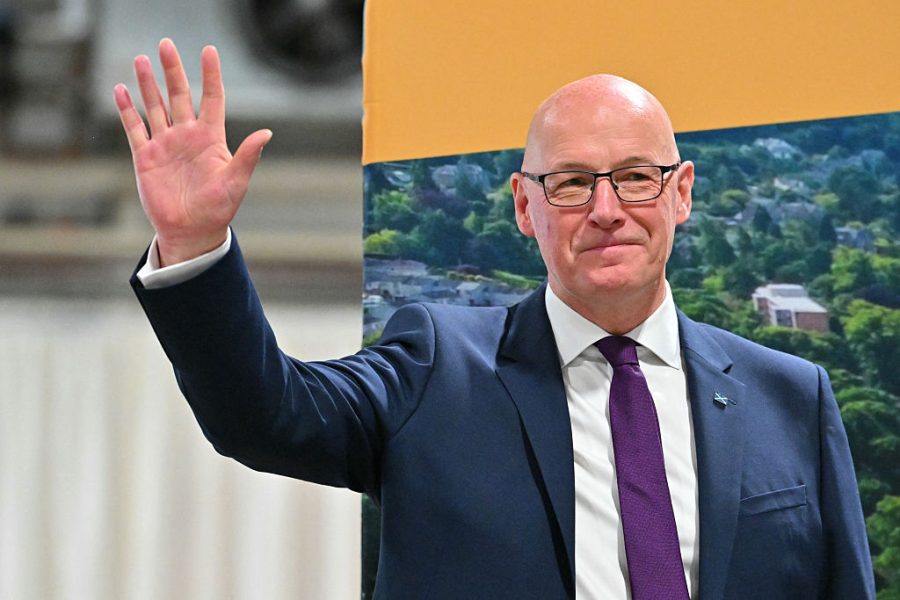
The Scottish National party (SNP) has failed to win an overall majority in the Scottish parliament. With an expected 58 MSPs, it has fallen short of the 65 target which John Swinney said would have been a mandate for an independence referendum – not that Westminster would have authorised one any time soon.
However, this is still a good result for Mr Swinney after a pretty lacklustre campaign in which many of his party’s policies – like a price cap on supermarket goods – did not land well. Many forecasters, including Ipsos in the Times, thought he would return fewer than sixty MSPs.
This means that, with the Scottish Green party result – which has been the other big story of the Holyrood elections – there will be the largest ever parliamentary majority for independence. The Scottish Greens won 15 seats including their first ever constituency. The Greens won Nicola Sturgeon’s old seat in Glasgow Southside, and they defeated the SNP cabinet minister Angus Robertson in Edinburgh Central.
John Swinney has to decide how to secure a stable administration in the Scottish parliament
John Swinney will now have to decide whether he seeks another coalition with the Scottish Green Party or tries to live dangerously as a minority administration. The last coalition with the Scottish Greens ended in ignominy in 2024 when the then SNP first minister, Humza Yousaf, ejected them from the coalition. He resigned as first minister shortly afterwards following a cabinet rebellion.
Many in the SNP membership would wish to resume a formal alliance with the Greens, not least because this would cement the pro-independence majority. They would not wish to see any kind of formal alliance with the Scottish Liberal Democrats, who are the most unionist party in Holyrood. The SNP also has policy positions in common with the Greens on the environment and gender issues.
The Scottish Labour leader, Anas Sarwar, who less than two years ago was seen as a shoo-in for defeating the SNP, has had a very poor result. Mr Sarwar famously called for the UK Labour Prime Minister, Keir Starmer, to resign. He may now be forced to consider his own position.
The new kids on the Holyrood block, Reform UK, did not quite do as well as some of the more optimistic forecasts. Their leader, Malcolm Offord, had forecast victory in constituency seats, and this did not come to pass. However, from a standing start, they still won a solid block of 17 seats and tied with Labour, who also returned 17 MSPs. There will be fun and games in Holyrood next week deciding whether Labour or the Reform Party is the official opposition party. They’ll probably take turns. This means that Nigel Farage’s party, which used to be regarded as a pariah in Scottish politics, will be a significant force in Scottish politics.
But standing back from the immediate results, the reality is that the SNP has won its fifth consecutive election victory in the Scottish parliament – and with a convincing majority, albeit not an absolute one. By the time of the next election, John Swinney’s party will have been in government for a quarter of a century.
This consistent support for the party of independence could well become a constitutional issue long before then, not least because the SNP’s sister nationalist party, Plaid Cymru, has ended Labour’s dominance of Wales by coming top in the Senedd elections. With a Sinn Féin First Minister in Northern Ireland, the SNP believes that the wave of nationalist leadership in the nations and regions of the UK will force Westminster to rethink its blanket opposition to a referendum on independence. Swinney has controversially been making direct overtures to Michelle O’Neill, the Sinn Féin First Minister.
Under the Good Friday Agreement, Northern Ireland has the potential option of a border poll on Irish reunification every seven years should a majority wish it. The nationalists would love this principle to be applied to Scotland. The SNP say they have repeatedly delivered a parliamentary majority for independence and that this must eventually be recognised by Westminster.
But for the time being, John Swinney has first of all to decide how to secure a stable, day-to-day administration in the Scottish parliament. Will he seek the security of a coalition, or will he try to persevere with a minority administration as he has since April 2024? With this resounding victory, he may try to go it alone, as his predecessor Alex Salmond did in 2007.



Comments