
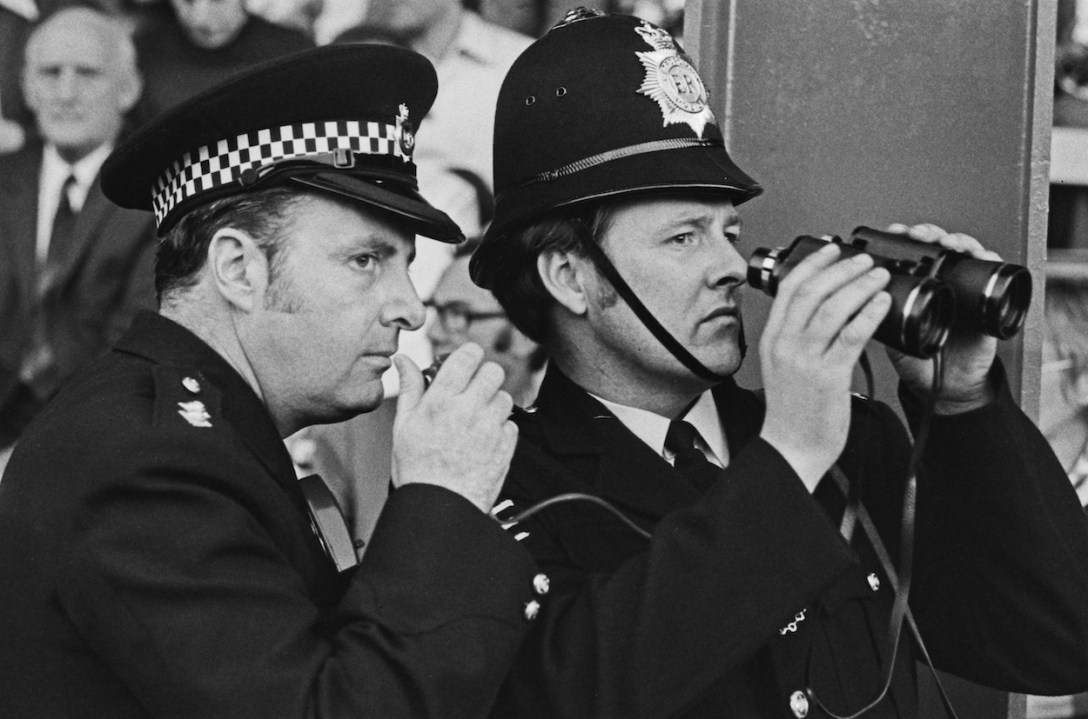
I was not an easily spooked child – I don’t recall ever ‘hiding behind the sofa’ as some aggy dustbin expressed a desire to exterminate – but one cultural artefact which really put the wind up me was a song called ‘The Laughing Policeman’. Though recorded by Charles Penrose in 1922, it was still being played frequently in the 1960s on the BBC Light Programme’s Children’s Favourites and then on Junior Choice on Radio 1 in the 1970s, when I was young.
Why was I frightened by the song? I was too young to know about bribery and corruption, so it can’t have been the line ‘Just shake him by his fat old hand and give him half a crown’. It was this: ‘He laughs on point of duty / He laughs upon his beat / He laughs at everybody / When he’s walking in the street.’

Why is he laughing in this mysterious manner? Is he perhaps laughing at the people who he pretends to be protecting?
Increasingly, and perhaps frivolously, I think of this song whenever we hear of the latest news of police misconduct. The sense of the policeman being out of control, a law unto himself and his buddies, to whom he has fealty rather than to the public – ‘civilians’ – has grown in recent years. None of us with any sense want to ‘defund the police’, as the famously thick Antifa chant went; in New York, Mayor Mamdani has just disbanded the NYPD’s Strategic Response Group, around 500 officers trained to tackle terror threats and violent crowds, and replaced it with a 30-strong ‘First Amendment Support Team’, a civilian ‘dialogue division’ with no weapons and no arrest powers, an action which may well disproportionately affect the city’s Jews, who last month were the victims of more than half of all hate crimes. But many of us do feel that something has gone very wrong with the police. The thin blue line is still there, but sometimes appears to blur into the very evil which we seek protection from.
Ever since Sir Robert Peel invented the world’s first modern professional police force – the London Metropolitan Police, in 1829 – the sentiment that ‘the British police are the best in the world’ was largely accepted by the majority of law-abiding people. But according to the most recent Crime Survey for England and Wales, fewer than half of respondents felt the police were doing a good job, down from 62 per cent a decade before. Confidence in the police is around 67 per cent, as opposed to 76 per cent in the 2010s; complaints against the police are higher than they have ever been. We are often told that crime is at an all-time low – Owen Jones is keen on repeatedly squealing this, for reasons we may only guess at – but that may well be due to an unprecedentedly low reporting of crime, due to lack of confidence in police interest in solving them. The perception of the one-time ‘bobbies on the beat’ as desk-bound busybodies poring over social media and arresting gender-realists for being ‘unkind’ to cross-dressing males (culminating in the arrest of Graham Linehan last year by five armed police officers, earning him £25,000 compensation and an apology from the Met) has led to the saying ‘Police the streets, not my tweets’ as we see crimes such as shoplifting practically decriminalised.
As well as backing trans people over those who don’t agree with them, the police often appear to be infected with an anti-white prejudice and to elevate Islam to a special place of respect and deference. The shame of the grooming gangs, where raped children were dismissed by police as responsible for their own abuse, and sometimes delivered back to their tormentors, and the unhealthily close relationship the police appear to have with certain mosques, contrast sharply with the Met’s threat to arrest an ‘openly Jewish’ man for breach of the peace when he dared go near a pro-Palestine march in 2024 or their tireless harassment of Christian street preachers. This anti-white bias came to a head in the dreadful case of the murdered teenager Henry Novak, leading to the mounting suspicion of ‘two-tier policing’, whereby the paler person involved in any violent dispute is presumed to be the guilty one, even as they lie dying. This week the Home Secretary warned a conference of police chiefs of the ‘corrosive and growing perception of two-tier policing… We must be wary of misguided attempts at course correction, where the pursuit of equality leads instead to differential treatment.’
At the same time, alongside the idea of the coppers as aggressively prissy woke-scolds, the idea of the sex-fiend policeman – often enabled and emboldened by his colleagues – has loomed. That the police might not have the most enlightened view of women was made shockingly clear to those of us who were around in 1982 when the BBC broadcast ‘A Complaint of Rape’ as part of a fly-on-the-wall series about the police. The contemptuous way the officers involved addressed the woman alleging the assault was breathtakingly nasty, as they asked her about her sex life and her mental health, branding her complaint ‘a fairy tale’. The prime minister, Margaret Thatcher, addressed the Commons on the programme, condemning the detectives as ‘bullying’ and calling on the Home Office to review how the police treated rape complainants.
More than 40 years on, though, the Office for National Statistics claims that five in six women who are raped do not report it to the police; among reasons cited by Rape Crisis are that it would be embarrassing and that the police would not believe them. But another reason may be the increasing number of domestic attackers, rapists and even murderers of women perceived to be protected by the police force. To the names of Wayne Couzens and David Carrick – both of the Metropolitan Police Service – can now be added Warren Arter, also of the Met.
I have the greatest admiration for those who step up, mostly while still very young, to do a job I would never have the guts to do
Arter led a unit investigating sex assaults in south London. Talk about hiding in plain sight. In a Panorama programme, a woman says that he raped her. He also filmed and distributed a video of his wife Rebekah – who he met when she reported domestic abuse to the Met, and who died two years later, on holiday with him – being sexually abused by various men. A would-be whistleblower, Detective Inspector Jaysen Veeren, found himself blocked by his seniors; Arter was eventually suspended on full pay for seven years (he kept his pension) and despite a sizeable file of evidence against him, his case was called a ‘witch hunt’ by a detective chief inspector, who worried that the Met was ‘haemorrhaging talent’. (Unexpected echoes of ‘protecting the talent’.) The CPS refused to pursue criminal charges and Arter was only finally sacked in 2023 – for drug offences. The only time justice appears to have got a look-in was when he killed himself in HMP Wandsworth two years ago, after being arrested on his return from the holiday where his wife died in a blood-soaked bed, for abusing another woman.
I have met wonderful policemen and women. I have the greatest admiration for those who step up, mostly while still very young, to do a job I would never have the guts to do. I’m aware that if I stopped working, society would not be impacted one whit. If the police were to stop working, society would very quickly resemble the more hellish of Bruegel the Elder’s paintings. But I don’t think anyone would deny that trust in the police is eroding, quietly and lethally.
It was in 2023 that the Casey Review called the Met ‘institutionally misogynistic’, and quoted one officer who stated ‘You may as well say [rape is] legal in London’ due to the low conviction rates. It was in response to this that Mark Rowley vowed to ‘lift the stone’ and ‘tackle everything underneath it’ while ‘removing the cancer from the body’. These words seemed characteristically badly chosen and melodramatic at the time, full of sound and fury and signifying a man keen to hold onto his job. The Arter case – which has come to prominence due to the efforts of Rebekah’s son Elliott Usher to memorialise his mother – makes them even more so. The Panorama programme is a sobering reminder of what rot lies at the heart of the Met, and the bittersweet relationship between public and policing. It’s like the old gag about prison food: ‘It’s terrible – and there’s not enough of it.’ But nobody’s laughing now.





Comments