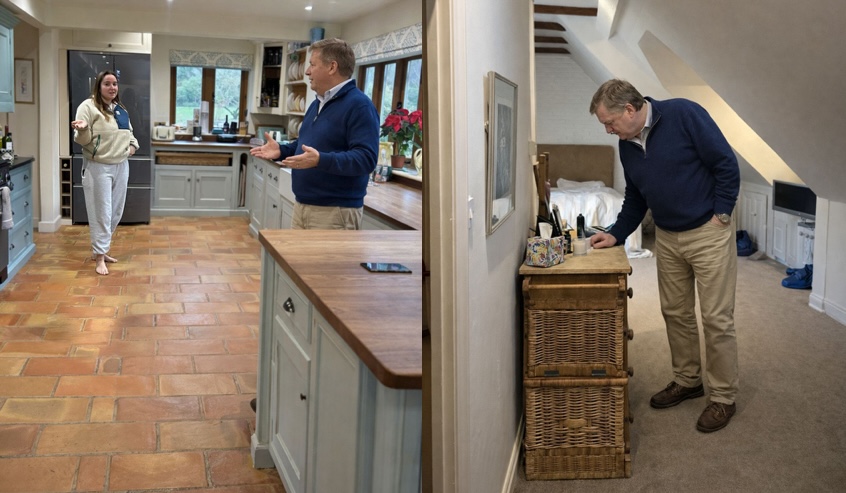
I was walking my dog when a WhatsApp message and photo came through from Simon, an old school friend of more than 50 years. His kids had sent him a picture of a man who had turned up unexpectedly at the family home. The accompanying message said simply: ‘Your friend Andrew from Epsom College is here?’ Simon, who was out shopping, didn’t recognise him. Did I?
No, I replied, but he looks familiar. But then again he was white, rotund and greying and thus a 99 per cent DNA match for one of our social circle: i.e. a well-fed 60-something with a 20-something handicap. The more I studied the photo the more worried I got. For Simon and his family. Who on earth was this mysterious visitor standing in the middle of his kitchen? What did he want?
He looked like a smug, entitled Boomer – takes one to know one perhaps – so my first thought was ‘conman’. A Home Counties Boden catalogue crypto-flogging Tinder swindler perhaps? Then, mindful of scary news stories about intruders, and having seen a slew of recent dramas like The Housemaid, The Girlfriend and The Guest – all featured unexpected house guests and all ended badly and bloodily – I felt concerned enough to call Simon.

Was it a deranged neighbour with a grievance and an AK-47 in his Range Rover? He looked normal – but then nut jobs often do. In The Housemaid, for example – spoiler alert – the charming husband turns out to be a Norman Bates-style psycho who locks his wife in the attic and makes her pull 100 hairs out, one at a time, as punishment for not dying her roots properly.
Not surprisingly, Simon was even more worried than I, especially now more pictures were coming through. One was of Mystery Man in the kitchen, talking to Simon’s daughter, holding his palms out, as if to say: ‘What do you mean you don’t know who I am? I am your father’s friend. You must know me.’
Then, even more perturbing, a picture of Mystery Man taking a nap in Simon’s front room, with his feet on the table. Finally, most unsettling of all, Mystery Man in Simon’s bedroom, looking at framed family portraits, with a caption saying: ‘He deffo knows you – he recognises you from your old photos.’
Better safe than sorry, I told Simon. Call the police. Let me know what happens. And good luck.
I spent the next half hour on the phone to mutual friends and we all agreed the conman, if that’s what he was, a) looked just like the sort of person we should know but didn’t, b) it felt very sinister and c) this was definitely one for the police. No update from Simon came. This, I told my now equally concerned wife, could be because Surrey Police had surrounded his home and were conducting tense hostage negotiations via a very loud megaphone. I tried calling Simon. No reply. I texted: ‘WTF is happening? Are you OK?’
If you thought, several paragraphs back, ‘it’s AI, you moron’, well done. Because this was indeed the 2026 equivalent of the whoopee cushion. It was a completely plausible, AI-generated picture hoax – an utterly convincing scam which 100 per cent fooled me, all my friends and my wife (even though she has done a course in this sort of thing).
Simon’s Gen Z kids had, it turned out, taken pictures of several rooms in their house and instructed ChatGPT to ‘add a 55-plus-year-old man who looks relatively posh, a little overweight and wearing chinos, boat shoes and a quarter-zip T-shirt’ doing various, creepy, privacy-invading things.
We are not the only ones to have been fooled this way, of course. Similar anecdotes are now rolling in. The middle-aged dad who created an AI video of himself expertly breakdancing, which delighted his five-year-old daughter. The mother who sent her teenager a picture of his bedroom looking like a bomb had exploded in it, with the message ‘your room needs cleaning’.
A Home Counties Boden catalogue crypto-flogging Tinder swindler perhaps?
After Simon’s failed attempt at retaliation – he sent his kids an unconvincing AI picture of him with two stern-looking uniformed policemen – we all had a good laugh. The prevailing narrative may be ‘AI is a bad thing’ but here, even though the intelligence was artificial, the emotions were genuine. A benign family wind-up had, momentarily, brought us closer together.
There’s a darker side to this, of course. Scammers now have the bazooka of AI, as opposed to the pea-shooter of email (‘Congratulations! You have won the lottery! Send your bank details now!’). And boy are they using it.
Fraudsters using AI-enabled deepfake technology stole nearly $17 billion from Americans in 2024, according to the FBI. Many of the scams are domestic: for example, the Florida woman who got a call from someone sounding exactly like her daughter, claiming to have been in a car crash. The woman transferred her $15,000 life savings in bail money. Only later did she realise her daughter’s voice had been AI-cloned.
The corporate scams are even more lucrative. A finance worker for a Hong Kong-based multinational was tricked into transferring $25 million, no less, to fraudsters who used a deepfake version of his chief financial officer to request the payment. The worker was initially suspicious but put his doubts to one side as there were several other people on the video call in question, all of whom seemed real.
The moral of this story? If you want to avoid being fleeced by artificial intelligence, as opposed to being the victim of a harmless hoax, a healthy degree of Genuine Intelligence is very much required.



Comments