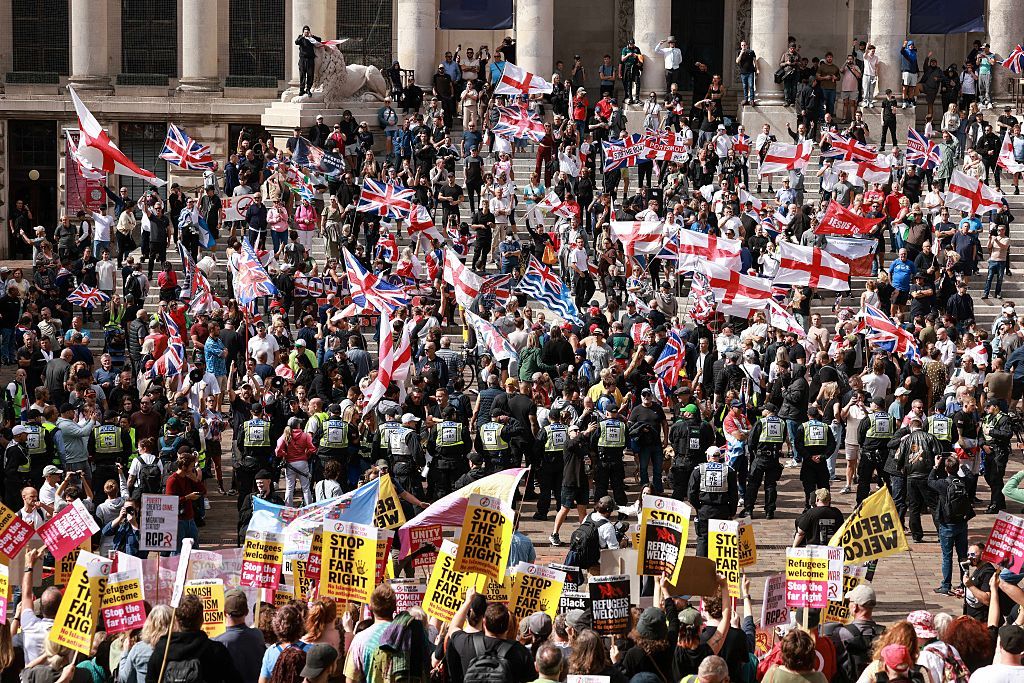
As ever more illegal migrants arrive on our shores and anti-immigration protests rock England’s south coast, the British state is attempting to restore order not by stopping the boats, but by punishing the dissenters.
This week, Del Somerville, a 42-year-old father of two, was sentenced to two years in prison for violent disorder at a protest in Portsmouth, which erupted after a ‘small’ boat carrying 114 migrants arrived in the city. The sentence is to serve as a deterrent to others following later protests in the area.
Why, many will ask, is any judge opining on the political palatability of a protest as he sentences someone involved in it?
On 6 September, Somerville approached a police cordon in an ‘intimidating manner’ and threw an empty plastic bottle he had picked up at officers. Body-worn video footage showed Somerville ‘aggressively pushing’ through the police line, ‘shouting verbal abuse at police officers’ and ‘pointing aggressively’ at them, the prosecution added.
Somerville, a local who spends three nights a week with his boat moored at Portsmouth marina, had been remanded in custody before pleading guilty last week. He awaits trial on an additional charge of assaulting a police officer on a different day, to which he has pleaded not guilty.
We can all agree that protesters ought to refrain from menacing police officers, who after all are only doing their job. But many will nevertheless find it extraordinary that at a time when the justice system is creaking under pressure for prison spaces, Somerville has met with two years behind bars essentially for throwing a plastic bottle.
It’s not hard to see why the book was thrown back at him. Judge Daniel Sawyer, sentencing, decided to label Somerville a ‘thug’. It’s a rather classist insult for a white father-of-two who objects to illegal migrants being dumped on his town, and whom Sawyer even admitted was not a ‘dangerous offender’. But exemplary punishment for anti-immigration protesters is now par for the course in the two-tier British justice system.

During the disturbances in Epping last year, for instance, two protesters were sentenced to more time in prison for ‘violent disorder’ than the mere 12-month sentence handed to Ethiopian migrant Hadush Kebatu for his sex crimes which sparked the protests. The judge ruled the defendants’ actions were ‘racially motivated at least in part’ and admonished them for not waiting for ‘due process’.
And to take just one example of many from the Southport unrest in 2024, grandfather Peter Lynch held a sign and shouted ‘racist and provocative’ remarks at a protest at a Rotherham asylum hotel which later turned violent. The sentencing judge called Lynch a ‘disgraceful example’ as a grandfather handed him an extraordinary two years and eight months for violent disorder. He was later found dead in his cell.
When other, less political offenders encounter our courts, they can expect a softer touch. Sentencing four Palestine Action activists earlier this year for their 2024 raid on Elbit systems, where one of them had beaten a security guard with a sledgehammer and fractured her spine, the judge astonishingly went out of his way to praise the defendants’ character. ‘You are all young people who were of exemplary good character’, trilled Mr Justice Johnson, noting ‘your kindness, your selflessness, and your caring and compassionate nature’. Earlier this month, an Algerian migrant avoided jail after molesting a 16-year-old girl in a London alleyway, after the defence argued that his actions were ‘out of character’. This follows the Syrian asylum seeker who last year also avoided jail for three sexual assaults in Horley, Surrey, who ‘claimed to be unfamiliar with UK laws regarding physical contact’.
But where some defendants have it easier because of who they are and what they represent, the likes of Mr Somerville get it in the neck for the same reason. ‘This was persistent and sustained violent activity [and] there was widespread violence’ at the protest, said Sawyer at sentencing. This may be relevant, but it rather suggests that Somerville is being sentenced as much for the overall tone of the protest rather than his individual actions. The demo ‘caused distress, disruption [and] a detrimental impact to the community’, Sawyer asserts – an assessment the many British communities coming out to protest against illegal migration would surely disagree with.
Sawyer then sniffs about the ‘cost to the public purse’ of the police operation and ‘attacks on public servants’. Has a judge ever chided an illegal migrant for costing taxpayers, one wonders, or would that violate the strictures of the Equal Treatment Bench Book? He concludes: ‘The simple fact is that this offence is so serious that the only punishment can be immediate imprisonment.’
Why, many will ask, is any judge opining on the political palatability of a protest as he sentences someone involved in it? In part this is the legacy of the politicised Southport crackdown – the long shadow of two-tier Keir. After all, ‘gang[s] of thugs’ and ‘far-right thugs’ was exactly how Starmer described every angry Brit who took to the streets after the horror in Southport.
This political narrative, demonising protests as violent and beyond the pale, catalysed the entire justice system to crack down remorselessly. So it did then, and so it continues to. The result is that in two-tier Britain, some protests are more equal than others.






Comments