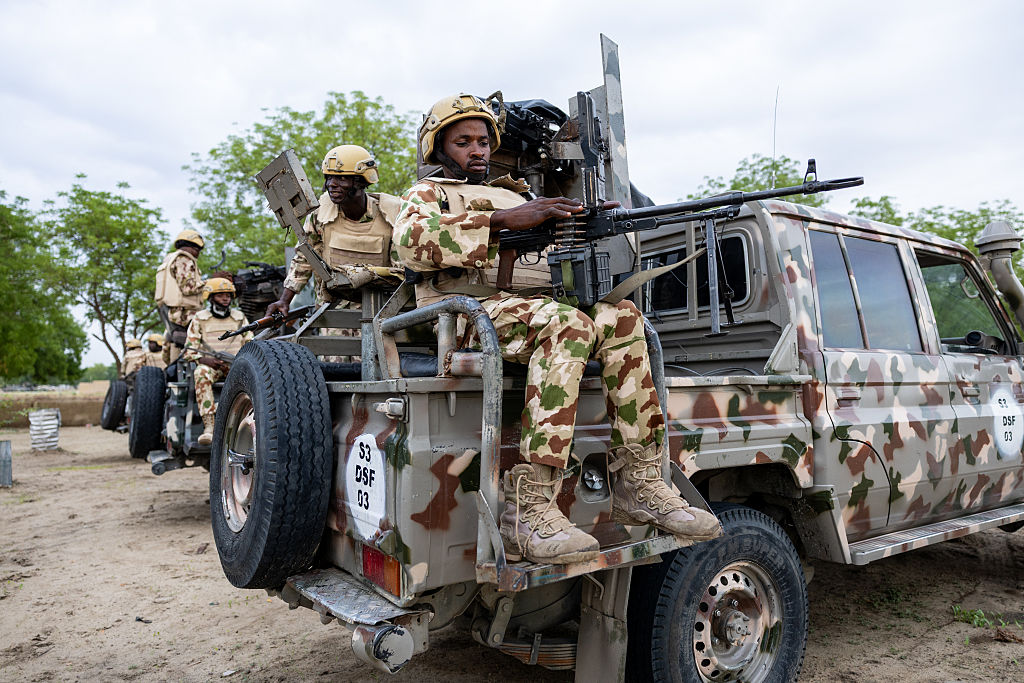
For the Pentagon, Nigeria is firmly on the list of countries where terror has run amok. In 2025 and again in January and May this year, the US Air Force bombed rebel camps in the north in an effort to halt a spree of murders and abductions that has left thousands dead or missing.
US bombings earlier this week killed Islamic State’s second in command, Abu Bakr al-Mainuki, but the insurgency shows no sign of slowing; 17 trainees died recently in an attack on the army’s special forces academy and the conflict has spread to nearby Mali.
In Nigeria, keeping the peace is a challenge. Since independence from Britain in 1960, there have been six coups and a civil war.
Divided by Islam and Christianity – which is split between Catholic and Protestant – and disparate ethnic groups, fracture is always a risk but rarely of concern to Washington. However, a jihad in the north that has run more than 16 years has seen churches burned, villages destroyed and the army routed as rebels fight to establish an independent caliphate.
With an election due in January and parties currently naming candidates for president, the manifestos are frothy with talk of a better, more equal nation and an end to abuse of state funds that has long been epidemic.
But there’s scarcely a mention of the war, or chronic levels of unemployment that make extremist cells a siren call to the millions of youth, educated but out of work and ignored by the government in Abuja.
This is not only Africa’s most populous country but one of the youngest: its 243m people have a median age of just 18. Not that you’d know it, looking at the leadership. President Bola Tinubu is 74 and his predecessor, the late Muhammadu Buhari, was close to 80 when he stepped down in 2023. Then again, Donald Trump turns 80 in June.
On President Tinubu’s watch the naira has crashed, pushing up cost of living; this is Africa’s biggest oil exporter yet in three years the price of fuel has risen four-fold.
And not only does the war continue, but Tinubu largely ignores it in his speeches. By contrast, the press has an almost daily take on a rising number of soldiers and civilians either killed or ransomed by the guerrillas.
When the government responds, the figures are dismissed as an exaggeration. Reports in the media claim millions of abductions and payouts that rival the defense budget, now a record $5 billion. But it’s undeniable that in buying the freedom of its kidnapped soldiers, the state is both fighting and funding the insurgents, then calling on America to bomb the payees.
Reports in the media claim millions of abductions and payouts that rival the defense budget
If the president could announce victory or even a negotiated peace, the election would be his to win. Instead, in 2025, the continent’s key polling firm, Afrobarometer, found that 93 percent of Nigerians thought their country was headed in the wrong direction.
Tinubu and his ageing cabinet may be known to the electorate, but a new man is winning support from their grandchildren. Mohammed Hayatu-Deen — known by his initials MHD — is an economist educated at Harvard. At 72 he has achieved more than most with a swag of companies under his belt. Well-known at the World Economic Forum, he owns two of the country’s largest shopping malls.
It has been his frankness that turned heads. “There is no plan for a country with such a young population,” he says. “If we have too few jobs now, where will it be in 10 or 20 years?”
And he is the only candidate who gives voice to one of the more obvious causes of war. “You have to ask what kind of people would join these agents of terror who murder and kidnap civilians, burn villages and say they want to end our democracy.”
It’s rhetorical, as he makes clear. “They are young Nigerian men, some taken against their will but others drawn to the cause by poverty and a lack of jobs. Dysfunction by one government after another has left us with an economy that doesn’t work and, we tolerate the fact that billions are lost every year to theft and corruption instead of being used to create jobs for these very same youngsters.”
MHD has issued a plan to close down a money laundering system that has for decades allowed bribes and stolen funds to be sent abroad. The same channel, he says, by which terror groups are able to ransom their captives. And he wants special courts to try captured fighters who too often escape or vanish in custody.
MHD borrows Ronald Reagan’s line that, far from government being able to solve these problems, “government is the problem!”
Without change, he says, the best brains will continue to leave. “I see Nigerians running companies in the US and Britain, but less-so here. Why? Because our bureaucracy strangles enterprise.”
His boldness is bound to disturb some of the old-timers used to reassuring words at election time rather than the ills of a nation laid bare.
He shrugs. “All my life I’ve watched the same politicians pass half-truths for policy as their promise of a better Nigeria went unfulfilled. If my words scare the old guard, it means I’m on the right track.”


Comments