
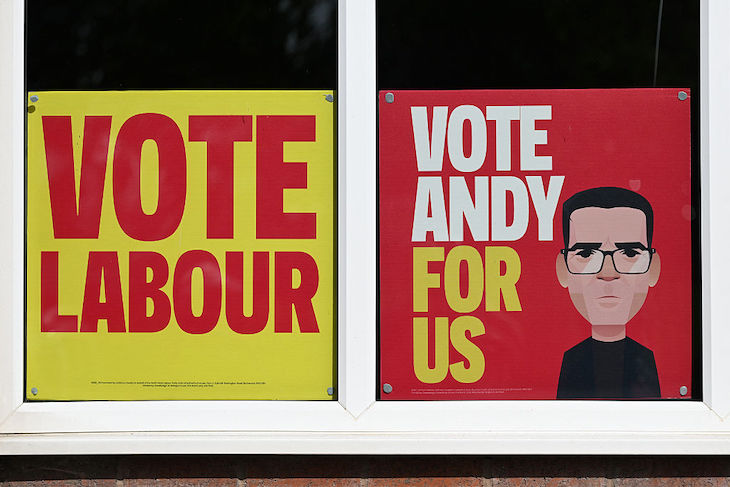
Andy Burnham is not giving much away as to what a government led by him would look like. Given that it seems unlikely there will be a leadership election, we are probably not going to find out very much before he takes office, either. But there is one way to shed light on the matter.
East Germany has a similar socio-economic structure to that of northern England, where a few large cities are doing very well
Two years ago, Burnham published, jointly written with Liverpool mayor Steve Rotheram, a manifesto entitled Head North: A Rallying Cry for a More Equal Britain. Anyone who lives in the South East of England might want to look away now. It lays bare Burnham’s plan for regional redistribution of wealth on a grand scale.
Take this passage:
“To ensure a perception of fairness, and build a sense of unity between the two halves which had spent fifty years apart, Germany decided to add a Basic Law – or Grundgesetz – to its written constitution. The Basic Law stipulates that there must be ‘equivalent living standards’ between all of the German lander. To achieve this, the wealthier states are required to pay into a central system which ensures that funds are redistributed around the country to achieve the law’s central requirement. When you visit Germany, you can see and feel the success of this policy. In all German towns and cities, there is high quality public transport, public realm and Infrastructure not seen in England outside London and the South East.”
The passage is historic gobbledegook. Germany’s Basic Law wasn’t added to the constitution upon reunification. It WAS the constitution of West Germany, and Article 72, which refers to “the establishment of equivalent living conditions throughout the federal territory” was there all along, since it was written and adopted in 1949. Specifically, it gives the federal government the right to pass legislation to override the laws of individual lander in the name achieving balanced economic growth throughout the country. It was devised in a very different Germany from that of the present, or even the 1990s. West Germany was still occupied by the Allied powers, and divided into zones run by the United States, Britain and France. Germany’s capital city had been divided into two and remained marooned in Soviet-run East Germany.

The government of reunified Germany did try hard after 1990 to stick to the ambitions of the Basic Law. Money was thrown at the old East Germany to try to bring living standards there up to the level of West Germany.
In terms of the public realm, which is what Burnham refers to, it might be regarded as a success: roads in the East nowadays look little different from those in the West. Every city has its own, modern tram network, and the central districts often look indistinguishable from those in the West.
Yet in terms of household incomes or living standards, the old East Germany has never come remotely close to matching the West. That might not be obvious in the centre of Berlin, which has attracted investment and incomers because it is the capital city. But more rural and former industrial zones remain a long way behind. The former East, excluding Berlin and its hinterland, has a median monthly household income of €2,850 (£2,500). In Bavaria, and much of the rest of southern Germany, it is €3,809 (£3,300).
In fact, East Germany has a similar socio-economic structure to that of northern England, where a few large cities are doing very well but where the secondary towns and more remote areas lag well behind. As in the North of England, this shows up politically in support for anti-migration, populist parties which are right-wing on issues of identity and nationalism but lean to the left economically. In Germany, these are the AfD heartlands; in England, the realm of Reform UK and now, it seems, Restore, too.
If Burnham just wants better buses and trams for the North, that is one thing, but if he is plotting to try to equalise living standards across Britain, no level of taxation is going to achieve it. As Germany has proved, there will always be places where businesses and wealthy individuals want to be, and other places where they are not so keen to be.
The only way you are going to equalise living standards is to tax people in wealthy parts of the country so heavily as to impoverish them, bringing everyone down to the same, lowly level. By then, many UK residents will have flocked to new favoured places of residence, abroad.






Comments