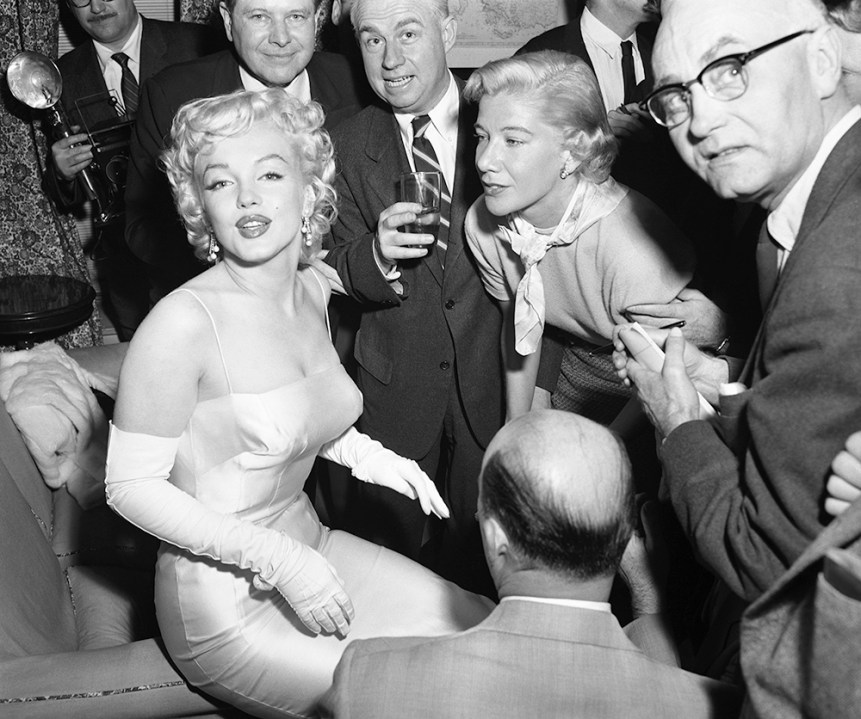
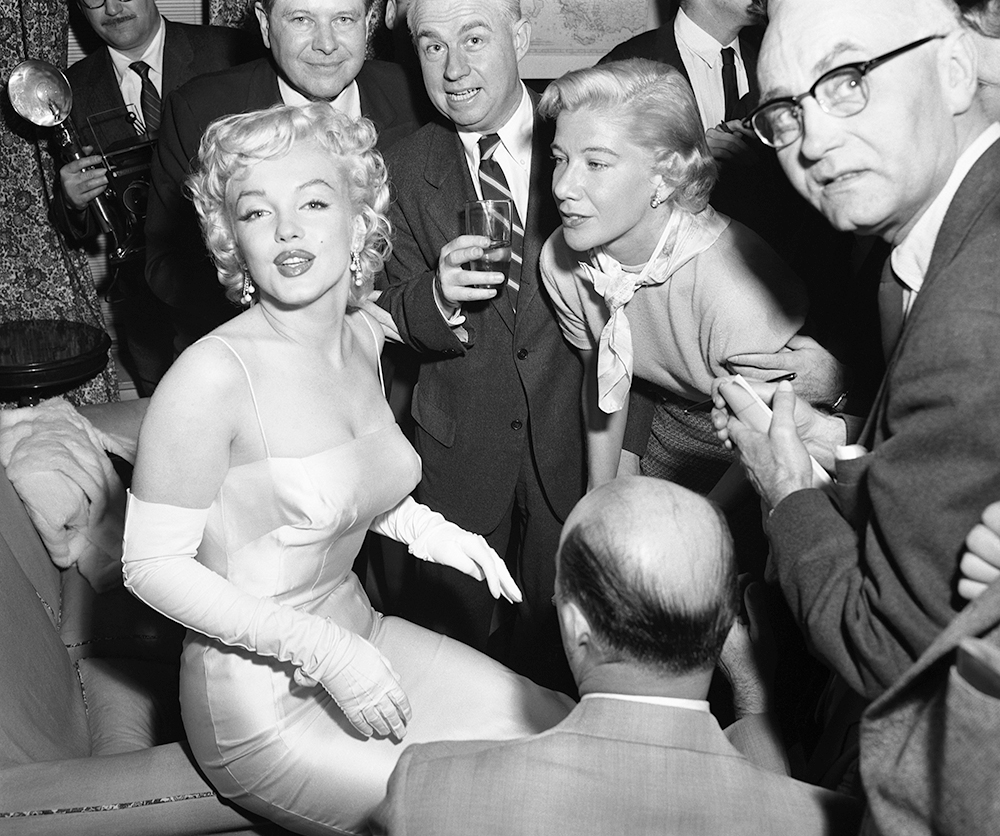
Marilyn Monroe would have celebrated her 100th birthday this year. My new biography of her begins with this story: she’s walking with a friend down Park Avenue dressed in a raincoat and sunglasses and without make-up. As the crowds stream past her, nobody gives her a second glance. Then she turns to her friend and asks, “Do you want to see me be her?”
Without changing her hair or dress, the transformation begins and, after making some kind of inner psychological adjustment, she morphs from an ordinary woman into Marilyn Monroe, superstar. As her friend, the actress Susan Strasberg, recalled: “There she was – not the simple girl I’d been strolling with, but ‘Marilyn Monroe,’ resplendent, ready for her public. Now heads turned. People crowded around her.”
The incident illustrates not only Marilyn’s ability to switch on the full wattage of her stardom with ease, but it also explains why her story continues to resonate more than 60 years after her death. She haunts our culture unlike any other star from the Golden Age of Hollywood. She’s constantly referenced in pop culture; she’s the subject of films – including the controversial Blonde (2022), an adaptation of Joyce Carol Oates’s novel – TV shows, musicals, artworks, fashion shoots. This year alone there are major exhibitions about her in London, Paris, New York, Los Angeles and the Netherlands.
There was madness in her family, Monroe said, and she feared she had ‘bad blood’
Her narrative arc – from poor, abandoned foster child Norma Jeane to the “blonde bombshell of the atomic age” – taps into a modern fascination with self-reinvention. “I used to think as I looked out on the Hollywood night, there must be thousands of girls sitting alone like me, dreaming of becoming a movie star,” said Monroe about her desire for fame. “But I’m not going to worry about them. I’m dreaming the hardest.”
And so, through a combination of hard work, disciplined study and bucketloads of erotic capital, Monroe began the carefully choreographed manufacture of the “dumb blonde” persona of films such as All About Eve, Gentlemen Prefer Blondes, How to Marry a Millionaire and The Prince and the Showgirl. This character was so successful that Josh Logan, who directed Marilyn in Bus Stop, said that it would be remembered as one of the great comic creations of the 20th century.
Many of us will remember Monroe for her sparkling portrayal of Sugar Kane in Billy Wilder’s 1959 comic masterpiece Some Like It Hot. Monroe was notoriously late on set and needed 47 takes to say the simple line, “It’s me, Sugar.” Monroe’s co-star Tony Curtis famously described kissing her as like “kissing Hitler,” but though the actress could be difficult to work with, Wilder regarded her as an “absolute genius.” There was, said the director, “no way to fathom her – if there was she’d have found it. She tried harder than anybody. She was just as bewildered by herself as we are looking back at her.”
The wide gap between the stark brutalities of Monroe’s early life and her glittering Hollywood career only makes the story even more compelling. Born Norma Jeane Mortenson in Los Angeles on June 1, 1926, her prospects were not good. Her mother, Gladys, suffered from schizophrenia and placed her daughter in foster care when she was just 12 days old. There was madness in her family, Monroe later said, and she feared she had “bad blood.”
Monroe’s grandmother, Della, tried to smother her when she was a baby; her grandfather, Otis, had contracted syphilis which rotted his brain. Later, Monroe confessed: “For a long time I was scared I’d find out that I was like my mother and end up in the crazy house. I wonder when I break down if I’m not tough enough – like her.”

At the age of eight, she suffered sexual abuse in her foster home at the hands of a “star boarder,” a man Monroe named as Mr. Kimmel in her posthumously published memoirs. “When he put his arms around me I kicked and fought as hard as I could, but I didn’t make any sound,” she wrote. “He was stronger than I was and wouldn’t let me go. He kept whispering to me to be a good girl.”
The fact that Monroe was prepared to reveal the details of this abuse, at a time when the Hollywood studio system tried to control and sanitize every aspect of a star’s private life, shows she was ahead of her time. She tapped into the confessional mode of discourse decades before figures such as Britney Spears, Drew Barrymore and Lena Dunham.
Of course, Monroe’s story, for all its sparkle, also articulates another issue which haunts contemporary culture: our obsession with the dark side of fame. Her third husband, the playwright Arthur Miller, saw first-hand how the public hunted her.
Once, Miller had a disturbing dream that he and his wife were at a fairground. He noticed a large crowd gathered around a gigantic chrome machine which churned out hamburgers. He watched, appalled, as Monroe’s dress became caught in the mechanism. Then she was sucked inside. As he ran around to the other side of the contraption to try to rescue her, Miller saw that she had been turned into a hamburger. The mob went crazy for pieces of her, each of the onlookers greedy for her flesh, blood dripping down their chins as they ate her.
As Miller would later write in his own memoir, Monroe needed an audience to survive, even though she knew it could spell danger. “Sometimes it was as though the crowd had given her birth,” he wrote. “I never saw her unhappy in a crowd, even some that ripped pieces of her clothes as souvenirs.” Since Monroe first started dreaming of being a Hollywood actress, she had cultivated a relationship with the public. Dismantling the image from the woman would come with terrible consequences. Miller’s conclusion was devastating: “She was ‘Marilyn Monroe,’ and that was what was killing her.”
Monroe compared celebrity to caviar: while it was thrilling to have it occasionally, nobody would want to eat it every day. “Fame is fickle,” she told her last interviewer. “It’s nothing I’m counting on. I’ll find a way to exist; I have since I was five years old. And I would say, gee, it was a painful time, when I was famous. And I’ll remember some pleasurable times. You know?”
But a future separate from the carefully constructed image of Marilyn Monroe was not to be. She died from a suspected overdose in August 1962, after being prescribed 830 units of sedative medication in the last two months of her life: enough pills to kill several people several times over.
Monroe was not allowed to rest in peace. If we think we are plagued by conspiracy theories now, take pity on the poor actress, whose demise has been linked, by some, to John F. Kennedy, Robert F. Kennedy, the Mafia, the CIA – even aliens.
A future separate from the carefully constructed image of Marilyn Monroe was not to be
During the course of my research, I investigated the sources of some of these conspiracy theories, particularly the idea that Robert Kennedy, then the US attorney general, played some part in Monroe’s death. I managed to find a wealth of unpublished documents which show how a right-wing cabal wanted to use her death to smear Kennedy, whom they regarded as too left-wing to lead America as a future president.
So what is the truth about Monroe’s death? She was under the care of two doctors: her therapist, Dr. Ralph Greenson, and the man who prescribed her medication, Dr. Hyman Engelberg. It was clear that Monroe was in a vulnerable state in the summer of 1962. She had been fired from Something’s Got to Give due to her health issues and long absences from set, and suffered several depressive episodes.
Dr. Engelberg was supposed to inform his colleague Dr. Greenson about changes to Monroe’s medication, yet he failed to tell him that the star was taking the sleeping pill Nembutal. Even worse, he prescribed another drug for Monroe – chloral hydrate. During the autopsy these two drugs – which can be fatal if taken together – were found in her body and blamed for her death.
Dr. Engelberg always denied he had prescribed the powerful sedative chloral hydrate. Yet during my research I uncovered a prescription for Monroe for this drug written by Dr. Engelberg and bearing his signature, dated June 7, 1962.
I believe that his denial implies guilt: if he thought he had done nothing wrong, then why did he not tell the authorities the truth about the prescription? Dr. Engelberg was going through a difficult separation from his wife, Esther and his mind was probably not on his most famous patient. Today, it seems likely that the doctor, who died in 2005 at the age of 92, would be charged with medical negligence or involuntary manslaughter.
I Wanna Be Loved By You – Marilyn Monroe, A Life in 100 Takes by Andrew Wilson is published by Grand Central.


Comments