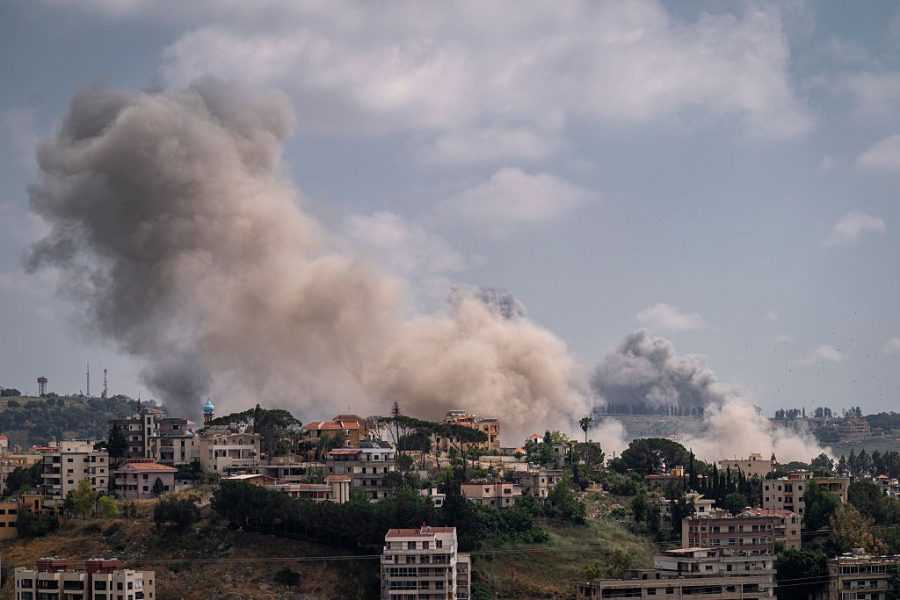
Exchanges of fire between Israeli forces and Hezbollah in southern Lebanon have continued this week, despite US-led efforts to broker a new ceasefire. In Israel, Prime Minister Benjamin Netanyahu faced criticism from both the opposition and elements within his own government after he apparently called off attacks on Hezbollah’s Dahiyeh stronghold in south Beirut. This followed a request from President Donald Trump. Israeli forces are continuing their advance into southern Lebanon.
In a move celebrated by government supporters but with ominous memories for many Israelis, the IDF’s 36th Division took the Beaufort Castle, built by the crusaders, earlier this week. The Golani Infantry Brigade raised its banner over the fort. Defence Minister Yisrael Katz said at a ceremony that ‘26 years after the withdrawal, our heroic soldiers have captured Beaufort once again, and will remain there as part of the security zone in Lebanon’. The Beaufort was first captured by the Golani Brigade in 1982.
The Beirut government isn’t strong enough to stop Hezbollah, still less to disarm it
Israel’s retaking of this strategic location represents the deepest continuous advance by the IDF into Lebanon since the unilateral withdrawal from the last ‘security zone’ in 2000. It also reflects the evident inability of Israel to develop a policy or strategy able to finally place relations with its smaller northern neighbour on a firm and stable footing.
It is possible, of course, to criticise Israel’s leaders for a lack of strategic vision. Certainly no one ever accused defence minister Israel Katz of an excess of imagination or creativity. Netanyahu’s pre-7 October career was also mainly characterised by a reluctance to effect major change. Still, the perennial re-appearance of Lebanon into Israeli considerations derives in the main not from Jerusalem’s failure to pursue this or that diplomatic or military path, but rather from the state of affairs within Lebanon itself, which provides no magic formulas and few attractive options.

Lebanese sovereignty is a fiction. The country is the site of the earliest and, until now, most successful effort by Iran and its Islamic Revolutionary Guards Corps to implant a system of their own in an Arabic-speaking country and to then grow that system’s power, both within and alongside the official state, until its strength eventually outstrips the capacities of the state itself. In Lebanon, this is a reality, no longer an ambition. For the sake of the historical record, it should be recalled that the collapse of Lebanese sovereignty occurred prior to the emergence of Hezbollah as a result of Muslim versus Christian civil war.
Hezbollah, as established by the Islamic republic of Iran in the early 1980s, today fields an armed force more powerful than the one available to the official government in Beirut. On two occasions over the last three years of the Middle East war, Tehran has chosen to activate this force against Israel from Lebanese soil, without even a cursory glance towards the desires of the non-Shia Lebanese population and their government. These occasions were 8 October 2023, when Hezbollah launched shells and missiles in support of the Hamas rampage from Gaza, and 2 March this year, when the organisation resumed fire in support of its patrons after the US and Israel recommenced hostilities with Iran on 28 February.
This unfortunate fact is denied or obscured by western governments, including that of the US. The western approach appears to be to treat the Lebanese government of Prime Minister Nawaf Salam and President Joseph Aoun as sovereign in the hope that this will, in some unclear way, eventually cause it to be so.
This is unlikely to work. The direct talks between Israel and the Lebanese government at ambassador level are there to placate this sensibility, but have little other function. The Beirut government isn’t strong enough to stop Hezbollah, still less to disarm it. From the Israeli point of view, since Hezbollah and its patrons decide on a regular basis to attack Israel, this leaves military force as pretty much the only option.
The exercise of this option has currently collided with the desire of the US administration to exit the war with Iran as quickly as possible, so as to open up the Strait of Hormuz and get gas prices down. This explains the reported shouting match between Netanyahu and Trump earlier this week. Iran is clearly aware of the gap between the Israeli and US positions and is doing everything it can to widen it. Tehran is insisting that any ceasefire includes Lebanon, seeking to drive a wedge between the US and Israel.
But for Israel the option of military force in Lebanon is problematic for deeper reasons than the immediate needs and preferences of powerful allies. This explains the public disquiet that accompanied the defence minister’s excitement at the return of Golani to the Beaufort.
There is no political or diplomatic solution to the problem of Hezbollah in Lebanon, at least without a major change in the political and military balance within the country. The problem is that for Israel, it’s also difficult to see what a comprehensive military solution would look like.
For as long as the Iranian regime exists, Hezbollah will have a patron ready and willing to arm and finance it. Hezbollah is also deeply rooted in the Lebanese Shia population. Israel is obviously not going to try and conquer the entirety of Lebanon. This means that the present policy, the rhetoric of the politicians notwithstanding, is designed not to comprehensively defeat Hezbollah. Rather, it is intended to create a buffer zone between the organisation and Israel’s northern communities while establishing deterrence against the organisation by hitting it hard.
The problem comes when the temptation to probe further serves to entangle the armed forces in a renewed major ground commitment on Lebanese soil, which then starts inevitably to lead to attrition. As of now, Israel has clearly not managed to find a solution to Hezbollah’s use of first person view drones. The result is that its forces in Lebanon are currently subject to daily attacks using these weapons, even as they take areas further from the border. A buffer zone extensive enough to shield the civilian population of the north, without giving Hezbollah and Iran a focus (and extensive targets) for a new insurgency is the problematic but only achievable goal. It is a difficult balance to maintain.





Comments