
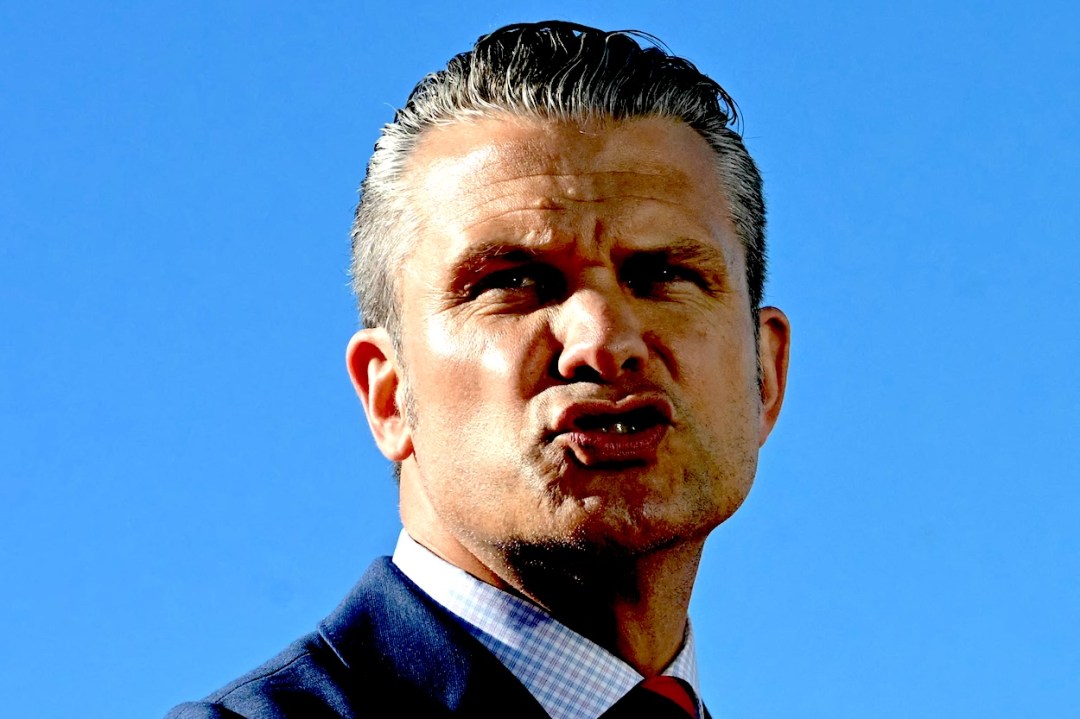
Livestreaming the execution of mass murderer Nidal Malik Hasan is a moral outrage but no one can explain quite why. Hasan’s crime was heinous. The US Army psychiatrist opened fire on unarmed soldiers at a medical unit in Fort Hood, Texas in 2009, killing 13 including a pregnant woman and injuring 32 others. As he gunned them down, the Palestinian-American major shouted ‘Allahu akbar’. It was later revealed that Hasan had been in correspondence with radical imam and al-Qaeda operative Anwar al-Awlaki. He was court-martialled and sentenced to death in 2013.
The US Army intends to carry out that sentence at Fort Hood on 3 December, via firing squad, and Secretary of War Pete Hegseth says: ‘We’ll make sure that people are able to watch it, that it’s public, because people need to understand there’s serious consequences for these types of things.’ This has occasioned a rhetorical oneupmanship among the foes of Donald Trump’s administration. The United Nations declaimed the announcement as ‘abhorrent’. Amnesty International called the plans ‘barbaric and deeply shocking’. Senator Jack Reed (D-RI) decried ‘a barbaric spectacle’ while Senator Mark Kelly (D-AZ) called it ‘the kind of thing Iran and the Taliban do’.
There are those of us who oppose the death penalty on principle, for whom there can be no justification either for shooting Hasan or for turning the event into a macabre spectacle. However, the death sentence is a permitted penalty in the Uniform Code of Military Justice, was recommended by a unanimous jury after a trial, and the condemned has exhausted his appeals. Nor can the method be said to superadd to the pain or emotional anguish of being killed: as Supreme Court justice Sonia Sotomayor argues, shooting delivers ‘near instant’ death, may be ‘comparatively painless’, historically ‘has yielded significantly fewer botched executions’, and might afford the condemned ‘more dignity’.
Any such dignity would surely be stripped away by broadcasting the proceedings for the entertainment of a morbid audience. Here is where we encounter difficulties. Who cares whether a mass murdering jihadist feels a sense of dignity in the final moments of his miserable existence? Indeed, much of the opposition to livestreaming Hasan’s death draws on normative precepts that no longer pertain. The Victorians did away with public hangings in part because of the spectacle involved – great crowds would gather as though at a circus – and the moral harm done to the spectator by witnessing death amid a carnival atmosphere. The reforming moralists of the mid-19th century believed the experience coarsened the characters of those who watched. The condemned was merely killed; the spectators were brutalised.
Two centuries on, the notion that seeing a criminal draw his final breaths would be uniquely distressing seems almost quaint. Users of sites such as LiveLeak and Facebook Live were able to watch the hanging of Saddam Hussein, the Islamic State beheading of James Foley, the Christchurch mosque shootings, and the 2017 racially-motivated torture of an intellectually disabled white teenager. Even today on YouTube and X there are channels and accounts dedicated to compiling dashcam, CCTV and other footage of catastrophic car wrecks, shoot-outs, stunts gone wrong and fatal misadventures. Observing the bloody demise of strangers has become, for certain demographics of internet users, nothing more than a dark form of entertainment, no longer shocking or disturbing. The desensitisation to violence that opponents of livestreaming Hasan’s execution fear already happened some time ago.
That process of spiritual numbing came about as a result of the very legal and normative changes championed by liberalism. Those currently preaching dignity and public decency are appealing to a Christian morality which their philosophical forebears ran out of town, and which they continue to resent and resist. The concepts at play here – the inviolable dignity of the individual, the suppression of public vice, the enforcement of moral standards – all stem from Christian doctrine, and often specifically Catholic social teaching. The Christian case against livestreamed executions is the easiest to make because it is grounded in centuries of truth as discerned by scriptural interpretation, moral philosophy and pastoral observation. Secular progressives struggle, however, because they have so successfully amputated the culture from the ethical framework of its Christian heritage that they sound like arsonists urging us to fireproof the house they’ve just set ablaze.
One need not be a seasoned politico to see what is going on here. With gas prices still high and the Iran War unresolved, Republicans face a reckoning in the 3 November midterm elections, but if Donald Trump is adept at anything it is baiting his emotionally incontinent opponents into putting themselves on the wrong side of public opinion. His opponents have yet again obliged and, having rounded up enough quotes for a 30-second weak-on-terrorism attack ad, Trump appears to be walking back talk of the livestream plans. The president tells reporters the army is still ‘making a determination’. For Trump’s critics, the mere floating of a public execution only confirms the moral turpitude of this administration. But isn’t virtue subjective? Shouldn’t it be kept out of government? And why should we all labour under these outdated religious notions? Progressives are learning the hard way that a morally neutral public square isn’t all it’s cracked up to be.




Comments