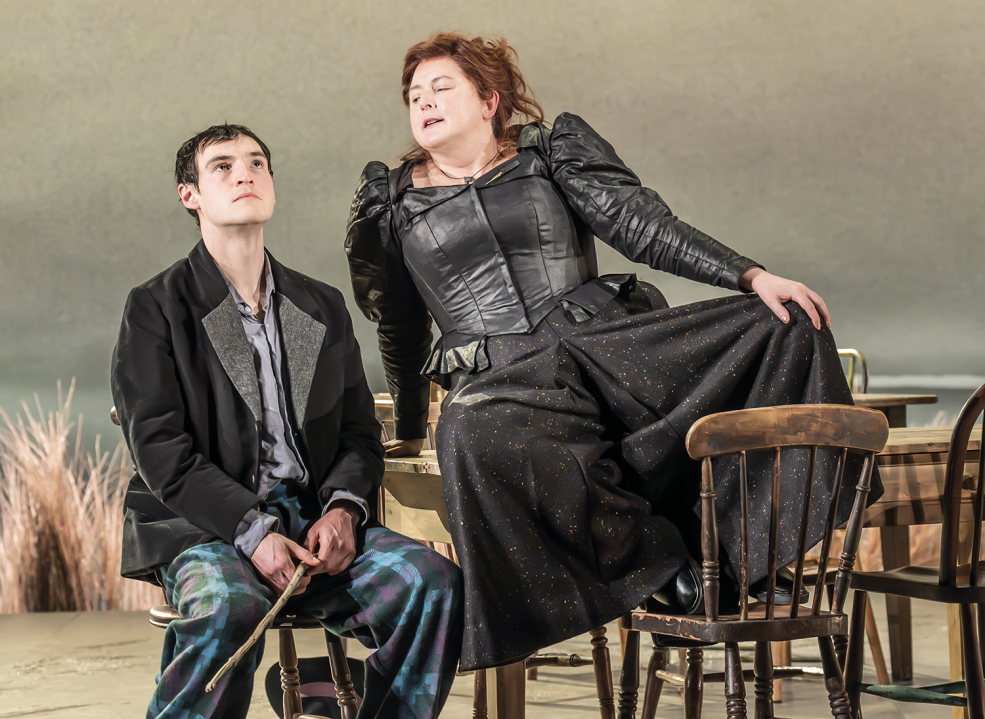


The Playboy of the Western World is like the state opening of parliament. Worth seeing once. Director Caitriona McLaughlin delivers a faithful production of John Millington Synge’s grand satire about dim-witted Oirish peasants and, perhaps unwisely, she spreads the show across the entire length of the vast Lyttelton stage. It looks as if it’s being performed on a railway platform.
The drama consists of several broad, daring and improbable steps. A handsome farmer’s boy, Christy, rolls up in a sleepy village in Co. Mayo and claims to have murdered his father. The lustful local girls treat him as a hero rather than an outlaw and compete for his hand in marriage. When Christy wins a prestigious donkey race he sets the seal on his pluck and manliness.

Then, disaster. His father arrives and accuses Christy of trying and failing to kill him with a shovel. Christy’s exposure as a liar is the moral crux of the piece. The villagers round on him even though his offence is revealed to be the lesser crime of assault rather than murder. And the self-righteous mob turns into a freakish and irrational force of nature and not an instrument of truth or justice.
The story lumbers on from here and delivers a few amusing surprises towards the end but it feels like hard work. The language is so rich and ornamental that you’ll miss the nuances unless you pore over the text in advance. Here’s the barmaid, Pegeen, describing a solitary night in a farmhouse: ‘It’s a queer father’d be leaving me lonesome these 12 hours of dark, and I piling the turf with the dogs barking and the cows mooing and my own teeth rattling with the fear.’ When Christy makes his confession, she doesn’t believe him. ‘A soft lad the like of you wouldn’t slit the windpipe of a screeching sow.’ Synge maintains this level of exquisite verbosity throughout even though the characters seem crude, boorish and unlettered.
You may be glad you went but you’ll certainly be glad to get out
At one point, they tether Christy to a rope and try to hang him. And there’s no range or psychological subtlety. The stage is filled with identikit characters, rowdy drunken males sparring with vain, preening, superficial females. When it premièred in 1907, the play was attacked for encouraging genteel Dubliners to mock the bumptious oafs living out in the sticks. Well, that’s hardly a criticism. It’s the whole point. The script has the same format as a reality TV show. It assembles a gang of garrulous and impulsive dimwits and forces them to cope with a set of challenges contrived by some unseen authority. It’s The Apprentice in frocks and waistcoats. And it coarsens the spirits by dragging the viewer into the mire along with the brutish, aggressive, self-indulgent and incurious bumpkins it mocks. You may be glad you went but you’ll certainly be glad to get out.
Zany spoofs of classic novels are everywhere these days, and the latest effort takes an amusing pop at Bram Stoker’s Dracula. The title, Dracapella, refers to the hit melodies sung by the performers without musical accompaniment. The show sticks closely to Stoker’s hoary old yarn about a Balkan count with a thirst for female blood and it adds a layer of modern sketch-show silliness and an endless parade of one-liners. ‘It was pancake day but no one gave a toss,’ says the narrator. A character searches for a looking glass in his accommodation. ‘I can’t see myself living in a place with no mirrors.’ If you love gags you won’t be disappointed.
The script lampoons the sexist culture of Victorian novels where strapping, confident chaps behave like superheroes while ditzy females swoon to the floor and ask helpful questions like ‘what’s going on?’ to clarify the plot.
At the curtain call the entire crowd leapt to its feet and cheered. Pure escapism. Pure joy
The show is co-written by Dan Patterson (who invented Mock the Week) and the director Jez Bond, and they’ve come up with a brilliant new way to deliver sound effects. A champion beatboxer, Alex Hackett, also known as ABH, stands on stage and reproduces the noises of creaking doors, horse-drawn carriages, elevator motors, chainsaws, machine guns and so on. Hackett’s virtuosity is a marvel in its own right. At first you aren’t sure where the sounds are coming from and then you spot an unobtrusive actor with a hand-held mike and nothing else. Hackett’s amazing talent lifts the show beyond its comic roots and turns it into a bravura display of acoustic magicianship. Other producers are bound to steal this inspirational idea.
The actors seem to be having a great time on stage and they improvise around the edges when they invite an audience member to join the show by dying a horrible gory death. There’s an unusual energy and freedom about this production. At the curtain call the entire crowd leapt to its feet and cheered. Pure escapism. Pure joy. Could this be the next Operation Mincemeat? No reason why not.






Comments