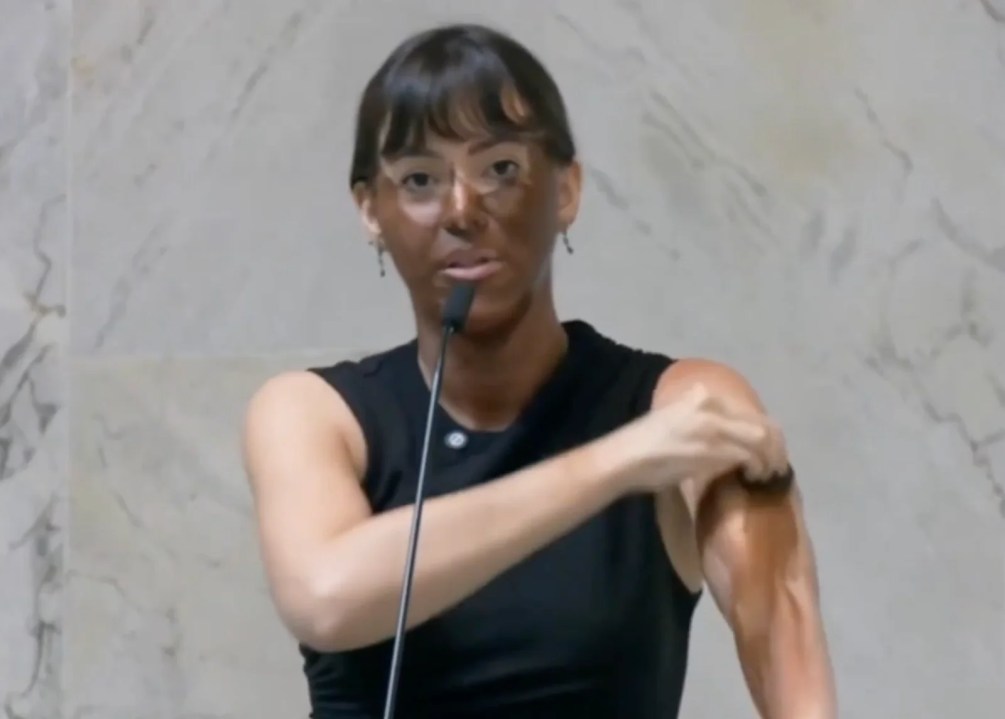
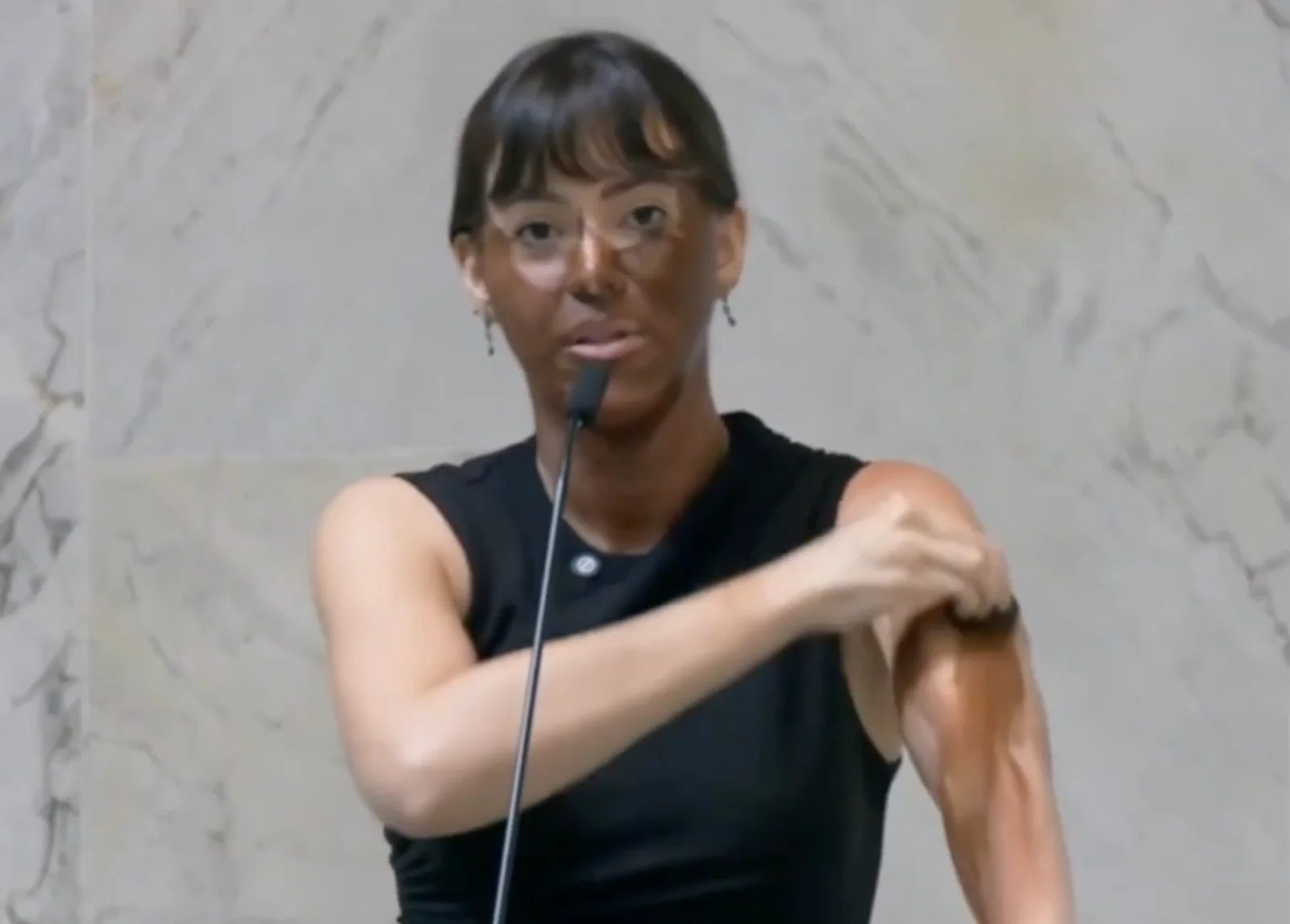
Fabiana Bolsonaro, a member of Brazil’s São Paulo state assembly, last week used makeup to darken her face and arms in what can only be described as a crude attempt at blackface in the middle of a parliamentary session. Her performance appeared to be a doubling down, in distinctly embarrassing fashion, on her earlier insistence that she is of mixed race – parda, in Brazilian-Portuguese.
Fabiana’s birth surname is Barroso. She is a white woman, the daughter of the politician Adilson Barroso. Like her father, she belongs to the Liberal party of former President Jair Bolsonaro, whose name she adopted in 2022.
Her blackface performance was reportedly intended as a protest – not only against what she perceives as preferential policies for people of colour, but also against the progressive transgender agenda associated with Erika Hilton, a fellow São Paulo politician. Hilton (not her original name – which is reportedly Felipe Santos Silva) is parda and a transgender woman.
Race remains a delicate subject in South America’s largest country. Brazil’s history of casual and overt racial discrimination is beyond dispute, though matters have improved somewhat in recent years. At the same time, Brazilians have long had a certain informality – even bluntness – in assigning nicknames based on physical traits. A blue-eyed or fair hared individual might be dubbed alemão (German), while a large black man will more often than not be called negão. Nor is it unusual for politicians to take on the surname of a political idol – particularly among Bolsonaro’s supporters. One of Fabiana’s colleagues in Rio de Janeiro state’s assembly, a retired army officer named Hélio Barbosa Lopes, combines it all: he is known as Hélio Bolsonaro and as Hélio Negão.
There is, of course, a distinction to be made between resisting woke politics and other excesses of progressive orthodoxy in Europe or in the United States, and engaging in blackface in a country where a majority of the population identifies as black or pardo. The latter is not merely unforgivable; it is electorally reckless for the political right.
Brazil is set for a general election in October 2026. Voters will choose a president, vice-president, members of congress and state governors. Of these, it is the presidential contest that commands the greatest attention.
At present, just two principal candidates have emerged: the incumbent, Luiz Inácio da Silva (better known as Lula), representing the left-wing Workers’ party, and Flávio Bolsonaro of the right-wing Liberal party and son of the former president. Jair Bolsonaro himself is barred from standing, having been sentenced to more than 27 years for his role in a failed coup attempt following his 2022 electoral defeat. Even so, he remains the pre-eminent figure on the Brazilian right.
Brazil may well tire of an ageing and increasingly unconvincing Lula, who is – in his words – only running for a fourth term in order to prevent the Bolsonaros from returning to power. More moderate, centre-right or centre-left figures have so far hesitated to enter the fray, perhaps waiting for a more opportune moment.
After its leader was convicted late last year, the veteran political analyst Bolívar Lamounier predicted that the Bolsonaro movement would swiftly lose relevance. That prediction, for now, appears premature. Though Flávio Bolsonaro has trailed Lula in the polls, the gap has narrowed a bit in recent months.
Tarcísio de Freitas, the technocratic and widely respected governor of São Paulo, a member of Brazil’s Republican party, is frequently cited as a figure capable of uniting a fractured right. Some polls suggest he may be better placed than Flávio Bolsonaro to defeat Lula in a second round. Less ideological and more managerial in temperament, Tarcísio draws support from urban and middle-class voters, as well as backing from Brazil’s influential business and political elites. The Bolsonaros, by contrast, retain a strong following in rural areas and among Brazil’s expanding evangelical electorate.
While Jair Bolsonaro has endorsed his son, the final line-up of the race remains uncertain. Tarcísio may yet strike an accommodation with smaller right-wing parties – or even with the Bolsonaro camp itself. Much will depend on controversies such as Fabiana Bolsonaro’s blacking up, if they are seen as symptoms of the Bolsonaro movement being unfit for stable government. That perception could persuade Brazil’s political dealmakers on the right to reorganise the playing field, pave the way for Tarcísio’s candidacy and throw the country’s presidential race wide open again.

Comments