Kemi Badenoch, I can feel your pain. Nope, not the feeling of being knifed by a former colleague –but having your name mangled beyond recognition.
The Tory leader has pointed out, with admirable restraint, that ‘there’s no ‘bad’ in my name’
There is a particular kind of silence that arrives just before someone mispronounces your name – the flicker of hesitation, the calculation, the internal conflict over the decision to even attempt it. My name is Iram. It means garden in paradise (I know, right?), yet it’s hellish for some people to pronounce. It is short, phonetic, yet routinely transformed into Imran, Eye-ram, or some other curious innovation. In emails, I’m frequently misgendered altogether. ‘Dear Mr Ramzan,’ some correspondents have written. I once had an editor who insisted on calling me ‘i-raaam’, drawing the syllables out with exaggerated care.
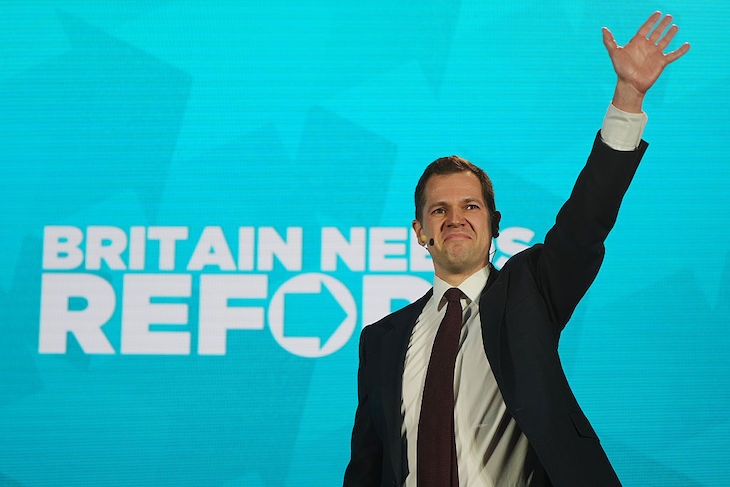
That’s why recently, watching Robert Jenrick repeatedly mispronounce Kemi Badenoch’s surname at a Reform party press conference felt instantly familiar. It’s pronounced Bay-danoch. The Tory leader has previously pointed out, with admirable restraint, that ‘there’s no “bad” in my name’. It seems that Jenrick wasn’t listening. Asked in a Times Radio interview why he mispronounced Badenoch’s name, and if it was deliberate, Jenrick appeared untroubled and insisted there were more pressing concerns to discuss. ‘If you think that this is important, then you need your head checking,’ he told his interviewer.
“If you, Kate, think that this is important, then you need your head checking.”
— Times Radio (@TimesRadio) January 19, 2026
Robert Jenrick says he finds suggestions he's dismissive of female journalists and politicians "offensive".@RobertJenrick | @KateEMcCann pic.twitter.com/YLyKTMMwru
The issue, of course, was never the initial slip – that happens to everyone – but the persistence. It’s hard not to conclude that Jenrick knew what he was doing.
For years, I’ve had to correct people. In retrospect, this was an extraordinary waste of time. It made no lasting difference. People still get it wrong.
Sometimes I wish I had legally changed my name at 18, swapped it for something softer, more obviously feminine. Layla for example, or Sara. Something that did not require explanation or rehearsal. I don’t even have a middle name that I can use instead.
It could be worse, I tell myself. Tech billionaire Elon Musk and his girlfriend Grimes named their newborn baby boy X Æ A-12. Good luck pronouncing that.
William Shakespeare, of course, would tell me that none of this matters. ‘What’s in a name?’ Juliet famously asks. ‘That which we call a rose by any other name would smell as sweet.’ Most of us will remember this line from having it relentlessly drummed into us in GCSE English. Juliet may have a point. Do we hear a name and immediately assume something about the person attached to it? Do names shape us, or merely describe us?
My name doesn’t appear on keychains or novelty mugs in gift shops, but I did once (to my joy) find an Iram keyring at a gift stall in the Pakistani hill station of Murree.
In my case, there’s at least one impressive literary association. My name appears in Omar Khayyam’s Rubaiyat:
‘Iram indeed is gone with all its Rose,
And Jamshyd’s Sev’n-ring’d Cup where no one Knows;
But still the Vine her ancient ruby yields,
And still a Garden by the Water blows.‘
It’s flattering. And if one must have a name people struggle to pronounce, it helps if it has enjoyed a moment of poetic immortality.
That sense of grandeur was swiftly punctured by an Arabic tutor I once had, who immediately recognised my name from the Qur’an: Iram dhat al-ʿimad, the city of lofty pillars. ‘But you know it was a cursed city, so why did your parents call you that?’ He frowned. I briefly wondered whether my fate had been sealed before I could even walk.
I asked my mother. It turned out the name had been suggested by someone who lived on the same street as my family in Bradford, where I was born. Clearly not a great deal of thought had gone into it.
What makes all this more puzzling is how selective our tolerance for ‘difficult’ names can be. We manage Tchaikovsky and Dostoevsky without complaint. We rehearse Saoirse Ronan, usually after hearing the actress correct people with weary good humour.
Even presidents aren’t above such mistakes. Speaking at a Diwali event in Washington a few years ago, Joe Biden announced that ‘Rashi Sanook’ was now prime minister. The first British prime minister of Indian descent was a ‘groundbreaking milestone,’ said bumbling Biden. So ‘groundbreaking’ he couldn’t even get Rishi Sunak’s name right.
There are, however, notable exceptions. While working at my local paper in Oldham a decade ago, I interviewed Sir Ranulph Fiennes. When I introduced myself, the intrepid explorer said he was delighted to meet an Iram. He explained, with genuine enthusiasm, how he had once searched for the lost city of my namesake in Arabia.
Here was a man who had crossed deserts, lost fingers to frostbite, and dragged himself to both Poles. Yet somehow he still found the energy to get a four-letter name right. Jenrick could learn a thing or two from him.






Comments