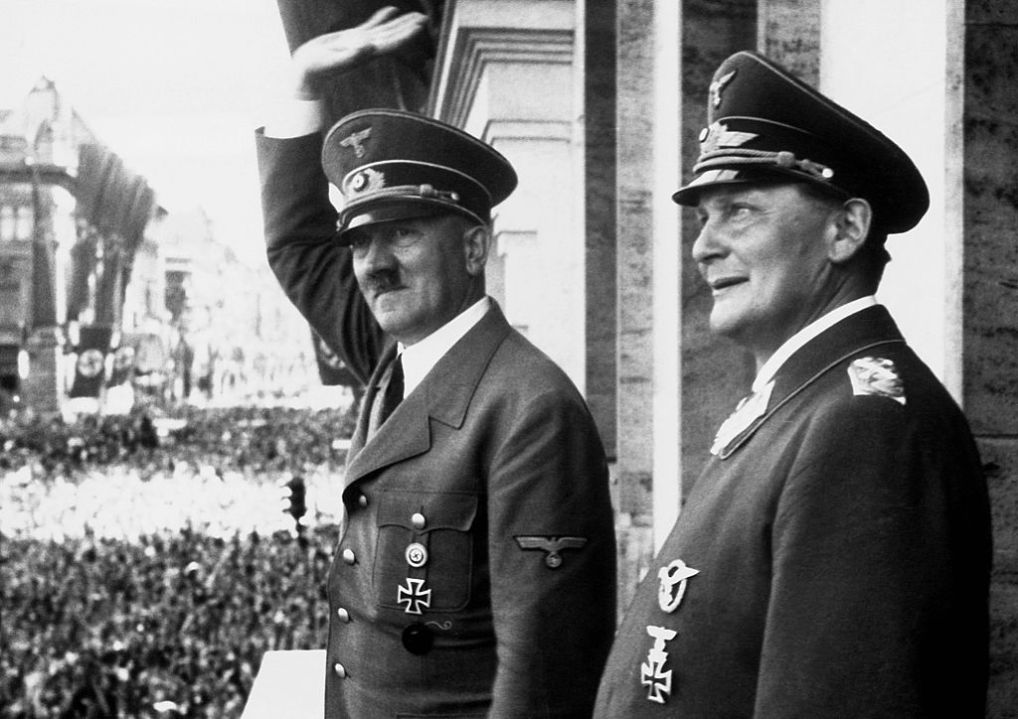
Eighty-five years ago today, one of the most important directives in world history was issued. On 31 July 1941, Hermann Göring – a powerful senior member of the Nazi regime – wrote a letter to SS Gruppenführer Reinhard Heydrich, the chief of the security police and security service. In it, Göring directed Heydrich with ‘making all necessary preparations’ and ‘promptly’ submitting a plan ‘for the execution of the intended final solution of the Jewish question.’
We found a third of students still believe Hitler was solely responsible for the Holocaust – while 39.9 per cent of pupils believed mass killings began with Hitler coming to power.
Today, these words have a distinctly obsidian complexion. For those familiar with the term, ‘final solution’ is understood as the bureaucratic shorthand for the annihilation of Jewish men, women and children across occupied Europe. But Göring’s directive was not the first time that the term had been used within the Nazi regime. Nor did it mark the beginning of mass murder.
Since 1939 Heydrich had held the brief of solving the so-called ‘Jewish question’ through ‘emigration or evacuation’. Robert Gerwarth has shown that as far back as November or December of 1940 Heydrich had been instructed to prepare a draft for a ‘final solution project’ to be enacted once the war was won. And we also know Heydrich discussed his ideas for this with Göring in January and March 1941.
Göring’s letter 85 years ago did not come out of the blue. It had been drafted by Heydrich with the support of his assistant, Adolf Eichmann. And it had evolved over a period of months, during which the Nazis had planned for and then carried out the invasion of the Soviet Union; an action which duly led to killing squads moving into villages, towns and cities to execute Jewish individuals and communities.
None of which is to diminish the significance of the letter. But its importance lies not just in what it affected, but also in what it tells us about the development of Nazi policy towards the Jews of Europe across 1941. It reveals a great deal about the structures of power in Nazi Germany; about who had agency; and about how the intent of influential figures was shifting and changing.
Christopher Browning reminds us it would be wrong to assume that in the weeks and months which followed, continental genocide immediately took place. If that ambition was now emerging from the Nazi regime, its enactment was far from settled, its implementation had not been planned out, and contingency could not be catered for. Twists and turns would be made. Disagreements over ‘the how’ would continue – even as late as January 1942 at the now infamous Wannsee Conference.
Such are the complications and complexities of the historical record. Yet these facts matter not simply to satisfy historians. They are important on account of what they tell us about how genocide happens. With Göring’s letter we can see that it was not Hitler alone who was responsible for the Holocaust; we can appreciate how policy and intent evolved and developed; and we can better understand how the annihilation of Europe’s Jews is deeply entwined with the course of the second world war.
It seems reasonable to expect that someone who knows about the Holocaust would be familiar with these realities. If they are not, then it is questionable whether what they possess is historical knowledge or something else entirely. And yet research by the UCL Centre for Holocaust Education continually illustrates that worrying misconceptions persist around the Final Solution, the role of Adolf Hitler, and how genocide unfolded. Most recently we found a third of students still believe Hitler was solely responsible for the Holocaust – while 39.9 per cent of pupils believed mass killings began with Hitler coming to power.
The endurance of these and other misconceptions should focus the minds of everyone who is interested in teaching and learning about the Holocaust. Why do they persist? What is sustaining them? How can we hope to address these issues by simply doing more of the same?
In some sense, there should be no surprise that such misconceptions still exist. Given the plethora of misinformation and disinformation that students now face, and the way the Holocaust continues to be represented in wider culture, it becomes harder for educators to counter these narratives.
This should give the whole country pause. The Holocaust has been a mandatory part of the National Curriculum for a generation, and the government has rightly reaffirmed that this will continue in the Curriculum and Assessment Review. But such measures can only do so much.
Teaching and learning about the Holocaust is now taking place at a time when the education system is facing acute pressures and demands. It is occurring at a moment of enormous societal change and political turmoil. With mis- and disinformation about the Holocaust swirling at an unprecedented pace thanks to the untrammelled excesses of social media, we are confronted with new issues that old ways of ‘doing’ Holocaust education cannot solve.
Eighty-five years on from Göring’s letter, more of our teachers need evidence-based training. More of our schools require access to sustained, immersive and research-informed support. It is only through these ways that more of our students will be helped to develop robust knowledge from which to debunk the myths and misconceptions that threaten this history.



Comments