
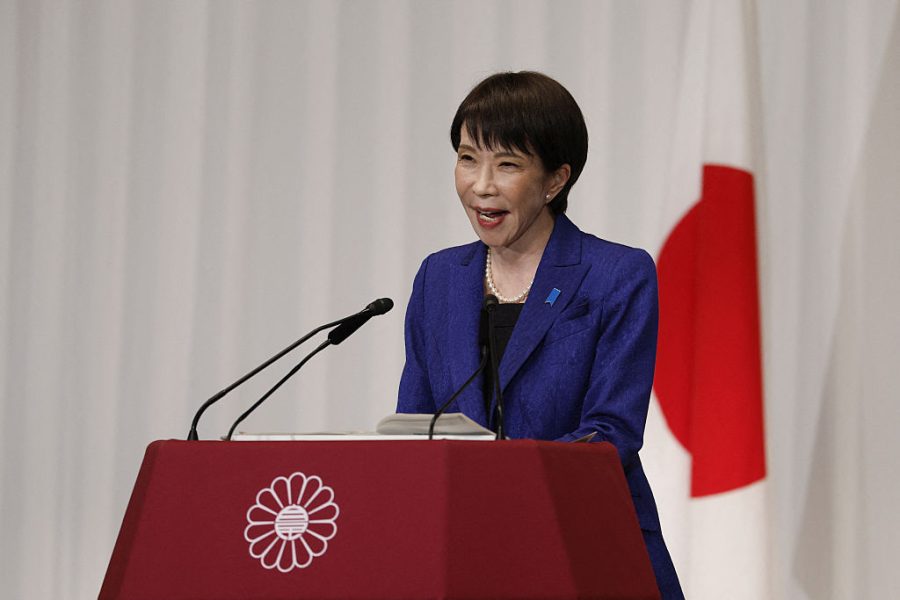
Well, she pulled it off. Japan’s prime minister Sanae Takaichi took the bold gamble of calling a general election after just two months in office but has been rewarded with a landslide victory. Over the weekend, her Liberal Democratic party’s coalition with the JIP (Japan Innovation party) easily secured two-thirds of the 465 seats in the lower house needed to push through most bills even if the upper chamber, where Takaichi does not have a majority, tries to stop her. The contrast between her position and that of the beleaguered Sir Keir Starmer, whom she met just over a week ago in Tokyo, could hardly be starker. One is enjoying the time of her political life, the other is fighting for his.
Political analysts may study Takaichi’s snap election strategy in the hope of emulating it. She got a number of things spot on. She put herself, rather than her tired and scandal-wracked party, front and centre, always presenting a positive image, talking the country up and stressing how bright the future could be if we all just believe – in her. She has a reasonably impressive backstory but mainly let others outline it, not overdoing things in ‘son of a toolmaker’ style. She refreshingly avoided identity politics, never boring on about being a woman in a man’s world, having to work twice as hard to get half as far, etc., etc.
Takaichi is an energy realist and is about as far from woke as you can get
Takaichi played to her strengths and steered clear of one-on-one debates, swerving Japan’s main political programmes. She also kept criticism of her opponents to a minimum to the extent that they faded into the background. And she appealed to the young, not by promising the earth, but by appearing youthful herself (she’s 64), playing drums with the South Korean president Lee Jae-myung and serenading Italian president Giorgia Meloni on her birthday visit to Tokyo. In general, she appeared to enjoy herself.

Now comes the hard part, though: she has to deliver. A cross-party committee will be convened to consider the vexed question of the consumption tax that dominated the campaign. Suspending the 8 per cent levy on food would be immediately popular but might come with a heavy price tag for the government in terms of lost revenue. To do something deeply unfashionable and quote Liz Truss, ‘unfunded tax cuts are a left-wing idea’ – so simply to assume it would lead to disaster is perhaps unfair. But the jittery bond markets, which lurched recently at the mere thought of her plans becoming reality, could be severely stress-tested by what people are already calling ‘Sanaenomics’.
On the international front, much attention will be paid to Takaichi’s relationship with China. Her comments in November, where she implied that Japan would have to act if Taiwan were invaded, caused one of the biggest clashes in the Sino-Japanese relationship in decades. Even President Trump advised her to walk it back. There was no hint of a mellowing in the prime minister’s stance in her post-victory comments, though. She said only that ‘Japan will respond appropriately and calmly from the standpoint of Japan’s interest’, suggesting Beijing will have to make the first move.
Takaichi has the ambitious long-term goal of building Japan into a significant military power. She is accelerating increases in military spending and wants to revise the country’s pacifist constitution to allow for formal recognition of Japan’s self-defence force. She also wants to insert an emergency clause to allow for military action in exceptional circumstances. That exceptional measure would require a two-thirds majority in both houses, though, and Takaichi lacks the numbers in the upper house. Hence, perhaps, her immediate post-victory comment of her intention to work with all parties and be ‘flexible’.
Foreigners in Japan, like me, will be watching closely to see how serious she is about capping immigration and making it harder to get work visas or acquire property. This was one of the main themes of the election and one where Takaichi, with her reputation as a Japanese nationalist in the Maga mould, scored well. The crux of the issue – how Japan could cope without foreign workers – was, however, less discussed.
It’s a controversial topic. The foreign population in Japan is growing rapidly, but numbers compared to Europe are still low (3.2 per cent in Japan compared to over 16 per cent in the UK). Attempts to argue that foreigners commit more crimes than the Japanese, are buying up swathes of real estate or are taking all the jobs tend to flounder when confronted with statistical reality. But the Japanese might reasonably counter that now is the very time to get tough, before it is too late and Japan is presented with all the problems Europe faces.
These are significant challenges then, but if Takaichi can succeed – and success, given the decades-long stagnation in Japanese society, might only need to be modest – it could inspire nation-state conservatives around the world. As well as her bullish talk on immigration and Sino-scepticism, Takaichi is an energy realist (keen to get Japan’s nuclear programme fully up and running as soon as possible), and is about as far from woke as you can get. She is opposed to gay marriage and quotas for women (some even call her an anti-feminist).
If that sort of policy mix can be shown to be both electorally popular and effective in practice, it could put a second wind in ‘small c’ conservatives everywhere and serve as a sort of template. Nigel Farage and Kemi Badenoch might want to make her acquaintance.






Comments