
When Zia Yusuf first walked into the headquarters of Reform UK, he gestured at the empty room and asked: ‘Where’s the office?’ Ed Sumner, the party’s director of communications, replied: ‘This is it. It’s empty. This is the party.’ That was not even two years ago.
Since then, Nigel Farage and Yusuf have built a party from scratch and expect to be the biggest winners in the local elections on 7 May. With more than 270,000 members, their grassroots base is the largest in Britain, bigger than both Labour and the Tories. ‘I would argue no party has built political infrastructure and established itself more quickly in British history than Reform,’ Yusuf says.
This marriage of Farage’s campaigning ability with Yusuf’s professionalism and ‘Goldman Sachs approach’ (he founded a start-up and sold it for $300 million) led to Reform fielding a full slate of council candidates last May, the first time in a century that a third party has contested more seats than Labour and the Tories. Reform has led every national opinion poll for 12 months.
‘I think we will wake up on 8 May and realise that the Conservative party’s gone’
Yet over the past few months a slight dip in Reform’s polling numbers has raised questions about whether the party has peaked. The defection of several senior Tories has tempered its appearance as an insurgent force and many wonder if Farage can make Reform look like a government in waiting. But the party’s most senior figures argue that in the story of Reform’s rise lie the answers to how they can regain momentum, permanently shatter the political mould and replace the Tories as the party of the centre right.
Their goal is to repeat the magic of 1 May last year, when Reform gained more than 600 council seats and won the Runcorn and Helsby by-election in a previously rock-solid Labour seat. ‘We established ourselves properly as a political party that could actually fight campaigns on a broad level,’ says Farage now. ‘Big, big moment.’
Farage and Yusuf campaigned on the day in Runcorn, and came across a family who were out in their garden – father, wife, two sons, one arriving on a motorbike mid-conversation. They were on the fence about how to vote. Yusuf watched Farage ‘go into full campaign mode for about 20 minutes’. That evening, Labour were briefing that they had won. ‘I was told afterwards that betting markets were moving based on my facial expressions,’ Yusuf recalls. Reform won by six votes. ‘There’s every chance that conversation was decisive. I’ll take those memories with me to my grave. I felt like that was a moment of destiny.’
For others, the breakthrough came when the council results were announced. Farage and his closest aides, who had gone 36 delirious hours without sleep, were in the green room in Kent waiting. Sumner, sustained only by gin and tonic, glanced at his phone and declared: ‘We won Northamptonshire West!’ The council was far down the party’s list of targets. ‘We’d put no money into those seats,’ a party official says. ‘Suddenly we’d won both Northamptonshire councils. That was the moment I thought: this is magical.’
Can they recapture that lightning in a bottle? Over the next six weeks they will focus on three issues: crime, immigration and the cost of living. In a mega poll conducted by Reform last month, 72 per cent of Reform-curious voters said energy bills are the expense they’d most like politicians to address.
On Wednesday, Farage was in Essex, the only place where he is campaigning twice. He sees it as ground zero in the battle to destroy the Conservatives. ‘What do we have in Essex?’ he asks. ‘We have Priti Patel, we have the inappropriately named James Cleverly, we have Kemi Badenoch, we have rising star Alex Burg-hart, we have former cabinet minister John Whittingdale and former ERG [European Research Group] chair Mark Francois.’ His message to Essex voters is blunt: ‘These people let you down like a cheap pair of braces – which the old East Enders will get because the old dockers used to wear braces.’
Many of Farage’s old City contacts are from round these parts. ‘They were all from southern Essex, all the traders and dealers. I’ve got loads of old colleagues coming to a big curry afterwards.’
Farage has little time for claims of a Badenoch revival. When Lord Ashcroft wrote a piece on the ‘Kemi comeback’ in the Mail on Sunday recently, Farage texted him: ‘What the fuck are you talking about?’ He says: ‘The Tories have had a good run for 200 years. I think we wake up on 8 May and realise that the Conservative party’s gone, that the “Kemi bounce” was nothing more than a Westminster myth and that the Tories have been obliterated in Norfolk, Suffolk, Essex. The only real opposition to socialism, leftism, Islamism is Reform. And if that moment comes, there’ll be a large chunk of Conservative voters that will switch.’
This has been the plan from the beginning. Between Farage’s appearance on I’m a Celebrity, which introduced him to a new generation of social-media-savvy young voters, and his decision to stand for parliament in 2024, he talked to his longtime pollster Chris Bruni-Lowe. Farage wanted to gauge whether the political environment was conducive to a comeback.
Bruni-Lowe, a shrewd message man who is in demand from right-of-centre parties for election campaigns around the world, devised the ‘Blue Ocean strategy’, based on an early Noughties business book. The pollster told him: ‘You can’t fish in waters that are over-fished. Everything you and the party do has to be entirely unique – the events, the language, the press conferences, everything.’
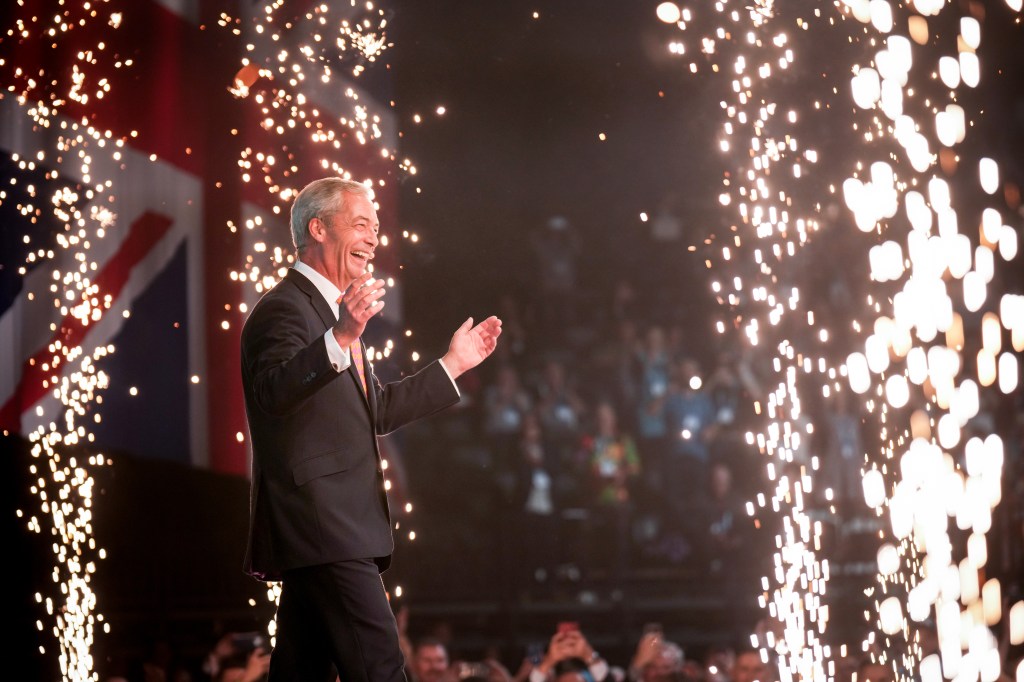
From this came Reform’s focus on immigration and the unique ‘vibes’ of a party which favours Trump-style rallies and high-camp visuals. At last year’s party conference, Farage came on stage to fireworks and clouds of dry ice.
Central to this image-making has been Aaron Lobo, recruited from GB News, who once recreated an entire airline departure lounge in just two days to dramatise an announcement on deportation policy. Lobo’s most recent PR win came when Farage launched a fuel prices campaign at a petrol station decked in Reform colours. The Conservatives responded with a fake estate agency and pledging a stamp duty cut. ‘They had a PVC banner all creased up with a bit of A4 paper in the window,’ a Reform staffer says. ‘It looked cheap and low-grade. They are a party on dial-up internet and we’re Starlink.’
The first breakthrough came in December 2024, when aides realised that their membership numbers were going to overtake the Tories’ on Boxing Day. Lobo and Dan Jukes, Farage’s closest aide, spent Christmas Day filming as they projected the numbers onto the side of Conservative campaign headquarters. A clever stunt became a huge moment in a dead news cycle when Badenoch claimed Reform had fabricated the figures. Farage’s team brought in journalists from Reform-sceptical media outlets such as the FT and Sky News and proved they were telling the truth. ‘We got another 70,000 members that week,’ an official recalls. ‘That was when the dam broke. Thank you, Kemi. Awesome week.’
Farage is often criticised for refusing to let others step out from his shadow. ‘I would fully accept that I’m a slightly dominant entrepreneur who comes into the room and smashes all the crockery, but gets stuff done,’ he admits. ‘And that’s what we needed in the first 18 months.’ But when Yusuf – exhausted by months of working flat-out for no pay and triggered by a party row about banning the burka – resigned as chairman in June last year, Farage had to persuade him to come back. Farage was ‘blindsided and upset’ by the resignation, a close ally recalls. By six the following morning, Sumner had put the two together on a conference call and by 11 a.m. Yusuf was back in the fold. ‘I can completely get disagreement, dissent,’ Farage insists. ‘What I don’t deal with is disloyalty. That’s me all over.’
‘The Hampshire Tory ladies won’t see Nigel as their person. Jenrick gives them a gateway drug into Reform’
Yusuf remains a Marmite figure. One Reform football fan compares him to Chelsea’s former talented hatchet man Diego Costa: ‘If he was against you, you hated him because he’d stamp on your players. But if you’re a Chelsea fan, he was your favourite player. He’d rile people up, shove them, kick them. He’d be the nastiest man to play on the pitch and he’d also score a few goals. That’s Zia for me.’
Yet by the spring of 2025 it was clear that Reform needed to be more than Farage, Yusuf and deputy leader Richard Tice. Farage is committed to the view that if he wins power, the top jobs should go to non-politicians with expertise. ‘People respect someone who has done something in the real world,’ an aide says.
Critics question why the team of successful businessmen, NHS officials and retired generals whom Farage has promised will form half of his cabinet have yet to appear. Internally, the expectation is that they are busy and important people who will only publicly signal their willingness to serve a few months before the election.
But the truth is that questions about Reform’s readiness for government caused Farage to pivot away from the blue ocean strategy and accept the defection of senior Tories with government experience. Farage was no longer just wooing the pro-Brexit working-class voters who loved his anti-establishment insurgency – he had to find ways of impressing middle-class voters who were sick of state failure.
‘The party went from insurgent start-up to being judged as if there were three months to a general election,’ says one aide. Another adds: ‘You could no longer have just the butcher, the baker, the candlestick maker. The lobby would say: “Hang on, who’s going to be foreign secretary?”’
Farage drew early inspiration from Italy’s populist Five Star Movement. But allies who spoke to senior figures in that movement reported back to Farage: ‘When they got there [into government], they realised they had no idea how this works. Their non-politician MPs were captured by lobbyists. They said, you need a mix of both outsiders and insiders.’
That insight persuaded Farage to admit the former Tory cabinet members Nadine Dorries, Jake Berry, Suella Braverman and Nadhim Zahawi. Insiders are clear that the only defector he actively coveted was Robert Jenrick, the former immigration minister and shadow justice secretary who is now Reform’s shadow chancellor. Colleagues say Jenrick and Farage are comfortable in each other’s company and that Jenrick can reach parts of the electorate others can’t. ‘The Hampshire Tory ladies won’t see Nigel as their person,’ a source says. ‘Jenrick gives them a gateway drug into Reform.’
When he defected, Jenrick and his new colleagues went for drinks and dinner at the OWO Raffles hotel on Whitehall. He sat next to Yusuf, the most outspoken Tory-hater in the party. They bonded over a shared work ethic and a belief that the next election is the last chance for the country. Yusuf and Jenrick are to occupy offices next door to each other when the party moves into its 23rd-floor expansion in Millbank Tower next month. ‘[Jenrick] is a thoughtful guy,’ says Yusuf. ‘He’s a smart guy, he gets the attention economy, he’s a very good campaigner and he’s a serious person… philosophically aligned with where we are now.’
Yusuf insists claims of Reform infighting are ‘Tory coded’, though three insiders say the recruitment of Zahawi, who is plugged in with lots of donors but served in several Tory cabinets, is ‘enormously’ unpopular internally. Zahawi’s defection is said to be, variously, ‘the biggest misstep’ and ‘going down like a lead balloon’. There is a visceral loathing of ‘poncy’ Tories in Farage’s circle.
Farage has set a hard deadline of 7 May for Tory defectors, ‘because they’re hedging’. He says: ‘I generally wait for them to come to me. I don’t think me going out fishing and hunting is the right approach.’ He has had his ‘first significant Labour defector’, Sir Robin Wales, the former mayor of Newham. ‘There’s more Labour to come. I’ve had really interesting chats with Blue Labour people – the older generation, mostly, but some of the younger ones as well.’
Farage has set a hard deadline of 7 May for Tory defectors, ‘because they’re hedging’
Sharing the spotlight has not eased Farage’s burden. ‘Oddly, devolving all this responsibility and power hasn’t reduced my workload at all as I really hoped it would,’ he jokes. But the mood is upbeat. Fundraising is buoyant. Even without the £12 million which Christopher Harborne gave Reform last year, by the autumn they were still beating Labour when it came to donations.
Allies say Farage’s approach has changed. ‘He’s got less impulsive now,’ one says. ‘He will take his time to deliberate.’ When Yusuf proposed the flagship policy of deporting all illegal immigrants, Farage’s question was not whether it was politically desirable but whether it was realistic. Yusuf said it was. ‘I might have to deliver it,’ says Farage.
Once the local elections are done, Danny Kruger, the most surprising of the Tory recruits, will publish his plans to reform the civil service if they win power. His precise plans about what laws to change will follow later in the year or early in 2027. But Farage will ration how much policy he puts out. ‘Operation Restoring Justice, about the deportation of illegals, was actually the strongest policy you could ever think of in history. But everyone forgot it because we just moved on. Policy rollout needs to be sensible. Less is more and sensibly timed.’
Reform’s national polling average is around 27 per cent, down from its peak in the mid-thirties. But it recently had a PR win when YouGov, which consistently has the party four points lower than other pollsters, admitted its methodology deflates Reform because its vote is spread nationally rather than concentrated locally. Farage’s team is withering about the idea that the party has ‘peaked’. Yusuf recalls: ‘I remember Dominic Cummings saying in summer 2024 that Reform had peaked at 14 per cent.’
They believe that when the general election campaign begins, whichever party of the right is polling higher will swallow the other, just as Boris Johnson’s Tories did with the Brexit party in 2019. ‘The moment it became an election, every voter in Britain looked at the electoral mathematics,’ an adviser notes. ‘So as long as Nigel is ahead of Badenoch [in 2029], even if it’s by one point, the Tory vote will disintegrate overnight.’
Reform is not the only ones who think this. One Tory peer who advises Badenoch has taken to describing their plan as the ‘nuclear winter strategy’, where a tiny remnant of MPs survive in order to revive the party at some future point.
Since Zia Yusuf walked into that office in 2024, much remains the same. Before going on stage in Milton Keynes on Tuesday, Farage wolfed down bangers and mash and sipped from a coffee cup of red wine. Outside, he flicked Benson & Hedges dog ends into a rusty fire bucket. Asked what the media line ought to be on a hostile story about Farage’s Cameo recordings he replied, ‘Go fuck yourself!’ Then a Sid James chuckle.
But much too has changed. ‘I remember quite vividly on the day Nigel announced he was returning, Betfair had him on a 35 per cent chance to win Clacton,’ Yusuf says. ‘Now he’s roughly that to be the next prime minister.’






Comments