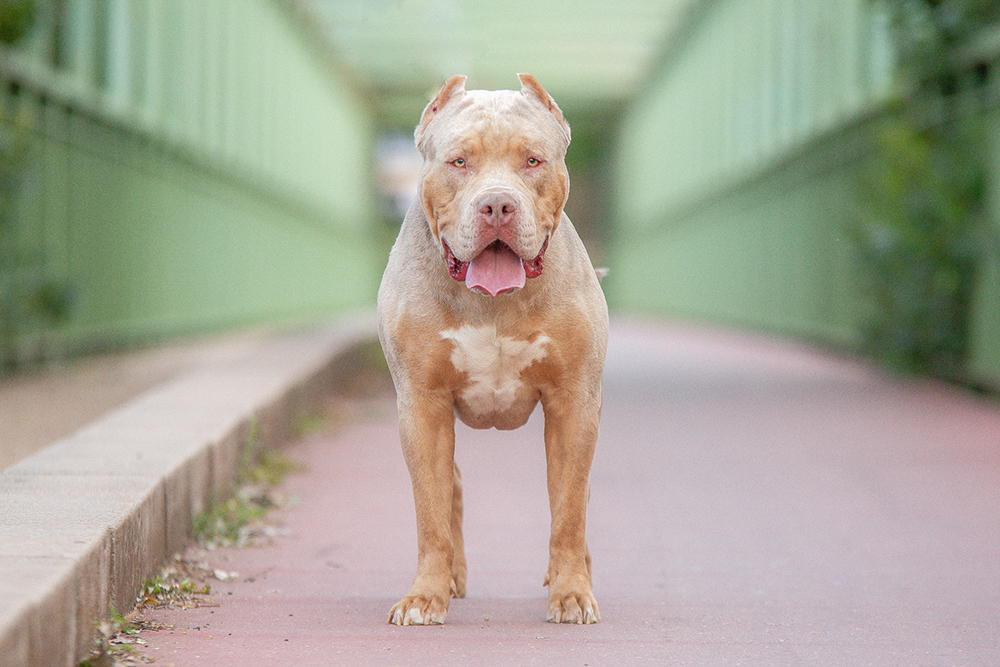
‘There’s no way of finding out what’s really happening in there,’ says Aaron Rainey, an XL bully expert who advises police forces and dog owners across the UK. ‘Nobody knows where the kennels are – the police keep the information under wraps in case people turn up and try to break out their XL bullies.’
Rainey was preparing to make a trip to assess an XL bully in Leicester, three hours from the dog’s previous home. He is concerned about the number of volunteers working in kennels housing XL bullies: many of them are college students trying to bolster their CV ahead of applying for veterinary studies at university. They are serving as prison guards to the UK’s most dangerous dogs. Welcome to XL bully death row.
Because of overcrowding, one officer said they had been told not to seize dogs unless absolutely necessary
It is well known that Britain’s prisons are overcrowded and dangerous for inmates and guards. Less well known is that kennels are facing the same problems. Two years after the ban on XL bullies (a breed described by the government as a ‘large dog with a muscular body and blocky head… [and] strong, well-defined jaws’), kennels holding these dangerous dogs are at capacity. Magistrates are squeamish about ordering the death penalty for them, which means many are left in kennels awaiting their fate for months.
The cost is piling further pressure on already stretched police budgets. More than a thousand dogs have been destroyed, but kennels used by the police remain full, some operating a one in, one out policy.
The XL bully ban was the result of extensive grassroots campaigning, with activists successfully highlighting the worrying correlation between the breed and fatal attacks on humans and other animals in recent years. Then prime minister Rishi Sunak acted decisively: on 31 December 2023, it became illegal to sell, give away, abandon or breed from an XL bully, and a month later to own them. The ban was essentially replicated from the pitbull ban of 1991. But last year, the National Police Chiefs Council issued warnings about the state of the UK’s kennels, and the XL bully problem.

On the front lines, the police are desperately short of dog liaison officers, who chiefly deal with XL bullies. Dog handlers in other areas of the police – who often investigate drug- or theft-related offences – are being seconded away to dangerous dog units to deal with the crisis.
The cost to the British state of kennelling thousands of potentially dangerous dogs seized each year has increased fivefold. The number of dog liaison officers has more than doubled. The bill for some forces is now more than £1 million a year. The wait between seizure and a court hearing for dangerous dog cases can be up to 18 months. Last year, the government approved £9.5 million of emergency additional funding to deal with these dangerous dogs. As part of the deal, Gloucestershire’s police force received £116,000, but this will not be enough. In the year to March 2025, the cost of housing XL bullies was almost £300,000, four times more than before the ban came in. It looks set to rise even further.
Kennels are expensive, run by private operators who are free to charge eye-watering amounts. One officer said you would struggle to find any kennel in the country willing to house an XL bully for less than £900 a month, outstripping housing rent across swaths of the country.
Some kennel owners simply do not want to be in the bully business. A 60kg animal is very different to a traditional family dog, and the teenage animal lovers who often staff the businesses while studying at colleges are a poor match for them.
The ability of the police to recoup costs is limited, as Kent Police found in a recent case heard at Folkestone Magistrates’ Court, where one man accrued almost £15,000 in kennel costs for his two XL bullies. The court required him to pay back £7,000, in a monthly £20 repayment plan. It will take him 29 years to settle the bill.
The funding issues have had a knock-on effect within police forces. One officer said they had been told not to seize dangerous dogs unless absolutely necessary, because of the scale of overcrowding.
Attempts from charities to provide kennelling for the dogs have had limited success. A charity in Forfar in the Scottish Highlands, the All Bullie Rescue Charity, has had two applications to create an XL bully ‘sanctuary’ rejected by the local council, who are understandably not keen on the idea of a sanctuary for a dog breed which has been implicated in around 20 deaths in Britain – especially with a 1:25 ratio of staff members to XL bullies at the site.
Despite the ban, magistrates can convert a destruction order to a contingent one, provided that the dog is not a danger and the owner is considered a fit and proper person. One officer noted that the definitions of this can be somewhat liberal.
But even in cases where the dogs are ruled to be safe, police kennels can’t seem to get rid of them, as a case heard in Leicester Magistrates’ Court in 2024 heard. Harry Lunn’s two dogs were seized by Leicestershire Police shortly after the ban came into force. Before they were taken away, he had believed the animals, one of which was an XL bully, were safe, adequately registered and appropriate for wider society. But when the non-XL bully was returned a week later, Mr Lunn said he noticed a change: after its time inside the dog was ‘not itself’. What this could mean for his second dog spooked Mr Lunn enough that he refused to take it back, fearing for the safety of his children.
Despite this, the XL bully was not put down. The magistrates decided it would remain in kennels for the next two months, in case Mr Lunn changed his mind. He was asked to contribute £500 towards kennel costs, likely to be a fraction of the total.
The tale is not unique. In Shropshire, magistrates opted to spare an XL bully after it attacked another dog. In Jarrow, one called Creed was spared despite having grievously injured another dog and attacked its owner.
Meanwhile, police forces continue to say their budgets are strained by the costs. More than two years after the ban, many dangerous dogs might be off the streets, but the problem hasn’t gone away.




Comments